REVIEW 3 major objections 4 minor 33 references
Optimizing System Latency for Blockchain-Encrypted Edge Computing in Internet of Vehicles
T0 review · 3 major / 4 minor · reviewed 2026-08-07 · deepseek-v4-flash
Pith's one-line read A single closed-form extraction rate minimizes expected latency in Raft-blockchain edge computing for connected vehicles.
desk verdict The claimed closed-form optimal extraction rate is new, but the model behind it is flawed and the simulation contradicts it. read the letter →
The pith
A machine-rendered reading of the paper's core claim, the machinery that carries it, and where it could break.
The reading
What carries the argument
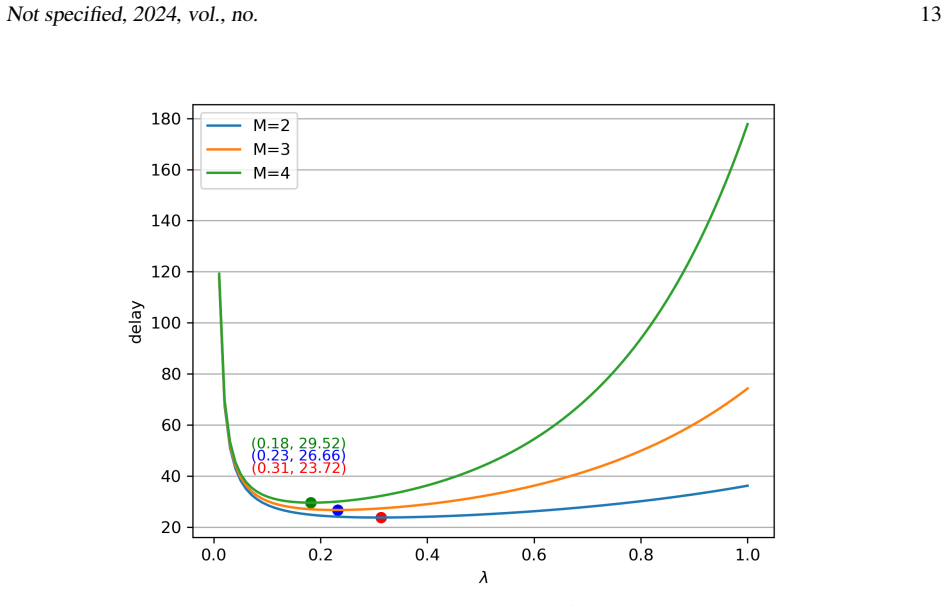
The load-bearing object is the exponential collision term $e^{B\lambda}$ inside the delay expression. It comes from the collision probability $p_c = 1 - e^{-\lambda M(M-1)\tau_c/2}$, where $\tau_c$ is the packet collision timeout and $B = M(M-1)\tau_c/2$; this makes the expected number of retransmissions grow exponentially in $\lambda$. Differentiating the convex delay function with respect to $\lambda$ converts the minimization into solving the quadratic $BT_{ec}\lambda^2 + B\lambda - 1 = 0$, whose positive root is $\lambda^*$.
What would settle it
A discrete-event simulation of $M$ independent Poisson transmitters, each extracting at rate $\lambda$ and retransmitting after a collision, can measure the collision probability directly and compare it with $1 - e^{-\lambda M(M-1)\tau_c/2$; the same simulation can find the empirical minimizer of expected delay and compare it with $\lambda^*$ from Eq. (24) under the paper's Table 2 settings. If the measured collision curve or the measured optimum deviates from the formula, the claimed closed-form optimization is not confirmed.
Extended reading notes
Core claim
The paper's central claim is that the expected system delay in a Raft-blockchain edge computing network for the Internet of Vehicles is minimized by a closed-form vehicle data extraction rate. With $B = M(M-1)\tau_c/2$, the delay takes the convex form $E[T] = \frac{A}{1-p_d}\left[\left(T_{ec}+\frac{1}{\lambda}\right)e^{B\lambda} + T_{si}\right]$, and its unique positive minimizer is $\lambda^* = \frac{-B+\sqrt{B^2+4BT_{ec}}}{2BT_{ec}}$. The paper argues that this optimum is independent of the number of servers $N$ and of attack intensity $a$, which affect only the multiplicative prefactor $A$, so a vehicle can simply measure $M$ and set its extraction rate to $\lambda^*$.
Load-bearing premise
The result rests on the assumed formula for how often vehicle transmissions collide, which treats each pair of vehicles' sending times as independent; if that collision formula is not exact, the optimal extraction rate changes.
Editorial extensions
If this is right
- Setting each vehicle's data extraction rate to $\lambda^*$ yields the minimum expected system delay for the given number of vehicles per station and collision timeout.
- The optimal rate depends on $M$ but not on the number of servers $N$ or the attack intensity $a$, so the same per-station tuning rule remains optimal even as servers are attacked or added.
- Because the delay function is convex, the optimum can be re-computed and applied online whenever the network configuration $M$ changes.
- Latency rises steeply on both sides of $\lambda^*$, since small rates inflate the extraction wait $1/\lambda$ while large rates inflate collision-induced retransmissions.
- The closed-form optimum gives network designers a direct latency floor for a given vehicle density, which can be compared against ultra-low-latency budget requirements.
Reading between the lines
- Going beyond the paper, the same convex-delay structure would generalize to other consensus mechanisms that impose a fixed per-epoch election overhead; only the expression for the expected election delay would change, not the quadratic form of the optimization.
- A practical extension would make the tuning rule local: a base station broadcasts $M$ and $\tau_c$, and each vehicle computes $\lambda^*$ itself, avoiding the need for a centralized optimizer.
- One could test whether adapting $\lambda$ dynamically as $M$ changes during a drive-by scenario outperforms keeping a fixed rate, using the paper's delay formula as the performance baseline.
Signed reviews
Editorial analysis
A structured set of objections, weighed in public.
Referee Report
Summary. The paper proposes a security framework that integrates the Raft consensus mechanism with edge computing for Internet of Vehicles (IoV), models the expected system latency E[T] as a function of the vehicle data extraction rate λ, and derives a closed-form optimal rate λ* given by Eq. (24) via convex optimization. The paper claims that setting λ to λ* minimizes system latency, and presents simulations that it says confirm the theoretical optimum.
Significance. If the derivation were correct, the paper would offer a simple, closed-form rule for choosing a data extraction rate that minimizes latency in a blockchain-protected IoV edge computing system, which could be a useful engineering guideline for 5G and future networks. The paper has a clear system model and the algebraic minimization from the delay expression to Eq. (24) is internally consistent. However, the core collision probability model is not justified, and the reported simulation optima do not match the derived formula, so the central contribution is not currently established.
major comments (3)
- [§5.2, Eqs. (11)-(12)] The collision probability derivation is incorrect and load-bearing. The event in Eq. (11) is defined over ordered pairs with Pr((Tm1 - Tm2) > τc). For two independent Exp(λ) inter-arrival times, this probability is 0.5 e^{-λ τc}, not e^{-λ τc}; multiplying over all ordered pairs would give M(M-1) factors, not the M(M-1)/2 that appears in Eq. (12). Moreover, the no-collision event for M vehicles is not the product of independent pairwise events: in a superposition of M Poisson streams of rate λ, collisions are governed by the total rate Mλ, and the probability that no two events fall within τc does not factor as a product of pairwise tail probabilities. Since B = M(M-1)τc/2 enters directly into the optimum λ* in Eq. (24), this error invalidates the main theoretical result.
- [§6, Fig. 3] The simulation results contradict Eq. (24). Using the Table 2 parameters (Tec = 10, τc = 0.1), Eq. (24) gives λ* ≈ 0.95 for M = 2, λ* ≈ 0.53 for M = 3, and λ* ≈ 0.36 for M = 4. The paper reports optimal points of 0.31, 0.23, and 0.18 for M = 2, 3, 4, respectively. This is a substantial discrepancy, and it means the statement that the curves 'align with our theoretical derivations' is not supported. The simulation does not validate the proposed formula.
- [§3.2, Eqs. (3)-(4)] The non-homogeneous Poisson process formulas are incorrect. The first-arrival time CDF should be P(T1 ≤ t1) = 1 − exp(−∫_0^{t1} Λ(x) dx), not 1 − exp(−∫_0^{t1} e^{−Λ(x)} dx). Similarly, Eq. (4) should condition on T1 = t1 and use ∫_{t1}^{t2} Λ(x) dx inside the exponential. These equations are not used later in the latency derivation, but they are presented as part of the system model and are mathematically wrong.
minor comments (4)
- [§5.1, Eq. (7)] The expression for Pp appears to contain a repeated term 'Q(η, ρη) − Q(η, ρη)' and the definition is unclear; the Bessel function J0 is introduced but does not appear in the expression.
- [§5.3, Algorithm 2] The 'real-time data extra algorithm' is essentially a single assignment (λ ← λ*) and does not describe how λ* is recomputed when N or M changes beyond a jump; the pseudocode is too trivial to be informative.
- [Footnote 1] The GitHub link provided in the introduction points to a repository named 'BVIB-for-Data-Extraction-Based-on-Mutual-Information-in-the-IoV', which appears unrelated to the present paper's topic of Raft-blockchain edge computing; this should be corrected or the link should be verified.
- [Throughout] There are several typographical and presentation issues, including 'V ANET' in Section 2, 'transmition' in Fig. 2, and the text in Section 5.3 referring to '−AE^{−Bλ}/((1−pd)λ^2)' as 'always non-zero' when the correct nonzero factor is A e^{Bλ}/((1−pd)λ^2); these should be corrected.
Circularity Check
No significant circularity: lambda* is the analytic minimizer of the paper's own closed-form delay expression, not a fitted parameter or a definitionally recycled quantity.
full rationale
The paper's derivation chain is self-contained: E[Tex]=1/lambda (Eq. 9) follows from the stated Poisson/exponential arrival model; the collision probability pc (Eq. 12) is a modeling assumption derived from pairwise separation of transmission times; E[T] is assembled from the named delay components in Eqs. (15)-(20); and lambda* (Eq. 24) is obtained as the closed-form solution of E'[T]=0 for the paper's own convex objective (Eqs. 21-22). No parameter is fitted to data and then renamed a prediction: lambda* is not calibrated from Fig. 3 or any other measurement. The only self-citation is the BVIB framing in Section 4 (reference [27]), and it is not load-bearing: the Raft mechanism is fully described within the paper, and the Section 5 algebra does not import any result from [27]. The self-referential structure in Eqs. (17)-(20), where E[Tele] depends on E[T], is an explicit fixed-point equation that is algebraically solved for E[T]; it is a modeling closure, not a hidden circular reduction. The reader-flagged problems -- the questionable derivation of Eq. (12) (the pairwise tail product and the M(M-1)/2 factor), the sign/consistency slips in Eqs. (3) and (22), and the mismatch between Fig. 3's reported optima (0.31, 0.23, 0.18) and Eq. (24) evaluated at Table 2 parameters (approximately 0.95, 0.53, 0.36) -- are concerns about mathematical correctness and about whether the simulation independently confirms the model. A failed external check is the opposite of circular self-confirmation; under the stated rules, mathematical errors and non-standard assumptions are correctness risks, not circularity. Because no claimed 'prediction' reduces by construction to its own inputs, and the self-citation is not load-bearing, the circularity score is 0.
Assumptions & free parameters
free parameters (8)
- tau_c =
0.1 (simulation)
- Tec =
10
- pd =
0.02
- tau_ele =
150
- Tterm =
2000
- N =
10
- a =
2
- Tsi =
14 (Tdc+Tf+Tp)
assumptions (5)
- domain assumption Vehicle data extraction is a homogeneous Poisson process with rate lambda.
- domain assumption The extraction delay is the inter-arrival time of the Poisson process, giving E[Tex] = 1/lambda.
- ad hoc to paper Collisions among M vehicles are independent events with probability pc = 1 - exp(-lambda M(M-1)tau_c/2).
- ad hoc to paper Raft election overhead per block is E[T]/Tterm * tau_ele * (1 + a/N).
- domain assumption The channel drop probability pd from Eq. (8) is a constant.
Cite this review
Pith. "Pith review of Optimizing System Latency for Blockchain-Encrypted Edge Computing in Internet of Vehicles." pith.science (2026). https://pith.science/paper/7DYCCLBP
@misc{pith2026250614208,
  author       = {Pith},
  title        = {Pith review of: Optimizing System Latency for Blockchain-Encrypted Edge Computing in Internet of Vehicles},
  year         = {2026},
  howpublished = {\url{https://pith.science/paper/7DYCCLBP}},
  note         = {Machine review of arXiv:2506.14208}
}
read the original abstract
As Internet of Vehicles (IoV) technology continues to advance, edge computing has become an important tool for assisting vehicles in handling complex tasks. However, the process of offloading tasks to edge servers may expose vehicles to malicious external attacks, resulting in information loss or even tampering, thereby creating serious security vulnerabilities. Blockchain technology can maintain a shared ledger among servers. In the Raft consensus mechanism, as long as more than half of the nodes remain operational, the system will not collapse, effectively maintaining the system's robustness and security. To protect vehicle information, we propose a security framework that integrates the Raft consensus mechanism from blockchain technology with edge computing. To address the additional latency introduced by blockchain, we derived a theoretical formula for system delay and proposed a convex optimization solution to minimize the system latency, ensuring that the system meets the requirements for low latency and high reliability. Simulation results demonstrate that the optimized data extraction rate significantly reduces system delay, with relatively stable variations in latency. Moreover, the proposed optimization solution based on this model can provide valuable insights for enhancing security and efficiency in future network environments, such as 5G and next-generation smart city systems.
Figures


Figures from the paper (3 more)


Reference graph
Works this paper leans on
-
[1]
SDN/NFV-empowered future IoV with enhanced communication, computing, and caching
Weihua Zhuang, Qiang Ye, Feng Lyu, Nan Cheng, and Ju Ren. SDN/NFV-empowered future IoV with enhanced communication, computing, and caching. Proceedings of the IEEE, 108(2):274–291, 2019
work page 2019
-
[2]
Wei Wang, Nan Cheng, Mushu Li, Tingting Yang, Conghao Zhou, Changle Li, and Fangjiong Chen. Value matters: A novel value of information-based resource scheduling method for CA Vs.IEEE Transactions on Vehicular Technology, 2024
work page 2024
-
[3]
Edgecooper: Network-aware cooperative lidar perception for enhanced vehicular awareness
Guiyang Luo, Chongzhang Shao, Nan Cheng, Haibo Zhou, Hui Zhang, Quan Yuan, and Jinglin Li. Edgecooper: Network-aware cooperative lidar perception for enhanced vehicular awareness. IEEE Journal on Selected Areas in Communications, 2023
work page 2023
-
[4]
Qiong Wu, Wenhua Wang, Pingyi Fan, Qiang Fan, Huiling Zhu, and Khaled B. Letaief. Cooperative 160 Not specified, 2024, vol., no. Figure 6: Latency with M and N. edge caching based on elastic federated and multi-agent deep reinforcement learning in next-generation networks. IEEE Transactions on Network and Service Management, 21(4):4179–4196, 2024
work page 2024
-
[5]
Maoxin Ji, Qiong Wu, Pingyi Fan, Nan Cheng, Wen Chen, Jiangzhou Wang, and Khaled B. Letaief. Graph neural networks and deep reinforcement learning based resource allocation for v2x communications. IEEE Internet of Things Journal, pages 1–1, 2024
work page 2024
-
[6]
Kangwei Qi, Qiong Wu, Pingyi Fan, Nan Cheng, Wen Chen, Jiangzhou Wang, and Khaled B. Letaief. Deep-reinforcement-learning-based aoi-aware resource allocation for ris-aided iov networks. IEEE Transactions on Vehicular Technology, pages 1–14, 2024
work page 2024
-
[7]
Accessibility analysis and modeling for IoV in an urban scene
Jiujun Cheng, Guiyuan Yuan, Mengchu Zhou, Shangce Gao, Cong Liu, Hua Duan, and QingTian Zeng. Accessibility analysis and modeling for IoV in an urban scene. IEEE Transactions on Vehicular Technology, 69(4):4246–4256, 2020
work page 2020
-
[8]
Cui Zhang, Wenjun Zhang, Qiong Wu, Pingyi Fan, Qiang Fan, Jiangzhou Wang, and Khaled B. Letaief. Distributed deep reinforcement learning based gradient quantization for federated learning enabled vehicle edge computing. IEEE Internet of Things Journal, pages 1–1, 2024
work page 2024
Show all 33 references
-
[9]
Space/aerial- assisted computing offloading for IoT applications: A learning-based approach.IEEE Journal on Selected Areas in Communications, 37(5):1117–1129, 2019
Nan Cheng, Feng Lyu, Wei Quan, Conghao Zhou, Hongli He, Weisen Shi, and Xuemin Shen. Space/aerial- assisted computing offloading for IoT applications: A learning-based approach.IEEE Journal on Selected Areas in Communications, 37(5):1117–1129, 2019
2019
-
[10]
A blockchain- based authentication scheme and secure architecture for IoT-enabled maritime transportation systems
Peiying Zhang, Yaqi Wang, Gagangeet Singh Aujla, Anish Jindal, and Yasser D Al-Otaibi. A blockchain- based authentication scheme and secure architecture for IoT-enabled maritime transportation systems. IEEE Transactions on Intelligent Transportation Systems, 24(2):2322–2331, 2022
2022
-
[11]
Characterizing user association patterns for optimizing small-cell edge system performance
Fan Wu, Feng Lyu, Huaqing Wu, Ju Ren, Yaoxue Zhang, and Xuemin Shen. Characterizing user association patterns for optimizing small-cell edge system performance. IEEE Network, 37(3):210–217, 2022
2022
-
[12]
End-to-end latency upper bounds and service chain deployment algorithm based on industrial internet network
Min Wang, Ziyi Gao, Haoyuan Wang, Sibo Qiao, and Jinhai Wang. End-to-end latency upper bounds and service chain deployment algorithm based on industrial internet network. Simulation Modelling Not specified, 2024, vol., no. 17 Practice and Theory, 138:103031, 2025
2024
-
[13]
In search of an understandable consensus algorithm
Diego Ongaro and John Ousterhout. In search of an understandable consensus algorithm. In 2014 USENIX Annual Technical Conference (USENIX ATC 14), pages 305–319, Philadelphia, PA, June 2014. USENIX Association
2014
-
[14]
Heterogeneous system list scheduling algorithm based on improved optimistic cost matrix
Min Wang, Haoyuan Wang, Sibo Qiao, Jiawang Chen, Qin Xie, and Cuijuan Guo. Heterogeneous system list scheduling algorithm based on improved optimistic cost matrix. Future Generation Computer Systems, 164:107576, 2025
2025
-
[15]
Secure data sharing: Blockchain-enabled data access control framework for IoT
Xin Wei, Yong Yan, Shaoyong Guo, Xuesong Qiu, and Feng Qi. Secure data sharing: Blockchain-enabled data access control framework for IoT. IEEE Internet of Things Journal, 9(11):8143–8153, 2021
2021
-
[16]
Secure computation offloading in blockchain based IoT networks with deep reinforcement learning
Dinh C Nguyen, Pubudu N Pathirana, Ming Ding, and Aruna Seneviratne. Secure computation offloading in blockchain based IoT networks with deep reinforcement learning. IEEE Transactions on Network Science and Engineering, 8(4):3192–3208, 2021
2021
-
[17]
UA V-assisted computation offloading toward energy-efficient blockchain operations in internet of things
Xunqiang Lan, Xiao Tang, Ruonan Zhang, Wensheng Lin, and Zhu Han. UA V-assisted computation offloading toward energy-efficient blockchain operations in internet of things. IEEE Wireless Communi- cations Letters, 12(8):1469–1473, 2023
2023
-
[18]
Vikas Hassija, Vinay Chamola, Guangjie Han, Joel J. P. C. Rodrigues, and Mohsen Guizani. Dagiov: A framework for vehicle to vehicle communication using directed acyclic graph and game theory. IEEE Transactions on Vehicular Technology, 69(4):4182–4191, 2020
2020
-
[19]
Crt-biov: A cognitive radio technique for blockchain-enabled internet of vehicles
Geetanjali Rathee, Farhan Ahmad, Fatih Kurugollu, Muhammad Ajmal Azad, Razi Iqbal, and Muhammad Imran. Crt-biov: A cognitive radio technique for blockchain-enabled internet of vehicles. IEEE Transactions on Intelligent Transportation Systems, 22(7):4005–4015, 2021
2021
-
[20]
Blockchain empowered asynchronous federated learning for secure data sharing in internet of vehicles
Yunlong Lu, Xiaohong Huang, Ke Zhang, Sabita Maharjan, and Yan Zhang. Blockchain empowered asynchronous federated learning for secure data sharing in internet of vehicles. IEEE Transactions on Vehicular Technology, 69(4):4298–4311, 2020
2020
-
[21]
A blockchain-based efficient, secure and anonymous conditional privacy-preserving and authentication scheme for the internet of vehicles
Kashif Naseer Qureshi, Luqman Shahzad, Abdelzahir Abdelmaboud, Taiseer Abdalla Elfadil Eisa, Bandar Alamri, Ibrahim Tariq Javed, Arafat Al-dhaqm, and Noël Crespi. A blockchain-based efficient, secure and anonymous conditional privacy-preserving and authentication scheme for th...
2022
-
[22]
An iov-pbft consensus-based blockchain for collaborative congestion avoidance and simulation test
Cheng Li, Hao Wu, Lei Xiong, and Yunlong Lu. An iov-pbft consensus-based blockchain for collaborative congestion avoidance and simulation test. Wireless Communications and Mobile Computing, 2022
2022
-
[23]
Blockchain unleashed: Empowering information- centric network computing in cloud, fog, and edge services
Pranav Zambre, Mitali Panchal, and Ankit Chouhan. Blockchain unleashed: Empowering information- centric network computing in cloud, fog, and edge services. In 2023 14th International Conference on Computing Communication and Networking Technologies (ICCCNT), pages 1–6, 2023
2023
-
[24]
A security architecture of vanet based on blockchain and mobile edge computing
XiaoDong Zhang, Ru Li, and Bo Cui. A security architecture of vanet based on blockchain and mobile edge computing. In 2018 1st IEEE International Conference on Hot Information-Centric Networking (HotICN), pages 258–259, 2018
2018
-
[25]
Model checking the efficiency of blockchain-based edge computing network
Kai Zheng, Xiang Yao, Zhe Zhang, Liyou Fang, and Xin Huang. Model checking the efficiency of blockchain-based edge computing network. In 2021 20th International Symposium on Distributed Computing and Applications for Business Engineering and Science (DCABES), pages 168–171, 2021
2021
-
[26]
Resource allocation of iot systems integrated with blockchain and mobile edge computing
Zihan Bai, Jianxiong Wan, Leixiao Li, Chuyi Liu, and Mingda Duan. Resource allocation of iot systems integrated with blockchain and mobile edge computing. In 2022 4th International Conference on Frontiers Technology of Information and Computer (ICFTIC), pages 377–382, 2022
2022
-
[27]
Blockchain-enabled variational information bottleneck for iot networks
Qiong Wu, Le Kuai, Pingyi Fan, Qiang Fan, Junhui Zhao, and Jiangzhou Wang. Blockchain-enabled variational information bottleneck for iot networks. IEEE Networking Letters, 6(2):92–96, 2024
2024
-
[28]
Zhongbang Yao, Junfeng Jiang, Pingyi Fan, Zhigang Cao, and V .O.K. Li. A neighbor-table-based multipath routing in ad hoc networks. In The 57th IEEE Semiannual Vehicular Technology Conference,
-
[29]
Reconfigurable holographic surfaces for ultra-massive MIMO in 6G: Practical design, optimization and implementation
Ruoqi Deng, Yutong Zhang, Haobo Zhang, Boya Di, Hongliang Zhang, H Vincent Poor, and Lingyang Song. Reconfigurable holographic surfaces for ultra-massive MIMO in 6G: Practical design, optimization and implementation. IEEE Journal on Selected Areas in Communications, 41(8):2367...
2023
-
[30]
Hybrid near-far field channel estimation for holographic MIMO communications
Shaohua Yue, Shuhao Zeng, Liang Liu, Yonina C Eldar, and Boya Di. Hybrid near-far field channel estimation for holographic MIMO communications. IEEE Transactions on Wireless Communications, 2024
2024
-
[31]
Improving multipath TCP performance over wifi and cellular networks: An analytical approach
Shiva Raj Pokhrel and Michel Mandjes. Improving multipath TCP performance over wifi and cellular networks: An analytical approach. IEEE Transactions on Mobile Computing, 18(11):2562–2576, 2019
2019
-
[32]
Federated learning with blockchain for autonomous vehicles: Analysis and design challenges
Shiva Raj Pokhrel and Jinho Choi. Federated learning with blockchain for autonomous vehicles: Analysis and design challenges. IEEE Transactions on Communications, 68(8):4734–4746, 2020
2020
-
[2003]
180 Not specified, 2024, vol., no
VTC 2003-Spring., volume 3, pages 1739–1743 vol.3, 2003. 180 Not specified, 2024, vol., no
2003
Reviewed August 7, 2026 · model on record in the stance chip above.
Discussion (0). Continue with ORCID to comment.