Hyperstatistical thermodynamics of the one-dimensional Klein-Gordon and Dirac oscillators: a closed-form q-generalized Boltzmann factor and a quantitative comparison with Beck's superstatistics
Pith reviewed 2026-06-27 19:59 UTC · model grok-4.3
The pith
Hyperstatistics produces a q-generalized Boltzmann factor independent of the fluctuation density for one-dimensional Klein-Gordon and Dirac oscillators.
A machine-rendered reading of the paper's core claim, the machinery that carries it, and where it could break.
Core claim
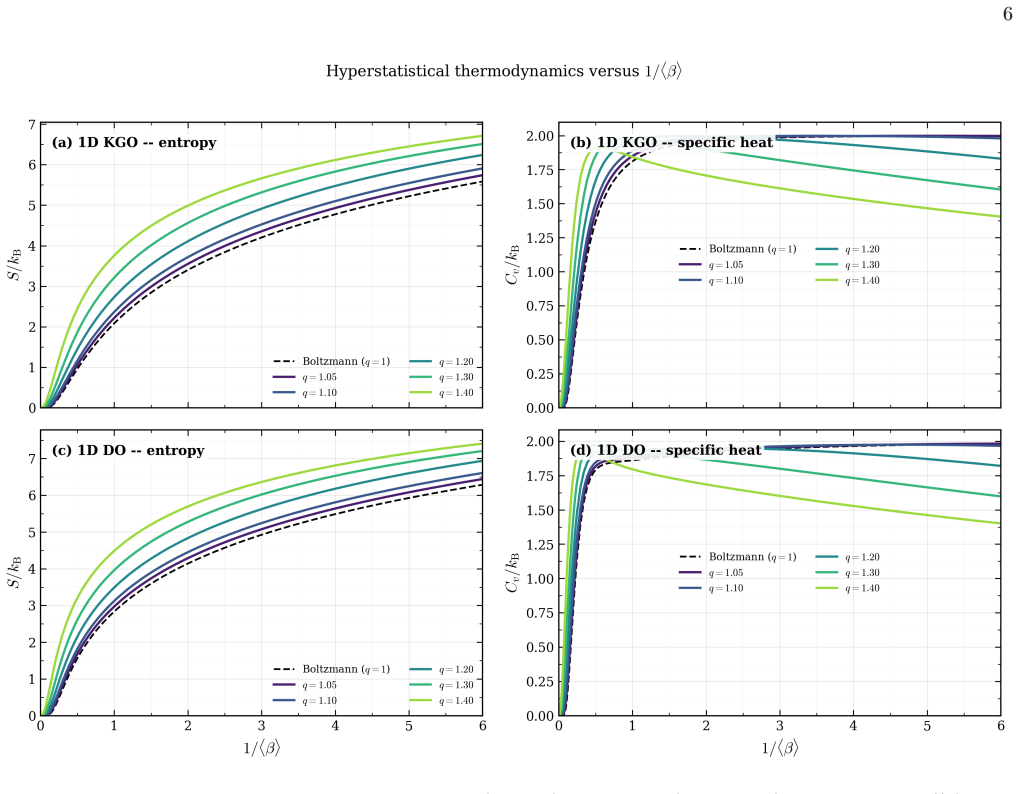
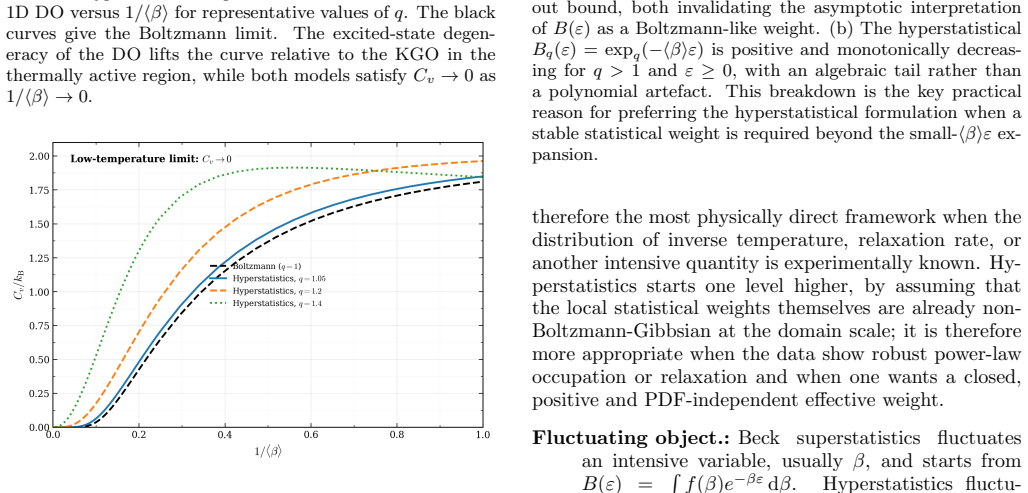
In hyperstatistics the averaging over a gamma distribution of domain Boltzmann factors yields after Laplace transformation the closed-form q-generalized Boltzmann factor B_q(ε) = exp_q(−⟨β⟩ε) that is independent of the density f(β). Applied to the excitation spectrum of the one-dimensional Klein-Gordon oscillator with unit degeneracy and the Dirac oscillator with double degeneracy for excited states, this factor produces partition functions, entropies, and specific heats that satisfy the third law, approach the classical limit at high temperature, and distinguish the two systems quantitatively.
What carries the argument
The Laplace transform of gamma-distributed domain Boltzmann factors that generates the q-exponential independent of f(β).
If this is right
- Partition functions for both oscillators can be written directly from the q-exponential without specifying f(β).
- Specific heat approaches 2k_B at high temperature for both the Klein-Gordon and Dirac cases.
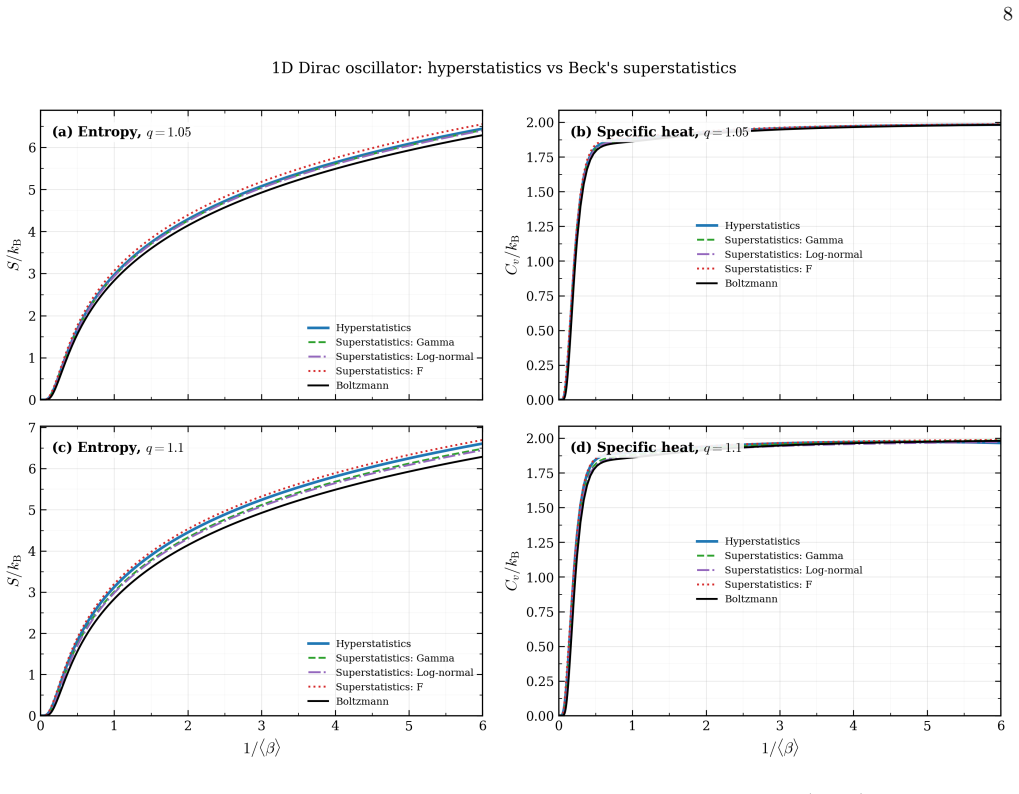
- Entropy is systematically larger for the Dirac oscillator because of the spin-induced degeneracy factor of two.
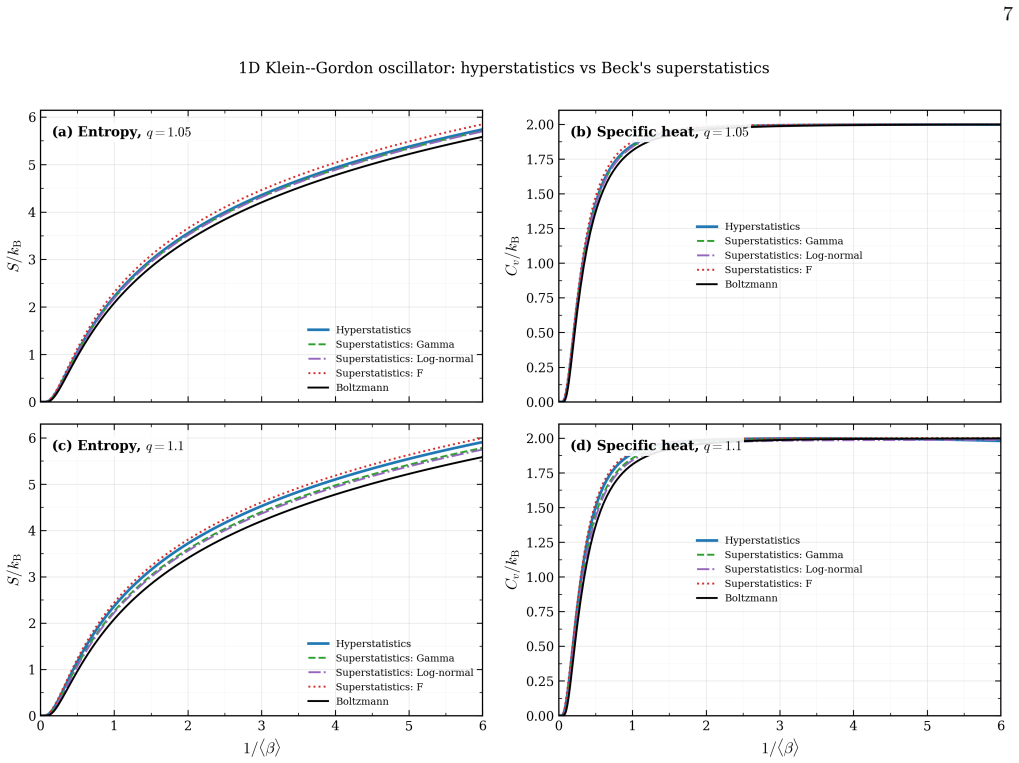
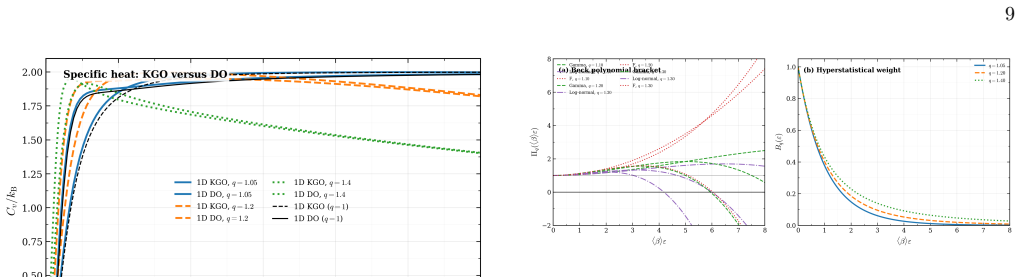
- The hyperstatistical expressions remain positive, monotonic, and analytic at temperatures where Beck's polynomial bracket becomes negative or invalid.
- Quantitative agreement between the two frameworks holds only for q close to one and ⟨β⟩E less than or equal to about two.
Where Pith is reading between the lines
- The independence from f(β) allows the same closed-form factor to be used in systems where the precise temperature-fluctuation distribution cannot be measured.
- The sharper specific-heat peak produced by degeneracy could serve as a diagnostic for spin effects in other relativistic oscillator models.
- The method's numerical stability at high temperature suggests it could be extended to two- or three-dimensional versions or to cases with external fields without encountering sign problems.
Load-bearing premise
The domain Boltzmann factors follow a gamma distribution.
What would settle it
Numerical evaluation of the averaged Boltzmann factor for gamma-distributed domains using two different normalisable densities f(β) would show whether the resulting q-exponential remains exactly the same.
Figures
read the original abstract
We revisit the thermodynamics of the one-dimensional Klein-Gordon (KGO) and Dirac (DO) oscillators within two frameworks of generalized statistics: Beck's asymptotic superstatistics and the recently introduced hyperstatistics. In hyperstatistics, a $\gamma$-distribution of domain Boltzmann factors yields, after Laplace transformation and averaging over a normalisable density $f(\beta)$, the closed-form q-generalized Boltzmann factor $B_q(\varepsilon) = \exp_q(-\langle\beta\rangle\varepsilon)$, independent of $f(\beta)$. We compute the partition function, entropy $S$, and specific heat $C_v$ for both 1D oscillators using excitation energies $\varepsilon_n = E_n - E_0$ to remove the rest-energy shift and enforce third-law behaviour $C_v \to 0$ as $T = 1/\langle\beta\rangle \to 0$. Appropriate degeneracies ($g_n = 1$ for KGO; $g_0 = 1$, $g_n = 2$ for $n \geq 1$ for DO) are applied. Hyperstatistics successfully (i) reproduces the high-temperature Boltzmann limit $C_v \to 2k_B$, (ii) is structurally independent of $f(\beta)$, (iii) avoids the unphysical negative regions of the Beck polynomial bracket, and (iv) systematically distinguishes KGO from DO by capturing the enhanced entropy and sharper specific-heat structure caused by spin-induced degeneracy. The frameworks agree quantitatively for $q - 1 \ll 1$ and $\langle\beta\rangle E \lesssim 2$, but diverge at high temperatures where Beck's polynomial expansion loses validity and the exact hyperstatistical q-exponential remains positive, monotonic, and analytic. Ultimately, hyperstatistics provides a numerically stable and analytically tractable alternative to asymptotic superstatistics for relativistic oscillators, naturally extensible to higher dimensions and external magnetic fields.
Editorial analysis
A structured set of objections, weighed in public.
Referee Report
Summary. The manuscript claims that hyperstatistics, by positing a gamma distribution for domain Boltzmann factors, yields via Laplace transform and averaging over any normalizable f(β) the closed-form q-generalized Boltzmann factor B_q(ε) = exp_q(−⟨β⟩ε) independent of f(β). This framework is applied to the thermodynamics of the 1D Klein-Gordon and Dirac oscillators using excitation energies ε_n = E_n − E_0 and appropriate degeneracies (g_n=1 for KGO; g_0=1, g_n=2 for n≥1 for DO), producing partition functions, entropy S, and specific heat C_v that reproduce the high-T Boltzmann limit C_v→2k_B, avoid negative values, and distinguish the two oscillators via spin degeneracy while agreeing with Beck's asymptotic superstatistics for q−1≪1 and ⟨β⟩E≲2.
Significance. If the gamma-distribution modeling step is accepted, the work supplies an analytically closed and numerically stable alternative to Beck's polynomial expansion for relativistic oscillators, with the independence from f(β) and the degeneracy-driven distinction between KGO and DO as potentially useful features for extensions to magnetic fields or higher dimensions.
major comments (2)
- [Abstract] Abstract (and the hyperstatistics construction): the headline claim that B_q(ε) is independent of f(β) holds only after assuming a gamma distribution for the domain Boltzmann factors; the Laplace-transform step then produces the q-exponential by design. No derivation of this distributional choice from the oscillator Hamiltonian or from a physical fluctuation mechanism is supplied, so the independence is not a general property of hyperstatistics but an artifact of the auxiliary assumption.
- [Thermodynamic calculations] Thermodynamic calculations (partition function and C_v sections): the use of excitation energies ε_n = E_n − E_0 is invoked to enforce C_v→0 as T→0, but the manuscript does not verify whether this shift remains consistent with the q-generalized statistics for arbitrary q>1, where the effective temperature definition may alter the low-T asymptotics.
minor comments (2)
- Notation for the q-exponential should be defined explicitly on first use (including the range of q for which it remains positive and monotonic).
- The quantitative agreement regime (q−1≪1 and ⟨β⟩E≲2) is stated but would benefit from an explicit equation or plot boundary showing where Beck's polynomial bracket first becomes negative.
Simulated Author's Rebuttal
We thank the referee for the thorough review and valuable comments on our manuscript. We provide point-by-point responses to the major comments below.
read point-by-point responses
-
Referee: [Abstract] Abstract (and the hyperstatistics construction): the headline claim that B_q(ε) is independent of f(β) holds only after assuming a gamma distribution for the domain Boltzmann factors; the Laplace-transform step then produces the q-exponential by design. No derivation of this distributional choice from the oscillator Hamiltonian or from a physical fluctuation mechanism is supplied, so the independence is not a general property of hyperstatistics but an artifact of the auxiliary assumption.
Authors: We agree with the referee that the independence of B_q(ε) from f(β) is a direct consequence of adopting the gamma distribution for the domain Boltzmann factors within the hyperstatistics framework, which then leads to the q-exponential form via the Laplace transform. The manuscript introduces hyperstatistics with this specific assumption and highlights the resulting independence as a key feature. No claim is made regarding a derivation from the underlying Hamiltonian or a fundamental physical mechanism; the approach is model-based. We will revise the abstract to explicitly state that this independence holds under the gamma-distribution assumption of hyperstatistics. revision: yes
-
Referee: [Thermodynamic calculations] Thermodynamic calculations (partition function and C_v sections): the use of excitation energies ε_n = E_n − E_0 is invoked to enforce C_v→0 as T→0, but the manuscript does not verify whether this shift remains consistent with the q-generalized statistics for arbitrary q>1, where the effective temperature definition may alter the low-T asymptotics.
Authors: The shift to excitation energies ε_n = E_n - E_0 is employed to set the ground-state contribution to zero, ensuring that the partition function yields C_v → 0 as T → 0 in accordance with the third law, consistent with the high-temperature limit discussed. Our numerical evaluations for the q-generalized Boltzmann factor demonstrate this behavior. Nevertheless, we recognize that in q-statistics the relation between the average inverse temperature ⟨β⟩ and the effective temperature could affect low-temperature asymptotics for q > 1, and an explicit analytical verification for arbitrary q is not provided in the manuscript. We will include additional analysis or a clarifying remark in the revised version to address this consistency. revision: partial
Circularity Check
B_q independence from f(β) obtained by construction via gamma ansatz on domain factors
specific steps
-
self definitional
[Abstract]
"In hyperstatistics, a γ-distribution of domain Boltzmann factors yields, after Laplace transformation and averaging over a normalisable density f(β), the closed-form q-generalized Boltzmann factor B_q(ε) = exp_q(−⟨β⟩ε), independent of f(β)."
The independence of B_q from f(β) and its exact q-exponential form are produced solely by the auxiliary assumption that domain factors obey a gamma distribution (chosen for its Laplace transform property). Absent that specific distributional input, the averaged Boltzmann factor retains explicit dependence on f(β); the claimed independence is therefore equivalent to the modeling choice by construction.
full rationale
The central claim that hyperstatistics produces a closed-form B_q(ε) = exp_q(−⟨β⟩ε) independent of the normalisable density f(β) rests on positing a γ-distribution for the domain Boltzmann factors. This distribution is selected precisely because its Laplace transform yields the q-exponential; the independence and functional form are therefore forced by the modeling choice rather than emerging from the oscillator Hamiltonian or any physical fluctuation mechanism. The paper presents this as a derived result of hyperstatistics, but the step reduces to the input assumption by construction. No other circular patterns (self-citation chains or renaming) are evident from the provided text.
Axiom & Free-Parameter Ledger
free parameters (2)
- q
- ⟨β⟩
axioms (2)
- domain assumption Fluctuations of the inverse temperature follow a gamma distribution.
- domain assumption Excitation energies ε_n = E_n − E_0 remove the rest-energy shift and enforce C_v → 0 as T → 0.
Reference graph
Works this paper leans on
-
[1]
[29] for the 1DKGOin a notation di- rectly comparable with hyperstatistics
we reformulate the asymptotic-superstatistics anal- ysis of Ref. [29] for the 1DKGOin a notation di- rectly comparable with hyperstatistics
-
[2]
we extend the same comparison to the 1DDO, re- taining the degeneracy structure imposed by the spectrum of Pachecoet al.[5]
-
[3]
(7) and compare them with the Gamma, Log-Normal and F versions of Beck’s asymptotic expansion
we compute the entropy and specific heat of both oscillators with the closed hyperstatistical weight of Eq. (7) and compare them with the Gamma, Log-Normal and F versions of Beck’s asymptotic expansion
-
[4]
we identify the parameter range in which Beck’s polynomial bracket remains a positive Boltzmann- like weight and determine how its breakdown af- fects the thermodynamic functions. This structure makes the comparison quantitative rather than purely qualitative: the same spectra, degeneracies and excitation energies are used in both approaches, so that any ...
-
[5]
S. Bruce and P. Minning, “The Klein–Gordon oscillator,” Nuovo Cimento A106, 711 (1993). DOI: 10.1007/BF02787240. 11
-
[6]
A. Boumali, “Thermal properties of the one-dimensional Duffin–Kemmer–Petiau oscillator using Hurwitz zeta function,” Z. Naturforsch. A70, 867 (2015). DOI: 10.1515/zna-2015-0140
-
[7]
M. Moshinsky and A. Szczepaniak, “The Dirac os- cillator,” J. Phys. A: Math. Gen.22, L817 (1989). DOI: 10.1088/0305-4470/22/17/002
-
[8]
An example of dy- namical systems with linear trajectory,
D. Itˆ o, K. Mori, and E. Carriere, “An example of dy- namical systems with linear trajectory,” Nuovo Cimento A51, 1119 (1967). DOI: 10.1007/BF02721775
-
[9]
M. H. Pacheco, R. R. Landim, and C. A. S. Almeida, “One-dimensional Dirac oscillator in a thermal bath,” Phys. Lett. A311, 93 (2003). DOI: 10.1016/S0375- 9601(03)00467-5
-
[10]
Three-dimensional Dirac oscil- lator in a thermal bath,
M. H. Pacheco, R. V. Maluf, C. A. S. Almeida, and R. R. Landim, “Three-dimensional Dirac oscil- lator in a thermal bath,” EPL108, 10005 (2014). DOI: 10.1209/0295-5075/108/10005
-
[12]
Relativistic quantum mechanics with trapped ions,
L. Lamata, J. Casanova, R. Gerritsma, C. F. Roos, J. J. Garc´ ıa-Ripoll, and E. Solano, “Relativistic quantum mechanics with trapped ions,” New J. Phys.13, 095003 (2011). DOI: 10.1088/1367-2630/13/9/095003
-
[13]
Quantum simulations with trapped ions,
R. Blatt and C. F. Roos, “Quantum simulations with trapped ions,” Nat. Phys.8, 277 (2012). DOI: 10.1038/nphys2252
-
[14]
J. A. Franco-Villafa˜ ne, E. Sadurn´ ı, S. Barkhofen, U. Kuhl, F. Mortessagne, and T. H. Seligman, “First experimental realization of the Dirac oscillator,” Phys. Rev. Lett.111, 170405 (2013). DOI: 10.1103/Phys- RevLett.111.170405
-
[15]
A. Boumali, “Thermodynamic properties of the graphene in a magnetic field via the two-dimensional Dirac oscilla- tor,” Phys. Scr.90, 045702 (2015). DOI: 10.1088/0031- 8949/90/4/045702
-
[16]
C. Beck and E. G. D. Cohen, “Superstatistics,” Physica A322, 267 (2003). DOI: 10.1016/S0378-4371(03)00019- 0
-
[17]
Generalised information and entropy measures in physics,
C. Beck, “Generalised information and entropy measures in physics,” Phil. Trans. R. Soc. A369, 453 (2011). DOI: 10.1098/rsta.2010.0280
-
[18]
C. Tsallis, “Possible generalization of Boltzmann–Gibbs statistics,” J. Stat. Phys.52, 479 (1988);Introduc- tion to Nonextensive Statistical Mechanics: Approach- ing a Complex World(Springer, New York, 2009). DOI: 10.1007/BF01016429; DOI: 10.1007/978-0-387- 85359-8
-
[19]
L. Squillante, S. M. Soares, C. Tsallis, and M. de Souza, “Hyperstatistics,” arXiv:2604.24783 (2026). DOI: 10.48550/arXiv.2604.24783
work page internal anchor Pith review Pith/arXiv arXiv doi:10.48550/arxiv.2604.24783 2026
-
[20]
On the Dirac theory of spin 1/2 particles and its non-relativistic limit,
L. L. Foldy and S. A. Wouthuysen, “On the Dirac theory of spin 1/2 particles and its non-relativistic limit,” Phys. Rev.78, 29 (1950). DOI: 10.1103/PhysRev.78.29
-
[21]
Covariance, CPT and the Foldy–Wouthuysen transformation for the Dirac os- cillator,
M. Moreno and A. Zentella, “Covariance, CPT and the Foldy–Wouthuysen transformation for the Dirac os- cillator,” J. Phys. A: Math. Gen.22, L821 (1989). DOI: 10.1088/0305-4470/22/17/003
-
[22]
The Dirac oscillator: from theory to ex- periment,
C. Quesne, “The Dirac oscillator: from theory to ex- periment,” Mod. Phys. Lett. A32, 1730028 (2017). DOI: 10.1142/S0217732317300282
-
[23]
Dirac oscillator in an ex- ternal magnetic field,
B. P. Mandal and S. Verma, “Dirac oscillator in an ex- ternal magnetic field,” Phys. Lett. A374, 1021 (2010). DOI: 10.1016/j.physleta.2009.12.048
-
[24]
A. M. Frassino, D. Marinelli, O. Panella, and P. Roy, “Thermodynamics of quantum phase transitions of a Dirac oscillator in a homogenous magnetic field,” J. Phys. A: Math. Theor.53, 185204 (2020). DOI: 10.1088/1751- 8121/ab7c1f
-
[25]
The thermal proper- ties of a two-dimensional Dirac oscillator under an exter- nal magnetic field,
A. Boumali and H. Hassanabadi, “The thermal proper- ties of a two-dimensional Dirac oscillator under an exter- nal magnetic field,” Eur. Phys. J. Plus128, 124 (2013). DOI: 10.1140/epjp/i2013-13124-y
-
[26]
R. R. S. Oliveira and R. R. Landim, “Thermodynamic properties of the noncommutative Dirac oscillator with a permanent electric dipole moment,” Eur. Phys. J. Plus 138, 74 (2023). DOI: 10.1140/epjp/s13360-023-03700-3
-
[27]
Ef- fects of a minimal length on the thermal properties of a Dirac oscillator,
A. Boumali, L. Chetouani, and H. Hassanabadi, “Ef- fects of a minimal length on the thermal properties of a Dirac oscillator,” Can. J. Phys.94, 1019 (2016). DOI: 10.1139/cjp-2016-0257
-
[28]
Dirac oscillator in the cosmic string spacetime in the context of grav- ity’s rainbow,
K. Bakke and H. Mota, “Dirac oscillator in the cosmic string spacetime in the context of grav- ity’s rainbow,” Eur. Phys. J. Plus133, 409 (2018). DOI: 10.1140/epjp/i2018-12273-9
-
[29]
A. Bouzenada, A. Boumali, R. L. L. Vit´ oria, and C. Fur- tado, “Dynamics of a Klein–Gordon oscillator in the presence of a cosmic string in the Som–Raychaudhuri space-time,” Theor. Math. Phys.221, 2193 (2024). DOI: 10.1134/S0040577924120134
-
[30]
Statis- tical properties of the 1D space fractional Klein– Gordon oscillator,
N. Korichi, A. Boumali, and Y. Chargui, “Statis- tical properties of the 1D space fractional Klein– Gordon oscillator,” J. Low Temp. Phys.206, 32 (2022). DOI: 10.1007/s10909-021-02638-z
-
[31]
A. Boumali, N. Jafari, B. Shukirgaliyev, and F. Ser- douk, “Thermal properties of Klein–Gordon oscillator in the context of Amelino–Camelia and Magueijo–Smolin doubly special relativity frameworks,” arXiv:2511.11709 (2025). DOI: 10.48550/arXiv.2511.11709
-
[32]
A. Boumali and N. Jafari, “Three-dimensional modi- fied Klein–Gordon oscillator in standard and general- ized doubly special relativity,” arXiv:2602.22444 (2026). DOI: 10.48550/arXiv.2602.22444
-
[33]
S. Siouane and A. Boumali, “On the superstatistical properties of the Klein–Gordon oscillator using Gamma, log, and F distributions,” J. Low Temp. Phys.217, 598 (2024). DOI: 10.1007/s10909-024-03222-x
-
[34]
Superstatis- tical properties of the Dirac oscillator with Gamma, log- normal, and F distributions,
S. Siouane, A. Boumali, and A. Guvendi, “Superstatis- tical properties of the Dirac oscillator with Gamma, log- normal, and F distributions,” Theor. Math. Phys.219, 673 (2024). DOI: 10.1134/S0040577924050015
-
[35]
Superstatistics and temperature fluctuations
F. Sattin, “Superstatistics and temperature fluctua- tions,” Physica A530, 121566 (2019); arXiv:1804.06359 (2018). DOI: 10.1016/j.physa.2019.121566
work page internal anchor Pith review Pith/arXiv arXiv doi:10.1016/j.physa.2019.121566 2019
-
[36]
Universally non-diverging Gr¨ uneisen pa- rameter at critical points,
S. M. Soares, L. Squillante, H. S. Lima, C. Tsallis, and M. de Souza, “Universally non-diverging Gr¨ uneisen pa- rameter at critical points,” Phys. Rev. B111, L060409 (2025). DOI: 10.1103/PhysRevB.111.L060409
-
[37]
S. M. Soares, L. Squillante, H. S. Lima, C. Tsal- 12 lis, and M. de Souza, “Universal and non-universal facets of quantum critical phenomena unveiled along the Schmidt decomposition theorem,” arXiv:2512.11093 (2025). DOI: 10.48550/arXiv.2512.11093
discussion (0)
Sign in with ORCID, Apple, or X to comment. Anyone can read and Pith papers without signing in.