Robust Containment Queries over Collections of Trimmed NURBS Surfaces via Generalized Winding Numbers
Pith reviewed 2026-05-22 20:17 UTC · model grok-4.3
The pith
Containment queries on trimmed NURBS surfaces use a boundary formulation of the solid angle to compute generalized winding numbers without discretization.
A machine-rendered reading of the paper's core claim, the machinery that carries it, and where it could break.
Core claim
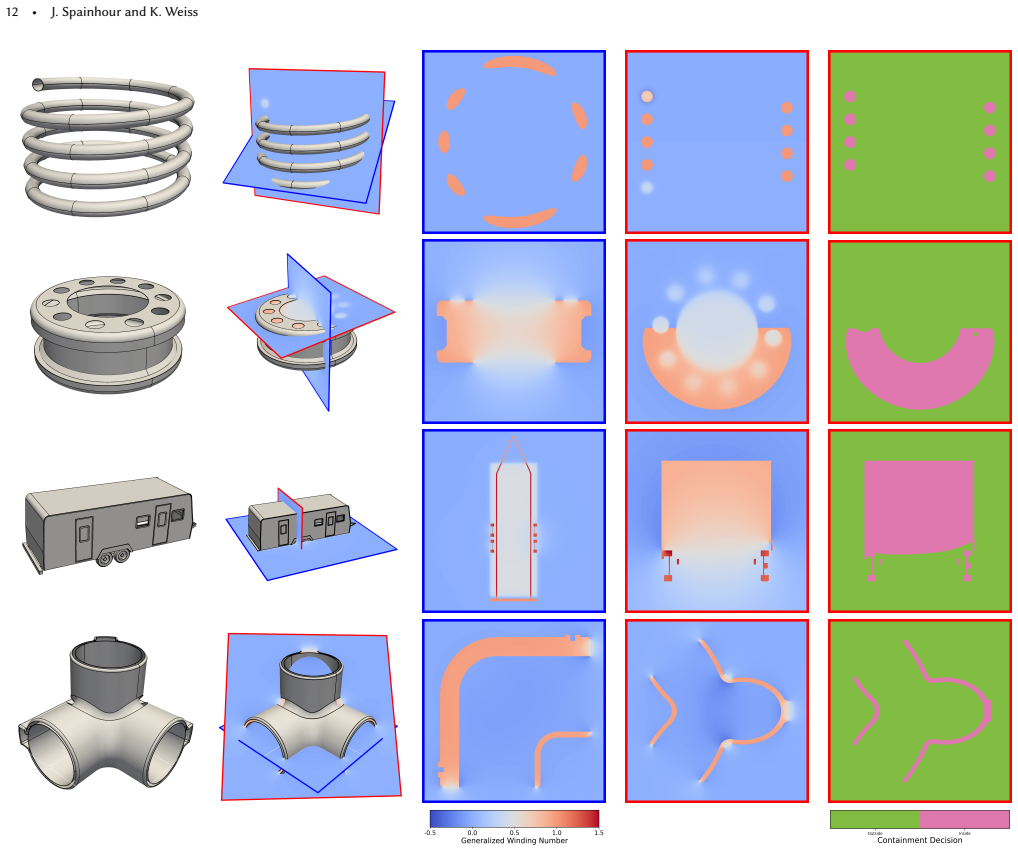
The generalized winding number relative to trimmed NURBS surfaces can be obtained by converting the surface integral of the 3D solid angle into a boundary integral over the trimming curves and solving that integral with rapidly converging adaptive quadrature; memoization of node positions and tangents further accelerates batches of queries. This formulation is indifferent to gaps or overlaps between surfaces and preserves all curved features of the original NURBS patches, yielding a containment classification that is robust to the non-watertight character of typical CAD models.
What carries the argument
Boundary formulation of the 3D solid angle integral, solved by adaptive quadrature along NURBS trimming curves.
If this is right
- Containment classification remains correct for points arbitrarily close to the surface without discretization-induced errors.
- All original curved geometry of the NURBS patches is respected rather than approximated.
- Batches of queries run faster once quadrature node positions and tangents are cached and reused.
- The method applies directly to complex trimming geometry found in real CAD models.
Where Pith is reading between the lines
- The same boundary reduction might be applied to other surface integrals that appear in graphics or simulation pipelines that ingest CAD data.
- Direct use on parametric surfaces could reduce the need for intermediate meshing steps when testing containment inside simulation loops.
- Extending the quadrature caching scheme to neighboring points or to time-varying queries could yield further speedups in interactive settings.
Load-bearing premise
The boundary formulation of the solid angle integral can be evaluated accurately and stably for arbitrary trimming curves on NURBS surfaces without introducing numerical instabilities or requiring special handling of trimming topology.
What would settle it
A sequence of query points placed arbitrarily close to trimming curves of increasing curvature or with complex intersections, where the adaptive quadrature either fails to converge to a consistent winding number or produces values that flip the inside-outside classification.
Figures






read the original abstract
We propose a containment query that is robust to the watertightness of regions bound by trimmed NURBS surfaces, as this property is difficult to guarantee for in-the-wild CAD models. Containment is determined through the generalized winding number (GWN), a mathematical construction that is indifferent to the arrangement of surfaces in the shape. Applying contemporary techniques for the 3D GWN to trimmed NURBS surfaces requires some form of geometric discretization, introducing computational inefficiency to the algorithm and even risking containment misclassifications near the surface. In contrast, our proposed method leverages properties of the 3D solid angle to solve the relevant surface integral using a boundary formulation with rapidly converging adaptive quadrature. Batches of queries are further accelerated by \textit{memoizing} (i.e. caching and reusing) quadrature node positions and tangents as they are evaluated. We demonstrate that our GWN method is robust to complex trimming geometry in a CAD model, and is accurate up to arbitrary precision at arbitrary distances from the surface. The derived containment query is therefore robust to model non-watertightness while respecting all curved features of the input shape.
Editorial analysis
A structured set of objections, weighed in public.
Referee Report
Summary. The paper proposes a containment query for collections of trimmed NURBS surfaces based on the generalized winding number (GWN). It converts the surface solid-angle integral to a boundary integral over trimming curves, evaluates it via rapidly converging adaptive quadrature, and accelerates batches via memoization of quadrature nodes and tangents. The method is claimed to be robust to non-watertightness, to respect all curved features without discretization, and to achieve arbitrary precision at arbitrary distances from the surface.
Significance. If the numerical stability and accuracy claims hold, the work would be significant for CAD and geometry-processing applications, where trimmed NURBS models are routinely non-watertight. It offers a direct, discretization-free route to GWN queries that preserves exact curved geometry, addressing a practical pain point that current meshing-based approaches cannot reliably solve.
major comments (2)
- [Abstract] Abstract: the central claims of 'accurate up to arbitrary precision' and 'robust to complex trimming geometry' are asserted without any quantitative validation data, error analysis, convergence plots, or comparison against existing GWN or containment methods; this absence leaves the load-bearing robustness guarantee unsupported.
- [Method (boundary formulation)] The boundary formulation of the solid-angle integral is presented as the key technical step that enables stable adaptive quadrature on trimmed NURBS. However, no derivation, explicit line-integral expression, or handling of trimming-curve topology (intersections, open endpoints, high curvature) is supplied; without this, it is impossible to verify that the quadrature remains well-defined and singularity-free precisely where the method is advertised to succeed.
minor comments (1)
- [Implementation] The memoization strategy for batch queries is mentioned but its data structures, invalidation policy, and interaction with adaptive node placement are not described; a short algorithmic outline would improve reproducibility.
Simulated Author's Rebuttal
We thank the referee for their positive assessment of the potential significance of our work for CAD applications and for highlighting areas where the manuscript can be strengthened. We provide point-by-point responses to the major comments and indicate the revisions we will make.
read point-by-point responses
-
Referee: [Abstract] Abstract: the central claims of 'accurate up to arbitrary precision' and 'robust to complex trimming geometry' are asserted without any quantitative validation data, error analysis, convergence plots, or comparison against existing GWN or containment methods; this absence leaves the load-bearing robustness guarantee unsupported.
Authors: We acknowledge that the abstract, as a concise summary, does not embed quantitative data or plots. The manuscript body includes demonstrations on complex CAD models that illustrate robustness to trimming geometry and accuracy at varying distances. To directly address the concern, we will revise the abstract to reference the supporting experimental observations and add dedicated error analysis, convergence plots, and a comparison subsection in the results. revision: yes
-
Referee: [Method (boundary formulation)] The boundary formulation of the solid-angle integral is presented as the key technical step that enables stable adaptive quadrature on trimmed NURBS. However, no derivation, explicit line-integral expression, or handling of trimming-curve topology (intersections, open endpoints, high curvature) is supplied; without this, it is impossible to verify that the quadrature remains well-defined and singularity-free precisely where the method is advertised to succeed.
Authors: We agree that a self-contained derivation and explicit treatment of curve topology would improve verifiability. The formulation is obtained via Stokes' theorem, reducing the solid-angle surface integral to a line integral over trimming curves whose explicit integrand depends on the position and tangent vectors. Topology is handled by splitting curves at intersections, treating open endpoints as boundary contributions, and relying on adaptive quadrature to refine near high-curvature or near-singular regions. We will insert the full derivation, the closed-form line-integral expression, and a dedicated paragraph on topology handling into the revised method section. revision: yes
Circularity Check
No circularity: derivation applies standard solid-angle boundary reduction and quadrature to GWN
full rationale
The paper's central step converts the surface solid-angle integral for the generalized winding number into a boundary line integral over trimming curves, then evaluates it via adaptive quadrature. This reduction follows from classical vector calculus identities (Stokes' theorem applied to the solid-angle kernel) and does not redefine any quantity in terms of itself, fit parameters to the target output, or rely on a self-citation chain whose validity is internal to the present work. The abstract and described method treat the boundary formulation and quadrature convergence as externally established mathematical facts, with the novelty lying in their application to trimmed NURBS without discretization. No equation is shown to equal its own input by construction, and the robustness claim is presented as a consequence of these independent properties rather than a tautology. Therefore the derivation chain remains self-contained against external benchmarks.
Axiom & Free-Parameter Ledger
axioms (1)
- standard math Properties of the 3D solid angle permit an exact boundary formulation of the surface integral over trimmed patches.
Lean theorems connected to this paper
-
IndisputableMonolith/Foundation/AlexanderDuality.leanalexander_duality_circle_linking unclear?
unclearRelation between the paper passage and the cited Recognition theorem.
our proposed method leverages properties of the 3D solid angle to solve the relevant surface integral using a boundary formulation with rapidly converging adaptive quadrature
-
IndisputableMonolith/Cost/FunctionalEquation.leanwashburn_uniqueness_aczel unclear?
unclearRelation between the paper passage and the cited Recognition theorem.
Stokes’ theorem to reformulate the problem as a 1D line integral over the boundary of each patch
What do these tags mean?
- matches
- The paper's claim is directly supported by a theorem in the formal canon.
- supports
- The theorem supports part of the paper's argument, but the paper may add assumptions or extra steps.
- extends
- The paper goes beyond the formal theorem; the theorem is a base layer rather than the whole result.
- uses
- The paper appears to rely on the theorem as machinery.
- contradicts
- The paper's claim conflicts with a theorem or certificate in the canon.
- unclear
- Pith found a possible connection, but the passage is too broad, indirect, or ambiguous to say the theorem truly supports the claim.
Reference graph
Works this paper leans on
-
[1]
Line integrals and physical optics. Part I. The transformation of the solid-angle surface integral to a line integral.J. Opt. Soc. Am. A2, 6 (Jun 1985), 891–895. doi:10.1364/JOSAA.2.000891 Axom_data
-
[2]
Direct immersogeometric fluid flow and heat transfer analysis of objects represented by point clouds.Computer Methods in Applied Mechanics and Engineering404 (Feb. 2023), 115742. doi:10.1016/j.cma.2022.115742 S. Bang, K. Serkh, O. Stein, and A. Jacobson
-
[3]
An adaptive fast-multipole-accelerated hybrid boundary integral equation method for accurate diffusion curves.ACM Trans. Graph.42, 6, Article 215 (Dec. 2023), 28 pages. doi:10.1145/3618374 G. Barill, N. Dickson, R. Schmidt, D. I. W. Levin, and A. Jacobson
-
[4]
Fast winding numbers for soups and clouds.ACM Transactions on Graphics37, 4, Article 43 (July 2018), 12 pages. doi:10.1145/3197517.3201337 J. Binysh and G. P. Alexander
-
[5]
Maxwell’s theory of solid angle and the construction of knotted fields.Journal of Physics A: Mathematical and Theoretical51, 38 (Aug. 2018), 385202. doi:10.1088/1751-8121/aad8c6 M. Borodzik, S. Dangskul, and A. Ranicki
-
[6]
Solid angles and Seifert hypersurfaces
Solid angles and Seifert hypersurfaces. arXiv:1706.06405 [math.GT] https://arxiv.org/abs/1706.06405 A. Capps, R. Carson, B. Corbett, N. Elliott, J. Essman, B. Gunney, B. Han, C. Harrison, R. Hornung, M. Larsen, A. Moody, E. Pauli, R. Settgast, J. Spainhour, L. Taylor, K. Weiss, C. White, B. Whitlock, M. Yang, and G. Zagaris. 2025.Axom: CS infrastructure c...
work page internal anchor Pith review Pith/arXiv arXiv doi:10.11578/dc.20210915.2 2025
-
[7]
II.2 – Point in polyhedron testing using spherical polygons. InGraphics Gems V, A. W. Paeth (Ed.). Academic Press, Boston, 42–49. doi:10.1016/B978-0-12-543457-7.50015-2 E. B. Chin and N. Sukumar
-
[9]
InProceedings of the 21st Spring Conference on Computer Graphics(Budmerice, Slovakia)(SCCG ’05)
Robust and numerically stable Bézier clipping method for ray tracing NURBS surfaces. InProceedings of the 21st Spring Conference on Computer Graphics(Budmerice, Slovakia)(SCCG ’05). Association for Computing Machinery, New York, NY, USA, 127–135. doi:10.1145/1090122.1090144 N. Feng and K. Crane
-
[10]
Graph.43, 4, Article 92 (July 2024), 19 pages
A heat method for generalized signed distance.ACM Trans. Graph.43, 4, Article 92 (July 2024), 19 pages. doi:10.1145/3658220 J. E. Fromm, N. Wunsch, R. Xiang, H. Zhao, K. Maute, J. A. Evans, and D. Kamensky
-
[12]
Ray tracing harmonic functions. ACM Trans. Graph.43, 4, Article 99 (July 2024), 18 pages. doi:10.1145/3658201 D. Gunderman, K. Weiss, and J. A. Evans
-
[13]
doi:10.1016/j.cad.2020.102944 D
Spectral mesh-free quadrature for planar regions bounded by rational parametric curves.Computer-Aided Design130 Robust Containment Queries over Collections of Trimmed NURBS Surfaces via Generalized Winding Numbers•19 (2020). doi:10.1016/j.cad.2020.102944 D. Gunderman, K. Weiss, and J. A. Evans
-
[14]
High-accuracy mesh-free quadrature for trimmed parametric surfaces and volumes.Computer-Aided Design141 (2021), 103093. doi:10.1016/j.cad.2021.103093 E. Haines and T. Akenine-Möller (Eds.). 2019.Ray tracing gems. Apress. http: //raytracinggems.com. B. Hamann and P.-Y. Tsai
-
[15]
doi:10.1016/0010-4485(95)00043-7 K
A tessellation algorithm for the representation of trimmed NURBS surfaces with arbitrary trimming curves.Computer-Aided Design 28, 6–7 (1996), 461–472. doi:10.1016/0010-4485(95)00043-7 K. Hormann and A. Agathos
-
[16]
Computational Geometry20, 3 (2001), 131–144
The point in polygon problem for arbitrary polygons. Computational Geometry20, 3 (2001), 131–144. doi:10.1016/S0925-7721(01)00012-8 T. J. R. Hughes, J. A. Cottrell, and Y. Bazilevs
-
[17]
Isogeometric analysis: CAD, finite elements, NURBS, exact geometry and mesh refinement.Computer Methods in Applied Mechanics and Engineering194, 39 (2005), 4135–4195. doi:10.1016/j.cma. 2004.10.008 A. Jacobson, L. Kavan, and O. Sorkine
-
[18]
Robust inside-outside segmentation using generalized winding numbers.ACM Transactions on Graphics32, 4 (2013), 1–12. doi:10.1145/2461912.2461916 A. Jacobson, D. Panozzo, et al
-
[19]
An immersogeometric variational framework for fluid–structure interaction: Application to bioprosthetic heart valves.Computer Methods in Applied Mechanics and Engineering284 (2015), 1005–1053. doi:10.1016/j. cma.2014.10.040 Isogeometric Analysis Special Issue. D.J. Kasik, W. Buxton, and D.R. Ferguson
work page doi:10.1016/j 2015
-
[20]
Ten CAD challenges.IEEE Computer Graphics and Applications25, 2 (2005), 81–92. doi:10.1109/MCG.2005.48 L. Klinteberg and A. H. Barnett
-
[21]
doi:10.1007/s10543-020-00820-5 S
Accurate quadrature of nearly singular line integrals in two and three dimensions by singularity swapping.BIT Numerical Mathematics61 (07 2020), 1–36. doi:10.1007/s10543-020-00820-5 S. Koch, A. Matveev, Z. Jiang, F. Williams, A. Artemov, E. Burnaev, M. Alexa, D. Zorin, and D. Panozzo
-
[22]
doi:10.1016/j.cad.2009.06.015 S
Optimized GPU evaluation of arbitrary degree NURBS curves and surfaces.Computer-Aided Design41, 12 (2009), 971–980. doi:10.1016/j.cad.2009.06.015 S. Liu, L. Liu, and X.-M. Fu
-
[23]
Graph.44, 4, Article 75 (July 2025), 9 pages
Closed-form generalized winding numbers of rational parametric curves for robust containment queries.ACM Trans. Graph.44, 4, Article 75 (July 2025), 9 pages. doi:10.1145/3730886 E. Marchandise, C. Piret, and J.-F. Remacle
-
[24]
CAD and mesh repair with Radial Basis Functions.J. Comput. Phys.231, 5 (2012), 2376–2387. doi:10.1016/j.jcp.2011.11.033 Z. Marschner, P. Zhang, D. Palmer, and J. Solomon
-
[25]
Sum-of-squares geometry processing.ACM Transactions on Graphics40, 6, Article 253 (Dec. 2021), 13 pages. doi:10.1145/3478513.3480551 C. Martens and M. Bessmeltsev
-
[26]
One-shot method for computing generalized winding numbers.Computer Graphics Forum44 (2025). Issue
work page 2025
-
[27]
doi:10.1111/cgf.70194 W. Martin, E. Cohen, R. Fish, and P. Shirley
-
[28]
Practical ray tracing of trimmed NURBS surface.Journal of Graphics Tools5 (09 2000). doi:10.1080/10867651.2000. 10487519 B. Marussig and T. Hughes
-
[29]
doi:10.1007/s11831-017-9220-9 A
A review of trimming in isogeometric analysis: Challenges, data exchange and simulation aspects.Archives of Computational Methods in Engineering25 (06 2017), 1–69. doi:10.1007/s11831-017-9220-9 A. McAdams, Y. Zhu, A. Selle, M. Empey, R. Tamstorf, J. Teran, and E. Sifakis
-
[30]
Effi- cient elasticity for character skinning with contact and collisions.ACM Transactions on Graphics30, 4, Article 37 (July 2011), 12 pages. doi:10.1145/2010324.1964932 T. Nishita, T. W. Sederberg, and M. Kakimoto
-
[31]
Ray tracing trimmed rational surface patches.SIGGRAPH Comput. Graph.24, 4 (Sept. 1990), 337–345. doi:10.1145/ 97880.97916 Open Cascade SAS
-
[32]
Bayesian Segmentation of Atrium Wall Using Globally-Optimal Graph Cuts on 3D Meshes
Open Cascade Technology. https://dev.opencascade.org/. Version 7.8. L. Piegl and W. Tiller. 1997.The NURBS book. Springer-Verlag. doi:10.1007/978-3-642- 59223-2 L. A. Piegl and A. M. Richard
-
[33]
doi:10.1016/0010-4485(95)90749-6 A
Tessellating trimmed NURBS surfaces.Computer- Aided Design27, 1 (1995), 16–26. doi:10.1016/0010-4485(95)90749-6 A. Reshetov. 2019.Cool patches: A geometric approach to ray/bilinear patch intersections. Apress, Berkeley, CA, 95–109. doi:10.1007/978-1-4842-4427-2_8 R. Sawhney and K. Crane
-
[34]
Monte Carlo geometry processing: A grid-free approach to PDE-based methods on volumetric domains.ACM Transactions on Graphics39, 4 (2020). A. Schollmeyer and B. Fröhlich
work page 2020
-
[35]
ACM Transactions on Graphics28, 3, Article 47 (July 2009), 9 pages
Direct trimming of NURBS surfaces on the GPU. ACM Transactions on Graphics28, 3, Article 47 (July 2009), 9 pages. doi:10.1145/ 1531326.1531353 A. Schollmeyer and B. Fröhlich
-
[36]
doi:10.1109/TVCG.2018.2814987 T
Efficient and anti-aliased trimming for rendering large NURBS models.IEEE Transactions on Visualization and Computer Graphics25, 3 (2019), 1489–1498. doi:10.1109/TVCG.2018.2814987 T. W. Sederberg, G. T. Finnigan, X. Li, H. Lin, and H. Ipson
-
[37]
InACM SIGGRAPH 2008 Papers(Los Angeles, California)(SIGGRAPH ’08)
Watertight trimmed NURBS. InACM SIGGRAPH 2008 Papers(Los Angeles, California)(SIGGRAPH ’08). Association for Computing Machinery, New York, NY, USA, Article 79, 8 pages. doi:10.1145/1399504.1360678 R. Sevilla, S. Fernández-Méndez, and A. Huerta
-
[38]
NURBS-enhanced finite element method for Euler equations.International Journal for Numerical Methods in Fluids 57, 9 (2008), 1051–1069. doi:10.1002/fld.1711 R. Sevilla, S. Fernández-Méndez, and A. Huerta
-
[39]
3D NURBS-enhanced finite element method (NEFEM).Internat. J. Numer. Methods Engrg.88, 2 (2011), 103–125. doi:10.1002/nme.3164 R. Sevilla and A. Huerta
-
[40]
Journal of Scientific Computing77, 3 (Feb
HDG-NEFEM with degree adaptivity for Stokes flows. Journal of Scientific Computing77, 3 (Feb. 2018), 1953–1980. doi:10.1007/s10915-018- 0657-2 J. Shen, L. Busé, P. Alliez, and N. Dodgson
-
[41]
doi:10.1016/j.cagd.2016.07.002 X
A line/trimmed NURBS surface intersection algorithm using matrix representations.Computer Aided Geometric Design48 (2016), 1–16. doi:10.1016/j.cagd.2016.07.002 X. Sheng and B. E. Hirsch
-
[42]
Computer-Aided Design24, 8 (1992), 437–444
Triangulation of trimmed surfaces in parametric space. Computer-Aided Design24, 8 (1992), 437–444. doi:10.1016/0010-4485(92)90011-X J. Sloup and V. Havran
-
[43]
Wiley Online Library, 161–172. doi:10.1111/cgf.14410 B. M. Smith, T. J. Tautges, and P. P. H. Wilson
-
[44]
Robust containment queries over collections of rational parametric curves via generalized winding numbers.ACM Transactions on Graphics43, 4, Article 38 (July 2024), 14 pages. doi:10.1145/3658228 P. Trettner, J. Nehring-Wirxel, and L. Kobbelt
-
[45]
EMBER: Exact mesh booleans via efficient & robust local arrangements.ACM Transactions on Graphics41, 4, Article 39 (July 2022), 15 pages. doi:10.1145/3528223.3530181 K. Ueda
-
[46]
doi:10.1016/0167-8396(95)00038-0 H
Mean normal vector to a surface bounded by Bézier curves.Computer Aided Geometric Design13, 5 (1996), 441–451. doi:10.1016/0167-8396(95)00038-0 H. J. Wolters
-
[47]
Extensions: Extrapolation methods for CAD.Curve and Surface Design(04 2000), 433–441. X. Xiao, P. Alliez, L. Busé, and L. Rineau
work page 2000
-
[48]
Delaunay meshing and repairing of NURBS models.Computer Graphics Forum40, 5 (2021), 125–142. doi:10.1111/cgf. 14362 R. Xiong, Y. Lu, C. Chen, J. Zhu, Y. Zeng, and L. Liu
work page doi:10.1111/cgf 2021
-
[49]
ETER: Elastic tessellation for real-time pixel-accurate rendering of large-scale NURBS models.ACM Transactions on Graphics42, 4, Article 133 (July 2023), 13 pages. doi:10.1145/3592419 J. Zhu, Y. Lu, R. Xiong, C. Chen, and L. Liu
-
[50]
doi:10.1016/j.cagd.2025.102451 X
Projection-driven grid-BSP tree for real-time trimming on GPU.Computer Aided Geometric Design119 (2025), 102451. doi:10.1016/j.cagd.2025.102451 X. Zou, S. B. Lo, R. Sevilla, O. Hassan, and K. Morgan
-
[51]
doi:10.1016/j.cad.2023.103653 20•J
The generation of 3D surface meshes for NURBS-enhanced FEM.Computer-Aided Design168 (2024), 103653. doi:10.1016/j.cad.2023.103653 20•J. Spainhour and K. Weiss A Analytic discontinuity fix for Near-Field GWN In this section, we provide a formal proof of the correction term in Equation
-
[52]
∥ ®𝑥∥,0 ·𝑑 ®Γ(22) + ( 0.5 if the origin isabovethe intersection point , −0.5 if the origin isbelowthe intersection point . Along with our handling of points coincident with the surface in Section 3.3, this yields Equation 6, as desired.□ Robust Containment Queries over Collections of Trimmed NURBS Surfaces via Generalized Winding Numbers•21 B Pseudocode f...
work page 2019
-
[53]
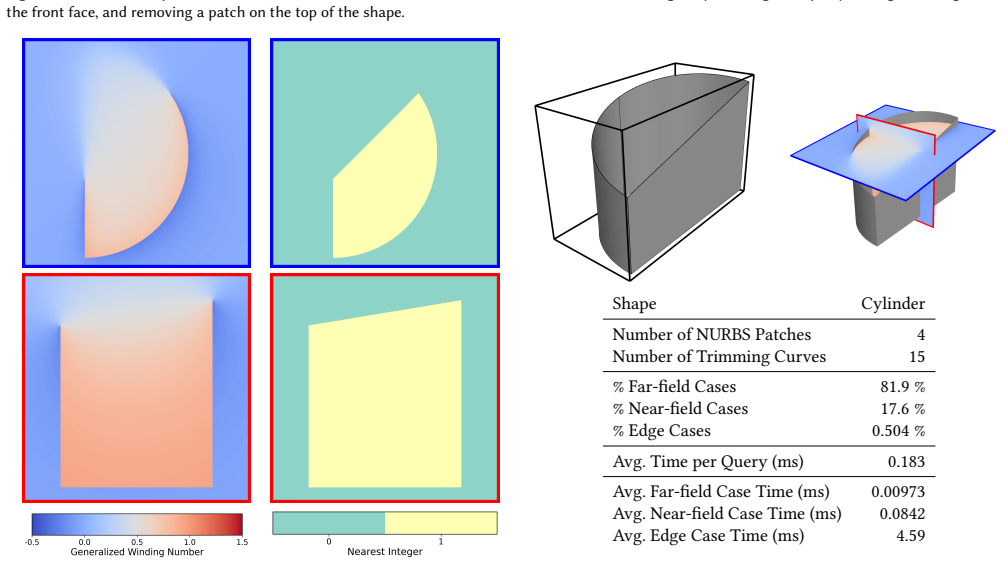
We modeled this open “Sliced-Cylinder” shape after an example from [Marussig and Hughes 2017] using Rhino3D. 26•J. Spainhour and K. Weiss Shape Box-Sphere Number of NURBS Patches 192 Number of Trimming Curves 968 % Far-field Cases 99.43 % % Near-field Cases 0.554 % % Edge Cases 0.012 % Avg. Time per Query (ms) 1.46 Avg. Far-field Case Time (ms) 0.0064 Avg...
work page 2017
-
[54]
This “Vase” shape is adapted from an example in [Martens and Bessmeltsev 2025], and was created as a surface of revolution from 7 cubic Bézier curves around the z-axis with circular cross-sections composed of 4 rational Bézier curves. Robust Containment Queries over Collections of Trimmed NURBS Surfaces via Generalized Winding Numbers•27 Shape Connector N...
work page 2025
-
[55]
This “Connector” model is bundled with releases of OpenCascade [Open Cascade SAS 2011]. Shape Utah Teapot Number of NURBS Patches 28 Number of Trimming Curves 112 % Far-field Cases 98.7 % % Near-field Cases 1.23 % % Edge Cases 0.0271 % Avg. Time per Query (ms) 0.152 Avg. Far-field Case Time (ms) 0.00310 Avg. Near-field Case Time (ms) 0.103 Avg. Edge Case ...
work page 2011
-
[56]
This original “Utah Teapot” [Johnson 2000] is composed of Bézier patches, many of which overlap. Note that the lid to the teapot is disconnected from the body, and the shape has no bottom. 28•J. Spainhour and K. Weiss Shape Lamp Number of NURBS Patches 78 Number of Trimming Curves 214 % Far-field Cases 97.4 % % Near-field Cases 2.56 % % Edge Cases 0.0093 ...
work page 2000
discussion (0)
Sign in with ORCID, Apple, or X to comment. Anyone can read and Pith papers without signing in.