REVIEW 3 major objections 6 minor 22 references
High-efficiency position resolved gamma ray detectors for 2D-measurements of the angular correlation of annihilation radiation
T0 review · 3 major / 6 minor · reviewed 2026-08-11 · deepseek-v4-flash
Pith's one-line read A pixelated LYSO gamma-ray detector with MPPC readout reports 45% detection efficiency for 511 keV annihilation quanta and 1 mm position resolution, which the authors project to a 25-fold count-rate gain for 2D-ACAR Fermi-surface…
desk verdict Solid prototype with credible physics benchmarks, but the 45%/25x efficiency headline is asserted, not measured, and conflicts with the paper's own Table 1. read the letter →
The pith
A machine-rendered reading of the paper's core claim, the machinery that carries it, and where it could break.
The reading
What carries the argument
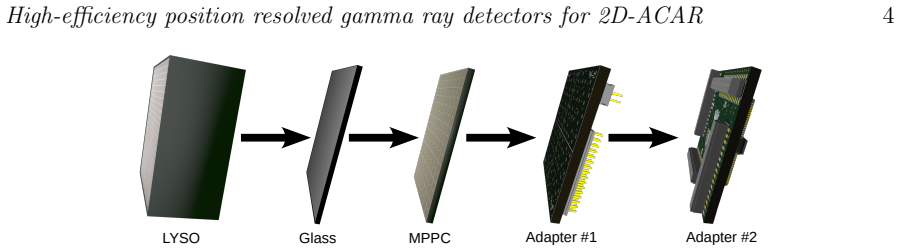
The central object is an Anger-camera replacement: a 20 mm thick pixelated LYSO scintillator with 24x24 pixels of 1 mm pitch, a 2 mm glass light guide, and an 8x8 Multi-Pixel Photon Counter array. The mechanism combines LYSO's high attenuation coefficient for 511 keV gamma rays, which gives the efficiency gain, with the pixelated crystal, which fixes the position resolution at 1 mm regardless of optical spread, and the MPPC/TOFPET2 readout, whose per-element energy signals allow center-of-gravity reconstruction of gamma impact positions. The momentum sampling function, the convolution of the two detectors' angular efficiencies, is the quantity that connects measured coincidence positions to the transverse electron momentum distribution in the sample.
What would settle it
Place the same 22Na source between one LYSO detector and one NaI(Tl) Anger camera, record coincidence count rates with identical energy windows, and also measure the single-detector efficiency of the NaI(Tl) camera under the same illumination geometry; if the coincidence gain is not close to 25 and the efficiency ratio is not close to five, the central performance claim fails.
Extended reading notes
Core claim
The paper claims that a position-resolved 511 keV gamma detector built from a 24x24 pixelated LYSO crystal (26.8 mm x 26.8 mm x 20 mm) read out through a glass light guide by an 8x8 MPPC array can replace the conventional NaI(Tl) Anger camera in 2D-ACAR experiments. It reports 45% photo-peak detection efficiency, about five times that of the NaI(Tl) Anger cameras, a 1 mm spatial resolution equal to the crystal pixel pitch, and an energy resolution around 25% FWHM. From this, the authors conclude that a coincidence pair of these detectors would record 2D-ACAR spectra at 25 times the count rate, and they demonstrate the concept by imaging a 22Na distribution in aluminum and measuring a Fermi energy of (6.8 +/- 0.8) eV for copper.
Load-bearing premise
The quoted five-fold efficiency gain and 25-fold coincidence gain are measured against the authors' own NaI(Tl) Anger cameras, but the paper reports no measured efficiency or side-by-side count-rate comparison for that baseline camera.
Editorial extensions
If this is right
- A full-size detector built from the same LYSO pixels should record 2D-ACAR spectra about 25 times faster than the NaI(Tl) Anger cameras, or reach the same statistical quality in about 1/25th of the beam time.
- The 1 mm position resolution, set by the crystal pixel, improves angular resolution by about 3.5 times at a fixed baseline, or allows the sample-detector distance to shrink from roughly 8 m to about 2.4 m.
- Positron-emitting isotope distributions can be imaged directly from the two annihilation quanta, as demonstrated for 22Na in an aluminum plate, giving a spatially resolved check on activation profiles.
- Fermi energies of metals can be extracted from a 10 hour 2D-ACAR measurement on a polycrystalline sample, as shown for copper (6.8 +/- 0.8 eV versus the accepted 7.0 eV).
Reading between the lines
- Editorial inference: if the single-detector 45% efficiency carries over to coincidence operation, a pair's combined efficiency would be about 20%, making 2D-ACAR spectra with the demonstrated quality feasible in roughly one day at a moderate source instead of several days at a long baseline.
- Editorial inference: because the resolution is tied to the crystal pixel and not to the readout, tiling multiple LYSO/MPPC modules into a larger camera should preserve the 1 mm resolution, with tile alignment and pixel-boundary calibration as the practical limits.
- Editorial inference: the same two-detector coincidence logic could be applied to positron emission imaging of thin targets at millimeter scale, effectively a miniature PET geometry without tomographic scanning, since the 22Na benchmark already reconstructs source distributions from two coincident gamma hits.
Editorial analysis
A structured set of objections, weighed in public.
Referee Report
Summary. The manuscript describes a prototype two-detector system for 2D-ACAR measurements based on pixelated 24×24 LYSO crystals (1 mm pixel pitch, 20 mm thick) coupled through a glass light guide to 8×8 MPPCs and TOFPET2 readout electronics. The paper claims a 45% detection efficiency for 511 keV gamma quanta, a factor-of-five improvement over the NaI(Tl) Anger cameras used by the group, and hence a 25-fold coincidence count-rate gain, together with 1 mm spatial resolution. The performance is illustrated by imaging 22Na in a proton-irradiated aluminum plate and by a 2D-ACAR measurement on polycrystalline copper, from which a Fermi energy of (6.8 ± 0.8) eV is extracted, consistent with the literature value of 7.0 eV. The paper's characterization content is organized around spatial resolution, energy resolution, temperature stability, and background behavior, followed by the two benchmark demonstrations.
Significance. If the headline efficiency and count-rate claims are substantiated, this prototype addresses a central bottleneck in 2D-ACAR, namely long measurement times due to low coincidence rates. The paper has clear strengths that are independent of that claim: the 1 mm spatial resolution is demonstrated by a direct lead-edge scan rather than inferred from the pixel pitch; the 22Na image agrees with earlier measurements; the Cu Fermi energy is consistent with the literature value; and the temperature-stability test convincingly shows reproducibility. These positive results are credible and would support publication once the quantitative efficiency claim is either measured directly or derived with an explicit baseline and acceptance definition.
major comments (3)
- [§3.2, §5, Abstract] The 45% detection efficiency is asserted rather than demonstrated. Section 3.2 states that the detector was illuminated by 4.3×10^3 511-keV gammas per second and shows the resulting energy spectrum, but it does not report the accepted count rate in the 511-keV window and does not compute an absolute efficiency from these data. The abstract and Section 5 describe this as a photopeak efficiency, but the acceptance definition is missing. A simple single-interaction estimate using the Table 1 values (total attenuation coefficient 0.80 cm^-1, photoelectric fraction 33.8%, thickness 2 cm) gives roughly 27% for full-energy deposition by the first photoelectric interaction, so reaching 45% requires either multi-Compton full-energy deposition or a different acceptance definition, neither of which is specified. The claim should be backed by a calibrated-source measurement or by a simulation with the threshold and energy-window criteria stated.
- [§5, Abstract] The factor-of-five comparison with NaI(Tl) in the group's Anger cameras is not testable because no NaI(Tl) thickness, measured efficiency, or side-by-side count-rate data are reported. The 25-fold coincidence gain is the square of the per-detector efficiency ratio, so it is highly sensitive to the baseline and to the acceptance definitions. For a common 25.4-mm-thick NaI(Tl) crystal, the same simple photopeak formula gives roughly 10%, which would yield a ratio of about 2.6 to 4.5 depending on how the LYSO acceptance is defined. A five-fold ratio requires a specific, thinner NaI(Tl) baseline. The authors should either report a direct measurement of the ratio or derive it from the actual Anger-camera crystal geometry with uncertainties.
- [§3, §5] The efficiency characterization is performed on one detector only, based on the statement that both detectors are identical in construction and performance. Since the central quantitative claim is a coincidence count-rate gain, the manuscript should show that the second detector has the same accepted-photopeak efficiency, ideally through a two-detector coincidence measurement or at least a direct comparison of the two single-detector energy spectra and count rates. Without this, the extrapolation from one detector to the 25-fold coincidence advantage remains unsupported.
minor comments (6)
- [Abstract] The exclamation mark in "25 (!) times" is informal for a journal article and should be removed.
- [§2.2] The acronym "MSf" should be written as "MSF" for consistency with equation (1) and the surrounding text.
- [§4.2] The word "distrubition" should be corrected to "distribution".
- [§3.1, Figure 5] The caption of Figure 5 should state whether the lead-brick scan was performed on one detector and how the color scale maps to the lead-brick position, as this is central to the claimed 1 mm resolution.
- [§5] The statement that position resolution is improved by a factor of 3.5 compared with conventional Anger cameras should be supported by a reference or measurement of the Anger-camera resolution, since no such baseline value appears elsewhere in the manuscript.
- [§3.2] The energy resolution values (36% unfiltered, 25% filtered) should state explicitly that they refer to the 511-keV photopeak, and the fit range used for the Gaussian should be quoted.
Circularity Check
No significant circularity: the performance claims are asserted or measured, not fitted; the Fermi-energy comparison uses an independent literature value.
full rationale
The derivation chain does not reduce any result to its inputs. The headline efficiency (45%) and the five-fold/25-fold rate comparisons are presented as detector characterization outcomes rather than as parameters fitted to the benchmark data; no equation in the paper constructs these values from the 22Na imaging or Cu ACAR fits. The Fermi energy is obtained by fitting the measured ACAR spectrum and then compared with the independent literature value of 7.0 eV, which is a standard measurement check rather than a circular prediction. The 22Na spatial distribution is compared with previous work [22]; although that reference shares an author, it is a separate published benchmark and is not used to generate the central efficiency or resolution claims. Because no load-bearing step is defined in terms of the quantity it is supposed to establish, there is no significant circularity.
Assumptions & free parameters
free parameters (6)
- Fermi cutoff angle theta_F =
(5.14 +/- 0.32) mrad
- Energy acceptance width =
0.5 x FWHM of Gaussian fit to the 511 keV peak
- Rectangular spot width (beam extension in beta) =
not quoted numerically
- 2D Gaussian FWHM of the 22Na distribution =
(4.2 +/- 0.3) mm x (7.7 +/- 0.4) mm
- Gaussian background amplitude and width in the ACAR fit =
not quoted
- Detector-sample distance for ACAR measurement =
87 cm
assumptions (6)
- standard math Small-angle approximation alpha ~ (Delta x1 - Delta x2)/d, beta ~ (Delta y1 - Delta y2)/d, and Delta alpha ~ p_perp/(m0 c)
- domain assumption For thermalized positrons annihilating with electrons, the two 511 keV photons carry the electron momentum; for polycrystalline Cu the momentum density is spherically symmetric and the 1D projection is a parabola with cutoff at p_F
- domain assumption The two detectors are identical in construction and performance, so single-detector characterization applies to the coincidence pair
- domain assumption The MSF can be computed from geometric detector efficiencies as a 2D convolution, assuming homogeneous detector response
- domain assumption The energy pre-filter and 0.5 x FWHM acceptance reject background without biasing the angular correlation
- domain assumption Positrons emit from the 22Na source and annihilate inside the sample; annihilation in the source is blocked by lead shielding
Cite this review
Pith. "Pith review of High-efficiency position resolved gamma ray detectors for 2D-measurements of the angular correlation of annihilation radiation." pith.science (2026). https://pith.science/paper/7GGACAUX
@misc{pith2026241216024,
  author       = {Pith},
  title        = {Pith review of: High-efficiency position resolved gamma ray detectors for 2D-measurements of the angular correlation of annihilation radiation},
  year         = {2026},
  howpublished = {\url{https://pith.science/paper/7GGACAUX}},
  note         = {Machine review of arXiv:2412.16024}
}
read the original abstract
The measurement of the 2D-Angular Correlation of Electron Positron Annihilation Radiation (ACAR) provides unique information about the bulk electronic structure of single crystals. We set up a new prototype for 2D-ACAR measurements using two 24 x 24 (26.8 mm x 26.8 mm) pixelated LYSO scintillation crystals in combination with a glass light guide and 8 x 8 (24 mm x 24 mm) Multi Pixel Photon Counters (MPPCs). Compared to conventional Anger-cameras, typically comprising large NaI(Tl) scintillators read out with photomultiplier arrays a larger implementation of our prototype would drastically improve resolution and count rate by taking advantage of the small pixel size of the scintillator, its much higher attenuation coefficient for 511 keV {\gamma}-quanta and faster digital readout. With our prototype we achieved a detection efficiency of 45%, i.e. five times higher compared to NaI(Tl) used in our Anger cameras, leading to a 25 (!) times higher coincidence count rate in ACAR measurements. A spatial resolution of 1 mm was obtained, which is limited by the pixel size of the scintillator. We demonstrate the high performance of the setup by (i) imaging the local distribution of 22Na in a proton-irradiated aluminum target and (ii) determining the Fermi energy of Cu from 2D-ACAR spectra recorded for a polycrystalline copper sample.
Figures


Figures from the paper (8 more)


Reference graph
Works this paper leans on
-
[1]
Sauthoff G 1995 Intermetallics (Wiley-VCH)
work page 1995
-
[2]
Pfleiderer C 2009 Rev. Mod. Phys. 81(4) 1551–1624 URL https://link.aps.org/doi/10.1103/ RevModPhys.81.1551
work page 2009
-
[3]
L¨ ohneysen H v, Rosch A, Vojta M and W¨ olfle P 2007Rev. Mod. Phys. 79(3) 1015–1075 URL https://link.aps.org/doi/10.1103/RevModPhys.79.1015
-
[4]
Shoenberg D 2007 Magnetic Oscillations in Metals (Cambridge University Press)
work page 2007
-
[5]
Cooper M J 1985 Reports on Progress in Physics 48 415 URL https://dx.doi.org/10.1088/ 0034-4885/48/4/001
work page 1985
-
[6]
Ketels J, Billington D, Dugdale S B, Leitner M and Hugenschmidt C P 2021 Phys. Rev. B 104(7) 075160 URL https://link.aps.org/doi/10.1103/PhysRevB.104.075160
-
[7]
Damascelli A, Hussain Z and Shen Z X 2003 Rev. Mod. Phys. 75(2) 473–541 URL https: //link.aps.org/doi/10.1103/RevModPhys.75.473
-
[8]
Hautoj¨ arvi P 1979Positrons in Solids (Topics in Current Physics vol 12) (Springer)
Show all 22 references
-
[9]
Ceeh H, Weber J A, B¨ oni P, Leitner M, Benea D, Chioncel L, Ebert H, Min´ ar J, Vollhardt D and Hugenschmidt C 2016 Scientific reports 6 20898
2016
-
[10]
Weber J A, Bauer A, B¨ oni P, Ceeh H, Dugdale S B, Ernsting D, Kreuzpaintner W, Leitner M, Pfleiderer C and Hugenschmidt C 2015 Phys. Rev. Lett. 115(20) 206404 URL https: //link.aps.org/doi/10.1103/PhysRevLett.115.206404
2015 doi
-
[11]
wiley.com/doi/pdf/10.1002/pssb.202100151) URL https://onlinelibrary.wiley.com/ doi/abs/10.1002/pssb.202100151
Ketels J, Leitner M, B¨ oni P, Hugenschmidt C, Sekania M, James A D N, Bonart J A E, Unglert N and Chioncel L 2022 physica status solidi (b) 259 2100151 (Preprint https://onlinelibrary. wiley.com/doi/pdf/10.1002/pssb.202100151) URL https://onlinelibrary.wiley.com/ doi/abs/10.1...
2022 doi
-
[12]
Ceeh H, Weber J A, Leitner M, B¨ oni P and Hugenschmidt C 2013Review of Scientific Instruments 84 043905 ISSN 0034-6748 ( Preprint https://pubs.aip.org/aip/rsi/article-pdf/doi/ 10.1063/1.4801454/16149870/043905_1_online.pdf) URL https://doi.org/10.1063/1. 4801454
-
[13]
Weber J A, B¨ oni P, Ceeh H, Leitner M and Hugenschmidt C 2013 Journal of Physics: Conference Series 443 012092 URL https://dx.doi.org/10.1088/1742-6596/443/1/012092
2013 doi
-
[14]
Element/compound/mixture selection URL https://physics.nist.gov/PhysRefData/Xcom/ html/xcom1.html
-
[16]
Nai(tl) scintillator URL https://www.epic-crystal.com/data/upload/20230728/ 64c32a167ae2a.pdf
-
[17]
2022 Mppc ® (multi-pixel photon counter) arrays URL https://www.hamamatsu.com/content/ dam/hamamatsu-photonics/sites/documents/99_SALES_LIBRARY/ssd/s13361-3050_ series_kapd1054e.pdf
2022
-
[18]
2022 Mppc ® URL https://www.hamamatsu.com/content/dam/hamamatsu-photonics/sites/ documents/99_SALES_LIBRARY/ssd/mppc_kapd9005e.pdf
2022
-
[19]
Petsys tofpet 2c asic - datasheet (rev 16) URL https://www.petsyselectronics.com/web/ website/documentation/TOFPET2%20Downloads/Documentation/PETsys%20TOFPET%202C% 20ASIC%20-%20Datasheet%20(rev%2016).pdf
2016
-
[20]
Schug D, Lerche C, Weissler B, Gebhardt P, Goldschmidt B, Wehner J, Dueppenbecker P M, Salomon A, Hallen P, Kiessling F and Schulz V 2016 Physics in Medicine and Biology 61 2851–2878 ISSN 1361-6560 URL http://dx.doi.org/10.1088/0031-9155/61/7/2851
2016 doi
-
[21]
Piatek S S, Corporation H and of Technology N J I 2014 Physics and operation of an mppc URL https://zeus.phys.uconn.edu/halld/siliconPM/MPPC_physics_of_operation_2014.pdf
2014
-
[22]
Krug L M, Chryssos L, Bundesmann J, Dittwald A, Kourkafas G, Denker A and Hugenschmidt C 2024 Nuclear Instruments and Methods in Physics Research Section B: Beam Interactions with High-efficiency position resolved gamma ray detectors for 2D-ACAR 16 Materials and Atoms 555 1654...
2024
-
[23]
Kittel C 2004 Introduction to Solid State Physics (John Wiley and Sons Inc.) ISBN 9780471415268 URL https://www.wiley.com/en-us/Introduction+to+Solid+State+ Physics%2C+8th+Edition-p-9780471415268
2004
Reviewed August 11, 2026 · model on record in the stance chip above.
Discussion (0). Continue with ORCID to comment.