REVIEW 3 major objections 6 minor 84 references
Robotic Manipulation Framework Based on Semantic Keypoints for Packing Shoes of Different Sizes, Shapes, and Softness
T0 review · 3 major / 6 minor · reviewed 2026-08-05 · deepseek-v4-flash
Pith's one-line read This paper claims that a robotic framework using five semantic keypoints per shoe can pack pairs of shoes from any initial state into the standard side-by-side, inside-outside configuration in a box.
desk verdict A real, worth-refereeing shoe-packing pipeline whose core idea is good, but the 'any initial state' claim is overbroad and the toppling model's rigid-body assumption is the load-bearing weakness. read the letter →
The pith
A machine-rendered reading of the paper's core claim, the machinery that carries it, and where it could break.
The reading
What carries the argument
The load-bearing object is the semantic keypoint set Kshoe = {Ptoe, Pheel, Ptopline, Poutside, Pinside}—five geometrically defined points on a shoe that are visible across states and deformations. KeypointNet, an encoder-decoder with residual blocks, detects these as heat maps; a rule-based postprocessor uses their visibility to classify state and their geometry to estimate pose, size, and grasp position. Two reorientation mechanisms carry the manipulation: the toppling primitive, whose start/end poses are computed from kinematic models relating shoe width W, height H, and gripper length Lgripper (Eqs. 7-12), and the contact-based flip, which uses the box edge as a fulcrum plus gravity, with
What would settle it
Run the complete packing planner on a shoe type softer and more elastic than the tested sandals (e.g., a foam slipper) across all seven initial combinations, ten trials each; the claim that the framework packs pairs from any initial state is falsified if the contact-based flip or any required toppling transition fails in all ten trials for that shoe type.
Extended reading notes
Core claim
The paper's core discovery is that five semantic keypoints (toe, heel, topline, outside, inside) can carry the perception burden of a deformable-object packing task: they classify shoe state by occlusion rules, estimate pose from geometry, and yield grasp points and size. Reorientation uses a toppling primitive from a rigid-body kinematic model (Eqs. 7-12) with soft-gripper interference, plus a contact-based flip that sets a top-state shoe on the box edge with a controlled offset so gravity restores a stable state. A packing state machine enumerates the seven initial pair combinations, chooses the shortest transition, and treats top+side as directly placeable. Experiments on four shoe types
Load-bearing premise
The toppling planner assumes a shoe in the side or top state rotates about the edge as a rigid body while the soft gripper pushes it; real shoes deform, slide, or over-rotate, and high-heeled shoes in the side state toppled successfully only once in ten attempts.
Editorial extensions
If this is right
- The top+side configuration, enabled by the contact-based flip, cuts the required toppling operations from 10 to 6 over all seven initial pair combinations and yields the highest success rate (97.5%).
- Applying the contact-based flip to the second-placed shoe improves success from 76% to 90% for sports shoes and from 76% to 96% for sandals.
- Combinations that avoid toppling side-state shoes (Group A) are more reliable (90-97.5%) than those requiring reorientation through side+side (Group B, 57.5-75%), identifying toppling count as the dominant reliability factor.
- A single forward pass of the keypoint network provides state, pose, size, and grasp information at 201-346 fps on an RTX 3080, making the representation suitable for real-time control without separate modules.
Reading between the lines
- The same pipeline could generalize to other paired deformable goods with a small set of stable states—gloves, socks, slippers—as long as their semantic keypoints are annotatable and visible across states; this is a direct transfer of the paper's representation, not something it tests.
- The rigid-body toppling model is the natural place to add a learned or deformable-aware dynamics model; the 1/10 side-to-top result for high-heeled shoes already marks the regime where the kinematic assumption breaks.
- The box-edge flip can be viewed as an extrinsic-dexterity primitive; a testable extension is to vary the edge height or offset to shape the flip dynamics, which the paper only explores within a fixed offset range (5-25 mm) for four boxes.
- Because packing success declines with each additional toppling, improving side-to-top toppling (the hardest primitive) would improve overall performance more than improving any other single step.
Editorial analysis
A structured set of objections, weighed in public.
Referee Report
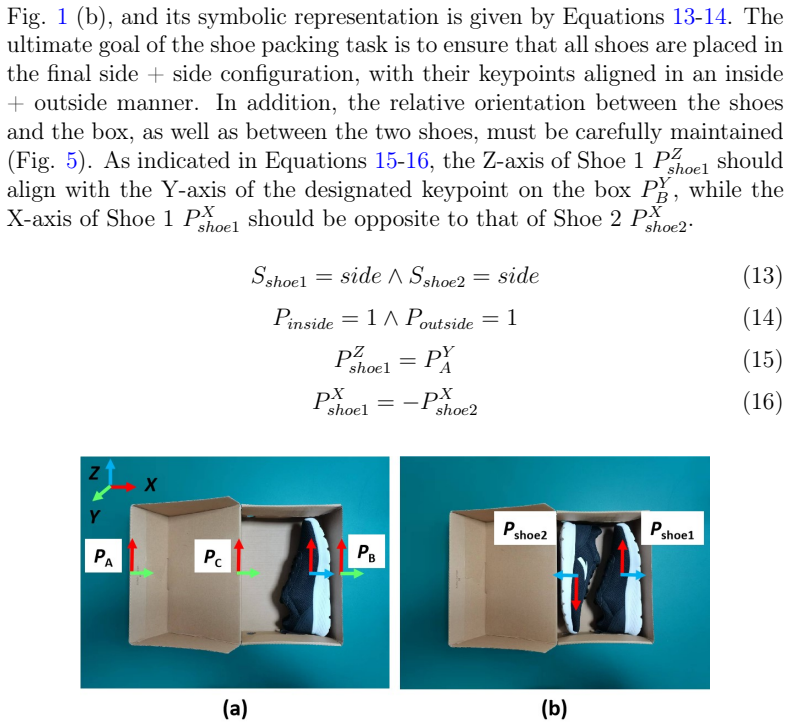
Summary. The paper proposes a complete robotic manipulation framework for packing pairs of shoes into a box from arbitrary initial states (top, side, bottom). Perception is built on YOLO object detection, a KeypointNet that detects five semantic keypoints, and geometric post-processing that infers shoe state, pose, and grasp pose. Reorientation is performed by a toppling primitive (Algorithm 1, Eqs. 7–12) and by a contact-based method that uses the box edge and gravity for top-state shoes. A task planner (Section 4.3) chooses state transitions to reach the standard side+side, inside+outside packing configuration defined by Eqs. (13)–(16). The paper reports real-robot experiments on four shoe types (sports, high-heeled, leather, sandal) with ten trials per initial-state combination, including perception accuracy, primitive success rates, contact-based reorientation success, and end-to-end packing success rates.
Significance. If the claims were fully supported, the paper would make a useful contribution to deformable and multi-object manipulation: it demonstrates that semantic keypoints plus intra-class geometric features can support state/pose estimation for objects with large shape variation, and it introduces an extrinsic box-edge reorientation primitive for a 3D deformable object. The authors provide publicly available code, real-robot experiments over four shoe types and seven initial combinations, and a transparent breakdown of success/failure causes. However, the headline claim that the framework 'can complete the packing of pairs of shoes in any initial state' is contradicted by the paper's own quantitative results, and the toppling model is a rigid-body model applied to deformable shoes. With the central claim narrowed and the model's limitations made explicit, the system integration and experimental study would still be of interest to the robotics packing community.
major comments (3)
- [Abstract and §5.4.2 (Table 7)] The abstract and Section 1 claim that the framework 'can complete the packing of pairs of shoes in any initial state'. Table 7 does not support this for the tested shoe types: high-heeled shoes succeed in only 4/10 for side+side (inside+outside) and 2/10 for side+side (inside+inside); the Group B averages range from 57.5% to 75%, based on only 10 trials per condition with no confidence intervals. Section 5.3.1 itself concedes that for high heels in a mispaired side+side configuration 'the robot may fail during reorientation'. Since 'any initial state' includes these configurations, the central claim is not established. I recommend replacing it with a clearly quantified claim about the tested conditions and success-rate ranges.
- [§4.2.1, Algorithm 1, Eqs. (7)–(12); Table 4] The toppling planner models the shoe as a rigid body rotating about the toppling edge, with angles computed only from shoe width/height W,H and gripper length. The text states that soft-gripper interference is essential for toppling deformable uppers, but this compliance/contact is not represented in the kinematic model. The failure pattern is consistent with this mismatch: high-heeled side2top succeeds only 1/10 due to over-rotation, and sandal bottom2side succeeds 8/10 due to elastic-upper over-rotation. Since toppling is the only mechanism for converting bottom states and mispaired side states, these failures propagate into the packing planner (Table 7). The model should be revised to include deformation/contact effects, or explicitly framed as an idealization whose validity for each shoe type is empirically bounded.
- [§5.3.2 and §5.4.1] The contact-based reorientation applies only to top-state shoes, and its success rate depends strongly on the offset (Table 5: 76–88% across shoes at 5–25 mm). The final system uses 'approximately 10 mm' and applies the method only to the second shoe, based on the same experiments used to select the offset. No held-out validation is provided. For sports shoes, Table 5 shows 6/10 at 10 mm but 10/10 at 25 mm, so the chosen offset is not clearly optimal even on the training data. The claim of an 'optimal packing strategy' in Section 1 is therefore not established; the authors should either validate the 10 mm/second-shoe choices on independent trials or present them as tuning choices without optimality claims.
minor comments (6)
- [§5.4.2] The text states that 'the success rate for the side+side (inside + outside) combination for high heels is only 2/10', but Table 7 reports 4/10 for that row and 2/10 for side+side (inside+inside). The text should be corrected to match the table.
- [§5.3.2] The text lists the matching box heights as '110, 90, 115, 115, and 110 mm' for four shoe types. Figure 9 shows four boxes with heights 110, 90, 115, and 110 mm. This appears to be a typographical error with five numbers instead of four.
- [§4.1.2, Eq. (3)] Lned is described as an 'average normalized 2D Euclidean distance', but no normalization term appears in Eq. (3). Please clarify whether normalization is by the toe–heel distance, image size, or another quantity.
- [§5.2.2] The keypoint position error is reported only as a single mean (0.01774) with no variance or per-state breakdown. Since the paper attributes many failure cases to inaccurate keypoint detection, a per-state error analysis would be more informative.
- [§4.2.1, Algorithm 1] The notation Ptop, Pinside, and Poutside is used in the algorithm but is not explicitly listed in the symbol definitions. Please define all variables, including the difference between Ptop (topline keypoint?) and the 'top' shoe state.
- [§4.1.3, Eq. (5)] The state-classification rule is ambiguous when multiple keypoints are absent. For example, if both Ptopline and Pinside are zero, both the 'side' and 'bottom' conditions are satisfied. A hierarchical definition or a decision tree would be clearer.
Circularity Check
No significant circularity; the one self-citation is not load-bearing, and the main limitation is over-claiming 'any initial state', not circular derivation.
full rationale
The paper's central derivation chain is empirical rather than circular. Perception (Section 4.1) is a supervised keypoint detector evaluated against manually annotated test keypoints/state/pose labels (Tables 1-3), which is standard external benchmarking, not a self-justifying definition. The toppling planner (Algorithm 1, Eqs. 7-12) is a rigid-body kinematic model whose angles are computed from measured shoe width/height; it is then tested for success/failure in Table 4. The model is not fitted to those success rates, so the successes are real predictions, and the failures (e.g., high-heeled side2top 1/10) are falsifying evidence. The contact-based method (Section 4.2.2) is similarly an open-loop primitive whose offset is varied experimentally (Table 5); choosing a 10 mm offset for the integrated system is parameter tuning, not a fitted quantity disguised as a prediction. The only self-citation [49] appears in box pose estimation ('Based on our previous work [49], both the minimum external rectangle and the convex hull are necessary'), and it supports a peripheral geometric detail rather than the central packing claim; it is not a uniqueness theorem or an ansatz import. The abstract's 'any initial state' claim is contradicted by the paper's own Group B results (Table 7, high-heeled side+side 4/10 and 2/10, and the concession in Section 5.3.1 that the robot 'may fail during reorientation' for high heels). That is a correctness/generalization limitation, not circularity: the failures are independent evidence against the strong claim, which is the opposite of a self-fulfilling derivation.
Assumptions & free parameters
free parameters (2)
- Loss weight alpha =
0.618
- Contact-reorientation offset =
~10 mm (second shoe)
assumptions (5)
- domain assumption Shoes have exactly three stable initial states: top, side, bottom.
- domain assumption In the side state the inside or outside keypoint is invisible; in the bottom state the topline keypoint is invisible.
- domain assumption The initial X-axis of the shoe is aligned with the camera X-axis.
- domain assumption Toppling can be modeled by rolling and settling phases with toppling edge parallel to shoe X-axis; center of mass above toppling edge for bottom state.
- domain assumption The final state after box-edge contact reorientation can be controlled by the offset amount.
Cite this review
Pith. "Pith review of Robotic Manipulation Framework Based on Semantic Keypoints for Packing Shoes of Different Sizes, Shapes, and Softness." pith.science (2026). https://pith.science/paper/7I7BNEIC
@misc{pith2026250906048,
  author       = {Pith},
  title        = {Pith review of: Robotic Manipulation Framework Based on Semantic Keypoints for Packing Shoes of Different Sizes, Shapes, and Softness},
  year         = {2026},
  howpublished = {\url{https://pith.science/paper/7I7BNEIC}},
  note         = {Machine review of arXiv:2509.06048}
}
read the original abstract
With the rapid development of the warehousing and logistics industries, the packing of goods has gradually attracted the attention of academia and industry. The packing of footwear products is a typical representative paired-item packing task involving irregular shapes and deformable objects. Although studies on shoe packing have been conducted, different initial states due to the irregular shapes of shoes and standard packing placement poses have not been considered. This study proposes a robotic manipulation framework, including a perception module, reorientation planners, and a packing planner, that can complete the packing of pairs of shoes in any initial state. First, to adapt to the large intraclass variations due to the state, shape, and deformation of the shoe, we propose a vision module based on semantic keypoints, which can also infer more information such as size, state, pose, and manipulation points by combining geometric features. Subsequently, we not only proposed primitive-based reorientation methods for different states of a single deformable shoe but also proposed a fast reorientation method for the top state using box edge contact and gravity, which further improved the efficiency of reorientation. Finally, based on the perception module and reorientation methods, we propose a task planner for shoe pair packing in any initial state to provide an optimal packing strategy. Real-world experiments were conducted to verify the robustness of the reorientation methods and the effectiveness of the packing strategy for various types of shoes. In this study, we highlight the potential of semantic keypoint representation methods, introduce new perspectives on the reorientation of 3D deformable objects and multi-object manipulation, and provide a reference for paired object packing.
Figures


Figures from the paper (8 more)



Reference graph
Works this paper leans on
-
[1]
Huang, Z
S. Huang, Z. Wang, J. Zhou, J. Lu, Planning irregular obje ct packing via hierarchical reinforcement learning, IEEE Robotics an d Automation Letters 8 (1) (2022) 81–88
2022
-
[2]
F. Wang, K. Hauser, Dense robotic packing of irregular an d novel 3d objects, IEEE Transactions on Robotics 38 (2) (2021) 1160–1 173
2021
-
[3]
Bahety, S
A. Bahety, S. Jain, H. Ha, N. Hager, B. Burchfiel, E. Cousin eau, S. Feng, S. Song, Bag all you need: Learning a generalizable bagging s trategy for 34 heterogeneous objects, in: 2023 IEEE/RSJ International Co nference on Intelligent Robots and Systems (IROS), IEEE, 2023, pp. 960– 967
2023
-
[4]
W. Ma, B. Zhang, L. Han, S. Huo, H. Wang, D. Navarro-Alarco n, Action planning for packing long linear elastic objects into compa ct boxes with bimanual robotic manipulation, IEEE/ASME Transactions on Mecha- tronics 28 (3) (2022) 1718–1729
2022
-
[5]
C. Pérez-Vidal, L. Gracia, J. de Paco, M. Wirkus, J. M. Azo rín, J. de Gea, Automation of product packaging for industrial ap plications, International Journal of Computer Integrated Manufacturi ng 31 (2) (2018) 129–137
work page 2018
- [6]
-
[7]
J. Lin, Z. Wei, Y. Zhang, K. Jia, Vi-net: Boosting categor y-level 6d object pose estimation via learning decoupled rotations on the spher- ical representations, in: Proceedings of the IEEE/CVF Inte rnational Conference on Computer Vision, 2023, pp. 14001–14011
work page 2023
-
[8]
X. Lin, W. Yang, Y. Gao, T. Zhang, Instance-adaptive and g eometric- aware keypoint learning for category-level 6d object pose e stimation, in: Proceedings of the IEEE/CVF Conference on Computer Visi on and Pattern Recognition, 2024, pp. 21040–21049
work page 2024
Show all 84 references
-
[9]
L. Zou, Z. Huang, N. Gu, G. Wang, Learning geometric consi stency and discrepancy for category-level 6d object pose estimati on from point clouds, Pattern Recognition 145 (2024) 109896
2024
-
[10]
A. S. Periyasamy, A. Amini, V. Tsaturyan, S. Behnke, Yol opose v2: Understanding and improving transformer-based 6d pose est imation, Robotics and Autonomous Systems 168 (2023) 104490
2023
-
[11]
Zhang, J
L. Zhang, J. Lu, S. Zheng, X. Zhao, X. Zhu, Y. Fu, T. Xiang, J. Feng, P. H. Torr, Vision transformers: From semantic segmentatio n to dense prediction, International Journal of Computer Vision (202 4) 1–21. 35
-
[12]
S. Amir, Y. Gandelsman, S. Bagon, T. Dekel, Deep vit feat ures as dense visual descriptors, arXiv preprint arXiv:2112.05814 2 (3) (2021) 4
2021 arXiv
-
[13]
Y. Liu, Z. Shen, Z. Lin, S. Peng, H. Bao, X. Zhou, Gift: Lea rning transformation-invariant dense visual descriptors via gr oup cnns, Ad- vances in Neural Information Processing Systems 32 (2019)
2019
-
[14]
Manuelli, W
L. Manuelli, W. Gao, P. Florence, R. Tedrake, kpam: Keyp oint affor- dances for category-level robotic manipulation, in: The In ternational Symposium of Robotics Research, Springer, 2019, pp. 132–15 7
2019
-
[15]
W. Gao, R. Tedrake, kpam-sc: Generalizable manipulati on planning using keypoint affordance and shape completion, in: 2021 IEE E Inter- national Conference on Robotics and Automation (ICRA), IEE E, 2021, pp. 6527–6533
2021
-
[16]
W. Gao, R. Tedrake, kpam 2.0: Feedback control for categ ory-level robotic manipulation, IEEE Robotics and Automation Letter s 6 (2) (2021) 2962–2969
2021
-
[17]
Fang, B.-R
X. Fang, B.-R. Huang, J. Mao, J. Shone, J. B. Tenenbaum, T . Lozano- Pérez, L. P. Kaelbling, Keypoint abstraction using large mo dels for object-relative imitation learning, arXiv preprint arXiv :2410.23254 (2024)
2024 arXiv
-
[18]
Y. Deng, D. Hsu, General-purpose clothes manipulation with semantic keypoints, arXiv preprint arXiv:2408.08160 (2024)
2024 arXiv
-
[19]
Sundaresan, S
P. Sundaresan, S. Belkhale, D. Sadigh, J. Bohg, Kite: Ke ypoint- conditioned policies for semantic manipulation, arXiv pre print arXiv:2306.16605 (2023)
2023 arXiv
-
[20]
Z. Luo, W. Xue, J. Chae, G. Fu, Skp: Semantic 3d keypoint d etection for category-level robotic manipulation, IEEE Robotics an d Automation Letters 7 (2) (2022) 5437–5444
2022
-
[21]
Robson, M
M. Robson, M. Sridharan, A keypoint-based object repre sentation for generating task-specific grasps, in: 2022 IEEE 18th Interna tional Con- ference on Automation Science and Engineering (CASE), IEEE , 2022, pp. 374–381. 36
2022
-
[22]
J. Wang, S. Lin, C. Hu, Y. Zhu, L. Zhu, Learning semantic k eypoint representations for door opening manipulation, IEEE Robot ics and Au- tomation Letters 5 (4) (2020) 6980–6987
2020
-
[23]
Huang, C
W. Huang, C. Wang, Y. Li, R. Zhang, L. Fei-Fei, Rekep: Spa tio- temporal reasoning of relational keypoint constraints for robotic ma- nipulation, arXiv preprint arXiv:2409.01652 (2024)
2024 arXiv
-
[24]
F. Liu, K. Fang, P. Abbeel, S. Levine, Moka: Open-vocabu lary robotic manipulation through mark-based visual prompting, in: Fir st Workshop on Vision-Language Models for Navigation and Manipulation at ICRA 2024, 2024
2024
-
[25]
Xu, F.-J
R. Xu, F.-J. Chu, C. Tang, W. Liu, P. A. Vela, An affordance keypoint detection network for robot manipulation, IEEE Robotics an d Automa- tion Letters 6 (2) (2021) 2870–2877
2021
-
[26]
Z. Qin, K. Fang, Y. Zhu, L. Fei-Fei, S. Savarese, Keto: Le arning key- point representations for tool manipulation, in: 2020 IEEE International Conference on Robotics and Automation (ICRA), IEEE, 2020, p p. 7278– 7285
2020
-
[27]
P. Xu, H. Cheng, J. Wang, M. Q.-H. Meng, Learning to reori ent objects with stable placements afforded by extrinsic supports, IEEE Transac- tions on Automation Science and Engineering (2023)
2023
-
[28]
U. A. Mishra, Y. Chen, Reorientdiff: Diffusion model base d reorientation for object manipulation, in: 2024 IEEE International Confe rence on Robotics and Automation (ICRA), IEEE, 2024, pp. 10867–1087 3
2024
-
[29]
K. Wada, S. James, A. J. Davison, Reorientbot: Learning object reori- entation for specific-posed placement, in: 2022 Internatio nal Conference on Robotics and Automation (ICRA), IEEE, 2022, pp. 8252–825 8
2022
-
[30]
K. Xu, H. Yu, R. Huang, D. Guo, Y. Wang, R. Xiong, Efficient o bject manipulation to an arbitrary goal pose: Learning-based any time pri- oritized planning, in: 2022 International Conference on Ro botics and Automation (ICRA), IEEE, 2022, pp. 7277–7283. 37
2022
-
[31]
Shome, W
R. Shome, W. N. Tang, C. Song, C. Mitash, H. Kourtev, J. Yu , A. Boularias, K. E. Bekris, Towards robust product packing w ith a mini- malistic end-effector, in: 2019 International Conference o n Robotics and Automation, IEEE, 2019, pp. 9007–9013
2019
-
[32]
W. Wan, K. Harada, Reorientating objects with a grippin g hand and a table surface, in: 2015 IEEE-RAS 15th International Confe rence on Humanoid Robots (Humanoids), IEEE, 2015, pp. 101–106
2015
-
[33]
T. Chen, M. Tippur, S. Wu, V. Kumar, E. Adelson, P. Agrawa l, Vi- sual dexterity: In-hand dexterous manipulation from depth , in: Icml workshop on new frontiers in learning, control, and dynamic al systems, 2023
2023
-
[34]
T. Chen, J. Xu, P. Agrawal, A system for general in-hand o bject re- orientation, in: Conference on Robot Learning, PMLR, 2022, pp. 297– 307
2022
-
[35]
M. V. Vieira, F. Ferreira, J. C. Duque, R. M. Almeida, On t he packing process in a shoe manufacturer, Journal of the Operational R esearch Society 72 (4) (2021) 853–864
2021
-
[36]
Morales, F
R. Morales, F. J. Badesa, N. García-Aracil, R. Bormann, J. Fis- cher, B. Graf, Bimanual robot manipulation and packaging of shoes in footwear industry, in: ROBOT2013: First Iberian Robotics C onference: Advances in Robotics, Vol. 1, Springer, 2014, pp. 315–329
2014
-
[37]
Balatti, M
P. Balatti, M. Leonori, A. Ajoudani, A flexible and colla borative ap- proach to robotic box-filling and item sorting, Robotics and Autonomous Systems 146 (2021) 103888
2021
-
[38]
Tresca, G
G. Tresca, G. Cavone, R. Carli, A. Cerviotti, M. Dotoli, Automat- ing bin packing: A layer building matheuristics for cost effe ctive logis- tics, IEEE Transactions on Automation Science and Engineer ing 19 (3) (2022) 1599–1613
2022
-
[39]
Agarwal, S
M. Agarwal, S. Biswas, C. Sarkar, S. Paul, H. S. Paul, Jam packer: An efficient and reliable robotic bin packing system for cuboid o bjects, IEEE Robotics and Automation Letters 6 (2) (2020) 319–326. 38
2020
-
[40]
S. Yang, S. Song, S. Chu, R. Song, J. Cheng, Y. Li, W. Zhang , Heuristics integrated deep reinforcement learning for online 3d bin pa cking, IEEE Transactions on Automation Science and Engineering 21 (1) ( 2023) 939– 950
2023
-
[41]
J. Jia, H. Shang, X. Chen, Robot online 3d bin packing str ategy based on deep reinforcement learning and 3d vision, in: 2022 IEEE Int ernational Conference on Networking, Sensing and Control (ICNSC), IEE E, 2022, pp. 1–6
2022
-
[42]
H. Zhao, C. Zhu, X. Xu, H. Huang, K. Xu, Learning practica lly feasible policies for online 3d bin packing, Science China Informati on Sciences 65 (1) (2022) 112105
2022
-
[43]
Z. Zhou, Z. Zhang, K. Xie, X. Zhu, H. Huang, Q. Cao, A metho d of tight placement for robotic dense packing, in: 2022 Internationa l Conference on Advanced Robotics and Mechatronics (ICARM), IEEE, 2022, pp. 707–712
2022
-
[44]
F. Wang, K. Hauser, Robot packing with known items and no ndeter- ministic arrival order, IEEE Transactions on Automation Sc ience and Engineering 18 (4) (2020) 1901–1915
2020
-
[45]
Shome, W
R. Shome, W. N. Tang, C. Song, C. Mitash, H. Kourtev, J. Yu , A. Boularias, and K. E. Be, Tight robot packing in the real world : A complete manipulation pipeline with robust primitives, ar Xiv preprint arXiv:1903.00984 (2019)
1903 arXiv
-
[46]
M. M. Mojtahedi, A. Mohammadi, M. T. Masouleh, Experime ntal study on autonomous food packaging with delta parallel robot and t wo fingered gripper, in: 2024 32nd International Conference on Electri cal Engineer- ing (ICEE), IEEE, 2024, pp. 1–6
2024
-
[47]
F. Wang, K. Hauser, Stable bin packing of non-convex 3d o bjects with a robot manipulator, in: 2019 International Conference on Ro botics and Automation (ICRA), IEEE, 2019, pp. 8698–8704
2019
-
[48]
L. Y. Chen, B. Shi, D. Seita, R. Cheng, T. Kollar, D. Held, K. Goldberg, Autobag: Learning to open plastic bags and insert objects, i n: 2023 IEEE International Conference on Robotics and Automation ( ICRA), IEEE, 2023, pp. 3918–3925. 39
2023
-
[49]
Y. Dong, J. Duan, Y. Liu, Z. Dai, P. Manoonpong, Robotic s hoe pack- aging strategies based on a single soft-gripper system and e xtrinsic re- sources, in: 2023 International Conference on Advanced Rob otics and Mechatronics (ICARM), IEEE, 2023, pp. 469–475
2023
-
[50]
B. Ai, S. Tian, H. Shi, Y. Wang, C. Tan, Y. Li, J. Wu, Robopa ck: Learn- ing tactile-informed dynamics models for dense packing, ar Xiv preprint arXiv:2407.01418 (2024)
2024 arXiv
-
[51]
W. Wan, H. Igawa, K. Harada, H. Onda, K. Nagata, N. Yamano be, A regrasp planning component for object reorientation, Aut onomous Robots 43 (2019) 1101–1115
2019
-
[52]
Z. Xue, Z. Yuan, J. Wang, X. Wang, Y. Gao, H. Xu, Useek: Uns u- pervised se (3)-equivariant 3d keypoints for generalizabl e manipulation, in: 2023 IEEE International Conference on Robotics and Auto mation (ICRA), IEEE, 2023, pp. 1715–1722
2023
-
[53]
S. Huo, A. Duan, C. Li, P. Zhou, W. Ma, H. Wang, D. Navarro- Alarcon, Keypoint-based planar bimanual shaping of deformable line ar objects under environmental constraints with hierarchical action framework, IEEE Robotics and Automation Letters 7 (2) (2022) 5222–5229
2022
-
[54]
K. Riou, K. Dong, K. Subrin, Y. Sun, P. Le Callet, From tem poral- evolving to spatial-fixing: A keypoints-based learning par adigm for vi- sual robotic manipulation, in: 2023 IEEE/RSJ Internationa l Conference on Intelligent Robots and Systems (IROS), IEEE, 2023, pp. 17 28–1734
2023
-
[55]
X. Li, S. Huang, Q. Yu, Z. Jiang, C. Hao, Y. Zhu, H. Li, P. Ga o, C. Lu, Skt: Integrating state-aware keypoint trajectories with vision- language models for robotic garment manipulation, arXiv pr eprint arXiv:2409.18082 (2024)
2024 arXiv
-
[56]
T. Mack, K. Zhang, K. Althoefer, A soft robotic gripper w ith active palm for in-hand object reorientation, arXiv preprint arXi v:2307.13657 (2023)
2023 arXiv
-
[57]
T. Chen, J. Xu, P. Agrawal, A simple method for complex in -hand manipulation, in: 5th Annual Conference on Robot Learning ( CoRL), Vol. 2, 2021, p. 16. 40
2021
-
[58]
V. P. da Fonseca, T. E. A. de Oliveira, K. Eyre, E. M. Petri u, Stable grasping and object reorientation with a three-fingered rob otic hand, in: 2017 IEEE international symposium on robotics and intellig ent sensors (IRIS), IEEE, 2017, pp. 311–317
2017
-
[59]
N. C. Dafle, A. Rodriguez, R. Paolini, B. Tang, S. S. Srini vasa, M. Erd- mann, M. T. Mason, I. Lundberg, H. Staab, T. Fuhlbrigge, Extr insic dexterity: In-hand manipulation with external forces, in: 2014 IEEE International Conference on Robotics and Automation (ICRA ), IEEE, 2...
2014
-
[60]
Tournassoud, T
P. Tournassoud, T. Lozano-Pérez, E. Mazer, Regrasping , in: Proceed- ings. 1987 IEEE international conference on robotics and au tomation, Vol. 4, IEEE, 1987, pp. 1924–1928
1987
-
[61]
K. M. Lynch, M. T. Mason, Stable pushing: Mechanics, con trollabil- ity, and planning, The international journal of robotics re search 15 (6) (1996) 533–556
1996
-
[62]
R. C. Brost, Planning robot grasping motions in the pres ence of uncer- tainty, Carnegie-Mellon University, The Robotics Inst itu te, 1985
1985
-
[63]
Aiyama, M
Y. Aiyama, M. Inaba, H. Inoue, Pivoting: A new method of g rasp- less manipulation of object by robot fingers, in: Proceeding s of 1993 IEEE/RSJ International Conference on Intelligent Robots a nd Systems (IROS’93), Vol. 1, IEEE, 1993, pp. 136–143
1993
-
[64]
K. M. Lynch, Toppling manipulation, in: Proceedings 19 99 IEEE Inter- national Conference on Robotics and Automation, Vol. 4, IEE E, 1999, pp. 2551–2557
1999
-
[65]
M. A. Farooqi, T. Omata, Reorientation planning for a mu ltifingered hand based on an orientation states network using regrasp pr imitives, Advanced robotics 11 (5) (1996) 541–554
1996
-
[66]
Omata, M
T. Omata, M. A. Farooqi, Reorientation planning for a mu ltifingered hand based on orientation states network using regrasp prim itives, in: Proceedings of the 1997 IEEE/RSJ International Conference on Intelli- gent Robot and Systems. Innovative Robotics for Real-World Applica-...
1997
-
[67]
Nguyen, D
A. Nguyen, D. Kanoulas, D. G. Caldwell, N. G. Tsagarakis , Prepara- tory object reorientation for task-oriented grasping, in: 2016 IEEE/RSJ International Conference on Intelligent Robots and System s (IROS), IEEE, 2016, pp. 893–899
2016
-
[68]
Y. Hou, Z. Jia, M. T. Mason, Fast planning for 3d any-pose -reorienting using pivoting, in: 2018 IEEE International Conference on R obotics and Automation (ICRA), IEEE, 2018, pp. 1631–1638
2018
-
[69]
S. M. Kristek, D. A. Shell, Orienting deformable polygo nal parts with- out sensors, in: 2012 IEEE/RSJ International Conference on Intelligent Robots and Systems, IEEE, 2012, pp. 973–979
2012
-
[70]
C.-Y. Wang, A. Bochkovskiy, H.-Y. M. Liao, Scaled-YOLO v4: Scaling cross stage partial network, in: Proceedings of the IEEE/CV F Confer- ence on Computer Vision and Pattern Recognition, 2021, pp. 1 3029– 13038
2021
-
[71]
K. He, X. Zhang, S. Ren, J. Sun, Deep residual learning fo r image recognition, in: Proceedings of the IEEE conference on comp uter vision and pattern recognition, 2016, pp. 770–778
2016
-
[72]
Srivastava, G
N. Srivastava, G. Hinton, A. Krizhevsky, I. Sutskever, R. Salakhutdinov, Dropout: a simple way to prevent neural networks from overfit ting, The journal of machine learning research 15 (1) (2014) 1929–195 8
2014
-
[73]
N. E. Khalifa, M. Loey, S. Mirjalili, A comprehensive su rvey of recent trends in deep learning for digital images augmentation, Ar tificial Intel- ligence Review (2022) 1–27
2022
-
[74]
Y. Ma, D. Yu, T. Wu, H. Wang, Paddlepaddle: An open-sourc e deep learning platform from industrial practice, Frontiers of D ata and Dom- puting 1 (1) (2019) 105–115
2019
-
[75]
R. Bi, T. Xu, M. Xu, E. Chen, Paddlepaddle: A production- oriented deep learning platform facilitating the competency of ente rprises, in: 2022 IEEE 24th Int Conf on High Performance Computing & Commu ni- cations; 8th Int Conf on Data Science & Systems; 20th Int Conf on Smart ...
2022
-
[76]
Y. Lin, J. Tremblay, S. Tyree, P. A. Vela, S. Birchfield, S ingle-stage keypoint- based category-level object pose estimation fro m an rgb image, in: 2022 International Conference on Robotics and Automati on, 2022, pp. 1547–1553. doi:10.1109/ICRA46639.2022.9812299
2022
-
[77]
Zhang, K
R. Zhang, K. Gupta, Automatic orienting of polyhedra th rough step de- vices, in: Proceedings. 1998 IEEE International Conferenc e on Robotics and Automation, Vol. 1, IEEE, 1998, pp. 550–556
1998
-
[78]
Ahmadyan, L
A. Ahmadyan, L. Zhang, A. Ablavatski, J. Wei, M. Grundma nn, Objec- tron: A large scale dataset of object-centric videos in the w ild with pose annotations, in: Proceedings of the IEEE/CVF conference on computer vision and pattern recognition, 2021, pp. 7822–7831
2021
-
[79]
Zitkovich, T
B. Zitkovich, T. Yu, S. Xu, P. Xu, T. Xiao, F. Xia, J. Wu, P. Wohlhart, S. Welker, A. Wahid, et al., Rt-2: Vision-language-action m odels trans- fer web knowledge to robotic control, in: Conference on Robo t Learning, PMLR, 2023, pp. 2165–2183
2023
-
[80]
Y. Ma, Z. Song, Y. Zhuang, J. Hao, I. King, A survey on visi on-language- action models for embodied ai, arXiv preprint arXiv:2405.1 4093 (2024)
2024
-
[81]
M. J. Kim, K. Pertsch, S. Karamcheti, T. Xiao, A. Balakri shna, S. Nair, R. Rafailov, E. Foster, G. Lam, P. Sanketi, et al., Openvla: A n open- source vision-language-action model, arXiv preprint arXi v:2406.09246 (2024)
2024 arXiv
-
[82]
Astanin, D
S. Astanin, D. Antonelli, P. Chiabert, C. Alletto, Refle ctive work- piece detection and localization for flexible robotic cells , Robotics and Computer-Integrated Manufacturing 44 (2017) 190–198
2017
-
[83]
T. Weng, A. Pallankize, Y. Tang, O. Kroemer, D. Held, Mul ti-modal transfer learning for grasping transparent and specular ob jects, IEEE Robotics and Automation Letters 5 (3) (2020) 3791–3798
2020
-
[84]
T. Sun, G. Zhang, W. Yang, J.-H. Xue, G. Wang, Trosd: A new rgb- d dataset for transparent and reflective object segmentatio n in prac- tice, IEEE Transactions on Circuits and Systems for Video Te chnology 33 (10) (2023) 5721–5733. 43
2023
Reviewed August 5, 2026 · model on record in the stance chip above.
Discussion (0). Sign in to comment.