REVIEW 4 major objections 5 minor 103 references
Tracing Galaxy Evolution in infalling galaxies of Abell 496: From Starburst to Quenching
T0 review · 4 major / 5 minor · reviewed 2026-08-07 · deepseek-v4-flash
Pith's one-line read Infalling late-type galaxies in Abell 496 pass through five stages — pre-triggering, starburst, peak, fading, quenching — in a few times 10^8 yr, with ram pressure driving massive galaxies and tides driving low-mass ones.
desk verdict New FUV data for A496 are solid, but the five-stage evolutionary sequence is a post-hoc narrative not supported by the tabulated sSFR values. read the letter →
The pith
A machine-rendered reading of the paper's core claim, the machinery that carries it, and where it could break.
The reading
What carries the argument
The load-bearing machinery is the pairing of FUV emission with HI imaging, read against a projected phase-space diagram (line-of-sight velocity versus projected cluster-centric radius). FUV traces recent star formation through young massive stars; HI traces the cold gas that fuels it and that environmental processes strip away. The projected phase-space diagram divides the cluster into infalling, virialized, ram-pressure-stripped, and backsplash regions, letting the authors assign each galaxy an infall time and interpret its FUV morphology and HI disruption code as a stage along a single evolutionary track. Combining these two tracers turns 22 snapshot images into a proposed timeline.
What would settle it
A direct test is to measure resolved HI kinematics and optical velocities for the 22 galaxies to identify backsplash or pre-processed members: if a 'stage 1' galaxy projected near the core has already passed pericenter, the monotonic ordering fails. A simpler check is to compare each galaxy's assigned stage with its infall time inferred from the projected phase-space zones; later stages should show longer infall times, and a sample-level mismatch would falsify the quoted few-times-$10^{8}$ yr timescale.
Extended reading notes
Core claim
The paper's central discovery is an evolutionary sequence for infalling late-type galaxies in Abell 496, read off from the combined FUV and HI properties of 22 cluster members. In the authors' picture, a normal gas-rich spiral enters the cluster, gets its star formation triggered (stage 2), reaches a peak of star formation with strong FUV asymmetries and HI disruption (stage 3), fades while the HI becomes deficient (stage 4), and finally drops below the main sequence into quenching (stage 5). The sequence is proposed to last a few times $10^{8}$ yr, and it splits by stellar mass: galaxies above $10^{9}$ M_sun with high specific star formation rates have no close companions and are attributed mainly to ram pressure stripping, while most low-mass objects have companions and are attributed mainly to tidal interactions. The authors emphasize that most FUV galaxies still retain significant HI, so the gas depletion is in its early stages and the infall is recent.
Load-bearing premise
The five-stage sequence stands or falls on the assumption that these 22 galaxies are first-infall objects caught at different moments of one monotonic path; if some are backsplash, group-pre-processed, or viewed at misleading projection angles, the ordering and the few-times-$10^{8}$ yr timescale do not follow.
Editorial extensions
If this is right
- According to the paper, the transformation from normal gas-rich spiral to gas-poor, red, passive object in a cluster like A496 can happen in a few times 10^8 yr, much faster than the cluster's dynamical timescale.
- Massive FUV galaxies in late stages having no close companions implies ram pressure stripping is the dominant agent for galaxies above about 10^9 M_sun.
- Low-mass FUV galaxies mostly having companions implies tidal interactions, possibly pre-processing, are the dominant trigger for star formation in dwarfs.
- The presence of blue, HI-rich galaxies projected near the cluster core implies A496 is being fed by fresh, gas-rich galaxies falling in from the foreground along the line of sight.
- Since most FUV galaxies still have substantial HI, the paper concludes that gas depletion is in its early stages and most of the sample has not yet reached first pericenter.
Reading between the lines
- If the sequence is generic, the same FUV-plus-HI snapshot method could be applied cluster by cluster to build a statistical clock for environmental quenching, with each stage's duration testable by fitting stellar populations in larger samples.
- The paper's mass split implies a boundary near 10^9 M_sun: above it the cluster's hot gas wins, below it gravity wins; whether that boundary shifts with cluster mass or gas density is an extension the paper does not test.
- Because the UVIT fields were chosen where blue galaxies are common, the sample is not cluster-representative; a full-volume FUV survey would show whether stage-5 objects are truly rare or just outside the observed fields.
- The prominence of FUV-peculiar but HI-normal galaxies suggests the star-formation response to infall precedes detectable gas removal; comparing young-star indicators with HI deficiency in individual galaxies could test this sequence of events.
Editorial analysis
A structured set of objections, weighed in public.
Referee Report
Summary. The paper presents FUV imaging from UVIT-AstroSat and HI data from the VLA for 22 late-type galaxies in the central region of the cluster Abell 496. The authors derive FUV-based SFRs and sSFRs, classify the galaxies by HI and FUV morphology, place them in projected phase space, search for close companions, and propose a five-stage evolutionary sequence from pre-triggering to SF-quenching, with a total timescale of a few times 10^8 yr and a mass-dependent split between ram-pressure stripping and tidal interactions. The observational material is new and the photometric and statistical steps are generally careful, but the central evolutionary-sequence claim rests on a visual, non-quantitative assignment of galaxies to stages in Section 4.2, and the quoted timescale is imported from literature arguments rather than measured from the sample.
Significance. If the five-stage sequence and its short timescale were established, this would be a valuable contribution to our understanding of how infalling cluster galaxies are transformed from star-forming late types to quenched objects, and it would strengthen the case for a mass-dependent competition between ram-pressure stripping and tidal interactions. The paper has genuine strengths: it provides the first UV imaging of A496, uses two independent aperture methods for photometry, applies extinction and K-corrections, supports the high-sSFR excess with a binomial test, supports the velocity asymmetry with a shuffling test, and uses conservative companion criteria. However, the central interpretive layer is not yet quantitatively supported: the stage assignments in Table 3 do not follow from the tabulated sSFR, HI, and morphological parameters, and no ordering test is presented. The claimed few-times-10^8 yr timescale therefore currently functions as an assumption rather than a measured outcome.
major comments (4)
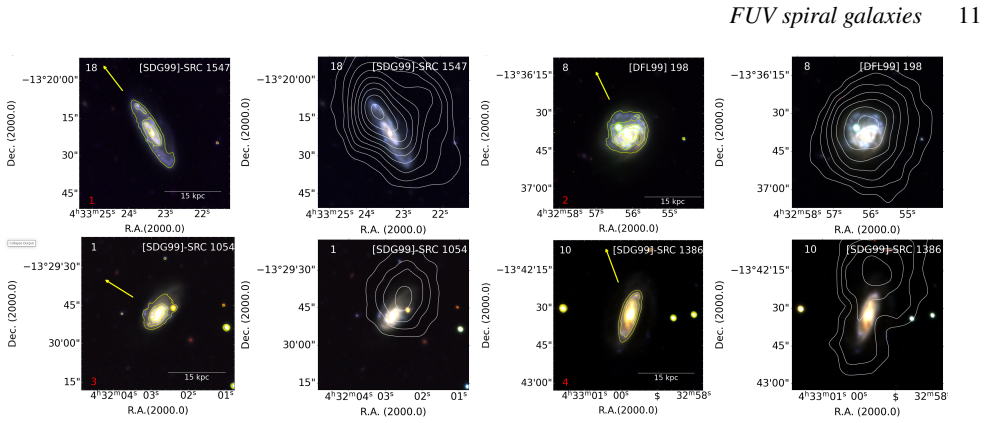
- [4.2 / Table 3] The five-stage evolutionary sequence is the central claim, but the stage assignments in Table 3, column 16, are not derivable from the quantitative columns 10-14. Section 4.2 defines the stages in prose without thresholds or ordering criteria, and the assigned stages are inconsistent with the tabulated sSFR values: ID 21 is placed in stage 4 ('SF-fading') while having log(sSFR_FUV) = -8.1, the highest specific star-formation rate in the entire sample, while ID 5, with log(sSFR_FUV) = -8.4, is placed in stage 2. ID 16 is the sole stage 5 object, with log(sSFR_FUV) = -10.8, but the text gives no quantitative criterion for this placement and notes only that it is too faint in FUV and HI to be displayed. No rank test (for example, Spearman correlation between stage number and sSFR, HI-deficiency, or FUV morphological class) is presented. Without such a test, the ordering is a post-hoc narrative; the table as it stands is equally compatible with a non-monotonic or heterogeneous population.
- [4.2 / Section 5] The quoted timescale of 'a few times 10^8 yr' is not measured from the A496 sample. Section 4.2 reasons that because most FUV galaxies retain fairly normal HI content and because literature starburst and HI-stripping timescales are of order 10^8 to several 10^8 yr, this constitutes a reasonable upper limit to the infall time. Even if the stage ordering were valid, this argument assumes a homogeneous first-infall history and that HI depletion begins at stage 1. The paper itself notes in Section 4.1 that the small sample cannot distinguish first infallers from backsplash or pre-processed galaxies, and Section 5 concedes that the UVIT fields were selected ad hoc and are not representative of the cluster. The timescale is therefore an assumption imported from external studies, not a result of this analysis, and it should be presented as such or supported by orbital modeling or simulation comparison.
- [4.1 / 4.2] The central claim that the 22 galaxies trace a single, monotonic first-infall evolutionary path is not protected against alternative orbital histories. Section 4.1 states that the sample cannot resolve whether the blue, HI-rich objects projected near the core are truly first infallers along the line of sight, and that the infall hypothesis is 'not totally supported' by the Mahajan et al. (2011) simulations. The PPS zones used in Figure 8 have broad, overlapping infall-time distributions (Table 4), so a galaxy's position does not uniquely determine its time since infall. Under these conditions, the five-stage sequence can absorb a heterogeneous mix of projection angles, backsplash orbits, and group-preprocessed galaxies. The data are consistent with an unordered collection of galaxies at different orbital phases; the authors should either restrict the claim to a phenomenological morphological sequence or provide a quantitative test that separates first infallers from other histories.
- [4.3] The mass-dependent split between ram-pressure stripping and tidal interactions is based on a small and partially contradictory subsample. Section 4.3 reports that eleven of the 22 FUV galaxies have a close companion, with isolated objects preferentially among the massive galaxies and companions preferentially among low-mass galaxies. However, the two lowest-mass, highest-sSFR galaxies (IDs 5 and 21) explicitly do not follow this trend, and the companion search uses conservative thresholds (100 kpc, 500 km/s) that exclude fast flybys, as the authors acknowledge for the possible neighbor of ID 9 at 700 km/s. With n = 22 and the acknowledged exceptions, the statistical separation between the two channels is marginal; binomial confidence intervals on the 11/22 fraction and on the mass-dependence contrast are needed before the claim that 'pre-processing does not appear to play a major role' for massive galaxies can be evaluated.
minor comments (5)
- [Abstract / Section 2.1] The abstract contains a typo ('conduted' for 'conducted'), and the first sentence of the Introduction uses 'experiment' where 'experience' is meant; 'BGC' in Section 2.1 should be 'BCG'.
- [Table 3] The table header for column (15) is printed as 'olumn (15)'; also, the stage numbers in the last column are not defined in the table caption, requiring the reader to consult Section 4.2.
- [4.2] The subsection heading 'Infering the orbital histories' should be 'Inferring the orbital histories'.
- [Equation (2)] Equation (2) has mismatched parentheses: Flux[Jy] = 10^{(m(AB)_corr - 8.9)/2.5} should be written with a consistent bracketing structure.
- [Figure 9 / Figure A1] The captions state that evolutionary stage numbers are indicated in red in the bottom-left corner, but the only stage-5 object, ID 16, is deliberately not displayed because it is too faint; this should be stated explicitly in the caption of Figure 9.
Circularity Check
Mild self-definitional element in the five-stage sequence; no load-bearing circularity.
-
self definitional
[Section 4.2, 'Evolutionary sequence from star forming to quenching'; Table 3, column (16)]
"Considering the FUV and HI properties of the studied sample we propose an evolutionary pathway consisting of five steps. (1) Pre-triggering: galaxies display normal HI and their SFR remains close to the main sequence."
The five stages are defined by the same FUV/SFR and HI observables that are later used to assign each object a stage in Table 3, column (16): stage 2 requires the FUV luminosity to rise and only minor HI perturbations; stage 4 requires the SFR to fade and the HI to appear disrupted; stage 5 is assigned to the one object that is faint in FUV and HI-deficient. The ordered list is then presented as an 'evolutionary sequence' lasting 'a few times 10^8 yr', with the timescale imported from literature rather than measured from the sample. Thus the chronological ordering is largely a re-description of the input classifications instead of a test against an independent dynamical clock.
full rationale
The central five-stage sequence is built from the same FUV and HI properties that define the stages, so the evolutionary ordering is partly self-referential: the paper proposes a time-ordered path and then assigns galaxies to that path using the same morphology and gas-deficiency indicators. This is a mild self-definitional element rather than a quantitative circular derivation, because no equation forces the result and the paper does not claim to predict an independent quantity from a fitted parameter. The main physical dichotomy, ram-pressure stripping versus tidal interactions, is supported by independent proxies: companion counts within 100 kpc and |Delta v| < 500 km/s, stellar mass cuts, and r-band asymmetry residuals. The self-citations to LG22 provide the HI catalog, cluster parameters, and the RPS anchoring pressure; those are data and measurements with independent content, not an unverified theorem on which the conclusion uniquely rests. The paper itself flags its limitations, including the small sample and the inability to distinguish true first infallers from projection effects (Section 4.1) and the ad-hoc field selection (Section 5). These are interpretive and statistical concerns, not circularity. Overall, no load-bearing circular step was found; the score reflects only the descriptive, self-referential construction of the five-stage taxonomy.
Assumptions & free parameters
free parameters (4)
- Stellar mass threshold for low-mass vs. massive galaxies =
log(M*/Msun) = 9.0
- Companion search projected separation =
100 kpc
- Companion search velocity window =
|dv| <= 500 km/s
- sSFR threshold for high star-formation activity =
log(sSFR) = -9.7 yr^-1 (0.2 Gyr^-1)
assumptions (4)
- domain assumption The observed diversity in FUV morphology and HI structure among the 22 galaxies represents different phases of a single temporal sequence, rather than a set of unrelated physical states.
- domain assumption FUV luminosity converted to SFR using the Salim et al. (2007) calibration with the Chabrier IMF correctly traces recent star formation.
- domain assumption The projected phase-space infall times and zone boundaries from Pasquali et al. (2019) and Mahajan et al. (2011) are valid for Abell 496.
- domain assumption The Chabrier IMF and the adopted LCDM cosmology (Omega_m=0.3, Omega_Lambda=0.7, H0=70) are assumed.
Cite this review
Pith. "Pith review of Tracing Galaxy Evolution in infalling galaxies of Abell 496: From Starburst to Quenching." pith.science (2026). https://pith.science/paper/7IKIGEKY
@misc{pith2026250521983,
  author       = {Pith},
  title        = {Pith review of: Tracing Galaxy Evolution in infalling galaxies of Abell 496: From Starburst to Quenching},
  year         = {2026},
  howpublished = {\url{https://pith.science/paper/7IKIGEKY}},
  note         = {Machine review of arXiv:2505.21983}
}
abstract
During the fall of late-type galaxies into clusters, they can experiment a variety of evolutionary mechanisms according their local environment. Consequently, studying the UV emission and the cold gas of late-type galaxies provide key insights in the evolution of short-lived starburst and galaxy quenching. In this work, we conduted a study of two 28' fields observed with UVIT-AstroSat in the central region of the Abell cluster A496 ($z=0.033$), including HI, data from NRAO VLA. We reported 22 cluster members detected in FUV; all of them are detected in HI, or have upper limits for the HI-mass. We find our FUV detected galaxies generally have higher specific star formation rates than other star forming galaxies. Most of the FUV galaxies with masses above 10$^9 \mathrm{M}_{\odot}$,and showing high sSFR have no close neighbors, pointing at RPS as the dominant mechanism affecting them. In contrast, most of the low-mass FUV objects present at least one companion, suggesting that tidal interactions also play an important role in the triggering of infalling galaxies. Combining the FUV-SFR with the HI properties of the observed galaxies in A496 we identify an evolutionary sequence consisting of five stages: (1) Pre-triggering, (2) Initial SF-triggering, (3) Peak of star-formation, (4) SF-fading, and (5) SF-quenching. During this path, normal gas-rich objects reach a gas-deficiency phase with SFR well below the main sequence. This process, prior to becoming a full passive galaxy, can be accomplished within a few 10$^{8}$ yr.
Figures


Figures from the paper (6 more)




Reference graph
Works this paper leans on
-
[1]
write newline
" write newline "" before.all 'output.state := FUNCTION fin.entry write newline FUNCTION new.block output.state before.all = 'skip after.block 'output.state := if FUNCTION new.sentence output.state after.block = 'skip output.state before.all = 'skip after.sentence 'output.state := if if FUNCTION not #0 #1 if FUNCTION and 'skip pop #0 if FUNCTION or pop #1...
-
[2]
Balogh M. L., Morris S. L., Yee H. K. C., Carlberg R. G., Ellingson E., 1997, @doi [ ] 10.1086/310927 , https://ui.adsabs.harvard.edu/abs/1997ApJ...488L..75B 488, L75
doi:10.1086/310927 1997
-
[3]
Balogh M. L., Baldry I. K., Nichol R., Miller C., Bower R., Glazebrook K., 2004, @doi [ ] 10.1086/426079 , https://ui.adsabs.harvard.edu/abs/2004ApJ...615L.101B 615, L101
doi:10.1086/426079 2004
-
[4]
Barnes J. E., Hernquist L., 1992, @doi [ ] 10.1146/annurev.aa.30.090192.003421 , https://ui.adsabs.harvard.edu/abs/1992ARA&A..30..705B 30, 705
arXiv 1992
-
[5]
Barsanti S., et al., 2018, @doi [ ] 10.3847/1538-4357/aab61a , https://ui.adsabs.harvard.edu/abs/2018ApJ...857...71B 857, 71
-
[6]
Bellhouse C., et al., 2021, @doi [ ] 10.1093/mnras/staa3298 , https://ui.adsabs.harvard.edu/abs/2021MNRAS.500.1285B 500, 1285
-
[7]
Bertin E., Arnouts S., 1996, @doi [ ] 10.1051/aas:1996164 , https://ui.adsabs.harvard.edu/abs/1996A&AS..117..393B 117, 393
-
[8]
Bianchi L., 2011, @doi [ ] 10.1007/s10509-011-0612-2 , https://ui.adsabs.harvard.edu/abs/2011Ap&SS.335...51B 335, 51
Show all 103 references
-
[9]
Bigiel F., Leroy A., Walter F., Blitz L., Brinks E., de Blok W. J. G., Madore B., 2010, @doi [ ] 10.1088/0004-6256/140/5/1194 , https://ui.adsabs.harvard.edu/abs/2010AJ....140.1194B 140, 1194
2010 doi
-
[10]
Boselli A., Gavazzi G., 2006, @doi [ ] 10.1086/500691 , https://ui.adsabs.harvard.edu/abs/2006PASP..118..517B 118, 517
2006 doi
-
[11]
Boselli A., Cortese L., Boquien M., Boissier S., Catinella B., Lagos C., Saintonge A., 2014, @doi [ ] 10.1051/0004-6361/201322312 , https://ui.adsabs.harvard.edu/abs/2014A&A...564A..66B 564, A66
2014 doi
-
[12]
Boselli A., et al., 2021, @doi [ ] 10.1051/0004-6361/202039046 , https://ui.adsabs.harvard.edu/abs/2021A&A...646A.139B 646, A139
2021 doi
-
[13]
A., Cayatte V., 2008, @doi [ ] 10.1051/0004-6361:20077723 , https://ui.adsabs.harvard.edu/abs/2008A&A...479..335B 479, 335
Bou \'e G., Adami C., Durret F., Mamon G. A., Cayatte V., 2008, @doi [ ] 10.1051/0004-6361:20077723 , https://ui.adsabs.harvard.edu/abs/2008A&A...479..335B 479, 335
2008 doi
-
[14]
H., Balkowski C., 2000, @doi [ ] 10.1086/301194 , https://ui.adsabs.harvard.edu/abs/2000AJ....119..580B 119, 580
Bravo-Alfaro H., Cayatte V., van Gorkom J. H., Balkowski C., 2000, @doi [ ] 10.1086/301194 , https://ui.adsabs.harvard.edu/abs/2000AJ....119..580B 119, 580
2000 doi
-
[15]
H., Balkowski C., 2001, @doi [ ] 10.1051/0004-6361:20011242 , https://ui.adsabs.harvard.edu/abs/2001A&A...379..347B 379, 347
Bravo-Alfaro H., Cayatte V., van Gorkom J. H., Balkowski C., 2001, @doi [ ] 10.1051/0004-6361:20011242 , https://ui.adsabs.harvard.edu/abs/2001A&A...379..347B 379, 347
2001 doi
-
[16]
A., Lobo C., Durret F., Scott T., 2009, @doi [ ] 10.1051/0004-6361:200810731 , https://ui.adsabs.harvard.edu/abs/2009A&A...495..379B 495, 379
Bravo-Alfaro H., Caretta C. A., Lobo C., Durret F., Scott T., 2009, @doi [ ] 10.1051/0004-6361:200810731 , https://ui.adsabs.harvard.edu/abs/2009A&A...495..379B 495, 379
2009 doi
-
[17]
Byrd G., Valtonen M., 1990, @doi [ ] 10.1086/168362 , https://ui.adsabs.harvard.edu/abs/1990ApJ...350...89B 350, 89
1990 doi
-
[18]
A., et al., 2023, @doi [ ] 10.22201/ia.01851101p.2023.59.02.13 , https://ui.adsabs.harvard.edu/abs/2023RMxAA..59..345C 59, 345
Caretta C. A., et al., 2023, @doi [ ] 10.22201/ia.01851101p.2023.59.02.13 , https://ui.adsabs.harvard.edu/abs/2023RMxAA..59..345C 59, 345
2023 doi
-
[19]
Catinella B., et al., 2018, @doi [ ] 10.1093/mnras/sty089 , https://ui.adsabs.harvard.edu/abs/2018MNRAS.476..875C 476, 875
2018 doi
-
[20]
Cavaliere A., Fusco-Femiano R., 1976, , https://ui.adsabs.harvard.edu/abs/1976A&A....49..137C 49, 137
1976
-
[21]
H., Balkowski C., Kotanyi C., 1990, @doi [ ] 10.1086/115545 , https://ui.adsabs.harvard.edu/abs/1990AJ....100..604C 100, 604
Cayatte V., van Gorkom J. H., Balkowski C., Kotanyi C., 1990, @doi [ ] 10.1086/115545 , https://ui.adsabs.harvard.edu/abs/1990AJ....100..604C 100, 604
1990 doi
-
[22]
Chabrier G., 2003, @doi [ ] 10.1086/376392 , https://ui.adsabs.harvard.edu/abs/2003PASP..115..763C 115, 763
2003 doi
-
[23]
H., B \"o hringer H., Ikebe Y., Zhang Y
Chen Y., Reiprich T. H., B \"o hringer H., Ikebe Y., Zhang Y. Y., 2007, @doi [ ] 10.1051/0004-6361:20066471 , https://ui.adsabs.harvard.edu/abs/2007A&A...466..805C 466, 805
2007 doi
-
[24]
Chen H., et al., 2020, @doi [ ] 10.1093/mnras/staa1868 , https://ui.adsabs.harvard.edu/abs/2020MNRAS.496.4654C 496, 4654
2020 doi
-
[25]
H., Kenney J
Chung A., van Gorkom J. H., Kenney J. D. P., Crowl H., Vollmer B., 2009, @doi [ ] 10.1088/0004-6256/138/6/1741 , https://ui.adsabs.harvard.edu/abs/2009AJ....138.1741C 138, 1741
2009 doi
-
[26]
Cortese L., Catinella B., Smith R., 2021, @doi [ ] 10.1017/pasa.2021.18 , https://ui.adsabs.harvard.edu/abs/2021PASA...38...35C 38, e035
2021 doi
-
[27]
L., Songaila A., 1977, @doi [ ] 10.1038/266501a0 , https://ui.adsabs.harvard.edu/abs/1977Natur.266..501C 266, 501
Cowie L. L., Songaila A., 1977, @doi [ ] 10.1038/266501a0 , https://ui.adsabs.harvard.edu/abs/1977Natur.266..501C 266, 501
1977 doi
-
[28]
S., McGaugh S
Das M., Yadav J., Patra N., Dwarakanath K. S., McGaugh S. S., Schombert J., Rahna P. T., Murthy J., 2021, @doi [Journal of Astrophysics and Astronomy] 10.1007/s12036-021-09749-9 , https://ui.adsabs.harvard.edu/abs/2021JApA...42...85D 42, 85
2021 doi
-
[29]
De Lucia G., Hirschmann M., Fontanot F., 2019, @doi [ ] 10.1093/mnras/sty3059 , https://ui.adsabs.harvard.edu/abs/2019MNRAS.482.5041D 482, 5041
2019 doi
-
[30]
Donnari M., Pillepich A., Nelson D., Marinacci F., Vogelsberger M., Hernquist L., 2021, @doi [ ] 10.1093/mnras/stab1950 , https://ui.adsabs.harvard.edu/abs/2021MNRAS.506.4760D 506, 4760
2021 doi
-
[31]
Dressler A., 1980, @doi [ ] 10.1086/157753 , https://ui.adsabs.harvard.edu/abs/1980ApJ...236..351D 236, 351
1980 doi
-
[32]
A., 1988, @doi [ ] 10.1086/114694 , https://ui.adsabs.harvard.edu/abs/1988AJ.....95..985D 95, 985
Dressler A., Shectman S. A., 1988, @doi [ ] 10.1086/114694 , https://ui.adsabs.harvard.edu/abs/1988AJ.....95..985D 95, 985
1988 doi
-
[33]
Durret F., Felenbok P., Lobo C., Slezak E., 1999, @doi [ ] 10.1051/aas:1999403 , https://ui.adsabs.harvard.edu/abs/1999A&AS..139..525D 139, 525
1999 doi
-
[34]
George K., et al., 2018, @doi [ ] 10.1093/mnras/sty1452 , https://ui.adsabs.harvard.edu/abs/2018MNRAS.479.4126G 479, 4126
2018 doi
-
[35]
George K., et al., 2023, @doi [ ] 10.1093/mnras/stac3593 , https://ui.adsabs.harvard.edu/abs/2023MNRAS.519.2426G 519, 2426
2023 doi
-
[36]
L., 2003, @doi [ ] 10.1046/j.1365-2966.2003.07114.x , https://ui.adsabs.harvard.edu/abs/2003MNRAS.346..601G 346, 601
Goto T., Yamauchi C., Fujita Y., Okamura S., Sekiguchi M., Smail I., Bernardi M., Gomez P. L., 2003, @doi [ ] 10.1046/j.1365-2966.2003.07114.x , https://ui.adsabs.harvard.edu/abs/2003MNRAS.346..601G 346, 601
2003
-
[37]
E., Gott III J
Gunn J. E., Gott III J. R., 1972, @doi [ ] 10.1086/151605 , https://ui.adsabs.harvard.edu/abs/1972ApJ...176....1G 176, 1
1972 doi
-
[38]
P., et al., 2015, @doi [ ] 10.1088/0004-637X/806/1/101 , https://ui.adsabs.harvard.edu/abs/2015ApJ...806..101H 806, 101
Haines C. P., et al., 2015, @doi [ ] 10.1088/0004-637X/806/1/101 , https://ui.adsabs.harvard.edu/abs/2015ApJ...806..101H 806, 101
2015 doi
-
[39]
P., Giovanelli R., 1984, @doi [ ] 10.1086/113573 , https://ui.adsabs.harvard.edu/abs/1984AJ.....89..758H 89, 758
Haynes M. P., Giovanelli R., 1984, @doi [ ] 10.1086/113573 , https://ui.adsabs.harvard.edu/abs/1984AJ.....89..758H 89, 758
1984 doi
-
[40]
S., Lee M
Hwang H. S., Lee M. G., 2008, @doi [ ] 10.1086/528733 , https://ui.adsabs.harvard.edu/abs/2008ApJ...676..218H 676, 218
2008 doi
-
[41]
L., Smith R., Candlish G
Jaff \'e Y. L., Smith R., Candlish G. N., Poggianti B. M., Sheen Y.-K., Verheijen M. A. W., 2015, @doi [ ] 10.1093/mnras/stv100 , https://ui.adsabs.harvard.edu/abs/2015MNRAS.448.1715J 448, 1715
2015 doi
-
[42]
S., Tandon S
Joseph P., Stalin C. S., Tandon S. N., Ghosh S. K., 2021, @doi [Journal of Astrophysics and Astronomy] 10.1007/s12036-020-09680-5 , https://ui.adsabs.harvard.edu/abs/2021JApA...42...25J 42, 25
2021 doi
-
[43]
Kenney J. D. P., van Gorkom J. H., Vollmer B., 2004, @doi [ ] 10.1086/420805 , https://ui.adsabs.harvard.edu/abs/2004AJ....127.3361K 127, 3361
2004 doi
-
[44]
Kenney J. D. P., Abramson A., Bravo-Alfaro H., 2015, @doi [ ] 10.1088/0004-6256/150/2/59 , https://ui.adsabs.harvard.edu/abs/2015AJ....150...59K 150, 59
2015 doi
-
[45]
J., 1998, @doi [ ] 10.1146/annurev.astro.36.1.189 , https://ui.adsabs.harvard.edu/abs/1998ARA&A..36..189K 36, 189
Kennicutt Robert C. J., 1998, @doi [ ] 10.1146/annurev.astro.36.1.189 , https://ui.adsabs.harvard.edu/abs/1998ARA&A..36..189K 36, 189
1998 doi
-
[46]
S., den Herder J.-W
Kumar A., et al., 2012, in Takahashi T., Murray S. S., den Herder J.-W. A., eds, Society of Photo-Optical Instrumentation Engineers (SPIE) Conference Series Vol. 8443, Space Telescopes and Instrumentation 2012: Ultraviolet to Gamma Ray. p. 84431N ( @eprint arXiv 1208.4670 ), @...
2012 arXiv
-
[47]
B., Tinsley B
Larson R. B., Tinsley B. M., 1978, @doi [ ] 10.1086/155753 , https://ui.adsabs.harvard.edu/abs/1978ApJ...219...46L 219, 46
1978 doi
-
[48]
B., Tinsley B
Larson R. B., Tinsley B. M., Caldwell C. N., 1980, @doi [ ] 10.1086/157917 , https://ui.adsabs.harvard.edu/abs/1980ApJ...237..692L 237, 692
1980 doi
-
[49]
Lee B., et al., 2017, @doi [ ] 10.1093/mnras/stw3162 , https://ui.adsabs.harvard.edu/abs/2017MNRAS.466.1382L 466, 1382
2017 doi
-
[50]
Lin X., et al., 2023, @doi [ ] 10.3847/1538-4357/accea2 , https://ui.adsabs.harvard.edu/abs/2023ApJ...956..148L 956, 148
2023 doi
-
[51]
M., et al., 2022, @doi [ ] 10.1093/mnras/stac2526 , https://ui.adsabs.harvard.edu/abs/2022MNRAS.517.1218L 517, 1218
L \'o pez-Guti \'e rrez M. M., et al., 2022, @doi [ ] 10.1093/mnras/stac2526 , https://ui.adsabs.harvard.edu/abs/2022MNRAS.517.1218L 517, 1218
2022 doi
-
[52]
A., Raychaudhury S., 2011, @doi [ ] 10.1111/j.1365-2966.2011.19236.x , https://ui.adsabs.harvard.edu/abs/2011MNRAS.416.2882M 416, 2882
Mahajan S., Mamon G. A., Raychaudhury S., 2011, @doi [ ] 10.1111/j.1365-2966.2011.19236.x , https://ui.adsabs.harvard.edu/abs/2011MNRAS.416.2882M 416, 2882
2011
-
[53]
Mahajan S., et al., 2018, @doi [ ] 10.1093/mnras/stx3202 , https://ui.adsabs.harvard.edu/abs/2018MNRAS.475..788M 475, 788
2018 doi
-
[54]
P., Postma J
Mahajan S., Singh K. P., Postma J. E., Pradeep K. G., George K., C \^o t \'e P., 2022, @doi [ ] 10.1017/pasa.2022.45 , https://ui.adsabs.harvard.edu/abs/2022PASA...39...48M 39, e048
2022 doi
-
[55]
A., Biviano A., Bou \'e G., 2013, @doi [ ] 10.1093/mnras/sts565 , https://ui.adsabs.harvard.edu/abs/2013MNRAS.429.3079M 429, 3079
Mamon G. A., Biviano A., Bou \'e G., 2013, @doi [ ] 10.1093/mnras/sts565 , https://ui.adsabs.harvard.edu/abs/2013MNRAS.429.3079M 429, 3079
2013 doi
-
[56]
A., Cava A., Biviano A., Moretti A., Poggianti B., Bettoni D., 2019, @doi [ ] 10.1051/0004-6361/201935081 , https://ui.adsabs.harvard.edu/abs/2019A&A...631A.131M 631, A131
Mamon G. A., Cava A., Biviano A., Moretti A., Poggianti B., Bettoni D., 2019, @doi [ ] 10.1051/0004-6361/201935081 , https://ui.adsabs.harvard.edu/abs/2019A&A...631A.131M 631, A131
2019 doi
-
[57]
R., Sarazin C
Markevitch M., Vikhlinin A., Forman W. R., Sarazin C. L., 1999, @doi [ ] 10.1086/308124 , https://ui.adsabs.harvard.edu/abs/1999ApJ...527..545M 527, 545
1999 doi
-
[58]
Molinari E., Chincarini G., Moretti A., de Grandi S., 1997, The Messenger, https://ui.adsabs.harvard.edu/abs/1997Msngr..90...23M 90, 23
1997
-
[59]
Moore B., Katz N., Lake G., Dressler A., Oemler A., 1996, @doi [ ] 10.1038/379613a0 , https://ui.adsabs.harvard.edu/abs/1996Natur.379..613M 379, 613
1996 doi
-
[60]
Moretti A., et al., 2020, @doi [ ] 10.3847/2041-8213/ab9f3b , https://ui.adsabs.harvard.edu/abs/2020ApJ...897L..30M 897, L30
2020 doi
-
[61]
Y., Hwang H
Mun J. Y., Hwang H. S., Lee M. G., Chung A., Yoon H., Lee J. C., 2021, @doi [Journal of Korean Astronomical Society] 10.5303/JKAS.2021.54.1.17 , https://ui.adsabs.harvard.edu/abs/2021JKAS...54...17M 54, 17
2021 doi
-
[62]
T., Sutaria F., Safonova M., Gudennavar S
Murthy J., Rahna P. T., Sutaria F., Safonova M., Gudennavar S. B., Bubbly S. G., 2017, @doi [Astronomy and Computing] 10.1016/j.ascom.2017.07.001 , https://ui.adsabs.harvard.edu/abs/2017A&C....20..120M 20, 120
2017 doi
-
[63]
Nulsen P. E. J., 1982, @doi [ ] 10.1093/mnras/198.4.1007 , https://ui.adsabs.harvard.edu/abs/1982MNRAS.198.1007N 198, 1007
1982 doi
-
[64]
A., 1974, @doi [ ] 10.1086/153216 , https://ui.adsabs.harvard.edu/abs/1974ApJ...194....1O 194, 1
Oemler Jr. A., 1974, @doi [ ] 10.1086/153216 , https://ui.adsabs.harvard.edu/abs/1974ApJ...194....1O 194, 1
1974 doi
-
[65]
A., Hudson M
Oman K. A., Hudson M. J., 2016, @doi [ ] 10.1093/mnras/stw2195 , https://ui.adsabs.harvard.edu/abs/2016MNRAS.463.3083O 463, 3083
2016 doi
-
[66]
A., Bah \'e Y
Oman K. A., Bah \'e Y. M., Healy J., Hess K. M., Hudson M. J., Verheijen M. A. W., 2021, @doi [ ] 10.1093/mnras/staa3845 , https://ui.adsabs.harvard.edu/abs/2021MNRAS.501.5073O 501, 5073
2021 doi
-
[67]
K., 2019, @doi [ ] 10.1093/mnras/sty3530 , https://ui.adsabs.harvard.edu/abs/2019MNRAS.484.1702P 484, 1702
Pasquali A., Smith R., Gallazzi A., De Lucia G., Zibetti S., Hirschmann M., Yi S. K., 2019, @doi [ ] 10.1093/mnras/sty3530 , https://ui.adsabs.harvard.edu/abs/2019MNRAS.484.1702P 484, 1702
2019 doi
-
[68]
Peng Y.-j., et al., 2010, @doi [ ] 10.1088/0004-637X/721/1/193 , https://ui.adsabs.harvard.edu/abs/2010ApJ...721..193P 721, 193
2010 doi
-
[69]
W., Pointecouteau E., Melin J
Piffaretti R., Arnaud M., Pratt G. W., Pointecouteau E., Melin J. B., 2011, @doi [ ] 10.1051/0004-6361/201015377 , https://ui.adsabs.harvard.edu/abs/2011A&A...534A.109P 534, A109
2011 doi
-
[70]
M., et al., 2006, @doi [ ] 10.1086/500666 , https://ui.adsabs.harvard.edu/abs/2006ApJ...642..188P 642, 188
Poggianti B. M., et al., 2006, @doi [ ] 10.1086/500666 , https://ui.adsabs.harvard.edu/abs/2006ApJ...642..188P 642, 188
2006 doi
-
[71]
M., et al., 2009, @doi [ ] 10.1088/0004-637X/697/2/L137 , https://ui.adsabs.harvard.edu/abs/2009ApJ...697L.137P 697, L137
Poggianti B. M., et al., 2009, @doi [ ] 10.1088/0004-637X/697/2/L137 , https://ui.adsabs.harvard.edu/abs/2009ApJ...697L.137P 697, L137
2009 doi
-
[72]
M., et al., 2019, @doi [ ] 10.3847/1538-4357/ab5224 , https://ui.adsabs.harvard.edu/abs/2019ApJ...887..155P 887, 155
Poggianti B. M., et al., 2019, @doi [ ] 10.3847/1538-4357/ab5224 , https://ui.adsabs.harvard.edu/abs/2019ApJ...887..155P 887, 155
2019 doi
-
[73]
T., Murthy J., Safonova M., Sutaria F., Gudennavar S
Rahna P. T., Murthy J., Safonova M., Sutaria F., Gudennavar S. B., Bubbly S. G., 2017, @doi [ ] 10.1093/mnras/stx1748 , https://ui.adsabs.harvard.edu/abs/2017MNRAS.471.3028R 471, 3028
2017 doi
-
[74]
K., Jaff \'e Y., Candlish G., S \'a nchez-J \'a nssen R., 2017, @doi [ ] 10.3847/1538-4357/aa6d6c , https://ui.adsabs.harvard.edu/abs/2017ApJ...843..128R 843, 128
Rhee J., Smith R., Choi H., Yi S. K., Jaff \'e Y., Candlish G., S \'a nchez-J \'a nssen R., 2017, @doi [ ] 10.3847/1538-4357/aa6d6c , https://ui.adsabs.harvard.edu/abs/2017ApJ...843..128R 843, 128
2017 doi
-
[75]
L., Han S., Yi S
Rhee J., Smith R., Choi H., Contini E., Jung S. L., Han S., Yi S. K., 2020, @doi [ ] 10.3847/1538-4365/ab7377 , https://ui.adsabs.harvard.edu/abs/2020ApJS..247...45R 247, 45
2020 doi
-
[76]
D., Parker L
Roberts I. D., Parker L. C., 2020, @doi [ ] 10.1093/mnras/staa1213 , https://ui.adsabs.harvard.edu/abs/2020MNRAS.495..554R 495, 554
2020 doi
-
[77]
Saintonge A., et al., 2016, @doi [ ] 10.1093/mnras/stw1715 , https://ui.adsabs.harvard.edu/abs/2016MNRAS.462.1749S 462, 1749
2016 doi
-
[78]
Salim S., et al., 2007, @doi [ ] 10.1086/519218 , https://ui.adsabs.harvard.edu/abs/2007ApJS..173..267S 173, 267
2007 doi
-
[79]
Salim S., et al., 2016, @doi [ ] 10.3847/0067-0049/227/1/2 , https://ui.adsabs.harvard.edu/abs/2016ApJS..227....2S 227, 2
2016 doi
-
[80]
Salinas V., et al., 2024, @doi [ ] 10.1093/mnras/stae1784 , https://ui.adsabs.harvard.edu/abs/2024MNRAS.533..341S 533, 341
2024 doi
-
[81]
F., Finkbeiner D
Schlafly E. F., Finkbeiner D. P., 2011, @doi [ ] 10.1088/0004-637X/737/2/103 , https://ui.adsabs.harvard.edu/abs/2011ApJ...737..103S 737, 103
2011 doi
-
[82]
J., Finkbeiner D
Schlegel D. J., Finkbeiner D. P., Davis M., 1998, @doi [ ] 10.1086/305772 , https://ui.adsabs.harvard.edu/abs/1998ApJ...500..525S 500, 525
1998 doi
-
[83]
Schmidt M., 1959, @doi [ ] 10.1086/146614 , https://ui.adsabs.harvard.edu/abs/1959ApJ...129..243S 129, 243
1959 doi
-
[84]
C., et al., 2010, @doi [ ] 10.1111/j.1365-2966.2009.16204.x , https://ui.adsabs.harvard.edu/abs/2010MNRAS.403.1175S 403, 1175
Scott T. C., et al., 2010, @doi [ ] 10.1111/j.1365-2966.2009.16204.x , https://ui.adsabs.harvard.edu/abs/2010MNRAS.403.1175S 403, 1175
2010
-
[85]
Scott T. C., Cortese L., Brinks E., Bravo-Alfaro H., Auld R., Minchin R., 2012, @doi [ ] 10.1111/j.1745-3933.2011.01169.x10.1086/122162 , https://ui.adsabs.harvard.edu/abs/2012MNRAS.419L..19S 419, L19
2012
-
[86]
C., Morrison G., Windhorst R
Sengupta A., Keel W. C., Morrison G., Windhorst R. A., Miller N., Smith B., 2022, @doi [ ] 10.3847/1538-4365/ac3761 , https://ui.adsabs.harvard.edu/abs/2022ApJS..258...32S 258, 32
2022 doi
- [87]
-
[88]
Slezak E., Durret F., Guibert J., Lobo C., 1999, @doi [ ] 10.1051/aas:1999408 , https://ui.adsabs.harvard.edu/abs/1999A&AS..139..559S 139, 559
1999 doi
-
[89]
Smith R., et al., 2022, @doi [ ] 10.3847/1538-4357/ac7ab5 , https://ui.adsabs.harvard.edu/abs/2022ApJ...934...86S 934, 86
2022 doi
-
[90]
S., Steinhardt C
Speagle J. S., Steinhardt C. L., Capak P. L., Silverman J. D., 2014, @doi [ ] 10.1088/0067-0049/214/2/15 , https://ui.adsabs.harvard.edu/abs/2014ApJS..214...15S 214, 15
2014 doi
-
[91]
N., et al., 2017, @doi [ ] 10.3847/1538-3881/aa8451 , https://ui.adsabs.harvard.edu/abs/2017AJ....154..128T 154, 128
Tandon S. N., et al., 2017, @doi [ ] 10.3847/1538-3881/aa8451 , https://ui.adsabs.harvard.edu/abs/2017AJ....154..128T 154, 128
2017 doi
-
[92]
Tonnesen S., 2019, @doi [ ] 10.3847/1538-4357/ab0960 , https://ui.adsabs.harvard.edu/abs/2019ApJ...874..161T 874, 161
2019 doi
-
[93]
Venkatapathy Y., et al., 2017, @doi [ ] 10.3847/1538-3881/aa8df8 , https://ui.adsabs.harvard.edu/abs/2017AJ....154..227V 154, 227
2017 doi
-
[94]
Vollmer B., 2009, @doi [ ] 10.1051/0004-6361/200911892 , https://ui.adsabs.harvard.edu/abs/2009A&A...502..427V 502, 427
2009 doi
-
[95]
J., 2001, @doi [ ] 10.1086/323368 , https://ui.adsabs.harvard.edu/abs/2001ApJ...561..708V 561, 708
Vollmer B., Cayatte V., Balkowski C., Duschl W. J., 2001, @doi [ ] 10.1086/323368 , https://ui.adsabs.harvard.edu/abs/2001ApJ...561..708V 561, 708
2001 doi
-
[96]
Vollmer B., Braine J., Pappalardo C., Hily-Blant P., 2008, @doi [ ] 10.1051/0004-6361:200810432 , https://ui.adsabs.harvard.edu/abs/2008A&A...491..455V 491, 455
2008 doi
-
[97]
Vulcani B., et al., 2018, @doi [ ] 10.1093/mnras/sty2095 , https://ui.adsabs.harvard.edu/abs/2018MNRAS.480.3152V 480, 3152
2018 doi
-
[98]
Wang J., Xu W., Lee B., Du M., Overzier R., Shao L., 2020, @doi [ ] 10.3847/1538-4357/abb9aa , https://ui.adsabs.harvard.edu/abs/2020ApJ...903..103W 903, 103
2020 doi
-
[99]
Wang J., et al., 2021, @doi [ ] 10.3847/1538-4357/abfc52 , https://ui.adsabs.harvard.edu/abs/2021ApJ...915...70W 915, 70
2021 doi
-
[100]
Yagi M., et al., 2010, @doi [ ] 10.1088/0004-6256/140/6/1814 , https://ui.adsabs.harvard.edu/abs/2010AJ....140.1814Y 140, 1814
2010 doi
-
[101]
Yagi M., Yoshida M., Gavazzi G., Komiyama Y., Kashikawa N., Okamura S., 2017, @doi [ ] 10.3847/1538-4357/aa68e3 , https://ui.adsabs.harvard.edu/abs/2017ApJ...839...65Y 839, 65
2017 doi
-
[102]
L., 2017, @doi [ ] 10.3847/1538-4357/aa6579 , https://ui.adsabs.harvard.edu/abs/2017ApJ...838...81Y 838, 81
Yoon H., Chung A., Smith R., Jaff \'e Y. L., 2017, @doi [ ] 10.3847/1538-4357/aa6579 , https://ui.adsabs.harvard.edu/abs/2017ApJ...838...81Y 838, 81
2017 doi
-
[103]
write newline
" write newline "" before.all 'output.state := FUNCTION fin.entry write newline FUNCTION new.block output.state before.all = 'skip after.block 'output.state := if FUNCTION new.sentence output.state after.block = 'skip output.state before.all = 'skip after.sentence 'output.stat...
Reviewed August 7, 2026 · model on record in the stance chip above.
Discussion (0). Sign in to comment.