REVIEW 3 major objections 5 minor 44 references
Bayesian design and analysis of external pilot trials for complex interventions
T0 review · 3 major / 5 minor · reviewed 2026-08-14 · deepseek-v4-flash
Pith's one-line read The paper shows that external pilot trial progression decisions can be made by minimising a three-parameter piecewise-constant loss function, with operating characteristics evaluable at the design stage.
desk verdict A genuinely useful Bayesian framework for pilot-trial progression decisions, but the printed core equations have fixable typos and the paper needs a revision before anyone should implement from it. read the letter →
The pith
A machine-rendered reading of the paper's core claim, the machinery that carries it, and where it could break.
The reading
What carries the argument
The load-bearing object is an additive, piecewise-constant loss function over the substantive parameter space, together with a partition of that space into three hypotheses $\Phi_R$, $\Phi_A$, $\Phi_G$ corresponding to the ideal decisions. Its additivity makes the expected loss of each decision a linear function of the posterior probabilities $p_R,p_A,p_G$, so the minimising decision follows directly from an MCMC posterior sample; its piecewise constancy is what allows the whole preference structure to be collapsed into the three costs $c_1,c_2,c_3$. Around this sits a nested Monte Carlo scheme that draws parameters from a design prior, simulates pilot data, and repeats the Bayesian analysis, producing unconditional error probabilities that can be used to choose the sample size and to select loss parameters by multi-objective optimisation.
What would settle it
For a simple conjugate model with two independent binomial outcomes, compute the paper's operating characteristics both by nested Monte Carlo and by exact enumeration of all possible pilot data sets; disagreement beyond Monte Carlo error would indicate a flaw in the algorithm. To test the preference assumption, ask a decision maker the two indifference gambles the paper describes and a third logically equivalent gamble; if the implied cost parameters differ, the additive three-parameter loss does not capture the stated preferences.
Extended reading notes
Core claim
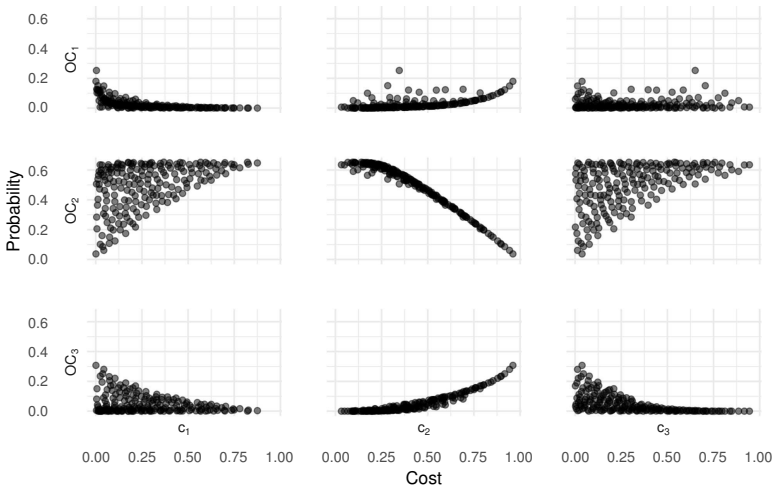
The central claim is that progression decisions in external pilot trials can and should be made by minimising expected loss rather than by comparing point estimates to arbitrary thresholds. The substantive parameter space is partitioned into regions corresponding to the red, amber and green decisions; three error types are defined — proceeding to an infeasible main trial, discarding a promising intervention, and making unnecessary adjustments — and a loss function $L(d,\phi)=c_1E_1+c_2E_2+c_3E_3$ assigns costs to each. Because the loss is piecewise constant, the expected loss of each action depends only on the posterior probabilities of the three hypothesis regions, which can be computed by MCMC even for complex multilevel models. At the design stage, sampling from a design prior and repeating the analysis yields unconditional probabilities of each error type, and a search over the cost parameters reveals the achievable trade-offs. In the worked examples, the resulting pilot designs have error probabilities near conventional levels, and one cost parameter — the cost of discarding a promising intervention — dominates the operating characteristics.
Load-bearing premise
The decision maker's preferences can be summarised by three fixed costs, one for each type of wrong decision, with no additional dependence on how far wrong the decision is or on which other wrong decisions occur at the same time.
Editorial extensions
If this is right
- Progression criteria become decision rules with known error rates, so pilot sample size can be chosen to control the probability of a wrong go/no-go decision.
- Trade-offs between feasibility endpoints — such as accepting lower adherence when potential efficacy is higher — can be articulated through the hypothesis partition instead of being ignored by independent thresholds.
- Complex multilevel models with small samples can drive the decision, because only posterior probabilities of hypothesis regions are needed and these come from MCMC rather than closed-form criteria.
- A multi-objective search over the three costs lets sponsors view the frontier of achievable error probabilities and select a design matching their preferences rather than a conventional default.
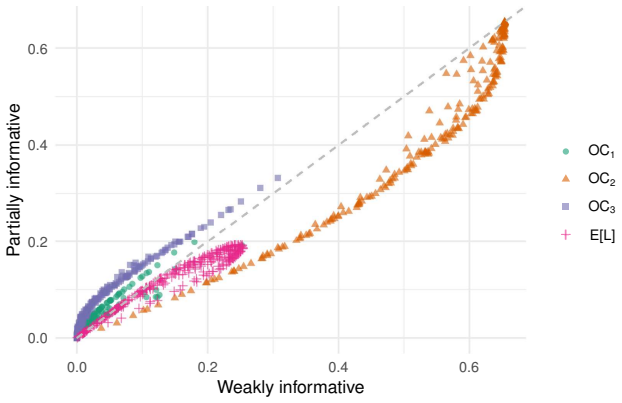
- Using an informative prior for a parameter with very little pilot data lowers expected loss while shifting the error balance, making prior choice a substantive design decision.
Reading between the lines
- The same decision machinery could be applied to internal pilot or seamless phase II/III designs, with the amber action modelled concretely as an adaptive change to the main trial rather than left as an unmodelled option.
- Because the three-cost loss assumes the cost of discarding an intervention does not depend on how effective it is, a natural test is to elicit indifference gambles at different points within a hypothesis and check whether the implied costs remain constant.
- If the three costs were derived from the health-economic consequences of each error rather than from expert judgement, the operating-characteristic frontier could be converted into expected net benefit and compared directly with value-of-information analyses.
- The finding that one cost parameter dominates the operating characteristics suggests a diagnostic: designs in which a single error dominates may need different hypotheses, larger samples, or different endpoints before costs are worth eliciting.
Signed reviews
Editorial analysis
A structured set of objections, weighed in public.
Referee Report
Summary. The manuscript develops a Bayesian decision-theoretic framework for designing and analysing external pilot trials of complex interventions. The pilot data update an analysis prior; a red/amber/green progression decision is then chosen by minimising posterior expected loss under a piecewise-constant, additive loss parameterised by three costs c1,c2,c3. At the design stage, operating characteristics are defined as unconditional error probabilities with respect to a design prior and estimated by nested Monte Carlo simulation; the loss parameters can be varied to approximate a Pareto frontier of operating characteristics, and this is used to support sample-size choice. The method is illustrated on the TIGA-CUB and REACH pilot trials, and the authors provide code and simulated data on GitHub.
Significance. If the technical errors below are corrected, the paper makes a useful contribution to pilot-trial methodology. It addresses a genuine and under-studied problem: progression criteria for external pilots are routinely pre-specified but their operating characteristics are rarely evaluated. The proposed framework is coherent, handles multiple endpoints, small samples, multi-level models, and nuisance parameters within a single Bayesian workflow, and is demonstrated on two real trials. The use of a subjective design prior for assurance-type operating characteristics is standard Bayesian design rather than circularity, and the authors are appropriately explicit about the practical burden of prior and hypothesis elicitation. The GitHub repository containing code and simulated data strengthens reproducibility. The main risks are internal inconsistencies in the printed equations and notation rather than the conceptual framework; these need to be fixed before the method can be implemented from the paper as written.
major comments (3)
- [Section 2.2, Eqs. (3)-(5)] The expected-loss equations are inconsistent with Table 1. From Table 1, the correct expressions are E[L(r)] = (p_A + p_G)c2, E[L(a)] = p_R(c1+c3) + p_G c3, and E[L(g)] = p_R c1 + p_A(c1+c2). The printed equations interchange c2 and c3 in every term. Because c2 and c3 differ in the REACH illustration (for point a, c2=0.9 and c3=0.03), a reader implementing the printed equations can obtain a different argmin and hence a different progression decision. These equations are the core decision rule and must be corrected; the fact that the special two-decision case in Section 3 is derived correctly suggests the numerical work may have used the right formulas, but the printed derivation is wrong.
- [Section 3, Eq. (10)] The indicator in Eq. (10) is reversed. The text states that decision g is optimal whenever p_G > c1, so the probability of proceeding to an infeasible trial should be computed using I(p_G > c1 | x_f, x_a, n), not I(p_G < c1 | x_f, x_a, n). As printed, Eq. (10) counts the opposite decision and would give incorrect operating characteristics for OC1. This is a load-bearing formula for the TIGA-CUB example and needs correction.
- [Section 3, Eq. (8) and surrounding text] The meaning of the sample size n is inconsistent. The likelihood is written with a per-arm sample size n, giving 2n follow-up observations and n adherence observations, yet Eq. (8) gives posterior Beta parameters (1+x_f, 1+n-x_f) and (1+x_a, 1+n/2-x_a), which correspond instead to a total sample size n with n/2 adherence observations. The paragraph also says 'given a total sample size n', while later text says 'n = 30 per arm'. Depending on the intended convention, the posterior probabilities and the operating characteristics in Figures 1-2 change. The paper should adopt one convention consistently and ensure Eq. (8), Eq. (10), and the simulation code all match it.
minor comments (5)
- [Section 4.2.2] The sentence reporting that the INA analysis prior leads to 'larger probabilities of an infeasible trial (OC1) and of unnecessary adjustment (OC2), while reducing the probability of discarding a promising intervention (OC3)' swaps the definitions of OC2 and OC3 from Section 2.3. It should say 'unnecessary adjustment (OC3)' and 'discarding a promising intervention (OC2)'.
- [Figure 6 caption] The caption states that the operating characteristics are evaluated at (c1,c2,c3) = (0.069, 0.116, 0.815), whereas the text says the parameters are set to point a of Table 3, (0.07, 0.9, 0.03). These are different cost vectors; the caption or the text must be corrected.
- [Section 2.4] In the dominance definition, the phrase 'If there exist c, c′ ∈ C*' should refer to two vectors in the sampled set C, not in C*, since C* is the set of non-dominated parameters being constructed.
- [Section 2.2] There is a typo in the sentence 'the our preferences for any one of the attributes E1,E2,E3 are independent...'; 'the our' should be 'our'.
- [Section 5] The Discussion correctly acknowledges that the piecewise-constant loss function may not adequately represent the decision maker's preferences. This is an important scope condition and should be stated at the point the loss function is introduced in Section 2.2, not only in the discussion.
Circularity Check
No significant circularity: the operating characteristics are simulation-based design outputs, not fitted predictions; the sole overlapping-author citation is background, and the printed equation typos are correctness issues outside this pass.
full rationale
The paper's derivation chain is self-contained and non-circular. The decision rule is obtained by minimizing posterior expected loss with respect to a user-specified piecewise-constant loss function (Section 2.2); the loss parameters are either elicited from preferences or selected by viewing the Pareto front of Monte Carlo simulated operating characteristics (Sections 2.3-2.4), so no fitted quantity is presented as a prediction. The operating characteristics are unconditional simulation outputs from the design prior and the same decision rule, not independent empirical outcomes, and the paper transparently labels them as design-stage evaluations. The only overlapping-author citation [16] is background support for the existence of methodological challenges, not a load-bearing theorem or uniqueness assertion. The apparent swaps of c2 and c3 in Eqs (3)-(5) and the reversed indicator in Eq (10) are internal arithmetic/indexing errors that would affect implementation, but they do not constitute circularity: they are correctness defects, not reductions of outputs to inputs.
Assumptions & free parameters
free parameters (6)
- Cost parameters (c1, c2, c3) with c1+c2+c3=1 =
c1=0.2, 0.36, 0.5 in TIGA-CUB; various vectors in REACH, e.g., (0.07, 0.9, 0.03)
- TIGA-CUB hypothesis thresholds =
pf >= 0.8 and pa >= 0.7 for green
- REACH hypothesis boundaries =
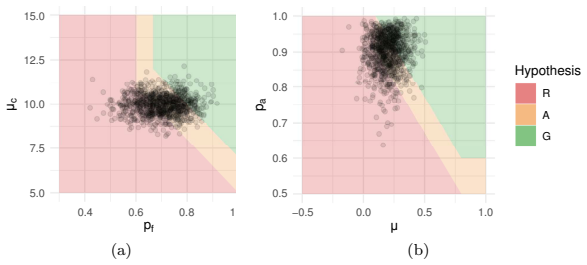
Phi_i: pf < 0.6 or 20 - 15pf > muc for red; pf > 0.66 and 22 - 15pf < muc for green.
- TIGA-CUB design prior hyperparameters =
pf ~ Beta(40,10), pa ~ Beta(11.2,4.8)
- REACH design prior hyperparameters =
muc ~ N(10, sigma^2/6), sigma^2 ~ Inv-Gamma(20,39); pf ~ Beta(22.4,9.6); pa ~ Beta(28.8,3.2); mu ~ N(0.2, 0.25^2)…
- Analysis prior hyperparameters =
TIGA-CUB: Beta(1,1); REACH: weakly informative prior detailed in the (missing) appendix
assumptions (5)
- domain assumption The sampling model p(x|theta) is correctly specified.
- domain assumption The additive loss function correctly represents preferences (independence of attributes).
- domain assumption The design prior p_D(theta) is a fully subjective representation of the decision maker's knowledge.
- domain assumption The hypothesis partition (Phi_R, Phi_A, Phi_G) is known and specifies the true optimal decision for each parameter value.
- standard math Standard Bayesian computation (MCMC) produces samples from the posterior.
Cite this review
Pith. "Pith review of Bayesian design and analysis of external pilot trials for complex interventions." pith.science (2026). https://pith.science/paper/7INPBUAU
@misc{pith2026190805955,
  author       = {Pith},
  title        = {Pith review of: Bayesian design and analysis of external pilot trials for complex interventions},
  year         = {2026},
  howpublished = {\url{https://pith.science/paper/7INPBUAU}},
  note         = {Machine review of arXiv:1908.05955}
}
read the original abstract
External pilot trials of complex interventions are used to help determine if and how a confirmatory trial should be undertaken, providing estimates of parameters such as recruitment, retention and adherence rates. The decision to progress to the confirmatory trial is typically made by comparing these estimates to pre-specified thresholds known as progression criteria, although the statistical properties of such decision rules are rarely assessed. Such assessment is complicated by several methodological challenges, including the simultaneous evaluation of multiple endpoints, complex multi-level models, small sample sizes, and uncertainty in nuisance parameters. In response to these challenges, we describe a Bayesian approach to the design and analysis of external pilot trials. We show how progression decisions can be made by minimising the expected value of a loss function, defined over the whole parameter space to allow for preferences and trade-offs between multiple parameters to be articulated and used in the decision making process. The assessment of preferences is kept feasible by using a piecewise constant parameterisation of the loss function, the parameters of which are chosen at the design stage to lead to desirable operating characteristics. We describe a flexible, yet computationally intensive, nested Monte Carlo algorithm for estimating operating characteristics. The method is used to revisit the design of an external pilot trial of a complex intervention designed to increase the physical activity of care home residents.
Figures


Figures from the paper (4 more)


Reference graph
Works this paper leans on
-
[1]
Developing and evaluating complex intervention s: the new medical research council guidance
Peter Craig, Paul Dieppe, Sally Macintyre, Susan Michie, Irwin Naz areth, and Mark Petticrew. Developing and evaluating complex intervention s: the new medical research council guidance. BMJ: British Medical Journal , 337, 9 2008
work page 2008
-
[2]
Sandra M. Eldridge, Gillian A. Lancaster, Michael J. Campbell, Leha na Thabane, Sally Hopewell, Claire L. Coleman, and Christine M. Bond. Defining feasibility and pilot studies in preparation for randomised con - trolled trials: Development of a conceptual framework. PLOS ONE , 11(3):e0150205, mar 2016
work page 2016
-
[3]
Lancaster, Susanna Dodd, and Paula R
Gillian A. Lancaster, Susanna Dodd, and Paula R. Williamson. Design a nd analysis of pilot studies: recommendations for good practice. Journal of Evaluation in Clinical Practice , 10(2):307–312, 2004
work page 2004
-
[4]
Research for patient benefit (rfpb) programme guidance on applying for feasibility studies, 2017
National Institute for Health Research. Research for patient benefit (rfpb) programme guidance on applying for feasibility studies, 2017
work page 2017
-
[5]
CONSORT 2010 statement: extension to randomised pilot and feasibility trials
Sandra M Eldridge, Claire L Chan, Michael J Campbell, Christine M Bon d, Sally Hopewell, Lehana Thabane, and Gillian A Lancaster. CONSORT 2010 statement: extension to randomised pilot and feasibility trials. BMJ, page i5239, oct 2016
work page 2010
-
[6]
Kerry N L Avery, Paula R Williamson, Carrol Gamble, Elaine O’Connell Francischetto, Chris Metcalfe, Peter Davidson, Hywel Williams, and Jane M Blazeby. Informing efficient randomised controlled trials: exp lo- ration of challenges in developing progression criteria for internal p ilot stud- ies. BMJ Open , 7(2):e013537, feb 2017
work page 2017
-
[7]
Lisa V Hampson, Paula R Williamson, Martin J Wilby, and Thomas Jaki. A framework for prospectively defining progression rules for inter nal pilot studies monitoring recruitment. Statistical Methods in Medical Research , 0(0):0962280217708906, 2017. PMID: 28589752
work page 2017
-
[8]
Richard H. Browne. On the use of a pilot sample for sample size dete rmi- nation. Statistics in Medicine , 14(17):1933–1940, 1995. 22
work page 1933
Show all 44 references
-
[9]
Steven A. Julious. Sample size of 12 per group rule of thumb for a p ilot study. Pharmaceutical Statistics, 4(4):287–291, 2005
2005
-
[10]
The size of a pilot study for a clinical tr ial should be calculated in relation to considerations of precision and effic iency
Julius Sim and Martyn Lewis. The size of a pilot study for a clinical tr ial should be calculated in relation to considerations of precision and effic iency. Journal of Clinical Epidemiology , 65(3):301–308, mar 2012
2012
-
[11]
Sample size requirements to estimate k ey de- sign parameters from external pilot randomised controlled trials: a simula- tion study
M Teare, Munyaradzi Dimairo, Neil Shephard, Alex Hayman, Amy White- head, and Stephen Walters. Sample size requirements to estimate k ey de- sign parameters from external pilot randomised controlled trials: a simula- tion study. Trials, 15(1):264, 2014
2014
-
[12]
How big should the pilot study for my cluste r randomised trial be? Statistical Methods in Medical Research , 2015
Sandra M Eldridge, Ceire E Costelloe, Brennan C Kahan, Gillian A Lan - caster, and Sally M Kerry. How big should the pilot study for my cluste r randomised trial be? Statistical Methods in Medical Research , 2015
2015
-
[13]
Estimating the sample size for a pilot randomised trial to min- imise the overall trial sample size for the external pilot and main trial for a continuous outcome variable
Amy L Whitehead, Steven A Julious, Cindy L Cooper, and Michael J Campbell. Estimating the sample size for a pilot randomised trial to min- imise the overall trial sample size for the external pilot and main trial for a continuous outcome variable. Statistical Methods in Medica...
2015
-
[14]
A simple formula for the calculation of sa mple size in pilot studies
Wolfgang Viechtbauer, Luc Smits, Daniel Kotz, Luc Bud´ e, Mark Spigt, Jan Serroyen, and Rik Crutzen. A simple formula for the calculation of sa mple size in pilot studies. Journal of Clinical Epidemiology , 68(11):1375–1379, nov 2015
2015
-
[15]
Are pilot trials useful for predicting randomisat ion and attrition rates in definitive studies: A review of publicly funded tr ials
Cindy L Cooper, Amy Whitehead, Edward Pottrill, Steven A Julious , and Stephen J Walters. Are pilot trials useful for predicting randomisat ion and attrition rates in definitive studies: A review of publicly funded tr ials. Clinical Trials, 0(0):1740774517752113, 2018. PMID: 29361833
2018
-
[16]
D. T. Wilson, R. E. Walwyn, J. Brown, A. J. Farrin, and S. R. Brow n. Statistical challenges in assessing potential efficacy of complex inte rven- tions in pilot or feasibility studies. Statistical Methods in Medical Research, 25(3):997–1009, jun 2015
2015
-
[17]
Stevens, and Michael J
Anthony O’Hagan, John W. Stevens, and Michael J. Campbell. As surance in clinical trial design. Pharmaceutical Statistics, 4(3):187–201, 2005
2005
-
[18]
Pract ical experiences of adopting assurance as a quantitative framework t o support decision making in drug development
Adam Crisp, Sam Miller, Douglas Thompson, and Nicky Best. Pract ical experiences of adopting assurance as a quantitative framework t o support decision making in drug development. Pharmaceutical Statistics, 0(0), 2018
2018
-
[19]
Fei Wang and Alan E. Gelfand. A simulation-based approach to ba yesian sample size determination for performance under a given model and for separating models. Statistical Science, 17(2):pp. 193–208, 2002. 23
2002
-
[20]
Walley, Claire L
Rosalind J. Walley, Claire L. Smith, Jeremy D. Gale, and Phil Woodwa rd. Advantages of a wholly bayesian approach to assessing efficacy in ea rly drug development: a case study. Pharmaceutical Statistics, 14(3):205–215, apr 2015
2015
-
[21]
A weakly informative default prior distribution for logistic and other re gres- sion models
Andrew Gelman, Aleks Jakulin, Maria Grazia Pittau, and Yu-Sung S u. A weakly informative default prior distribution for logistic and other re gres- sion models. The Annals of Applied Statistics , 2(4):1360–1383, dec 2008
2008
-
[22]
Spiegelhalter
David J. Spiegelhalter. Bayesian methods for cluster randomize d trials with continuous responses. Statistics in Medicine , 20(3):435–452, 2001
2001
-
[23]
Better decisio n mak- ing in drug development through adoption of formal prior elicitation
Nigel Dallow, Nicky Best, and Timothy H Montague. Better decisio n mak- ing in drug development through adoption of formal prior elicitation. Phar- maceutical Statistics, 0(0), 2018
2018
-
[24]
Buck, Alireza Daneshkhah, J
Anthony O’Hagan, Caitlin E. Buck, Alireza Daneshkhah, J. Richar d Eiser, Paul H. Garthwaite, David J. Jenkinson, Jeremy E. Oakley, and Tim Rakow. Uncertain Judgements: Eliciting Experts’ Probabilities. John Wiley and Sons, 2006
2006
-
[25]
Statistical Decision Theory
Simon French and David Rios Insua. Statistical Decision Theory. Number 9 in Kendall’s Library of Statistics. Oxford University Press, 2000
2000
-
[26]
Keeney and Howard Raiffa
Ralph L. Keeney and Howard Raiffa. Decisions with multiple objectives: preferences and value tradeoffs . John Wiley & Sons, 1976
1976
-
[27]
Research exploring physical activity in care homes (REACH): study pro- tocol for a randomised controlled trial
Anne Forster, , Jennifer Airlie, Karen Birch, Robert Cicero, Bo nnie Cundill, Alison Ellwood, Mary Godfrey, Liz Graham, John Green, Claire Hulme, Rebecca Lawton, Vicki McLellan, Nicola McMaster, and Amanda Farr in. Research exploring physical activity in care homes (REACH): st...
2017
-
[28]
RStan: the R interface to Stan, 2016
Stan Development Team. RStan: the R interface to Stan, 2016 . R package version 2.14.1
2016
-
[29]
Sin-Ho Jung, Taiyeong Lee, Kyung Mann Kim, and Stephen L. Geo rge. Admissible two-stage designs for phase II cancer clinical trials. Statistics in Medicine, 23(4):561–569, 2004
2004
-
[30]
Mander, James M.S
Adrian P. Mander, James M.S. Wason, Michael J. Sweeting, and S imon G. Thompson. Admissible two-stage designs for phase II cancer clinica l trials that incorporate the expected sample size under the alternative h ypothesis. Pharmaceutical Statistics, 11(2):91–96, 2012
2012
-
[31]
Current sample size conventions: Flaws, har ms, and al- ternatives
Peter Bacchetti. Current sample size conventions: Flaws, har ms, and al- ternatives. BMC Medicine, 8(1):17, Mar 2010. 24
2010
-
[32]
Sutton, Nicola J
Alexander J. Sutton, Nicola J. Cooper, David R. Jones, Paul C. Lambert, John R. Thompson, and Keith R. Abrams. Evidence-based sample siz e calculations based upon updated meta-analysis. Statistics in Medicine , 26(12):2479–2500, 2007
2007
-
[33]
Oakley, and Alan Brennan
Mark Strong, Jeremy E. Oakley, and Alan Brennan. Estimating m ultipa- rameter partial expected value of perfect information from a pro babilistic sensitivity analysis sample. Medical Decision Making , 34(3):311–326, apr 2014
2014
-
[34]
Es- timating the expected value of sample information using the probabilis tic sensitivity analysis sample: a fast, nonparametric regression-bas ed method
Mark Strong, Jeremy E Oakley, Alan Brennan, and Penny Breez e. Es- timating the expected value of sample information using the probabilis tic sensitivity analysis sample: a fast, nonparametric regression-bas ed method. Medical Decision Making , 35(5):570–583, 2015
2015
-
[35]
Donald R. Jones. A taxonomy of global optimization methods bas ed on response surfaces. Journal of Global Optimization , 21(4):345–383, 2001
2001
-
[36]
DiceKriging , DiceOptim: Two R packages for the analysis of computer experiment s by kriging-based metamodeling and optimization
Olivier Roustant, David Ginsbourger, and Yves Deville. DiceKriging , DiceOptim: Two R packages for the analysis of computer experiment s by kriging-based metamodeling and optimization. Journal of Statistical Software, 51(1):1–55, 2012
2012
-
[37]
Dennis V. Lindley. The choice of sample size. Journal of the Royal Statis- tical Society: Series D (The Statistician) , 46(2):129–138, 1997
1997
-
[38]
Lawrence Joseph and David B. Wolfson. Interval-based versu s decision the- oretic criteria for the choice of sample size. Journal of the Royal Statistical Society: Series D (The Statistician) , 46(2):145–149, 1997
1997
-
[39]
McCulloch, and Mark R
Peter Bacchetti, Charles E. McCulloch, and Mark R. Segal. Simple , defen- sible sample sizes based on cost efficiency. Biometrics, 64(2):577–585, jun 2008
2008
-
[40]
Bayesian sample size for exploratory clinical trials incorporatin g his- torical data
John Whitehead, Elsa Vald´ es-M´ arquez, Patrick Johnson, and Gordon Gra- ham. Bayesian sample size for exploratory clinical trials incorporatin g his- torical data. Statistics in Medicine , 27(13):2307–2327, 2008
2008
-
[41]
Optimal sample sizes for phase II clinical trials and pilot studies
Nigel Stallard. Optimal sample sizes for phase II clinical trials and pilot studies. Statistics in Medicine , 31(11-12):1031–1042, 2012
2012
-
[42]
James M. S. Wason, Thomas Jaki, and Nigel Stallard. Planning mult i- arm screening studies within the context of a drug developmentpro gram. Statistics in Medicine , 32(20):3424–3435, 2013
2013
-
[43]
Sam- ple size planning for phase II trials based on success probabilities for phase III
Heiko Gtte, Armin Schler, Marietta Kirchner, and Meinhard Kiese r. Sam- ple size planning for phase II trials based on success probabilities for phase III. Pharmaceutical Statistics, 14(6):515–524, sep 2015. 25
2015
-
[44]
Utility-based optimization of phase II/III programs
Marietta Kirchner, Meinhard Kieser, Heiko Gtte, and Armin Schle r. Utility-based optimization of phase II/III programs. Statist. Med. , 35(2):305–316, aug 2015. 26
2015
Reviewed August 14, 2026 · model on record in the stance chip above.
Discussion (0). Continue with ORCID to comment.