REVIEW 2 major objections 5 minor 36 references
On a progressive and iterative approximation method with memory for least square fitting
T0 review · 2 major / 5 minor · reviewed 2026-08-14 · deepseek-v4-flash
Pith's one-line read An iteration with memory converges to least-squares curve fits at a rate provably faster than LSPIA, even for rank-deficient collocation matrices.
desk verdict The curve-case acceleration result is genuine and the convergence proof checks out; the surface extension in Theorem 7 is asserted without proof and should be supplied or softened before publication. read the letter →
The pith
A machine-rendered reading of the paper's core claim, the machinery that carries it, and where it could break.
The reading
What carries the argument
The load-bearing object is the iteration matrix $H_{\omega,\gamma,\upsilon}$ that governs the coupled update of the auxiliary weighted sums $\Lambda^k$ and the control points $P^k$; the paper works in any normalized totally positive (NTP) basis, meaning basis functions that are nonnegative, sum to one, and have totally positive collocation matrices. An orthogonal change of variables built from the SVD of the collocation matrix $B$ block-diagonalizes $H_{\omega,\gamma,\upsilon}$, leaving eigenvalues $1-\omega$ together with the roots of a quadratic equation $\lambda^2+[\gamma\upsilon\sigma_i^2-(2-\omega)]\lambda+\sigma_i^2\upsilon(\omega-\gamma)+1-\omega=0$ for each positive singular value $\sigma_i$. A root-bound lemma converts those quadratics into the explicit weight condition (11), and at the paper's optimal weights every active eigenvalue has modulus $(\sigma_1-\sigma_r)/(\sigma_1+\sigma_r)$, the contraction factor that determines the convergence rate.
What would settle it
Construct a small tensor-product example, say with $B_1$ rank-deficient and $B_2$ a single-column positive basis, compute the spectral radius of the iteration matrix $H_{\omega^*,\gamma^*,\upsilon^*}$ formed from $B_1\otimes B_2$, and compare it with $(\sigma_1\mu_1-\sigma_r\mu_s)/(\sigma_1\mu_1+\sigma_r\mu_s)$; a mismatch in the asymptotic error contraction would show the omitted surface proof does not follow from the stated assumptions.
Extended reading notes
Core claim
The discovery, on the paper's own terms, is that the least-squares progressive iteration can be accelerated by adding memory: the increment to each control point at step $k$ blends the previous increment with two successive residual-weighted sums, controlled by weights $\omega$, $\gamma$, and $\upsilon$. The paper proves the resulting curves converge to a solution of the least-squares normal equations $B^T B X = B^T Q$ whenever (11) holds, regardless of whether $B$ has full column rank. The proof rewrites the iteration in coupled variables $(\Lambda^k, P^k)$, block-diagonalizes the iteration matrix by an orthogonal transform, and shows each singular value $\sigma_i$ contributes a quadratic eigenvalue equation; the root bound of Lemma 4 converts those equations into the explicit condition (11). At the weights $\omega^*=\gamma^*=4\sigma_1\sigma_r/(\sigma_1+\sigma_r)^2$, $\upsilon^*=1/(\sigma_1\sigma_r)$, the spectral radius is $(\sigma_1-\sigma_r)/(\sigma_1+\sigma_r)$, which is less than the fastest LSPIA rate $(\sigma_1^2-\sigma_r^2)/(\sigma_1^2+\sigma_r^2)$ whenever $\sigma_1>\sigma_r$. Numerical examples with cubic B-spline curves and a tensor-product cubic B-spline surface confirm that fewer iterations are needed.
Load-bearing premise
The surface result (Theorem 7) is stated without proof and rests on the unstated assumption that the tensor-product iteration behaves exactly like the curve iteration, with singular values of the two factors multiplying pairwise; if that spectral factorization fails for a rank-deficient factor, the stated surface rate does not follow from the paper's arguments.
Editorial extensions
If this is right
- For very large point sets, MLSPIA reaches a fixed fitting tolerance in fewer iterations than LSPIA, because its spectral radius is provably smaller at the recommended weights.
- The convergence guarantee covers rank-deficient collocation matrices, so redundant or nearly dependent basis functions no longer make the iterative fit fail or require a separate least-squares solver.
- The added memory costs only two extra additions and three extra scalar multiplications per control point per step, so the faster convergence is obtained at a small per-iteration premium.
- If Theorem 7's tensor-product claim is accepted, surface fitting inherits the same speed-up, with the extreme singular products $\sigma_1\mu_1$ and $\sigma_r\mu_s$ replacing $\sigma_1$ and $\sigma_r$ in the rate.
Reading between the lines
- The paper does not analyze how estimation error in knowing $\sigma_1$ and $\sigma_r$ affects the promised rate; a practical version would need cheap approximations of these extremes, and the sensitivity of the spectral radius to those estimates is an open question.
- The two-step memory is a linear acceleration; storing more past corrections could in principle push the contraction factor further toward a value governed by the square root of the condition number, although the present paper gives no such analysis.
- Because the argument relies only on the singular values of the collocation matrix, the same three-weight acceleration should transfer to other fitting settings with totally positive bases, such as generalized B-spline or subdivision-surface fitting, whenever the same spectral structure can be verified.
Signed reviews
Editorial analysis
A structured set of objections, weighed in public.
Referee Report
Summary. The paper proposes MLSPIA, a progressive and iterative approximation method with memory for least-squares fitting. The iteration (1)-(3) uses three weights to update control points and accumulated difference terms. For curves, the authors prove (Theorem 2) that for any normalized totally positive basis, even when the collocation matrix B has deficient column rank, the iteration converges to a least-squares fit provided the weights satisfy condition (11). They then derive a spectral-radius estimate at a particular weight choice (Theorem 6) and show that this rate is strictly smaller than the optimal LSPIA rate from [7] whenever the relevant extremal singular values differ. A tensor-product surface extension is stated as Theorem 7, and five numerical examples, including one surface example, illustrate the acceleration. The proof of Theorem 7 is explicitly omitted, although the abstract, the conclusions, and Example 5 rely on the surface result.
Significance. If the curve-case theorems are correct, the paper makes a useful contribution: it extends LSPIA convergence to rank-deficient collocation matrices, provides a constructive weight choice with a rigorously faster theoretical rate, and the numerical examples confirm the acceleration with negligible final deviations. The eigenvalue analysis in Lemma 3 and the discriminant computation leading to (29) are sound, and the treatment of the rank-deficient null-space block in Theorem 2 is careful. The omitted surface proof is the main weakness: because the surface theorem is a central advertised claim, the manuscript is not yet complete. A full proof of Theorem 7 is required before the surface claims can be accepted; the curve part alone would be a modest but valid contribution.
major comments (2)
- [Section 5, Theorem 7] The proof of the surface extension is explicitly omitted with the sentence 'The proof to the Theorem 7 is omitted since it is similar to the case for Theorems 2 and 6.' This is a load-bearing gap. The surface iteration (33)-(35) acts through the Kronecker product B1⊗B2, and the proof must establish the singular-value factorization of B1⊗B2, the corresponding block structure of the iteration matrix (a 2rs-dimensional coupled block, an (m1m2-rs)-dimensional diagonal block, and an (n1n2-rs)-dimensional identity block), and the rate formula ρ = (σ1μ1 - σrμs)/(σ1μ1 + σrμs). These are standard facts, but they are not written down, and the abstract, the conclusions, and Example 5 all rely on Theorem 7. Please supply a complete proof, or explicitly restrict the paper's central claims to curves.
- [Theorem 6(2) and its proof] The statement 'When the NTP basis is linearly independent, B is of full column rank' is not true in general. A normalized totally positive basis can be linearly independent as a set of functions while its collocation matrix at the chosen parameters is rank-deficient; for example, a B-spline basis with no data parameter in the support of one basis function yields a zero column. The comparison with the LSPIA rate from [7] is valid under the assumption that B has full column rank. Please restate item 2 in those terms and remove the false implication.
minor comments (5)
- [Equations (11) and (36)] The inequalities in (11) and (36) appear to be missing division signs: the lower bound should read ω - ω/(σ1^2 υ) and the upper bound ω/2 - (ω-2)/(σ1^2 υ); as typeset, the expressions are dimensionally inconsistent. The same correction applies to (36) with σ1μ1 in place of σ1.
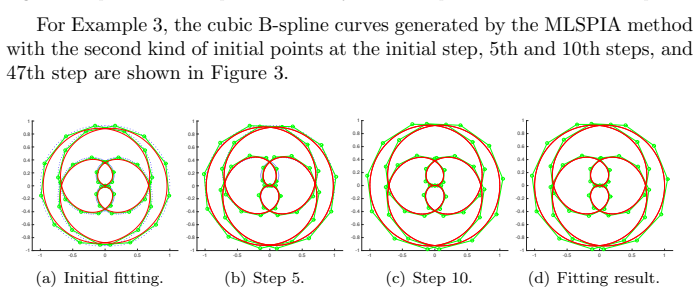
- [Figure 5 and Section 6.3] The caption of Figure 5 says '(b) Step 1000', while the text says the second and third panels are at steps 200 and 362, and Table 2 reports 362 iterations. Please reconcile these numbers.
- [Notation, Table 2] The symbols ν* and υ* are used interchangeably for the third weight in Table 2 and the surrounding text; please use a single notation throughout.
- [Section 2 and general text] There are several typographical errors, including 'woks', 'dada set', and 'expect' for 'except', and the running header 'Journal of LaTeX Templates' should be removed.
- [Reference [10]] Reference [10] is cited as an arXiv preprint; if a published version exists, please cite the published source.
Circularity Check
No circularity found: the convergence and rate theorems are derived from the iteration matrix, and the comparison target is an external benchmark, not the paper's own fitted output.
full rationale
The central derivation is self-contained. Theorem 2 obtains convergence of (Λ^k, P^k) from the contraction of H_{ω,γ,υ}, whose eigenvalues are characterized in Lemma 3 via the SVD of B; condition (11) is derived, not assumed, and the fixed point is shown to solve B^T B P = B^T Q. Theorem 6 compares the spectral radius at the analytically chosen weights ω*=γ*=4σ1σr/(σ1+σr)^2, υ*=1/(σ1σr) with the LSPIA rate (σ1^2−σr^2)/(σ1^2+σr^2) taken from Deng and Lin [7], an external benchmark whose authors do not overlap with the present paper. The weights depend only on singular values of the collocation matrix B, not on the data Q, so the claimed rate is a theorem rather than a fitted prediction. I also flag one non-circular gap: in Section 5, Theorem 7 (surface case) states `The proof to the Theorem 7 is omitted since it is similar to the case for Theorems 2 and 6.` The surface rate ρ=(σ1μ1−σrμs)/(σ1μ1+σrμs) and convergence condition (36) are therefore asserted without the needed Kronecker-product/SVD block-decoupling argument; this is a completeness and correctness risk, but it is an omitted proof, not an equation that reduces to its input by construction. No circularity score penalty is appropriate.
Assumptions & free parameters
free parameters (3)
- weight omega =
omega* = 4 sigma1 sigma_r / (sigma1 + sigma_r)^2
- weight gamma =
gamma* = 4 sigma1 sigma_r / (sigma1 + sigma_r)^2
- weight upsilon =
upsilon* = 1 / (sigma1 sigma_r)
assumptions (6)
- standard math The collocation matrix B is real and admits an SVD as in (12); the convergence analysis relies on the spectral decomposition of B^T B and B B^T.
- domain assumption The bases B_i(t) form a normalized totally positive basis, giving nonnegative entries and partition of unity, which is the application setting but not used in the linear-algebra proof.
- standard math Lemma 4 (both roots of a real quadratic have modulus less than 1 iff |c| < 1 and |b| < 1 + c) from [35] is used to characterize spectral radius.
- domain assumption The fastest LSPIA convergence rate is (sigma1^2 - sigma_r^2) / (sigma1^2 + sigma_r^2), as proved in the cited paper [7].
- standard math For the surface case, singular values of B1 tensor B2 are products sigma_i mu_j (undisplayed background fact).
- domain assumption The parameterization uses increasing sequences and the Schoenberg-Whitney condition to build cubic B-spline bases.
Cite this review
Pith. "Pith review of On a progressive and iterative approximation method with memory for least square fitting." pith.science (2026). https://pith.science/paper/7J64LVFJ
@misc{pith2026190806417,
  author       = {Pith},
  title        = {Pith review of: On a progressive and iterative approximation method with memory for least square fitting},
  year         = {2026},
  howpublished = {\url{https://pith.science/paper/7J64LVFJ}},
  note         = {Machine review of arXiv:1908.06417}
}
read the original abstract
In this paper, we present a progressive and iterative approximation method with memory for least square fitting(MLSPIA). It adjusts the control points and the weighted sums iteratively to construct a series of fitting curves (surfaces) with three weights. For any normalized totally positive basis even when the collocation matrix is of deficient column rank, we obtain a condition to guarantee that these curves (surfaces) converge to the least square fitting curve (surface) to the given data points. It is proved that the theoretical convergence rate of the method is faster than the one of the progressive and iterative approximation method for least square fitting (LSPIA) in [Deng C-Y, Lin H-W. Progressive and iterative approximation for least squares B-spline curve and surface fitting. Computer-Aided Design 2014;47:32-44] under the same assumption. Examples verify this phenomenon.
Figures


Figures from the paper (3 more)


Reference graph
Works this paper leans on
-
[7]
Progressive and iterative approximation for least squares B-spline curve and surface fitting
Deng C-Y, Lin H-W. Progressive and iterative approximation for least squares B-spline curve and surface fitting. Comput-Aided Des 2014;47:32– 44
work page 2014
-
[1]
Piegl L, Tiller W. The NURBS book. 2nd ed.; New York, USA: Springer- Verlag; 1997
work page 1997
-
[2]
Handbook of computer aided geometric design
Farin G, Hoschek J, Kim M-S. Handbook of computer aided geometric design. 1st ed.; North-Holland; 2002
work page 2002
-
[3]
Total least squares fitting of bezier and b-spline curves to ordered data
Borges CF, Pastva T. Total least squares fitting of bezier and b-spline curves to ordered data. Comput-Aided Des 2002;19:275–89
work page 2002
-
[4]
Fitting b-spline curves to point clouds by curvature-based squared distance minimization
Wang W, Pottmann H, Liu Y . Fitting b-spline curves to point clouds by curvature-based squared distance minimization. ACM Transactions on Graphics 2006;25:214–38
work page 2006
-
[5]
B-spline surface fitting by it- erative geometric interpolation/approximation algorithms
Kineri Y, Wang M, Lin H, Maekawa T . B-spline surface fitting by it- erative geometric interpolation/approximation algorithms. Comput-Aided Des 2012;44(7):697–708
work page 2012
-
[6]
An efficient method for fitting large data sets using T-splines
Lin H-W, Zhang Z-Y. An efficient method for fitting large data sets using T-splines. SIAM J Sci Comput 2013;35(6):A3052–68. 22
work page 2013
-
[8]
Elitist clonal selection algorithm for optimal choice of free knots in b-spline data fitting
Galveza A, Iglesiasa A, Avilaa A, Oteroc C, Ariasc R, Manchadoca C. Elitist clonal selection algorithm for optimal choice of free knots in b-spline data fitting. Applied Soft Computing 2015;26:90–106
work page 2015
Show all 36 references
-
[9]
Least square geometric iterative fitting method for generalized B-spline curves with two different kinds of weights
Zhang L, Ge X-Y, Tan J-Q. Least square geometric iterative fitting method for generalized B-spline curves with two different kinds of weights. Vis Comput 2016;32(9):1109–20
2016
-
[10]
The convergence of least-squares progressive iterative approximation with singular iterative matrix
Lin H, Cao Q, Zhang X . The convergence of least-squares progressive iterative approximation with singular iterative matrix. arXiv 2017;URL: arXiv:1707.09109
2017 arXiv
-
[11]
Shape modeling based on specifying the initial b-spline curve and scaled bfgs optimization method
Ebrahimi A, Loghmani BG. Shape modeling based on specifying the initial b-spline curve and scaled bfgs optimization method. Multimed Tools Appl 2018;77:30331–51
2018
-
[12]
Survey on geometric iterative methods and their applications
Lin H, Maekawa T, Deng C. Survey on geometric iterative methods and their applications. Comput-Aided Des 2018;95:40–51
2018
-
[13]
Progressive iterative approximation for regularized least square bivariate B-spline surface fitting
Liu M-Z, Li B-J, Guo Q-J, Zhu C-G, Hu P, Shao Y-H. Progressive iterative approximation for regularized least square bivariate B-spline surface fitting. J Comput Appl Math 2018;327:175–87
2018
-
[14]
Parameterizing and extending trimmed regions for tensor-product surface fitting
Vaitkus M, Varady T. Parameterizing and extending trimmed regions for tensor-product surface fitting. Comput-Aided Des 2018;104:125–40
2018
-
[15]
Totally positive bases and progressive iteration approximation
Lin H-W, Bao H-J, Wang G-J . Totally positive bases and progressive iteration approximation. Comput Math Appl 2005;50(3-4):575–86
2005
-
[16]
The convergence of the geometric interpolation algorithm
Lin H-W . The convergence of the geometric interpolation algorithm. Comput-Aided Des 2010;42(6):505–8
2010
-
[17]
Interpolation by geometric algo- rithm
Maekawa T, Matsumoto Y, Namiki K. Interpolation by geometric algo- rithm. Comput-Aided Des 2007;39(4):313–23
2007
-
[18]
How does Agee’s smoothing method work? Proceedings of the 1979 army numerical analysis and computers conference, ARO report 1979;79-3:299–302
De Boor C. How does Agee’s smoothing method work? Proceedings of the 1979 army numerical analysis and computers conference, ARO report 1979;79-3:299–302
1979
-
[19]
The method of numeric polish in curve fitting
Qi D, Tian Z, Zhang Y, Feng J. The method of numeric polish in curve fitting. Acta Mathematica Sinica 1975;18:173–84
1975
-
[20]
A method of designing free surfaces by computer display (1st report)
Yamaguchi F. A method of designing free surfaces by computer display (1st report). Precision Machinery 1977;43(2):168–73
1977
-
[21]
Convexity of rational curves and total positivity
Carnicer JM, Garc´ ıa-Esnaola M, Pe˜ na JM. Convexity of rational curves and total positivity. J Comput Appl Math 1996;71(2):365–82. 23
1996
-
[22]
A shape preserving representation with a evaluation algorithm of linear complexity
Delgado J, Pe˜ na, JM. A shape preserving representation with a evaluation algorithm of linear complexity. Comput Aided Geom Design 2003;20(1):1– 10
2003
-
[23]
Constructing iterative non-uniform B- spline curve and surface to fit data points
Lin H-W, Wang G-J, Dong C-S. Constructing iterative non-uniform B- spline curve and surface to fit data points. Sci China Ser F 2004;47(3):315– 31
2004
-
[24]
Weighted progressive iteration approximation and convergence analysis
Lu L-Z. Weighted progressive iteration approximation and convergence analysis. Comput Aided Geom Design 2010;27(2):129–37
2010
-
[25]
An extended iterative format for the progressive- iteration approximation
Lin H-W, Zhang Z-Y. An extended iterative format for the progressive- iteration approximation. Comput Graph 2011;35(5):967–75
2011
-
[26]
An iterative algorithm of NURBS interpolation and approximation
Shi L-M, Wang R-H. An iterative algorithm of NURBS interpolation and approximation. J Math Res Exposition 2006;26(4):735–43
2006
-
[27]
Local progressive-iterative approximation format for blending curves and patches
Lin H-W. Local progressive-iterative approximation format for blending curves and patches. Comput Aided Geom Design 2010;27(4):322–39
2010
-
[28]
Progressive iterative approximation for triangular B´ ezier surfaces
Chen J, Wang G-J . Progressive iterative approximation for triangular B´ ezier surfaces. Comput-Aided Des 2011;43(8):889–95
2011
-
[29]
An iterative algorithm for polynomial approximation of rational triangular B´ ezier surfaces
Hu Q-Q. An iterative algorithm for polynomial approximation of rational triangular B´ ezier surfaces. Appl Math Comput 2013;219(17):9308–16
2013
-
[30]
Loop subdivision surface based progressive interpolation
Cheng F-H, Fan F-T, Lai S-H, Huang C-L, Wang J-X, Yong J-H. Loop subdivision surface based progressive interpolation. J Comput Sci Tech 2009;24(1):39–46
2009
-
[31]
Weighted progressive interpolation of Loop subdivi- sion surfaces
Deng C-Y, Ma W-Y. Weighted progressive interpolation of Loop subdivi- sion surfaces. Comput-Aided Des 2012;44(5):424–31
2012
-
[32]
Progressive interpolation based on Catmull-Clark subdivision surfaces
Chen Z-X, Luo X-N, Tan L, Ye B-H, Chen J-P. Progressive interpolation based on Catmull-Clark subdivision surfaces. Computer Graphics Forum 2008;27(7):1823–7
2008
-
[33]
Subdivision based interpolation with shape control
Fan F-T, Cheng F-H, Lai S-H. Subdivision based interpolation with shape control. Computer-Aided Design and Applications 2008;5(1-4):539–47
2008
-
[34]
Least squares cubic spline approximation I-Fixed knots
De Boor C, Rice JR. Least squares cubic spline approximation I-Fixed knots. Computer Sciences, Purdue University; 1968
1968
-
[35]
Iterative solution of large linear systems
Young DM. Iterative solution of large linear systems. New York-London: Academic press; 1971
1971
-
[36]
On polya frequency functions
Sch¨ oenberg IJ, Whitney A. On polya frequency functions. Trans Amer Math Soc 1953;74:246–59. 24
1953
Reviewed August 14, 2026 · model on record in the stance chip above.
Discussion (0). Continue with ORCID to comment.