REVIEW 4 major objections 5 minor 21 references
Toward a Taxonomy of Inventory Systems for Virtual Reality Games
T0 review · 4 major / 5 minor · reviewed 2026-08-14 · deepseek-v4-flash
Pith's one-line read VR game inventories can be designed from four building blocks, and this paper names them.
desk verdict A modest but real first taxonomy of VR inventory design; the abstract overstates its completeness, but the paper is honest about being preliminary and worth refereeing. read the letter →
The pith
A machine-rendered reading of the paper's core claim, the machinery that carries it, and where it could break.
The reading
What carries the argument
The carrying mechanism is the taxonomy itself, an analytic instrument that splits any VR inventory into four named dimensions and lists concrete options under each. Its work is to turn a diffuse interface problem into a set of discrete design decisions, so that any two inventories can be compared by their positions in the space and new combinations can be generated deliberately. The three prototypes are not the contribution by themselves; they serve as proof-of-concept walks through the taxonomy and as probes that surface the issues designers should watch for.
What would settle it
Compile a catalogue of inventory systems from a broad sample of VR games and check whether every consequential design property can be expressed as a combination of the four building blocks; if any property, such as real-time item decay or shared player ownership, does not fit, the taxonomy's completeness claim fails.
Extended reading notes
Core claim
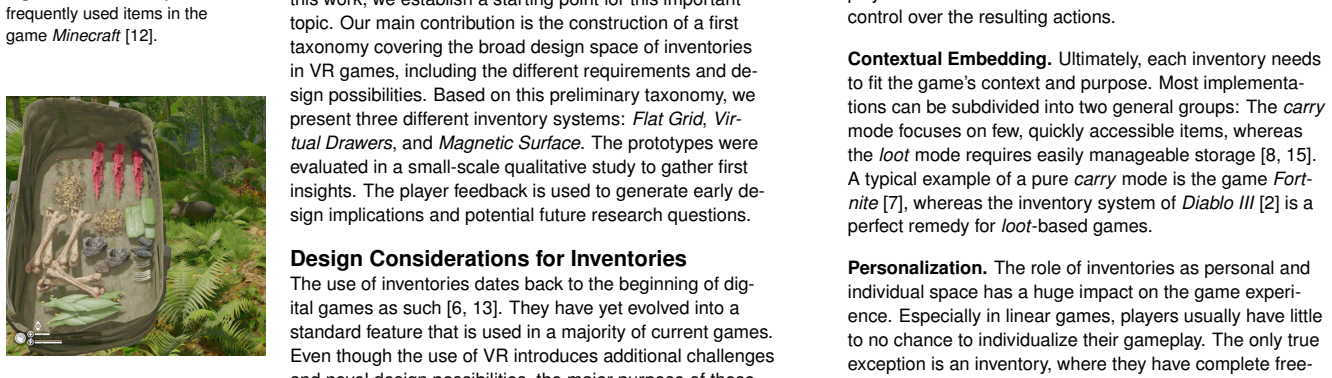
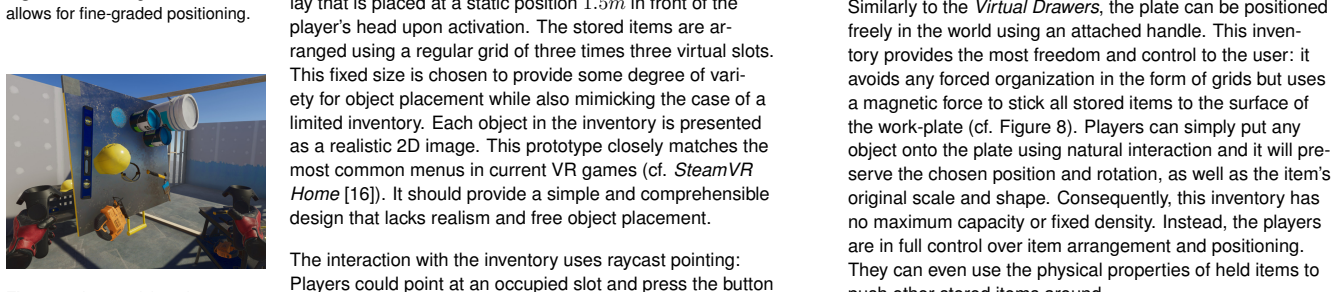
The central claim is that inventories in VR games, often underused compared with traditional games, can be decomposed into four atomic building blocks. Inventory Interface determines whether storage appears as an overlay, a virtual object, or a physical proxy, and whether it is static, movable, thematic, or abstract. Item Representation determines whether items are shown realistically or abstractly and at preserved, miniaturized, or normalized scale. Item Arrangement determines layout (linear, grid, ring, slots, or unrestricted), capacity (unlimited, fixed, or dynamic), ordering (unstructured, sortable, or sorted), and possible improvements such as categories, hierarchies, or stacking. Interaction determines how the inventory is opened (button or gesture), how items are added (automatic or manual), and how items are manipulated (pointer-based raycasting or physical action). The paper presents the three prototypes as distinct points in this space and reports that players preferred the most physical and flexible one, the magnetic surface, while still noting its limits in scalability and structure.
Load-bearing premise
The taxonomy is assumed to cover the whole design space of VR inventories, but the paper does not prove that four building blocks are exhaustive, and it evaluates only three instances, so an unlisted dimension such as shared ownership or system-driven organization would make it incomplete.
Editorial extensions
If this is right
- VR game designers gain a shared vocabulary for inventory decisions, replacing ad hoc descriptions with four dimensions and their options.
- The taxonomy can reveal unexplored combinations, such as realistic three-dimensional items paired with a structured grid, that current VR games rarely attempt.
- The study's small-sample preference for physical interaction and original-scale items suggests that natural, body-based inventory handling may be more engaging than raycast menus.
- Occlusion and the popularity of movable inventories indicate that spatial placement of the inventory is a design variable in its own right, not a cosmetic detail.
- The qualitative results give concrete targets for iteration, such as adding stackability to the drawers and letting players restore a preferred inventory position.
Reading between the lines
- An implicit consequence is that the same four-block decomposition could describe other persistent VR interfaces, such as crafting menus or quest logs, since the categories are generic; the paper itself does not claim this.
- A testable extension is a hybrid inventory that combines the magnetic surface's physical placement with an optional grid-snap or sorting mode; such a design could resolve the tension between freedom and structure found in the study.
- Because the taxonomy lacks an explicit dimension for ownership or multi-user access, social inventories, which one participant proposed for the magnetic surface, would likely need a fifth building block if the taxonomy grows in that direction.
- The strongest check on completeness would be a design exercise in which independent designers describe existing VR inventory systems using only these four building blocks and see whether any consequential decision is left over.
Signed reviews
Editorial analysis
A structured set of objections, weighed in public.
Referee Report
Summary. This paper proposes a preliminary taxonomy of inventory systems for VR games, decomposing the design space into four building blocks: Inventory Interface, Item Representation, Item Arrangement, and Interaction, each with several subdimensions. The authors use the taxonomy to design three distinct inventory prototypes (Flat Grid, Virtual Drawers, and Magnetic Surface) and report a small qualitative study with eight participants in a virtual construction scenario. The paper is explicitly framed as an early step, with the stated goal of generating design implications and future research questions rather than validating a complete theory.
Significance. If the proposed taxonomy proves robust, it would provide a useful shared vocabulary for VR inventory design and research, connecting established game design concepts with VR-specific interaction techniques. The paper has concrete strengths: the taxonomy is grounded in existing games and VR interaction literature, the three prototypes are clearly derived from the taxonomy under shared design constraints, and the qualitative feedback, though small-scale, yields plausible and actionable design insights. The authors are also appropriately cautious in the conclusion, calling the taxonomy preliminary and planning future refinement. The main reservation is that the abstract's claim of 'covering the broad design space' exceeds what the current evidence supports; the paper would be strengthened by aligning its claims with its explicitly preliminary status.
major comments (4)
- [Building Blocks of Inventories for VR (taxonomy box)] The four building blocks and their subdimensions are presented descriptively without a derivation from a corpus of games, prior classifications, or a systematic coding procedure, and no argument establishes that the listed dimensions are exhaustive or at a consistent level of granularity. Because the abstract's phrase 'covering the broad design space' depends on this exhaustiveness, the taxonomy as presented under-supports the central claim. I recommend either adding a systematic derivation and a completeness argument, or softening the claim to 'a first step / preliminary taxonomy covering identified aspects.'
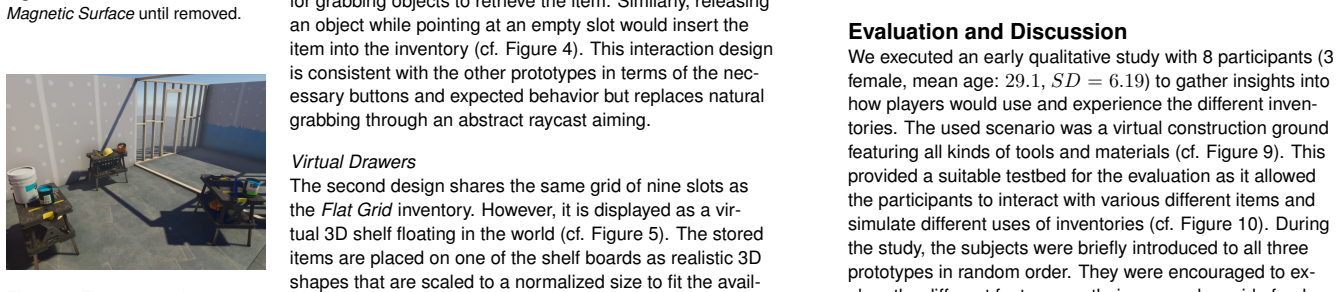
- [Evaluation and Discussion] The qualitative study cannot validate the taxonomy's coverage: it involves eight participants, one construction scenario, and three prototypes, and the paper does not describe any systematic qualitative analysis method, such as thematic coding, transcription procedures, or inter-rater reliability. Consequently, the conclusion's statement that the feedback is 'backing our taxonomy approach' overstates the evidence. The authors should present the study explicitly as formative and exploratory, and either add methodological detail about the analysis or restrict the claims to design implications.
- [Conclusion and Future Work] The paper itself calls the taxonomy 'preliminary' and states that future work will 'refine and extend' it, which directly conflicts with the abstract's stronger claim that the taxonomy covers the broad design space of VR inventories. The participant suggestion of shared multiplayer storage also illustrates a potentially consequential dimension—social or shared inventories—that is not present in the current taxonomy. The authors should either explicitly scope the taxonomy to single-player personal inventories or add and discuss such dimensions; as written, a designer using the taxonomy could systematically omit relevant designs.
- [Inventory Designs] The three prototypes instantiate only a small fraction of the taxonomy's combinations: there is no real-proxy interface, no automatic item addition, no sorting or categories, no stackability, and limited variation in capacity and layout. The statement that the designs were chosen to cover 'the most interesting aspects of the taxonomy' is subjective and unsupported. The authors should clarify the selection criteria for the prototypes and discuss how the evaluation can inform taxonomy dimensions that were not instantiated, or they should limit the generalization claims accordingly.
minor comments (5)
- [Motivation] The phrase 'can provide an enjoying experience' should be 'can provide an enjoyable experience.'
- [Item Arrangement] The phrase 'free object placement bares the risk' should be 'bears the risk'; the same correction applies elsewhere if the typo recurs.
- [Evaluation and Discussion] The paper mentions an audio-recorded think-aloud process but gives no details on how the recordings were analyzed; a sentence on transcription, coding, or even an informal affinity-diagram approach would improve reproducibility.
- [Related Work and References] The claim of a 'first taxonomy' should be supported by a short related-work discussion of prior inventory classifications or comparative studies, going beyond the single citation to Wegner et al.; this would help readers assess novelty.
- [Taxonomy presentation] The taxonomy box would be easier to use if each subdimension included a brief definition or example; currently terms such as 'improvements' and 'ordering' are ambiguous without reading the prose.
Circularity Check
No circularity found: the taxonomy is a descriptive design-space construction, and the qualitative study is not presented as validation of the taxonomy itself.
full rationale
The paper makes no formal derivation that could reduce to its inputs. Its central contribution is a preliminary taxonomy of VR inventory building blocks (interface, item representation, item arrangement, interaction), presented descriptively with examples from existing games. The three prototypes (Flat Grid, Virtual Drawers, Magnetic Surface) are deliberately constructed to instantiate different regions of the taxonomy, and the qualitative study gathers player feedback on the prototypes; the authors explicitly treat the taxonomy as preliminary and plan to 'refine and extend the existing taxonomy to incorporate additional player and developer input.' No parameter is fitted and then renamed a prediction. The only self-citations are to the authors' prior work on navigation and controller design, cited as examples of prior VR research topics; these are not load-bearing for the taxonomy. The claim that the taxonomy 'covers the broad design space' is an assertion of completeness, but an unsupported completeness claim is a correctness/evidentiary limitation, not circularity, because the taxonomy is not derived from the completeness assumption nor from the study results.
Assumptions & free parameters
assumptions (3)
- domain assumption The success of an inventory implementation depends on comprehensibility, interactivity, contextual embedding, and personalization.
- ad hoc to paper The four building blocks (Inventory Interface, Item Representation, Item Arrangement, Interaction) are sufficient to describe the inventory design space.
- domain assumption Qualitative feedback from eight participants can yield valid first insights for design implications.
Cite this review
Pith. "Pith review of Toward a Taxonomy of Inventory Systems for Virtual Reality Games." pith.science (2026). https://pith.science/paper/7JYSXX5F
@misc{pith2026190803591,
  author       = {Pith},
  title        = {Pith review of: Toward a Taxonomy of Inventory Systems for Virtual Reality Games},
  year         = {2026},
  howpublished = {\url{https://pith.science/paper/7JYSXX5F}},
  note         = {Machine review of arXiv:1908.03591}
}
read the original abstract
Virtual reality (VR) games are gradually becoming more elaborated and feature-rich, but fail to reach the complexity of traditional digital games. One common feature that is used to extend and organize complex gameplay is the in-game inventory, which allows players to obtain and carry new tools and items throughout their journey. However, VR imposes additional requirements and challenges that impede the implementation of this important feature and hinder games to unleash their full potential. Our current work focuses on the design space of inventories in VR games. We introduce this sparsely researched topic by constructing a first taxonomy of the underlying design considerations and building blocks. Furthermore, we present three different inventories that were designed using our taxonomy and evaluate them in an early qualitative study. The results underline the importance of our research and reveal promising insights that show the huge potential for VR games.
Figures


Figures from the paper (7 more)




Reference graph
Works this paper leans on
-
[1]
Blizzard Entertainment. 2004. World of Warcraft. Game [PC]. (23 November 2004). Vivendi, Paris, France
work page 2004
-
[2]
Blizzard Entertainment. 2012. Diablo 3. Game [PC]. (15 May 2012). Blizzard Entertainment, Irvine, California, United States
work page 2012
-
[3]
Cloudhead Games Ltd. 2016. The Gallery - Episode 1: Call of the Starseed. Game [SteamVR]. (5 April 2016). Cloudhead Games Ltd., Vancouver Island, Canada
work page 2016
-
[4]
Sebastian Cmentowski, Andrey Krekhov, and Jens Krüger. 2019. Outstanding: A Perspective-Switching Technique for Covering Large Distances in VR Games. In Extended Abstracts of the 2019 CHI Conference on Human Factors in Computing Systems. ACM, ACM, New Y ork, NY , USA, LBW1612
work page 2019
-
[5]
Creepy Jar. 2018. Green Hell. Game [PC]. (29 August 2018). Creepy Jar, Warsaw, Poland
work page 2018
-
[6]
Doug Dyment. 1968. Hamurabi. Game [PC]. (1968)
work page 1968
-
[7]
Epic Games and People Can Fly. 2017. Fortnite. Game [PC]. (25 July 2017). Epic Games and Gearbox Publishing, Raleigh, North Carolina, United States
work page 2017
-
[8]
Juho Hamari and Vili Lehdonvirta. 2010. Game design as marketing: How game mechanics create demand for virtual goods. International Journal of Business Science & Applied Management 5, 1 (2010), 14–29
work page 2010
Show all 21 references
-
[9]
Andrey Krekhov, Sebastian Cmentowski, Katharina Emmerich, Maic Masuch, and Jens Krüger. 2018. GulliVR: A walking-oriented technique for navigation in virtual reality games based on virtual body resizing. In Proceedings of the 2018 Annual Symposium on Computer-Human Interaction...
2018
-
[10]
Andrey Krekhov, Katharina Emmerich, Philipp Bergmann, Sebastian Cmentowski, and Jens Krüger
-
[11]
Mark R Mine, Frederick P Brooks Jr, and Carlo H Sequin. 1997. Moving objects in space: exploiting proprioception in virtual-environment interaction.. In SIGGRAPH, Vol. 97. ACM Press/Addison-Wesley Publishing Co., New Y ork, NY , USA, 19–26
1997
-
[12]
Mojang. 2009. Minecraft. Game [PC]. (17 May 2009). Mojang, Stockholm, Sweden
2009
-
[13]
Don Rawitsch, Bill Heinemann, and Paul Dillenberger
-
[14]
Rocksteady Studios. 2016. Batman: Arkham VR. Game [PS4 VR]. (13 October 2016). Warner Bros. Interactive Entertainment, Burbank, California, United States
2016
-
[15]
Paul Sztajer. 2010. Mechanical Breakdown: The Inventory. (August 2010). Retrieved July 4, 2019 from https://kotaku.com/ mechanical-breakdown-the-inventory-5612149
2010
-
[16]
Valve. 2014. SteamVR. Software [PC]. (January 2014). Valve, Bellevue, Washington State, United States
2014
-
[17]
Konstantin Wegner, Sven Seele, Helmut Buhler, Sebastian Misztal, Rainer Herpers, and Jonas Schild
-
[18]
André Zenner and Antonio Krüger. 2019. Drag: on: A Virtual Reality Controller Providing Haptic Feedback Based on Drag and Weight Shift. In Proceedings of the 2019 CHI Conference on Human Factors in Computing Systems. ACM, ACM, New Y ork, NY , USA, 211
2019
-
[20]
In Extended Abstracts Publication of the Annual Symposium on Computer-Human Interaction in Play
Comparison of two inventory design concepts in a collaborative virtual reality serious game. In Extended Abstracts Publication of the Annual Symposium on Computer-Human Interaction in Play. ACM, ACM, New Y ork, NY , USA, 323–329
-
[1971]
Game [PC]
The Oregon Trail. Game [PC]. (3 December 1971). Minnesota Educational Computing Consortium and The Learning Company, Minnesota
1971
-
[2017]
In Proceedings of the Annual Symposium on Computer-Human Interaction in Play
Self-transforming controllers for virtual reality first person shooters. In Proceedings of the Annual Symposium on Computer-Human Interaction in Play. ACM, ACM, New Y ork, NY , USA, 517–529
Reviewed August 14, 2026 · model on record in the stance chip above.
Discussion (0). Continue with ORCID to comment.