REVIEW 4 major objections 6 minor 1 cited by
Understanding Design Fixation in Generative AI
T0 review · 4 major / 6 minor · reviewed 2026-08-08 · deepseek-v4-flash
Pith's one-line read This paper claims that generative AI systems exhibit design fixation, a measurable restriction of their creative exploration that reduces the novelty and diversity of their outputs, and it proposes a framework for understanding and…
desk verdict A plausible new lens for GenAI output homogeneity, but the quantitative evidence leans on an unmatched baseline; worth engaging on the concept, not on the numbers. read the letter →
The pith
A machine-rendered reading of the paper's core claim, the machinery that carries it, and where it could break.
The reading
What carries the argument
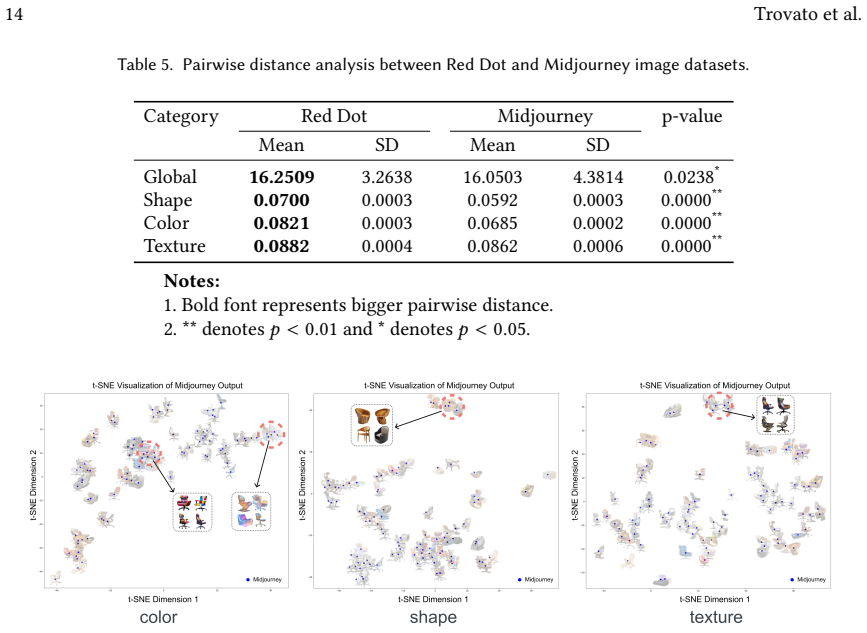
The carrying mechanism is the transfer of the human design-fixation construct onto generative models, made measurable by two operational devices. Text fixation is quantified by P_novelty = U/(U+S), the share of unique keyword types among all unique and shared types extracted from chair-design descriptions. Image fixation is quantified by pairwise distances between CLIP-ViT embeddings (image features from a vision-language encoder) for global, shape, color, and texture attributes, compared across datasets with the Mann-Whitney U test and visualized with t-SNE clustering. The experimental setting, an office-chair co-ideation session with the CombinatorX combinational-creativity method offered as an optional scaffold, supplies the context in which fixation is expected to appear.
What would settle it
Run the same office-chair task with a sample of novice human designers producing their own text descriptions and concept sketches in the lab, then compute P_novelty and pairwise CLIP distances on those outputs; if the human sample shows no higher novelty or diversity than the ChatGPT and Midjourney outputs, the claim that GenAI is distinctively fixated would fail.
Extended reading notes
Core claim
GenAI design fixation is defined as "the state in which a Generative AI model restricts its design exploration of the generative space due to unconscious bias stemming from technical aspects and human factors, which limits the diversity and originality of the model's design output, leading to repetitive or constrained results." The paper's discovery is that this state can be observed in practice: ChatGPT-generated chair descriptions had a novelty proportion (P_novelty) of 67.4% versus 78.2% for Red Dot descriptions, and Midjourney-generated images had significantly smaller pairwise distances than the human award-winning images on global, shape, color, and texture attributes. From the text data the authors identify four fixation manifestations (descriptive statements, repetitive themes, limited contextual variation, dependence on high-frequency words), and from the image data seven (including restricted shooting angles, surface-mapping generation patterns, restrained response to prompts, and dependence on high-frequency visual motifs). These observations ground the paper's proposal that the GenAI design fixation lens should inform creativity-support tool design and evaluation.
Load-bearing premise
The load-bearing premise is that Red Dot award-winning chair designs are a valid stand-in for the diversity of ordinary human design output; because award winners are chosen for distinction, they may set a bar that makes any AI output look fixated by comparison.
Editorial extensions
If this is right
- Creativity support tools built on generative AI should be evaluated for whether they induce or amplify fixation, not only for usability and output quality.
- Mitigation strategies can target the source (more balanced training data), the method (multi-agent collaboration, analogies, human-AI iteration), or the interaction (flagging flaws, adjustable randomness, prompt guidance).
- The lens predicts that novice designers, who tend to accept generated output uncritically, are especially vulnerable to converging on the model's repetitive solutions.
- Because fixation can also be beneficial for speed, consistency, and adherence to proven solutions, designers may need to trade diversity against efficiency rather than eliminate fixation entirely.
Reading between the lines
- If frequency dependence is the mechanism, then corpus statistics of a model's training data could predict where fixation will appear, allowing designers to screen for it before running user studies; this is an extension the paper does not pursue.
- The Red Dot baseline likely overstates human diversity because award winners are selected for distinction; measuring the same metrics on ordinary, unselected human ideation would give a fairer effect size.
- A direct test of generality would be to run the same chair task with different model families and model versions, checking whether the fixation patterns hold across architectures and training distributions.
Editorial analysis
A structured set of objections, weighed in public.
Referee Report
Summary. The paper introduces the concept of "GenAI design fixation," defined as a state in which a generative AI model restricts its exploration of the generative design space because of unconscious bias from technical and human factors, leading to repetitive or constrained outputs. The authors develop a theoretical framework of causes, manifestations, impacts, and mitigations, and report an exploratory study in which ten novice designers used ChatGPT and Midjourney to generate office chair designs. The quantitative analyses compare text keyword novelty and CLIP-based image diversity of AI outputs against 105 Red Dot award-winning chair designs, while qualitative data come from semi-structured interviews and observed design sessions. The central claim is that generative AI exhibits design fixation that limits novelty and diversity, and the paper proposes design strategies and evaluation metrics for future creativity support tools.
Significance. If the central claim were established, the proposed lens could provide a useful organizing framework for HCI research on GenAI creativity limitations and for the design of creativity support tools. The paper's conceptual contribution is a clear definition and a structured taxonomy of potential manifestations, and the qualitative vignettes (e.g., P7's neck brace failure and P2's puzzle chair) are intuitively compelling illustrations of perceived output repetition. The authors also usefully connect to prior homogenization and design fixation literature. However, the quantitative evidence is not currently strong enough to carry the paper's central claim: the human baseline is not matched to the AI generation task, the statistical tests have independence and sample-size problems, and the small exploratory sample limits generality. The paper does not provide code or data, so the quantitative comparisons cannot be independently checked. As an exploratory framework paper, it has value, but the empirical sections need substantial revision before the title-level claim is supported.
major comments (4)
- [Section 3.4.1, Sections 4.1 and 4.2] The Red Dot award-winning chair dataset is not a valid matched baseline for the AI-generation task. Award winners are curated for innovation and diversity, and their text descriptions are professionally written for juries, whereas the AI outputs come from novice-prompted, 30-minute lab sessions. Since all quantitative support for the fixation claim (P_novelty in Section 4.1 and pairwise CLIP distances in Table 5) is contrastive against this baseline, the observed gaps may reflect selection, curation, description length, and corpus size rather than a model-internal restriction of generative space. The paper needs either a matched human ideation baseline under the same task and time constraints or a substantially weakened claim that the study demonstrates perceived repetition in GenAI outputs rather than GenAI design fixation as a model property.
- [Table 3 and Eq. (1)] The proportion of novelty P_novelty is computed on item counts over corpora of different sizes and different total keyword counts: 105 Red Dot entries versus 96 ChatGPT entries, and 398 versus 266 keyword items. Unique-word counts grow with corpus and vocabulary size, so the observed difference (78.2% vs 67.4%) may be largely a size artifact. The analysis should use matched sample sizes, normalized diversity measures, or a permutation procedure that accounts for differing corpus sizes.
- [Section 4.2, Table 5] The Mann-Whitney U test is applied to within-dataset pairwise distances that are not independent because each image contributes to many distances, so the reported p-values are anticonservative. Moreover, the global feature means differ only slightly (16.25 vs 16.05) with overlapping and even larger standard deviations for Midjourney, so the claim of lower diversity in AI-generated images is not robust. The authors should use an appropriate permutation or bootstrap test at the image level and report effect sizes with confidence intervals.
- [Section 2, Section 4.3, Section 6.3] The definition asserts that GenAI design fixation stems from "unconscious bias stemming from technical aspects and human factors," but the experiment does not separate technical from human causes. The interview data measure participants' perceptions of repetition after a single session, and the observed output regularities are correlational. The causal language should be reframed as hypotheses, and the empirical contribution should be presented as an exploratory demonstration of perceived manifestations rather than proof of the proposed mechanism.
minor comments (6)
- [Abstract] The sentence "we propose a theoretical framework includes the definition" should read "that includes," and "GenAI similarly experience" should be "GenAI similarly experiences."
- [Section 6.1.3] The heading and the first sentence refer to "GenAI hallucination" where the text is about "GenAI bias"; this appears to be a copy-paste error and should be corrected.
- [Table 5] The p-values are reported as 0.0000; the actual values should be reported, and multiple-comparison correction should be considered given that four attributes are tested.
- [Section 5.1] The text "divided into soucre, methods and instructions" contains a typo; it should read "sources, methods, and instructions."
- [Section 3.4.2 and Section 4.3] The qualitative analysis does not describe a coding scheme, inter-rater reliability, or a transparent procedure for deriving the manifestation categories, which makes the thematic results difficult to audit.
- [General] No data or code availability statement is provided; releasing anonymized prompts, outputs, and analysis scripts would materially improve reproducibility.
Circularity Check
Mild self-definitional overlap in the manifestation taxonomy; the central quantitative claim is externally benchmarked and not circular.
-
self definitional
[Section 2 definition; Section 4.1 and Table 4]
"GenAI design fixation is the state in which a Generative AI model restricts its design exploration ... leading to repetitive or constrained results. ... Based on the quantitative analysis above and the manual analysis by two of the researchers, we categorized the design fixation in text generation models into four dimensions: ... Repetitive theme ... Susceptibility to high-frequency words."
The construct is defined by its predicted symptom ('leading to repetitive or constrained results'), and the empirical 'manifestations' are induced from the same experimental outputs (e.g., 'Repetitive theme', 'Dependency on high-frequency words'). The observation that outputs are repetitive is therefore partly entailed by the definition rather than providing independent confirmation of the hypothesized underlying 'state' of GenAI fixation. The comparison to Red Dot data and participant interviews supply additional, non-circular evidence, so the overlap is partial and not the sole support for the claim.
full rationale
The quantitative support for the central claim is contrastive against an external benchmark (Red Dot award-winning chair designs), not a fitted parameter or an author-derived uniqueness theorem. P_novelty and pairwise CLIP distances are descriptive statistics with a stated external comparison; their validity is questionable due to unmatched baseline and corpus-size effects, but that is a methodological limitation rather than circularity. The self-citations (CombinatorX [12], DesignFusion [11]) are used for the experimental scaffold and keyword-extraction procedure and are not load-bearing evidence for the existence of GenAI design fixation. The chief circularity concern is the definition-to-taxonomy overlap: the qualitative manifestation categories in Tables 4 and 6 are induced from the same sessions that the framework then interprets, so these categories partly restate the definition's predicted symptoms. Participant interviews (7/10 and 8/10 noticing repetition) and the external Red Dot comparisons give the paper some independent empirical content, so the paper is only mildly circular rather than a derivation that reduces by construction.
Assumptions & free parameters
assumptions (4)
- domain assumption The analogy between human design fixation and GenAI behavior is valid enough to transfer the concept.
- domain assumption Red Dot award-winning chair designs are a representative and comparable baseline of human design diversity for office chair design.
- domain assumption The selected CLIP attention heads, specifically Layer 22 Head 1, Layer 22 Head 11, and Layer 23 Head 12, yield valid semantic attributes for shape, color, and texture in chair images.
- domain assumption Manual keyword extraction and categorization by two authors, without reported inter-rater reliability, produce unbiased measures of design description content.
invented entities (1)
-
GenAI design fixation
Cite this review
Pith. "Pith review of Understanding Design Fixation in Generative AI." pith.science (2026). https://pith.science/paper/7K6MQ7X5
@misc{pith2026250205870,
  author       = {Pith},
  title        = {Pith review of: Understanding Design Fixation in Generative AI},
  year         = {2026},
  howpublished = {\url{https://pith.science/paper/7K6MQ7X5}},
  note         = {Machine review of arXiv:2502.05870}
}
read the original abstract
Generative AI (GenAI) provides new opportunities for creativity support, but the phenomenon of GenAI design fixation remains underexplored. While human design fixation typically constrains ideas to familiar or existing solutions, our findings reveal that GenAI similarly experience design fixation, limiting its ability to generate novel and diverse design outcomes. To advance understanding of GenAI design fixation, we propose a theoretical framework includes the definition, causes, manifestations, and impacts of GenAI design fixation for creative design. We also conducted an experimental study to investigate the characteristics of GenAI design fixation in practice. We summarize how GenAI design fixation manifests in text generation model and image generation model respectively. Furthermore, we propose methods for mitigating GenAI design fixation for future creativity support tool design. We recommend adopting the lens of GenAI design fixation for creativity-oriented HCI research, as the unique perspectives and insights it provides.
Figures


Figures from the paper (3 more)


Forward citations
Cited by 1 Pith paper
-
"Code Is Cheap. Show Me the Talk.": Lessons from Teaching and Managing AI Coding Tool Usage in a Visualization Course
In a CS visualization course, AI coding labs showed refinement as half of student prompts, explanation nearly absent, optional AI preferred by only 56%, and final projects more polished but visually homogeneous.
Reference graph
Works this paper leans on
-
[1]
Leyla Alipour, Mohsen Faizi, Asghar Mohammad Moradi, and Gholamreza Akrami. 2018. A review of design fixation: Research directions and key factors. International Journal of Design Creativity and Innovation 6, 1-2 (2018), 22–35. 26 Trovato et al
work page 2018
-
[2]
Barrett R Anderson, Jash Hemant Shah, and Max Kreminski. 2024. Evaluating Creativity Support Tools via Homogenization Analysis. In Extended Abstracts of the CHI Conference on Human Factors in Computing Systems . 1–7
work page 2024
-
[3]
Barrett R Anderson, Jash Hemant Shah, and Max Kreminski. 2024. Homogenization effects of large language models on human creative ideation. In Proceedings of the 16th Conference on Creativity & Cognition . 413–425
work page 2024
-
[4]
Emily M Bender and Alexander Koller. 2020. Climbing towards NLU: On meaning, form, and understanding in the age of data. In Proceedings of the 58th annual meeting of the association for computational linguistics . 5185–5198
work page 2020
-
[5]
Jesse Josua Benjamin, Arne Berger, Nick Merrill, and James Pierce. 2021. Machine learning uncertainty as a design material: A post-phenomenological inquiry. In Proceedings of the 2021 CHI conference on human factors in computing systems . 1–14
2021
-
[6]
Merim Bilalić, Peter McLeod, and Fernand Gobet. 2008. Why good thoughts block better ones: The mechanism of the pernicious Einstellung (set) effect. Cognition 108, 3 (2008), 652–661
work page 2008
-
[7]
Margaret A Boden. 2004. The creative mind: Myths and mechanisms
work page 2004
-
[8]
Tom B Brown. 2020. Language models are few-shot learners. arXiv preprint arXiv:2005.14165 (2020)
arXiv 2020
Show all 77 references
-
[9]
Hui Cai, Ellen Yi-Luen Do, and Craig M Zimring. 2010. Extended linkography and distance graph in design evaluation: an empirical study of the dual effects of inspiration sources in creative design. Design studies 31, 2 (2010), 146–168
2010
-
[10]
Tuhin Chakrabarty, Philippe Laban, Divyansh Agarwal, Smaranda Muresan, and Chien-Sheng Wu. 2024. Art or artifice? large language models and the false promise of creativity. InProceedings of the CHI Conference on Human Factors in Computing Systems . 1–34
2024
-
[11]
Liuqing Chen, Qianzhi Jing, Yixin Tsang, Qianyi Wang, Lingyun Sun, and Jianxi Luo. 2024. DesignFusion: Integrating Generative Models for Conceptual Design Enrichment. Journal of Mechanical Design 146, 11 (2024)
2024
-
[12]
Liuqing Chen, Yuan Zhang, Ji Han, Lingyun Sun, Peter Childs, and Boheng Wang. 2024. A foundation model enhanced approach for generative design in combinational creativity. Journal of Engineering Design (2024), 1–27
2024
-
[13]
Peiyao Cheng, Ruth Mugge, and Jan PL Schoormans. 2014. A new strategy to reduce design fixation: Presenting partial photographs to designers. Design Studies 35, 4 (2014), 374–391
2014
-
[14]
Hyunmin Cheong and LH Shu. 2013. Using templates and mapping strategies to support analogical transfer in biomimetic design. Design Studies 34, 6 (2013), 706–728
2013
-
[15]
DaEun Choi, Sumin Hong, Jeongeon Park, John Joon Young Chung, and Juho Kim. 2024. CreativeConnect: Supporting Reference Recombination for Graphic Design Ideation with Generative AI. In Proceedings of the CHI Conference on Human Factors in Computing Systems. 1–25
2024
-
[16]
John Joon Young Chung. 2022. Artistic user expressions in AI-powered creativity support tools. In Adjunct Proceedings of the 35th Annual ACM Symposium on User Interface Software and Technology . 1–4
2022
-
[17]
Nathan Crilly and Carlos Cardoso. 2017. Where next for research on fixation, inspiration and creativity in design? Design Studies 50 (2017), 1–38
2017
-
[18]
Anil R Doshi and Oliver Hauser. 2023. Generative artificial intelligence enhances creativity. A vailable at SSRN (2023)
2023
-
[19]
Anil R Doshi and Oliver P Hauser. 2024. Generative AI enhances individual creativity but reduces the collective diversity of novel content. Science Advances 10, 28 (2024), eadn5290
2024
-
[20]
Karl Duncker and Lynne S Lees. 1945. On problem-solving. Psychological monographs 58, 5 (1945), i
1945
-
[21]
Christof Ebert and Panos Louridas. 2023. Generative AI for software practitioners. IEEE Software 40, 4 (2023), 30–38
2023
-
[22]
Emilio Ferrara. 2023. Should chatgpt be biased? challenges and risks of bias in large language models. arXiv preprint arXiv:2304.03738 (2023)
2023 arXiv
-
[23]
Jonas Frich, Lindsay MacDonald Vermeulen, Christian Remy, Michael Mose Biskjaer, and Peter Dalsgaard. 2019. Mapping the landscape of creativity support tools in HCI. In Proceedings of the 2019 CHI Conference on Human Factors in Computing Systems . 1–18
2019
-
[24]
Jonas Frich, Michael Mose Biskjaer, and Peter Dalsgaard. 2018. Twenty years of creativity research in human-computer interaction: Current state and future directions. In Proceedings of the 2018 Designing Interactive Systems Conference . 1235–1257. Design Fixation in GenAI 27
2018
-
[25]
Yossi Gandelsman, Alexei A Efros, and Jacob Steinhardt. 2023. Interpreting CLIP’s Image Representation via Text-Based Decomposition. arXiv preprint arXiv:2310.05916 (2023)
2023 arXiv
-
[26]
Frederic Gmeiner, Humphrey Yang, Lining Yao, Kenneth Holstein, and Nikolas Martelaro. 2023. Exploring challenges and opportunities to support designers in learning to co-create with AI-based manufacturing design tools. In Proceedings of the 2023 CHI Conference on Human Factors...
2023
-
[27]
Gabriela Goldschmidt. 2011. Avoiding design fixation: transformation and abstraction in mapping from source to target. The Journal of creative behavior 45, 2 (2011), 92–100
2011
-
[28]
Jonathan Ho, Ajay Jain, and Pieter Abbeel. 2020. Denoising diffusion probabilistic models. Advances in neural information processing systems 33 (2020), 6840–6851
2020
-
[29]
Thomas J Howard, Anja Maier, Balder Onarheim, and Morten Friis-Olivarius. 2013. Overcoming design fixation through education and creativity methods. In 19th International Conference on Engineering Design . Design Society, 139–148
2013
-
[30]
steerability
Ali Jahanian, Lucy Chai, and Phillip Isola. 2019. On the" steerability" of generative adversarial networks. arXiv preprint arXiv:1907.07171 (2019)
2019 arXiv
-
[31]
David G Jansson and Steven M Smith. 1991. Design fixation. Design studies 12, 1 (1991), 3–11
1991
-
[32]
Ziwei Ji, Nayeon Lee, Rita Frieske, Tiezheng Yu, Dan Su, Yan Xu, Etsuko Ishii, Ye Jin Bang, Andrea Madotto, and Pascale Fung
-
[33]
Hyeonsu B Kang, David Chuan-En Lin, Nikolas Martelaro, Aniket Kittur, Yan-Ying Chen, and Matthew K Hong. 2024. BioSpark: An End-to-End Generative System for Biological-Analogical Inspirations and Ideation. InExtended Abstracts of the CHI Conference on Human Factors in Computin...
2024
-
[34]
If the Machine Is As Good As Me, Then What Use Am I?
Charlotte Kobiella, Yarhy Said Flores López, Franz Waltenberger, Fiona Draxler, and Albrecht Schmidt. 2024. " If the Machine Is As Good As Me, Then What Use Am I?"–How the Use of ChatGPT Changes Young Professionals’ Perception of Productivity and Accomplishment. In Proceedings...
2024
-
[35]
Bart Lamiroy and Emmanuelle Potier. 2022. Lamuse: Leveraging Artificial Intelligence for Sparking Inspiration. In International Conference on Computational Intelligence in Music, Sound, Art and Design (Part of EvoStar) . Springer, 148–161
2022
-
[36]
Soohwan Lee, Seoyeong Hwang, and Kyungho Lee. 2024. Conversational Agents as Catalysts for Critical Thinking: Challenging Design Fixation in Group Design. arXiv preprint arXiv:2406.11125 (2024)
2024 arXiv
-
[37]
Jingyi Li, Eric Rawn, Jacob Ritchie, Jasper Tran O’Leary, and Sean Follmer. 2023. Beyond the Artifact: Power as a Lens for Creativity Support Tools. In Proceedings of the 36th Annual ACM Symposium on User Interface Software and Technology . 1–15
2023
-
[38]
Yangming Li, Kaisheng Yao, Libo Qin, Wanxiang Che, Xiaolong Li, and Ting Liu. 2020. Slot-consistent NLG for task-oriented dialogue systems with iterative rectification network. InProceedings of the 58th annual meeting of the association for computational linguistics. 97–106
2020
-
[39]
David Chuan-En Lin and Nikolas Martelaro. 2024. Jigsaw: Supporting Designers to Prototype Multimodal Applications by Chaining AI Foundation Models. In Proceedings of the CHI Conference on Human Factors in Computing Systems . 1–15
2024
-
[40]
Julie S Linsey, Arthur B Markman, and Kristin L Wood. 2012. Design by analogy: A study of the WordTree method for problem re-representation. (2012)
2012
-
[41]
Julie S Linsey, Ian Tseng, Katherine Fu, Jonathan Cagan, Kristin L Wood, and Christian Schunn. 2010. A study of design fixation, its mitigation and perception in engineering design faculty. (2010)
2010
-
[42]
Fang Liu, Junyan Lv, Shenglan Cui, Zhilong Luan, Kui Wu, and Tongqing Zhou. 2024. Smart" Error"! Exploring Imperfect AI to Support Creative Ideation. Proceedings of the ACM on Human-Computer Interaction 8, CSCW1 (2024), 1–28
2024
-
[43]
Qinghan Liu, Yiyong Zhou, Jihao Huang, and Guiquan Li. 2024. When ChatGPT is gone: Creativity reverts and homogeneity persists. arXiv preprint arXiv:2401.06816 (2024)
2024 arXiv
-
[44]
Vivian Liu and Lydia B Chilton. 2022. Design guidelines for prompt engineering text-to-image generative models. In Proceedings of the 2022 CHI conference on human factors in computing systems . 1–23. 28 Trovato et al
2022
-
[45]
Abraham S Luchins and Edith Hirsch Luchins. 1959. Rigidity of behavior: A variational approach to the effect of Einstellung. (1959)
1959
-
[46]
Jianxi Luo, Serhad Sarica, and Kristin L Wood. 2019. Computer-aided design ideation using InnoGPS. In International design engineering technical conferences and computers and information in engineering conference , Vol. 59186. American Society of Mechanical Engineers, V02AT03A011
2019
-
[47]
Atefeh Mahdavi Goloujeh, Anne Sullivan, and Brian Magerko. 2024. Is It AI or Is It Me? Understanding Users’ Prompt Journey with Text-to-Image Generative AI Tools. In Proceedings of the CHI Conference on Human Factors in Computing Systems . 1–13
2024
-
[48]
Laura Manduchi, Kushagra Pandey, Robert Bamler, Ryan Cotterell, Sina Däubener, Sophie Fellenz, Asja Fischer, Thomas Gärtner, Matthias Kirchler, Marius Kloft, et al. 2024. On the challenges and opportunities in generative ai. arXiv preprint arXiv:2403.00025 (2024)
2024 arXiv
-
[49]
Tri Nguyen, Mir Rosenberg, Xia Song, Jianfeng Gao, Saurabh Tiwary, Rangan Majumder, and Li Deng. 2016. Ms marco: A human-generated machine reading comprehension dataset. (2016)
2016
-
[50]
Jeongseok Oh, Seungju Kim, and Seungjun Kim. 2024. LumiMood: A Creativity Support Tool for Designing the Mood of a 3D Scene. In Proceedings of the CHI Conference on Human Factors in Computing Systems . 1–21
2024
-
[51]
Vishakh Padmakumar and He He. 2023. Does Writing with Language Models Reduce Content Diversity? arXiv preprint arXiv:2309.05196 (2023)
2023 arXiv
-
[52]
Artidoro Pagnoni, Vidhisha Balachandran, and Yulia Tsvetkov. 2021. Understanding factuality in abstractive summarization with FRANK: A benchmark for factuality metrics. arXiv preprint arXiv:2104.13346 (2021)
2021 arXiv
-
[53]
Sashank Santhanam, Behnam Hedayatnia, Spandana Gella, Aishwarya Padmakumar, Seokhwan Kim, Yang Liu, and Dilek Hakkani-Tur. 2021. Rome was built in 1776: A case study on factual correctness in knowledge-grounded response generation. arXiv preprint arXiv:2110.05456 (2021)
2021 arXiv
-
[54]
Wout Schellaert, Fernando Martínez-Plumed, Karina Vold, John Burden, Pablo AM Casares, Bao Sheng Loe, Roi Reichart, Anna Korhonen, José Hernández-Orallo, et al. 2023. Your prompt is my command: on assessing the human-centred generality of multimodal models. Journal of Artifici...
2023
-
[55]
Feng Shi, Liuqing Chen, Ji Han, and Peter Childs. 2017. A data-driven text mining and semantic network analysis for design information retrieval. Journal of Mechanical Design 139, 11 (2017), 111402
2017
-
[56]
Steven M Smith, Thomas B Ward, and Jay S Schumacher. 1993. Constraining effects of examples in a creative generation task. Memory & cognition 21 (1993), 837–845
1993
-
[57]
Shuhan Tan, Yujun Shen, and Bolei Zhou. 2020. Improving the fairness of deep generative models without retraining. arXiv preprint arXiv:2012.04842 (2020)
2020 arXiv
-
[58]
Vera van der Burg, AA Akdag Salah, RSK Chandrasegaran, and PA Lloyd. 2022. Ceci n’est pas une Chaise:: Emerging Practices in Designer-AI Collaboration. In DRS 2022. Design Research Society
2022
-
[59]
Laurens Van der Maaten and Geoffrey Hinton. 2008. Visualizing data using t-SNE. Journal of machine learning research 9, 11 (2008)
2008
-
[60]
A Vaswani. 2017. Attention is all you need. Advances in Neural Information Processing Systems (2017)
2017
-
[61]
Samangi Wadinambiarachchi, Ryan M Kelly, Saumya Pareek, Qiushi Zhou, and Eduardo Velloso. 2024. The Effects of Generative AI on Design Fixation and Divergent Thinking. In Proceedings of the CHI Conference on Human Factors in Computing Systems . 1–18
2024
-
[62]
Zhijie Wang, Yuheng Huang, Da Song, Lei Ma, and Tianyi Zhang. 2024. PromptCharm: Text-to-Image Generation through Multi-modal Prompting and Refinement. In Proceedings of the CHI Conference on Human Factors in Computing Systems . 1–21
2024
-
[63]
Thomas B Ward. 1994. Structured imagination: The role of category structure in exemplar generation. Cognitive psychology 27, 1 (1994), 1–40
1994
-
[64]
Justin D Weisz, Jessica He, Michael Muller, Gabriela Hoefer, Rachel Miles, and Werner Geyer. 2024. Design Principles for Generative AI Applications. In Proceedings of the CHI Conference on Human Factors in Computing Systems . 1–22. Design Fixation in GenAI 29
2024
-
[65]
Justin D Weisz, Michael Muller, Jessica He, and Stephanie Houde. 2023. Toward general design principles for generative AI applications. arXiv preprint arXiv:2301.05578 (2023)
2023 arXiv
-
[66]
Sam Wiseman, Stuart M Shieber, and Alexander M Rush. 2017. Challenges in data-to-document generation. arXiv preprint arXiv:1707.08052 (2017)
2017 arXiv
-
[67]
Tongshuang Wu, Michael Terry, and Carrie Jun Cai. 2022. Ai chains: Transparent and controllable human-ai interaction by chaining large language model prompts. In Proceedings of the 2022 CHI conference on human factors in computing systems . 1–22
2022
-
[68]
Daeun Yoo and Jaewoo Joo. 2024. BI-CST: Behavioral Science-based Creativity Support Tool for Overcoming Design Fixation.. In Companion Publication of the 2024 ACM Designing Interactive Systems Conference . 116–120
2024
-
[69]
Robert J Youmans. 2011. The effects of physical prototyping and group work on the reduction of design fixation. Design studies 32, 2 (2011), 115–138
2011
-
[70]
JD Zamfirescu-Pereira, Richmond Y Wong, Bjoern Hartmann, and Qian Yang. 2023. Why Johnny can’t prompt: how non-AI experts try (and fail) to design LLM prompts. In Proceedings of the 2023 CHI Conference on Human Factors in Computing Systems . 1–21
2023
-
[71]
Chunting Zhou, Graham Neubig, Jiatao Gu, Mona Diab, Paco Guzman, Luke Zettlemoyer, and Marjan Ghazvininejad. 2020. Detecting hallucinated content in conditional neural sequence generation. arXiv preprint arXiv:2011.02593 (2020)
2020 arXiv
-
[72]
Jiayi Zhou, Renzhong Li, Junxiu Tang, Tan Tang, Haotian Li, Weiwei Cui, and Yingcai Wu. 2024. Understanding nonlinear collaboration between human and AI agents: A co-design framework for creative design. In Proceedings of the CHI Conference on Human Factors in Computing Systems . 1–16
2024
-
[73]
Mi Zhou, Vibhanshu Abhishek, Timothy Derdenger, Jaymo Kim, and Kannan Srinivasan. 2024. Bias in generative ai. arXiv preprint arXiv:2403.02726 (2024)
2024 arXiv
-
[74]
Yiyang Zhou, Chenhang Cui, Jaehong Yoon, Linjun Zhang, Zhun Deng, Chelsea Finn, Mohit Bansal, and Huaxiu Yao. 2023. Analyzing and mitigating object hallucination in large vision-language models. arXiv preprint arXiv:2310.00754 (2023)
2023 arXiv
-
[75]
Qihao Zhu and Jianxi Luo. 2023. Generative transformers for design concept generation. Journal of Computing and Information Science in Engineering 23, 4 (2023), 041003
2023
-
[76]
Qihao Zhu, Xinyu Zhang, and Jianxi Luo. 2023. Biologically inspired design concept generation using generative pre-trained transformers. Journal of Mechanical Design 145, 4 (2023), 041409
2023
-
[2023]
Survey of hallucination in natural language generation. Comput. Surveys 55, 12 (2023), 1–38
2023
Reviewed August 8, 2026 · model on record in the stance chip above.
Discussion (0). Continue with ORCID to comment.