REVIEW 4 major objections 4 minor 49 references
Optimized Gutzwiller Projected States for Doped Antiferromagnets in Fermi-Hubbard Simulators
T0 review · 4 major / 4 minor · reviewed 2026-08-07 · deepseek-v4-flash
Pith's one-line read This paper claims that finite-temperature resonating valence bond states, with only two optimized mean-field parameters, reproduce measured two- and three-point correlations in doped Fermi-Hubbard quantum simulators.
desk verdict Useful optimization pipeline for RVB states against quantum simulator data, but the doping-dependent parameter trends are underdetermined by the flat loss landscape. read the letter →
The pith
A machine-rendered reading of the paper's core claim, the machinery that carries it, and where it could break.
The reading
What carries the argument
The machinery is a finite-temperature RVB ansatz built from a quadratic mean-field Hamiltonian with staggered flux $\phi$ and a Néel field $h$; the thermal density matrix of this Hamiltonian is Gutzwiller-projected by restricting Monte Carlo configurations to singly occupied sites. Expectation values are estimated via Metropolis sampling over pairs of real-space and mean-field basis states, and gradients of the objective $L$ are computed from the same samples using finite differences. This lets the authors run gradient descent over the two-parameter landscape, whose arc-shaped valley explains why many parameter sets give nearly identical correlations. The key work of the machinery is to turn experimental snapshots into a handful of interpretable parameters while exposing which experimental correlations the ansatz cannot represent.
What would settle it
The claim would be refuted if a high-precision experiment and an unbiased numerical simulation of the Hubbard model agreed on a correlation—for instance a four-point correlator, or the sign of $C_Z$ at $d=\sqrt2$ for large hole doping on the square lattice—that no choice of $\phi$ and $T_{\mathrm{MF}}/J_{\mathrm{MF}}$ reproduces.
Extended reading notes
Core claim
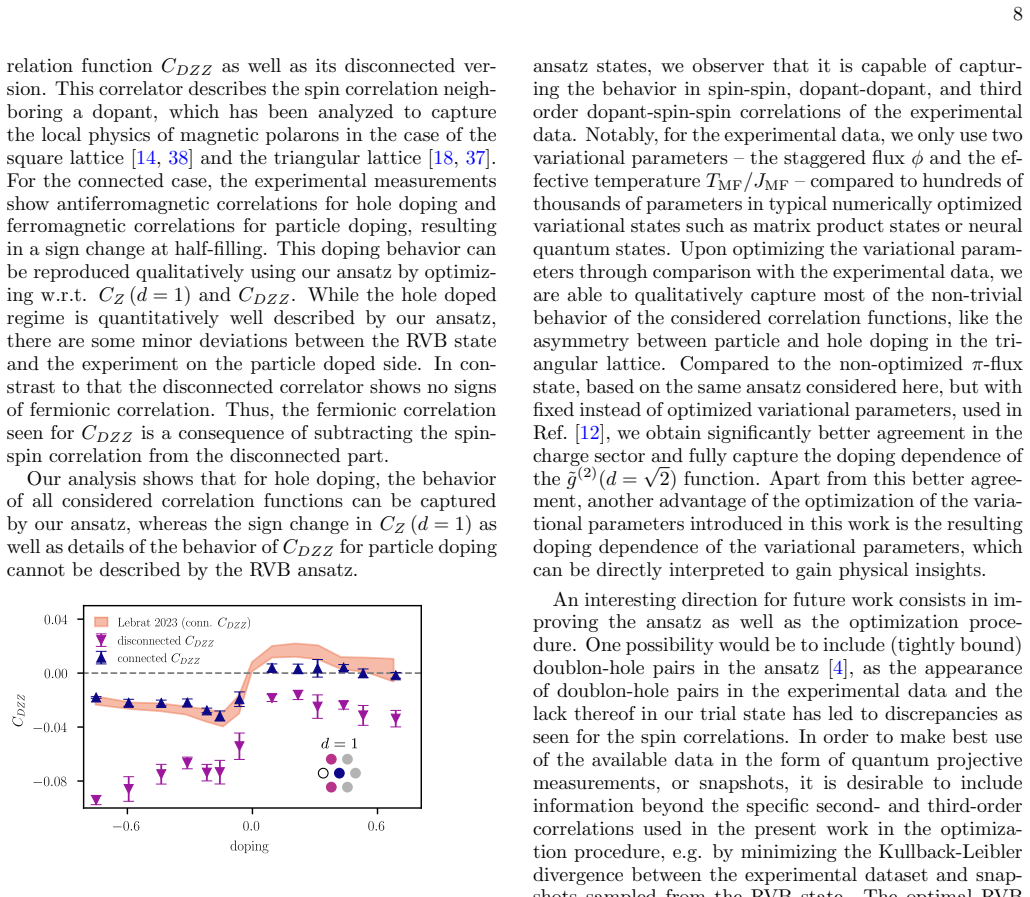
The central discovery is that a Gutzwiller-projected finite-temperature mean-field state, with the Néel field set to zero and only $\phi$ and $T_{\mathrm{MF}}/J_{\mathrm{MF}}$ varied, captures the measured two- and three-point correlations of Fermi-Hubbard quantum simulators. Using gradient descent with a Metropolis-sampled objective, the authors reproduce spin-spin correlations $C_Z$ at distances not used in the fit, the dopant-dopant function $\tilde g^{(2)}(d=\sqrt2)$, and the connected dopant-spin-spin correlator $C_{DZZ}$ on the triangular lattice. The optimized ratio $T_{\mathrm{MF}}/J_{\mathrm{MF}}$ rises with doping up to about 25% and then falls, consistent with a crossover from Heisenberg to free-fermion physics. The paper also reports where the ansatz fails: the sign change of $C_Z(d=\sqrt2)$ at large square-lattice doping and the ferromagnetic correlations on the particle-doped triangular lattice are not captured.
Load-bearing premise
The argument stands on the assumption that the real Fermi-Hubbard state at U/t of roughly 8–9 and T/J near 0.65–0.8 is well represented by a Gutzwiller-projected spin-liquid ansatz with no double occupancies and with the Néel field set to zero.
Editorial extensions
If this is right
- The optimized RVB states describe hole-doped correlations on the triangular lattice across the full measured doping range, including the three-point correlator $C_{DZZ}$.
- A fixed $\pi$-flux RVB state with unoptimized parameters performs noticeably worse in the charge sector, so parameter optimization is essential to capturing the measured $\tilde g^{(2)}(d=\sqrt2)$.
- The doping dependence of $T_{\mathrm{MF}}/J_{\mathrm{MF}}$ can be read as a physical crossover, with Heisenberg-like behavior near half-filling and free-fermion-like behavior at high doping.
- Because only two parameters are used, the ansatz offers an interpretable benchmark against which more complex variational states, such as those containing doublon-hole pairs, can be compared.
Reading between the lines
- The flat, arc-shaped optimization landscape means individual optimized parameters are not uniquely determined; physical conclusions should be drawn from the matched correlation functions rather than from the specific values of $\phi$ and $T_{\mathrm{MF}}/J_{\mathrm{MF}}$.
- The specific failures—the square-lattice $d=\sqrt2$ sign change and the particle-doped triangular lattice—suggest that physics outside the no-doublon spin-liquid picture, such as doublon-hole fluctuations or different magnetic order, becomes relevant in those regimes.
- The same optimization pipeline could be applied directly to other lattice geometries and to data from Rydberg tweezer arrays or $t$–$J$ models, searching for hidden RVB signatures.
- A natural extension is to optimize against the full distribution of experimental snapshots via the Kullback-Leibler divergence, rather than a small set of correlation functions, which would test whether the ansatz captures correlations beyond those studied here.
Editorial analysis
A structured set of objections, weighed in public.
Referee Report
Summary. The paper proposes a method to optimize the variational parameters of finite-temperature Gutzwiller-projected resonating-valence-bond (RVB) states against correlation functions measured in cold-atom Fermi-Hubbard quantum simulators. The ansatz is a staggered-flux (SF) or staggered-flux-plus-Néel (SFN) mean-field state with at most three parameters: the flux φ, the effective temperature TMF/JMF, and the Néel field h/JMF. The authors benchmark the gradient-descent optimizer on self-generated Monte Carlo data and on quantum Monte Carlo data for the Heisenberg model, then apply it to square-lattice and triangular-lattice experimental datasets. They report that the optimized RVB states reproduce two- and three-point correlation functions reasonably in the hole-doped regime, including a held-out distance on the square lattice, and they interpret the doping dependence of the optimized parameters as evidence for a possible underlying spin-liquid description.
Significance. If the correlation-capture claim survives scrutiny, this is a valuable demonstration that a very small number of physically motivated parameters can describe local correlations of the doped Fermi-Hubbard model at finite temperature, providing an interpretable alternative to high-dimensional variational states. The paper also contains honest benchmarks and an explicit discussion of the flat optimization landscape. The main strength is the comparison against QMC Heisenberg data and the held-out distance d=2 for the square lattice, which give independent support beyond simple fitting. The main weakness is that the optimized parameters are not identifiable from the flat loss landscape, which undermines the second central claim that the doping dependence of the parameters can be directly interpreted as physical insight.
major comments (4)
- [Section IV, Fig. 2] The benchmark on self-generated data shows that the optimizer cannot recover the true target parameters even when the reference data come from the same ansatz: the final parameters are 'significantly spread out' while the objective reaches values of order 10^-5. This confirms that the loss landscape contains a large low-loss manifold. Since the experimental analysis in Section V and the physical interpretation in Section VII rely on point estimates (φ, TMF/JMF) and their doping dependence, the paper must demonstrate that the reported doping trends are shared by the full low-loss manifold, rather than being artifacts of initialization and trajectory. I would like to see, for each doping, the distribution of optimized parameters over many runs together with a statement of which functionals of the parameters (if any) are stable across the manifold.
- [Section V, Eq. (8)] The objective function is an equally weighted sum of squared deviations over all observables and distances, with no treatment of experimental uncertainties or Monte Carlo sampling errors. In a flat landscape small changes in the objective can move the optimum substantially, so the reported optimized parameters are not well defined unless the sensitivity to the weighting scheme is quantified. For example, if one reweights CZ(d=1) relative to CZ(d=sqrt2) or CD(d=sqrt2), do the doping trends in Fig. 5B survive? Without such a sensitivity analysis, the 'physically meaningful' interpretation of the parameters is not supported.
- [Abstract and Section VI] The abstract states that finite-temperature data from Fermi-Hubbard quantum simulators 'can be well captured by RVB states,' and the introduction and conclusion repeat this broad claim. However, Section VI reports that for the triangular lattice at large particle doping the ansatz fails to reproduce the sign change in CZ(d=1) and also misses details of CDZZ in the intermediate particle-doped regime. The claim should be qualified to specify the regime in which the ansatz is successful, namely hole doping on both lattices and, on the square lattice, the investigated doping ranges. As written, the central claim overstates the evidence in the paper itself.
- [Section V, setting h/JMF=0] The paper justifies setting h/JMF=0 for the experimental analyses by stating that at T/J≈0.65–0.8 the optimized h/TMF is very small based on the QMC benchmark in Section IV. This is not quantitatively demonstrated: Fig. 3B shows a monotonic decrease of h/TMF with T/J, but at T/J=0.7 the value appears to be a sizable fraction of the range shown. Please provide the actual optimized h/TMF values from the benchmark for the relevant T/J window, or explicitly state the threshold below which h/JMF is deemed negligible. Without this, the reduction to 'only two variational parameters' for the experimental fits is not fully justified.
minor comments (4)
- [Throughout] There are several typographical issues, including inconsistent spacing in 'R VB', nonstandard accents such as 'N´ eel' and 'Ans¨ atze', and occasional grammatical slips. These should be corrected in a final revision.
- [Section V, Fig. 4 caption] The caption says the SF state captures CZ(d) for all distances considered 'even if we do not consider a given distance in the optimization as for d=2 and [25].' For the [25] dataset, both d=1 and d=sqrt2 are used in the optimization, so the held-out claim applies only to d=2 for the [12] dataset. Please clarify the wording.
- [Section V, around Eq. (16)] The comparison to the non-optimized π-flux state would benefit from a precise definition of that state and from a statement of whether its parameters are fixed to φ=π and TMF/JMF=T/J in all datasets, or only for the Chiu et al. data.
- [Section III, Eqs. (8)-(10)] The paper does not provide details on the number of Monte Carlo samples, the Metropolis proposal, the step size for finite-difference gradients, or the stopping criterion. Since the method is a central contribution, these numerical details should be reported for reproducibility.
Circularity Check
The three-point correlator CDZZ is used in the objective function, so the abstract's claim that it is captured 'even when not specifically used' is a fit presented as a prediction; the central fitting study otherwise has genuine held-out and QMC checks.
-
fitted input called prediction
[Abstract; Sec. VI (Eq. 8 and Fig. 7 caption)]
"Abstract: 'We find that the resulting RVB states are capable of capturing two- as well as three-point correlations measured in experiments, even when they are not specifically used in the optimization.' Fig. 7 caption: 'Optimizing with respect to both the spin-spin correlations and measurements of CDZZ , we observe that the spin-spin correlation next to a dopant CDZZ as defined in Eq. (17) can be qualitatively captured by our ansatz.'"
In the triangular-lattice analysis, CDZZ is one of the reference observables entering the objective L in Eq. (8), not a held-out quantity: Sec. VI states 'we consider CZ for d=1 and CDZZ ... from Ref. [18] as reference data' and Fig. 7 confirms the optimization is performed 'with respect to both the spin-spin correlations and measurements of CDZZ.' Agreement on CDZZ is therefore minimized, not predicted. The abstract's 'even when they are not specifically used in the optimization' is thus not satisfied for the three-point correlator; that part of the claimed capability reduces by construction to the fitted inputs. The paper does contain genuine held-out checks elsewhere (e.g., QMC distances not in L), so the circularity is partial.
full rationale
The paper is primarily a fitting study: phi and TMF/JMF are adjusted to minimize L over a set of experimental correlations, and agreement on those included distances is expected from the optimization rather than being an independent prediction. The abstract overstates the case by implying that three-point correlations are captured even when not used in the optimization, whereas CDZZ is explicitly part of the objective for the triangular-lattice data; that specific claim is a fitted input presented as a prediction. However, the method is validated against external QMC data with held-out distances (Sec. IV, Fig. 3A: 'we only use d=1 and sqrt8 in the optimization'), and comparisons at distances not included in the objective provide real, non-circular evidence for the expressiveness of the RVB ansatz. The benchmark in Fig. 2 additionally shows that the optimized parameters are not uniquely identifiable, undermining the physical interpretation of the doping dependence of TMF/JMF, but this is an identifiability limitation, not a circular derivation. Overall, one central claim is partially circular, while the core fitting-plus-held-out-check structure retains independent content.
Assumptions & free parameters
free parameters (3)
- phi (staggered flux) =
optimized per doping, not reported as a single numeric value; trends shown in figures
- TMF/JMF (effective mean-field temperature) =
optimized per doping, values roughly 1 to 4 (see Fig. 5B)
- h/JMF (Néel field) =
set to 0 for experimental data; optimized in benchmarks
assumptions (5)
- domain assumption The Fermi-Hubbard model at U/t approximately 8 to 9 is well approximated by t-J type physics, justifying the Gutzwiller-projected RVB ansatz.
- domain assumption Finite-temperature states are represented by thermally occupying Slater eigenstates of the mean-field Hamiltonian, then Gutzwiller projecting.
- domain assumption Doublon-hole pairs in experimental images appear as nearest-neighbor empty sites and can be excluded from dopant correlations.
- ad hoc to paper Equally weighted squared deviations over the chosen distances and observables is a suitable objective for determining physically meaningful parameters.
- standard math Standard Monte Carlo sampling and gradient estimation converge without significant bias.
Cite this review
Pith. "Pith review of Optimized Gutzwiller Projected States for Doped Antiferromagnets in Fermi-Hubbard Simulators." pith.science (2026). https://pith.science/paper/7LOQTJJF
@misc{pith2026250611227,
  author       = {Pith},
  title        = {Pith review of: Optimized Gutzwiller Projected States for Doped Antiferromagnets in Fermi-Hubbard Simulators},
  year         = {2026},
  howpublished = {\url{https://pith.science/paper/7LOQTJJF}},
  note         = {Machine review of arXiv:2506.11227}
}
read the original abstract
In quantum many-body physics, one aims to understand emergent phenomena and effects of strong interactions, ideally by developing a simple theoretical picture. Recently, progress in quantum simulators has enabled the measurement of site resolved snapshots of Fermi-Hubbard systems at finite doping on square as well as triangular lattice geometries. These experimental advances pose the quest for theorists to analyze the ensuing data in order to gain insights into these prototypical, strongly correlated many-body systems. Here we employ machine learning techniques to optimize the mean-field parameters of a resonating valence bond (RVB) state through comparison with experimental data, thus determining a possible underlying simple model that is physically motivated and fully interpretable. We find that the resulting RVB states are capable of capturing two- as well as three-point correlations measured in experiments, even when they are not specifically used in the optimization. The analysis of the mean-field parameters and their doping dependence can be used to obtain physical insights and shed light on the nature of possible underlying quantum spin liquid states. Our results show that finite temperature data from Fermi-Hubbard quantum simulators can be well captured by RVB states. This work paves the way for a new, systematic analysis of data from numerical as well as quantum simulation of strongly correlated quantum many-body systems.
Figures


Figures from the paper (3 more)


Reference graph
Works this paper leans on
-
[1]
zero temperature square lattice
-
[2]
finite temperature square lattice
-
[3]
finite temperature triangular lattice. For case 1 we set TMF/JMF = 0 and for case 3 h/JMF = 0, while optimizing with respect to the remain- ing parameters. We construct the objective function us- ing the spin-spin correlation function averaged over Nn sites at distance d CS (|d|) = 1 Nn X i,d D ˆSi · ˆSi+d E . (13) In order to account for short and longer...
-
[4]
M. C. Gutzwiller, Phys. Rev. Lett. 10, 159 (1963)
1963
-
[5]
The data from both ex- FIG. 6. CZ in the triangular lattice F ermi-Hubbard model. We optimize our ansatz with respect to [18] and [25]. For the triangular lattice, the spin-spin correlation defined in Eq. (14) shows a particle-hole asymmetry. Within our ansatz, we are able to capture some part of this asymmetry, like the overall shape as well as the diffe...
-
[6]
function. Apart from this better agree- ment, another advantage of the optimization of the varia- tional parameters introduced in this work is the resulting doping dependence of the variational parameters, which can be directly interpreted to gain physical insights. An interesting direction for future work consists in im- proving the ansatz as well as the...
2020
-
[7]
J. G. Bednorz and K. A. M¨ uller, Zeitschrift f¨ ur Physik B Condensed Matter 64, 189 (1986)
1986
-
[8]
P. W. Anderson, Science 235, 1196 (1987)
1987
Show all 49 references
-
[9]
P. W. Anderson, Materials Research Bulletin 8, 153 (1973)
1973
-
[10]
Qin, C.-M
M. Qin, C.-M. Chung, H. Shi, E. Vitali, C. Hubig, U. Schollw¨ ock, S. R. White, and S. Zhang, Physical Re- view X 10 (2020), 10.1103/physrevx.10.031016
2020 doi
-
[11]
Gros, Annals of Physics 189, 53 (1989)
C. Gros, Annals of Physics 189, 53 (1989)
1989
-
[12]
with total spin S = 0. In particular, we directly ap- ply the Gutzwiller projection ˆPG by only allowing singly occupied sites in the real space configurations |αr⟩ during the Monte Carlo sampling procedure, thus accessing the state ˆρ = 1 Z ˆPG X αk |αk⟩ ⟨αk| e−βMFEαk ! ˆPG, ...
-
[13]
Paramekanti, M
A. Paramekanti, M. Randeria, and N. Trivedi, Phys. Rev. Lett. 87, 217002 (2001)
2001
-
[14]
Paramekanti, M
A. Paramekanti, M. Randeria, and N. Trivedi, Phys. Rev. B 70, 054504 (2004)
2004
-
[15]
P. W. Anderson, P. A. Lee, M. Randeria, T. M. Rice, N. Trivedi, and F. C. Zhang, Journal of Physics: Con- densed Matter 16, R755 (2004)
2004
-
[16]
Edegger, V
B. Edegger, V. N. Muthukumar, and C. Gros, Advances in Physics 56, 927 (2007)
2007
-
[17]
Xu, C.-M
H. Xu, C.-M. Chung, M. Qin, U. Schollw¨ ock, S. R. White, and S. Zhang, Science 384 (2024), 10.1126/sci- ence.adh7691
2024 doi
-
[18]
C. S. Chiu, G. Ji, A. Bohrdt, M. Xu, M. Knap, E. Demler, F. Grusdt, M. Greiner, and D. Greif, Science 365, 251 (2019)
2019
-
[19]
Bohrdt, C
A. Bohrdt, C. S. Chiu, G. Ji, M. Xu, D. Greif, M. Greiner, E. Demler, F. Grusdt, and M. Knap, Nature Physics 15, 921 (2019), 1811.12425
2019 arXiv
-
[20]
Koepsell, D
J. Koepsell, D. Bourgund, P. Sompet, S. Hirthe, A. Bohrdt, Y. Wang, F. Grusdt, E. Demler, G. Salomon, C. Gross, and I. Bloch, Science 374, 82–86 (2021)
2021
-
[21]
Gross and I
C. Gross and I. Bloch, Science 357, 995 (2017)
2017
-
[22]
Bohrdt, L
A. Bohrdt, L. Homeier, C. Reinmoser, E. Demler, and F. Grusdt, Annals of Physics 435, 168651 (2021), 2107.08043
2021 arXiv
-
[23]
Semeghini, H
G. Semeghini, H. Levine, A. Keesling, S. Ebadi, T. T. Wang, D. Bluvstein, R. Verresen, H. Pichler, M. Kali- nowski, R. Samajdar, A. Omran, S. Sachdev, A. Vish- wanath, M. Greiner, V. Vuleti´ c, and M. D. Lukin, Sci- ence 374, 1242–1247 (2021)
2021
-
[24]
Lebrat, M
M. Lebrat, M. Xu, L. H. Kendrick, A. Kale, Y. Gang, P. Seetharaman, I. Morera, E. Khatami, E. Demler, and M. Greiner, Nature 629, 317 (2024)
2024
-
[25]
Wen, Physical Review B 65, 165113 (2002)
X.-G. Wen, Physical Review B 65, 165113 (2002)
2002
-
[26]
Becca and S
F. Becca and S. Sorella, Quantum Monte Carlo Ap- proaches for Correlated Systems(Cambridge University Press, Cambridge, 2017)
2017
-
[27]
Metropolis, A
N. Metropolis, A. W. Rosenbluth, M. N. Rosenbluth, A. H. Teller, and E. Teller, The Journal of Chemical Physics 21, 1087 (1953)
1953
-
[28]
Dalla Piazza, Theories of Experimentally Observed Excitation Spectra of Square Lattice Antiferromagnets, Ph.D
B. Dalla Piazza, Theories of Experimentally Observed Excitation Spectra of Square Lattice Antiferromagnets, Ph.D. thesis, EPFL, Lausanne (2014)
2014
-
[29]
A. W. Sandvik, Phys. Rev. B 59, R14157 (1999)
1999
-
[30]
Wen and P
X.-G. Wen and P. A. Lee, Physical Review Letters 76, 503 (1996)
1996
-
[31]
M. Xu, L. H. Kendrick, A. Kale, Y. Gang, G. Ji, R. T. Scalettar, M. Lebrat, and M. Greiner, Nature 620, 971 (2023)
2023
-
[32]
Drescher, L
M. Drescher, L. Vanderstraeten, R. Moessner, and F. Pollmann, Phys. Rev. B 108, L220401 (2023)
2023
-
[33]
O. I. Motrunich, Phys. Rev. B 72, 045105 (2005)
2005
-
[34]
S.-S. Gong, W. Zhu, J.-X. Zhu, D. N. Sheng, and K. Yang, Phys. Rev. B 96, 075116 (2017)
2017
-
[35]
Cookmeyer, J
T. Cookmeyer, J. Motruk, and J. E. Moore, Phys. Rev. Lett. 127, 087201 (2021)
2021
-
[36]
B.-B. Chen, Z. Chen, S.-S. Gong, D. N. Sheng, W. Li, and A. Weichselbaum, Phys. Rev. B 106, 094420 (2022)
2022
-
[37]
Schl¨ omer, T
H. Schl¨ omer, T. A. Hilker, I. Bloch, U. Schollw¨ ock, F. Grusdt, and A. Bohrdt, Communications Materials 4, 64 (2023)
2023
-
[38]
Ghorbani, L
E. Ghorbani, L. F. Tocchio, and F. Becca, Physical Re- view B 93, 085111 (2016)
2016
-
[39]
Iqbal, W.-J
Y. Iqbal, W.-J. Hu, R. Thomale, D. Poilblanc, and F. Becca, Physical Review B 93, 144411 (2016)
2016
-
[40]
Weber, A
C. Weber, A. L¨ auchli, F. Mila, and T. Giamarchi, Phys- ical Review B 73, 014519 (2006)
2006
-
[41]
J. Yang, L. Liu, J. Mongkolkiattichai, and P. Schauss, PRX Quantum 2, 020344 (2021)
2021
-
[42]
Mongkolkiattichai, L
J. Mongkolkiattichai, L. Liu, D. Garwood, J. Yang, and P. Schauss, Phys. Rev. A 108, L061301 (2023)
2023
-
[43]
M. L. Prichard, B. M. Spar, I. Morera, E. Demler, Z. Z. Yan, and W. S. Bakr, Nature 629, 323 (2024)
2024
-
[44]
Koepsell, J
J. Koepsell, J. Vijayan, P. Sompet, F. Grusdt, T. A. Hilker, E. Demler, G. Salomon, I. Bloch, and C. Gross, Nature 572, 358 (2019)
2019
-
[45]
E. R. Bennewitz, F. Hopfmueller, B. Kulchytskyy, J. Car- rasquilla, and P. Ronagh, Nature Machine Intelligence 10 4, 618 (2022)
2022
-
[46]
Czischek, M
S. Czischek, M. S. Moss, M. Radzihovsky, E. Merali, and R. G. Melko, Physical Review B 105, 205108 (2022), 2203.04988
2022 arXiv
-
[47]
M. S. Moss, S. Ebadi, T. T. Wang, G. Semeghini, A. Bohrdt, M. D. Lukin, and R. G. Melko, Phys. Rev. A 109, 032410 (2024)
2024
-
[48]
Lange, G
H. Lange, G. Bornet, G. Emperauger, C. Chen, T. La- haye, S. Kienle, A. Browaeys, and A. Bohrdt, (2024), arXiv:2406.00091 [cond-mat.dis-nn]
2024 arXiv
-
[49]
E. J. K¨ onig, Y. Komijani, and P. Coleman, Phys. Rev. B 105, 075142 (2022)
2022
Reviewed August 7, 2026 · model on record in the stance chip above.
Discussion (0). Continue with ORCID to comment.