REVIEW 3 major objections 5 minor 20 references
Automorphisms of the generalised Thompson's group $T_{n,r}$
T0 review · 3 major / 5 minor · reviewed 2026-08-14 · deepseek-v4-flash
Pith's one-line read The paper proves that the automorphism group of every generalized Thompson group $T_{n,r}$ consists precisely of the finite, bi-synchronizing transducers that preserve the cyclic order on the circle, and derives the structure of the outer…
desk verdict Completes the automorphism program for T_{n,r}, but the main proof hinges on an unproven proposition in the unpublished BCMNO preprint. read the letter →
The pith
A machine-rendered reading of the paper's core claim, the machinery that carries it, and where it could break.
The reading
What carries the argument
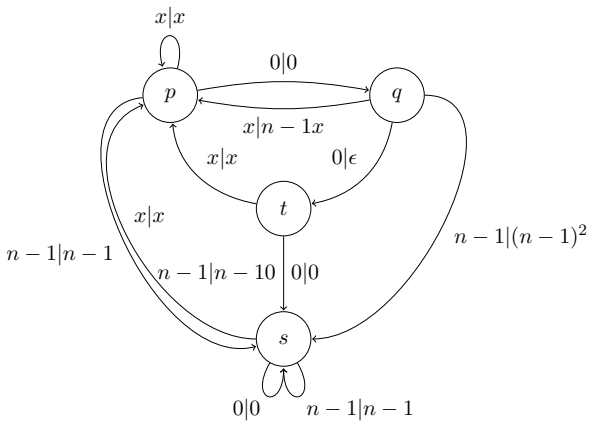
The workhorse is the finite initial transducer over the alphabet $X_n$: a finite automaton with a distinguished initial state that reads one letter from the finite set $\dot{r}$ and then processes $n$-adic words, emitting $n$-adic words. The load-bearing property is bi-synchronicity: after a fixed-length prefix, the active state of the transducer, and of its inverse, is forced regardless of the starting state. The paper also uses the reduced node distance between incomparable words to encode the cyclic combinatorics of $T_{n,r}$, and the reduced signature of a core transducer, an element of $\mathbb{Z}_{n-1}$, to control membership in the groups $T O_{n,r}$; the congruence $r\cdot\mathrm{sig} \equiv r \pmod{n-1}$ organizes the divisibility lattice of outer automorphism groups.
What would settle it
Construct a homeomorphism of $C_{n,r}$ that preserves the cyclic-order relation $\simeq$, lies in the rational group, and has infinitely many distinct local actions $h_\nu$; if it normalizes $T_{n,r}$, then the paper's finite-local-action corollary fails and Theorem 5.4 cannot hold. The paper's machinery predicts instead that every normalizer element has finitely many local-action types, so this is a direct falsifier.
Extended reading notes
Core claim
The central discovery is an exact transducer description of the automorphisms of $T_{n,r}$. Working inside the rational group $R_{n,r}$ of homeomorphisms of the Cantor space $C_{n,r}$ generated by finite initial transducers over the alphabet $X_n$, the paper proves that $\mathrm{Aut}(T_{n,r})$ is isomorphic to the subgroup $T B_{n,r}$ consisting of those elements of $R_{n,r}$ that can be represented by a finite, initial, bi-synchronizing transducer and whose induced map preserves the equivalence relation $\simeq$ identifying Cantor space with the circle $S_r$. The proof adapts the corresponding argument for $G_{n,r}$: a normalizer element of $T_{n,r}$ must preserve the tail equivalence relation $\sim_t$, act on incomparable cones almost in the same fashion, and therefore have only finitely many local actions; these facts force the minimal transducer to be finite and bi-synchronizing, and preservation of $\simeq$ is shown to be necessary and sufficient. A direct corollary is the strict inclusion $\mathrm{Aut}(T_{n,r}) < \mathrm{Aut}(G_{n,r})$.
Load-bearing premise
The whole transducer description rests on the imported proposition that a homeomorphism of Cantor space whose local actions on $\tau\chi$ and $\eta\chi$ differ for every suffix $\chi$ cannot preserve the tail equivalence relation; if that proposition failed, the bi-synchronizing characterization of $\mathrm{Aut}(T_{n,r})$ would collapse.
Editorial extensions
If this is right
- Every automorphism of $T_{n,r}$ is an automorphism of $G_{n,r}$, so $\mathrm{Aut}(T_{n,r})$ is a subgroup of $\mathrm{Aut}(G_{n,r})$.
- The groups $\mathrm{Out}(T_{n,r})$ embed in $\mathrm{Out}(T_{n,n-1})$; divisibility in the cyclic group $\mathbb{Z}_{n-1}$ gives containments $T O_{n,i} \leq T O_{n,j}$, with $T O_{n,1}$ contained in every $T O_{n,r}$.
- For $n>2$, every $\mathrm{Out}(T_{n,r})$ is infinite and contains a copy of Thompson's group $F$.
- $\mathrm{Out}(T_{n,r}) = \mathrm{Out}(T_{n,d})$ whenever $d = \gcd(n-1,r)$, but the converse isomorphism question has a negative answer (the case $n=7$), so equal gcd is not necessary for isomorphic outer automorphism groups.
- Every $T_{n,r}$ has the $R_\infty$ property: for every automorphism, the twisted conjugacy relation has infinitely many equivalence classes.
Reading between the lines
- Because both conditions in the characterization are properties of a finite transducer, membership in $\mathrm{Aut}(T_{n,r})$ and in $\mathrm{Out}(T_{n,r})$ is decidable for a given element of the rational group; the paper's algorithms for $O_n$ transfer to $T O_n$.
- If the signature homomorphism is surjective on $T O_n$, the join of $\mathrm{Out}(T_{n,r})$ and $\mathrm{Out}(T_{n,s})$ is exactly $\mathrm{Out}(T_{n,\mathrm{lcm}(r,s)})$; surjectivity is proved for $O_n$ whenever divisors of $n$ generate the units of $\mathbb{Z}_{n-1}$, leaving the $T O_n$ case open.
- A natural next step suggested by the methods is an automorphism description for the $F$-analogues of these groups, obtained by running the same local-action and synchronizing argument in the $F$ setting.
- The $R_\infty$ property gives every automorphism of $T_{n,r}$ an infinite Reidemeister number, placing these groups alongside the known examples in the twisted-conjugacy literature.
Signed reviews
Editorial analysis
A structured set of objections, weighed in public.
Referee Report
Summary. The paper characterizes the automorphism group of the generalized Thompson group T_{n,r} as the subgroup of the rational group R_{n,r} consisting of elements represented by finite, initial, bi-synchronizing transducers that preserve the cyclic order relation ≃ on the Cantor space (Theorem 5.4). It defines a corresponding subgroup T O_{n,r} of the transducer group O_{n,r} from Bleak–Cameron–Maissel–Navas–Olukoya (BCMNO), and proves that Out(T_{n,r}) is isomorphic to T O_{n,r}. The paper then establishes the nesting structure T O_{n,1} ⊴ T O_{n,r} ⊴ T O_{n,n-1}, equality T O_{n,r} = T O_{n,gcd(n-1,r)}, a negative answer to the BCMNO question on isomorphism of Out(G_{n,r}) versus gcd, the existence of a copy of Thompson's group F in Out(T_{n,r}) for n ≥ 3, and the R∞ property for all T_{n,r}. The proofs use transducer dynamics, viable combinations, and explicit transducer constructions.
Significance. Assuming the validity of the imported Proposition 4.13 from [3], the main theorem is a natural and substantial extension of the BCMNO characterization of Aut(G_{n,r}) to the T_{n,r} family. The structural results for Out(T_{n,r}) (infinite, containing F, lattice relations, R∞ property) were previously known only for special cases, and the negative answer to the gcd question is a concrete new contribution. The paper is detailed and provides explicit transducers for key examples, including the element of T O_4 that is not in any T O_{4,r} for r < 3, and the generators of the F-subgroup. The main results are coherent and mostly self-contained except for the reliance on [3]. If Proposition 4.13 is correct, the paper meets the standard for acceptance; the remaining issues are local corrections.
major comments (3)
- [§4, Proposition 4.13] Proposition 4.13 is stated without proof and is attributed to the unpublished preprint [3] (arXiv:1605.09302). This proposition is load-bearing: its contrapositive is used in Corollary 4.14 to produce, for each residue class i ∈ {0,1,...,n-2}, a pair (τ,η) with h_τ = h_η; Lemma 4.15 then uses this to show that h acts 'almost in the same fashion' on any two disjoint cones, and Corollary 4.16 derives the finiteness of local action types. These results are the basis for Lemma 5.1 and hence for Theorems 5.3 and 5.4, the paper's main characterization. Since the manuscript does not prove Proposition 4.13 and [3] is an unpublished preprint, the central claim is not fully verifiable from the manuscript alone. Please provide a proof of Proposition 4.13, or a precise reference to a published version, or at least state the location in [3] where the proof appears and confirm its status.
- [§10, Theorem 10.2] The statement 'For n > 3 and 1 ≤ r ≤ n − 1, the group T_{n,r} is infinite' is trivially true, since T_{n,r} is an infinite group. The intended statement, as the surrounding text indicates, is that Out(T_{n,r}) is infinite. Moreover, the proof, which uses the transducers in Figures 2 and 3, requires only n > 2. Please correct the theorem to: 'For n > 2 and 1 ≤ r ≤ n − 1, the group Out(T_{n,r}) is infinite.'
- [§11, Theorem 11.8] The theorem states 'The group T_{n,r} for 1 ≤ r < n − 1 has the R∞ property', but the abstract and the introduction claim the R∞ property for all T_{n,r}. The proof in Section 11 appears to cover all 1 ≤ r ≤ n − 1: the orientation-preserving case treats r > 1 explicitly, and the orientation-reversing case treats 1 < r < n. Please correct the range in the theorem statement to '1 ≤ r ≤ n − 1' (with the case n=2, r=1 handled by [7]) and make the abstract and theorem consistent.
minor comments (5)
- [Abstract and Theorem 1.1] The phrase 'the induced homeomorphisms on Cantor space respects the cyclic ordering' should read 'respect the cyclic ordering' (subject–verb agreement). The same wording appears in Theorem 5.4.
- [Corollary 1.4] The statement 'For 1 ≤ 1 ≤ n − 1' contains a typo; it should be 'For 1 ≤ i ≤ n − 1'.
- [Throughout, e.g., §4, Proposition 4.13] The word 'Proposition' is consistently misspelled as 'Propostion' in the manuscript (e.g., Proposition 4.13, Proposition 7.7). Please correct all occurrences.
- [Theorem 1.10] The phrase 'is unto the group of units' should be 'is onto the group of units'.
- [§7, Theorem 1.9 and Remark 7.19] Theorem 1.9 states the existence of a homomorphism from X_n to the group of units of Z_{n−1} with kernel X_{n,1} for X = T and G. The proof in §7 gives the construction for O_n (Theorem 7.15) and Remark 7.19 says the results carry over to T O_n without further detail. Since the theorem is stated for both, please add an explicit statement (or one sentence in Remark 7.19) that sig|_{T O_n} is a homomorphism with kernel T O_{n,1}, using Proposition 7.7.
Circularity Check
No circularity: Aut(T_{n,r}) characterization is derived from new transitivity lemmas plus independent BCMNO machinery for G_{n,r}; heavy reliance on [3] is a dependency, not a reduction.
full rationale
The central theorem (Theorem 5.4) is not assumed in the paper's inputs. The proof derives it from the new transitivity results for T_{n,r} (Lemmas 2.1 and 3.4), the normalizer reduction to cyclic-order-preserving homeomorphisms (Lemmas 3.5 and 3.6), and the finite-local-action argument in Section 4. That argument imports Proposition 4.13 from BCMNO [3] to obtain Corollary 4.14, which feeds Lemma 4.15 and Corollary 4.16; these are then used to prove the bi-synchronizing transducer representation in Theorem 5.3. The dependence on [3] is indeed load-bearing, and [3] is a preprint coauthored by the present author, so the paper is not fully self-contained. However, this is reliance on an external (though overlapping-author) result about the Higman groups G_{n,r} and tail equivalence, not an equation-level reduction: no conclusion of the present paper is used as a hypothesis, and the new claims—the Aut(T_{n,r}) characterization, the containment/lattice results, the negative answer to the gcd question, and the R_infinity property—are not fitted parameters, renamed known results, or definitions of the target in terms of itself. The reader-flagged risk that Corollary 4.16 collapses if Proposition 4.13 is false is a verifiability and correctness concern, located at Proposition 4.13 / Corollaries 4.14 and 4.16, but it is not circularity under the stated hard rules.
Assumptions & free parameters
assumptions (4)
- standard math Rubin's theorem: for sufficiently rich groups of homeomorphisms of a compact space, the automorphism group is isomorphic to the normalizer in the homeomorphism group.
- domain assumption BCMNO characterization of Aut(G_{n,r}) as the group B_{n,r} of bi-synchronizing transducers, and the associated group O_n with the viable combination membership criterion (Lemma 6.9).
- domain assumption Grigorchuk-Nekrashevych-Suschanski transducer minimalization theory, including the existence of a unique minimal transducer under omega-equivalence and the inverse transducer construction.
- domain assumption Brin-Guzman results on Out(T_{n,n-1}) being infinite and containing a copy of Thompson's group F for n ≥ 3.
Cite this review
Pith. "Pith review of Automorphisms of the generalised Thompson's group $T_{n,r}$." pith.science (2026). https://pith.science/paper/7NOALU3H
@misc{pith2026190803816,
  author       = {Pith},
  title        = {Pith review of: Automorphisms of the generalised Thompson's group $T_n,r$},
  year         = {2026},
  howpublished = {\url{https://pith.science/paper/7NOALU3H}},
  note         = {Machine review of arXiv:1908.03816}
}
abstract
The recent paper "The further chameleon groups of Richard Thompson and Graham Higman: automorphisms via dynamics for the Higman groups $G_{n,r}$" of Bleak, Cameron, Maissel, Navas and Olukoya (BCMNO) characterises the automorphisms of the Higman-Thompson groups $G_{n,r}$ as the specific subgroup of the rational group $\mathcal{R}_{n,r}$ of Grigorchuk, Nekrashevych and Suchanski{\u i}'s consisting of those elements which have the additional property of being bi-synchronizing. In this article, we extend the arguments of BCMNO and characterise the automorphism group of $T_{n,r}$ as a subgroup of $\mathrm{Aut}{G_{n,r}}$. We then show that the groups $\mathrm{Out}{T_{n,r}}$ can be identified with subgroups of the group $\mathrm{Out}{T_{n,n-1}}$. Extending results of Brin and Guzman, we show that the groups $\mathrm{Out}{T_{n,r}}$, for $n>2$, are all infinite and contain an isomorphic copy of Thompson's group $F$. For $X \in \{T,G\}$, we study the groups $\mathrm{Out}{X_{n,r}}$ and show that these fit in a lattice structure where $\mathrm{Out}{X_{n,1}} \unlhd \mathrm{Out}{X_{n,r}}$ for all $1 \le r \le n-1$ and $\mathrm{Out}{X_{n,r}} \unlhd \mathrm{Out}{X_{n,n-1}}$. This gives a partial answer to a question in BCMNO concerning the normal subgroup structure of $\mathrm{Out}{G_{n,n-1}}$. Furthermore, we deduce that for $1\le j,d \le n-1$ such that $d = \gcd(j, n-1)$, $\mathrm{Out}{X_{n,j}} = \mathrm{Out}{X_{n,d}}$ extending a result of BCMNO for the groups $G_{n,r}$ to the groups $T_{n,r}$. We give a negative answer to the question in BCMNO which asks whether or not $\mathrm{Out}{G_{n,r}} \cong \mathrm{Out}{G_{n,s}}$ if and only if $\gcd(n-1,r) = \gcd(n-1,s)$. We conclude by showing that the groups $T_{n,r}$ have the $R_{\infty}$ property extending the result of Burillo, Matucci and Ventura and, independently, Gon{\c c}alves and Sankaran, for Thompson's group $T$.
Figures


Figures from the paper (1 more)

Reference graph
Works this paper leans on
-
[3]
Collin Bleak, Peter Cameron, Yonah Maissel, Andr´ es Nav as, and Feyishayo Olukoya. The furhter chameleon groups of Richard Thompson and Graham Higm an: Automorphisms via dynamics for the Higman groups Gn,r. Version 2. 2019. ArXiv: 1605.09302 (math.GR)
work page Pith review arXiv 2019
-
[7]
T he conjugacy problem in extensions of Thompson’s group F
Jos´ e Burillo, Francesco Matucci, and Enric Ventura. “T he conjugacy problem in extensions of Thompson’s group F ”. In: Israel J. Math. 216.1 (2016), pp. 15–59. issn: 0021-2172. doi: 10.1007/s11856-016-1403-9 . url: https://doi.org/10.1007/s11856-016-1403-9
-
[1]
On De Bruijn automorphisms of shift spaces
Collin Bleak, Peter Cameron, and Feyishayo Olukoya. On De Bruijn automorphisms of shift spaces. In Preparation, 2019
work page 2019
-
[2]
Twisted conjugacy classes in R. Thompson’s group F
Collin Bleak, Alexander Fel ′shtyn, and Daciberg L. Gon¸ calves. “Twisted conjugacy classes in R. Thompson’s group F ”. In: Pacific J. Math. 238.1 (2008), pp. 1–6. issn: 0030-8730. doi: 10.2140/pjm.2008.238.1. url: http://dx.doi.org/10.2140/pjm.2008.238.1
-
[4]
The chameleon groups of Richard J. Thom pson: automorphisms and dynamics
Matthew G. Brin. “The chameleon groups of Richard J. Thom pson: automorphisms and dynamics”. In: Inst. Hautes ´Etudes Sci. Publ. Math. 84 (1996), 5–33 (1997). issn: 0073-
work page 1996
-
[5]
Automorphisms of generalized Thompson groups
Matthew G. Brin and Fernando Guzm´ an. “Automorphisms of generalized Thompson groups”. In: J. Algebra 203.1 (1998), pp. 285–348. issn: 0021-8693. doi: 10.1006/jabr.1997.7315. url: http://dx.doi.org/10.1006/jabr.1997.7315. 42
-
[6]
The automorphism group o f Thompson’s group F : subgroups and metric properties
Jos´ e Burillo and Sean Cleary. “The automorphism group o f Thompson’s group F : subgroups and metric properties”. In: Rev. Mat. Iberoam. 29.3 (2013), pp. 809–828. issn: 0213-2230. doi: 10.4171/RMI/741. url: https://doi.org/10.4171/RMI/741
doi:10.4171/rmi/741 2013
-
[8]
Isomorphisms of Brin-Higman-Thompson groups
Warren Dicks and Conchita Mart ´ ınez-P´ erez. “Isomorphisms of Brin-Higman-Thompson groups”. In: Israel Journal of Mathematics 199.1 (2014), pp. 189–218. issn: 1565-8511. doi: 10.1007/s11856-013-0042-7 . url: https://doi.org/10.1007/s11856-013-0042-7
Show all 20 references
-
[9]
The Reidemeister Number of Any Automor phism of a Gromov Hyperbolic Group is Infinite
A. L. Fel’shtyn. “The Reidemeister Number of Any Automor phism of a Gromov Hyperbolic Group is Infinite”. In: Journal of Mathematical Sciences 119.1 (2004), pp. 117–123. issn: 1573-8795. doi: 10.1023/B:JOTH.0000008749.42806.e3. url: https://doi.org/10.1023/B:JOTH.0000008749.42806.e3
2004
-
[10]
The Rei demeister Number of Any Automorphism of a Baumslag-Solitar Group is Infinite
Alexander Fel’shtyn and Daciberg Gon¸ calves. “The Rei demeister Number of Any Automorphism of a Baumslag-Solitar Group is Infinite”. In: ( Jan. 2008)
2008
-
[11]
Twisted conjugacy classes in saturated weakly branch groups
Alexander Fel’shtyn, Yuriy Leonov, and Evgenij Troits ky. “Twisted conjugacy classes in saturated weakly branch groups”. In: Geometriae Dedicata 134.1 (2008), pp. 61–73. issn: 1572-9168. doi: 10.1007/s10711-008-9245-1 . url: https://doi.org/10.1007/s10711-008-9245-1
2008 doi
-
[12]
Twisted conjugacy in Richard Thompson’s group T
D. L. Gon¸ calves and P. Sankaran. “Twisted conjugacy in Richard Thompson’s group T”. In: ArXiv e-prints (Sept. 2013). arXiv: 1309.2875 [math.GR]
2013 arXiv
-
[13]
Twisted conjugac y classes in wreath products
Daciberg Gon¸ calves and Peter Wong. “Twisted conjugac y classes in wreath products”. In: Internat. J. Algebra Comput. 16.5 (2006), pp. 875–886. issn: 0218-1967. doi: 10.1142/S0218196706003219. url: https://doi.org/10.1142/S0218196706003219
2006 doi
-
[14]
Automata, dynamical systems, and groups
R. I. Grigorchuk, V. V. Nekrashevich, and V. I. Sushchan ski ˘ ı. “Automata, dynamical systems, and groups”. In: Tr. Mat. Inst. Steklova 231.Din. Sist., Avtom. i Beskon. Gruppy (2000), pp. 134–214. issn: 0371-9685
2000
-
[15]
Finitely presented infinite simple groups
Graham Higman. Finitely presented infinite simple groups . Notes on Pure Mathematics, No. 8 (1974). Department of Pure Mathematics, Department of Mathematics, I.A.S. Australian National University, Canberra, 1974, pp. vii+8 2
1974
-
[16]
On dimension functions and topolog ical Markov chains
Wolfgang Krieger. “On dimension functions and topolog ical Markov chains”. In: Inventiones mathematicae 56.3 (1980), pp. 239–250. issn: 1432-1297. doi: 10.1007/BF01390047. url: https://doi.org/10.1007/BF01390047
1980 doi
-
[17]
Most automorphisms of a hyperbolic group have very simple dynamics
Gilbert Levitt and Martin Lustig. “Most automorphisms of a hyperbolic group have very simple dynamics”. In: Ann. Sci. ´Ecole Norm. Sup. (4) 33.4 (2000), pp. 507–517. issn: 0012-9593. doi: 10.1016/S0012-9593(00)00120-8. url: https://doi.org/10.1016/S0012-9593(00)00120-8
2000 doi
-
[18]
On the growth rate of automata groups generated by reset auto mata
Feyishayo Olukoya. On the growth rate of automata groups generated by reset auto mata. Version 1. 2017. ArXiv: 1708.07209 (math.GR)
2017 arXiv
-
[19]
The isomorphism problem for Higman-Thompso n groups
E. Pardo. “The isomorphism problem for Higman-Thompso n groups”. In: J. Algebra 344 (2011), pp. 172–183. issn: 0021-8693. doi: 10.1016/j.jalgebra.2011.07.026. url: http://dx.doi.org/10.1016/j.jalgebra.2011.07.026. 43
2011 doi
-
[8301]
url: http://www.numdam.org/item?id=PMIHES_1996__84__5_0
Reviewed August 14, 2026 · model on record in the stance chip above.
Discussion (0). Continue with ORCID to comment.