REVIEW 2 major objections 3 minor 40 references
Tropical Ehrhart Theory and Tropical Volume
T0 review · 2 major / 3 minor · reviewed 2026-08-14 · deepseek-v4-flash
Pith's one-line read Counting lattice points in tropical polytopes gives a genuine intrinsic volume: the tropical barycentric volume.
desk verdict Loho–Schymura builds a real tropical Ehrhart theory and an intrinsic volume with the right axioms; the alcoved-triangulation domain gap for unbounded −∞ vertices is real but fixable. read the letter →
The pith
A machine-rendered reading of the paper's core claim, the machinery that carries it, and where it could break.
The reading
What carries the argument
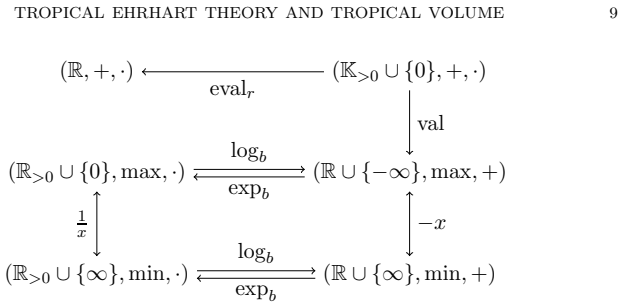
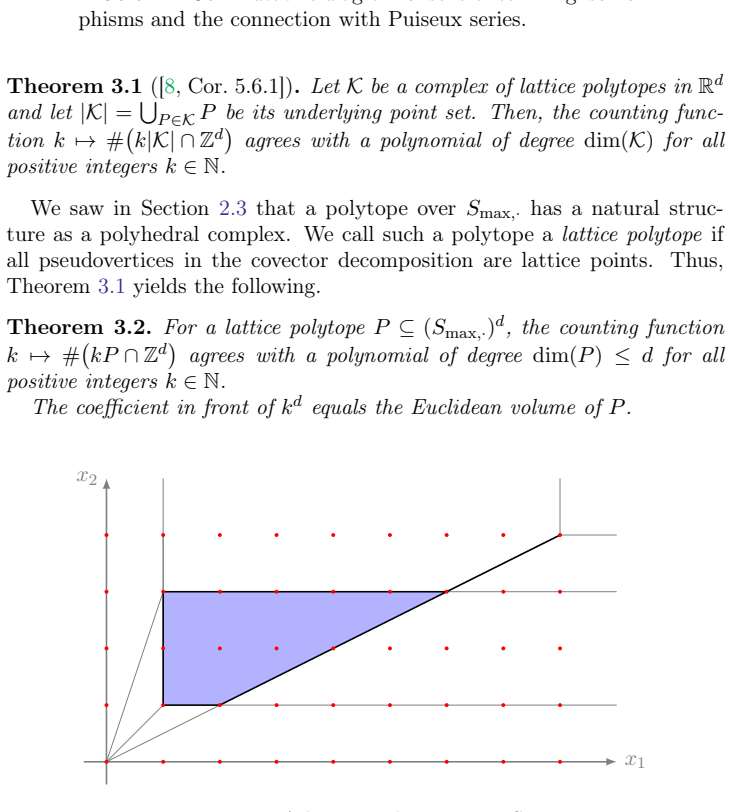
The mechanism is the alcoved triangulation, a subdivision of a tropical lattice polytope $P$ into alcoved simplices $\Delta_\pi(a)=\mathrm{conv}\{a+e_{\pi(1)}+\cdots+e_{\pi(\ell)}:\ell=0,\dots,d\}$ with integral shift vectors $a\in\mathbb{Z}^d$; each such simplex is both tropically and classically convex. Lemma 3.11 is the hinge: the coordinatewise logarithm $\varphi(z)=(\log_b z_1,\dots,\log_b z_d)$ restricts to a bijection between the ordinary lattice points of $b^k D_b^a\mathbf{1}+(b^{k+1}-b^k)D_b^a\Delta_s(0)$ and the tropical lattice points of $k\odot\Delta_s(a)$, where $D_b^a=\mathrm{diag}(b^{a_1},\dots,b^{a_d})$. This reduces tropical lattice-point counting to classical Ehrhart counting on the diagonally transformed alcoved simplices, yielding the explicit signed-sum formula (3) for every tropical Ehrhart coefficient. The logarithmic map $\mathrm{Log}|f|=\lim_{b\to\infty}\log_b|f(b)|$ then strips the fineness parameter $b$ and gives the closed form $\mathrm{tbvol}(P)=\max\{a_1+\cdots+a_d+d:\Delta_\pi(a)\in\mathcal{T}_P\}$.
What would settle it
One decisive test: compute $L_b^P(k)$ for a small tropical lattice polygon with a known alcoved triangulation and check the result against formula (3); the deeper structural check is whether every tropical lattice polytope admits an alcoved triangulation with integral shifts, since a polytope without one would invalidate the explicit coefficient formula.
Extended reading notes
Core claim
The central claim is that a tropical Ehrhart theorem holds in the strong sense: for every tropical lattice polytope $P\subseteq\mathbb{T}^d$, the enumerator $L_b^P(k)$ agrees with a polynomial in $b^k$, so the usual Ehrhart machinery, including leading coefficients, reciprocity, and valuation, has a tropical counterpart. The leading coefficient $c_b^d(P)$ equals the Euclidean volume of the exponentiated polytope $\exp_b(P)$, and its logarithmic asymptotics in $b$ converge to the tropical barycentric volume $\mathrm{tbvol}(P)=\max_{x\in\mathrm{Tr}_d(P)}\sum_i x_i=\max\{a_1+\cdots+a_d+d:\Delta_\pi(a)\in\mathcal{T}_P\}$. This quantity is well defined even without integrality, is monotone, idempotent, rotation invariant under scaled permutation matrices of tropical determinant zero, homogeneous, non-singular, multiplicative under products, and it is bounded above by the tropical dequantized volume $\mathrm{qtvol}_+(M)$ whenever $P=\mathrm{tconv}(M)$. Equality holds if and only if the tropical barycenter lies in the $d$-trunk, which in particular covers pure tropical lattice polytopes.
Load-bearing premise
The load-bearing premise is that every tropical lattice polytope can be cut into the special simplex pieces with integer shifts that the whole coefficient formula uses; the paper takes this structural fact as given.
Editorial extensions
If this is right
- The tropical Ehrhart enumerator $L_b^P(k)$ is polynomial in $b^k$, so tropical lattice-point counting inherits Ehrhart reciprocity and coefficient valuations; for pure tropical lattice polytopes reciprocity holds in the form $c_b^i(\overset{\circ}{P})=(-1)^{d-i}c_b^i(P)$.
- The leading coefficient $c_b^d(P)=\mathrm{vol}(\exp_b(P))$ is the tropical $b$-volume, and its $b$-asymptotic limit is $\mathrm{tbvol}(P)$; hence every tropical lattice polytope has a well-defined parameter-free volume.
- $\mathrm{tbvol}(\cdot)$ satisfies the volume axioms of monotonicity, valuation or idempotency, rotation invariance, homogeneity, non-singularity, and multiplicativity, making it a genuine intrinsic volume for tropical polytopes rather than an ad hoc measure.
- For $P=\mathrm{tconv}(M)$ with integer data, $\mathrm{tbvol}(P)\le \mathrm{qtvol}_+(M)$, and equality holds exactly when the tropical barycenter lies in the $d$-trunk, in particular for all pure tropical lattice polytopes, linking the new volume to maximal tropical determinants.
- The lower barycentric $i$-volumes satisfy $\mathrm{tbvol}_i^-(P)\le \mathrm{tmi}(M)$, and the paper conjectures $\mathrm{Log}|c_b^i(P)|\le \mathrm{tmi}(M)$; computing $\mathrm{tbvol}$ reduces to evaluating tropical simplices in $O\big(\binom{m}{d+1}d^3\big)$, and deciding non-vanishing lies in NP $\cap$ coNP via tropical linear programming.
Reading between the lines
- Because $\mathrm{tbvol}(P)$ is the coordinate sum of the tropical barycenter of the $d$-trunk, it measures the full-dimensional core of $P$ and ignores lower-dimensional tentacles; this makes it robust to small perturbations of vertices, in contrast to the dequantized volume, which is governed by an extremal tropical determinant.
- The multiplicativity of $\mathrm{tbvol}$ under Cartesian products, a property the dequantized volume lacks, suggests that $\mathrm{tbvol}$ is the more natural candidate for factorization and isoperimetric statements in tropical convex geometry; the isoperimetric questions raised in the paper could be tested first on products of tropical simplices.
- The conjecture $\mathrm{Log}|c_b^i(P)|\le \mathrm{tmi}(M)$ is computationally checkable on random 0/1 tropical matrices; if it holds, the tropical Ehrhart coefficients become functions of tropical minors, tying Ehrhart theory to tropical rank and to the hardness results of Section 6.
- The definition of tropical integers as $\log_b(\mathbb{Z}_{\ge 0})$ is one choice in a family; replacing $b$ by other multiplicative bases or by algebraic integers would give a parametrized family of tropical Ehrhart theories whose $b\to\infty$ limit is presumably the same $\mathrm{tbvol}$, providing a robustness check for the whole construction.
Signed reviews
Editorial analysis
A structured set of objections, weighed in public.
Referee Report
Summary. The paper develops a tropical analogue of Ehrhart theory. It introduces the tropical b-lattice Gamma_b^d = (log_b(Z_{\ge 0}))^d and defines tropical lattice polytopes as tropical polytopes whose vertices lie in Gamma_b^d, with a distinguished class of canonical tropical lattice polytopes with vertices in (Z_{\ge 0} \cup \{-\infty\})^d. The main structural result, Theorem 3.6, shows that the tropical lattice point enumerator L_b^P(k) = #((k \odot P) \cap Gamma_b^d) is a polynomial in b^k, obtained by applying the semiring isomorphism log_b to a classical Ehrhart result for polytopes over the (max, \cdot)-semiring. The paper then refines this via the covector decomposition and alcoved triangulations, giving explicit formulas for the tropical Ehrhart coefficients (Theorem 3.14). The leading coefficient leads to the tropical b-volume, and taking the b-to-infinity logarithmic limit yields the tropical barycentric volume tbvol(P) = max_{x \in Tr_d(P)} (x_1 + \cdots + x_d). The paper proves monotonicity, valuation, rotation invariance, homogeneity, non-singularity, and multiplicativity of tbvol, compares it with the tropical dequantized volume qtvol_+, introduces lower-dimensional barycentric i-volumes, and discusses algorithms and complexity, including an O(\binom{m}{d+1} d^3) algorithm for computing tbvol of a tropical d-polytope with m vertices.
Significance. If the results stand, the paper provides the first systematic intrinsic volume concept for tropical polytopes that is genuinely tied to a tropical lattice point count, with properties strongly analogous to classical Euclidean volume. The approach is conceptually clean: it reduces tropical Ehrhart theory to classical Ehrhart theory through the semiring isomorphism log_b, and the key Lemma 3.11 gives an explicit, fully proved bijection between tropical lattice points in scaled alcoved simplices and classical lattice points in diagonally transformed alcoved simplices. The paper also contributes useful structural results about higher trunks, a comparison with qtvol_+, and a complexity discussion connecting tbvol to tropical linear programming and mean-payoff games. These are substantial contributions. The main caveat is that several central statements are formulated for all tropical lattice polytopes, while the alcoved-triangulation machinery used to prove them is only established for a narrower class; this is a fixable but load-bearing gap.
major comments (2)
- [§2.1, Definition 2.5, Definition 4.3, Theorem 3.14]
- [§3.2, Theorem 3.14]
minor comments (3)
- [Definition 4.3]
- [Theorem 5.7]
- [§4.1]
Circularity Check
No circularity: the tropical Ehrhart/volume derivation reduces to external classical Ehrhart theory and alcoved triangulations, not to its own outputs.
full rationale
The paper's central chain is self-contained against external results rather than circular. Theorem 3.6 obtains polynomiality of the tropical lattice point enumerator by applying the semiring isomorphism log_b to classical Ehrhart theory for lattice polytopes over (S_max,·), citing Beck–Robins and standard semiring facts; this is an external reduction, not a re-derivation of its conclusion from its conclusion. Theorem 3.14 derives the explicit coefficient formula from the alcoved triangulation imported from Lam–Postnikov and Develin–Sturmfels, combined with classical Ehrhart reciprocity; again the structural input is external and does not presuppose the tropical Ehrhart coefficients being computed. The tropical barycentric volume tbvol(P) is independently defined in Definition 4.5 as max_{x in Tr_d(P)} 1^T x, and Proposition 4.4 proves the equality with the leading-coefficient limit / max over alcoved simplices, rather than defining the quantity through that equality. The comparison with qtvol+ in Theorem 4.13 rests on the cited external identity qtvol+(M) = max tropical minor from Depersin–Gaubert–Joswig, and the paper explicitly contrasts tbvol with that concept. There are no fitted parameters, no 'prediction' that is statistically forced by a prior fit, and no load-bearing uniqueness theorem imported from the authors' own prior work. The reviewer-flagged concern about the alcoved triangulation for unbounded tropical lattice polytopes such as [−∞,0]^d is a possible domain/correctness gap in the stated class, not a circularity: the final max-over-trunk definition and the explicit examples of limiting leading coefficients do not reduce to the triangulation as their own input. Accordingly, the derivation chain does not exhibit any step where a claimed output is equivalent to an input by construction.
Assumptions & free parameters
free parameters (1)
- b (base of tropical b-lattice) =
arbitrary integer >= 2
assumptions (5)
- standard math Classical Ehrhart theorem for complexes of lattice polytopes (Beck and Sanyal [8, Cor. 5.6.1])
- domain assumption Develin and Sturmfels covector decomposition and Lam and Postnikov alcoved triangulation of tropical polytopes with integer vertices
- domain assumption Tropical Minkowski-Weyl theorem (Gaubert and Katz [23])
- standard math Ehrhart-MacDonald reciprocity (Beck and Robins [7, Thm. 4.1])
- standard math Tropical Cauchy-Binet formula (Poplin and Hartwig [36, Thm. 5.4], Akian, Gaubert and Guterman [2, Ex. 3.7])
invented entities (1)
-
Tropical b-lattice Gamma_b^d = (log_b(Z_{\ge0}))^d
Cite this review
Pith. "Pith review of Tropical Ehrhart Theory and Tropical Volume." pith.science (2026). https://pith.science/paper/7OFRLZIQ
@misc{pith2026190807893,
  author       = {Pith},
  title        = {Pith review of: Tropical Ehrhart Theory and Tropical Volume},
  year         = {2026},
  howpublished = {\url{https://pith.science/paper/7OFRLZIQ}},
  note         = {Machine review of arXiv:1908.07893}
}
read the original abstract
We introduce a novel intrinsic volume concept in tropical geometry. This is achieved by developing the foundations of a tropical analog of lattice point counting in polytopes. We exhibit the basic properties and compare it to existing measures. Our exposition is complemented by a brief study of arising complexity questions.
Figures

Figures from the paper (3 more)


Reference graph
Works this paper leans on
-
[1]
Marianne Akian, Densities of idempotent measures and large deviations , Trans. Amer. Math. Soc. 351 (1999), no. 11, 4515–4543
work page 1999
-
[2]
Marianne Akian, Stéphane Gaubert, and Alexander Guterma n, Linear independence over tropical semirings and beyond , Tropical and idempotent mathematics, Contemp. Math., vol. 495, Amer. Math. Soc., Providence, RI, 2009, pp. 1–38
work page 2009
-
[3]
Xavier Allamigeon, Pascal Benchimol, Stéphane Gaubert, and Michael Joswig, Log- barrier interior point methods are not strongly polynomial ., SIAM J. Appl. Algebra Geom. 2 (2018), no. 1, 140–178
work page 2018
-
[4]
Katz, Minimal external representations of tropical polyhedra, J
Xavier Allamigeon and Ricardo D. Katz, Minimal external representations of tropical polyhedra, J. Combin. Theory Ser. A 120 (2013), no. 4, 907–940
work page 2013
-
[5]
, Tropicalization of facets of polytopes , Linear Algebra Appl. 523 (2017), 79– 101
work page 2017
-
[6]
Velleda Baldoni, Nicole Berline, Jesús A. De Loera, Matth ias Köppe, and Michèle Vergne, Computation of the highest coefficients of weighted Ehrhart q uasi-polynomials of rational polyhedra , Found. Comput. Math. 12 (2012), no. 4, 435–469
work page 2012
-
[7]
Matthias Beck and Sinai Robins, Computing the continuous discretely , second ed., Undergraduate Texts in Mathematics, Springer, New York, 20 15, Integer-point enu- meration in polyhedra, With illustrations by David Austin
-
[8]
195, American Mathematical Society, Providence, Rhode Island, 2018
Matthias Beck and Raman Sanyal, Combinatorial reciprocity theorems: An invitation to enumerative geometric combinatorics , Graduate Studies in Mathematics, vol. 195, American Mathematical Society, Providence, Rhode Island, 2018
work page 2018
Show all 40 references
-
[9]
Wills, Notes on the roots of Ehrhart poly- nomials, Discrete Comput
Christian Bey, Martin Henk, and Jörg M. Wills, Notes on the roots of Ehrhart poly- nomials, Discrete Comput. Geom. 38 (2007), no. 1, 81–98
2007
-
[10]
Wachs, Shellable nonpure complexes and posets
Anders Björner and Michelle L. Wachs, Shellable nonpure complexes and posets. I , Trans. Amer. Math. Soc. 348 (1996), no. 4, 1299–1327
1996
-
[11]
Burago and Viktor A
Yuri D. Burago and Viktor A. Zalgaller, Geometric Inequalities , Grundlehren der Mathematischen Wissenschaften [Fundamental Principles o f Mathematical Sciences], vol. 285, Springer-Verlag, Berlin, 1988, Translated from t he Russian by A. B. Sosinski ˘ ı, Springer Series in So...
1988
-
[12]
Peter Butkovič, Max-linear systems: theory and algorithms , Springer Monographs in Mathematics, Springer-Verlag London, Ltd., London, 2010
2010
-
[13]
438 (2013), no
Peter Butkovič and Marie MacCaig, On integer eigenvectors and subeigenvectors in the max-plus algebra , Linear Algebra Appl. 438 (2013), no. 8, 3408–3424
2013
-
[14]
, Linear Algebra Appl
Guy Cohen, Stéphane Gaubert, and Jean-Pierre Quadrat, Duality and separation theorems in idempotent semimodules. , Linear Algebra Appl. 379 (2004), 395–422
2004
-
[15]
Francisco Criado, Michael Joswig, and Francisco Santos , Tropical bisectors and Voronoi diagrams, https://arxiv.org/abs/1906.10950, 2019
1906 arXiv
-
[16]
Jules Depersin, Stéphane Gaubert, and Michael Joswig, A tropical isoperimetric in- equality, Sém. Lothar. Combin. 78B (2017), Art. 27, 12
2017
-
[17]
Mike Develin, Francisco Santos, and Bernd Sturmfels, On the rank of a tropical ma- trix, Combinatorial and computational geometry, Math. Sci. Res . Inst. Publ., vol. 52, Cambridge Univ. Press, Cambridge, 2005, pp. 213–242
2005
-
[18]
Mike Develin and Bernd Sturmfels, Tropical convexity, Doc. Math. 9 (2004), 1–27 (electronic), erratum ibid., pp. 205–206
2004
-
[19]
Mike Develin and Josephine Yu, Tropical polytopes and cellular resolutions , Experi- ment. Math. 16 (2007), no. 3, 277–291
2007
-
[20]
Dyer and Alan M
Martin E. Dyer and Alan M. Frieze, On the complexity of computing the volume of a polyhedron, SIAM J. Comput. 17 (1988), no. 5, 967–974
1988
-
[21]
Stefan Felsner and Kolja Knauer, Distributive lattices, polyhedra, and generalized flows , European J. Combin. 32 (2011), no. 1, 45–59
2011
-
[22]
Alex Fink and Felipe Rincón, Stiefel tropical linear spaces , J. Combin. Theory Ser. A 135 (2015), 291–331
2015
-
[23]
Katz, The Minkowski theorem for max-plus convex sets, Linear Algebra Appl
Stéphane Gaubert and Ricardo D. Katz, The Minkowski theorem for max-plus convex sets, Linear Algebra Appl. 421 (2007), no. 2-3, 356–369. TROPICAL EHRHART THEORY AND TROPICAL VOLUME 33
2007
-
[24]
Stéphane Gaubert and Marie MacCaig, Approximating the volume of tropical polytopes is difficult , Internat. J. Algebra Comput. 29 (2019), no. 2, 357–389
2019
-
[25]
Ziegler, eds.), Birkhäuser, 2000, pp
Ewgenij Gawrilow and Michael Joswig, polymake: a Framework for Analyzing Convex Polytopes, Polytopes — Combinatorics and Computation (Gil Kalai and G ünter M. Ziegler, eds.), Birkhäuser, 2000, pp. 43–74
2000
-
[26]
35, Birkhäuser Verl ag, Basel, 2009
Ilia Itenberg, Grigory Mikhalkin, and Eugenii Shustin, Tropical algebraic geometry , second ed., Oberwolfach Seminars, vol. 35, Birkhäuser Verl ag, Basel, 2009
2009
-
[27]
Math., vol
Michael Joswig, Tropical convex hull computations , Tropical and idempotent mathe- matics, Contemp. Math., vol. 495, Amer. Math. Soc., Provide nce, RI, 2009, pp. 193– 212
2009
-
[28]
Michael Joswig and Katja Kulas, Tropical and ordinary convexity combined , Adv. Geom. 10 (2010), no. 2, 333–352
2010
-
[29]
501 (2016), 304–343
Michael Joswig and Georg Loho, Weighted digraphs and tropical cones, Linear Algebra Appl. 501 (2016), 304–343
2016
-
[30]
Michael Joswig, Bernd Sturmfels, and Josephine Yu, Affine buildings and tropical convexity, Albanian J. Math. 1 (2007), no. 4, 187–211
2007
-
[31]
Kim and Fred W
Ki H. Kim and Fred W. Roush, Factorization of polynomials in one variable over the tropical semiring, https://arxiv.org/abs/math/0501167, 2005
2005 arXiv
-
[32]
Kosowsky and Alan L
Jeffrey J. Kosowsky and Alan L. Yuille, The invisible hand algorithm: Solving the assignment problem with statistical physics , Neural Netw. 7 (1994), no. 3, 477–490
1994
-
[33]
I, Discrete Comput
Thomas Lam and Alexander Postnikov, Alcoved polytopes. I, Discrete Comput. Geom. 38 (2007), no. 3, 453–478
2007
-
[34]
Macdonald, Polynomials associated with finite cell-complexes , J
Ian G. Macdonald, Polynomials associated with finite cell-complexes , J. London Math. Soc. (2) 4 (1971), 181–192
1971
-
[35]
327, Springer-Verlag, Berlin, 2003
Jacques Martinet, Perfect lattices in Euclidean spaces , Grundlehren der Mathema- tischen Wissenschaften [Fundamental Principles of Mathem atical Sciences], vol. 327, Springer-Verlag, Berlin, 2003
2003
-
[36]
Poplin and Robert E
Phillip L. Poplin and Robert E. Hartwig, Determinantal identities over commutative semirings, Linear Algebra Appl. 387 (2004), 99–132
2004
-
[37]
44, Cambridge University Press, Cambridge, 1993
Rolf Schneider, Convex bodies: the Brunn-Minkowski theory , Encyclopedia of Mathe- matics and its Applications, vol. 44, Cambridge University Press, Cambridge, 1993
1993
-
[38]
Lou van den Dries and Patrick Speissegger, The real field with convergent generalized power series. , Trans. Am. Math. Soc. 350 (1998), no. 11, 4377–4421
1998
-
[39]
Ruriko Yoshida, Leon Zhang, and Xu Zhang, Tropical principal component analysis and its application to phylogenetics. , Bull. Math. Biol. 81 (2019), no. 2, 568–597
2019
-
[40]
Leon Zhang, Computing Convex Hulls in the Affine Building of SLd, https://arxiv.org/abs/1811.08884, 2018. London School of Economics and Political Science, Houghton Street, London, WC2A 2AE, UK E-mail address : g.loho@lse.ac.uk Institute for Ma thema tics, École Polytechnique Fé...
2018 arXiv
Reviewed August 14, 2026 · model on record in the stance chip above.
Discussion (0). Continue with ORCID to comment.