REVIEW 4 major objections 4 minor 53 references
Topological Control of Extreme Waves
T0 review · 4 major / 4 minor · reviewed 2026-08-14 · deepseek-v4-flash
Pith's one-line read The genus of a nonlinear wave—the number of oscillating phases in its Riemann theta solution—can be chosen in advance by setting the input waist and detection time, making dispersive shocks, rogue waves, and soliton gases stages of one…
desk verdict A credible experimental sweep through NLSE box-problem regimes via time-dependent photorefractive nonlinearity, but the quantitative t-to-genus map has uncalibrated anchors and the SI loss estimate is wrong. read the letter →
The pith
A machine-rendered reading of the paper's core claim, the machinery that carries it, and where it could break.
The reading
What carries the argument
The central object is the Riemann theta function solution of the focusing nonlinear Schrödinger equation with box initial data, classified by the genus g of the associated toroidal surface; g counts the independent oscillating phases in the wave packet. The paper's control mechanism is the mapping from (W0, t) to g mediated by the time-dependent photorefractive response f(t)=1−exp(−t/τ), which enters the dispersion parameter ε via Eq. (4). The separatrices of Eq. (5) divide the evolution diagram into genus regions and, together with the measured shock velocity law in Eq. (6), turn the genus into a scheduling tool: the experimenter fixes the waist and the readout time to land in the chosen region.
What would settle it
Interferometrically measure the time-dependent nonlinear index change f(t) in the same crystal, then insert the measured f(t) into Eq. (4) and compare the predicted genus sequence (flat box → two shocks → breathers/Peregrine peaks → soliton gas) with the observed output at a fixed waist. If the observed transitions do not follow the separatrices of Eq. (5) when plotted against ζ = L/(ε zD), the topological control claim is falsified; a sharper variant performs the same protocol at several input powers and voltages, changing τ, and requires the genus-versus-ζ curves to collapse onto one universal curve.
Extended reading notes
Core claim
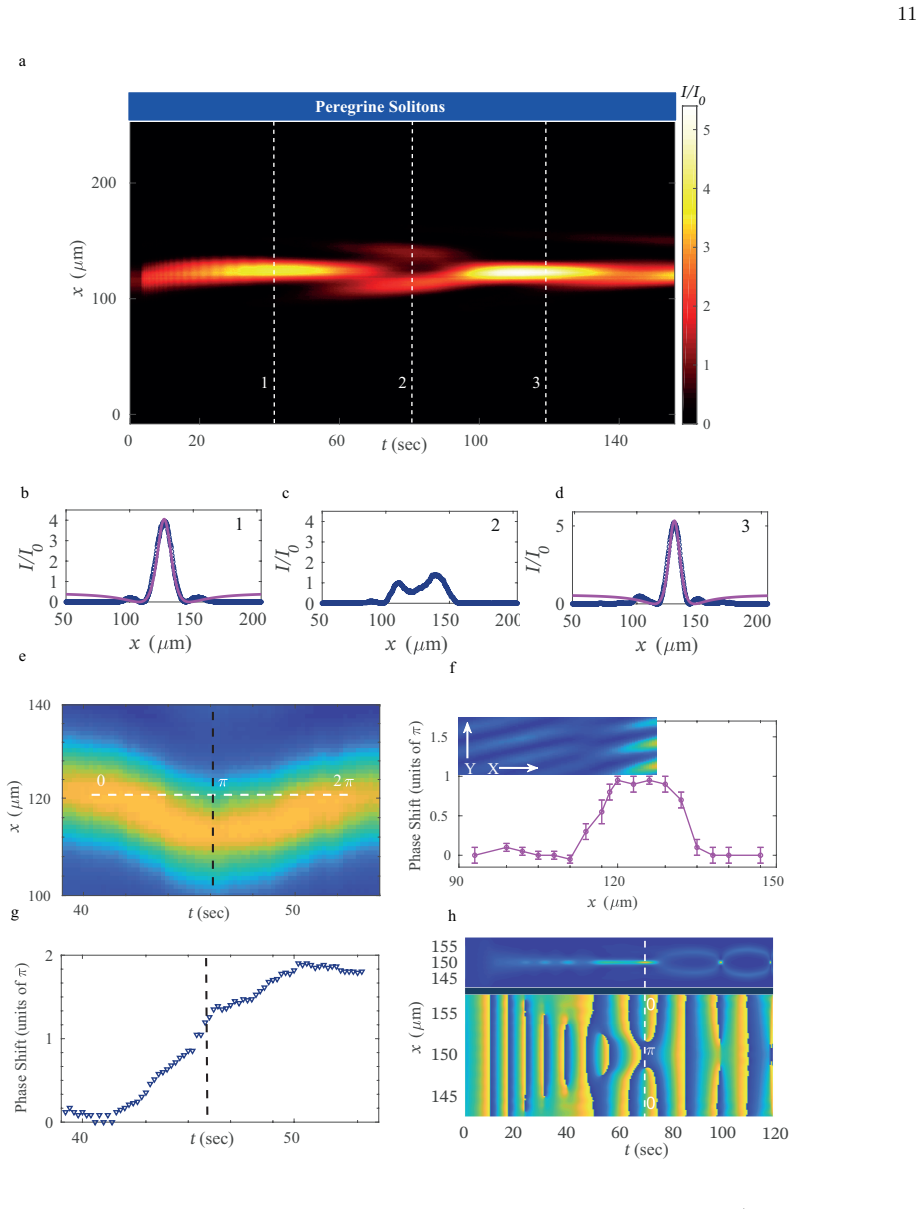
The central claim is that the genus of the final wave in the nonlinear Schrödinger box problem is a controlled experimental observable: for a fixed crystal length, the genus is determined by the input waist W0 and the detection time t. This follows from Eq. (4), which expresses the dispersion parameter as ε = λ/(π W0) sqrt(IS/(2 n0 δn0 I0 f(t))) with f(t)=1−exp(−t/τ), so that time continuously rescales the effective nonlinear propagation distance ζ = L/(ε zD). The separatrices in Eq. (5) and the shock velocity in Eq. (6) then give concrete predictions for when and where the genus changes, allowing a target wave state—shock, Akhmediev breather, Peregrine soliton, or soliton gas—to be selected before the experiment. The experiments in a pumped photorefractive crystal show the predicted sequence: two counterpropagating shocks at early times, breathers and Peregrine-like peaks after the shock collision, and a soliton gas at long times, with phase measurements showing the longitudinal 2π shift and two transverse π jumps that mark the transition from genus 0 to genus 2.
Load-bearing premise
The control schedule assumes the photorefractive nonlinear index grows as a single exponential f(t)=1−exp(−t/τ) with a known saturation time τ≈100 s; if the response is not a pure Kerr-like exponential with that calibrated time constant, the predicted genus for a chosen waist and detection time loses its quantitative meaning.
Editorial extensions
If this is right
- For a fixed crystal, the output wave genus is a predictable function of detection time, so no feedback or stochastic search is needed to reach a chosen extreme-wave regime.
- The dispersive-shock-to-rogue-wave transition is deterministic and continuous, supporting the view that these distinct-looking phenomena share the same integrable dynamics.
- Because the control is formulated in the nonlinear Schrödinger equation itself, the same time-as-genus dial should transfer to other systems governed by the focusing NLSE, including optical fibers and water waves, whenever the nonlinearity can be modulated slowly.
- The linear dependence of shock velocity on input power provides a quantitative handle for preselecting the shock collision time and therefore the moment at which the genus-two breather lattice appears.
- The measured phase signatures—one longitudinal 2π shift and two transverse π jumps—give a direct experimental readout of the genus, making topology measurable in the lab.
Reading between the lines
- A direct extension would be to measure f(t) interferometrically and check that all observed transitions collapse onto a single genus-versus-ζ curve; the paper reports the schedule but not this independent calibration.
- The same time-as-genus dial could be applied to other integrable systems with slowly modulated nonlinearity, such as optical fibers or water tanks, turning genus from a classification label into a design parameter.
- Adding controlled loss or noise would test how much of the topological control survives non-integrable perturbations, a regime the paper does not explore.
Signed reviews
Editorial analysis
A structured set of objections, weighed in public.
Referee Report
Summary. The paper proposes and demonstrates a scheme called 'topological control' of extreme waves in the focusing nonlinear Schrödinger equation (NLSE) box problem. The key idea is that the genus g of the asymptotic solution, which classifies the number of oscillating phases, can be tuned by exploiting the time-dependent photorefractive nonlinearity: the effective dispersion parameter epsilon in Eq. (4) grows with exposure time t through f(t)=1-exp(-t/tau), so that a single fixed input beam can be made to traverse the genus sequence g=0, 1, 2, ... and reach different final states (dispersive shock waves, Akhmediev breathers, Peregrine solitons, soliton gas) at different detection times. The authors report experimental observations for W0=140 um showing DSWs, breathers, and a soliton-gas-like final state, and for W0=30 um showing Peregrine-like structures with measured intensity and phase signatures. Numerical split-step simulations support the qualitative dynamics. The central claim is that the final genus is determined by the input waist and the detection time.
Significance. If the control map were quantitatively established, the paper would be a valuable contribution: it connects disparate extreme-wave phenomena (DSWs, rogue waves, soliton gases) in a single integrable system and proposes a concrete experimental knob (detection time in a photorefractive medium) to steer the asymptotic state. The paper includes reproducible split-step simulations, direct phase measurements of the Peregrine-like structures, and statistical evidence of heavy-tailed intensity distributions. The linear velocity-versus-power scaling in Fig. 3b is consistent with Eq. (6). However, the central quantitative claim rests on the calibration of the time-dependent photorefractive response and on the identification of genus through fits to the same analytical solutions that define the genus classification. At present, the paper demonstrates a qualitatively controlled sequence but does not provide the quantitative calibration and comparison needed to support the headline statement that the genus is determined by (W0,t) as a predictive tool.
major comments (4)
- [Results, Genus Control; Methods, Photorefractive Media] The central control relation, Eq. (4), uses f(t)=1-exp(-t/tau) with tau only quoted as approximately 100 s, and no independent calibration of tau, IS, or delta_n0 is reported for the actual crystal, voltage, and intensity conditions. Since the separatrices in Eq. (5) and the collision time t0 are derived from this relation, the predicted genus for a chosen (W0,t) is not quantitatively testable. The experimental x-t map in Fig. 3c is not overlaid with the predicted separatrix lines or t0, and the only quantitative check, the linear velocity-power scaling in Fig. 3b, does not constrain the absolute values of tau, IS, or delta_n0. The authors should measure the response function f(t) under the experimental conditions and compare the predicted transition time with the observed onset of the breather phase.
- [Supplementary Information, Potentially Competing Effects: Modulation Instability and Losses] The loss estimate in the SI is incorrect: alpha = 2 cm^-1 gives Lloss = alpha^-1 = 0.5 cm, which is only twice the crystal length L = 2.5 mm, not 'one order of magnitude higher.' Since the 633 nm pump is absorbed over a length comparable to L, the saturation intensity IS is not uniform along the propagation direction, and the homogeneous-NLSE normalization leading to Eq. (4) is not justified. The authors should either provide a direct measurement of the absorption at 633 nm in their KLTN sample, quantify the resulting z-dependence of IS and its effect on the effective epsilon(t), or present evidence that the pump absorption does not appreciably alter the calibration of the control schedule.
- [Results, Peregrine Solitons Emergence] The experimental genus labels are assigned by matching observed intensity and phase profiles to Akhmediev breather and Peregrine soliton solutions that are also the basis of the theoretical genus classification (refs. 40 and 44). This identification is not an independent measurement of the genus. To support the central claim of topological control, the experimental x-t maps in Figs. 3c and 5a should be quantitatively compared with the predicted separatrices, the collision time t0, and the genus boundaries from the theory. Without such a comparison, the observed sequence is consistent with the predicted genus schedule, but the paper does not demonstrate that the genus is deterministically controlled by (W0,t) in the strong sense claimed.
- [Results, Supervised Transition from Shock to Rogue Waves; Discussion] The identification of the long-time state as a soliton gas (for example, in Figs. 3c and the Discussion) is supported only by visual inspection of the intensity pattern and by a qualitative reference to the asymptotic theory of ref. 40. No quantitative signature of a soliton gas, such as a soliton density, velocity distribution, or comparison with the kinetic theory of soliton gases, is provided. This weakens the claim of having observed 'the continuous transition from dispersive shock to rogue waves and soliton gases'; the transition to a true soliton gas remains to be established.
minor comments (4)
- [Introduction] The phrase 'control strategies still miss' should be corrected to 'control strategies are still missing'.
- [Results, Fig. 3b and Eq. (6)] The axis label 'v/v0 (10^2)' is ambiguous; please clarify whether the plotted values are v/v0 multiplied by 10^2 and specify the uncertainty on v0 (the stated tbar = 30 +/- 2 s) in the figure or caption.
- [Fig. 1b] The phase diagram is plotted in terms of epsilon and W0 even though epsilon itself depends on W0 through Eq. (4); this makes the axes not independent. Please clarify whether epsilon is evaluated at a fixed time and list the parameter values used to construct the diagram.
- [Discussion] The claim 'the first observation of the continuous transition from dispersive shock to rogue waves and soliton gases' should be discussed in relation to ref. 41, which already reported Peregrine-like events in optical dam-break flows; the paper should state explicitly what is new beyond that work.
Circularity Check
No construction-level circularity: the genus-control map is imported from external finite-gap theory and the experimental signatures are compared against, not derived from, the fitted input parameters.
full rationale
The paper's central derivation chain maps the experimentally chosen input waist W0 and detection time t to the NLSE parameters epsilon and zeta through Eqs. (3)-(4), and then to the genus g through the external finite-gap/Riemann-theta theory of El-Khamis-Tovbis and Bertola-El-Tovbis (refs. 40 and 44). This is a forward modeling chain: g is a mathematical property of the NLSE box solution, not an input to Eq. (4). The separatrix equations and the collision-time/shock-velocity expressions (Eqs. (5)-(6)) are consequences of that theory, and the predicted linear scaling v proportional to input power is checked against an independent power scan (Fig. 3b). The saturation time tau in f(t) is quoted from the authors' earlier FPU-recurrence experiment (ref. 5); that is an external measurement rather than a parameter fitted in this paper, so it does not reduce the prediction to its own input. The experimental genus labels are assigned by matching measured intensity and phase profiles to the analytical Akhmediev-breather and Peregrine-soliton waveforms, which makes the genus readout dependent on the same solution family used for the taxonomy; however, this is a standard data-to-theory comparison and not an equation-level reduction of the prediction to the fit. The SI loss estimate contains an arithmetic error, since alpha = 2 cm^-1 gives L_loss = 0.5 cm, only twice the crystal length L = 2.5 mm rather than one order of magnitude larger; this is a quantitative correctness concern, not circularity. Overall, no step of the claimed derivation is equivalent by construction to its inputs, and no load-bearing claim rests solely on a self-citation chain.
Assumptions & free parameters
free parameters (4)
- Saturation time tau =
~100 s (quoted, no calibration)
- Saturation intensity IS =
not specified
- Nonlinear coefficient delta_n0 =
not specified
- AB/PS fit parameters =
not reported
assumptions (5)
- domain assumption The focusing NLSE box problem is described by finite-gap solutions classified by genus g, with g=1 for dispersive shock waves, g=2 after collision, and g approximately zeta asymptotically (refs. 40, 44).
- domain assumption The photorefractive crystal acts as a Kerr-like medium with delta_n = 2 delta_n0 (I/IS) f(t) and f(t)=1-exp(-t/tau) in the intensity range used.
- domain assumption The beam is quasi-one-dimensional, with d_y A approximately 0, so the 1D NLSE governs the observed evolution.
- domain assumption Loss and modulation instability do not affect the dynamics for beam waists below about 150 micrometers.
- domain assumption Small-dispersion and finite-gap asymptotics apply at the experimental epsilon values, roughly 0.02 to 0.08.
Cite this review
Pith. "Pith review of Topological Control of Extreme Waves." pith.science (2026). https://pith.science/paper/7OG5RACJ
@misc{pith2026190805212,
  author       = {Pith},
  title        = {Pith review of: Topological Control of Extreme Waves},
  year         = {2026},
  howpublished = {\url{https://pith.science/paper/7OG5RACJ}},
  note         = {Machine review of arXiv:1908.05212}
}
read the original abstract
From optics to hydrodynamics, shock and rogue waves are widespread. Although they appear as distinct phenomena, new theories state that transitions between extreme waves are allowed. However, these have never been experimentally observed because of the lack of control strategies. We introduce a new concept of nonlinear wave topological control, based on the one-to-one correspondence between the number of wave packet oscillating phases and the genus of toroidal surfaces associated with the nonlinear Schr\"odinger equation solutions by the Riemann theta function. We prove it experimentally by reporting the first observation of supervised transitions between extreme waves with different genera, like the continuous transition from dispersive shock to rogue waves. Specifically, we use a parametric time-dependent nonlinearity to shape the asymptotic wave genus. We consider the box problem in a focusing Kerr-like photorefractive medium and tailor time-dependent propagation coefficients, as nonlinearity and dispersion, to explore each region in the state-diagram and include all the dynamic phases in the nonlinear wave propagation. Our result is the first example of the topological control of integrable nonlinear waves. This new technique casts light on dispersive shock waves and rogue wave generation, and can be extended to other nonlinear phenomena, from classical to quantum ones. The outcome is not only important for fundamental studies and control of extreme nonlinear waves, but can be also applied to spatial beam shaping for microscopy, medicine and spectroscopy, and to the broadband coherent light generation.
Figures


Figures from the paper (2 more)

Reference graph
Works this paper leans on
-
[1]
Gardner, C. S., Greene, J. M., Kruskal, M. D. & Miura, R. M. Method for solving the Korteweg-de Vries equa- tion. Phys. Rev. Lett. 19, 1095–1097 (1967)
work page 1967
-
[2]
Zakharov, V. E. & Shabat, A. B. Exact theory of two-dimensional self-focusing and one-dimensional self- modulation of waves in nonlinear media. Sov. Phys. JETP 34, 62–69 (1972)
work page 1972
-
[3]
Gardner, C. S., Greene, J. M., Kruskal, M. D. & Miura, R. M. Korteweg-de Vries equation and generalizations. VI. methods for exact solution. Comm. on Pure and Appl. Math. 27, 97–133 (1974)
work page 1974
-
[4]
Ablowitz, M. J., Kaup, D. J., Newell, A. C. & Segur, H. The inverse scattering transform-Fourier analysis for nonlinear problems. Stud. Appl. Math. 53, 249–315 (1974)
work page 1974
-
[5]
Pierangeli, D. et al. Observation of Fermi-Pasta-Ulam- Tsingou recurrence and its exact dynamics. Phys. Rev. X 8, 041017–041025 (2018)
work page 2018
-
[6]
Mussot, A. et al. Fibre multi-wave mixing combs re- veal the broken symmetry of FermiPastaUlam recur- rence. Nat. Photon. 12, 303–308 (2018)
work page 2018
-
[7]
Akhmediev, N. N., Eleonskii, V. M. & Kulagin, N. E. Exact first-order solutions of the nonlinear Schr¨ odinger equation. Theor. Math. Phys. 72, 809–818 (1987)
work page 1987
-
[8]
Hoefer, M. A. et al. Dispersive and classical shock waves in Bose-Einstein condensates and gas dynamics. Phys. Rev. A 74, 023623–023646 (2006)
work page 2006
Show all 53 references
-
[9]
& Fleischer, J
Wan, W., Jia, S. & Fleischer, J. W. Dispersive superfluid- like shock waves in nonlinear optics. Nat. Phys. 3, 46–51 (2007)
2007
-
[10]
& Hoefer, M
El, G. & Hoefer, M. Dispersive shock waves and modu- lation theory. Phys. D 333, 11–65 (2016)
2016
-
[11]
R., Ropers, C., Koonath, P
Solli, D. R., Ropers, C., Koonath, P. & Jalali, B. Optical rogue waves. Nature 450, 1054–1057 (2007)
2007
-
[12]
Bonatto, C. et al. Deterministic optical rogue waves. Phys. Rev. Lett. 107, 053901–053905 (2011)
2011
-
[13]
M., Dias, F., Erkintalo, M
Dudley, J. M., Dias, F., Erkintalo, M. & Genty, G. Insta- bilities, breathers and rogue waves in optics.Nat. Photon. 8, 755–764 (2014)
2014
-
[14]
Akhmediev, N. et al. Roadmap on optical rogue waves and extreme events. J. Opt. 18, 063001–063036 (2016)
2016
-
[15]
& Clarkson, P
Ablowitz, M. & Clarkson, P. A. Solitons, Nonlinear Evo- lution Equations and Inverse Scattering (Cambridge Uni- versity Press, 1991)
1991
-
[16]
Kivshar, Y. S. & Agrawal, G. P. Optical Solitons (Aca- demic Press, Elsevier Science, 2003)
2003
-
[17]
& Conti, C
Bulso, N. & Conti, C. Effective dissipation and nonlocal- ity induced by nonparaxiality. Phys. Rev. A 89, 023804– 023810 (2014)
2014
-
[18]
& Trillo, S
Ghofraniha, N., Conti, C., Ruocco, G. & Trillo, S. Shocks in nonlocal media. Phys. Rev. Lett. 99, 043903–043906 (2007)
2007
-
[19]
& Conti, C
Marcucci, G., Braidotti, M., Gentilini, S. & Conti, C. Time asymmetric quantum mechanics and shock waves: Exploring the irreversibility in nonlinear optics. Ann. Phys. 529, 1600349–1600365 (2017)
2017
-
[20]
A., Gammal, A., Khamis, E
El, G. A., Gammal, A., Khamis, E. G., Kraenkel, R. A. & Kamchatnov, A. M. Theory of optical dispersive shock waves in photorefractive media. Phys. Rev. A 76, 053813–053830 (2007)
2007
-
[21]
& Conti, C
Ghofraniha, N., Gentilini, S., Folli, V., DelRe, E. & Conti, C. Shock waves in disordered media. Phys. Rev. Lett. 109, 243902–243905 (2012)
2012
-
[22]
Kartashov, Y. V. & Kamchatnov, A. M. Two- dimensional dispersive shock waves in dissipative optical media. Opt. Lett. 38, 790–792 (2013)
2013
-
[23]
& Dudley, J
Erkintalo, M., Genty, G. & Dudley, J. M. On the statis- tical interpretation of optical rogue waves. Eur. Phys. J. Sp. Top. 185, 135–144 (2010)
2010
-
[24]
Erkintalo, M. et al. Higher-order modulation instability in nonlinear fiber optics. Phys. Rev. Lett. 107, 253901– 253905 (2011)
2011
-
[25]
& Akhme- diev, N
Chabchoub, A., Hoffmann, N., Onorato, M. & Akhme- diev, N. Super rogue waves: Observation of a higher- order breather in water waves. Phys. Rev. X 2, 011015– 011020 (2012)
2012
-
[26]
M., Solli, D
Akhmediev, N., Dudley, J. M., Solli, D. R. & Turit- syn, S. K. Recent progress in investigating optical rogue waves. J. Opt. 15, 060201–060209 (2013)
2013
-
[27]
Agafontsev, D. S. & Zakharov, V. E. Integrable turbu- lence and formation of rogue waves. Nonlinearity 28, 2791–2821 (2015)
2015
-
[28]
& Zakharov, V
Kibler, B., Chabchoub, A., Gelash, A., Akhmediev, N. & Zakharov, V. E. Superregular breathers in optics and hydrodynamics: Omnipresent modulation instability be- yond simple periodicity. Phys. Rev. X 5, 041026–041037 (2015)
2015
-
[29]
Pierangeli, D., Di Mei, F., Conti, C., Agranat, A. J. & DelRe, E. Spatial rogue waves in photorefractive ferro- electrics. Phys. Rev. Lett. 115, 093901–093906 (2015)
2015
-
[30]
Toenger, S. et al. Emergent rogue wave structures and statistics in spontaneous modulation instability.Sci. Rep. 5, 10380–10387 (2015)
2015
-
[31]
Suret, P. et al. Single-shot observation of optical rogue waves in integrable turbulence using time microscopy. Nat. Commun. 7, 13136–13143 (2016)
2016
-
[32]
Tikan, A. et al. Universality of the Peregrine soliton in the focusing dynamics of the cubic nonlinear Schr¨ odinger equation. Phys. Rev. Lett. 119, 033901–033906 (2017)
2017
-
[33]
Gelash, A. A. & Agafontsev, D. S. Strongly interacting soliton gas and formation of rogue waves. Phys. Rev. E 98, 042210–042221 (2018)
2018
-
[34]
Gelash, A. et al. Bound state soliton gas dynamics underlying the noise-induced modulational instability. arXiv:1907.07914 (2019). 1907.07914
2019 arXiv
-
[35]
E., Sobolev, V
Zakharov, V. E., Sobolev, V. V. & Synakh, V. C. Be- havior of light beams in nonlinear media. J. Exp. Theor. Phys. 33, 77–81 (1971)
1971
-
[36]
El, G. A. & Kamchatnov, A. M. Kinetic equation for a dense soliton gas. Phys. Rev. Lett. 95, 204101–204104 (2005)
2005
-
[37]
& Mordant, N
Redor, I., Barthlemy, E., Michallet, H., Onorato, M. & Mordant, N. Experimental evidence of a hydrodynamic 6 soliton gas. Phys. Rev. Lett. 122, 214502–214507 (2019)
2019
-
[38]
V., Barsi, C
Wan, W., Dylov, D. V., Barsi, C. & Fleischer, J. W. Diffraction from an edge in a self-focusing medium. Opt. Lett. 35, 2819–2021 (2010)
2010
-
[39]
Picozzi, A. et al. Optical wave turbulence: Towards a uni- fied nonequilibrium thermodynamic formulation of sta- tistical nonlinear optics. Phys. Rep. 542, 1–132 (2014)
2014
-
[40]
A., Khamis, E
El, G. A., Khamis, E. G. & Tovbis, A. Dam break prob- lem for the focusing nonlinear Schr¨ odinger equation and the generation of rogue waves. Nonlinearity 29, 2798– 2836 (2016)
2016
-
[41]
& Finot, C
Audo, F., Kibler, B., Fatome, J. & Finot, C. Experimen- tal observation of the emergence of peregrine-like events in focusing dam break flows. Opt. Lett. 43, 2864–2867 (2018)
2018
-
[42]
Riemann problems and dispersive shocks in self-focusing media
Biondini, G. Riemann problems and dispersive shocks in self-focusing media. Phys. Rev. E 98, 052220–052226 (2018)
2018
-
[43]
& Lottes, J
Biondini, G. & Lottes, J. Nonlinear interactions between solitons and dispersive shocks in focusing media. Phys. Rev. E 99, 022215–022221 (2019)
2019
-
[44]
Bertola, M., El, G. A. & Tovbis, A. Rogue waves in mul- tiphase solutions of the focusing nonlinear Schr¨ odinger equation. Proc. R. Soc. A 472, 20160340–20160351 (2016)
2016
-
[45]
& Trillo, S
Xu, G., Conforti, M., Kudlinski, A., Mussot, A. & Trillo, S. Dispersive dam-break flow of a photon fluid. Phys. Rev. Lett. 118, 254101–254105 (2017)
2017
-
[46]
Kibler, B. et al. The Peregrine soliton in nonlinear fibre optics. Nat. Phys. 6, 790–795 (2010)
2010
-
[47]
Chabchoub, Kibler, B
Randoux, S., Suret, A., P. Chabchoub, Kibler, B. & El, G. Nonlinear spectral analysis of Peregrine solitons ob- served in optics and in hydrodynamic experiments. Phys. Rev. E 98, 022219–022230 (2018)
2018
-
[48]
Xu, G. et al. Phase evolution of Peregrine-like breathers in optics and hydrodynamics. Phys. Rev. E 99, 012207– 012214 (2019)
2019
-
[49]
& Tamburrini, M
DelRe, E., Ciattoni, A., Crosignani, B. & Tamburrini, M. Approach to space-charge field description in pho- torefractive crystals. J. Opt. Soc. Am. B 15, 1469–1475 (1998)
1998
-
[50]
& Palange, E
DelRe, E. & Palange, E. Optical nonlinearity and ex- istence conditions for quasi-steady-state photorefractive solitons. J. Opt. Soc. Am. B 23, 2323–2327 (2006)
2006
-
[51]
& Di Porto, P
DelRe, E., Crosignani, B. & Di Porto, P. Photorefractive solitons and their underlying nonlocal physics. vol. 53 of Progr. Opt., chap. 3, 153–200 (Elsevier, 2009)
2009
-
[52]
Kutz, J. N. Data-Driven Modeling and Scientific Com- puting (Oxford University Press, 2013)
2013
-
[53]
Pierangeli, D. et al. Super-crystals in composite ferro- electrics. Nat. Commun. 7, 10674–10680 (2016). ACKNOWLEDGEMENTS We acknowledge M. Conforti, S. Gentilini, P. G. Grinevich, A. Mussot, P. M. Santini, S. Trillo, and V. E. Zakharov for fruitful conversations on related top...
2016 arXiv
Reviewed August 14, 2026 · model on record in the stance chip above.
Discussion (0). Continue with ORCID to comment.