REVIEW 3 major objections 4 minor 39 references
Data assimilation for energy-aware hybrid models
T0 review · 3 major / 4 minor · reviewed 2026-08-05 · deepseek-v4-flash
Pith's one-line read This paper claims that in a Gulf Stream quasi-geostrophic model, data assimilation only improves a coarse simulation after an energy-aware hybrid correction puts the model in the right phase space, making targeted observations nearly as eff
desk verdict Genuinely new combo of energy-aware hybrid modeling with a particle filter, with informative empirical findings; main weakness: energy-band matching is asserted, not shown, to control posterior proximity, and the twin experiment leaves out-of-sample skill underdetermined. read the letter →
The pith
A machine-rendered reading of the paper's core claim, the machinery that carries it, and where it could break.
The reading
What carries the argument
The load-bearing object is the stochastic energy-aware hybrid QG model, equation (19): a coarse-grid (129×129) three-layer QG model with a scale-selective nudging term G(qh,q)=η(M(qh,q)−qh) and a stochastic velocity corrector A built from two spectral bands (30–300 km and 300–3840 km), with amplitudes λs and γs re-optimised by Powell's method every 24 h to keep total kinetic and potential energy inside the reference band. This hybrid is coupled to the DA machinery of Algorithm 3: a bootstrap particle filter whose particles evolve under the hybrid stochastic dynamics, with tempering and Metropolis-Hastings jittering to avoid weight collapse, G-nudging to keep particles near the reference phas
What would settle it
Take the same experiment but use an independently generated reference year as truth, while fitting the hybrid amplitudes to the original band; if the hybrid+DA advantage vanishes, the energy-matching step was fitting the truth rather than creating phase-space proximity. A cheaper check: perturb the target energy band by ±10% and see whether the particle-filter posterior stays near the reference; the paper's mechanism predicts it should.
Extended reading notes
Core claim
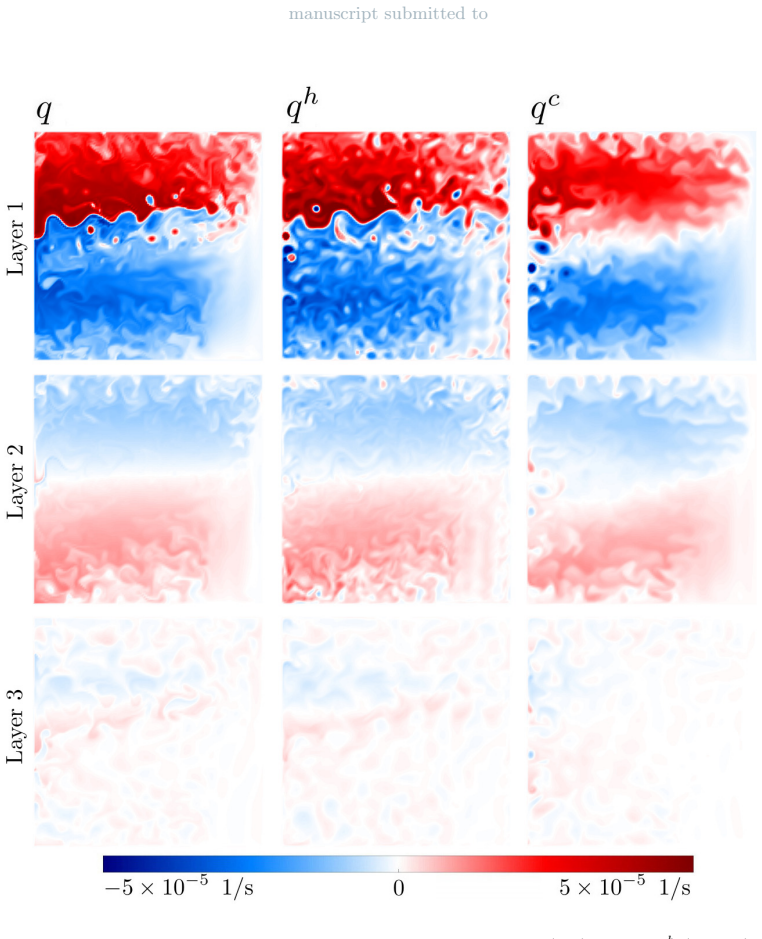
The central claim is a model-adequacy result: data assimilation cannot compensate for a forecast model whose reachable states lie far from the reference flow, and once the model is corrected energetically, assimilation becomes strongly beneficial. The paper shows that (i) the standard coarse QG model with an EOF-based stochastic DA scheme has tracking error nearly identical to the free model and loses vortices; (ii) the energy-aware hybrid model alone reproduces the reference jet and vortices; (iii) the same DA applied to the hybrid (Algorithm 3) reduces tracking error and ensemble spread below the hybrid-only baseline; (iv) a Gulf-Stream-focused observation grid performs as well as the dens
Load-bearing premise
The load-bearing premise is that tuning the hybrid model's total kinetic and potential energy to a band computed from one two-year reference run, at two chosen scale ranges, is enough to make the model's probability distribution over flow states close to the true distribution; this proximity is asserted, not proven.
Editorial extensions
If this is right
- In the Gulf Stream QG regime, DA alone cannot beat the free coarse model: without phase-space-compatible dynamics, increments are lost between assimilation steps.
- Combining the energy-aware hybrid with Algorithm 3 yields tracking error and ensemble spread below both the hybrid-only and the DA-only baselines.
- A Gulf Stream-focused observation grid (3×11×31) matches a full-domain 3×31×31 grid in error and spread, so observation placement can substitute for coverage.
- Surface-only assimilation degrades even the hybrid solution; vertically distributed observations are required for baroclinic flows.
- Reducing the assimilation interval from 4 to 1 day monotonically improves accuracy, so assimilation frequency matters.
Reading between the lines
- If model adequacy is the binding constraint, scarce computational resources in operational prediction should go first to model fidelity (hybridization or resolution) and only then to finer-grained DA; in this QG regime, the paper's figures support that priority.
- The energy-matching criterion is a scalar proxy for distributional closeness; a natural test is to repeat the DA experiments with the scale bands or energy band perturbed, or with the fitting reference withheld, to see whether the posterior advantage survives.
- The targeted-observation result suggests a concrete observing-system design rule for real ocean monitoring: dense subsurface profiles along the energetic jet may beat uniform surface coverage, since surface-only increments violate vertical coupling here.
- In systems with weaker vertical coupling, surface-only DA might not be counterproductive; the paper's mechanism predicts degradation should scale with baroclinicity.
Editorial analysis
A structured set of objections, weighed in public.
Referee Report
Summary. The paper integrates ensemble-based data assimilation (a particle filter with tempering, jittering, and nudging) with an energy-aware hybrid hyper-parameterization model for a three-layer quasi-geostrophic Gulf Stream twin experiment. The experiments compare: standard coarse QG without and with DA; hybrid QG without and with DA; full-domain versus Gulf-Stream-focused observation grids; and full-depth versus surface-only assimilation. The central claims are that DA on the standard QG model cannot reduce tracking error and can be counterproductive; the hybrid model alone restores the large-scale jet and small-scale vortices; hybrid plus DA lowers tracking error and ensemble spread below both hybrid-only and DA-only baselines; targeted assimilation with a 3×11×31 Gulf Stream grid matches a full 3×31×31 grid; and surface-only assimilation degrades the hybrid solution. The paper interprets these results as evidence of a "Model Adequacy Problem" in which model fidelity is a precondition for DA benefit.
Significance. If the findings hold, the paper provides a clean and operationally relevant demonstration that model fidelity is a precondition for useful data assimilation: it shows, on a common QG testbed, that stochastic DA cannot compensate for structurally missing flow features, while a hybrid model with energy control can. The comparative design is a genuine strength: the same algorithms, grids, and diagnostics are used for the standard and hybrid models, and the observation-network sweep (full-domain, targeted, surface-only) is well motivated. The targeted-observation result and the surface-only failure mode are falsifiable and practically important. However, the central theoretical justification for replacing the reference signal by the hybrid proxy is asserted rather than demonstrated, and the twin-experiment validation is not independent of the reference data used to construct the hybrid model. The significance is therefore conditional: the paper currently calibrates its hybrid model to the truth and then validates on a continuation of the same truth, leaving open the question of whether the reported DA gains reflect predictive skill or calibration fidelity.
major comments (3)
- [Section 3 and Eqs. (7)-(8)] The proximity claim is load-bearing and unproven. The text states that 'the proximity between the original and proxy distributions is ensured by controlling energy at specified spatial scales in the hybrid model,' but no topology on probability measures is fixed and no estimate links the scalar energy error ||E(phi)-E(psi)|| to any distributional distance (e.g., total variation or Wasserstein) between the law of the reference signal and the law of the hybrid SPDE. Moreover, the energy-band constraint is exactly the objective of the Powell minimization (criteria C1/C2, Eqs. 7-8); hence 'the hybrid solution remains within the reference energy band' is true by construction, not by prediction. Since Algorithm 3 weights particles against the hybrid proxy, the reduced tracking error and spread in Figures 5, 7, and 9 are not yet backed by a quantified approximation of the posterior. The authors
- [Section 5, Eqs. (3) and (19)] The validation is not independent of the reference data used to construct the hybrid model. The hybrid QG equation (19) contains the G-nudging term G(qh_j, q_j) = eta(M(qh_j, q_j) - qh_j), and M uses bphi = (1/m) sum_{i in UI} phi_i from the nearest reference states. Throughout the two-year run, including the second year that is 'retained for hybrid model validation,' the first-year reference fields are fed into the model via this term. The energy band K in [76,90], P in [487,499] is also computed from the same one-year reference record. Consequently, the superiority of the hybrid over the standard QG model (Figure 5) and the further gains from hybrid+DA (Figure 7) may measure calibration to the reference library rather than predictive skill. The authors should test the hybrid model with the energy band and neighbor library constructed from a training period disjoint from the validation
- [Section 3.3 / Algorithm 3] The minimization step in Algorithm 3 is not specified at the ensemble level. The combined cost in Eq. (14) includes Phi(gamma), but Eq. (12) defines Phi for a single particle and includes a likelihood term evaluated at the new observations Y_{t_{j+1}}. It is unclear whether gamma and lambda are optimized separately for each particle, for the ensemble mean, or globally; whether the same observations that determine the weights are also used to select gamma; and how many Powell iterations are performed at each assimilation time. If the optimization is allowed to exploit the current observation in setting the model parameters, the reported DA gains mix genuine filtering with per-step parameter fitting. This is a reproducibility issue and directly affects the interpretation of Figures 7 and 8. Please state the exact optimization procedure, including variables, objective per particle, data use
minor comments (4)
- [Section 2, Eq. (3)] Notation is inconsistent: the text says 'the neighborhood is a set of M fields' but Eq. (3) uses m for the number of neighbours. Clarify M vs m and also distinguish the number of scales S from the set UI.
- [Figures 10-11] Figure 11's caption says 'a randomly chosen ensemble member of the modelled solution qc_1 with surface-only data assimilation,' but the surrounding text describes the right column as the hybrid solution with surface-only DA. Correct the caption to match the experiments.
- [Section 7, Figure 7] The ensemble size N is not stated explicitly; only 'doubling the ensemble size to N = 100' is mentioned, which implies the baseline is N = 50. State the baseline N and the number of independent realizations/experiments used for each reported curve, and consider adding uncertainty bands around the metrics.
- [Section 6] The EOF-based SALT corrector is central to the baseline DA experiments, but the calibration procedure is only referenced to earlier papers. Summarize the key calibration choices (number of EOFs, training data, noise amplitude) so that the QG-with-DA baseline is reproducible without consulting the earlier literature.
Circularity Check
Energy-band matching is enforced by the optimizer, and the hybrid model is continuously nudged toward reference-library states, so the claimed 'proximity' and the hybrid/DA tracking gains are partly true by construction.
-
self definitional
[Section 3, paragraph on model reduction (after 'This substitution constitutes a model reduction strategy...')]
"The posterior distribution πt depends continuously on the prior distribution of the signal and the observational data. Consequently, replacing the reference signal distribution with a proxy distribution yields a reliable approximation of πt, provided that the proxy is sufficiently close to the original in a suitably chosen topology ... The proximity between the original and proxy distributions is ensured by controlling energy at specified spatial scales in the hybrid model."
The only mechanism offered for 'proximity between the original and proxy distributions' is the energy-control optimization of Section 2, namely criteria (7)-(8): min ||E(ϕ)−E(ψ)||^2. This objective is fitted, so hybrid energy staying in the reference band is true by construction, not by an independent test. No estimate or theorem links energy error to any distributional distance. The DA posterior approximation (Algorithm 3) therefore rests on an asserted equivalence between 'energy matching' and 'distributional closeness' that is actually the fitted objective. The central model-fidelity premise is thus self-definitional rather than demonstrated.
-
fitted input called prediction
[Section 5, 'The hybrid quasi-geostrophic model' (energy band paragraph) together with eq. (2)-(3) and Section 4 validation statement]
"The lower and upper boundary of this energies (calculated from the 1-year reference record) are K(q) ∈ [76, 90] and P(q) ∈ [487, 499], respectively. These boundaries are used in the optimization method to search for the scale amplitudes {λs, γs}, s ∈ [1, 2]. ... The first of these 2 years is used as the reference solution, while the second is retained for hybrid model validation."
The same 1-year reference record provides: (i) the energy band used as the optimization target, (ii) the neighbor library bϕ = (1/m)Σ ϕ_i that enters the model through G(ψ,ϕ)=η(M(ψ,ϕ)−ψ), and (iii) the reference for the DA experiments. The hybrid 'reproduces the jet and vortices' because the G-nudging term continuously relaxes ψ toward averaged reference states from that library; the energy-band compliance is the objective being minimized, not a predictive result. Consequently, the tracking-error reductions attributed to 'hybrid + DA' compare a model that is continually fed first-year reference information against a reference drawn from the same twin run, making the improvement partly forced by construction rather than an independent measure of predictive skill.
full rationale
The paper has genuinely non-circular components: the comparison of targeted vs full-domain observation grids, the surface-only DA degradation, and the DA-vs-no-DA contrast within the same hybrid model are empirical findings not directly contained in the energy-matching fit. However, the load-bearing justification for using the hybrid proxy in DA — that energy control 'ensures' distributional proximity — is not derived; it is asserted and is equivalent to the optimization objective. In addition, the hybrid model itself uses an explicit nudging term toward reference states (bϕ), so its 'reproduction' of reference features and the subsequent DA gains are partly attributable to reference-data injection rather than to a physics-only forecast. These two issues make the central claim partially circular, though not wholly: the observation-design and surface-only results retain independent content. Self-citations to prior work by the same authors (Cotter et al.; Shevchenko & Crisan) are present but are not the main source of the circularity. Score 6 reflects that one or more 'predictions' reduce by construction while other parts of the study stand independently.
Assumptions & free parameters
free parameters (6)
- Scale amplitudes λs, γs (s=1,2) =
Not reported; re-optimized every 24 h by Powell's method
- Nudging strength η =
0.02
- Perturbation parameter ρ (jittering) =
0.9999
- ESS resampling threshold N* =
80
- MCMC jitter steps M1 =
20
- Spectral scale decomposition (S=2, s1 in [30,300) km, s2 in [300,3840] km) =
S=2; 30-300 km and 300-3840 km
assumptions (6)
- domain assumption The coarse QG model at 129x129 with stated parameters is a deficient but meaningful surrogate, and the 513x513 reference run is an appropriate truth
- ad hoc to paper Matching total energy in two spectral bands keeps the hybrid solution close to the reference phase space
- standard math The conditional posterior πt depends continuously on the prior, so the hybrid proxy gives a reliable approximation
- standard math Girsanov's theorem justifies likelihood reweighting under the stochastic velocity corrector
- domain assumption A spatial scale is resolved only if it spans at least 10 grid points (CABARET dispersion criterion)
- ad hoc to paper Observation noise model: pointwise reference velocity equals cell average plus Gaussian noise with sigma from local velocity variability
invented entities (2)
-
Multi-scale energy-correction operator (spectral decomposition M with scale amplitudes λs, γs and G-nudging)
-
Model Adequacy Problem (named concept)
Cite this review
Pith. "Pith review of Data assimilation for energy-aware hybrid models." pith.science (2026). https://pith.science/paper/7PCUGX23
@misc{pith2026250901726,
  author       = {Pith},
  title        = {Pith review of: Data assimilation for energy-aware hybrid models},
  year         = {2026},
  howpublished = {\url{https://pith.science/paper/7PCUGX23}},
  note         = {Machine review of arXiv:2509.01726}
}
read the original abstract
This work integrates ensemble-based data assimilation (DA) with the energy-aware hybrid modeling approach, applied to a three-layer quasi-geostrophic (QG) model of the Gulf Stream flow. Building on prior DA success in the QG channel regime, where stochastic corrections based on EOFs were effective, we show that this method fails to address persistent errors in the more complex, dynamically richer Gulf Stream setting.To overcome this, we employ a hybrid model that controls energy at selected scales, maintaining dynamic consistency and physical realism. We evaluate the combined effect of hybrid modeling and DA, using a particle filter which combines model reduction, tempering, jittering, and nudging. Numerical experiments show that the hybrid model reproduces both the large-scale jet and small-scale vortices seen in high-resolution reference simulations, but missing in the standard (non-hybrid) QG model. When DA is incorporated, the hybrid model further reduces tracking error and ensemble divergence. Moreover, targeted assimilation from the most energetic region matches tracking error and uncertainty reduction of full-domain networks, highlighting the critical importance of observation network design. These findings demonstrate that combining energy-aware hybrid modeling with ensemble-based DA enables high-fidelity, computationally efficient tracking of the reference solution even under sparse, noisy, localized observations.
Figures


Figures from the paper (8 more)


Reference graph
Works this paper leans on
-
[1]
Berloff_etal_2021 APACrefauthors Berloff, P. , Ryzhov, E. \ Shevchenko, I. APACrefauthors \ 2021 . On dynamically unresolved oceanic mesoscale motions On dynamically unresolved oceanic mesoscale motions . J. Fluid Mech. 920 A41
work page 2021
-
[2]
beucler2021enforcing APACrefauthors Beucler, T. , Gentine, P. , Rasp, S. \ Ott, S. APACrefauthors \ 2021 . Enforcing analytic constraints in neural networks emulating physical systems Enforcing analytic constraints in neural networks emulating physical systems . Phys. Rev. Lett. 126 9 098302
work page 2021
-
[3]
Bonavita2024 APACrefauthors Bonavita, M. APACrefauthors \ 2024 . On some limitations of current machine learning weather prediction models On some limitations of current machine learning weather prediction models . GRL 51
work page 2024
-
[4]
brenowitz2018prognostic APACrefauthors Brenowitz, N D. \ Bretherton, C S. APACrefauthors \ 2018 . Prognostic validation of a data-driven, stochastic convective parameterization Prognostic validation of a data-driven, stochastic convective parameterization . J. Adv. Model. Earth Syst. 10 217--231
work page 2018
-
[5]
CCHWS2019_1 APACrefauthors Cotter, C. , Crisan, D. , Holm, D. , Pan, W. \ Shevchenko, I. APACrefauthors \ 2019 . Numerically modelling stochastic L ie transport in fluid dynamics Numerically modelling stochastic L ie transport in fluid dynamics . Multiscale Model. Simul. 17 192--232
work page 2019
-
[6]
CCHWS2020_4 APACrefauthors Cotter, C. , Crisan, D. , Holm, D. , Pan, W. \ Shevchenko, I. APACrefauthors \ 2020 1 . Data assimilation for a quasi-geostrophic model with circulation-preserving stochastic transport noise Data assimilation for a quasi-geostrophic model with circulation-preserving stochastic transport noise . Journal of Statistical Physics 179...
work page 2020
-
[7]
CCHPS2020_J2 APACrefauthors Cotter, C. , Crisan, D. , Holm, D. , Pan, W. \ Shevchenko, I. APACrefauthors \ 2020 2 . Modelling uncertainty using stochastic transport noise in a 2-layer quasi-geostrophic model Modelling uncertainty using stochastic transport noise in a 2-layer quasi-geostrophic model . Foundations of Data Science 2 173-205
work page 2020
-
[8]
CCHWS2019_3 APACrefauthors Cotter, C. , Crisan, D. , Holm, D. , Pan, W. \ Shevchenko, I. APACrefauthors \ 2020 3 . A Particle Filter for Stochastic Advection by Lie Transport (SALT): A case study for the damped and forced incompressible 2D Euler equation A Particle Filter for Stochastic Advection by Lie Transport (SALT): A case study for the damped and fo...
Show all 39 references
-
[9]
\ Doucet, A
Crisan2002ASO APACrefauthors Crisan, D. \ Doucet, A. APACrefauthors \ 2002 . A survey of convergence results on particle filtering methods for practitioners A survey of convergence results on particle filtering methods for practitioners . IEEE Trans. Signal Processing 50 736-746
2002
-
[10]
, Freitas, N
DFG2001 APACrefauthors Doucet, A. , Freitas, N. \ Gordon, N. APACrefauthors \ 2001 . Sequential Monte Carlo Methods in Practice Sequential Monte Carlo Methods in Practice . Springer
2001
-
[11]
APACrefauthors \ 2009
evensen2009data APACrefauthors Evensen, G. APACrefauthors \ 2009 . Data Assimilation: The Ensemble Kalman Filter Data assimilation: The ensemble kalman filter \ ( 2nd \ ). Berlin, Heidelberg Springer
2009
-
[12]
\ Bocquet, M
farchi2021using APACrefauthors Farchi, A. \ Bocquet, M. APACrefauthors \ 2021 . Using machine learning to correct model error in data assimilation and forecast applications Using machine learning to correct model error in data assimilation and forecast applications . Q. J. R. ...
2021
-
[13]
APACrefauthors \ 2021
geer2021learning APACrefauthors Geer, A J. APACrefauthors \ 2021 . Learning earth system models from observations: Machine learning or data assimilation? Learning earth system models from observations: Machine learning or data assimilation? Philos. Trans. R. Soc. A 379 2194 20200089
2021
-
[14]
, Pritchard, G
gentine2018could APACrefauthors Gentine, P. , Pritchard, G. , Rasp, S. , Reinaudi, G. \ Yacalis, A. APACrefauthors \ 2018 . Could machine learning break the convection parameterization deadlock? Could machine learning break the convection parameterization deadlock? Geophys. Re...
2018
-
[15]
\ Zanna, L
guillaumin2021machine APACrefauthors Guillaumin, A. \ Zanna, L. APACrefauthors \ 2021 . Machine learning for geophysical fluid dynamics: challenges and opportunities Machine learning for geophysical fluid dynamics: challenges and opportunities . Philos. Trans. R. Soc. A 379 21...
2021
-
[16]
, McWilliams, J
HMG_1992 APACrefauthors Haidvogel, D. , McWilliams, J. \ Gent, P. APACrefauthors \ 1992 . Boundary Current Separation in a Quasigeostrophic, Eddy-resolving Ocean Circulation Model Boundary current separation in a quasigeostrophic, eddy-resolving ocean circulation model . J. Ph...
1992
-
[17]
APACrefauthors \ 2015
holm2015variational APACrefauthors Holm, D. APACrefauthors \ 2015 . Variational principles for stochastic fluids Variational principles for stochastic fluids . Proc. Roy. Soc. A 471
2015
-
[18]
\ Mitchell, H L
houtekamer2005ensemble APACrefauthors Houtekamer, P L. \ Mitchell, H L. APACrefauthors \ 2005 . Ensemble Kalman filtering Ensemble kalman filtering . Q. J. R. Meteorol. Soc. 131 3269--3289
2005
-
[19]
, Berloff, P
Karabasov_et_al2009 APACrefauthors Karabasov, S. , Berloff, P. \ Goloviznin, V. APACrefauthors \ 2009 . CABARET in the ocean gyres CABARET in the ocean gyres . Ocean Model. 2--3 155--168
2009
-
[20]
, Kevrekidis, I G
karniadakis2021physics APACrefauthors Karniadakis, G E. , Kevrekidis, I G. , Lu, L. , Perdikaris, P. , Wang, S. \ Yang, L. APACrefauthors \ 2021 . Physics-informed machine learning Physics-informed machine learning . Nat. Rev. Phys. 3 422--440
2021
-
[21]
, Watkins, W
karpatne2017theory APACrefauthors Karpatne, A. , Watkins, W. , Read, J. \ Kumar, V. APACrefauthors \ 2017 . Physics-guided neural networks (PGNN): An application in lake temperature modeling Physics-guided neural networks (pgnn): An application in lake temperature modeling . a...
2017 arXiv
-
[22]
APACrefauthors \ 1986
lorenc1986analysis APACrefauthors Lorenc, A C. APACrefauthors \ 1986 . Analysis methods for numerical weather prediction Analysis methods for numerical weather prediction . Quart. J. Roy. Meteor. Soc. 112 1177--1194
1986
-
[23]
, San, O
maulik2019subgrid APACrefauthors Maulik, R. , San, O. , Jacob, J D. , Mahesh, K. \ Brunton, S L. APACrefauthors \ 2019 . Subgrid modelling for two-dimensional turbulence using neural networks Subgrid modelling for two-dimensional turbulence using neural networks . J. Fluid Mec...
2019
-
[24]
APACrefauthors \ 1977
McWilliams1977 APACrefauthors McWilliams, J. APACrefauthors \ 1977 . A note on a consistent quasigeostrophic model in a multiply connected domain A note on a consistent quasigeostrophic model in a multiply connected domain . Dynam. Atmos. Ocean 5 427--441
1977
-
[25]
, Ianiro, A
mendez_ianiro_noack_brunton_2023 APACrefauthors Mendez, M. , Ianiro, A. , Noack, B. \ Brunton, S. APACrefauthors \ ( ). \ 2023 . Data-Driven Fluid Mechanics: Combining First Principles and Machine Learning Data-driven fluid mechanics: Combining first principles and machine lea...
2023
-
[26]
APACrefauthors \ 1987
Pedlosky1987 APACrefauthors Pedlosky, J. APACrefauthors \ 1987 . Geophysical fluid dynamics Geophysical fluid dynamics . Springer-Verlag, New York
1987
-
[27]
, Walter, A
Potthast_et_al2019 APACrefauthors Potthast, R. , Walter, A. \ Rhodin, A. APACrefauthors \ 2019 . A Localized Adaptive Particle Filter within an Operational NWP Framework A Localized Adaptive Particle Filter within an Operational NWP Framework . Monthly Weather Review 147 345-362
2019
-
[28]
APACrefauthors \ 1964
Powell1964 APACrefauthors Powell, M. APACrefauthors \ 1964 . An efficient method for finding the minimum of a function of several variables without calculating derivatives An efficient method for finding the minimum of a function of several variables without calculating deriva...
1964
-
[29]
\ Cotter, C J
reich2015probabilistic APACrefauthors Reich, S. \ Cotter, C J. APACrefauthors \ 2015 . Probabilistic Forecasting and Bayesian Data Assimilation Probabilistic forecasting and bayesian data assimilation . Cambridge Cambridge University Press
2015
-
[30]
, Camps-Valls, G
reichstein2019deep APACrefauthors Reichstein, M. , Camps-Valls, G. , Stevens, B. , Jung, M. , Denzler, J. , Carvalhais, N. \ Prabhat. APACrefauthors \ 2019 . Deep learning and process understanding for data-driven Earth system science Deep learning and process understanding fo...
2019
-
[31]
, Kondrashov, D
Ryzhov_etal_2019 APACrefauthors Ryzhov, E. , Kondrashov, D. , Agarwal, N. \ Berloff, P. APACrefauthors \ 2019 . On data-driven augmentation of low-resolution ocean model dynamics On data-driven augmentation of low-resolution ocean model dynamics . Ocean Model. 142 101464
2019
-
[32]
APACrefauthors \ 2006
Sagaut2006 APACrefauthors Sagaut, P. APACrefauthors \ 2006 . Large eddy Simulation for Incompressible Flows: A n Introduction Large eddy simulation for incompressible flows: A n introduction . Springer Science & Business Media
2006
-
[33]
\ Berloff, P
SB2021_J1 APACrefauthors Shevchenko, I. \ Berloff, P. APACrefauthors \ 2021 . A method for preserving large-scale flow patterns in low-resolution ocean simulations A method for preserving large-scale flow patterns in low-resolution ocean simulations . Ocean Model. 161 101795
2021
-
[34]
\ Berloff, P
SB2022_J2 APACrefauthors Shevchenko, I. \ Berloff, P. APACrefauthors \ 2022 . A method for preserving nominally-resolved flow patterns in low-resolution ocean simulations: Constrained dynamics A method for preserving nominally-resolved flow patterns in low-resolution ocean sim...
2022
-
[35]
\ Crisan, D
SC2024_J1 APACrefauthors Shevchenko, I. \ Crisan, D. APACrefauthors \ 2024 . On energy-aware hybrid models On energy-aware hybrid models . JAMES 16 e2024MS004306
2024
-
[36]
, Haigh, M
Sun_etal_2021 APACrefauthors Sun, L. , Haigh, M. , Shevchenko, I. , Berloff, P. \ Kamenkovich, I. APACrefauthors \ 2021 . On non-uniqueness of the mesoscale eddy diffusivity On non-uniqueness of the mesoscale eddy diffusivity . J. Fluid Mech. 920 A32
2021
-
[37]
, Reich, S
vanleeuwen2019particle APACrefauthors van Leeuwen, P J. , Reich, S. \ Bocquet, G. APACrefauthors \ 2019 . Particle filters for data assimilation Particle filters for data assimilation . Q. J. R. Meteorol. Soc. 145 2335--2365
2019
-
[38]
, Durran, D R
weyn2019can APACrefauthors Weyn, J A. , Durran, D R. \ Caruana, R. APACrefauthors \ 2019 . Can machines learn to predict weather? Using deep learning to predict gridded 500-hPa geopotential height from historical weather data Can machines learn to predict weather? using deep l...
2019
-
[39]
\ O'Gorman, P A
yuval2020stable APACrefauthors Yuval, J. \ O'Gorman, P A. APACrefauthors \ 2020 . Stable machine-learning parameterization of subgrid processes for climate modeling at a range of resolutions Stable machine-learning parameterization of subgrid processes for climate modeling at ...
2020
Reviewed August 5, 2026 · model on record in the stance chip above.
Discussion (0). Continue with ORCID to comment.