REVIEW 4 major objections 6 minor 37 references
$\pi_1$-injective bounding and application to 3- and 4-manifolds
T0 review · 4 major / 6 minor · reviewed 2026-08-07 · deepseek-v4-flash
Pith's one-line read The paper establishes that every closed oriented 3-manifold can be π1-injectively bounded by a 4-manifold with residually finite fundamental group, and that a finite fundamental group for the 3-manifold can be preserved in the filling.
desk verdict A genuinely new construction with repairable proof slips in the key acyclicity lemma; the main theorems look right and deserve refereeing. read the letter →
The pith
A machine-rendered reading of the paper's core claim, the machinery that carries it, and where it could break.
The reading
What carries the argument
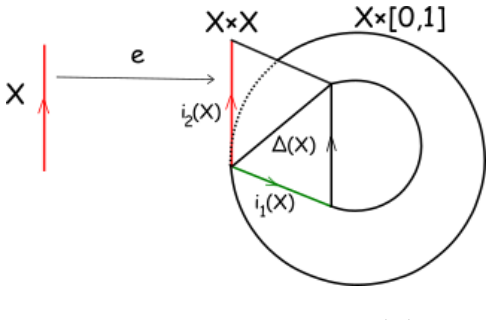
The load-bearing machinery is the iterated σ-construction and its infinite mapping telescope. For a space X, σ(X) is built from X×X and X×[0,1] by identifying the diagonal embedding of X with X×{0} and identifying the first-factor copy X×{x0} with X×{1}; this gives a compact CW-complex whose fundamental group is the HNN extension σ(G) of G×G. The maps X→σ(X) are injective on π1 and preserve residual finiteness. The key fact is Proposition 3.5, that the mapping telescope X∞ of the infinite sequence has H∗(X∞)=H∗(point); this is what allows a bordism theorem to fill M with a compact manifold mapping into X∞. Proposition 2.2 is then the surgical tool: given a π1-injective map from a boundary manifold into a K(Γ,1) that extends over a filling, one can do surgeries on the filling so that the extended map becomes a π1-isomorphism, making the boundary inclusion itself π1-injective.
What would settle it
Take X=S1 and compute the maps H1(XN)→H1(Xn) along the σ-telescope. Proposition 3.5 predicts that for every d>0 and N>0 there is n>N with the map trivial in degrees 1 through d (Lemma 3.6); in particular the composition S1→σ(S1)→σ2(S1)→... should eventually kill the generator of H1. A direct calculation of e∗ on the generator, using the corrected Künneth decomposition, would either confirm the vanishing or produce a surviving class. The specific identity to test is the equality in Lemma 3.9 asserting e∗=q∗∘(Δ∗−i1∗)=0.
Extended reading notes
Core claim
The central claim is Theorem 1.2: for a closed oriented bounding n-manifold M, the inclusion of M into a bounding (n+1)-manifold can be made π1-injective while keeping the fundamental group of the filling residually finite (when π1(M) is) or finite (when π1(M) is). The proof runs through a sequence of spaces X0=M, Xk=σ(Xk-1), where σ(X) is a quotient of X×X together with X×[0,1] that identifies the diagonal with one end and the first factor with the other; on fundamental groups this is the HNN extension σ(G)=⟨G×G,t | t(g,1)$t^{{-1}}$=(g,g)⟩. The embeddings Xk→Xk+1 are π1-injective and preserve residual finiteness, and the infinite mapping telescope X∞ is shown to have the homology of a point. A bordism theorem then extends the map M→X∞ to a filling W, and a surgery proposition replaces W by one whose map to a finite stage Xn is a π1-isomorphism; since the embedding M→Xn is π1-injective, the boundary inclusion is π1-injective. For finite π1(M), a residual-finiteness lemma embeds π1(M) into a finite quotient, and the same surgery upgrades the filling to one with finite fundamental group.
Load-bearing premise
The whole construction rests on the claim that the infinite mapping telescope X∞ built from M has no homology except in degree zero. If that homology vanishing fails, the bordism theorem cannot be invoked to produce the filling. As written, the proof of this claim contains a mis-stated Künneth formula in Lemma 3.9 and several asserted equalities in the diagram chase of Proposition 3.8, so this vanishing is the point most in need of verification.
Editorial extensions
If this is right
- Every closed oriented 3-manifold π1-injectively bounds a compact oriented 4-manifold with residually finite fundamental group; when π1(M) is finite, the 4-manifold can be chosen with finite fundamental group.
- Two lens spaces are π1-isomorphic cobordant if and only if there is an orientation-preserving homotopy equivalence (equivalently, a degree-one map) between them.
- Each spherical 3-manifold other than S3 is realized as the unique non-free orbit type of an almost free finite group action on a closed, simply connected 4-manifold.
- For a prime p≥5, the minimal bounding index of L(p,q) is the least integer d≥3 dividing p−1; every prime occurs as such a minimal bounding index.
- If an aspherical 3-manifold has finite minimal bounding index, it is virtually achiral; for hyperbolic Y, Ob(Y)=2 exactly when Y admits an orientation-reversing free involution.
Reading between the lines
- The σ-telescope construction is not obviously tied to residual finiteness alone: since σ preserves HNN extensions, the same route might yield fillings with other HNN-stable properties (for instance, being residually a finite p-group) whenever π1(M) has them.
- Theorem 1.5's criterion suggests a purely number-theoretic description of π1-isomorphic cobordism for all spherical 3-manifolds, whose fundamental groups are finite subgroups of SO(4); the quadratic-residue calculation for lens spaces may be a first case of a more general representation-theoretic formula.
- The relation between finiteness of Ob and virtual achirality raises the question of whether infinite Ob is actually equivalent to virtual achirality for aspherical 3-manifolds, or whether index bounds can be extracted from the geometry of the group.
- The explicit manifold W2 for L(5,1) realizes both minimal bounding index and minimal Euler characteristic; constructing analogous examples for other lens spaces would test whether the arithmetic criterion in Theorem 1.6 aligns with minimal Euler characteristic, not just index.
Editorial analysis
A structured set of objections, weighed in public.
Referee Report
Summary. The paper proves Theorem 1.2: if a closed oriented bounding n-manifold M has residually finite fundamental group, then M π1-injectively bounds a compact oriented (n+1)-manifold whose fundamental group is residually finite; if π1(M) is finite, the filling can be chosen with finite fundamental group. The proof builds an infinite mapping telescope X∞ from iterated doubling constructions σ(X), shows X∞ is acyclic, and applies Atiyah's bordism theorem to extend M→X∞ to a filling, then uses a surgery argument to make the extension π1-isomorphic. Applications include: a characterization of π1-isomorphic cobordism of lens spaces in terms of degree-one maps; realizability of each spherical 3-manifold as the unique non-free orbit type of an almost free finite group action on a closed simply connected 4-manifold; the definition and partial computation of the minimal bounding index Ob(Y); and explicit constructions of 4-manifolds bounded by lens spaces and of surface bundles bounding surface bundles.
Significance. If the main theorem and its applications are correct, this is a substantial contribution to the study of π1-injective bounding and to the topology of 3- and 4-manifolds. The paper gives a new proof of Hausmann's theorem and strengthens it by controlling the fundamental group of the filling. The applications to lens-space cobordism, finite group actions, and the minimal bounding index are original and potentially useful. The paper is ambitious and contains many explicit computations, including the construction of a 4-manifold bounded by L(5,1) realizing both Ob(L(5,1)) and the minimal Euler characteristic. However, the central acyclicity argument (Proposition 3.5) contains a false equality in Lemma 3.9 and a genuinely underjustified induction step in Proposition 3.7; as written, the proof of Theorem 1.2 is incomplete. These gaps appear repairable, but they are load-bearing.
major comments (4)
- [§3.2, Lemma 3.9] The equality q∘Δ = q∘i1 is false at the level of maps: in σ(X), the image of Δ is identified with X×{0} and the image of i1 is identified with X×{1}, and the cylinder X×[0,1] supplies a homotopy between these two maps, not an equality. The intended conclusion e∗=0 in H1 can be recovered by using homotopy instead of equality, but the proof as written rests on a false assertion. The Künneth formula in the same lemma also contains a typo: H1(X×X) should be decomposed as (H1(X)⊗Z) ⊕ (Z⊗H1(X)), not Z⊗H1(X×X).
- [§3.2, Proposition 3.7] The induction step as written is not valid. The text states that by the induction hypothesis on n−1, the first two maps in the displayed sequence induce trivial maps on Hi for 1≤i≤n, but the induction hypothesis P(n−1) only supplies triviality for 1≤i≤n−1, and it applies to the map X→σ^{3^{n−2}}(X), not to the first map X→σ^{3^{n−1}}(X) displayed in the proof. The second map is σ^{3^{n−1}}(X)→σ^{2·3^{n−1}}(X), which is an embedding of the form Z→σ^{3^{n−1}}(Z) and is not covered by P(n−1). Consequently Proposition 3.7 is unproved as written, and with it the acyclicity of X∞ (Proposition 3.5) is not established. A repair appears possible by applying Proposition 3.8 with A1=X, A2=σ^{3^{n−2}}(X), A3=σ^{2·3^{n−2}}(X) and then composing with the remaining inclusions to σ^{3^{n−1}}(X), but this needs to be written out carefully.
- [§6.1, Proposition 6.1 proof] The claim that a semidirect product of residually finite groups is residually finite is false in general (for example, BS(1,2) = Z[1/2]⋊Z is a semidirect product of residually finite groups but is not residually finite). The residual finiteness of π1(W) in the surface-bundle construction therefore does not follow from the stated reason. Since this is part of the conclusion of Proposition 1.12, a correct proof or a precise citation for this specific class of semidirect products is needed.
- [§3.2, Proposition 3.8 proof] The proof again uses the equality q3∘Δ3 = q3∘i1, which is only true up to homotopy. The homology conclusion remains valid once the equality is replaced by the homotopy coming from the cylinder in σ(A3). In addition, there are typographical issues in the same proof: 'α3=f1(α2)' should presumably read 'α3=f2(α2)', and the symbol 'α1' is used without definition.
minor comments (6)
- [§2.1, Proposition 2.2 proof] The connected sum term 'S^{n−1}×S^1' has dimension n, not n+1, so it cannot be used in the connected sum with the (n+1)-manifold W. The intended term should be S^n×S^1, whose fundamental group contribution is the desired free Z factor; this is a typo but should be corrected.
- [§3.3, Theorem 3.11 proof] When applying Proposition 2.2 to the map τ˜n:W→Xn, the target Xn is not a K(π1,1) space. The argument should pass to the classifying space K(π1(Xn),1) by composing with the canonical map Xn→K(π1(Xn),1); the text should make this explicit.
- [§4.1, Theorem 4.1 proof] In the step (4)⇒(1), the phrase 'we can require that ef:W→L is a π1-isomorphism' should refer to a map to K(Z_n,1), since L is not aspherical. The subsequent argument is unaffected after replacing L by its K(π1,1) relaxation.
- [§4.1, Lemma 4.2 proof] In the converse direction, the notation for the map obtained by connected sum is garbled: the target of the added map should be L(n,q′), not L(n,1), and the degree of p_{n,k} should be chosen consistently with the desired degree d=qq′x^2+nk. Please clarify.
- [§5.1, Lemma 5.3 proof] The proof ends with 'This is a contradiction' without explicitly identifying the contradiction. One should state that the hypothesis i∗:H3(J)→H3(G) is trivial means p∗:H3(K~)→H3(K) is zero, which combined with p∗p∗=d·id on H3(K;Q) contradicts the injectivity of p∗ on H3(K;Q).
- [General notation] There are several minor notational inconsistencies, e.g., ∂fW for ∂fW, 'eY' for the lift of Y, and 'Σ_{n,1}' with '1 boundary components'. These do not affect the mathematics but should be cleaned up.
Circularity Check
No circularity: Theorem 1.2 is derived from independent inputs (Atiyah bordism, Hausmann, Hempel residual finiteness); self-citations are contextual and not load-bearing.
full rationale
The central derivation chain is Theorem 3.11: construct X∞ via σ-embeddings, prove H∗(X∞)=H∗(pt) (Proposition 3.5), invoke Atiyah's Theorem 2.1 to extend M→X∞ to a filling W→X∞, then identify π1(W) with π1(Xn), whose residual finiteness follows from Proposition 3.2, proved using Hempel's Lemma 3.3 on HNN extensions. Each load-bearing theorem is external: Atiyah's generalized homology theory [Ati], Thom/Rokhlin bordism, Hempel's residual finiteness criteria [He], and Hausmann's theorem [Hau] (which is reproved, not assumed). The O_b calculations in Section 5 are derived from group homology and Lemma 5.10, not fitted to the invariant's definition. The paper's self-citations ([SW1], [SW2], [TWWY]) appear only in remarks, context, or as notes that standard calculations also appear there; none is needed for Theorem 1.2, Theorem 1.5, or Theorem 1.10. The referee-visible concern about Proposition 3.7/3.8 is a possible proof gap (the induction hypothesis as stated gives vanishing only up to n−1 and uses a pointwise equality q∘Δ=q∘i1 that is homotopic rather than exact), but a gap or error in a proof is not a circular reduction: the conclusion is not assumed as an input anywhere in the paper. No fitted parameter is renamed a prediction, and no known result is repackaged under new coordinates in a way that forces the outcome. Hence the paper earns a circularity score of 0.
Assumptions & free parameters
assumptions (9)
- standard math Atiyah's bordism homology MSO_*(X) is a generalized homology theory admitting an Atiyah-Hirzebruch spectral sequence.
- standard math The oriented cobordism groups Omega_q vanish for 1 <= q <= 3, and Omega_3 = 0.
- standard math Hempel's residual finiteness criterion for HNN extensions (Proposition 15.20) and Lemma 15.16 on finite-index subgroups.
- standard math Scott and Wall's theorem that the canonical map from a group into an HNN extension is injective.
- standard math Mostow rigidity for finite-volume hyperbolic 3-manifolds, plus the non-elementary Kleinian group fact that if gamma^2 commutes with J then gamma^2 = g^2.
- standard math The Hayat, Kudryavtseva, Wang, Zieschang theorem describing degrees of pi_1-isomorphic self-maps of lens spaces.
- standard math Casson-Gordon lemma: if L(p,q) bounds a rational homology 4-ball then p is a square.
- standard math Daverman's theorem: O_b(Y) = 1 iff Y is S^3 or a connected sum of S^2 x S^1.
- standard math Agol's virtual Haken theorem and Przytycki-Wise virtually special theorems for hyperbolic and mixed 3-manifolds.
Cite this review
Pith. "Pith review of $\pi_1$-injective bounding and application to 3- and 4-manifolds." pith.science (2026). https://pith.science/paper/7QAGDLL3
@misc{pith2026250608847,
  author       = {Pith},
  title        = {Pith review of: $\pi_1$-injective bounding and application to 3- and 4-manifolds},
  year         = {2026},
  howpublished = {\url{https://pith.science/paper/7QAGDLL3}},
  note         = {Machine review of arXiv:2506.08847}
}
abstract
Suppose a closed oriented $n$-manifold $M$ bounds an oriented $(n+1)$-manifold. It is known that $M$ $\pi_1$-injectively bounds an oriented $(n+1)$-manifold $W$. We prove that $\pi_1(W)$ can be residually finite if $\pi_1(M)$ is, and $\pi_1(W)$ can be finite if $\pi_1(M)$ is. In particular, each closed 3-manifold $M$ $\pi_1$-injectively bounds a 4-manifold with residually finite $\pi_1$, and bounds a 4-manifold with finite $\pi_1$ if $\pi_1(M)$ is finite. Applications to 3- and 4-manifolds are given: (1) We study finite group actions on closed 4-manifolds and $\pi_1$-isomorphic cobordism of 3-dimensional lens spaces. Results including: (a) Two lens spaces are $\pi_1$-isomorphic cobordant if and only if there is a degree one map between them. (b) Each spherical 3-manifold $M\ne S^3$ can be realized as the unique non-free orbit type for a finite group action on a closed 4-manifold. (2) The minimal bounding index $O_b(M)$ for closed 3-manifolds $M$ are defined, %and bounding Euler charicteristic $\chi_b(M)$. the relations between finiteness of $O_b(M)$ and virtual achirality of aspherical (hyperbolic) $M$ are addressed. We calculate $O_b(M)$ for some lens spaces $M$. Each prime is realized as a minimal bounding index. (3) We also discuss some concrete examples:Surface bundle often bound surface bundles, and prime 3-manifolds often virtually bound surface bundles, $W$ bounded by some lens spaces realizing $O_b$ is constructed.
Figures
Reference graph
Works this paper leans on
-
[1]
Agol, The virtual Haken conjecture , Doc
I. Agol, The virtual Haken conjecture , Doc. Math. 18 (2013) 1045--1087, with an appendix by I. Agol, D. Groves and J. Manning
work page 2013
-
[2]
Atiyah, Bordism and cobordism, Proc
M. Atiyah, Bordism and cobordism, Proc. Camb. Phil. Soc. 57 (1961) 200-208
work page 1961
- [3]
- [4]
-
[5]
R. M. Charney, M. W. Davis, Strict hyperbolization, Topology 34 (1995), no. 2, 329-350
work page 1995
- [6]
- [7]
-
[8]
Daverman, Fundamental group isomorphisms between compact 4 -manifolds and their boundaries
R. Daverman, Fundamental group isomorphisms between compact 4 -manifolds and their boundaries. Low-dimensional topology (Knoxville, TN, 1992), 31 - 34, Conf. Proc. Lecture Notes Geom. Topology, III, Int. Press, Cambridge, MA, 1994
work page 1992
Show all 37 references
-
[9]
I. Dai, J. Hom, M. Stoffregen, L. Truong, An infinite-rank summand of the homology cobordism group. Duke Math. J. 172 (2023), no. 12, 2365--2432
2023
-
[10]
M. W. Davis, T. Januszkiewicz,
-
[11]
Davis, T
M. Davis, T. Januszkiewicz and S. Weinberger, Relative hyperbolization and aspherical bordisms; An addendum to `Hyperbolization of polyhedra,' J. Differential Geom. 58 (2001), 535-541
2001
-
[12]
Foozwell and H
B. Foozwell and H. Rubinstein, Four-dimensional Haken cobordism theory, Illinois J. Math. 60 (2016), no. 1, 1-17
2016
-
[13]
B. Farb, D. Margalit, A primer on mapping class groups . Princeton Mathematical Series, 49. Princeton University Press, Princeton, NJ, 2012
2012
-
[14]
Hatcher, Algebraic topology
A. Hatcher, Algebraic topology. Cambridge University Press, Cambridge, 2002
2002
-
[15]
Hatcher, Notes on basic 3 -manifold topology
A. Hatcher, Notes on basic 3 -manifold topology. http://pi.math.cornell.edu/ hatcher/
-
[16]
Hayat, E
C. Hayat, E. Kudryavtseva, S.C. Wang, H. Zieschang, Degrees of self-mappings of Seifert manifolds with finite fundamental groups. Rend. Istit. Mat. Univ. Trieste 32 (2001), 131-147
2001
-
[17]
Hempel, 3 -manifolds, Princeton University Press and University of Tokyo Press, 1976
J. Hempel, 3 -manifolds, Princeton University Press and University of Tokyo Press, 1976
1976
-
[18]
Hausmann, On the homotopy of nonnilpotent spaces
J-C. Hausmann, On the homotopy of nonnilpotent spaces. Math. Z. 178 (1981), no. 1, 115-123
1981
-
[19]
Weinberger
J-C, Hausmann , S. Weinberger. Caractéristiques d'Euler et groupes fondamentaux des variétés de dimension 4 (in French). Comment Math Helv, 1985, 60: 139-144
1985
-
[20]
D. M. Kan, W. P. Thurston, Every connected space has the homology of a K(π,1)
-
[21]
W. B. R. Lickorish, A representation of orientable combinatorial 3 -manifolds, Ann. of Math. , 76 (1962) 531-540
1962
-
[22]
Liu and H
Y. Liu and H. Sun, Toward and after virtual specialization in 3-manifold topology. Surveys in differential geometry 2020. Surveys in 3-manifold topology and geometry, 215-252, Surv. Differ. Geom., 25, Int. Press, Boston, MA
2020
-
[23]
Maclachlan, A
C. Maclachlan, A. Reid, The arithmetic of hyperbolic 3 -manifolds. 2003, Springer-Verlag New York Inc
2003
-
[24]
Mumford, Abelian Quotients of the Teichmuller Modular Group, Journal d'Analyse, 1967, 28, pp
D. Mumford, Abelian Quotients of the Teichmuller Modular Group, Journal d'Analyse, 1967, 28, pp. 227-244
1967
-
[25]
Ontaneda, Riemannian hyperbolization,
P. Ontaneda, Riemannian hyperbolization,
-
[26]
Powell, Two theorems on the mapping class group of a surface
J. Powell, Two theorems on the mapping class group of a surface . Proc. Amer. Math. Soc., 68(3): 347-350, 1978
1978
-
[27]
Przytycki, D
P. Przytycki, D. Wise, Mixed 3 -manifolds are virtually special. J. Amer. Math. Soc.31(2018), no.2, 319–347
2018
-
[28]
Rolfsen, Knots and links
D. Rolfsen, Knots and links. Corrected reprint of the 1976 original. Mathematics Lecture Series, 7. Publish or Perish, Inc., Houston, TX, 1990. xiv +439 pp. ISBN: 0-914098-16-0
1976
-
[29]
Rokhlin, New results in the theory of 4 -dimensional manifolds
V. Rokhlin, New results in the theory of 4 -dimensional manifolds. Dokl. Akad. Nauk. SSSR 84 (1952), 221-224
1952
-
[30]
Scott, The geometries of three manifolds, Bull
P. Scott, The geometries of three manifolds, Bull. London Math. Soc. , 15 (1983) 401-487
1983
-
[31]
Scott, C
P. Scott, C. T. C. Wall, Topological methods in group theory. Homological group theory , (Proc. Sympos., Durham (1979), 137--203), London Math. Soc. Lecture Note Ser. 36, Cambridge Univ. Press, Cambridge-New York, 1979
1979
-
[32]
H. B. Sun, Z. Z. Wang, Minimum Euler Characteristics of 4 -manifolds with 3 -manifold groups. Science China Mathematics, (2023), volume 66, pages 2325-2336
2023
-
[33]
H. B. Sun, Z. Z. Wang, Maps from 3 -manifolds to 4 -manifolds that induce isomorphisms on _1 , To appear in Journal of Topology and Analysis. arXiv:2108.05784 [math.GT]
-
[34]
Thom, Quelques propriétés globales des variétés différentiables, Comment
R. Thom, Quelques propriétés globales des variétés différentiables, Comment. Math. Helv. , 28 (1954) 17-86
1954
-
[35]
Tian, S.C
Y. Tian, S.C. Wang, Z.Z. Wang and H. Yin, Achirality of commensurable class of geometric 3 -manifolds and Stevenhagen Conjecture, Preprint, 2025
2025
-
[36]
Thurston, Three dimensional manifolds, Kleinian groups and hyperbolic geometry , Bull
W. Thurston, Three dimensional manifolds, Kleinian groups and hyperbolic geometry , Bull. Amer. Math. Soc. 6 (1982) 357-381
1982
-
[37]
Wise , From riches to raags: 3 -manifolds, right-angled Artin groups, and cubical geometry , CBMS Regional Conference Series in Mathematics, 117
D. Wise , From riches to raags: 3 -manifolds, right-angled Artin groups, and cubical geometry , CBMS Regional Conference Series in Mathematics, 117. Published for the Conference Board of the Mathematical Sciences, Washington, DC; by the American Mathematical Society, Providenc...
2012
Reviewed August 7, 2026 · model on record in the stance chip above.
Discussion (0). Sign in to comment.