On Cycles in Multiset Permutations, Parking Functions, and Related Structures
Pith reviewed 2026-06-26 19:59 UTC · model grok-4.3
The pith
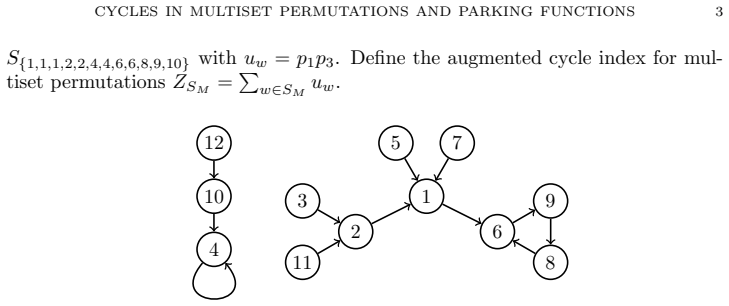
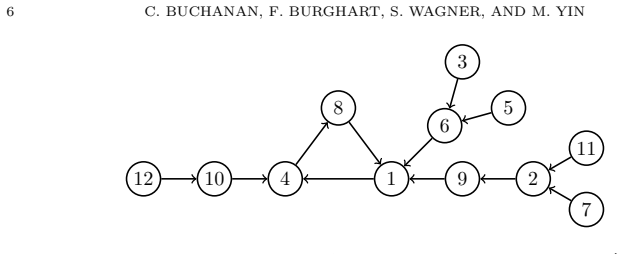
Multiset permutations show a correspondence between terminal closers and cyclic points that structures their cycles.
A machine-rendered reading of the paper's core claim, the machinery that carries it, and where it could break.
Core claim
The paper presents exact and asymptotic results on cycles in multiset permutations and parking functions, and points to a correspondence between terminal closers and cyclic points on multiset permutations that sheds light on their combinatorial structure.
What carries the argument
The correspondence between terminal closers and cyclic points, which equates two statistics on multiset permutations.
If this is right
- Algebraic methods yield exact cycle counts for both multiset permutations and parking functions.
- Analytic methods produce asymptotic distributions for the same cycle statistics.
- The correspondence implies that the two statistics share the same distribution on multiset permutations.
Where Pith is reading between the lines
- The correspondence may allow cycle results on parking functions to transfer directly to related objects such as labeled trees or mappings.
- Explicit bijections realizing the terminal-closer to cyclic-point match could be constructed and checked on small instances.
- Asymptotic formulas derived here might extend to cycle statistics in other families that interpolate between mappings and permutations.
Load-bearing premise
The standard definitions of multiset permutations and parking functions allow algebraic and analytic methods to produce exact and asymptotic cycle statistics without additional hidden constraints on the underlying sets.
What would settle it
A complete enumeration of terminal closers versus cyclic points across all multiset permutations of a small multiset that yields unequal totals would disprove the claimed correspondence.
Figures
read the original abstract
In this paper we study cycles in multiset permutations and parking functions. As combinatorial objects, multiset permutations are essential building blocks for mappings and permutations, while parking functions lie between mappings and permutations. We take both algebraic and analytic views in our investigation and present exact as well as asymptotic results. We point to a surprising correspondence between two statistics on multiset permutations, terminal closers and cyclic points, shedding light on the combinatorial structure.
Editorial analysis
A structured set of objections, weighed in public.
Referee Report
Summary. The paper studies cycles in multiset permutations and parking functions from both algebraic and analytic perspectives. It derives exact and asymptotic cycle statistics from the standard definitions of these objects and identifies a correspondence between the statistics of terminal closers and cyclic points on multiset permutations.
Significance. If the correspondence and the derived statistics hold under the conventional definitions, the work would clarify structural relationships among mappings, multiset permutations, and parking functions, offering both enumerative formulas and asymptotic tools that could be useful in broader combinatorial enumeration.
minor comments (2)
- [Abstract] Abstract: the phrase 'shedding light on the combinatorial structure' is vague; replace with a concrete statement of what the correspondence implies for cycle enumeration.
- [Introduction] The manuscript should include a short table or list in the introduction that explicitly contrasts the new results with prior work on cycle statistics in permutations and mappings.
Simulated Author's Rebuttal
We thank the referee for the positive summary, significance assessment, and recommendation of minor revision. No specific major comments appear in the report.
Circularity Check
No significant circularity detected
full rationale
The paper applies standard algebraic and analytic methods to the conventional definitions of multiset permutations and parking functions to derive exact and asymptotic cycle statistics, along with an observed correspondence between terminal closers and cyclic points. No equations, fitted parameters, self-definitional constructions, or load-bearing self-citations appear in the abstract or described structure that would reduce any claimed result to its own inputs by construction. The central correspondence is presented as a structural observation rather than a quantity defined in terms of itself, leaving the derivation self-contained against external combinatorial benchmarks.
Axiom & Free-Parameter Ledger
Reference graph
Works this paper leans on
-
[1]
Richard Arratia, A. D. Barbour, and Simon Tavar´ e.Logarithmic combinatorial structures: a probabilistic approach. EMS Monographs in Mathematics. European Mathematical Society (EMS), Z¨ urich, 2003.doi:10.4171/000
work page doi:10.4171/000 2003
-
[2]
Probabilizing parking functions.Adv
Persi Diaconis and Angela Hicks. Probabilizing parking functions.Adv. in Appl. Math., 89:125–155, 2017.doi:10.1016/j.aam.2017.05.004
-
[3]
The combinatorial statistics database
FindStat. The combinatorial statistics database. Database and Search Engine for Combina- torial Statistics and Maps. URL:https://www.findstat.org. CYCLES IN MULTISET PERMUTATIONS AND PARKING FUNCTIONS 17
-
[4]
P. Flajolet, P. Poblete, and A. Viola. On the analysis of linear probing hashing.Algorithmica, 22(4):490–515, 1998.doi:10.1007/PL00009236
-
[5]
Grabner, Peter Kirschenhofer, and Helmut Prodinger
Philippe Flajolet, Peter J. Grabner, Peter Kirschenhofer, and Helmut Prodinger. On Ramanu- jan’sQ-function.J. Comput. Appl. Math., 58(1):103–116, 1995.doi:10.1016/0377-0427(93) E0258-N
-
[6]
Philippe Flajolet and Andrew M. Odlyzko. Random mapping statistics. InAdvances in cryptology—EUROCRYPT ’89 (Houthalen, 1989), volume 434 ofLecture Notes in Com- put. Sci., pages 329–354. Springer, Berlin, 1990.doi:10.1007/3-540-46885-4\_34
-
[7]
Mappings of acyclic and parking functions.Aequationes Math., 10:10–22, 1974.doi:10.1007/BF01834776
Dominique Foata and John Riordan. Mappings of acyclic and parking functions.Aequationes Math., 10:10–22, 1974.doi:10.1007/BF01834776
-
[8]
Ira M. Gessel. Lagrange inversion.J. Combin. Theory Ser. A, 144:212–249, 2016.doi:10. 1016/j.jcta.2016.06.018
2016
-
[9]
Ira M. Gessel and Gilbert Labelle. Lagrange inversion for species.J. Combin. Theory Ser. A, 72(1):95–117, 1995.doi:10.1016/0097-3165(95)90030-6
-
[10]
I. P. Goulden and D. M. Jackson.Combinatorial enumeration. Wiley-Interscience Series in Discrete Mathematics. John Wiley & Sons, Inc., New York, 1983
1983
-
[11]
Leo Katz. Probability of indecomposability of a random mapping function.Ann. Math. Statist., 26:512–517, 1955.doi:10.1214/aoms/1177728496
-
[12]
Westin King and Catherine H. Yan. Prime parking functions on rooted trees.J. Combin. Theory Ser. A, 168:1–25, 2019.doi:10.1016/j.jcta.2019.05.015
-
[13]
Konheim and Benjamin Weiss
Alan G. Konheim and Benjamin Weiss. An occupancy discipline and applications.SIAM J. Appl. Math., 14:1266–1274, 1966
1966
-
[14]
Parking functions for mappings.J
Marie-Louise Lackner and Alois Panholzer. Parking functions for mappings.J. Combin. The- ory Ser. A, 142:1–28, 2016.doi:10.1016/j.jcta.2016.03.001
-
[15]
I. G. Macdonald.Symmetric functions and Hall polynomials. Oxford Mathematical Mono- graphs. The Clarendon Press, Oxford University Press, New York, second edition, 1995
1995
-
[16]
On the deepest cycle of a random mapping.J
Ljuben Mutafchiev and Steven Finch. On the deepest cycle of a random mapping.J. Combin. Theory Ser. A, 206:Paper No. 105875, 14, 2024.doi:10.1016/j.jcta.2024.105875
-
[17]
The On-Line Encyclopedia of Integer Sequences, 2026
OEIS Foundation Inc. The On-Line Encyclopedia of Integer Sequences, 2026. Published elec- tronically athttps://oeis.org
2026
- [18]
-
[19]
Neuer Beweis eines Satzes ¨ uber Permutationen.Archiv der Mathematik und Physik, 27:742–744, 1918
Heinz Pr¨ ufer. Neuer Beweis eines Satzes ¨ uber Permutationen.Archiv der Mathematik und Physik, 27:742–744, 1918
1918
-
[20]
A. R´ enyi. On connected graphs. I.Magyar Tud. Akad. Mat. Kutat´ o Int. K¨ ozl., 4:385–388, 1959
1959
-
[21]
Ballots and trees.J
John Riordan. Ballots and trees.J. Combinatorial Theory, 6:408–411, 1969
1969
-
[22]
Fixed points and cycles of parking functions.Enumer
Martin Rubey and Mei Yin. Fixed points and cycles of parking functions.Enumer. Comb. Appl., 5(2):Paper No. S2R10, 9, 2025.doi:10.54550/eca2025v5s2r10
-
[23]
Stanley.Enumerative combinatorics
Richard P. Stanley.Enumerative combinatorics. Vol. 2, volume 62 ofCambridge Studies in Advanced Mathematics. Cambridge University Press, Cambridge, 1999.doi:10.1017/ CBO9780511609589
1999
discussion (0)
Sign in with ORCID, Apple, or X to comment. Anyone can read and Pith papers without signing in.