From Agent Identity to Agent Economy: Measuring the Operational Readiness of ERC-8004 AI Agents
Pith reviewed 2026-06-27 07:48 UTC · model grok-4.3
The pith
ERC-8004 registers AI agents on Ethereum but shows limited operational activity beyond identity.
A machine-rendered reading of the paper's core claim, the machinery that carries it, and where it could break.
Core claim
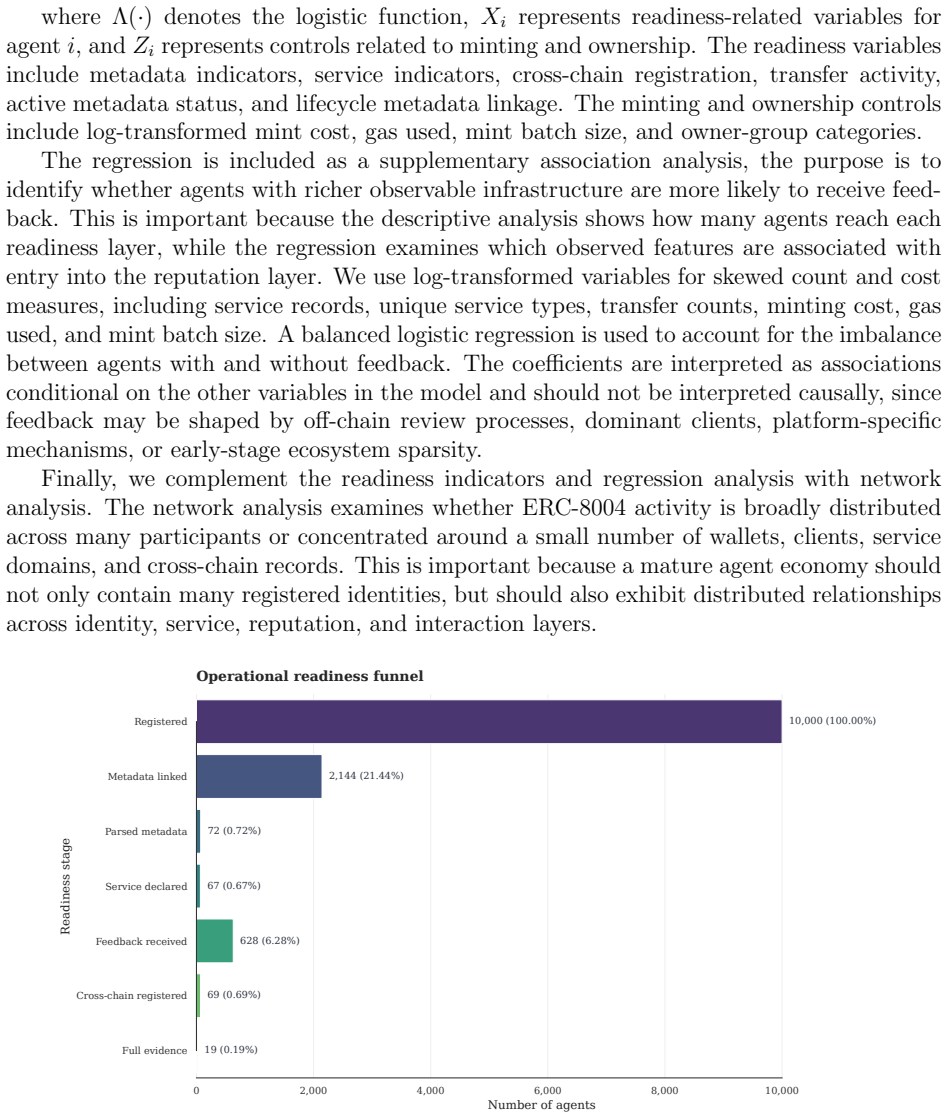
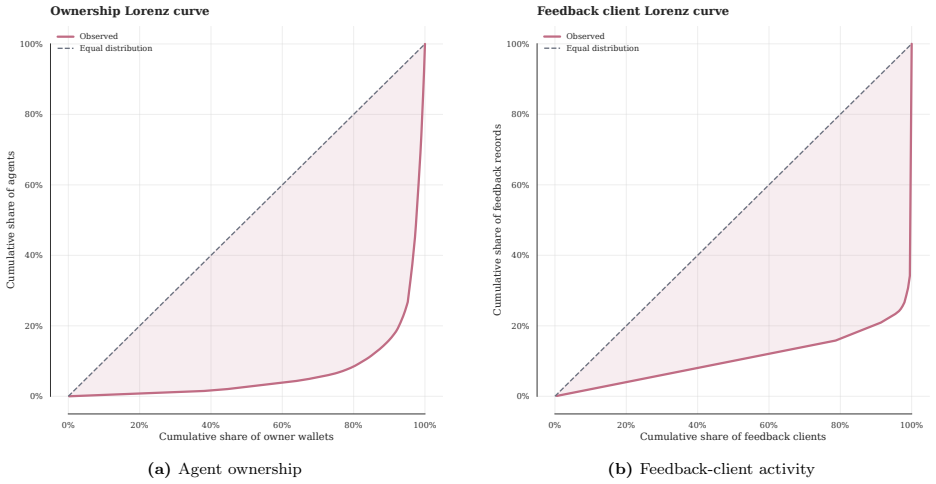
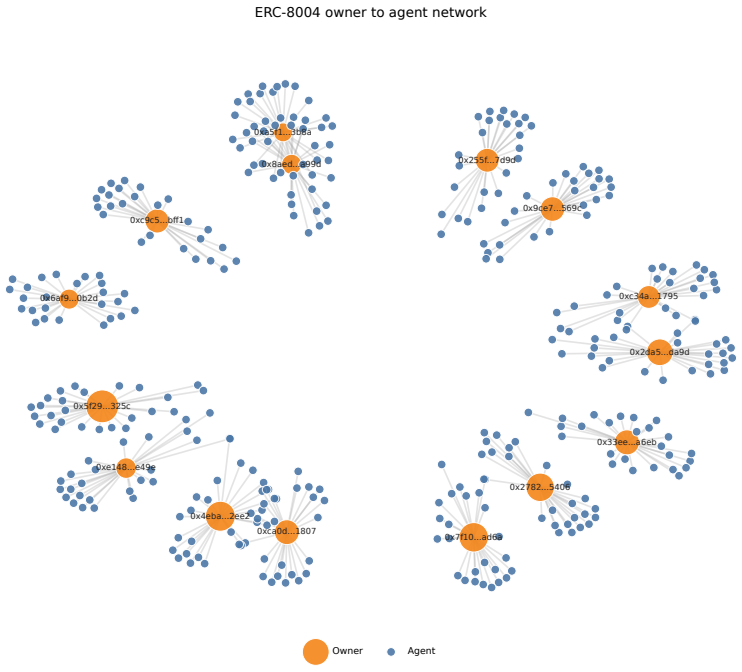
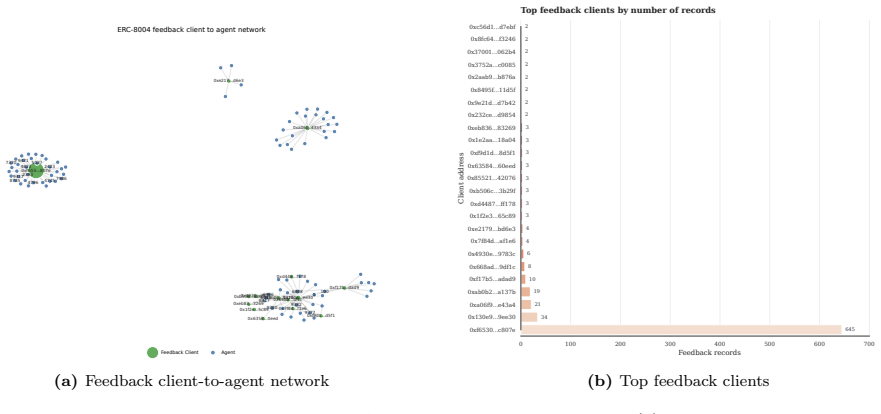
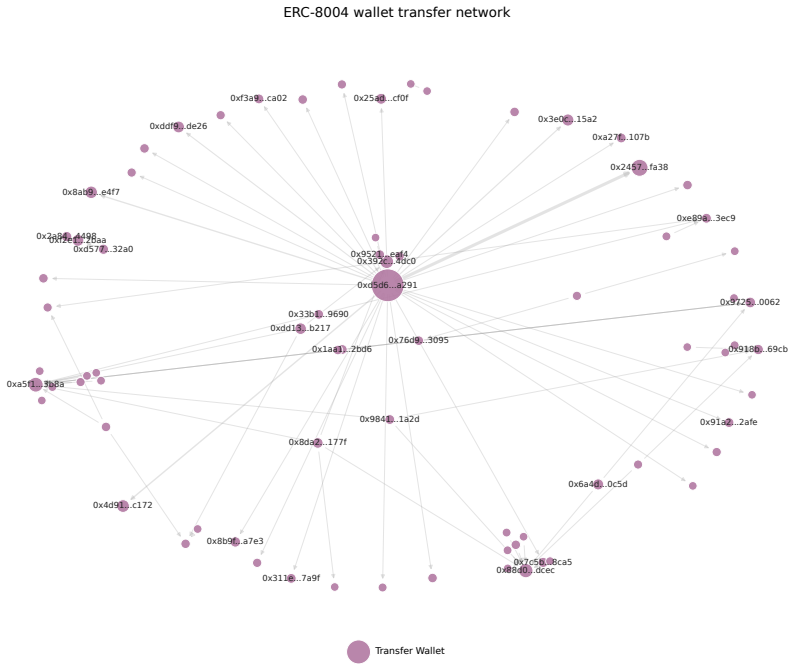
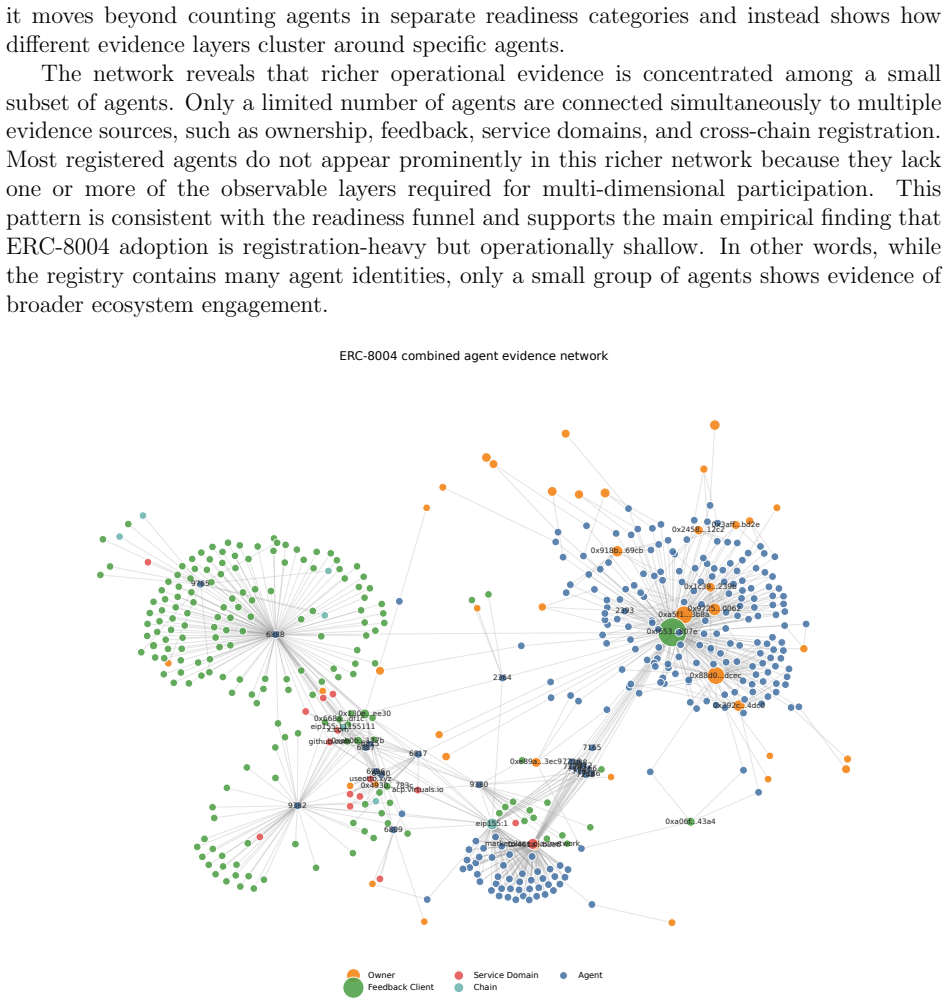
Early ERC-8004 adoption is registration-heavy but operationally shallow. While the identity layer is visible at scale, metadata availability, service exposure, reputation formation, and cross-chain evidence remain limited. Ownership and feedback activity are also highly concentrated, suggesting that early participation is shaped by a small number of high-activity wallets and clients. The network analysis further shows that richer operational evidence clusters around a small subset of agents rather than being broadly distributed across the ecosystem.
What carries the argument
Operational readiness framework built from observable evidence layers (identity status, metadata, service declarations, reputation feedback, transfers, cross-chain registration) plus network analysis of owner-agent, feedback-client, wallet-transfer, and combined evidence relationships.
If this is right
- The identity layer for decentralized AI agents is established at scale on Ethereum.
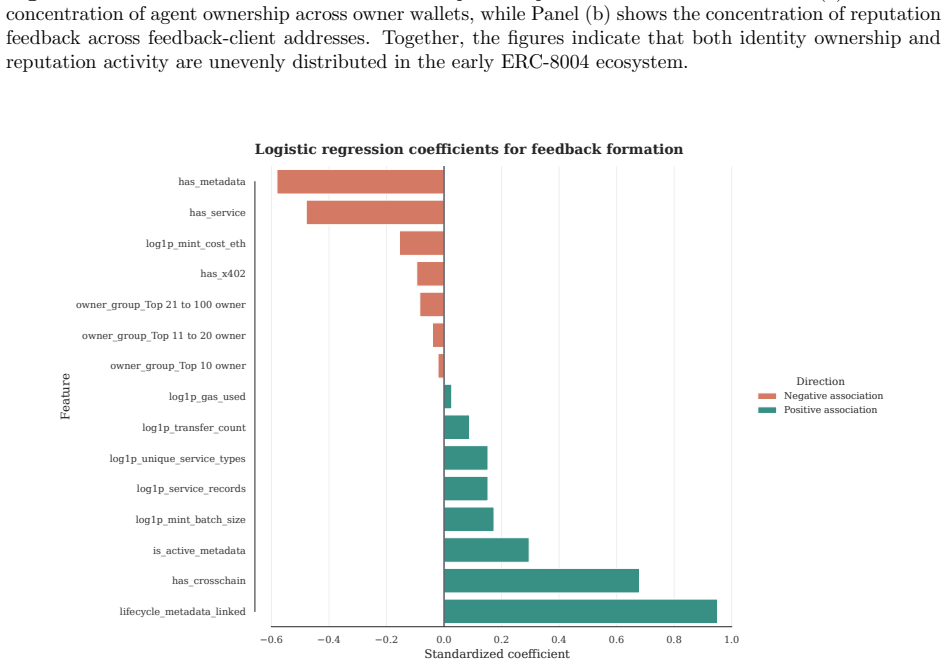
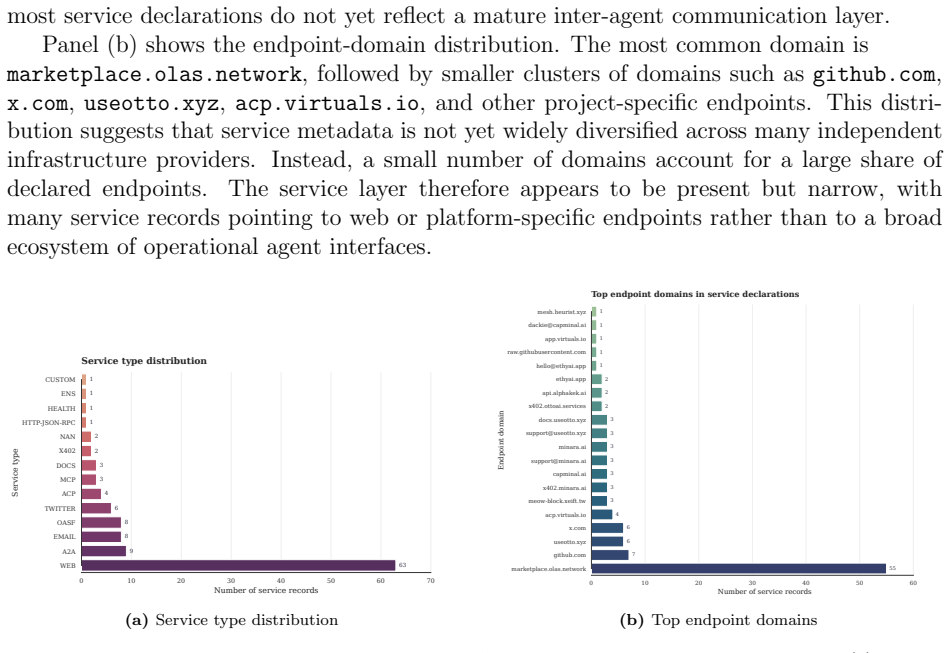
- Metadata availability, service exposure, reputation formation, and cross-chain evidence remain limited in the current dataset.
- Ownership and feedback activity are highly concentrated among a small number of high-activity wallets and clients.
- Richer operational evidence clusters around a small subset of agents rather than distributing broadly.
Where Pith is reading between the lines
- Standards or market incentives may be required to push agents toward exposing services and accumulating reputation.
- The observed concentration suggests the ecosystem remains in an early experimental stage dominated by a few active participants.
- Repeating the analysis on later data or additional chains could test whether operational depth increases over time.
Load-bearing premise
The constructed agent-level feature table and observable evidence layers are sufficient and unbiased proxies for operational readiness.
What would settle it
Finding a broad distribution of agents with complete metadata, active service declarations, formed reputation feedback, and cross-chain registrations across many owners and clients would show the transition to an agent economy is more advanced than reported.
Figures
read the original abstract
This paper examines whether blockchain-registered AI agents demonstrate operational readiness beyond identity registration. Using a dataset of ERC-8004 agents on Ethereum, we construct an agent-level feature table covering identity status, metadata, service declarations, reputation feedback, transfers, and cross-chain registration. We develop an operational readiness framework based on observable evidence layers and complement it with network analysis of owner-agent, feedback-client, wallet-transfer, and combined evidence relationships. The results show that early ERC-8004 adoption is registration-heavy but operationally shallow. While the identity layer is visible at scale, metadata availability, service exposure, reputation formation, and cross-chain evidence remain limited. Ownership and feedback activity are also highly concentrated, suggesting that early participation is shaped by a small number of high-activity wallets and clients. The network analysis further shows that richer operational evidence clusters around a small subset of agents rather than being broadly distributed across the ecosystem. The findings suggest that ERC-8004 provides an important identity layer for decentralized AI agents, but the transition from agent identity to agent economy remains incomplete.
Editorial analysis
A structured set of objections, weighed in public.
Referee Report
Summary. This paper examines whether blockchain-registered AI agents demonstrate operational readiness beyond identity registration. Using a dataset of ERC-8004 agents on Ethereum, the authors construct an agent-level feature table covering identity status, metadata, service declarations, reputation feedback, transfers, and cross-chain registration. They develop an operational readiness framework based on observable evidence layers and complement it with network analysis of owner-agent, feedback-client, wallet-transfer, and combined evidence relationships. The results show that early ERC-8004 adoption is registration-heavy but operationally shallow, with limited metadata availability, service exposure, reputation formation, and cross-chain evidence, plus high concentration in ownership and feedback activity. The network analysis shows richer operational evidence clustering around a small subset of agents. The findings suggest that ERC-8004 provides an important identity layer for decentralized AI agents, but the transition from agent identity to agent economy remains incomplete.
Significance. If the on-chain evidence layers accurately proxy operational readiness and economic activity, the work supplies a useful empirical snapshot of early ERC-8004 adoption and a structural view via network analysis of participation concentration. It establishes a baseline framework that could inform future measurements of decentralized AI agent ecosystems.
major comments (1)
- [Abstract and operational readiness framework] Abstract and operational readiness framework: The central claim that the transition from agent identity to agent economy remains incomplete rests on the constructed feature table (identity, metadata, services, reputation, transfers, cross-chain) serving as sufficient and unbiased proxies for operational readiness. No external validation, correlation to off-chain utility or activity, or analysis of potential biases from unindexed channels is reported, so the inference from observed on-chain shallowness to incomplete economic transition does not follow directly from the data.
minor comments (2)
- [Abstract] The abstract references results from a constructed dataset and network analysis but provides no sample size, data collection method, exclusion criteria, or statistical validation.
- [Abstract] Details on the precise thresholds or definitions used to classify evidence layers as 'limited' or activity as 'highly concentrated' are not stated.
Simulated Author's Rebuttal
We thank the referee for the constructive review. The central concern regarding the operational readiness framework and the strength of the inference to an incomplete agent economy transition is addressed below. We propose targeted revisions to clarify scope and limitations.
read point-by-point responses
-
Referee: Abstract and operational readiness framework: The central claim that the transition from agent identity to agent economy remains incomplete rests on the constructed feature table (identity, metadata, services, reputation, transfers, cross-chain) serving as sufficient and unbiased proxies for operational readiness. No external validation, correlation to off-chain utility or activity, or analysis of potential biases from unindexed channels is reported, so the inference from observed on-chain shallowness to incomplete economic transition does not follow directly from the data.
Authors: We agree that the manuscript does not include external validation against off-chain activity or explicit bias analysis for unindexed channels. The operational readiness framework is defined strictly in terms of observable on-chain evidence layers (identity registration, metadata, service declarations, reputation feedback, transfers, and cross-chain registration), as described in Sections 3 and 4. The central claim is therefore scoped to the visible on-chain transition rather than a comprehensive economic assessment. To strengthen the manuscript, we will revise the abstract to emphasize the on-chain scope, add an explicit limitations subsection in the discussion that acknowledges the absence of off-chain correlation and potential unindexed activity, and qualify the conclusion to state that the transition from identity to economy appears incomplete on the basis of on-chain observables. These changes will make the inferential limits transparent without altering the reported empirical findings. revision: yes
Circularity Check
No circularity: purely descriptive on-chain analysis with no derivations or fitted predictions
full rationale
The paper constructs an agent-level feature table from Ethereum ERC-8004 observables (identity, metadata, services, reputation, transfers, cross-chain) and applies network analysis to report concentration and shallowness. No equations, parameters, or predictions are defined; the operational readiness framework is explicitly built from the same observables used for measurement. No self-citations, uniqueness theorems, or ansatzes are invoked. Conclusions follow directly from the data without reduction to inputs by construction. This is standard descriptive empirical work and receives the default non-finding.
Axiom & Free-Parameter Ledger
axioms (1)
- domain assumption Observable on-chain events and metadata fields are valid and complete indicators of operational readiness.
Reference graph
Works this paper leans on
-
[1]
M. S. Al Jasem, T. De Clark, and A. K. Shrestha. Toward decentralized intelligence: A systematic literature review of blockchain-enabled ai systems.Information, 16(9):765,
-
[2]
URLhttps://doi.org/10.3390/info16090765
doi: 10.3390/info16090765. URLhttps://doi.org/10.3390/info16090765
-
[3]
L. Ante. Autonomous ai agents in decentralized finance: Market dynamics, application areas, and theoretical implications.Technological Forecasting and Social Change, 228: 124669, 2026. doi: 10.1016/j.techfore.2026.124669. URLhttps://doi.org/10.1016/ j.techfore.2026.124669
-
[4]
L. Cao. Decentralized ai: Edge intelligence and smart blockchain, metaverse, web3, and desci.IEEE Intelligent Systems, 37(3):6–19, 2022. doi: 10.1109/MIS.2022.3181504. URLhttps://doi.org/10.1109/MIS.2022.3181504
-
[5]
T. J. Chaffer, I. Goins, Charles von, B. Okusanya, D. Cotlage, and J. Goldston. Decen- tralized governance of autonomous ai agents, 2024. URLhttps://arxiv.org/abs/24 12.17114. arXiv preprint arXiv:2412.17114
arXiv 2024
-
[6]
Dafflon, B
J. Dafflon, B. Breidenbach, and M. Kistner. Erc-6551: Non-fungible token bound ac- counts, 2023. URLhttps://eips.ethereum.org/EIPS/eip-6551. Ethereum Im- provement Proposal, ERC-6551
2023
-
[7]
De Rossi, D
M. De Rossi, D. Crapis, J. Ellis, and E. Reppel. Erc-8004: Trustless agents, 2025. URL https://eips.ethereum.org/EIPS/eip-8004. Ethereum Improvement Proposal, EIP-8004
2025
-
[8]
Entriken, D
W. Entriken, D. Shirley, J. Evans, and N. Sachs. Erc-721: Non-fungible token standard,
-
[9]
Ethereum Improvement Proposal, EIP-721
URLhttps://eips.ethereum.org/EIPS/eip-721. Ethereum Improvement Proposal, EIP-721
-
[10]
S. Fan and T. Min. Web3agent: Automating on-chain operations via natural language interfaces.ACM Transactions on the Web, 20(1):9, 2026. doi: 10.1145/3777446. URL https://doi.org/10.1145/3777446
-
[11]
T. Fan, Y. Yang, Y. Jiang, Y. Zhang, Y. Chen, and C. Huang. Ai-trader: Benchmarking autonomous agents in real-time financial markets, 2025. URLhttps://arxiv.org/ab s/2512.10971. arXiv preprint arXiv:2512.10971
arXiv 2025
-
[12]
M. M. Karim, D. H. Van, S. Khan, Q. Qu, and Y. Kholodov. Ai agents meet blockchain: A survey on secure and scalable collaboration for multi-agents.Future Internet, 17(2): 57, 2025. doi: 10.3390/fi17020057. URLhttps://doi.org/10.3390/fi17020057
-
[13]
Y. Liu. A dataset of early blockchain-registered ai agents on ethereum, 2026. URL https://arxiv.org/abs/2604.22652. arXiv preprint arXiv:2604.22652
Pith/arXiv arXiv 2026
-
[14]
Y. Liu. Replication data for: A dataset of the first 10000 blockchain registered ai agents on ethereum, 2026. URLhttps://doi.org/10.7910/DVN/HJZW8Q. 20
-
[15]
R. Mafrur. Ai-based crypto tokens: The illusion of decentralized ai?IET Blockchain, 5: e70015, 2025. doi: 10.1049/blc2.70015. URLhttps://doi.org/10.1049/blc2.70015
- [16]
-
[17]
N. Romandini, C. Mazzocca, K. Otsuki, and R. Montanari. Sok: Security and privacy of ai agents for blockchain. In2025 7th International Conference on Blockchain Computing and Applications (BCCA), pages 708–720. IEEE, 2025. doi: 10.1109/BCCA66705.2025 .11229689. URLhttps://doi.org/10.1109/BCCA66705.2025.11229689
-
[18]
Tomaˇ sev, M
N. Tomaˇ sev, M. Franklin, J. Z. Leibo, J. Jacobs, W. A. Cunningham, I. Gabriel, and S. Osindero. Virtual agent economies, 2025. URLhttps://arxiv.org/abs/2509.101
2025
-
[19]
arXiv preprint arXiv:2509.10147
-
[20]
M. Xu. The agent economy: A blockchain-based foundation for autonomous ai agents,
-
[21]
arXiv preprint arXiv:2602.14219
URLhttps://arxiv.org/abs/2602.14219. arXiv preprint arXiv:2602.14219
-
[22]
J. Yu, A. Zhao, and D. Sui. Paper agents, paper gains: An empirical analysis of defi investment agents, 2026. URLhttps://arxiv.org/abs/2605.29174. arXiv preprint arXiv:2605.29174. 21
Pith/arXiv arXiv 2026
discussion (0)
Sign in with ORCID, Apple, or X to comment. Anyone can read and Pith papers without signing in.