REVIEW 2 major objections 4 minor 27 references
Local Weak Degeneracy of Planar Graphs
T0 review · 2 major / 4 minor · reviewed 2026-08-16 · deepseek-v4-flash
Pith's one-line read Planar graphs are weakly degenerate under local girth bounds
desk verdict A significant conjecture-resolution with a real gap: Observation 2.6, used throughout the induction, is false as stated, though the proof is likely patchable. read the letter →
The pith
A machine-rendered reading of the paper's core claim, the machinery that carries it, and where it could break.
The reading
What carries the argument
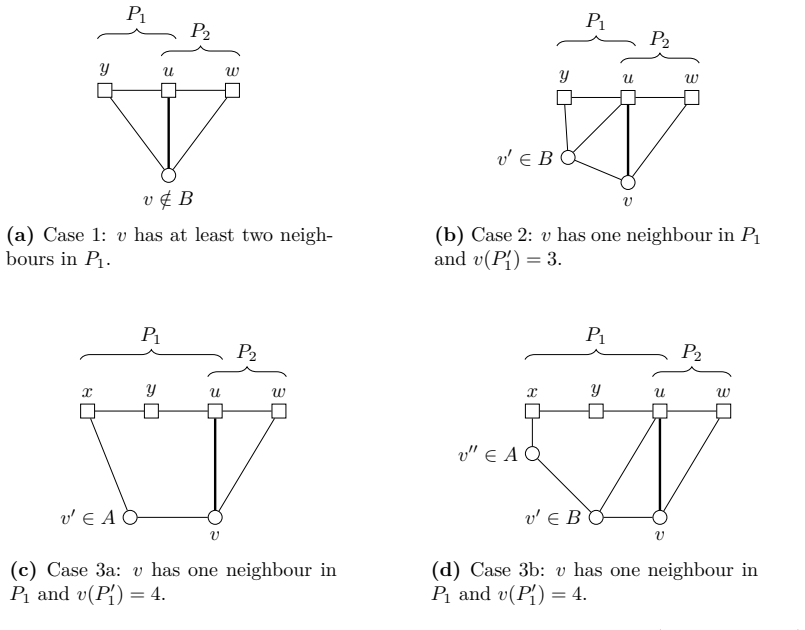
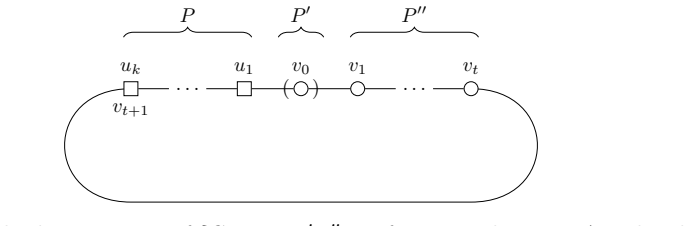
The load-bearing object is the canvas: a tuple $(G,P,A,B,f)$ in which $G$ is a plane graph, $P$ is an acceptable path or cycle on the outer face (a path of at most four vertices with a girth condition on its internal vertices), $A$ and $B$ are independent sets on the outer face boundary outside $P$ consisting of vertices of girth at least five (with $f=1$) and girth three (with $f=2$), and $f$ satisfies the local girth lower bounds (C4a)--(C4e). The induction removes not just a few vertices but an arbitrarily long path $R$ along the outer face, chosen according to eight case rules (R1)--(R8) that depend on the values of $f$; the corresponding deletion sequences (D1)--(D8) simulate a coordinated colour choice using Del and DelSave. Two structural chord lemmas classify every 2- and 3-chord in a minimum counterexample as belonging to one of the three exceptional canvas types, which is what guarantees that after a path removal the remaining smaller canvas still satisfies the induction hypothesis unless exactly one of $A$ or $B$ loses independence. Those two failure modes are then handled in Sections 4 and 5 by deleting the offending vertices and checking that the resulting smaller canvas is unexceptional.
What would settle it
Conduct a brute-force search over all plane graphs with at most ten vertices for a canvas $(G,P,A,B,f)$ satisfying Definition 2.5 with no (X1)--(X3) structure, for which the associated function $f_K(v)=f(v)-|N(v)\cap P|$ admits no legal Del/DelSave deletion sequence of $G-P$. Such a canvas would directly falsify Theorem 2.8 and hence the main theorem. Alternatively, exhibit a planar graph $G$ and the canonical local girth function $f(v)=\max\{7-g(v),2\}$ with no legal weak-degeneracy sequence; Theorem 1.11 says none exists.
Extended reading notes
Core claim
The central discovery is Theorem 1.11: if $G$ is planar and $f$ is a local girth function, meaning $f(v)\ge \max\{7-g(v),2\}$ for every vertex $v$, then $G$ is weakly $f$-degenerate. In the paper's language, weak $f$-degeneracy means there is a legal sequence of operations $\mathrm{Del}(v)$ and $\mathrm{DelSave}(v,w)$ that removes every vertex of $G$, where Del decrements all neighbours of $v$ and DelSave decrements all neighbours except the chosen neighbour $w$, with legality requiring $f(v)>f(w)$ for a save. The theorem is proved through the more restrictive canvas statement (Theorem 2.8): every canvas $(G,P,A,B,f)$ — a plane graph with an acceptable path or cycle $P$ on the outer face, independent sets $A$ and $B$ of vertices with extra-restricted values, and specified lower bounds on $f$ — is weakly $f$-degenerate unless it exhibits one of three exceptional configurations (X1), (X2), or (X3). Taking $P$ to be a single edge on the outer face recovers Theorem 1.11. Since weak $f$-degeneracy with a function $f$ implies $(f(v)+1)$-correspondence colouring, the theorem resolves the conjecture that every planar graph is local girth correspondence colourable, and it does so without any infinite family of exceptional structures.
Load-bearing premise
The load-bearing premise is the chord classification inside a minimum counterexample: Lemmas 3.12 and 3.13 assert that every 2-chord and every 3-chord whose endpoints are not internal vertices of $P$ forces one of the three exceptional canvas structures (X1), (X2), or (X3); if a chord of any other shape appeared, the induction step that removes a long boundary path could not conclude that the reduced canvas is still unexceptional.
Editorial extensions
If this is right
- Theorem 1.11 implies Theorem 1.7: every planar graph is local girth correspondence colourable, settling the open conjecture in that direction.
- Because weak degeneracy is the more flexible parameter, the theorem also implies the analogous statement for correspondence-painting, the online version of correspondence colouring.
- The theorem simultaneously recovers previously separate results: planar graphs are weakly 4-degenerate, planar graphs of girth at least five are weakly 2-degenerate, and the classical list-colouring theorems for planar graphs with girth 3, 4, and 5.
- The proof does not yield an exponential lower bound on the number of colourings; the paper states this explicitly and proposes a stronger availability conjecture that, via Proposition 1.13, would give exponentially many local girth correspondence colourings.
Reading between the lines
- A natural next step, not taken in the paper, is to check whether the chord-classification lemmas can be re-proved for other sparse graph classes; for locally planar graphs or graphs on surfaces, the same canvas framework could transfer if the exceptional structures are adjusted.
- The eight-case path removal scheme suggests a computational experiment: enumerate all legal Del and DelSave sequences for small planar graphs and measure the maximum average availability; consistent values above 1 would support the paper's availability conjecture, while a graph whose every legal sequence has average availability exactly 1 would refute it.
- Because the proof is a finite-case induction, it likely yields a polynomial-time algorithm that constructs the legal deletion order; if so, the correspondence colouring result becomes constructive, not just existential.
Signed reviews
Editorial analysis
A structured set of objections, weighed in public.
Referee Report
Summary. The paper proves that every planar graph is weakly f-degenerate for every local girth function f, i.e. f(v) ≥ max{7−g(v),2}; as a corollary it proves Postle and Smith-Roberge's conjecture that every planar graph is local girth correspondence colourable. The proof is by minimal counterexample to a stronger induction statement (Theorem 2.8) formulated in terms of canvases with a distinguished outer-face path P and two independent sets A and B of vertices with restricted f-values. Sections 3–5 establish structural properties of a minimum counterexample, remove a path R from the outer face, and handle the two possible failures of the resulting reduced canvas. The argument is detailed and, apart from the gaps noted below, appears to be self-contained.
Significance. If the proof is correctly repaired, this is a strong and significant result: it simultaneously strengthens weak 4-degeneracy of planar graphs and weak 2-degeneracy of planar girth-5 graphs, resolves the correspondence-colouring conjecture of Postle and Smith-Roberge, and does so with a self-contained argument whose exceptions are three finite configurations rather than infinite families. The paper also honestly discusses why its methods do not yield exponential colouring bounds. These are substantial strengths. The main concern is technical; I believe it is addressable, but it affects the foundation of the induction.
major comments (2)
- [Observation 2.6 (Section 2)] Observation 2.6 is false as stated. Consider the plane graph with outer cycle b-u-v-w-b and chord u-w, and let P=vw, A=∅, B={b}, f(b)=2, f(u)=3, f(v)=f(w)=0. This is an unexceptional canvas: b has girth 3, u satisfies (C4d), and v and w lie in P. Deleting u leaves the path b-w-v, in which b has infinite girth, so (G-u,P,A,B,f) violates (C3) and is not a canvas. The observation is invoked at the start of Lemmas 3.4, 3.5, 3.6, 3.7, 3.8, 3.12 and 3.13, and similar reasoning is used in Sections 4 and 5; the induction steps as written are therefore not justified. A repair is plausible: after deleting vertices, redefine B as the subset of the old B that still has girth 3 in the smaller graph, since girth can only increase under vertex deletion and f=2 still satisfies (C4c). Because vertex deletion cannot create new adjacencies, exceptionality cannot newly arise. However, this repair must be stated explicitly and checked in every invocation; it is not a harmless rephrasing, since the classifications in Lemmas 3.12 and 3.13 depend on the exact membership of B in exceptions (X1) and (X3).
- [Sections 4 and 5] Several canvas checks in Sections 4 and 5 are asserted very tersely, for example 'it is easy to check that w∈\widehat B' in Claim 1 and the verification that the final operations in Section 5 are legal. Since the false Observation 2.6 is used elsewhere, these checks need to be written out in full under the corrected understanding of how B and \widehat B are updated after vertex deletion. The current level of detail is not sufficient for a proof whose main mechanism is repeated reduction to a smaller canvas.
minor comments (4)
- [Lemma 3.11] This lemma is stated without proof and is not used later in the paper. Either provide the proof or remove the statement, since an unproved lemma in a minimal-counterexample proof is a formal gap.
- [Section 2, after Definition 2.5] The text says that exceptional canvases are not weakly f-degenerate because fK assigns a negative value to some vertex. For type (X3), the defining adjacencies give fK(v1)=fK(v2)=0, so this justification is not accurate; if the sentence is only motivational, it should be reworded.
- [Section 3.2, cases (R1)–(R8)] The cases for defining R are described as lexicographically minimal without explicit mutually exclusive conditions. This is understandable, but later arguments depend on knowing exactly which case applies, so the cases should be stated with clean disjoint conditions.
- [Claim 1, Section 4] The step 'it is easy to check that w∈\widehat B' should be expanded: one should explicitly verify that w has girth 3 in \widehat G and that \widehat f(w)=2, especially since the proof of (C3) depends on this membership.
Circularity Check
No circularity: the main theorem is established by an independent minimal-counterexample induction from definitions, and self-citations are contextual rather than load-bearing.
full rationale
The paper's central result, Theorem 1.11, is reduced to the stronger canvas statement Theorem 2.8, and Theorem 2.8 is proved by a minimum-counterexample induction over the canvas definition. The only imported result is Lemma 2.2 from Bernshteyn and Lee, a general monotonicity statement for weak degeneracy that does not encode the planar local-girth conclusion. The authors' self-citations ([4], [19], [20]) are used for context, inspiration, and the conjecture being resolved, not as black-box substitutes for the argument; the paper even states that its proof is self-contained and no longer relies on a theorem of Thomassen from [24]. No fitted parameter is renamed as a prediction, and no exceptional-case or chord classification is defined in terms of the theorem being proved. The skeptic's concern about Observation 2.6 is a potential correctness gap in an auxiliary assertion, not a circularity: the paper does not define the conclusion into the premise. Consequently, there is no circular step to report.
Assumptions & free parameters
assumptions (4)
- standard math Well-ordering principle: a minimum counterexample exists if any counterexample exists.
- standard math Eulerian plane embedding facts: the outer face boundary δG and chord separations behave as in plane topology.
- standard math Bernshteyn and Lee monotonicity of weak degeneracy (Lemma 2.2).
- domain assumption Finite simple graphs only.
Cite this review
Pith. "Pith review of Local Weak Degeneracy of Planar Graphs." pith.science (2026). https://pith.science/paper/7QT4YZOU
@misc{pith2026250421821,
  author       = {Pith},
  title        = {Pith review of: Local Weak Degeneracy of Planar Graphs},
  year         = {2026},
  howpublished = {\url{https://pith.science/paper/7QT4YZOU}},
  note         = {Machine review of arXiv:2504.21821}
}
abstract
Thomassen showed that planar graphs are 5-list-colourable, and that planar graphs of girth at least five are 3-list-colourable. An easy degeneracy argument shows that planar graphs of girth at least four are 4-list-colourable. In 2022, Postle and Smith-Roberge proved a common strengthening of these three results: with $g(v)$ denoting the length of a shortest cycle containing a vertex $v$, they showed that if $G$ is a planar graph and $L$ a list assignment for $G$ where $|L(v)| \geq \max\{3,8-g(v)\}$ for all $v \in V(G)$, then $G$ is $L$-colourable. Moreover, they conjectured that an analogous theorem should hold for correspondence colouring. We prove this conjecture; in fact, our main theorem holds in the still more restrictive setting of weak degeneracy, and moreover acts as a joint strengthening of the fact that planar graphs are weakly 4-degenerate (originally due to Bernshteyn, Lee, and Smith-Roberge), and that planar graphs of girth at least five are weakly 2-degenerate (originally due to Han et al.).
Figures


Figures from the paper (10 more)





Reference graph
Works this paper leans on
- [2]
-
[3]
A. Bernshteyn and E. Lee. Weak degeneracy of graphs.Journal of Graph Theory, 103(4):607– 634, 2023. doi:10.1002/jgt.22938
-
[4]
A. Bernshteyn, E. Lee, and E. Smith-Roberge. Weak degeneracy of planar graphs, 2024, arXiv:2406.02792
arXiv 2024
-
[5]
M. Bonamy, M. Delcourt, R. Lang, and L. Postle. Edge-colouring graphs with local list sizes. Journal of Combinatorial Theory, Series B, 165:68–96, 2024. doi:10.1016/j.jctb.2023.10.010
-
[6]
M. Bonamy, T. Kelly, P. Nelson, and L. Postle. Bounding χ by a fraction of ∆ for graphs without large cliques.Journal of Combinatorial Theory, Series B, 157:263–282, 2022. doi:10.1016/j.jctb.2022.06.002
-
[7]
O. Borodin, A. Kostochka, and D. Woodall. List Edge and List Total Colour- ings of Multigraphs. Journal of Combinatorial Theory, Series B , 71(2):184–204, 1997. doi:10.1006/jctb.1997.1780
arXiv 1997
-
[8]
E.Davies, R.deJoannisdeVerclos, R.J.Kang, andF.Pirot. Coloringtriangle-freegraphswith local list sizes.Random Structures & Algorithms, 57(3):730–744, 2020.doi:10.1002/rsa.20945
- [9]
Show all 27 references
-
[10]
Dvořák, D
Z. Dvořák, D. Král’, and R. Thomas. Three-Coloring Triangle-Free Graphs on Surfaces V. Coloring Planar Graphs with Distant Anomalies.Journal of Combinatorial Theory, Series B, 150:244–269, 2021. doi:10.1016/j.jctb.2020.04.006
2021 doi
-
[11]
Dvořák, B
Z. Dvořák, B. Lidický, and B. Mohar. 5-Choosability of Graphs with Crossings Far Apart. Journal of Combinatorial Theory, Series B, 123:54–96, 2017. doi:10.1016/j.jctb.2016.11.004
2017 doi
-
[12]
Dvořák and L
Z. Dvořák and L. Postle. Correspondence coloring and its application to list-coloring planar graphs without cycles of lengths 4 to 8.Journal of Combinatorial Theory, Series B, 129:38–54,
-
[13]
Erdős, A
P. Erdős, A. L. Rubin, and H. Taylor. Choosability in graphs. InProc. West Coast Conf. on Combinatorics, Graph Theory and Computing, Congressus Numerantium, volume 26, pages 125–157, 1979. 34
1979
-
[14]
Grötzsch
H. Grötzsch. Ein Dreifarbensatz für dreikreisfreie Netze auf der Kugel.Wiss. Z. Martin Luther Univ. Halle-Wittenberg, Math. Nat. Reihe, 8:109–120, 1959
1959
-
[15]
M. Han, T. Wang, J. Wu, H. Zhou, and X. Zhu. Weak degeneracy of planar graphs and locally planar graphs. 2023, arXiv:2303.07901
2023 arXiv
-
[16]
Kelly and L
T. Kelly and L. Postle. A local epsilon version of Reed’s Conjecture.Journal of Combinatorial Theory, Series B, 141:181–222, 2020. doi:10.1016/j.jctb.2019.08.001
2020 doi
-
[17]
S.-J. Kim, A. Kostochka, X. Li, and X. Zhu. On-line DP-coloring of graphs.Discrete Applied Mathematics, 285:443–453, 2020. doi:10.1016/j.dam.2020.06.009
2020 doi
-
[18]
Pirot and E
F. Pirot and E. Hurley. Colouring locally sparse graphs with the first moment method. 2021, arXiv:2109.15215
2021 arXiv
-
[19]
Postle and E
L. Postle and E. Smith-Roberge. Local girth choosability of planar graphs. Advances in Combinatorics, 2022. doi:10.19086/aic.2022.8
2022 doi
-
[20]
Postle and E
L. Postle and E. Smith-Roberge. Exponentially Many Correspondence Colourings of Planar and Locally Planar Graphs. 2023, arXiv:2309.17291
2023 arXiv
-
[21]
Thomassen
C. Thomassen. Every Planar Graph Is 5-Choosable.Journal of Combinatorial Theory, Series B, 62(1):180–181, 1994. doi:10.1006/jctb.1994.1062
1994
-
[22]
Thomassen
C. Thomassen. 3-List-Coloring Planar Graphs of Girth 5.Journal of Combinatorial Theory, Series B, 64(1):101–107, 1995. doi:10.1006/jctb.1995.1027
1995
-
[23]
Thomassen
C. Thomassen. A short list color proof of Grötzsch’s theorem. Journal of Combinatorial Theory, Series B, 88(1):189–192, 2003. doi:10.1016/S0095-8956(03)00029-7
2003 doi
-
[24]
Thomassen
C. Thomassen. Exponentially many 5-list-colorings of planar graphs.Journal of Combinatorial Theory, Series B, 97(4):571–583, 2007. doi:10.1016/j.jctb.2006.09.002
2007 doi
-
[25]
V. Vizing. Vertex colourings with given colours.Metody Diskret. Analiz., pages 3–10, 1976
1976
-
[26]
M. Voigt. List colourings of planar graphs. Discrete Mathematics, 120(1):215–219, 1993. doi:10.1016/0012-365X(93)90579-I
1993 doi
-
[27]
M. Voigt. A not 3-choosable planar graph without 3-cycles.Discrete Mathematics, 146(1):325– 328, 1995. doi:10.1016/0012-365X(94)00180-9. 35
1995 doi
-
[2018]
doi:10.1016/j.jctb.2017.09.001
2017 doi
Reviewed August 16, 2026 · model on record in the stance chip above.
Discussion (0). Continue with ORCID to comment.