REVIEW 2 major objections 5 minor 37 references
Extended framework for the hybrid Monte Carlo in lattice gauge theory
T0 review · 2 major / 5 minor · reviewed 2026-08-10 · deepseek-v4-flash
Pith's one-line read Embedding SU(N) in complex matrix space lets lattice gauge HMC use non-separable Hamiltonians exactly.
desk verdict Clever exact embedding for HMC; the headline non-separable capability is untested and rests on an unproven uniqueness assumption. read the letter →
The pith
A machine-rendered reading of the paper's core claim, the machinery that carries it, and where it could break.
The reading
What carries the argument
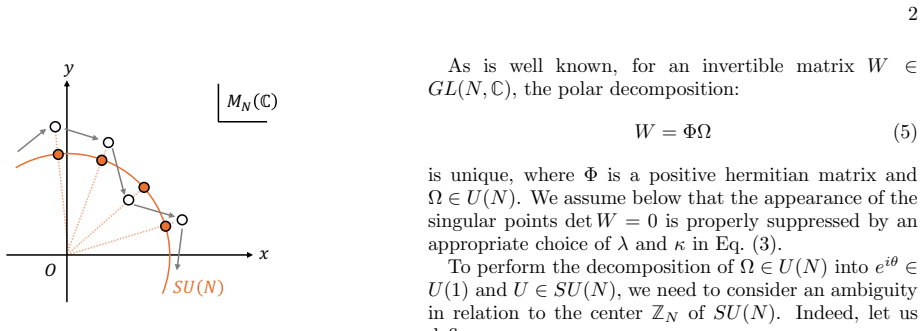
The load-bearing object is the polar decomposition $W=e^{i\theta}\Phi U$ with a continuity-preserving, reversible phase convention: after each molecular-dynamics step the $U(1)$ factor is updated by $\delta\theta=\frac{1}{N}\arg\det(e^{-i\theta}\Omega')$, keeping the $\mathrm{SU}(N)$ part smooth along the trajectory. On top of it, the algorithm uses a flat-space implicit leapfrog integrator on the $2N^2$ real variables $(x_{jk},y_{jk})$, with forces obtained by pulling gradients from the $(U,\theta,\Phi)$ basis back through the Jacobian $J(U,\theta,\Phi)$. The measure factorization $(dW)=\sqrt{\det g(\Phi)}\,d\theta\,(dU)\,(d\Phi)$ is what makes the auxiliary directions harmless: the $\Phi$ integral is finite and factorizes out of every expectation value. An alternative decomposition using $T_0=\mathrm{diag}(1,0,\ldots,0)$ removes the $Z_N$ center ambiguity of $\mathrm{SU}(N)$ entirely.
What would settle it
Run the extended HMC on a small lattice, for example two-dimensional $\mathrm{SU}(3)$, with a nontrivial non-separable kernel such as a covariant Laplacian, and compare forward and reverse trajectories while shrinking the step size $\tau$. A visible fraction of trajectories whose backward integration lands on a different configuration, or an acceptance rate that fails to approach one as $\tau\to 0$ in cases where the trivial-kernel run succeeds, would show the unique-solution assumption fails in the regime the paper targets.
Extended reading notes
Core claim
The central claim is that the obstruction to non-separable HMC in gauge theory is not fundamental: it comes from treating $\mathrm{SU}(N)$-valued links as constrained variables, so updating them requires exponentiating the force and generically breaks the symplectic two-form at finite step size. By embedding $\mathrm{SU}(N)$ in $M_N(\mathbb{C})$ and using the unconstrained matrix elements of $W$ as the molecular-dynamics variables, the leapfrog update becomes an ordinary symplectic integrator on a flat phase space. The physical $\mathrm{SU}(N)$ configuration is recovered by the polar decomposition $W=e^{i\theta}\Phi U$ with a reversible rule for fixing the $U(1)$ angle, and the $\Phi$, $\theta$ directions contribute a factorized, well-defined path-integral factor that does not alter expectation values of $\mathrm{SU}(N)$ observables. In the continuous-time limit the reduced equations on the physical variables coincide with the Riemannian-manifold HMC equations, so the framework lifts RMHMC from an approximate method with finite-step errors to an exact one, provided the implicit update equations have a unique solution.
Load-bearing premise
The discrete molecular-dynamics map is single-valued and reversible even when the kinetic kernel $K(w)$ is non-separable, because the implicit leapfrog equations are assumed to have a unique solution at every half-step; the paper proves and tests this only for the trivial kernel $K=1$.
Editorial extensions
If this is right
- Riemannian-manifold HMC in lattice QCD can in principle be run without gauge fixing and without the finite-step symplecticity error of earlier implementations.
- A covariant-Laplacian kinetic kernel, previously known to break symplecticity, becomes an allowed non-separable Hamiltonian inside the extended framework.
- Expectation values of $\mathrm{SU}(N)$-valued observables are unchanged by the embedding, so no reweighting or gauge-fixing correction is needed.
- The transfer-matrix viewpoint yields higher-order symplectic integrators for the non-separable case, not just the basic leapfrog.
- The extra cost of implicit iterations can be kept additive rather than multiplicative when fermion forces dominate, because the kernel-force terms can be pushed into a lower multilevel integrator.
Reading between the lines
- A natural stress test the paper does not include: run the same exactness check with a nontrivial kernel, for example $K(w)=1-c\nabla^2$ or a covariant Laplacian, and confirm that acceptances and plaquette values stay within errors as $\tau$ shrinks.
- If the implicit leapfrog equations develop multiple solutions for strong non-separable kernels, the discrete map becomes multi-valued and detailed balance could fail; monitoring fixed-point iteration convergence and comparing forward and backward trajectories would expose where that happens.
- The auxiliary $\Phi$ action is a tunable lever: the authors report that a quartic form worked better than the quadratic form in exploratory runs, suggesting systematic tuning of $S_0(\Phi)$ could reduce rejections while keeping the algorithm away from $\det W=0$.
- A floating-point implementation may want to prefer the alternative $T_0$ decomposition to avoid the measure-zero but numerically awkward phase discontinuities of the $Z_N$ convention.
Editorial analysis
A structured set of objections, weighed in public.
Referee Report
Summary. The paper proposes an extended HMC framework for lattice gauge theory by embedding SU(N) into the space M_N(C) of complex matrices. The physical SU(N) variables are recovered from the extended variable W via a reversible polar decomposition, and an auxiliary action S_0(Φ) is introduced to control the non-compact directions. The authors show that the integration measure factorizes into a physical Haar measure and an auxiliary Φ-dependent factor, so expectation values of SU(N) observables are unchanged. Molecular dynamics is performed on the unconstrained matrix elements of W, which permits, in principle, the use of non-separable Hamiltonians such as the Riemannian manifold HMC Hamiltonian. The paper presents a numerical test for 2D SU(3) pure gauge theory with a trivial kinetic kernel K=1, comparing plaquette expectation values to exact character-expansion values. The test shows agreement within 3σ, validating the embedding and the explicit leapfrog integration for that special case, but the non-separable regime, which is the stated motivation, is not numerically exercised.
Significance. If the framework indeed enables exact HMC with non-separable Hamiltonians without gauge fixing, it would be an important step toward Fourier-accelerated lattice QCD and a remedy for the finite-step-size inexactness of earlier Riemannian manifold HMC implementations. The path-integral factorization in Sec. II.C is derived carefully, the reversibility construction in Sec. II.B is thoughtful, and the numerical benchmark is a clean check of the embedding itself; no parameters are fitted to produce the expectation values. The main weakness is that the central claimed capability for non-separable kernels rests on an unproven well-posedness assumption for the implicit leapfrog integrator, and the provided numerical test deliberately avoids that regime. This gap is load-bearing for the paper's central claim.
major comments (2)
- [II.D, Eqs. (27)–(30); App. A] The exactness claim for non-separable Hamiltonians depends on the implicit leapfrog map being a single-valued, reversible, volume-preserving diffeomorphism. The proof in App. A that the first pair preserves the symplectic form assumes that Eq. (27) uniquely determines p_{1/2} for given (w,p), and the second pair is justified only by time-reversal symmetry, inheriting the same assumption. For a general non-separable kernel, for example the Hamiltonian in Eq. (35) with K^{-1}(w)=J^T diag(G^{-1},m)J, the force ∂_w H contains terms quadratic in p, so Eq. (27) is a vector quadratic fixed-point equation. The paper states no Lipschitz condition, small-τ bound, or branch-selection rule that would guarantee a unique root. A scalar toy with k(w)=1+εw^2 already exhibits two real roots for the p-half-step when ετ|p| is large. If the root is selected by the initial guess of an iterative solver, the resulting map can be discontinuous or non-reversible, breaking detailed balance. This must be addressed for the claim of exact non-separable HMC to hold.
- [III, Sec. II.D] The numerical test uses the trivial kernel K(w)=1_{2N^2}, as stated in the second paragraph of Sec. III. With this kernel, both implicit equations (27) and (29) become explicit, the quadratic-in-p terms vanish, and the integrator reduces to an ordinary explicit leapfrog. The benchmark therefore exercises the embedding and the polar-decomposition step, but it does not exercise the non-separable regime that motivates the 'exact non-separable Hamiltonians' claim in the abstract and introduction. A numerical test with a nontrivial, gauge-covariant kernel (e.g., one based on a covariant Laplacian) is needed to demonstrate that the implicit update can be solved in practice, that a consistent branch choice preserves reversibility, and that the acceptance remains acceptable. Without such a test, the paper's central new capability remains unvalidated.
minor comments (5)
- [III, Fig. 3] The y-axis label of Fig. 3, '(deviation)/(stat. error)', has a stray parenthesis; it should read '(deviation)/(stat. error)' or more clearly 'difference in units of statistical error'.
- [App. C, Eq. (C2)] The notation \lfloor N\delta\omega\rfloor for the projection of an angle onto the range [-π,π) is confusing because the same symbol is standard for the integer floor function. A different notation, such as \mathrm{proj}_{[-\pi,\pi)}(N\delta\omega), would improve clarity.
- [App. A, after Eq. (A8)] The phrase 'a prior' should be 'a priori' in the sentence 'Since we do not know the typical values of the derivatives a prior'.
- [II.D, step 5] Step 5 says 'We add to the ensemble the physical configuration U, calculated from the accepted W', but the Markov-chain state is described earlier in the same section as the triplet (U,θ,Φ). It would be clearer to specify that U is taken from the stored triplet after acceptance, to avoid implying that W alone is the state variable.
- [App. D, final paragraph] The text says 'We provide an implementation of the algorithm with the decomposition (D1) in the Grid Python Toolkit (GPT) [29]', but the manuscript gives no repository link, version, or instructions to access the code. If the implementation is meant to be a deliverable, an availability statement would be helpful.
Circularity Check
No significant circularity: the extended-HMC derivation is self-contained and the numerical benchmark is independent of the paper's fitted inputs.
full rationale
The paper's central construction is a mathematical factorization, not a fitted prediction. Eq. (23) follows from the polar decomposition (5), the metric (17), and the measure decomposition (18); the auxiliary action S0(Phi) and parameters lambda and kappa appear only in the factorized Phi integral and cancel in physical expectation values. The HMC exactness argument relies on reversibility (App. C) and volume preservation (App. A), both derived in the text from the flat phase-space measure, and the numerical test in Sec. III compares plaquette expectation values against analytically computed character-expansion values, an external benchmark. No parameter is fitted to those values, and no load-bearing premise is justified solely by a self-citation. The paper does state a real limitation in Sec. III: 'We adopt the trivial kernel K(w)=1... examining it independently from additional complications from implicit iteration', so the non-separable regime that motivated the framework is not numerically exercised, and App. A assumes, rather than proves, unique solvability of the implicit update (27). These are gaps in support for the strongest claim, not circular reductions; the derivation does not define its output in terms of its input.
Assumptions & free parameters
free parameters (3)
- lambda =
1 (in numerical test)
- kappa =
5 (in numerical test)
- MD step size tau =
0.1 (10 steps per trajectory of length 1)
assumptions (4)
- standard math Every invertible complex matrix W has a unique polar decomposition W = Phi Omega with Phi positive Hermitian and Omega unitary (used in Sec. II B).
- standard math The integration measure (dW) factorizes as (dW) = sqrt(det g(Phi)) dtheta (dU) (dPhi) with the Jacobian depending only on Phi (Eq. (18)).
- domain assumption The singular set {det W = 0} is avoided with probability 1 under the action S0(Phi), so the polar decomposition and the Jacobian remain well-defined along MD trajectories.
- domain assumption The implicit leapfrog equations (27)-(30) admit a unique solution for general K(w).
Cite this review
Pith. "Pith review of Extended framework for the hybrid Monte Carlo in lattice gauge theory." pith.science (2026). https://pith.science/paper/7R6ZSG3R
@misc{pith2026241219904,
  author       = {Pith},
  title        = {Pith review of: Extended framework for the hybrid Monte Carlo in lattice gauge theory},
  year         = {2026},
  howpublished = {\url{https://pith.science/paper/7R6ZSG3R}},
  note         = {Machine review of arXiv:2412.19904}
}
abstract
We develop an extended framework for the hybrid Monte Carlo (HMC) algorithm in lattice gauge theory by embedding the $SU(N)$ group into the space of general complex matrices,$M_N(\mathbb{C})$. Auxiliary directions will be completely factorized in the path integral, and the embedding does not alter the expectation values of the original theory. We perform the molecular dynamics updates by using the matrix elements of $W \in M_N(\mathbb{C})$ as the dynamical variables without group theoretic constraints. The framework enables us to introduce non-separable Hamiltonians for the HMC in lattice gauge theory exactly, whose immediate application includes the Riemannian manifold HMC.
Figures


Reference graph
Works this paper leans on
-
[1]
Suppose we have a configurationW
-
[2]
Generatepfrom the Gaussian distribution: Pinit(p;w)∝e − 1 2 pI K−1 IJ (w)pJ .(26)
-
[3]
Integrate the Hamiltonian equations: p1/2 I =p I − τ 2 ∂wI H(w, p1/2),(27) w1/2 I =w I + τ 2 ∂pI H(w, p1/2),(28) w′ I =w 1/2 I + τ 2 ∂pI H(w ′, p1/2),(29) p′ I =p 1/2 I − τ 2 ∂wI H(w ′, p1/2).(30)
-
[4]
Accept/reject the obtained configuration with the probability: min 1, e−H(w ′,p′)+H(w,p) .(31)
-
[5]
Multiscale acceleration: Pow- ering future discoveries in High Energy Physics
We add to the ensemble the physical configuration U, calculated from the acceptedW, to estimate the expectation values of the observables under the path integral (22). The symplecticity of the integrator (see App. A) implies the conservation of the phase-space volume. Together with reversibility, the exactness of the algorithm follows. Since the action is...
-
[6]
Duane, A
S. Duane, A. D. Kennedy, B. J. Pendleton, and D. Roweth, Hybrid Monte Carlo, Phys. Lett. B195, 216 (1987)
1987
-
[7]
G. Parisi, Prolegomena to any future computer evalua- tion of the qcd mass spectrum, inProgress in Gauge Field Theory, edited by G. ’t Hooft, A. Jaffe, H. Lehmann, P. K. Mitter, I. M. Singer, and R. Stora (Springer US, Boston, MA, 1984) pp. 531–541
work page 1984
-
[8]
G. G. Batrouni, G. R. Katz, A. S. Kronfeld, G. P. Lepage, B. Svetitsky, and K. G. Wilson, Langevin Simulations of Lattice Field Theories, Phys. Rev. D32, 2736 (1985)
work page 1985
Show all 37 references
-
[9]
C. T. H. Davies, G. G. Batrouni, G. R. Katz, A. S. Kro- nfeld, G. P. Lepage, P. Rossi, B. Svetitsky, and K. G. Wilson, Fourier Acceleration in Lattice Gauge Theories
-
[10]
Updating Field Configurations, Phys. Rev. D41, 1953 (1990)
1990
-
[11]
Duane, R
S. Duane, R. Kenway, B. J. Pendleton, and D. Roweth, Acceleration of Gauge Field Dynamics, Phys. Lett. B 176, 143 (1986)
1986
-
[12]
Duane and B
S. Duane and B. J. Pendleton, GAUGE INV ARIANT FOURIER ACCELERATION, Phys. Lett. B206, 101 (1988)
1988
-
[13]
Girolami and B
M. Girolami and B. Calderhead, Riemann manifold langevin and hamiltonian monte carlo methods, Jour- nal of the Royal Statistical Society Series B: Statistical Methodology73, 123 (2011)
2011
-
[14]
Nguyen, P
T. Nguyen, P. Boyle, N. H. Christ, Y.-C. Jang, and C. Jung, Riemannian Manifold Hybrid Monte Carlo in Lattice QCD, PoSLA TTICE2021, 582 (2022), arXiv:2112.04556 [hep-lat]
2022 arXiv
-
[15]
Jung and N
C. Jung and N. H. Christ, Riemannian manifold HMC with fermions, PoSLA TTICE2023, 009 (2024), arXiv:2401.13226 [hep-lat]
2024 arXiv
-
[16]
Cossu, P
G. Cossu, P. Boyle, N. Christ, C. Jung, A. J¨ uttner, and F. Sanfilippo, Testing algorithms for critical slowing down, EPJ Web Conf.175, 02008 (2018), arXiv:1710.07036 [hep-lat]
2018 arXiv
-
[17]
Fields, P
S. Fields, P. Boyle, N. Christ, C. Jung, and C. Lehner, Tuning the Riemannian Manifold Hybrid Monte Carlo with Fermions, PoSLA TTICE2024, 045 (2025)
2025
-
[18]
C. T. H. Davies, G. G. Batrouni, G. R. Katz, A. S. Kron- feld, G. P. Lepage, K. G. Wilson, P. Rossi, and B. Svetit- sky, Fourier Acceleration in Lattice Gauge Theories. 1. Landau Gauge Fixing, Phys. Rev. D37, 1581 (1988)
1988
-
[19]
Sheta, Y
A. Sheta, Y. Zhao, and N. H. Christ, Gauge-Fixed Fourier Acceleration, PoSLA TTICE2021, 084 (2022), arXiv:2108.05486 [hep-lat]
2022 arXiv
-
[20]
Cohen, M
T. Cohen, M. Weiler, B. Kicanaoglu, and M. Welling, Gauge equivariant convolutional networks and the icosa- hedral CNN, inProceedings of the 36th International Conference on Machine Learning, Proceedings of Ma- chine Learning Research, Vol. 97, edited by K. Chaudhuri and R. Sa...
2019
-
[21]
Kanwar, M
G. Kanwar, M. S. Albergo, D. Boyda, K. Cranmer, D. C. Hackett, S. Racani` ere, D. J. Rezende, and P. E. Shanahan, Equivariant flow-based sampling for lattice gauge theory, Phys. Rev. Lett.125, 121601 (2020), arXiv:2003.06413 [hep-lat]
2020 arXiv
-
[22]
Favoni, A
M. Favoni, A. Ipp, D. I. M¨ uller, and D. Schuh, Lat- tice Gauge Equivariant Convolutional Neural Networks, Phys. Rev. Lett.128, 032003 (2022), arXiv:2012.12901 [hep-lat]
2022 arXiv
-
[23]
Lehner and T
C. Lehner and T. Wettig, Gauge-equivariant neural net- works as preconditioners in lattice QCD, Phys. Rev. D 108, 034503 (2023), arXiv:2302.05419 [hep-lat]
2023 arXiv
-
[24]
Lehner and T
C. Lehner and T. Wettig, Gauge-equivariant pooling lay- ers for preconditioners in lattice QCD, Phys. Rev. D110, 034517 (2024), arXiv:2304.10438 [hep-lat]
2024 arXiv
-
[25]
Nagai and A
Y. Nagai and A. Tomiya, Self-learning Monte Carlo with equivariant Transformer, J. Phys. Soc. Jap.93, 114007 (2024), arXiv:2306.11527 [cond-mat.str-el]
2024 arXiv
-
[26]
Sexton and D
J. Sexton and D. Weingarten, Hamiltonian evolution for the hybrid monte carlo algorithm, Nuclear Physics B 380, 665 (1992)
1992
-
[27]
Luscher, Trivializing maps, the Wilson flow and the HMC algorithm, Commun
M. Luscher, Trivializing maps, the Wilson flow and the HMC algorithm, Commun. Math. Phys.293, 899 (2010), arXiv:0907.5491 [hep-lat]
2010 arXiv
-
[28]
I. P. Omelyan, I. M. Mryglod, and R. Folk, Construction of high-order force-gradient algorithms for integration of motion in classical and quantum systems, Physical Re- view E66, 10.1103/physreve.66.026701 (2002)
2002 doi
-
[29]
Takaishi, Choice of integrator in the hybrid monte carlo algorithm, Computer Physics Communications 133, 6 (2000)
T. Takaishi, Choice of integrator in the hybrid monte carlo algorithm, Computer Physics Communications 133, 6 (2000)
2000
-
[30]
Takaishi and P
T. Takaishi and P. de Forcrand, Testing and tuning sym- plectic integrators for the hybrid monte carlo algorithm 11 in lattice qcd, Phys. Rev. E73, 036706 (2006)
2006
-
[31]
Tang, Formal energy of a symplectic scheme for hamiltonian systems and its applications (i), Computers & Mathematics with Applications27, 31 (1994)
Y.-F. Tang, Formal energy of a symplectic scheme for hamiltonian systems and its applications (i), Computers & Mathematics with Applications27, 31 (1994)
1994
-
[32]
A. D. Kennedy, P. J. Silva, and M. A. Clark, Shadow Hamiltonians, Poisson Brackets, and Gauge Theories, Phys. Rev. D87, 034511 (2013), arXiv:1210.6600 [hep- lat]
2013 arXiv
-
[33]
A. D. Kennedy and P. Rossi, CLASSICAL MECHAN- ICS ON GROUP MANIFOLDS AND APPLICATIONS TO HYBRID MONTE CARLO, Nucl. Phys. B327, 782 (1989)
1989
-
[34]
K. S. Turitsyn, M. Chertkov, and M. Vucelja, Irreversible monte carlo algorithms for efficient sampling, Physica D: Nonlinear Phenomena240, 410 (2011)
2011
-
[35]
Lehner, M
C. Lehner, M. Bruno, D. Richtmann, M. Schlemmer, R. Lehner, D. Kn¨ uttel, T. Wurm, L. Jin, S. B¨ urger, A. Hackl, and A. Klein, Grid Python Toolkit (GPT), 2024-10 (2024)
2024
-
[36]
P. A. Boyle, G. Cossu, A. Yamaguchi, and A. Portelli, Grid: A next generation data parallel C++ QCD library, PoSLA TTICE2015, 023 (2016)
2016
-
[37]
Yamaguchi, P
A. Yamaguchi, P. Boyle, G. Cossu, G. Filaci, C. Lehner, and A. Portelli, Grid: OneCode and FourAPIs, PoS LA TTICE2021, 035 (2022), arXiv:2203.06777 [hep-lat]
2022 arXiv
Reviewed August 10, 2026 · model on record in the stance chip above.
Discussion (0). Continue with ORCID to comment.