REVIEW 3 major objections 6 minor 17 references
A Merge/Split Algorithm for Multitarget Tracking Using Generalized Labeled Multi-Bernoulli Filters
T0 review · 3 major / 6 minor · reviewed 2026-08-14 · deepseek-v4-flash
Pith's one-line read The paper proposes a Merge/Split algorithm that maintains a factored δ-GLMB filtering density whose resolution adapts to the measurements, keeping the track estimate within a fixed compute budget without dropping nascent tracks the way…
desk verdict A well-specified merge/split heuristic for dGLMB tracking with a clever indexing trick, but the central degeneracy claim is unverified and rests on an unquantified diminishing-influence assumption. read the letter →
The pith
A machine-rendered reading of the paper's core claim, the machinery that carries it, and where it could break.
The reading
What carries the argument
The load-bearing object is the pair $(\text{track\_id}, \text{density\_id})$, where $\text{density\_id}$ is the fixed-length moving-window tuple of the most recent $N$ measurement IDs incorporated into that track's kinematic density. This discretizes the density space: two densities with the same $\text{density\_id}$ are treated as identical, so merging factors via product hypotheses and splitting via marginalization become dictionary operations rather than density-distance computations. Around this index, the algorithm builds a joint probability table over gated and non-gated subhypotheses; the independence test is $\max_{i,j} |P(i,j) - P(i)P(j)|$. A K-min-sum algorithm, proved correct in the appendix, efficiently merges several factors by enumerating the top product hypotheses.
What would settle it
Run the filter on a scenario with a slow-converging sensor, such as bearing-only or range-rate-only, where two tracks have the same last N measurement IDs but their true kinematic densities diverge because older measurements still matter. Then compute the actual reconstruction error $\epsilon = \max_{i,j} |P(i,j) - P(i)P(j)|$ from the untruncated joint density; if this error exceeds the stated tolerance while the algorithm still splits, the central claim fails.
Extended reading notes
Core claim
The central claim is that a δ-GLMB posterior can be represented as a product of factors of varying granularity, and that this factorization can be maintained automatically by two operations. When a new batch of measurements gates with tracks that live in different factors, those factors are merged by forming product hypotheses; after merging, the algorithm attempts a split by marginalizing over one subset of tracks and checking whether the reconstruction error $\epsilon = \max_{i,j} |P(i,j) - P(i)P(j)|$ falls within a tolerance. If it does, the factor is replaced by two independent factors, one updated with the measurements and the other with negative information. The enabling device is indexing each kinematic density by the tuple of the most recent $N$ measurement IDs used in its update, so that 'the same density' becomes a discrete, checkable equality rather than a metric computation, and marginalization simply combines weights of hypotheses that share the same density index.
Load-bearing premise
The algorithm assumes that a track's current kinematic density is fully determined by the most recent N measurements used in its update, so that older measurements can be forgotten and densities sharing the same recent measurement-ID window can be treated as identical.
Editorial extensions
If this is right
- Within a fixed hypothesis budget, the filter can operate as a single global δ-GLMB factor when tracks are ambiguous and as a set of independent single-track LMB factors when they are well separated.
- Tracks that would be dropped by top-K truncation because their weights start small can survive by residing in a low-cost factor, since the budget is allocated over factors rather than consumed by incumbents.
- The split tolerance $\epsilon$ gives a direct, tunable trade-off between compute cost and approximation error: smaller tolerance keeps more coupling, larger tolerance produces more factored and cheaper densities.
- Because factors are updated independently, measurement updates can be parallelized across factors, and clusters that gate only within themselves are processed separately.
- The moving-window parameter $N$ controls the memory of the approximation; larger $N$ preserves more association history at higher cost.
Reading between the lines
- A natural stress test is a sensor with slow-converging measurements, such as bearing-only or range-rate-only, where the 'diminishing influence' assumption is weakest; if densities sharing the same recent measurement-ID window diverge appreciably, the split decision will be based on a faulty notion of equality.
- The same factorized representation could be composed across multiple sensors by letting each sensor maintain its own factors and merging only when their measurement gates overlap, which may scale better than a single global filter in large fleets.
- The reconstruction-error tolerance could be adapted online by monitoring the actual error at each split, but the paper does not discuss such an adaptive tolerance scheme.
- The density-indexing idea could be reused outside δ-GLMB, for example in any Bayesian filter where a moving window of measurement identities is a sufficient approximate statistic, though the paper does not make that extension.
Signed reviews
Editorial analysis
A structured set of objections, weighed in public.
Referee Report
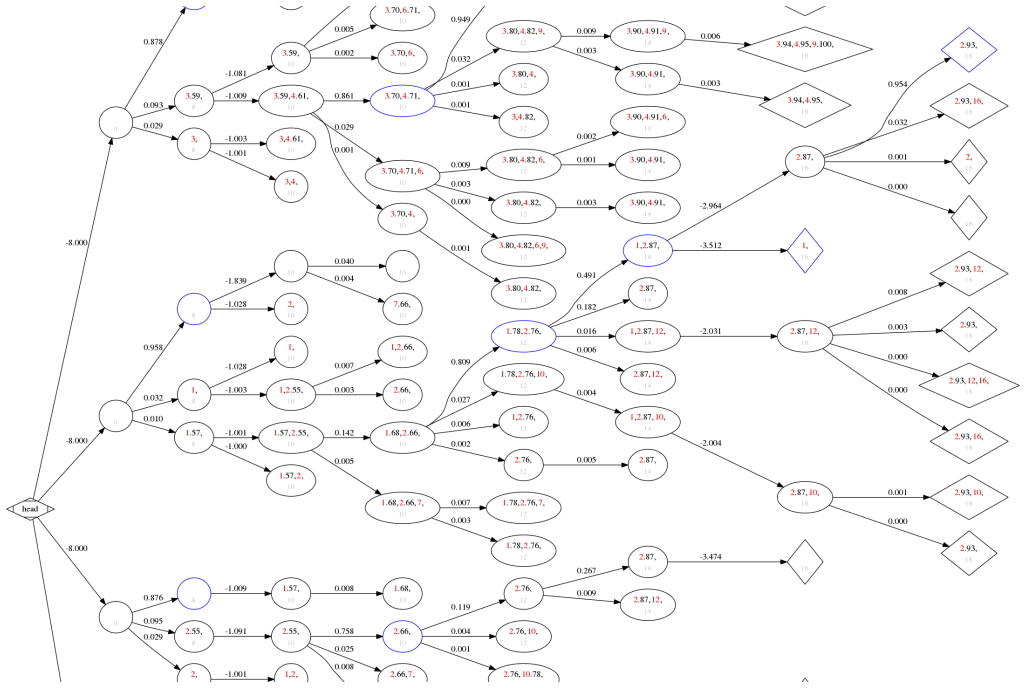
Summary. The paper proposes a Merge/Split algorithm for δ-GLMB multitarget filtering. The key idea is to maintain a factored representation of the filtering density, indexing each track density by the most recent N measurement IDs used in its update. When new measurements gate tracks from different factors, the factors are merged; afterwards, the merged factor may be split if a joint probability reconstruction error is within a given tolerance, yielding an adaptive resolution that ranges from a single global dGLMB factor to singleton LMB factors. The paper also describes an optimal top-K hypothesis selection scheme based on iterated Murty's algorithm and gives a correctness proof for a K-min-sum selection procedure in the Appendix. Section VI provides only illustrative output (a hypothesis tree and a factor/hypothesis count plot) and states that evaluation on public data is future work.
Significance. If validated, the proposed adaptive factorization could be a useful way to address the practical degeneracy of dGLMB filtering under a fixed hypothesis budget, and the algorithmic specification is concrete enough to implement. The Appendix proof of the K-min-sum selection is correct, and the merge/split logic is internally consistent. However, the central claim that the algorithm mitigates degeneracy is not supported by any quantitative evaluation, and the load-bearing 'diminishing influence' assumption is unquantified; the reconstruction-error tolerance used for splitting is not shown to control the kinematic approximation error. The contribution is therefore conditional on additional analysis and experiments.
major comments (3)
- [Section VI / overall] The paper's central claim—that the Merge/Split algorithm mitigates the degeneracy that drops nascent tracks under a fixed hypothesis budget—is not evaluated quantitatively. Section VI states that the algorithm has been 'successfully employed in challenging applications' and that evaluation 'is underway,' but it provides only a hypothesis-tree diagram and a plot of factor/hypothesis counts. There are no tracking-error metrics (e.g., OSPA or CLEAR MOT), no comparison against a standard truncation-only dGLMB filter or against the adaptive LMB filter of [8], and no ablation over the design parameters N, epsilon, and K. Because the abstract and Section I make the degeneracy-mitigation claim, the absence of measurement-based evidence is a load-bearing gap that requires additional experiments on public or simulated data, with baseline comparisons and sensitivity studies.
- [Section III] The moving-window indexing in Section III rests on the assumption that two track densities which have incorporated the same most recent N measurement IDs are 'usually negligible[ly]' different. This assumption is load-bearing for marginalization over forgotten history, for merge/split decisions, and for negative-information updates, but the paper provides no bound or numerical characterization of the approximation error as a function of N and sensor parameters. The tolerance epsilon defined in Section IV bounds only the discrete reconstruction error in the hypothesis-weight table, not the kinematic-density error caused by truncating history to N. For sensors with slow convergence or ambiguous measurements (e.g., long-range bearing-only), two hypotheses with the same density_id can still have substantially different densities, and merging them would introduce unmodeled bias. The manuscript restricts itself to 'sensing modalities that provide fast enough convergence' but does not define that condition quantitatively; a formal bound or a sensitivity analysis over N and sensor parameters is needed to justify the algorithm's correctness.
- [Section IV / Section V] The independence check that enables splitting compares P(i,j) with P(i)P(j), where the table entries are sums of hypothesis weights. This is a check on the discretized weight distribution only; it does not measure correlation between the kinematic densities of the two candidate factors, and because those densities have already been truncated to a moving window, the weight-table criterion can certify independence even when the underlying densities still share information from older measurements. Consequently the split operation in Section V may be applied when the factors are not truly independent, and the subsequent separate updates (one with measurements, one with negative information) would be an uncontrolled approximation. Please justify why the weight-table discrepancy suffices, or extend the criterion to a density-level independence measure.
minor comments (6)
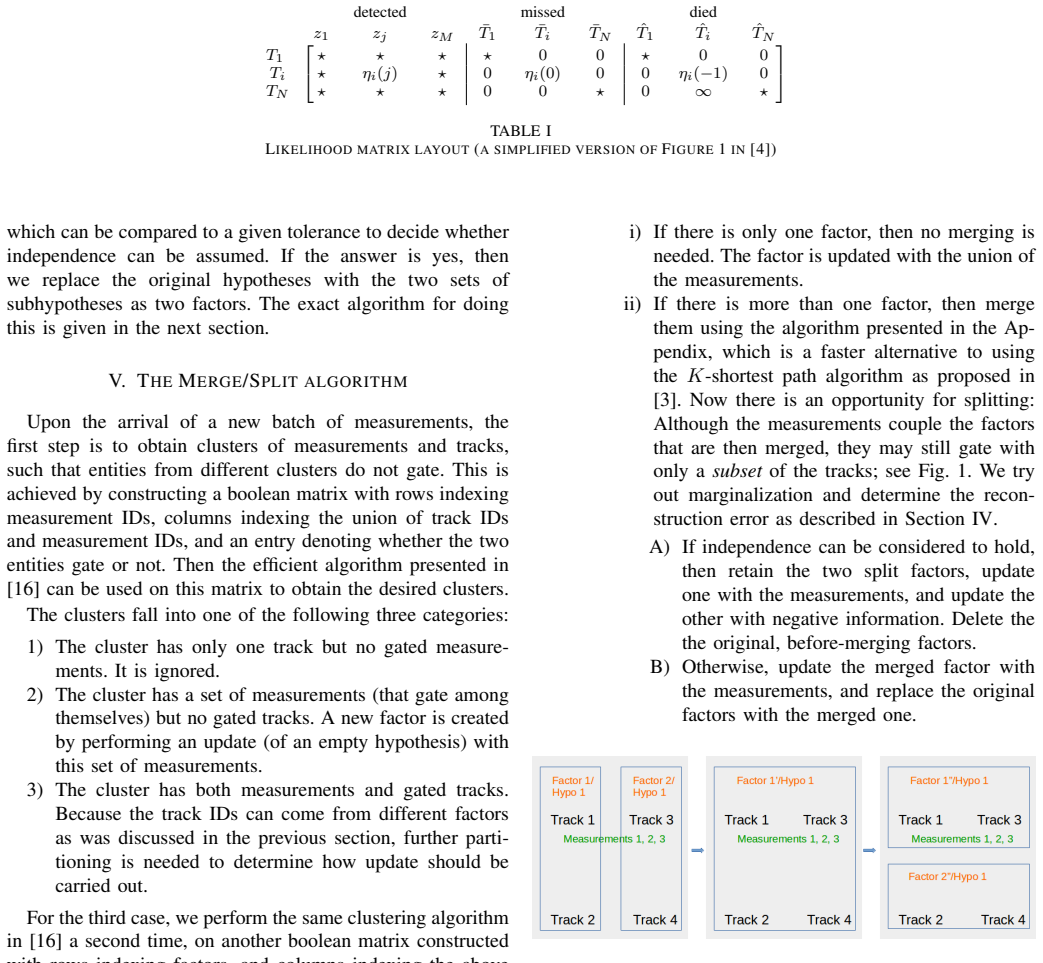
- [Section II] Table I uses an 'infinity' entry in the 'died' column block, but the text does not explain how these entries are handled in the Munkres and Murty algorithms; please clarify that unreachable assignments are forbidden by the assignment constraints or by setting costs to infinity.
- [Section III] The phrase 'if two track densities have incorporated the same measurements for the last, say, 5 updates' mixes an example value with the design parameter N; consider using N consistently throughout and stating how N is chosen in practice.
- [Section V] The sentence 'Delete the the original, before-merging factors' contains a duplicated 'the'.
- [Section VI] Figures 2 and 3 lack axis labels and parameter settings (e.g., N, epsilon, K, detection parameters), so the reader cannot reproduce or interpret the illustrated behavior.
- [Section V] The term 'negative information' is used without a formal definition or citation; please define it precisely (e.g., the event that a track in the sensor field of view is not detected) and explain how it updates the factor.
- [Introduction] The relationship to the adaptive LMB filter in [8] and the large-scale solution in [9] is asserted but not compared algorithmically; a table or explicit discussion of the differences would help the reader place the contribution.
Circularity Check
No circular derivation: the algorithm's approximations are explicit external assumptions, and the few self-citations are not load-bearing.
full rationale
This paper proposes a factored representation and a Merge/Split algorithm for dGLMB filters; it does not derive a benchmark result from its own definitions, so the classic circularity patterns do not appear. The independence check in Section IV defines epsilon = max |P(i,j) - P(i)P(j)| and compares it to a tolerance; this is by definition the criterion for approximate independence, and computing the marginals from the same joint table is not circular because the claim is only that the product approximates the table within a user-chosen tolerance. The moving-window density indexing in Section III is an explicit approximation: 'if two track densities have incorporated the same measurements for the last, say, 5 updates, then their difference is usually negligible.' This is a domain assumption, not a constructed identity, and the paper restricts it to 'sensing modalities that provide fast enough convergence for filtering, such as range/bearing/range-rate from a radar.' The K-min-sum appendix contains a self-contained correctness proof by contradiction. The self-citations, [5] and [15], are to the author's earlier exposition and implementation code, but they are not load-bearing: the dGLMB update is cited to external work [4], and the clustering routine is cited to [16]. No fitted parameter is relabeled as a prediction; N, tolerance, and K are hand-selected design parameters. The main caveat is the unquantified 'diminishing influence' assumption, which is a correctness or robustness risk rather than a circularity. Hence no circular step is present; the low non-zero score reflects only the presence of minor, non-load-bearing self-citations.
Assumptions & free parameters
free parameters (3)
- N (moving window length)
- epsilon (independence tolerance)
- K (hypothesis budget)
assumptions (4)
- domain assumption The effect of past measurements on the current filtering density diminishes as time progresses (Section III).
- domain assumption Two track densities that have incorporated the same measurements over the last N updates are negligibly different (Section III, paragraph after Eq. (3)).
- domain assumption Track densities are kept unimodal by splitting any multimodal density into mode hypotheses (Section III).
- standard math The clustering algorithm from Dezert and Bar-Shalom (1993) correctly identifies independent clusters of measurements and tracks (Section V).
Cite this review
Pith. "Pith review of A Merge/Split Algorithm for Multitarget Tracking Using Generalized Labeled Multi-Bernoulli Filters." pith.science (2026). https://pith.science/paper/7SSICYE5
@misc{pith2026190801743,
  author       = {Pith},
  title        = {Pith review of: A Merge/Split Algorithm for Multitarget Tracking Using Generalized Labeled Multi-Bernoulli Filters},
  year         = {2026},
  howpublished = {\url{https://pith.science/paper/7SSICYE5}},
  note         = {Machine review of arXiv:1908.01743}
}
read the original abstract
The class of Labeled Random Finite Set filters known as the delta-Generalized Labeled Multi-Bernoulli (dGLMB) filter represents the filtering density as a set of weighted hypotheses, with each hypothesis consisting of a set of labeled tracks, which are in turn pairs of a track label and a track kinematic density. Upon update with a batch of measurements, each hypothesis gives rise to many child hypotheses, and therefore truncation has to be performed for any practical application. Finite compute budget can lead to degeneracy that drops tracks. To mitigate, we adopt a factored filtering density through the use of a novel Merge/Split algorithm. Merging has long been established in the literature; our splitting algorithm is enabled by an efficient and effective marginalization scheme, through indexing a kinematic density by the measurement IDs (in a moving window) that have been used in its update. This allows us to determine when independence can be considered to hold approximately for a given tolerance, so that the "resolution" of tracking is adaptively chosen, from a single factor (dGLMB), to all-singleton factors (Labeled Multi-Bernoulli, LMB), and anywhere in between.
Figures

Reference graph
Works this paper leans on
-
[8]
The Adaptive Labeled Multi- Bernoulli Filter,
A. Danzer, S. Reuter, and K. Dietmayer, “The Adaptive Labeled Multi- Bernoulli Filter,” in 2016 19th International Conference on Information Fusion (FUSION), Jul. 2016, pp. 1531–1538
work page 2016
-
[1]
B.-n. V o, M. Mallick, Y . Bar-shalom, S. Coraluppi, R. Osborne, R. Mahler, and B.-t. V o, “Multitarget Tracking,” in Wiley Encyclopedia of Electrical and Electronics Engineering . Hoboken, NJ, USA: John Wiley & Sons, Inc., Dec. 2015, pp. 1–15. [Online]. Available: http://dx.doi.org/10.1002/047134608x.w8275
-
[2]
Labeled Random Finite Sets and Multi- Object Conjugate Priors,
B.-T. V o and B.-N. V o, “Labeled Random Finite Sets and Multi- Object Conjugate Priors,” Signal Processing, IEEE Transactions on , vol. 61, no. 13, pp. 3460–3475, Jul. 2013. [Online]. Available: http://dx.doi.org/10.1109/tsp.2013.2259822
arXiv 2013
-
[3]
Labeled Random Finite Sets and the Bayes Multi-Target Tracking Filter,
B.-N. V o, B.-T. V o, and D. Phung, “Labeled Random Finite Sets and the Bayes Multi-Target Tracking Filter,” Signal Processing, IEEE Transactions on, vol. 62, no. 24, pp. 6554–6567, Dec. 2014. [Online]. Available: http://dx.doi.org/10.1109/tsp.2014.2364014
arXiv 2014
-
[4]
An Efficient Implementation of the Generalized Labeled Multi-Bernoulli Filter,
B. N. V o, B.-T. V o, and H. Hoang, “An Efficient Implementation of the Generalized Labeled Multi-Bernoulli Filter,” IEEE Transactions on Signal Processing, vol. 65, no. 8, pp. 1975–1987, Apr. 2017. [Online]. Available: http://dx.doi.org/10.1109/tsp.2016.2641392
arXiv 1975
-
[5]
From labels to tracks: it’s complicated,
L. Chen, “From labels to tracks: it’s complicated,” in Signal Processing, Sensor/Information Fusion, and Target Recognition XXVII , vol. 10646. International Society for Optics and Photonics, 2018, p. 1064603
work page 2018
-
[6]
The Labeled Multi-Bernoulli Filter
S. Reuter, B.-T. V o, B.-N. V o, and K. Dietmayer, “The Labeled Multi-Bernoulli Filter.” IEEE Trans. Signal Processing, vol. 62, no. 12, pp. 3246–3260, 2014. [Online]. Available: http://dx.doi.org/10.1109/ TSP.2014.2323064
-
[7]
Towards large scale multi-target tracking,
B.-N. V o, B.-T. V o, S. Reuter, Q. Lam, and K. Dietmayer, “Towards large scale multi-target tracking,” in Sensors and Systems for Space Applications VII, 2014, p. 90850W
work page 2014
Show all 17 references
-
[9]
A Solution for Large-scale Multi-object Tracking,
M. Beard, B. T. V o, and B. N. V o, “A Solution for Large-scale Multi-object Tracking,” ArXiv e-prints, Apr. 2018. [Online]. Available: http://arxiv.org/abs/1804.06622
2018 arXiv
-
[10]
Scalable Multisensor Multitarget Tracking Using the Marginalized delta-GLMB Density,
C. Fantacci and F. Papi, “Scalable Multisensor Multitarget Tracking Using the Marginalized delta-GLMB Density,” IEEE Signal Processing Letters, vol. 23, no. 6, pp. 863–867, Jun. 2016
2016
-
[11]
Enhanced approximation of labeled multi-object density based on correlation analysis,
W. Yi and S. Li, “Enhanced approximation of labeled multi-object density based on correlation analysis,” in 2016 19th International Conference on Information Fusion (FUSION) . IEEE, Jul. 2016, pp. 1630–1637. [Online]. Available: http://ieeexplore.ieee.org/xpls/abs all. jsp?arn...
2016
-
[12]
Algorithms for the Assignment and Transportation Problems,
J. Munkres, “Algorithms for the Assignment and Transportation Problems,” Journal of the Society for Industrial and Applied Mathematics, vol. 5, no. 1, pp. 32–38, Mar. 1957. [Online]. Available: http://dx.doi.org/10.1137/0105003
1957 doi
-
[13]
Letter to the Editor—An Algorithm for Ranking all the Assignments in Order of Increasing Cost,
K. G. Murty, “Letter to the Editor—An Algorithm for Ranking all the Assignments in Order of Increasing Cost,” Operations Research, vol. 16, no. 3, pp. 682–687, 1968. [Online]. Available: http://dx.doi.org/10.1287/opre.16.3.682
1968 doi
-
[14]
Evaluation of optimizations of Murty’s M-best assignment,
Q. Lu, W. Dou, R. Visina, K. Pattipati, Y . Bar-Shalom, and P. Willett, “Evaluation of optimizations of Murty’s M-best assignment,” in Signal Processing, Sensor/Information Fusion, and Target Recognition XXVII , Fig. 2. An example of (part of) a hypothesis tree with merging (w...
2018
-
[15]
An introduction to the generalized labeled multi-Bernoulli filter through Matlab code,
L. Chen, “An introduction to the generalized labeled multi-Bernoulli filter through Matlab code,” in Signal Processing, Sensor/Information Fusion, and Target Recognition XXVII, vol. 10646. International Society for Optics and Photonics, 2018, p. 1064604
2018
-
[16]
Joint probabilistic data association for autonomous navigation,
J. Dezert and Y . Bar-Shalom, “Joint probabilistic data association for autonomous navigation,” IEEE Transactions on Aerospace and Electronic Systems, vol. 29, no. 4, pp. 1275–1286, Oct. 1993. [Online]. Available: http://dx.doi.org/10.1109/7.259531
1993 doi
-
[17]
nuScenes: A multimodal dataset for autonomous driving,
H. Caesar, V . Bankiti, A. H. Lang, S. V ora, V . E. Liong, Q. Xu, A. Kr- ishnan, Y . Pan, G. Baldan, and O. Beijbom, “nuScenes: A multimodal dataset for autonomous driving,”arXiv preprint arXiv:1903.11027, 2019. Fig. 3. The evolution of the number of factors (solid, red line,...
1903 arXiv
Reviewed August 14, 2026 · model on record in the stance chip above.
Discussion (0). Continue with ORCID to comment.