REVIEW 3 major objections 4 minor 31 references
Conservation of the Flux of Energy in Extra-Galactic Jets
T0 review · 3 major / 4 minor · reviewed 2026-08-14 · deepseek-v4-flash
Pith's one-line read This paper derives classical and relativistic jet trajectories from a single conserved energy flux through the jet's conical cross-section and matches the 3C31 radio-galaxy centerline intensity.
desk verdict A competent algebraic exercise built on an invalid energy-flux assumption, with fitted 3C31 curves sold as predictions; desk reject. read the letter →
The pith
A machine-rendered reading of the paper's core claim, the machinery that carries it, and where it could break.
The reading
What carries the argument
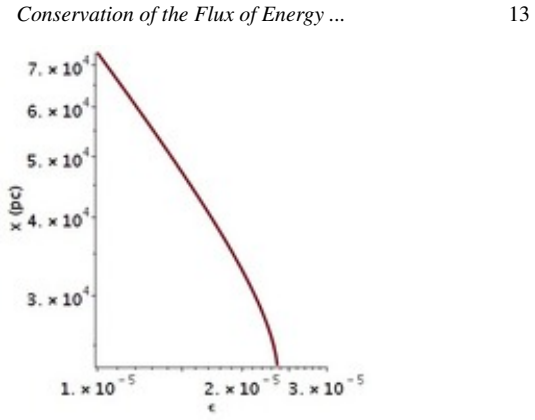
The load-bearing object is the conserved energy-flux identity for a conical jet, $F=\frac12\rho(x)v(x)^3\pi(x\tan(\alpha/2))^2=\text{const}$ in the classical case and $F=\rho c^2 v\gamma^2\pi(x\tan(\alpha/2))^2=\text{const}$ in the relativistic case with zero pressure. This identity is a first integral that converts the unknown jet dynamics into an algebraic relation $v(x)$ and a quadrature for $x(t)$; each density profile enters only through $\rho(x)$. The other mechanism is the radiative-loss prescription: losses equal $-\epsilon$ times the flux, with one free constant $\epsilon$, which introduces the back-reaction that terminates the jet at a finite length. For the Lane–Emden $n=5$ medium, the density $\rho(r)=\rho_c(1+r^2/3b^2)^{-5/2}$ comes from the analytic solution of the Lane–Emden equation, and hypergeometric functions, elliptic integrals, and Padé approximants supply the analytical approximations.
What would settle it
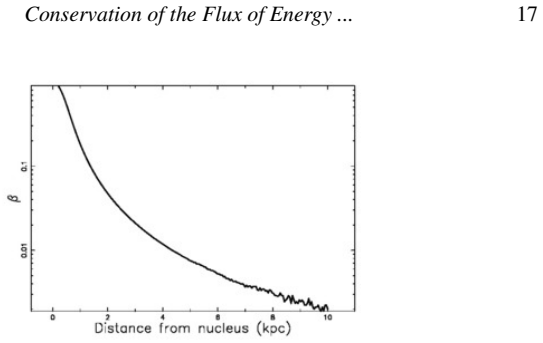
Observe the centerline velocity of a resolved jet in a roughly constant-density environment: the conserved-flux law predicts $v(x)\propto x^{-2/3}$, so measured velocities that decline faster or slower than that power law over a decade in $x$ would falsify the central claim. Alternatively, map the magnetic field strength along a jet by rotation-measure or spectral-index data: the equipartition-plus-flux model predicts $B(x)\propto x^{-3/2}$ outside the core radius for the Lane–Emden profile.
Extended reading notes
Core claim
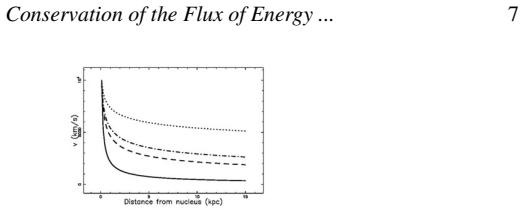
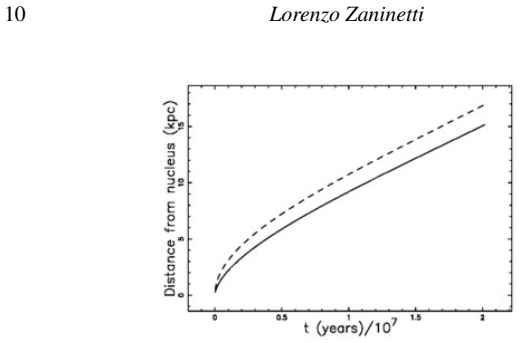
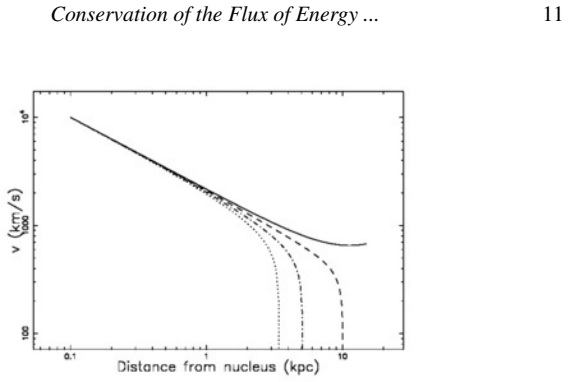
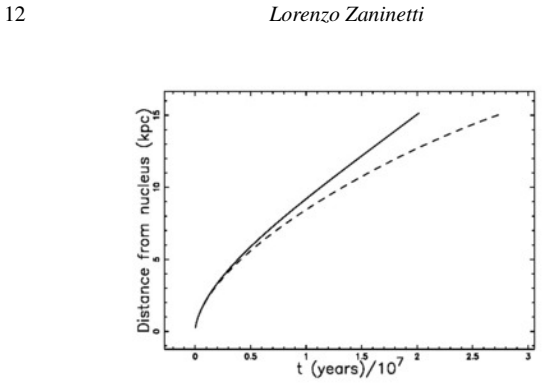
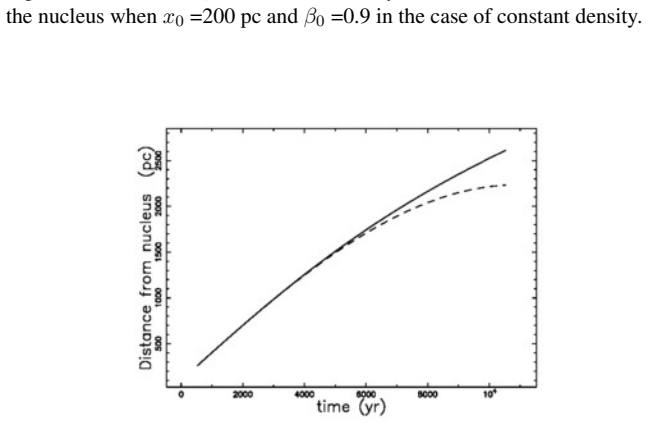
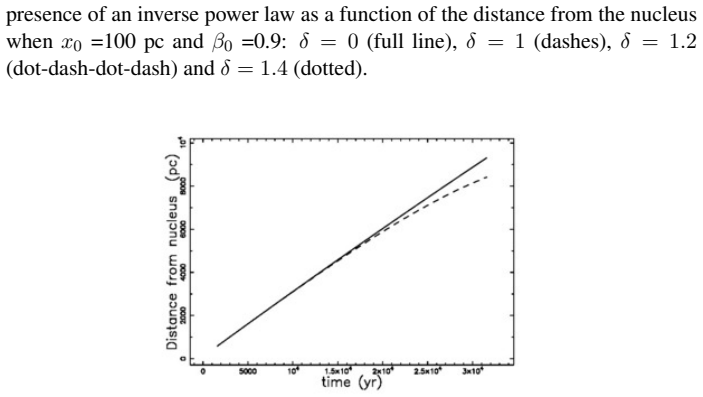
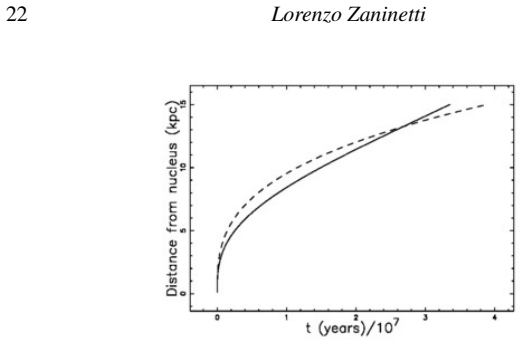
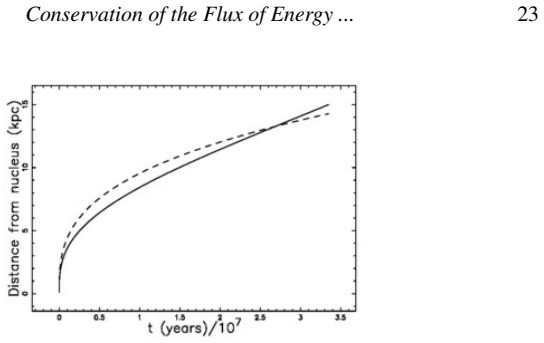
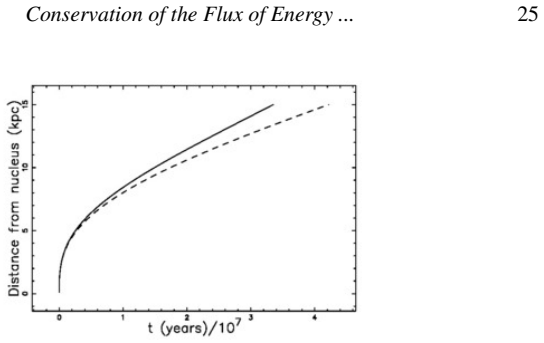
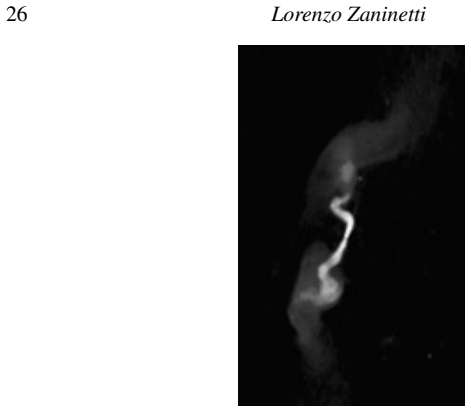
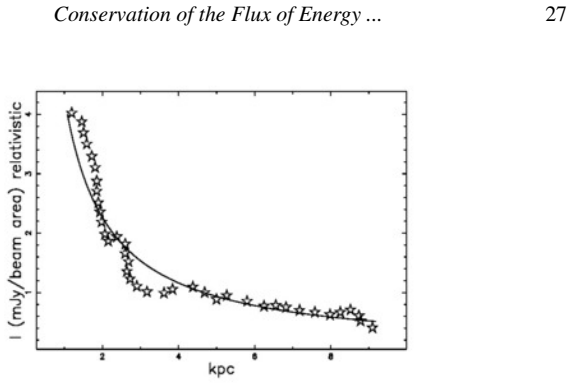
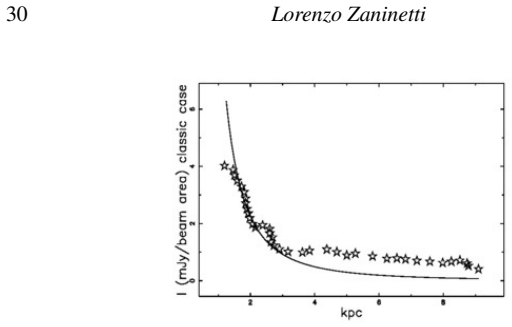
The paper's central claim is that energy-flux conservation alone, written as $\frac{1}{2}\rho(x_0)v_0^3 A(x_0)=\frac{1}{2}\rho(x)v^3 A(x)$ with $A(x)=\pi(x\tan(\alpha/2))^2$, fixes the trajectory of a turbulent extragalactic jet once the surrounding IGM density profile is specified. For constant density the model gives $v(x)=v_0 x_0^{2/3}x^{-2/3}$ and the asymptotic law $x(t)\propto t^{3/5}$; for a hyperbolic profile $x(t)\propto t^{3/4}$; for an inverse power law it gives an analytic $v(x)$ but no closed-form $x(t)$; and for a Lane–Emden $n=5$ profile the velocity is expressed through a regularized hypergeometric function, with the trajectory given implicitly by $F(x)-F(x_0)=t$ and by a closed-form asymptotic approximation. The same logic is applied relativistically with flux $\rho c^2 v\gamma^2 A$, yielding a first-order analytic $\beta(x)$, a power-series trajectory, and a Padé approximant. When radiative losses are modeled as a constant fraction $\epsilon$ of the flux, the back-reaction shortens the trajectory to a finite jet length. The astrophysical payoff is that the same machinery predicts the 3C31 centerline intensity, both by direct conversion of the losses divided by area and by equipartition magnetic fields feeding the standard synchrotron formula.
Load-bearing premise
The derivation rests on one premise: the jet's kinetic energy flux—energy per unit time crossing each circular cross-section of the conical jet—stays exactly constant along the jet, with zero pressure, no entrainment or dissipation, and radiative losses represented only by a fixed fraction $\epsilon$ of that flux.
Editorial extensions
If this is right
- In a constant-density intergalactic medium, every turbulent jet with fixed initial velocity eventually follows $x(t)\propto t^{3/5}$, so older sources at fixed $v_0$ accumulate distance more slowly than linear ballistic motion.
- For an inverse-power-law medium with $\delta=2$, the mass-flow rate $\dot m(x)$ becomes constant along the jet, so the model identifies density slopes that keep the particle supply uniform.
- Including radiative losses as a fixed fraction of the flux turns an infinite trajectory into one with a finite jet length $x_j$, which the paper evaluates by zeroing the derivative of the second-order velocity.
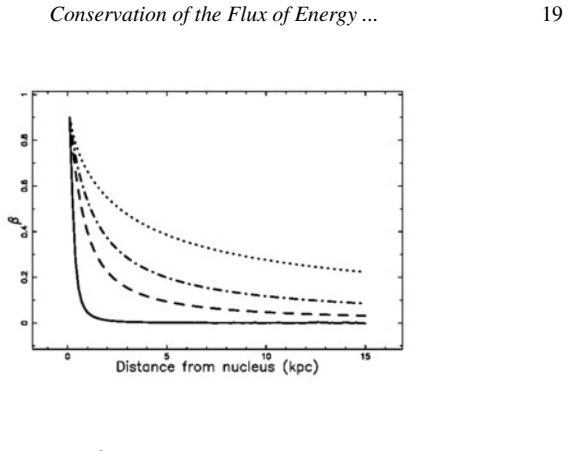
- The relativistic formulation predicts velocity–distance relations $\beta(x)$ for each density profile and, through a Padé approximant, gives a closed-form trajectory that stays within about 5 percent of the full numerical solution at 15 kpc.
- The centerline intensity of the radio galaxy 3C31 is reproduced from flux conservation alone, at 86% reliability for the direct-loss model and 74% for the equipartition magnetic-field model, without imposing a separate intensity profile.
Reading between the lines
- The zero-pressure, no-entrainment simplification should work best in highly supersonic, outer jet regions; where thermal pressure in a cluster core is comparable to the ram pressure, the conserved quantity would need to become an enthalpy flux rather than the kinetic flux.
- The single constant $\epsilon$ absorbs all radiative microphysics, so calibrating it across a sample of jets with measured total radio luminosity could turn $\epsilon$ into an empirical efficiency parameter for converting jet power into synchrotron radiation.
- The same flux-conservation identity can be applied to non-conical geometries, precessing jets, or density profiles drawn from cosmological structure models, since only the cross-section $A(x)$ and $\rho(x)$ enter the derivation.
- A velocity-field map of a resolved jet obtained from proper motions or spectral tomography would discriminate this model from momentum-conserving or mass-conserving jet models, because each makes a different power-law prediction for $v(x)$ at the same density profile.
Signed reviews
Editorial analysis
A structured set of objections, weighed in public.
Referee Report
Summary. The paper asserts that the kinetic energy flux (1/2)ρv^3A is conserved along an extragalactic turbulent jet and uses this to derive classical and relativistic velocity–distance relations and trajectories for four surrounding density profiles: constant, hyperbolic, inverse power law, and Lane–Emden (n=5). It then introduces a radiative-loss back-reaction term proportional to the energy flux, derives corrected velocities, and applies the results to model the centerline synchrotron intensity and magnetic field evolution in the radio galaxy 3C31, reporting 86.19% and 73.79% agreement with observed intensity profiles in two models.
Significance. If the central conservation premise were physically valid, the paper would offer simple analytic formulae for jet kinematics and intensity profiles that could be useful for quick modeling. The algebraic derivations are transparent and the analytic expressions are given explicitly, which is a strength. However, the premise itself is unvalidated and, as shown below, internally inconsistent with the paper's own mass-flow result and with basic fluid dynamics: kinetic energy flux is not conserved in a widening, entraining jet, and the derived Lane–Emden velocity grows linearly with distance, which is unphysical. The 3C31 comparisons do not test the model because they rely on fitted radiative-loss fractions, electron indices, and free normalizations. Consequently, the significance of the derived results for real jets is not established.
major comments (3)
- [Section 2, Eq. (4)] Equation (4) asserts that (1/2)ρv^3A is constant along the jet, but this is not a conservation law for an open control volume. The paper's own mass-flow result, Eq. (13), shows that the mass flux increases ∝ x^(4/3) in the constant-density case, meaning the jet is entraining ambient gas; the entrained mass carries energy, so the kinetic-energy flux of the original jet material cannot remain constant. The steady Euler equations conserve total energy flux including enthalpy and pressure work, and setting p0=0 while neglecting entrainment makes Eq. (4) an unvalidated ansatz rather than a derived conservation statement. All subsequent velocity and trajectory results—Eqs. (6)–(10), (16)–(19), (34)–(40), (57), (66), and (71)—are algebraic consequences of this premise and inherit its vulnerability.
- [Section 2.4, Eqs. (34)–(35)] The Lane–Emden velocity solution predicts an unphysical acceleration at large radius. From Eq. (34) and the asymptotic expansion in Eq. (35), v(x) ∼ const × x for x ≫ b, i.e., the jet accelerates without any driving mechanism. This contradicts the expectation that a jet propagating in a static external medium decelerates, and it is inconsistent with the observed behavior of 3C31. The paper does not discuss or justify this limit, and because the intensity models in Section 4 are built on this velocity profile, the physical plausibility of the entire Lane–Emden application is undermined.
- [Section 4, Eq. (42) and Figs. 14–15] The reported agreement with 3C31 (ϵobs = 86.19% and 73.79%) is not a quantitative validation of the model. The radiative-loss fraction ε in Eq. (42) and Eq. (83) is a free parameter fitted to the data, the electron spectral index p in Eq. (96) is free, and the intensity normalization I0 is arbitrarily chosen. The reliability metric in Eq. (90) is a mean-relative-error measure that rewards amplitude and shape tuning. With these free parameters, the figures demonstrate curve fitting rather than prediction, so they cannot provide independent support for the conservation premise or the derived velocity laws.
minor comments (4)
- [Abstract and running text] The manuscript opens with a stray 'Chapter' heading and contains several typographical artifacts; it should begin with the proper title and abstract without formatting remnants.
- [Section 2.2, after Eq. (14)] The text 'ρ0 = 0 is the density at x = x0' should read 'ρ0 is the density at x = x0'; the printed equality contradicts the intended meaning and the subsequent formula.
- [Figure captions 10 and 11] The captions for Figures 10 and 11 refer to 'equation (10)' and 'equation (11)', respectively, but the intended equations appear to be (74) and (77); the cross-references need correction.
- [Section 2.1, laboratory comparison] The comparison with laboratory jet data uses an ad hoc factor of 2 to convert averaged to centerline velocity without a derivation or error estimate; this comparison should be clearly presented as illustrative rather than as a quantitative validation.
Circularity Check
No construction-level circularity: the laws of motion are algebraic consequences of the stated conservation premise, and the 3C31 intensity figures are underdetermined fits rather than derived predictions.
full rationale
The central chain is Eq. (4) (energy-flux conservation, cited to De Young's Formula A28) through the differential equations (5), (15), (22), (33) to the solutions for v(x) and x(t). These follow by algebra and integration, and the constant-density result is checked against laboratory jet data with fixed parameters (Section 2.1), providing an external, parameter-free benchmark. The relativistic branch similarly solves Eq. (53)/(70) for beta(x). Nothing in these derivations defines the output in terms of the data being explained. The Lane-Emden radiative-loss term (Eq. 41) is an additional ansatz parametrized by epsilon, and the second-order velocity (45) and jet length (48) are mathematical consequences of that ansatz, not renamings of 3C31 data. The self-citations [11,12] are used only for unit conventions, not as load-bearing support. The 3C31 intensity comparisons (Figs. 14-15) are weaker than the paper implies: the theoretical intensity is proportional to the radiative-loss integral (Eqs. 88-89), whose amplitude contains the free constant epsilon and unspecified density/opening angle, and Eq. (98) has free I0 and p, so the reported reliability percentages measure shape agreement after arbitrary normalization rather than testing the conservation premise. That is an underdetermined fit/evidence weakness, but it is not a construction-level circularity because the intensity model is not derived from the 3C31 data. The physical validity of Eq. (4) for an entraining jet (the mass flux grows as x^{4/3}, Eq. 13) is a correctness risk, not a circularity.
Assumptions & free parameters
free parameters (3)
- epsilon =
not quoted; shown for 1e-4 to 3e-4 in Figs 3-5 and used in 3C31 fits
- p =
not quoted; inferred from 3C31 centerline intensity slope
- I0 / B0 normalization =
not quoted; adjusted to match intensity scale
assumptions (8)
- domain assumption The kinetic energy flux of the jet is conserved: (1/2)ρ v^3 A = constant (Eq 4).
- domain assumption Relativistic energy flux has zero pressure in the rest frame: A ρ c^2 v γ^2 = constant (Eq 53).
- standard math Jet geometry is a straight cone: A(x)=π(x tan(α/2))^2 (Eqs 1-3).
- domain assumption Density profiles are prescribed: constant, hyperbolic, inverse power law, Lane-Emden n=5 (Eqs 14, 21, 32).
- ad hoc to paper Radiative losses are proportional to the local energy flux: Q = -ε ρ v^3 π x^2 ... (Eqs 41-42).
- domain assumption Magnetic energy is in equipartition with kinetic energy: B^2/8π = 1/2 ρ v^2 (Eq 91).
- standard math Synchrotron emissivity formula (1.175) from Lang 1980 (Eq 94).
- ad hoc to paper Centerline velocity is about twice the averaged velocity (Section 2.1).
Cite this review
Pith. "Pith review of Conservation of the Flux of Energy in Extra-Galactic Jets." pith.science (2026). https://pith.science/paper/7T4VPCDT
@misc{pith2026190805723,
  author       = {Pith},
  title        = {Pith review of: Conservation of the Flux of Energy in Extra-Galactic Jets},
  year         = {2026},
  howpublished = {\url{https://pith.science/paper/7T4VPCDT}},
  note         = {Machine review of arXiv:1908.05723}
}
abstract
The conservation of the energy flux in turbulent jets that propagate in the intergalactic medium (IGM) allows us to deduce the law of motion in the classical and relativistic cases. Four types of IGM are considered: constant density, hyperbolic decrease of density, inverse power law decrease of density and a Lane--Emden ($n=5$) profile. The conservation of the relativistic flux for the energy allows us to derive, to the first order, an analytical expression for the velocity. It also allows us to numerically determine the trajectory for the four types of medium. In the case of a Lane--Emden ($n=5$) profile, the back-reaction due to the radiative losses for the trajectory is evaluated both in the classical and the relativistic case. Astrophysical applications are made to the centerline intensity of the synchrotron emission and to the evolution of the magnetic field in the case of the radio-galaxy 3C31.
Figures
Figures from the paper (12 more)
Reference graph
Works this paper leans on
-
[1]
Reynolds, O., An experimental investigation of the circumstances which determine whether the motion of water shall be direct or sinuous, and of the law of resistance in parallel channels,Proceedings of the Royal Society of London 35 (224-226) (1883) 84
-
[2]
Reynolds, O., On the dynamical theory of incompressible viscous fluids and the determination of the criterion, Proceedings of the Royal Society of London 56 (336-339) (1894) 40
-
[3]
van Dyke, M., An album of fluid motion, NASA STI/Recon Technical Re- port A 82 (1982) 36549
work page 1982
-
[4]
Goldstein, S., Modern Developments in Fluid Dynamics , Dover, New York, 1965
work page 1965
-
[5]
Landau, L., Fluid Mechanics 2nd edition, Pergamon Press, London, 1987
work page 1987
-
[6]
B., Turbulent Flows, Cambridge University Press, Cambridge, UK, 2000
Pope, S. B., Turbulent Flows, Cambridge University Press, Cambridge, UK, 2000. 32 Lorenzo Zaninetti
work page 2000
-
[7]
Bird, R., Stewart, W., & Lightfoot, E., Transport Phenomena; Second Edi- tion, John Wiley and Sons, New York, 2002
work page 2002
-
[8]
Lebedev, S. V ., Suzuki-Vidal, F., Ciardi, A., et al., Laboratory simulations of astrophysical jets, in: Bonanno, A., de Gouveia Dal Pino, E., & Koso- vichev, A. G. (Eds.), IAU Symposium, V ol. 274 of IAU Symposium, 2011, 26–35
work page 2011
Show all 31 references
-
[9]
Suzuki-Vidal, F., Lebedev, S. V ., Krishnan, M., et al., Laboratory as- trophysics experiments studying hydrodynamic and magnetically-driven plasma jets, Journal of Physics Conference Series 370 (1) (2012) 012002
2012
-
[10]
S., The physics of extragalactic radio sources, University of Chicago Press, Chicago, 2002
De Young, D. S., The physics of extragalactic radio sources, University of Chicago Press, Chicago, 2002
2002
-
[11]
Zaninetti, L., Classical and relativistic flux of energy conservation in astro- physical jets, Journal of High Energy Physics, Gravitation and Cosmology 1 (2016) 41
2016
-
[12]
Zaninetti, L., Classical and relativistic evolution of an extra-galactic jet with back-reaction, Galaxies 27 (2018) 134
2018
-
[13]
& Dawson, J
Mistry, D. & Dawson, J. R., Experimental investigation of entrainment processes of a turbulent jet, Bulletin of the American Physical Society 59
-
[14]
Laing, R. A. & Bridle, A. H., Relativistic models and the jet velocity field in the radio galaxy 3C 31, MNRAS 336 (2002) 328
2002
-
[15]
Lane, H. J., On the theoretical temperature of the sun, under the hypoth- esis of a gaseous mass maintaining its volume by its internal heat, and depending on the laws of gases as known to terrestrial experiment, Ameri- can Journal of Science 148 (1870) 57
-
[16]
Teubner., Berlin, 1907
Emden, R., Gaskugeln: anwendungen der mechanischen warmetheorie auf kosmologische und meteorologische probleme[Gas balls: applications of mechanical heat theory cosmological and meteorological problems], B. Teubner., Berlin, 1907
1907
-
[17]
Conservation of the Flux of Energy
Chandrasekhar, S., An introduction to the study of stellar structure, Dover, New York, 1967. Conservation of the Flux of Energy ... 33
1967
-
[18]
& Tremaine, S., Galactic dynamics, Second Edition, Princeton University Press, Princeton, NJ, 2011
Binney, J. & Tremaine, S., Galactic dynamics, Second Edition, Princeton University Press, Princeton, NJ, 2011
2011
-
[19]
Zwillinger, D., Handbook of differential equations, Academic Press, New York, 1989
1989
-
[20]
Hansen, C. J. & Kawaler, S. D., Stellar Interiors. Physical Principles, Structure, and Evolution., Springer-Verlag, Berlin, 1994
1994
-
[21]
& Stegun, I
Abramowitz, M. & Stegun, I. A., Handbook of Mathematical Functions with F ormulas, Graphs, and Mathematical Tables , Dover, New York, 1965
1965
-
[22]
von Seggern, D., CRC Standard Curves and Surfaces , CRC, New York, 1992
1992
-
[23]
J., Atlas for computing mathematical functions , Wiley- Interscience, New York, 1997
Thompson, W. J., Atlas for computing mathematical functions , Wiley- Interscience, New York, 1997
1997
-
[24]
Olver, F. W. J. e., Lozier, D. W. e., Boisvert, R. F. e., & Clark, C. W. e., NIST handbook of mathematical functions. , Cambridge University Press. , Cambridge, 2010
2010
-
[25]
F., The mass-energy equivalence principle in fluid dynamics, Journal of High Energy Physics, Gravitation and Cosmology 1 (01) (2015) 48
Palacios, A. F., The mass-energy equivalence principle in fluid dynamics, Journal of High Energy Physics, Gravitation and Cosmology 1 (01) (2015) 48
2015
-
[26]
& Pollard, H., Ordinary Differential Equations: An Ele- mentary Textbook for Students of Mathematics, Engineering, and the Sci- ences, Dover Publications, New York, 1963
Tenenbaum, M. & Pollard, H., Ordinary Differential Equations: An Ele- mentary Textbook for Students of Mathematics, Engineering, and the Sci- ences, Dover Publications, New York, 1963
1963
-
[27]
L., Ordinary differential equations , Courier Dover Publications, New York, 2012
Ince, E. L., Ordinary differential equations , Courier Dover Publications, New York, 2012
2012
-
[28]
& Kasai, M., An Analytical Approximation of the Luminosity Distance in Flat Cosmologies with a Cosmological Constant, Progress of Theoretical Physics 127 (2012) 145
Adachi, M. & Kasai, M., An Analytical Approximation of the Luminosity Distance in Flat Cosmologies with a Cosmological Constant, Progress of Theoretical Physics 127 (2012) 145. 34 Lorenzo Zaninetti
2012
-
[29]
Aviles, A., Bravetti, A., Capozziello, S., & Luongo, O., Precision cos- mology with Padé rational approximations: Theoretical predictions versus observational limits, Phys. Rev. D 90 (4) (2014) 043531
2014
-
[30]
Wei, H., Yan, X.-P., & Zhou, Y .-N., Cosmological applications of Pade approximant, Journal of Cosmology and Astroparticle Physic 1 (2014) 45
2014
-
[31]
R., Astrophysical formulae
Lang, K. R., Astrophysical formulae . (Second Edition), Springer, New York, 1980. Index conservation energy flux classic, 3 relativistic, 14 profile of density constant, 3 hyperbolic, 5 Lane–Emden, 8 35
1980
Reviewed August 14, 2026 · model on record in the stance chip above.
Discussion (0). Continue with ORCID to comment.