REVIEW 3 major objections 5 minor 102 references
First 20 Years of Green Radios
T0 review · 3 major / 5 minor · reviewed 2026-08-14 · deepseek-v4-flash
Pith's one-line read The first twenty years of green radio are best understood as fundamental tradeoffs plus two engineering breakthroughs: the Doherty power amplifier and the separated baseband/radio unit architecture.
desk verdict Useful, clearly-written survey with a genuinely useful engineering angle, but its milestone table overstates self-authored 'discoveries' and needs a scope note; deserves revision, not rejection. read the letter →
The pith
A machine-rendered reading of the paper's core claim, the machinery that carries it, and where it could break.
The reading
What carries the argument
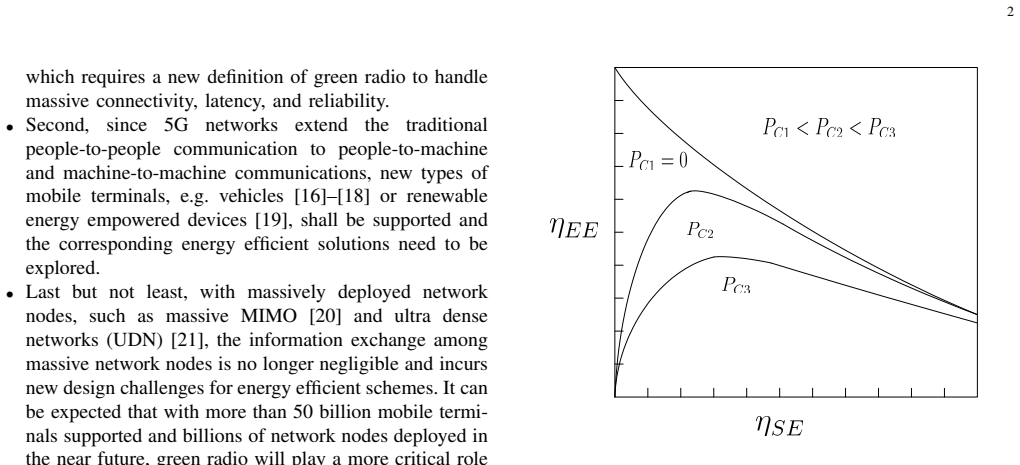
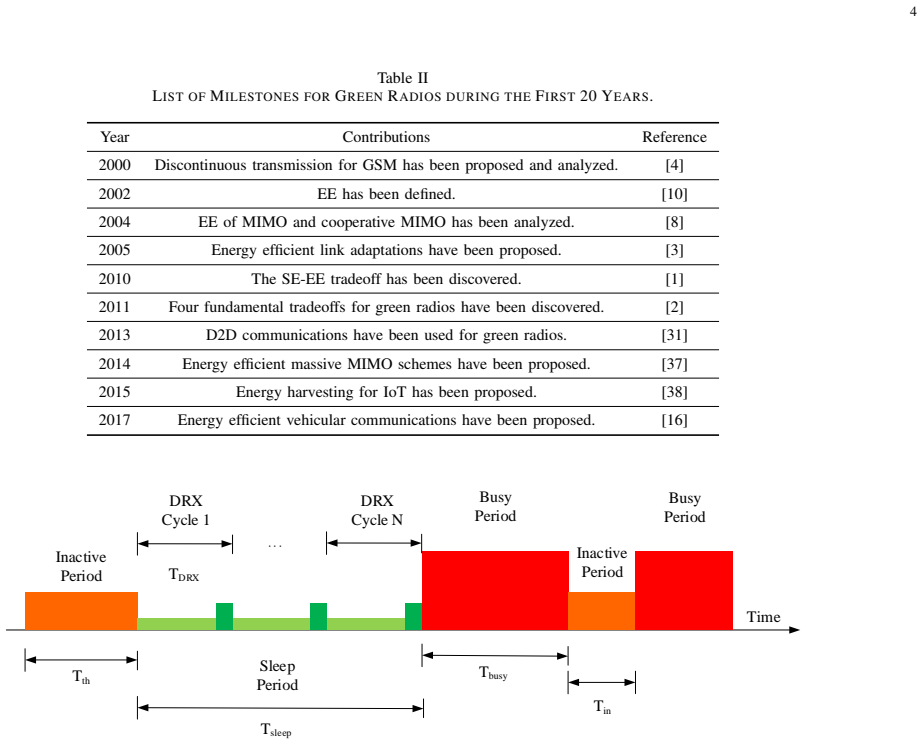
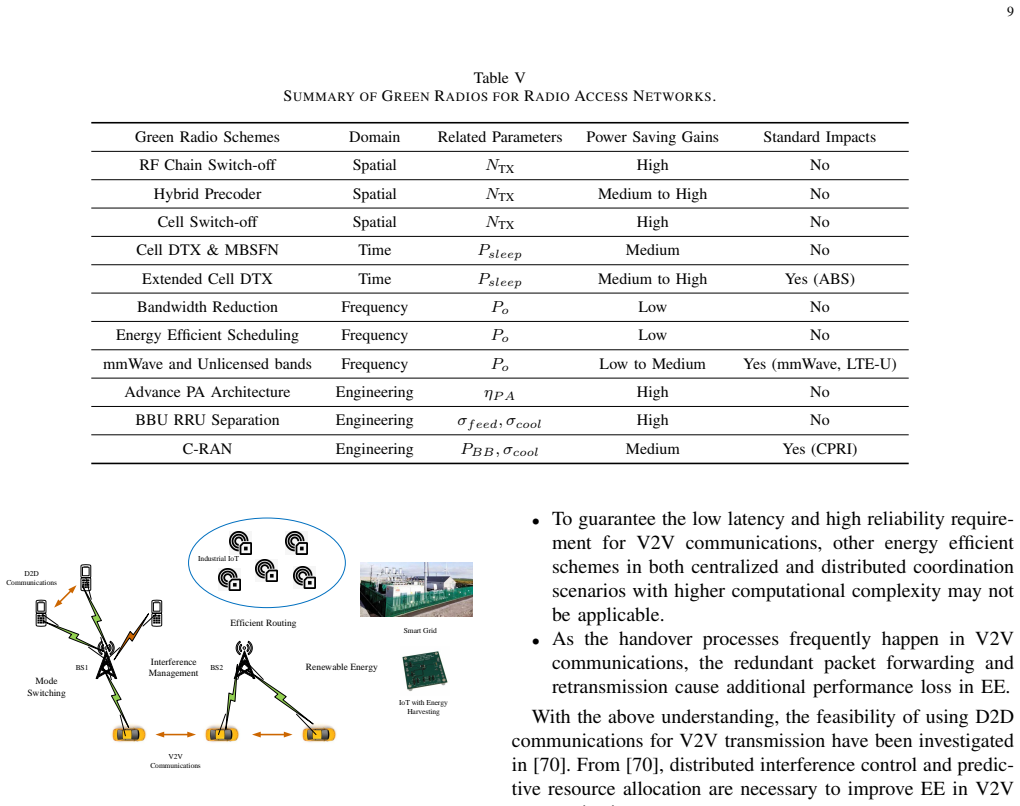
The load-bearing objects are the fundamental tradeoff curves and the base station power model. The SE-EE identity $\eta_{EE}(\eta_{SE})=\frac{\eta_{SE}}{(2^{\eta_{SE}}-1)N_0+P_c}$ turns the intuition that more throughput costs more energy into a curve with a unique optimum when circuit power $P_c>0$; a scheme helps if it moves the network toward that point or enlarges the region around it. The base station power model, with its linear approximation, breaks consumption into transceiver chains, power amplifier efficiency, and losses from feeders, cooling, DC conversion, and main supply, and this is what identifies where the two highlighted engineering fixes act: the Doherty architecture raises $\eta_{PA}$, and BBU-RRU separation reduces $\sigma_{feed}$ and $\sigma_{cool}$. Sleep and wake-up mechanisms such as DRX and cell DTX are the complementary time-domain machinery that turns idle hardware off.
What would settle it
Compare the milestone table against a systematic search of the pre-2010 literature for explicit SE-EE tradeoff analyses and for earlier documented work on efficient power amplifiers and remote radio heads; if an earlier explicit SE-EE curve or an earlier large-scale BBU-RRU deployment exists, the paper's stated history and its overlooked-engineering claim would need correction.
Extended reading notes
Core claim
The central claim is that green radio's first two decades have two complementary stories: a theoretical one organized by fundamental tradeoffs and a practical one driven by power-saving hardware and architecture. The theoretical thread begins with the SE-EE tradeoff, expressed as $\eta_{EE}(\eta_{SE})=\frac{\eta_{SE}}{(2^{\eta_{SE}}-1)N_0+P_c}$, which shows that with zero circuit power, energy efficiency falls monotonically as spectrum efficiency rises, while with positive circuit power the curve becomes bell-shaped and has a point of maximum energy efficiency. The same logic is extended to deployment efficiency, delay, bandwidth, and power. The engineering thread, which the authors say earlier surveys overlooked, centers on the Doherty power amplifier, which keeps high efficiency over a wide output range and can be paired with digital predistortion to reach more than 50% efficiency improvement, and the separated baseband unit/remote radio unit architecture, which cuts feeder and cooling losses and later grows into C-RAN.
Load-bearing premise
The survey assumes that its chosen references and milestone table fairly represent what actually happened in the field, so if the selection is unrepresentative, the periodization and the claim that Doherty power amplifiers and BBU-RRU separation were overlooked are assertions rather than established history.
Editorial extensions
If this is right
- If the tradeoff framework is right, energy-efficient network operation is not about maximizing throughput or minimizing power alone; it is about locating the bell-shaped curve's maximum EE point, making load-adaptive scheduling the natural control knob.
- The survey implies that algorithmic green radio schemes should be benchmarked against hardware and architectural savings, since Doherty power amplifiers and BBU-RRU separation deliver gains comparable to many optimization schemes.
- If the milestone table is correct, the field's center of gravity moved from battery-limited terminals before 2008 to radio access networks afterward, so a history of green radio that omits engineering deployment misses a major part of the story.
- If future green radio must be end-to-end, terminal-only or RAN-only energy accounting will miss large remaining savings, because virtualization, edge computing, and core network operation now consume a growing share of network energy.
Reading between the lines
- One implicit testable prediction is that the shape of the SE-EE curve, rather than any particular protocol, sets the ceiling on achievable green gains; if so, lowering circuit power will push the whole tradeoff region outward more reliably than smarter scheduling.
- The paper's emphasis on Doherty amplifiers and separated base stations suggests a general rule for future surveys: component-level and architectural energy efficiency may outweigh the algorithmic optimizations that dominate the literature, and a quantitative decomposition of where energy is lost would test that rule.
- A natural extension is to apply the same tradeoff map to new metrics such as latency-energy or computation-energy in edge computing, where circuit power is replaced by server idle power and a bell-shaped curve could reappear.
- The milestone table could be checked against citation data: if explicit SE-EE tradeoff analyses or large-scale BBU-RRU deployments predate the cited 2010 and 2011 works, the paper's periodization and its claim that those engineering fixes were overlooked would require revision.
Signed reviews
Editorial analysis
A structured set of objections, weighed in public.
Referee Report
Summary. This paper is a survey/history of green radio research over the two decades up to the time of submission, organized around fundamental tradeoffs (especially SE-EE), terminal-side and access-network-side power-saving techniques, engineering solutions such as the Doherty power amplifier and separated BBU-RRU architecture, advanced terminals (IoT, D2D, V2V, energy harvesting), and future network directions (SDN/NFV, MEC, joint BB-RF design, machine learning). The paper does not derive new technical results; it synthesizes existing literature, presents a milestone table (Table II), and argues that certain engineering aspects have been underappreciated in prior surveys.
Significance. If the historical claims are accurate, the paper could serve as a useful entry point and reference for both newcomers and practitioners, especially because it highlights engineering solutions that many theoretical surveys omit. The paper is clearly written and brings together a broad literature in one place. However, its novelty is limited: it is a narrative review rather than a systematic survey, and its central historical claims rest on the authors' own selection of milestones. With corrections to the milestone dating and a clearer statement of scope, the survey could be a worthwhile contribution.
major comments (3)
- [Table II vs. Section III] The milestone table's dating of the SE-EE tradeoff is internally inconsistent with the paper's own citations. Table II lists '2010: The SE-EE tradeoff has been discovered [1]' and '2011: Four fundamental tradeoffs ... discovered [2]', while Section III cites [3] (Cui, Goldsmith, and Bahai, 2005) for energy-constrained modulation optimization with circuit energy, reporting near-80% energy savings, and [8] (2004) for energy-efficient MIMO and cooperative MIMO. Selecting a constellation size under a circuit-power-aware energy budget already embodies the SE-EE tradeoff. Please rephrase the milestone entries to say 'analytically characterized for the RAN context' or explicitly distinguish an earlier terminal-side notion from the later network-side formulation, and justify the 2010 discovery date.
- [II (Table II) and V.D] The paper does not state any search or inclusion criteria for the references used to build the historical milestone table, and it presents Table II as a list of 'milestones' without the kind of caveat it attaches to the advanced-terminals section, where Section V.D explicitly says the solutions are 'by no means complete.' Because the paper's central contribution is a historical map, the absence of selection criteria and the lack of a similar caveat for Table II make the map's representativeness unverifiable. Please add a statement of scope (e.g., 'selected representative works' vs. 'comprehensive list') and, if the milestones are meant to be comprehensive, describe the search and inclusion procedure.
- [I and IV.D] The claim that engineering solutions such as the Doherty PA and separated BBU-RRU architecture 'might be overlooked in many past survey or tutorial papers' is asserted without specifying which past surveys or tutorials were examined. As written, this claim is not checkable. Please either name the comparison set of surveyed publications and show that they omit these topics, or soften the claim to indicate that these topics are not extensively discussed in the surveys the authors themselves cite.
minor comments (5)
- [IV, Eq. (2)] The text following Eq. (2) says 'PRF and RBB' but the equation uses P_RF and P_BB; please fix the notation inconsistency and check that the symbol definitions match between text, equations, and Figure 3.
- [III and IV] Quantitative gains such as '50-80% power savings' (Section IV.A, from [52]), '25% to 40%' (Section IV.B, from [56]), and 'more than 50%' (Section IV.D, from [61]) are cited without indicating that these are values reported in the cited works, not independently verified by this paper. Please add phrases like 'as reported in [x]' or 'according to [x]'.
- [Table II, 2002 entry] The 2002 milestone entry says 'EE has been defined' and cites [10]; the reference is a design-challenges paper, not a definitional paper. Please rephrase the entry to say 'energy efficiency was discussed for ad hoc networks' or cite the specific page or section where a definition is given.
- [Table I] The acronym table contains a typo: 'LPW A' should be 'LPWA'. In addition, the paper uses 'spectrum efficiency' and 'spectral efficiency' interchangeably; please unify.
- [Figure 3] Figure 3 appears to be a low-resolution or corrupted image; a clean redrawn diagram of the power model would substantially improve readability.
Circularity Check
No significant circularity: the paper is a survey whose claims are literature attributions, not derivations from its own outputs.
full rationale
This paper is a historical and tutorial survey of green radio research over 20 years. It contains no derivation chain in which a quantity is fitted and then renamed as a prediction, and no definition that presupposes its own conclusion. Eq. (1), the SE-EE expression, is quoted from prior work [22] and is used only to illustrate the tradeoff, not derived from the survey's own framework. The organizational claim that 'four fundamental tradeoffs have been identified in [2]' is an attribution to a peer-reviewed external publication; using the authors' own prior taxonomy as a classification lens is self-citation but not circular, because the tradeoffs are externally checkable and the survey adds no new mathematical result that would reduce to the taxonomy. Similarly, Table II's milestones cite [1] and [2], which are authored by the present authors, for the 2010 and 2011 entries, but those entries are historical attributions rather than predictions forced by a fit. The possible tension between the 2005 energy-constrained modulation work [3] and the 'discovered in 2010' dating is a historical-accuracy concern, not a circularity concern, and per the rules belongs under correctness risk rather than circularity. No step in the paper exhibits the specific reduction required to establish circularity, so the honest finding is no significant circularity.
Assumptions & free parameters
assumptions (3)
- domain assumption EE is defined as the ratio of total data delivered to total energy consumed, equivalent to rate over power for fixed transmission period.
- domain assumption The linear BS power model (3) with parameters in Table IV is a valid approximation of the detailed model (2).
- domain assumption The four fundamental tradeoffs (SE-EE, DE-EE, etc.) from [2] characterize green radio.
Cite this review
Pith. "Pith review of First 20 Years of Green Radios." pith.science (2026). https://pith.science/paper/7TABLFCP
@misc{pith2026190807696,
  author       = {Pith},
  title        = {Pith review of: First 20 Years of Green Radios},
  year         = {2026},
  howpublished = {\url{https://pith.science/paper/7TABLFCP}},
  note         = {Machine review of arXiv:1908.07696}
}
read the original abstract
Green radios jointly consider the spectrum efficiency and the energy efficiency in wireless networks in order to provide sustainable development. In the past two decades, various green radio solutions for different types of terminals and radio access networks have been developed, some of which have been used in the designs of wireless products. In this paper, we provide a historical view on some fundamental works and practical issues. In addition to providing a comprehensive overview on theoretical achievements, we also discuss several important power saving solutions with notable engineering impacts, such as Doherty power amplifier and separated baseband unit - remote radio unit architecture, which might be overlooked in previous publications. Moreover, with the huge growth of wireless traffic in the near future, green radio design for future wireless networks shall involve an end-to-end energy efficiency investigation of mobile terminals, radio access and core networks, and different applications. By introducing green radio schemes for advanced terminals and future wireless networks, this article will not only be beneficial for readers with only preliminary background in communications and signal processing but also have reference and historical values for researchers and practical engineers in the area.
Figures

Figures from the paper (6 more)



Reference graph
Works this paper leans on
-
[22]
Fundamental green tradeoffs: Progresses, challenges, and impacts on 5G networks,
S. Zhang, Q. Wu, S. Xu, and G. Y . Li, “Fundamental green tradeoffs: Progresses, challenges, and impacts on 5G networks,” IEEE Commun. Surv. & Tut., vol. 19, no. 1, pp. 33 – 56, 1st Quart. 2017
2017
-
[46]
Energy efficiency analysis of the reference systems, areas of improvements and target breakdown,
G. Auer and et. al. , “Energy efficiency analysis of the reference systems, areas of improvements and target breakdown,” Energy Aware Radio and neTwork tecHnologies (EARTH), Deliverable 2.3, Jan. 2012
work page 2012
-
[1]
Energy-efficient link adaptation in frequency-selective channels,
G. Miao, N. Himayat, and G. Y . Li, “Energy-efficient link adaptation in frequency-selective channels,” IEEE Trans. Commun., vol. 58, no. 2, pp. 545 – 554, Feb. 2010
2010
-
[2]
Fundamental trade-offs on green wireless networks,
Y . Chen, S. Zhang, S. Xu, and G. Y . Li, “Fundamental trade-offs on green wireless networks,” IEEE Commun. Mag. , vol. 49, no. 6, pp. 30 – 37, Jun. 2011
2011
-
[3]
Energy-constrained modulation optimization,
S. Cui, A. J. Goldsmith, and A. Bahai, “Energy-constrained modulation optimization,” IEEE Trans. Wireless Commun., vol. 4, no. 5, pp. 2349 – 2360, Sept. 2005
2005
-
[8]
Energy-efficiency of MIMO and cooperative MIMO techniques in sensor networks,
S. Cui, A. J. Goldsmith, and A. Bahai, “Energy-efficiency of MIMO and cooperative MIMO techniques in sensor networks,” IEEE J. Sel. Areas Commun., vol. 22, no. 6, pp. 1089 – 1098, Aug. 2004
2004
-
[52]
Dynamic base station switching-on/off strategies for green celluar networks,
E. Oh, K. Son, and B. Krishnamachari, “Dynamic base station switching-on/off strategies for green celluar networks,” IEEE Trans. Wireless Commun., vol. 12, no. 5, pp. 2126 – 2136, May 2013
work page 2013
-
[56]
Minimizing base station power consumption,
H. Holtkamp, G. Auer, S. Bazzi, and H. Haas, “Minimizing base station power consumption,” IEEE J. Sel. Areas Commun. , vol. 32, no. 2, pp. 297 – 306, Feb. 2014
work page 2014
-
[61]
Analysis and design of a Doherty-like RF-input load modulated balanced amplifier,
P. H. Pednekar, W. Hallberg, C. Fager, and T. W. Barton, “Analysis and design of a Doherty-like RF-input load modulated balanced amplifier,” IEEE Trans. Microw. Theory Tech., pp. 1 – 14, Early Access 2018
work page 2018
Show all 102 references
-
[4]
Analysis of the influence of the power control and discontinuous transmission on RF exposure with GSM mobile phones,
J. Wiart, C. Dale, A. Bosisio, and A. L. Cornec, “Analysis of the influence of the power control and discontinuous transmission on RF exposure with GSM mobile phones,” IEEE Trans. Electromagn. Compat., vol. 42, no. 4, pp. 376 – 385, Apr. 2000
2000
-
[5]
Effects of discontinuous transmis- sion on the performance of a WCDMA cellular system,
R. Perillo, V . Tralli, and M. Zorzi, “Effects of discontinuous transmis- sion on the performance of a WCDMA cellular system,” IEEE Trans. Veh. Technol., vol. 53, no. 5, pp. 1387 – 1399, May 2004
2004
-
[6]
HEED: a hybrid, energy-efficient, distributed clustering approach for ad hoc sensor networks,
O. Younis and S. Fahmy, “HEED: a hybrid, energy-efficient, distributed clustering approach for ad hoc sensor networks,” IEEE Trans. Mobile Comput., vol. 3, no. 4, pp. 366 – 379, Apr. 2004. 13
2004
-
[7]
On energy efficiency and optimum resource allocation of relay transmissions in the low-power regime,
Y . Yao, X. Cai, and G. Giannakis, “On energy efficiency and optimum resource allocation of relay transmissions in the low-power regime,” IEEE Trans. Wireless Commun. , vol. 4, no. 6, pp. 2917 – 2927, Jun. 2005
2005
-
[9]
Medium access control with co- ordinated adaptive sleeping for wireless sensor networks,
W. Ye, J. Heidemann, and D. Estrin, “Medium access control with co- ordinated adaptive sleeping for wireless sensor networks,” IEEE/ACM Trans. Netw., vol. 12, no. 3, pp. 493 – 506, Jun. 2004
2004
-
[10]
Design challenges for energy- constrained ad hoc wireless networks,
A. J. Goldsmith and S. B. Wicker, “Design challenges for energy- constrained ad hoc wireless networks,” IEEE Wireless Commun. Mag., vol. 9, no. 4, pp. 8 – 27, Aug. 2002
2002
-
[11]
Energy- efficient configuration of spatial and frequency resources in MIMO- OFDMA systems,
Z. Xu, C. Yang, G. Y . Li, S. Zhang, Y . Chen, and S. Xu, “Energy- efficient configuration of spatial and frequency resources in MIMO- OFDMA systems,” IEEE Trans. Commun. , vol. 61, no. 2, pp. 564 – 575, Feb. 2013
2013
-
[12]
The Doherty power amplifier,
B. Kim, J. Kim, I. Kim, and J. Cha, “The Doherty power amplifier,” IEEE Microw. Mag., vol. 7, no. 5, pp. 42 – 50, May 2006
2006
-
[13]
Application of BBU+RRU based CoMP system to LTE-Advanced,
Q. Wang, D. Jiang, J. Jin, G. Liu, Z. Yan, and D. Yang, “Application of BBU+RRU based CoMP system to LTE-Advanced,” in Proc. IEEE Int. Conf. Commun. (ICC) Worshop, Dresden, Germany, Jun. 2009, pp. 1 – 5
2009
-
[14]
Toward green and soft: a 5G perspective,
C.-L. I, C. Rowell, S. Han, Z. Xu, G. Li, and Z. Pan, “Toward green and soft: a 5G perspective,” IEEE Commun. Mag. , vol. 52, no. 2, pp. 66 – 73, Feb. 2014
2014
-
[15]
14.2.0, TSG-RAN, Tech
3GPP, Study on scenarios and requirements for next generation access technologies, Ver. 14.2.0, TSG-RAN, Tech. Rep. 38.913, Mar. 2017
2017
-
[16]
Vehicular communications: A physical layer perspective,
L. Liang, H. Peng, G. Y . Li, and X. Shen, “Vehicular communications: A physical layer perspective,” IEEE Trans. Veh. Technol. , vol. 66, no. 12, pp. 10 647 – 10 659, Dec. 2017
2017
-
[17]
Vehicular communications: A network layer perspective,
H. Peng, L. Liang, X. Shen, and G. Y . Li, “Vehicular communications: A network layer perspective,” IEEE Trans. Veh. Technol., pp. 1 – 14, Early Access 2018
2018
-
[18]
Low-power wide-area networks for green IoT,
Z. Qin, F. Y . Li, G. Y . Li, J. A. McCann, and Q. Ni, “Low-power wide-area networks for green IoT,” IEEE Wireless Commun. Mag., pp. 1 – 14, to appear 2018
2018
-
[19]
Social-aware energy harvesting device- to-device communications in 5G networks,
L. Jiang, H. Tian, Z. Xing, K. Wang, K. Zhang, S. Maharjan, S. Gjessing, and Y . Zhang, “Social-aware energy harvesting device- to-device communications in 5G networks,” IEEE Wireless Commun. Mag., vol. 23, no. 4, pp. 20 – 27, Apr. 2016
2016
-
[20]
An overview of massive MIMO: Benefits and challenges,
L. Lu, G. Y . Li, A. L. Swindlehurst, A. Ashikhmin, and R. Zhang, “An overview of massive MIMO: Benefits and challenges,” IEEE J. Sel. Topics Signal Process. , vol. 8, no. 5, pp. 742 – 758, May 2014
2014
-
[21]
Spectral and energy effi- ciency of ultra-dense networks under different deployment strategies,
S. F. Yunas, M. Valkama, and J. Niemel ¨a, “Spectral and energy effi- ciency of ultra-dense networks under different deployment strategies,” IEEE Commun. Mag. , vol. 53, no. 1, pp. 90 – 100, Jan. 2015
2015
-
[23]
An overview of sustainable green 5G networks,
Q. Wu, G. Y . Li, W. Chen, D. W. K. Ng, and R. Schober, “An overview of sustainable green 5G networks,” IEEE Wireless Commun. Mag. , vol. 24, no. 4, pp. 72 – 80, Aug. 2017
2017
-
[24]
Energy-efficient base-stations sleep-mode techniques in green cellular networks: a survey,
J. Wu, Y . Zhang, M. Zukerman, and E. K.-N. Yung, “Energy-efficient base-stations sleep-mode techniques in green cellular networks: a survey,” IEEE Commun. Surv. & Tut. , vol. 17, no. 2, pp. 803 – 826, 2nd Quart. 2015
2015
-
[25]
Power scheduling of universal decentralized estimation in sensor networks,
J.-J. Xiao, S. Cui, Z.-Q. Luo, and A. J. Goldsmith, “Power scheduling of universal decentralized estimation in sensor networks,” IEEE Trans. Signal Process., vol. 54, no. 2, pp. 413 – 422, Feb. 2006
2006
-
[26]
Energy- and spectral-efficiency tradeoff in downlink OFDMA networks,
C. Xiong, G. Y . Li, S. Zhang, Y . Chen, and S. Xu, “Energy- and spectral-efficiency tradeoff in downlink OFDMA networks,” IEEE Trans. Wireless Commun., vol. 10, no. 11, pp. 3874 – 3886, Nov. 2011
2011
-
[27]
Modeling UMTS discontinuous reception,
S.-R. Yang and Y .-B. Lin, “Modeling UMTS discontinuous reception,” IEEE Trans. Wireless Commun., vol. 4, no. 1, pp. 312 – 319, Jan. 2005
2005
-
[28]
Energy-efficient wireless communications: tutorial, survey, and open issues,
G. Y . Li, Z. Xu, C. Xiong, C. Yang, S. Zhang, Y . Chen, and S. Xu, “Energy-efficient wireless communications: tutorial, survey, and open issues,” IEEE Wireless Commun. Mag. , vol. 18, no. 6, pp. 28 – 35, Dec. 2011
2011
-
[29]
Network energy saving technologies for green wireless access networks,
T. Chen, Y . Yang, H. Zhang, H. Kim, and K. Horneman, “Network energy saving technologies for green wireless access networks,” IEEE Wireless Commun. Mag., vol. 18, no. 10, pp. 30 – 38, Oct. 2011
2011
-
[30]
Resource sharing optimization for device-to-device communication underlaying cellular networks,
C.-H. Yu, K. Doppler, C. B. Ribeiro, and O. Tirkkonen, “Resource sharing optimization for device-to-device communication underlaying cellular networks,” IEEE Trans. Wireless Commun., vol. 10, no. 8, pp. 2752 – 2763, Aug. 2011
2011
-
[31]
Device- to-device communications underlaying cellular networks,
D. Feng, L. Lu, Y . Yuan-Wu, G. Y . Li, G. Feng, and S. Li, “Device- to-device communications underlaying cellular networks,” IEEE Trans. Commun., vol. 61, no. 8, pp. 3541 – 3551, Aug. 2013
2013
-
[32]
Device- to-device communications in cellular networks,
D. Feng, L. Lu, Y . Yuan-Wu, G. Y . Li, S. Li, and G. Feng, “Device- to-device communications in cellular networks,” IEEE Commun. Mag., vol. 52, no. 4, pp. 49 – 55, Apr. 2014
2014
-
[33]
Energy-minimized design for ip over wdm networks,
G. Shen and R. S. Tucker, “Energy-minimized design for ip over wdm networks,” IEEE/OSA J. Optical Commun. Netw., vol. 1, no. 1, pp. 176 – 186, Jan. 2009
2009
-
[34]
Energy-efficient resource-provisioning algorithms for optical clouds,
J. Buysse, K. Georgakilas, A. Tzanakaki, M. D. Leenheer, B. Dhoedt, and C. Develder, “Energy-efficient resource-provisioning algorithms for optical clouds,” IEEE/OSA J. Optical Commun. Netw. , vol. 5, no. 3, pp. 226 – 239, Mar. 2013
2013
-
[35]
Energy-efficient traffic grooming in wdm networks with scheduled time traffic,
S. Zhang, D. Shen, and C.-K. Chan, “Energy-efficient traffic grooming in wdm networks with scheduled time traffic,” J. Lightw. Technol. , vol. 29, no. 17, pp. 2577 – 2584, Sep. 2011
2011
-
[36]
Energy efficiency in telecom optical networks,
Y . Zhang, P. Chowdhury, M. Tornatore, and B. Mukherjee, “Energy efficiency in telecom optical networks,” IEEE Commun. Surv. & Tut. , vol. 12, no. 4, pp. 441 – 458, 4th Quart. 2010
2010
-
[37]
Massive MIMO systems with non-ideal hardware: Energy efficiency, estimation, and capacity limits,
E. Bj ¨ornson, J. Hoydis, M. Kountouris, and M. Debbah, “Massive MIMO systems with non-ideal hardware: Energy efficiency, estimation, and capacity limits,” IEEE Trans. Inf. Theory, vol. 60, no. 11, pp. 7112 – 7139, Nov. 2014
2014
-
[38]
Wireless energy harvesting for the Internet of Things,
P. Kamalinejad, C. Mahapatra, Z. Sheng, S. Mirabbasi, V . C. M. Leung, and Y . L. Guan, “Wireless energy harvesting for the Internet of Things,” IEEE Commun. Mag. , vol. 53, no. 6, pp. 102 – 108, Jun. 2015
2015
-
[39]
5.1.0, TSG-RAN, Tech
3GPP, UE procedures in idle mode and procedures for cell reselection in connected mode , Ver. 5.1.0, TSG-RAN, Tech. Spec. 25.304, Jun. 2012
2012
-
[40]
Energy saving mechanism in the IEEE 802.16e wireless MAN,
Y . Xiao, “Energy saving mechanism in the IEEE 802.16e wireless MAN,” IEEE Commun. Lett. , vol. 9, no. 7, pp. 595 – 597, Jul. 2005
2005
-
[41]
A simple transmit diversity technique for wireless communications,
S. Alamouti, “A simple transmit diversity technique for wireless communications,” IEEE J. Sel. Areas Commun. , vol. 16, no. 8, pp. 1451 – 1458, Oct. 1998
1998
-
[42]
A centralized energy-efficient routing protocol for wireless sensor networks,
S. D. Muruganathan, D. C. F. Ma, R. I. Bhasin, and A. O. Fapojuwo, “A centralized energy-efficient routing protocol for wireless sensor networks,” IEEE Commun. Mag., vol. 43, no. 4, pp. 9 – 13, Mar. 2005
2005
-
[43]
Distributed energy-efficient cooperative routing in wireless networks,
A. S. Ibrahim, Z. Han, and K. J. R. Liu, “Distributed energy-efficient cooperative routing in wireless networks,” IEEE Trans. Wireless Com- mun., vol. 7, no. 10, pp. 3930 – 3941, Oct. 2008
2008
-
[44]
An energy-efficient data collection framework for wireless sensor networks by exploiting spatiotemporal correlation,
C. Liu, K. Wu, and J. Pei, “An energy-efficient data collection framework for wireless sensor networks by exploiting spatiotemporal correlation,” IEEE Trans. Parallel Distrib. Syst. , vol. 18, no. 7, pp. 1010 – 1023, Jul. 2007
2007
-
[45]
Energy-efficient distributed adaptive multisensor scheduling for target tracking in wireless sensor networks,
J. Lin, W. Xiao, F. L. Lewis, and L. Xie, “Energy-efficient distributed adaptive multisensor scheduling for target tracking in wireless sensor networks,” IEEE Trans. Instrum. Meas. , vol. 58, no. 6, pp. 1886 – 1896, Jun. 2009
2009
-
[47]
Large-scale antenna arrays with hybrid analog and digital beamforming for milimeter wave 5G,
S. Han, C.-L. I., Z. Xu, and C. Rowell, “Large-scale antenna arrays with hybrid analog and digital beamforming for milimeter wave 5G,” IEEE Commun. Mag. , vol. 53, no. 1, pp. 186 – 194, Jan. 2015
2015
-
[48]
Energy efficient hybrid analog and digital precoding for mmwave MIMO systems with large antenna arrays,
X. Gao, L. Dai, S. Han, C.-L. I., and R. W. Heath Jr., “Energy efficient hybrid analog and digital precoding for mmwave MIMO systems with large antenna arrays,” IEEE J. Sel. Areas Commun. , vol. 34, no. 4, pp. 998 – 1009, Apr. 2016
2016
-
[49]
Phase only RF precoding for massive MIMO systems with limited RF chains,
A. Liu and V . K. N. Lau, “Phase only RF precoding for massive MIMO systems with limited RF chains,” IEEE Trans. Signal Process., vol. 62, no. 17, pp. 4505 – 4515, Sept. 2014
2014
-
[50]
Green small-cell networks,
J. Hoydis, M. Kobayashi, and M. Debbah, “Green small-cell networks,” IEEE Veh. Technol. Mag., vol. 6, no. 1, pp. 37 – 43, Mar. 2011
2011
-
[51]
Cell zooming for cost-efficient green cellular networks,
Z. Niu, Y . Wu, J. Gong, and Z. Yang, “Cell zooming for cost-efficient green cellular networks,” IEEE Commun. Mag., vol. 48, no. 11, pp. 74 – 79, Nov. 2010
2010
-
[53]
Energy efficient heterogeneous cellular networks,
Y . S. Soh, T. Q. S. Quek, M. Kountouris, and H. Shin, “Energy efficient heterogeneous cellular networks,”IEEE J. Sel. Areas Commun., vol. 31, no. 5, pp. 840 – 850, May 2013
2013
-
[54]
Ericsson, Extended cell DTX for enhanced energy-efficent network operation, R1-092478, 3GPP TSG-RAN WG1, Miyazaki, Japan, Oct. 2009. 14
2009
-
[55]
10.8.0, TSG-RAN WG1, Tech
3GPP, Evolved universal terrestrial radio access (E-UTRA) and evolved universal terrestrial radio access network (E-UTRAN); Overview de- scription; Stage 2 , Ver. 10.8.0, TSG-RAN WG1, Tech. Spec. 36.300, Jul. 2012
2012
-
[57]
Dynamic eICIC - a proactive strategy for improving spectral efficiencies of heterogeneous LTE cellular networks by leveraging user mobility and traffic dynam- ics,
S. Vasudevan, R. N. Pupala, and K. Sivanesan, “Dynamic eICIC - a proactive strategy for improving spectral efficiencies of heterogeneous LTE cellular networks by leveraging user mobility and traffic dynam- ics,” IEEE Trans. Wireless Commun., vol. 12, no. 10, pp. 4956 – 4969, Oct. 2013
2013
-
[58]
Energy- and spectral-efficiency tradeoff in downlink OFDMA networks,
C. Xiong, G. Y . Li, S. Zhang, Y . Chen, and S. Xu, “Energy- and spectral-efficiency tradeoff in downlink OFDMA networks,” IEEE Trans. Commun., vol. 60, no. 12, pp. 3767 – 3778, Dec. 2012
2012
-
[59]
Design of wide-bandwidth envelop-tracking power amplifiers for OFDM applications,
F. Wang, A. H. Yang, D. F. Kimball, L. E. Larson, and P. M. Asbeck, “Design of wide-bandwidth envelop-tracking power amplifiers for OFDM applications,” IEEE Trans. Microw. Theory Tech. , vol. 53, no. 4, pp. 1244 – 1255, Apr. 2005
2005
-
[60]
A generalized memory polynomial model for digital predistortion of RF power amplifiers,
D. R. Morgan, Z. Ma, J. Kim, M. G. Zierdt, and J. Pastalan, “A generalized memory polynomial model for digital predistortion of RF power amplifiers,” IEEE Trans. Signal Process. , vol. 54, no. 10, pp. 3852 – 3860, Oct. 2006
2006
-
[62]
Next generation mobile fronthaul and midhaul architec- tures,
T. Pfeiffer, “Next generation mobile fronthaul and midhaul architec- tures,” IEEE/OSA J. Opt. Commun. Netw. , vol. 7, no. 11, pp. B38 – B45, Nov. 2015
2015
-
[63]
Group sparse beamforming for green cloud-ran,
Y . Shi, J. Zhang, and K. B. Letaief, “Group sparse beamforming for green cloud-ran,” IEEE Trans. Wireless Commun. , vol. 13, no. 5, pp. 2809 – 2823, May 2014
2014
-
[64]
Enabling technologies for green Internet of Things,
F. K. Shaikh, S. Zeadally, and E. Exposito, “Enabling technologies for green Internet of Things,” IEEE Syst. J. , vol. 11, no. 2, pp. 2809 – 2823, Jun. 2017
2017
-
[65]
LTE evolution for vehicle-to-everything services,
H. Seo, K.-D. Lee, S. Yasukawa, Y . Peng, and P. Sartori, “LTE evolution for vehicle-to-everything services,” IEEE Commun. Mag. , vol. 54, no. 6, pp. 22 – 28, Jun. 2016
2016
-
[66]
Mode switching for energy-efficient device-to-device communications in cellular networks,
D. Feng, G. Yu, C. Xiong, Y . Yuan-Wu, G. Y . Li, G. Feng, and S. Li, “Mode switching for energy-efficient device-to-device communications in cellular networks,” IEEE Trans. Wireless Commun., vol. 14, no. 12, pp. 6993 – 7003, Dec. 2015
2015
-
[67]
Exploiting social ties for cooperative D2D communications: a mobile social networking case,
X. Chen, B. Proulx, X. Gong, and J. Zhang, “Exploiting social ties for cooperative D2D communications: a mobile social networking case,” IEEE/ACM Trans. Netw., vol. 23, no. 5, pp. 1471 – 1484, Oct. 2015
2015
-
[68]
Efficiency resource allocation for device-to-device underlay com- munication systems: a reverse iterative combinatorial auction based approach,
C. Xu, L. Song, Z. Han, Q. Zhao, X. Wang, X. Cheng, and B. Jiao, “Efficiency resource allocation for device-to-device underlay com- munication systems: a reverse iterative combinatorial auction based approach,” IEEE J. Sel. Areas Commun. , vol. 31, no. 9, pp. 348 – 358, Sept. 2013
2013
-
[69]
Energy efficient resource sharing for mobile device-to-device multimedia communica- tions,
D. Wu, J. Wang, R. Q. Hu, Y . Cai, and L. Zhou, “Energy efficient resource sharing for mobile device-to-device multimedia communica- tions,” IEEE Trans. Veh. Technol., vol. 63, no. 5, pp. 2093 – 2103, Jun. 2014
2014
-
[70]
D2D for intelligent transportation systems: a feasibility study,
X. Cheng, L. Yang, and X. Shen, “D2D for intelligent transportation systems: a feasibility study,” IEEE Trans. Intell. Transp. Syst. , vol. 16, no. 4, pp. 1784 – 1793, Aug. 2015
2015
-
[71]
Energy-efficient vehicular heterogeneous networks for green cities,
Z. Zhou, F. Xiong, C. Xu, Y . He, and S. Mumtaz, “Energy-efficient vehicular heterogeneous networks for green cities,” IEEE Trans. Ind. Informat., vol. 14, no. 4, pp. 1522 – 1531, Apr. 2018
2018
-
[72]
The power of models: modeling power consumption for IoT devices,
B. Martinez, M. Mont ´on, I. Vilajosana, and J. D. Prades, “The power of models: modeling power consumption for IoT devices,” IEEE Syst. J., vol. 15, no. 10, pp. 5777 – 5789, Oct. 2015
2015
-
[73]
Analysis, experimental results, and range adaptation of magnetically coupled resonators for wireless power transfer,
A. P. Sample, D. T. Meyer, and J. R. Smith, “Analysis, experimental results, and range adaptation of magnetically coupled resonators for wireless power transfer,” IEEE Trans. Ind. Electron. , vol. 58, no. 2, pp. 544– 554, Feb. 2011
2011
-
[74]
MIMO broadcasting for simultaneous wireless information and power transfer,
R. Zhang and C. K. Ho, “MIMO broadcasting for simultaneous wireless information and power transfer,” IEEE Trans. Wireless Commun. , vol. 12, no. 5, pp. 1989 – 2001, May 2013
1989
-
[75]
Efficient energy management for the Internet of Things in smart cities,
W. Ejaz, M. Naeem, A. Shahid, A. Anpalagan, and M. Jo, “Efficient energy management for the Internet of Things in smart cities,” IEEE Commun. Mag., vol. 55, no. 1, pp. 84– 91, Jan. 2017
2017
-
[76]
The Internet of energy: a web-enabled smart grid system,
N. Bui, A. P. Castellani, P. Casari, and M. Zorzi, “The Internet of energy: a web-enabled smart grid system,” IEEE Netw., vol. 26, no. 4, pp. 39 – 45, Jul. 2012
2012
-
[77]
Green industrial Internet of things architecture: an enery-efficient perspective,
K. Wang, Y . Wang, Y . Sun, S. Guo, and J. Wu, “Green industrial Internet of things architecture: an enery-efficient perspective,” IEEE Commun. Mag., vol. 54, no. 12, pp. 48 – 54, Dec. 2016
2016
-
[78]
A prime on 3GPP narrowband Internet of Things,
Y .-P. E. Wang, X. Lin, A. Adhikary, A. Gr¨ovlen, Y . Sui, Y . Blankenship, and H. S. Razaghi, “A prime on 3GPP narrowband Internet of Things,” IEEE Commun. Mag. , vol. 55, no. 3, pp. 117 – 123, Mar. 2017
2017
-
[79]
Low power wide area machine-to-machine networks: key techniques and prototype,
X. Xiong, K. Zheng, R. Xu, W. Xiang, and P. Chatzimisios, “Low power wide area machine-to-machine networks: key techniques and prototype,” IEEE Commun. Mag. , vol. 53, no. 9, pp. 64 – 71, Sept. 2015
2015
-
[80]
On functionality separation for green mobile networks: concept study over LTE,
X. Xu, G. He, S. Zhang, Y . Chen, and S. Xu, “On functionality separation for green mobile networks: concept study over LTE,” IEEE Commun. Mag., vol. 51, no. 5, pp. 82 – 90, May 2013
2013
-
[81]
Software defined networking for flexible and green energy Internet,
W. Zhong, R. Yu, S. Xie, Y . Zhang, and D. H. K. Tsang, “Software defined networking for flexible and green energy Internet,” IEEE Commun. Mag., vol. 54, no. 12, pp. 68 – 75, Dec. 2016
2016
-
[82]
Are we ready for SDN? implementation challenges for software-defined networks,
S. Sezer, S. Scott-Hayward, P. K. Chouhan, B. Fraser, D. Lake, J. Finnegan, N. Viljoen, M. Miller, and N. Rao, “Are we ready for SDN? implementation challenges for software-defined networks,”IEEE Commun. Mag., vol. 51, no. 7, pp. 36 – 43, Jul. 2013
2013
-
[83]
Optimal model for the controller placement problem in software defined networks,
A. Sallahi and M. St-Hilaire, “Optimal model for the controller placement problem in software defined networks,” IEEE Commun. Lett., vol. 19, no. 1, pp. 30 – 33, Jan. 2015
2015
-
[84]
Energy-efficient offloading for mobile edge computing in 5G heterogeneous networks,
K. Zhang, Y . Mao, S. Leng, Q. Zhao, L. Li, X. Peng, L. Pan, S. Maharjan, and Y . Zhang, “Energy-efficient offloading for mobile edge computing in 5G heterogeneous networks,” IEEE Access, vol. 4, pp. 5896 – 5907, Oct. 2016
2016
-
[85]
Energy-efficient resource allocation for mobile-edge computation offloading,
C. You, K. Huang, H. Chae, and B.-H. Kim, “Energy-efficient resource allocation for mobile-edge computation offloading,” IEEE Trans. Wire- less Commun., vol. 16, no. 3, pp. 1397 – 1411, Mar. 2017
2017
-
[86]
Energy-efficient resource allocation for mobile edge computing-based augmented reality applications,
A. Al-Shuwaili and O. Simeone, “Energy-efficient resource allocation for mobile edge computing-based augmented reality applications,” IEEE Wireless Commun. Lett., vol. 6, no. 3, pp. 398 – 401, Jun. 2015
2015
-
[87]
Energy-efficient adaptive resource management for real-time vehicular cloud services,
M. Shojafar, N. Cordeschi, and E. Baccarelli, “Energy-efficient adaptive resource management for real-time vehicular cloud services,” IEEE Trans. Cloud Comput. , vol. 7, no. 1, pp. 196 – 209, Jan. 2019
2019
-
[88]
Dynamic carrier to mcpa allocation for energy efficient communication: Convex relaxation versus deep learning,
S. Zhang, C. Xiang, S. Cao, S. Xu, and J. Zhu, “Dynamic carrier to mcpa allocation for energy efficient communication: Convex relaxation versus deep learning,” IEEE Trans. Green Commun. Netw. , vol. 3, pp. 1 – 13, Early Access 2019
2019
-
[89]
Near maximum-likelihood detector and channel estimator for uplink multiuser massive MIMO systems with one-bit ADCs,
J. Choi, J. Mo, and R. W. Heath Jr., “Near maximum-likelihood detector and channel estimator for uplink multiuser massive MIMO systems with one-bit ADCs,” IEEE Trans. Commun. , vol. 64, no. 5, pp. 2005 – 2018, May 2016
2005
-
[90]
Mixed-ADC massive MIMO,
N. Liang and W. Zhang, “Mixed-ADC massive MIMO,” IEEE J. Sel. Areas Commun., vol. 34, no. 4, pp. 983 – 997, Apr. 2016
2016
-
[91]
Green wireless communications via cognitive dimension: an overview,
G. G ¨ur and F. Alag ¨oz, “Green wireless communications via cognitive dimension: an overview,” IEEE Netw. , vol. 25, no. 2, pp. 50 – 56, Mar./Apr. 2011
2011
-
[92]
Energy-efficiency oriented traffic offloading in wireless networks: A brief survey and a learning approach for heterogeneous cellular networks,
X. Chen, J. Wu, Y . Cai, H. Zhang, and T. Chen, “Energy-efficiency oriented traffic offloading in wireless networks: A brief survey and a learning approach for heterogeneous cellular networks,” IEEE J. Sel. Areas Commun., vol. 33, no. 4, pp. 627 – 640, Apr. 2015
2015
-
[93]
When the smart grid meets energy-efficient communications: Green wireless cellular networks powered by the smart grid,
S. Bu, F. R. Yu, Y . Cai, and X. P. Liu, “When the smart grid meets energy-efficient communications: Green wireless cellular networks powered by the smart grid,” IEEE Trans. Wireless Commun. , vol. 11, no. 8, pp. 3014 – 3024, Aug. 2012
2012
-
[94]
Energy-efficient resource allocation for heterogeneous cognitive radio networks with femtocells,
R. Xie, F. R. Yu, H. Ji, and Y . Li, “Energy-efficient resource allocation for heterogeneous cognitive radio networks with femtocells,” IEEE Trans. Wireless Commun., vol. 11, no. 11, pp. 3910 – 3920, Nov. 2012
2012
-
[95]
On green-energy-powered cognitive radio networks,
X. Huang, T. Han, and N. Ansari, “On green-energy-powered cognitive radio networks,” IEEE Commun. Surv. & Tut. , vol. 17, no. 2, pp. 827 – 842, 2nd Quart. 2015
2015
-
[96]
Machine learning paradigms for next-generation wireless networks,
C. Jiang, H. Zhang, Y . Ren, Z. Han, K.-C. Chen, and L. Hanzo, “Machine learning paradigms for next-generation wireless networks,” IEEE Wireless Commun. Mag., vol. 24, no. 4, pp. 98 – 105, Apr. 2017
2017
-
[97]
A non-stochastic learning approach to energy efficient mobility management,
C. Shen, C. Tekin, and M. van der Schaar, “A non-stochastic learning approach to energy efficient mobility management,” IEEE J. Sel. Areas Commun., vol. 34, no. 12, pp. 3854 – 3868, Dec. 2016
2016
-
[98]
Cooperative caching and transmission design in cluster-centric small cell networks,
Z. Chen, J. Lee, T. Q. S. Quek, and M. Kountouris, “Cooperative caching and transmission design in cluster-centric small cell networks,” IEEE Trans. Wireless Commun., vol. 16, no. 5, pp. 3401 – 3415, May 2017
2017
-
[99]
Green energy optimization in energy harvesting wireless sensor networks,
J. Zheng, Y . Cai, X. Shen, Z. Zheng, and W. Yang, “Green energy optimization in energy harvesting wireless sensor networks,” IEEE Commun. Mag., vol. 53, no. 11, pp. 150 – 157, Nov. 2015. 15
2015
-
[100]
TACT: A transfer actor-critic learning framework for energy saving in cellular radio access networks,
R. Li, Z. Zhao, X. Chen, J. Palicot, and H. Zhang, “TACT: A transfer actor-critic learning framework for energy saving in cellular radio access networks,” IEEE Trans. Wireless Commun. , vol. 13, no. 4, pp. 2000 – 2011, Apr. 2014
2000
-
[101]
Intelligent wireless communications enabled by cognitive radio and machine learning,
X. Zhou, M. Sun, G. Y . Li, and B.-H. F. Juang, “Intelligent wireless communications enabled by cognitive radio and machine learning,” China Commun., vol. 15, no. 12, pp. 16 – 48, Dec. 2018
2018
-
[102]
Deep learning in physical layer communications,
Z. Qin, H. Ye, G. Y . Li, and B.-H. F. Juang, “Deep learning in physical layer communications,” IEEE Wireless Commun. Mag. , vol. 26, no. 2, pp. 1 – 7, Apr. 2019. Shunqing Zhang (S’05-M’09-SM’14) received the B.S. degree from the Department of Microelectron- ics, Fudan Univers...
2019
Reviewed August 14, 2026 · model on record in the stance chip above.
Discussion (0). Continue with ORCID to comment.