REVIEW 2 major objections 4 minor 24 references
Frequency combs in a microring optical parametric oscillator
T0 review · 2 major / 4 minor · reviewed 2026-08-14 · deepseek-v4-flash
Pith's one-line read Bright soliton frequency combs are predicted to form in microring optical parametric oscillators even when the ring has normal dispersion.
desk verdict A genuine theoretical advance for normal-dispersion parametric soliton microcombs, but the load-bearing robustness claim about ε and FSR mismatch is asserted rather than tested. read the letter →
The pith
A machine-rendered reading of the paper's core claim, the machinery that carries it, and where it could break.
The reading
What carries the argument
The key machinery is a pair of coupled Lugiato-Lefever-type equations (Eqs. (1)-(2)) for the signal and pump envelopes $\psi_s$ and $\psi_p$, incorporating detunings $\delta_{s,p}$, free-spectral-range dispersion $D_1$, group-velocity dispersion $D_2$, losses, and both quadratic ($\gamma_2$) and Kerr ($\gamma_3$) nonlinearities. The load-bearing element is the parametric resonance tilt: the $\chi^{(2)}$ coupling produces a pump resonance shift proportional to the pump amplitude $h$ rather than $h^2$, so at low powers it can exceed the Kerr shift and, for negative detuning, act like effective anomalous dispersion. This is captured in the approximate bright-soliton solution Eq. (4), which predicts bright solitons for normal GVD ($D_{2s}<0$) only when $\delta_p=2\delta_s<0$. The critical power $P_{cr}=4\pi\omega_p\gamma_2^2/(9\eta F\gamma_3^2)$ separates the $\chi^{(2)}$-dominated comb regime from the Kerr-competition regime.
What would settle it
Pump a normal-GVD lithium-niobate microring OPO near 0.8 μm (with signal near 1.6 μm), set the pump detuning negative ($\delta_p<0$), and search for stable, sech-like bright soliton combs in the signal field over many round trips. The prediction is refuted if no stable soliton comb appears at pump powers below $P_{cr}$, or if bright solitons appear instead at positive detunings.
Extended reading notes
Core claim
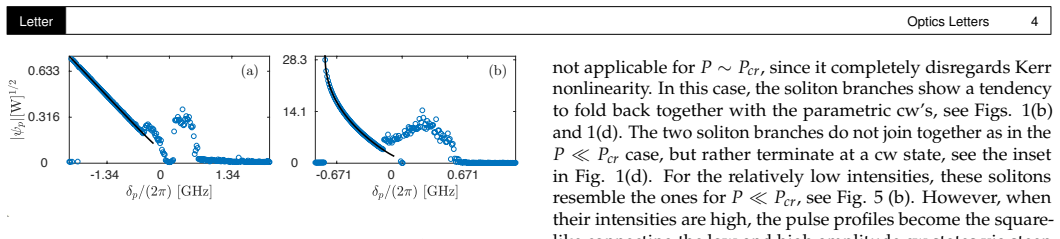
The paper's central claim is that coherent multi-sideband soliton combs can be generated in a microring optical parametric oscillator in the down-conversion regime under normal group-velocity dispersion, and that this is the first such demonstration for microring parametric combs. The underlying mechanism is a resonance split induced by the quadratic nonlinearity: the pump resonance tilts toward both positive and negative detunings, and for negative detuning ($\delta_p = 2\delta_s < 0$) the parametric shift dominates over the normal GVD, creating conditions for stable bright solitons. An approximate analytical solution, Eq. (4), explicitly shows a sech-profile soliton existing for $D_{2s}<0$ only when $\delta_p<0$. The paper also derives the critical power $P_{cr}=4\pi\omega_p\gamma_2^2/(9\eta F\gamma_3^2)$ at which the quadratic and cubic nonlinearities compete, and confirms by dynamical simulation that pulses emerging from modulational instability match the stationary soliton solutions.
Load-bearing premise
The main load-bearing assumption is that periodic modulation of the quadratic susceptibility cancels the modal-index mismatch between pump and signal in the leading order, while frequency mismatch and free-spectral-range mismatch are small enough not to change the results; if any of these fail, the parametric coupling weakens and the predicted soliton regime may disappear.
Editorial extensions
If this is right
- Soliton microcombs can be produced in lithium-niobate microrings with normal GVD, removing the need for anomalous-dispersion engineering.
- For down-conversion OPOs, the pump and signal lie in different polarization families, so the comb can span a full octave suitable for self-referencing.
- Negative detuning ($\delta_p=2\delta_s<0$) is the required operating point; positive detuning will not support bright solitons in the normal-dispersion regime.
- The critical power $P_{cr}$ gives a quantitative target: for high-Q rings, watt-level pump powers can already access the $\chi^{(2)}$-dominated soliton comb.
- As pump power approaches $P_{cr}$, soliton pulses change from sech-like shapes to square-fronted states with non-sech comb tails, a signature that should be observable.
Reading between the lines
- The same negative-detuning resonance-tilt mechanism should apply to second-harmonic generation in normal-GVD rings, potentially extending self-referenced combs to materials without anomalous GVD.
- Because $P_{cr}$ scales as $\gamma_2^2/\gamma_3^2$ and inversely with finesse, even lower thresholds might be reached in higher-Q or more strongly quadratic platforms; this is a testable prediction of the model's scaling law.
- The paper leaves nonzero frequency mismatch $\varepsilon$ and FSR mismatch largely unexamined; a numerical sweep of these parameters would show whether the soliton window survives realistic fabrication tolerances.
- The square-fronted solitons observed near $P_{cr}$ resemble switching waves in driven cavities, suggesting that their stability boundaries can be mapped with front-velocity arguments.
Signed reviews
Editorial analysis
A structured set of objections, weighed in public.
Referee Report
Summary. The paper proposes a mean-field Lugiato-Lefever-type model for a microring optical parametric oscillator with simultaneous χ(2) and Kerr nonlinearities, operating in the down-conversion regime with normal group-velocity dispersion. It studies continuous-wave states, modulational instability, and stationary soliton solutions, and reports a transition between low-power parametric-dominated combs and high-power combs shaped by competition between χ(2) and Kerr effects. The authors derive an approximate sech soliton solution, Eq. (4), predicting bright comb solitons for normal dispersion only for negative detunings, and they support this with Newton-Raphson solutions and direct dynamical simulations, including a comparison of pulse amplitudes in Fig. 6.
Significance. If the model assumptions hold, the result would extend soliton microcombs to the normal-GVD regime in χ(2) microring OPOs, a practically useful direction. The paper's strengths are the explicit derivation from a scalar wave equation, the closed-form threshold and critical-power estimates, the analytical sech solution with a clear sign prediction, and the internal consistency between the modulational-instability analysis, stationary soliton families, and time-domain simulations. The practical relevance, however, rests on two unquantified robustness assumptions: the frequency mismatch ε is set to zero and the FSRs of pump and signal are taken as equal, while the text asserts without evidence that nonzero values do not qualitatively alter the results.
major comments (2)
- [After Eqs. (1)-(2)] The claim that non-zero ε and 1−D1s/D1p do not qualitatively alter the results is stated without any supporting calculation, simulation, or bound. The quoted resonance frequencies imply ε/(2π) = ωs/(2π) − ωp/(4π) = 190.874707 THz − 190.8746905 THz = 16.5 MHz, which is comparable to κ/(2π) ≈ 19 MHz at Q = 10^7 and much larger than κ/(2π) ≈ 1.9 MHz at the Q = 10^8 used for the P ∼ Pcr runs. Because ε enters as e^{i2εt} in the parametric coupling, the stationary solitons found for ε = 0 are not stationary solutions for ε ≠ 0; the authors should provide numerical continuation in ε or dynamical simulations at the realistic 16.5 MHz mismatch to substantiate the robustness claim.
- [Model derivation, phase-matching assumption] The assumption that a periodic modulation of χ(2) compensates the modal-index mismatch mp−2ms 'in the leading order, while the higher order corrections are disregarded' is essential to the form of Eqs. (1)-(2). No estimate is given for the magnitude of the residual phase-matching error or for the bandwidth over which the compensation holds. If the residual wave-vector mismatch is comparable to the inverse round-trip length, the parametric coupling strength is effectively reduced and the predicted soliton window may close; a quantitative tolerance, such as the phase-matching bandwidth relative to the detuning range of Figs. 1-2, is needed before the practical claim can be accepted.
minor comments (4)
- [Introduction and abstract] The phrase 'the first of its kind' refers to simulations rather than experiments; it should be tempered to a prediction or qualified as 'to our knowledge, the first theoretical demonstration' unless an experimental realization is cited.
- [Around Eq. (4)] The symbols q± in Eq. (4) are used before being explicitly defined; the sentence following Eq. (4) gives q± = δs ± sqrt(γ2^2 h^2/δp^2 − κs^2), but the expression should appear alongside the solution for clarity.
- [Parameter listing] The text says 'ε ≃ 0' but the quoted frequencies give ε/(2π) = 16.5 MHz, not zero; the manuscript should either revise the frequencies to produce a genuinely negligible mismatch or explicitly state and quantify the residual value.
- [Parameter listing] The value of D2p after 'D2p =' appears to be missing in the compiled text, leaving the dispersion parameters incomplete; please ensure all numeric values are present and legible.
Circularity Check
No significant circularity: the model, soliton solutions, and critical power are derived from stated equations and checked by direct simulation; self-citations are used only for analogy.
full rationale
The paper's derivation chain is self-contained. Equations (1)-(2) are obtained from the transverse-averaged wave equation with an explicit modal expansion, and the parameters (γ2, γ3, κ, D1, D2, h) are computed from material constants and a specific resonator geometry (R∼500 µm, r∼250 µm) rather than fitted to the target soliton states. The critical power Pcr in Eq. (3) is derived by balancing the parametric and Kerr resonance shifts (|δprm_p|∼δKerr_p), not by matching to observed combs. The central prediction, Eq. (4), is an approximate analytical solution of the model under stated assumptions (γ3=D2p=0, D1p=D1s, κp/δp≪1) and yields the sech soliton with sign condition D2s<0, δp=2δs<0; it is not an input. Reported self-citations ([6], [13]) are used for analogy or background (e.g., "similar to what was previously described for the second harmonic generation in microrings [5,6]") and do not carry the derivation. The numerical MI analysis, dynamical simulations, and stationary Newton-Raphson solitons provide independent checks; the comparison in Fig. 6 is between dynamical pulses and stationary solitons, not a fit. Statements about robustness to nonzero ε and FSR mismatch are asserted rather than quantitatively verified, but that is a validation/correctness concern, not circularity.
Assumptions & free parameters
assumptions (4)
- domain assumption Scalar, single-transverse-mode, slowly varying envelope model with weak dispersion and nonlinearity per round trip (Lugiato-Lefever reduction).
- ad hoc to paper Periodic modulation of χ2 compensates the modal-index mismatch mp-2ms in leading order; higher-order corrections are disregarded.
- ad hoc to paper ε=0 and D1p≈D1s; nonzero values are claimed not to alter results qualitatively.
- domain assumption Transverse profiles f and susceptibilities χ2 and χ3 are treated as nondispersive.
Cite this review
Pith. "Pith review of Frequency combs in a microring optical parametric oscillator." pith.science (2026). https://pith.science/paper/7TTRYZFF
@misc{pith2026190804688,
  author       = {Pith},
  title        = {Pith review of: Frequency combs in a microring optical parametric oscillator},
  year         = {2026},
  howpublished = {\url{https://pith.science/paper/7TTRYZFF}},
  note         = {Machine review of arXiv:1908.04688}
}
abstract
We report the soliton frequency comb generation in microring optical parametric oscillators operating in the down-conversion regime and with the simultaneous presence of the $\chi^{(2)}$ and Kerr nonlinearities. The combs are studied considering a typical geometry of a bulk LiNbO$_3$ toroidal resonator with the normal group velocity dispersion spanning an interval between the pump and the down-converted signal. We have identified critical power signaling a transition between the relatively low pump power predominantly $\chi^{(2)}$ combs and the high pump power ones shaped by the competition between the $\chi^{(2)}$ and Kerr nonlinearities.
Figures


Figures from the paper (2 more)

Reference graph
Works this paper leans on
- [1]
-
[2]
A. Pasquazi, M. Peccianti, L. Razzari, D.J. Moss, S. Coen, M. Erkintalo, Y .K. Chembo, T. Hansson, S. Wabnitz, P . Del’Haye, X.X. Xue, A.M. Weiner, R. Morandotti, Phys. Rep.729, 1 (2018)
work page 2018
-
[3]
T. Herr, V. Brasch, J. D. Jost, C. Y . Wang, N. M. Kondratiev, M. L. Gorodetsky, and T. J. Kippenberg, Nat. Photonics8, 145 (2013)
work page 2013
-
[4]
T. J. Kippenberg, A. L. Gaeta, M. Lipson, and M. L. Gorodetsky, Science 361, eaan8083 (2018)
work page 2018
-
[5]
T. Hansson, P . Parra-Rivas, M. Bernard, F . Leo, L. Gelens, and S. Wab- nitz, Opt. Lett. 43, 6033 (2018)
work page 2018
- [6]
-
[7]
P . Parra-Rivas, L. Gelens, T. Hansson, S. Wabnitz, and F . Leo, Opt. Lett. 44, 2004 (2019)
work page 2019
-
[8]
S. J. Herr, V. Brasch, J. Szabados, E. Obrzud, Y . Jia, S. Lecomte, K. Buse, I. Breunig, and T. Herr, Opt. Lett.43, 5745 (2018)
work page 2018
Show all 24 references
-
[9]
Wilson, K
D.J. Wilson, K. Schneider, S. Hoenl, M. Anderson, T.J. Kippenberg, and P . Seidler, https://arxiv.org/abs/1808.03554
-
[10]
He, Q.-F
Y . He, Q.-F . Y ang, J. Ling, R. Luo, H. Liang, M. Li, B. Shen, H. Wang, K. Vahala, and Q. Lin, https://arxiv.org/abs/1812.09610
-
[11]
X. Xue, X. Zheng, and B. Zhou, Photon. Res. 6, 948 (2018)
2018
-
[12]
Ikuta, M
R. Ikuta, M. Asano, R. Tani, T. Y amamoto, and N. Imoto, Opt. Express 26, 15551 (2018)
2018
-
[13]
Buryak, P
A.V. Buryak, P . Di Trapani, D.V. Skryabin, and S. Trillo, Phys. Rep.370, 63 (2002)
2002
-
[14]
Breunig, Laser & Photon
I. Breunig, Laser & Photon. Rev. 10, 569 (2016)
2016
-
[15]
C. Wang, C. Langrock, A. Marandi, M. Jankowski, M. Zhang, B. Desia- tov, M. M. Fejer, and M. Lonˇcar, Optica. 5, 1438 (2018)
2018
-
[16]
Wolf, Y .C
R. Wolf, Y .C. Jia, S. Bonaus, C.S. Werner, S.J. Herr, I. Breunig, K. Buse, and H. Zappe, Optica 5, 872 (2018)
2018
-
[17]
Chembo, I.S
Y .K. Chembo, I.S. Grudinin, and N. Yu, Phys. Rev. A92, 043818 (2015); Y .K. Chembo, and N. Yu, Phys. Rev. A82, 033801 (2010)
2015
-
[18]
Mosca, M
S. Mosca, M. Parisi, I. Ricciardi, F . Leo, T. Hansson, M. Erkintalo, P . Maddaloni, P . De Natale, S. Wabnitz, and M. De Rosa, Phys. Rev. Lett. 121, 093903 (2018)
2018
-
[19]
Jankowski, A
M. Jankowski, A. Marandi, C. R. Phillips, R. Hamerly, K. A. Ingold, R. L. Byer, and M. M. Fejer, Phys. Rev. Lett.120, 053904 (2018)
2018
-
[20]
Zhang, C
M. Zhang, C. Wang, R. Cheng, A. Shams-Ansari, and M. Loncar, Optica 4, 1536 (2017)
2017
-
[21]
Leidinger, S
M. Leidinger, S. Fieberg, N. Waasem, F . Kuhnemann, K. Buse, and I. Breunig, Opt. Express 23, 21690 (2015)
2015
-
[22]
M. L. Gorodetsky and A. E. Fomin, IEEE J. Sel. Top. Quant. Electr. 12, 33 (2006)
2006
-
[23]
Leidinger, C
M. Leidinger, C. S. Werner, W. Y oshiki, K. Buse, I. Breunig, Opt. Lett. 41, 5474 (2016)
2016
-
[24]
I. V. Barashenkov, M. M. Bogdan, and V. I. Korobov, Europhys. Lett.15, 113 (1991)
1991
Reviewed August 14, 2026 · model on record in the stance chip above.
Discussion (0). Continue with ORCID to comment.