REVIEW 4 major objections 4 minor 190 references
Real-Time Obstacle Avoidance Algorithms for Unmanned Aerial and Ground Vehicles
T0 review · 4 major / 4 minor · reviewed 2026-08-06 · deepseek-v4-flash
Pith's one-line read The report claims that a hybrid of global RRT planning and reactive occlusion-line steering yields real-time collision-free navigation for UAVs and UGVs in dynamic 3D environments, with forest-fire rescue as the target application.
desk verdict A self-admitted compilation of prior conference papers whose forest-fire simulation violates its own feasibility condition; the central rescue claim is unreliable. read the letter →
The pith
A machine-rendered reading of the paper's core claim, the machinery that carries it, and where it could break.
The reading
What carries the argument
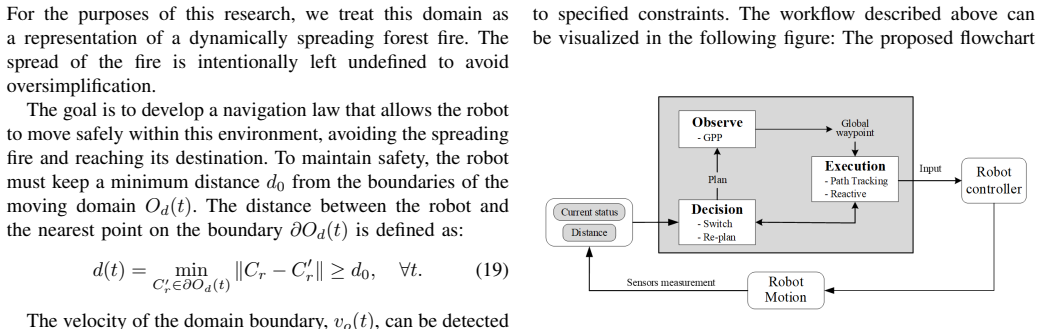
The load-bearing object is the occlusion line, a vector $\tau_i^{(j)}(t)=(v_{\max}-v)[\cos\beta_i^{(j)}(t),\sin\beta_i^{(j)}(t)]$ (or its 3D analogue $l_i(t)=\Delta V(t)[\cos\beta_i(t),\sin\beta_i(t)]$), formed from the sensor-measured distance to an obstacle and an enlarged vision cone with a safe escape angle $\alpha_{\text{safe}}$. These two lines bracket the directions the vehicle could take around the obstacle, and the controller picks the one that makes the smallest angle with the obstacle velocity. The supporting machinery is the mode switcher: the vehicle tracks the RRT waypoints at full speed in routine mode, switches to reactive escape mode when distance crosses $d_{\text{safe}}$ with $\dot d<0$, and switches back only when heading points to the next waypoint and a time-observer has elapsed, which avoids the dead-zone oscillation of distance-only switching. In 3D the avoidance plane $H_a(t)$—constructed from vehicle position, nearest obstacle point, and target, with its normal $\vec n_{H_a}(t)=\vec T\times e_a(t)$—carries the reactive law, and a replan rule triggered by an infeasible turning radius $R<R_{\min}$ restores a global path when local avoidance gets stuck.
What would settle it
A field or hardware-in-the-loop test with realistic range sensors: feed the controller distances with added noise and estimate surface velocities from those measurements instead of supplying them; if the minimum distance $d(t)$ ever falls below $d_{\text{safe}}$ while the vehicle is in reactive mode, the claimed collision-free guarantee is violated.
Extended reading notes
Core claim
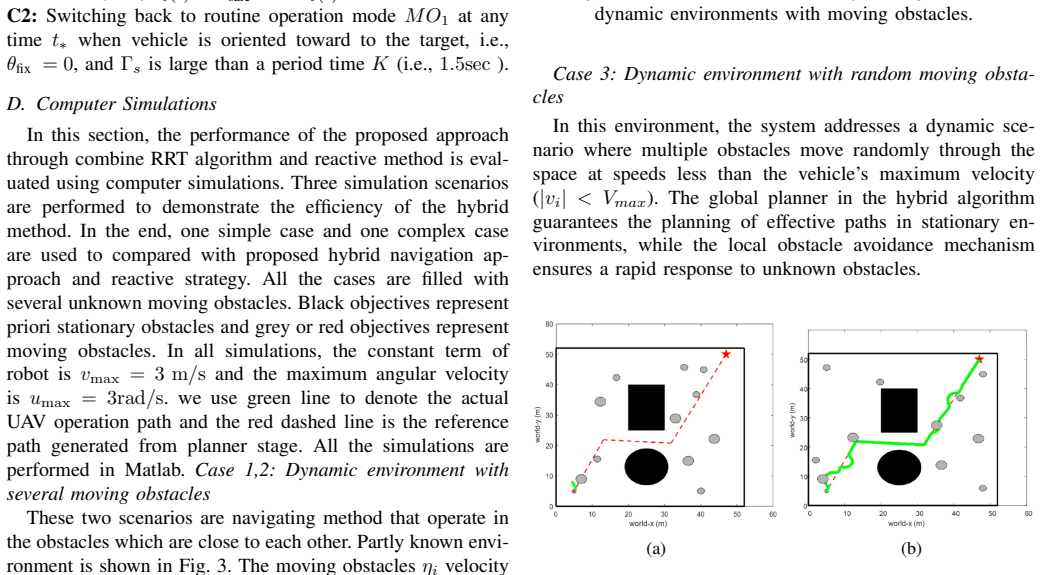
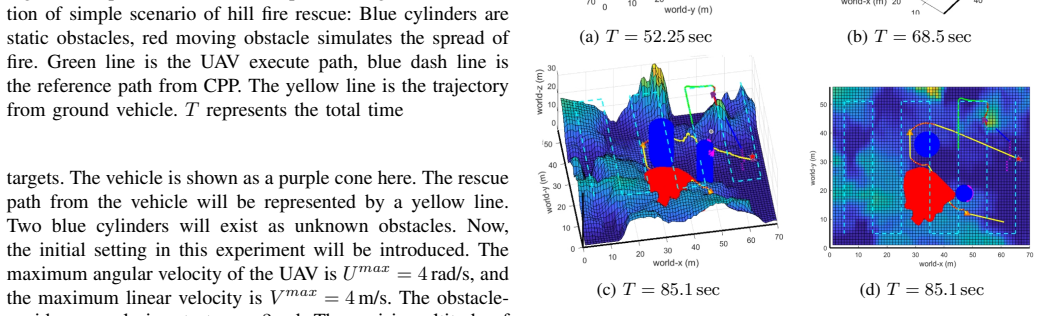
The central claim is that collision-free navigation in unknown, dynamic environments does not require a full map or heavy computation: a layered planner that alternates between tracking a globally planned reference path and executing a reactive escape law is enough. The report shows this in a specific way, deriving occlusion lines from the measured distance to the obstacle and its surface velocity, then choosing the avoidance direction with the smaller angular deviation $\min_{j=1,2}|\varphi(v+\tau_i^{(j)},v_i)|$. In 3D the same idea is lifted onto a collision-avoidance plane defined by the vehicle position, the nearest obstacle point, and the target, using a rotation matrix to convert coordinates into the body frame. The fire-spread simulations treat the advancing fire as a deformable obstacle whose boundary velocity is sensed, and compare the hybrid method with a purely reactive one; the reported result is that the hybrid method reaches the goal with shorter path, less time, and smaller turning angles. The report concludes that the framework provides a safe and efficient rescue navigation capability, grounded in those simulations.
Load-bearing premise
The load-bearing premise is that the onboard sensors can measure, without noise, delay, or occlusion, the exact distance to each obstacle and the velocity of its moving or deforming surface; every simulation gives the controller that information directly.
Editorial extensions
If this is right
- A vehicle using this hybrid law needs only distance and obstacle surface velocity, not a prebuilt map, to navigate dynamic environments.
- In the reported simulations the hybrid method outperforms the purely reactive method on path length, search time, and turning angle, with the gap growing as the environment becomes more complex.
- The same reactive law transfers from 2D ground robots to 3D UAV flight by rotating coordinates into the body frame and performing avoidance on a plane.
- Coordinated rescue is feasible with a centralized ground station assigning UAV coverage sub-areas and UGV rescue targets, with each vehicle running the same local avoidance law.
Reading between the lines
- If the exact-surface-velocity sensing assumption is weakened, the occlusion-line law would need an estimator, and the safe-distance guarantee would become probabilistic; this is not addressed in the paper.
- The report's own future-work discussion suggests the same reactive law could apply to autonomous underwater and surface vehicles, so the mechanism is arguably domain-agnostic, but the evidence here is only planar and 3D aerial/ground simulations.
- The centralized ground-station design limits scalability; a distributed version of the same avoidance law is a natural next step that the paper leaves open.
- The replan rule could be stress-tested in a random obstacle field: if replanning frequency grows without bound, real-time operation would degrade, a behavior the paper does not quantify.
Signed reviews
Editorial analysis
A structured set of objections, weighed in public.
Referee Report
Summary. The report develops a sequence of hybrid global/reactive navigation algorithms: a 2D hybrid planner for non-holonomic ground robots among moving and deformable obstacles, a 3D reactive avoidance method for UAVs over uneven terrain, a forest-fire rescue planner that couples an RRT-based global layer with a reactive layer and a simplified fire-spread model, and a multi-UAV/UGV cooperative surveillance and evacuation framework. Each phase is validated through MATLAB simulations and compared with a purely reactive method, generally showing shorter paths and shorter search times. The abstract and Section VIII claim that the methods are supported by mathematical and simulation-based evidence, but the body provides controller heuristics and simulated trajectories rather than formal guarantees.
Significance. If the algorithms perform as claimed, the work offers a practical template for hierarchical rescue navigation: global waypoints from RRT/RRT-connect, reactive avoidance based on distance and obstacle velocity, and a layered decision architecture with replanning. The comparative experiments in Sections III, IV, and VI provide quantitative evidence that the hybrid approach reduces path length and search time relative to the reactive baseline, and the plotted trajectories in Section V demonstrate collision-free behavior in the tested scenarios. However, the contribution is incremental and largely assembled from the author's own conference papers, the validation is entirely simulation-based under strong sensing assumptions, and the fire-rescue scenarios contain an internal parameter inconsistency that undermines their claimed support for the central 'collision-free in forest fires' statement.
major comments (4)
- [Section VI-B2 Remark and Section VI-D] The feasibility condition in the Remark states 0 ≤ ||v_wind|| < V_max, with V_max = 4 m/s, yet Section VI-D sets the wind speed vector to [-8, -8, 0, 1], whose Euclidean norm is sqrt(129) ≈ 11.36 m/s, exceeding V_max by a factor of 2.84. The same violation occurs in Section VII-D1 Case 2 with wind [8, 8, 0]. Because this condition is the stated necessary condition for the reactive controller to guarantee avoidance, the forest-fire simulations cannot be taken as evidence of collision-free capability. The paper also never reports the actual maximum boundary velocity of the deformable fire domain generated by equations (51)-(53), so the reader cannot verify whether the obstacle velocity constraint was satisfied in the experiments.
- [Sections III-C, IV-C, V-C and the abstract's 'mathematical validation' claim] The abstract and Section VIII-A claim that the methods are substantiated by thorough mathematical analysis, but no theorem or proof establishes d(t) ≥ d_safe or d(t) ≥ d0 for all t. For example, Section IV-C Equations (20)-(25) define a switching control law and a sign-based function f(·,·), yet no Lyapunov, barrier-certificate, or reachability argument is provided. This is a load-bearing gap because the central claim is collision-free navigation. The gap is aggravated by Assumptions 1 and 2 in Section V-B2, which require onboard sensors to measure the exact surface velocity vx of unknown obstacles and the relative velocity Δv; the simulations grant this information perfectly, with no treatment of sensing noise, latency, or occlusions.
- [Section VI-B2, Equations (51)-(53)] The forest fire spread model is insufficiently specified for verification. Equation (51) gives dTi(t)/dt as a sum over the 26-neighbor set N(i), with H_ij depending on T_trigger, κ, ρ, and the wind dot product W_ij(t) = V_wind(t)·D_ij + κ, but the paper does not state the time discretization scheme, the value of T_trigger, the sample time of the fire model, or how the boundary and boundary velocity of the deformable fire domain are extracted from the temperature field. Furthermore, the wind vector in Section VI-D is listed as [-8, -8, 0, 1], which has four components in a three-dimensional environment, and the meaning of the fourth component is unexplained. Without the boundary-velocity computation, the reported 'collision-free in fire' result cannot be independently checked against the stated feasibility condition.
- [Section VI-C, Remark 1 and Equation (59)] The multi-objective optimization Q = αJ1 + βJ2 + γJ3 is presented as a key part of the rescue path planner, but J3, described as a 'disaster coefficient' that minimizes environmental risks from fire proximity and uneven terrain, is never defined mathematically. The text says 'we introduced J3' but gives no expression, constraints, or weighting rationale. As a result, the actual path-planning objective used in the Section VI simulations is not fully specified, which limits the reproducibility of the claimed improvements in path length and search time.
minor comments (4)
- [Throughout] The manuscript contains numerous typographical and grammatical errors that should be corrected: for example, 'trrigerd' in the caption of Fig. 10, 'lack og pre-disaster warning' at the start of Section VII, and 'objectives' where 'obstacles' is intended in several places.
- [Section VII-B, Equation (60)] Equation (60) writes dot(S_u(t)) = |v(t)| omega(t) with v(t) described as a 'velocity vector', but the notation |v(t)| suggests a scalar speed, and the later text treats v(t) as both scalar and vector in different model descriptions; this should be made consistent.
- [Sections V-B and VI-B] The rotation matrix D in Equation (33) and the matrix b_gR in Equation (41) are identical, and a third copy appears as M in Equation (65); the paper should define this matrix once and reuse it, to avoid apparent inconsistency and unnecessary repetition.
- [Section VI-D and Section VII-D1] The fire simulation parameters do not report how the discretized temperature field is initialized, the value of T_trigger, or the integration time step; reporting these values would materially improve reproducibility.
Circularity Check
No load-bearing circularity; the report is heavily self-referential but the core algorithms are implemented and simulated directly rather than reduced to fitted inputs.
full rationale
The report is a compilation of the author's own prior conference papers, and several parts cite those papers for the reactive obstacle-avoidance components (e.g., Section VI-B1 refers to 'prior research [133]' for the avoidance-plane construction, and Section VII-C2 says the reactive methodology 'draws inspiration from the works presented in [90] and [132]'). These self-citations are visible but not load-bearing: the underlying 2D and 3D reactive controllers, RRT-based planners, switching rules, and coordinate transformations are re-derived and stated directly in Sections III, IV, and V of the same report, so the reader can check the derivation without relying solely on the self-citations. No parameter is fitted to reproduce a target path or a target safety distance; the simulations execute the proposed controllers and report path length, time, and clearance, which is a direct implementation check rather than a tautology. The paper's sensitivity to sensing assumptions (exact real-time knowledge of obstacle surface velocities) and the internal inconsistency in Section VI-D, where the wind vector [-8,-8,0,1] has norm about 11.36 m/s while the feasibility condition requires ||v_wind|| < V_max = 4 m/s, are serious validity concerns but they are not circular reductions: they concern whether the simulation scenario satisfies the algorithm's assumptions, not whether the derivation secretly assumes its conclusion. Accordingly, the central claim does not reduce by construction to its inputs, so the appropriate circularity finding is low with no specific circular step identified.
Assumptions & free parameters
free parameters (6)
- alpha_safe (α_safe / α_0 / α_O) =
π/5 in most simulations
- safety distance d0/d_epsilon =
4.5 m, 3 m, 8 m, 5 m, 4 m per case
- mode-switch time K (T_ob) =
1.5 s
- fire model coefficients κ and ρ =
κ=0.05, ρ=1 in Section VI-D
- detection and trigger distances C, d_safe, R_sensor =
C=1.1dε or 3dε; R_sensor=5 to 30 m
- T_trigger =
not specified
assumptions (5)
- domain assumption The nonholonomic kinematic model with bounds on linear and angular velocity (Equations 2-4, 26-28, 44-48) accurately represents UAV/UGV motion, ignoring rotor drag and disturbances.
- domain assumption Obstacles are closed and bounded, and their velocity is measurable in real time by onboard sensors; obstacle speed is below Vmax (Assumptions 1-2 in Section V-B and Section IV-B).
- ad hoc to paper Forest fire can be represented as a deformable moving plane or domain with a known boundary velocity; fire spread is intentionally left undefined (Section IV-B, Section VI-B2).
- ad hoc to paper The simplified fire spread model (Equations 51-53) with temperature triggers and wind weighting is adequate for testing navigation (Section VI-B2).
- domain assumption Obstacles in 3D can be approximated as cylinders or ellipsoids to define the collision avoidance plane (Remark 3.4, Section V-C).
invented entities (1)
-
Disaster coefficient J3
Cite this review
Pith. "Pith review of Real-Time Obstacle Avoidance Algorithms for Unmanned Aerial and Ground Vehicles." pith.science (2026). https://pith.science/paper/7UCMNL3J
@misc{pith2026250620311,
  author       = {Pith},
  title        = {Pith review of: Real-Time Obstacle Avoidance Algorithms for Unmanned Aerial and Ground Vehicles},
  year         = {2026},
  howpublished = {\url{https://pith.science/paper/7UCMNL3J}},
  note         = {Machine review of arXiv:2506.20311}
}
read the original abstract
The growing use of mobile robots in sectors such as automotive, agriculture, and rescue operations reflects progress in robotics and autonomy. In unmanned aerial vehicles (UAVs), most research emphasizes visual SLAM, sensor fusion, and path planning. However, applying UAVs to search and rescue missions in disaster zones remains underexplored, especially for autonomous navigation. This report develops methods for real-time and secure UAV maneuvering in complex 3D environments, crucial during forest fires. Building upon past research, it focuses on designing navigation algorithms for unfamiliar and hazardous environments, aiming to improve rescue efficiency and safety through UAV-based early warning and rapid response. The work unfolds in phases. First, a 2D fusion navigation strategy is explored, initially for mobile robots, enabling safe movement in dynamic settings. This sets the stage for advanced features such as adaptive obstacle handling and decision-making enhancements. Next, a novel 3D reactive navigation strategy is introduced for collision-free movement in forest fire simulations, addressing the unique challenges of UAV operations in such scenarios. Finally, the report proposes a unified control approach that integrates UAVs and unmanned ground vehicles (UGVs) for coordinated rescue missions in forest environments. Each phase presents challenges, proposes control models, and validates them with mathematical and simulation-based evidence. The study offers practical value and academic insights for improving the role of UAVs in natural disaster rescue operations.
Figures


Figures from the paper (27 more)





Reference graph
Works this paper leans on
-
[1]
Develop an unmanned aerial vehicle based automatic aerial spraying system,
X. Xue, Y . Lan, Z. Sun, C. Chang, and W. C. Hoffmann, “Develop an unmanned aerial vehicle based automatic aerial spraying system,” Computers and electronics in agriculture, vol. 128, pp. 58–66, 2016
2016
-
[2]
Monitoring road traffic with a UA V-based system,
M. Elloumi, R. Dhaou, B. Escrig, H. Idoudi, and L. A. Saidane, “Monitoring road traffic with a UA V-based system,” in2018 IEEE wireless communications and networking conference (WCNC). IEEE, 2018, pp. 1–6
2018
-
[3]
Applications of unmanned aerial vehicle (UA V) in road safety, traffic and highway infrastruc- ture management: Recent advances and challenges,
F. Outay, H. A. Mengash, and M. Adnan, “Applications of unmanned aerial vehicle (UA V) in road safety, traffic and highway infrastruc- ture management: Recent advances and challenges,”Transportation research part A: policy and practice, vol. 141, pp. 116–129, 2020
2020
-
[4]
A review of UA V monitoring in mining areas: Current status and future perspectives,
H. Ren, Y . Zhao, W. Xiao, and Z. Hu, “A review of UA V monitoring in mining areas: Current status and future perspectives,”International Journal of Coal Science & Technology, vol. 6, pp. 320–333, 2019
2019
-
[5]
UA V-assisted disaster management: Applications and open issues,
M. Erdelj and E. Natalizio, “UA V-assisted disaster management: Applications and open issues,” in2016 international conference on computing, networking and communications (ICNC). IEEE, 2016, pp. 1–5
2016
-
[6]
Toward a fully autonomous UA V: Research platform for indoor and outdoor urban search and rescue,
T. Tomic, K. Schmid, P. Lutz, A. Domel, M. Kassecker, E. Mair, I. L. Grixa, F. Ruess, M. Suppa, and D. Burschka, “Toward a fully autonomous UA V: Research platform for indoor and outdoor urban search and rescue,”IEEE robotics & automation magazine, vol. 19, no. 3, pp. 46–56, 2012
2012
-
[7]
Multi-UA V oxyrrhis marina-inspired search and dynamic formation control for forest fire- fighting,
K. Harikumar, J. Senthilnath, and S. Sundaram, “Multi-UA V oxyrrhis marina-inspired search and dynamic formation control for forest fire- fighting,”IEEE Transactions on Automation Science and Engineering, vol. 16, no. 2, pp. 863–873, 2018
2018
-
[8]
The adaptive vortex search algorithm of optimal path planning for forest fire rescue UA V,
C. Wang, P. Liu, T. Zhang, and J. Sun, “The adaptive vortex search algorithm of optimal path planning for forest fire rescue UA V,” in 2018 IEEE 3rd Advanced Information Technology, Electronic and Automation Control Conference (IAEAC). IEEE, 2018, pp. 400–403
2018
Show all 190 references
-
[9]
Forest fire monitoring with multiple small UA Vs,
D. W. Casbeer, R. W. Beard, T. W. McLain, S.-M. Li, and R. K. Mehra, “Forest fire monitoring with multiple small UA Vs,” inProceedings of the 2005, American Control Conference, 2005.IEEE, 2005, pp. 3530– 3535
2005
-
[10]
Towards fully autonomous UA Vs: A survey,
T. Elmokadem and A. V . Savkin, “Towards fully autonomous UA Vs: A survey,”Sensors, vol. 21, no. 18, p. 6223, 2021
2021
-
[11]
Navigation of a team of collab- orating uavs and ugvs for bushfire surveillance and people evacuating on uneven mountainous terrains,
Z. Fang, J. Wei, and A. V . Savkin, “Navigation of a team of collab- orating uavs and ugvs for bushfire surveillance and people evacuating on uneven mountainous terrains,”Guidance, Navigation and Control, vol. 5, pp. 235–254, 2025
2025
-
[12]
Navigation and deployment of solar-powered unmanned aerial vehicles for civilian applications: A comprehensive review,
S. Li, Z. Fang, S. C. Verma, J. Wei, and A. V . Savkin, “Navigation and deployment of solar-powered unmanned aerial vehicles for civilian applications: A comprehensive review,”Drones, vol. 8, no. 2, p. 42, 2024
2024
-
[13]
Different cell decom- position path planning methods for unmanned air vehicles-a review,
S. K. Debnath, R. Omar, S. Bagchi, E. N. Sabudin, M. H. A. Shee Kandar, K. Foysol, and T. K. Chakraborty, “Different cell decom- position path planning methods for unmanned air vehicles-a review,” inProceedings of the 11th National Technical Seminar on Unmanned System Technolo...
2019
-
[14]
A petri net based approach for multi- robot path planning,
M. Kloetzer and C. Mahulea, “A petri net based approach for multi- robot path planning,”Discrete Event Dynamic Systems, vol. 24, pp. 417–445, 2014
2014
-
[15]
Comparative study of tra- jectories resulted from cell decomposition path planning approaches,
R. Gonzalez, M. Kloetzer, and C. Mahulea, “Comparative study of tra- jectories resulted from cell decomposition path planning approaches,” in2017 21st International Conference on System Theory, Control and Computing (ICSTCC). IEEE, 2017, pp. 49–54
2017
-
[16]
The essential visibility graph: An approach to global motion planning for autonomous mobile robots,
J. A. Janet, R. C. Luo, and M. G. Kay, “The essential visibility graph: An approach to global motion planning for autonomous mobile robots,” inProceedings of 1995 IEEE international conference on robotics and automation, vol. 2. IEEE, 1995, pp. 1958–1963
1995
-
[17]
Global path planning using artificial potential fields,
C. W. Warren, “Global path planning using artificial potential fields,” in1989 IEEE International Conference on Robotics and Automation. IEEE Computer Society, 1989, pp. 316–317
1989
-
[18]
Obstacle avoidance for mobile robots using artificial potential field approach with simulated annealing,
M. G. Park, J. H. Jeon, and M. C. Lee, “Obstacle avoidance for mobile robots using artificial potential field approach with simulated annealing,” inISIE 2001. 2001 IEEE International Symposium on Industrial Electronics Proceedings (Cat. No. 01TH8570), vol. 3. IEEE, 2001, pp. 1530–1535
2001
-
[19]
Application of dijkstra algorithm in robot path-planning,
H. Wang, Y . Yu, and Q. Yuan, “Application of dijkstra algorithm in robot path-planning,” in2011 second international conference on mechanic automation and control engineering. IEEE, 2011, pp. 1067– 1069
2011
-
[20]
Geometric a-star algorithm: An improved a-star algorithm for AGVagv path planning in a port environment,
G. Tang, C. Tang, C. Claramunt, X. Hu, and P. Zhou, “Geometric a-star algorithm: An improved a-star algorithm for AGVagv path planning in a port environment,”IEEE access, vol. 9, pp. 59 196–59 210, 2021
2021
-
[21]
Path planning algorithm using d* heuristic method based on pso in dynamic environment,
F. A. Raheem, U. I. Hameedet al., “Path planning algorithm using d* heuristic method based on pso in dynamic environment,”American Scientific Research Journal for Engineering, Technology, and Sciences, vol. 49, no. 1, pp. 257–271, 2018
2018
-
[22]
Algorithms for collision- free navigation of mobile robots in complex cluttered environments: a survey,
M. Hoy, A. S. Matveev, and A. V . Savkin, “Algorithms for collision- free navigation of mobile robots in complex cluttered environments: a survey,”Robotica, vol. 33, no. 3, pp. 463–497, 2015
2015
-
[23]
An improved a-star based path planning algorithm for autonomous land vehicles,
S. Erke, D. Bin, N. Yiming, Z. Qi, X. Liang, and Z. Dawei, “An improved a-star based path planning algorithm for autonomous land vehicles,”International Journal of Advanced Robotic Systems, vol. 17, no. 5, p. 1729881420962263, 2020
2020
-
[24]
Rapidly-exploring random trees: A new tool for path planning,
S. LaValle, “Rapidly-exploring random trees: A new tool for path planning,”Research Report 9811, 1998
1998
-
[25]
RRT-connect: An efficient approach to single-query path planning,
J. J. Kuffner and S. M. LaValle, “RRT-connect: An efficient approach to single-query path planning,” inProceedings 2000 ICRA. Millennium Conference. IEEE International Conference on Robotics and Automa- tion. Symposia Proceedings (Cat. No. 00CH37065), vol. 2. IEEE, 2000, pp. 995–1001
2000
-
[26]
An improved rrt* path planning algorithm for service robot,
W. Wang, H. Gao, Q. Yi, K. Zheng, and T. Gu, “An improved rrt* path planning algorithm for service robot,” in2020 IEEE 4th Information Technology, Networking, Electronic and Automation Control Confer- ence (ITNEC), vol. 1. IEEE, 2020, pp. 1824–1828
2020
-
[27]
Goal-biased bidirectional RRT based on curve-smoothing,
H. Liu, X. Zhang, J. Wen, R. Wang, and X. Chen, “Goal-biased bidirectional RRT based on curve-smoothing,”IFAC-PapersOnLine, vol. 52, no. 24, pp. 255–260, 2019
2019
-
[28]
UA V trajectory planning based on bi-directional APF-RRT* algorithm with goal-biased,
J. Fan, X. Chen, and X. Liang, “UA V trajectory planning based on bi-directional APF-RRT* algorithm with goal-biased,”Expert Systems with Applications, vol. 213, p. 119137, 2023
2023
-
[29]
Robot motion planning using adaptive hybrid sampling in probabilistic roadmaps,
A. Kannan, P. Gupta, R. Tiwari, S. Prasad, A. Khatri, and R. Kala, “Robot motion planning using adaptive hybrid sampling in probabilistic roadmaps,”electronics, vol. 5, no. 2, p. 16, 2016
2016
-
[30]
Quadrotor UA Vs flying formation reconfiguration with collision avoidance using probabilistic roadmap algorithm,
M. U. Farooq, Z. Ziyang, and M. Ejaz, “Quadrotor UA Vs flying formation reconfiguration with collision avoidance using probabilistic roadmap algorithm,” in2017 International Conference on Computer Systems, Electronics and Control (ICCSEC). IEEE, 2017, pp. 866– 870
2017
-
[31]
A fast path planning algorithm fusing PRM and P-BI-RRT,
J. Xu, Z. Tian, W. He, and Y . Huang, “A fast path planning algorithm fusing PRM and P-BI-RRT,” in2020 11th International Conference on Prognostics and System Health Management (PHM-2020 Jinan). IEEE, 2020, pp. 503–508
2020
-
[32]
Dynamic window based approach to mobile robot motion control in the presence of moving obstacles,
M. Seder and I. Petrovic, “Dynamic window based approach to mobile robot motion control in the presence of moving obstacles,” inProceedings 2007 IEEE International Conference on Robotics and Automation. IEEE, 2007, pp. 1986–1991
2007
-
[33]
Local path planning: Dynamic window approach with virtual manipulators considering dynamic obstacles,
M. Kobayashi and N. Motoi, “Local path planning: Dynamic window approach with virtual manipulators considering dynamic obstacles,” IEEE Access, vol. 10, pp. 17 018–17 029, 2022
2022
-
[34]
The curvature-velocity method for local obstacle avoid- ance,
R. Simmons, “The curvature-velocity method for local obstacle avoid- ance,” inProceedings of IEEE international conference on robotics and automation, vol. 4. IEEE, 1996, pp. 3375–3382
1996
-
[35]
Obstacle avoidance in a dynamic en- vironment: A collision cone approach,
A. Chakravarthy and D. Ghose, “Obstacle avoidance in a dynamic en- vironment: A collision cone approach,”IEEE Transactions on Systems, Man, and Cybernetics-Part A: Systems and Humans, vol. 28, no. 5, pp. 562–574, 1998
1998
-
[36]
Reciprocal collision avoidance with acceleration-velocity obstacles,
J. Van Den Berg, J. Snape, S. J. Guy, and D. Manocha, “Reciprocal collision avoidance with acceleration-velocity obstacles,” in2011 IEEE International Conference on Robotics and Automation. IEEE, 2011, pp. 3475–3482
2011
-
[37]
Real-time navigation of mobile robots in problems of border patrolling and avoiding collisions with moving and deforming obstacles,
A. S. Matveev, C. Wang, and A. V . Savkin, “Real-time navigation of mobile robots in problems of border patrolling and avoiding collisions with moving and deforming obstacles,”Robotics and Autonomous systems, vol. 60, no. 6, pp. 769–788, 2012
2012
-
[38]
A method of reactive control for 3D navigation of a nonholonomic robot in tunnel- like environments,
A. S. Matveev, V . V . Magerkin, and A. V . Savkin, “A method of reactive control for 3D navigation of a nonholonomic robot in tunnel- like environments,”Automatica, vol. 114, p. 108831, 2020
2020
-
[39]
A boundary node method for path planning of mobile robots,
R. A. Saeed, D. R. Recupero, and P. Remagnino, “A boundary node method for path planning of mobile robots,”Robotics and autonomous systems, vol. 123, p. 103320, 2020
2020
-
[40]
A simple biologically inspired algorithm for collision-free navigation of a unicycle-like robot in dynamic envi- ronments with moving obstacles,
A. V . Savkin and C. Wang, “A simple biologically inspired algorithm for collision-free navigation of a unicycle-like robot in dynamic envi- ronments with moving obstacles,”Robotica, vol. 31, no. 6, pp. 993– 1001, 2013
2013
-
[41]
A strategy for safe 3D nav- igation of non-holonomic robots among moving obstacles,
C. Wang, A. V . Savkin, and M. Garratt, “A strategy for safe 3D nav- igation of non-holonomic robots among moving obstacles,”Robotica, vol. 36, no. 2, pp. 275–297, 2018
2018
-
[42]
Dynamic path planning based on improved boundary value problem for unmanned aerial vehicle [j],
L. Xiao, G. Meng, H. Luoet al., “Dynamic path planning based on improved boundary value problem for unmanned aerial vehicle [j],” Cluster Computing, vol. 19, no. 4, pp. 2087–2096, 2016
2016
-
[43]
A survey on coverage path planning for robotics,
E. Galceran and M. Carreras, “A survey on coverage path planning for robotics,”Robotics and Autonomous systems, vol. 61, no. 12, pp. 1258–1276, 2013
2013
-
[44]
Distributed coverage control of quadrotor multi-UA V systems for precision agriculture,
T. Elmokadem, “Distributed coverage control of quadrotor multi-UA V systems for precision agriculture,”IFAC-PapersOnLine, vol. 52, no. 30, pp. 251–256, 2019
2019
-
[45]
Dynamic path planning and trajectory tracking using MPC for satellite with collision avoidance,
Q. Hu, J. Xie, and C. Wang, “Dynamic path planning and trajectory tracking using MPC for satellite with collision avoidance,”ISA trans- actions, vol. 84, pp. 128–141, 2019
2019
-
[46]
Control for dynamic positioning and way-point tracking of underactuated autonomous un- derwater vehicles using sliding mode control,
T. Elmokadem, M. Zribi, and K. Youcef-Toumi, “Control for dynamic positioning and way-point tracking of underactuated autonomous un- derwater vehicles using sliding mode control,”Journal of Intelligent & Robotic Systems, vol. 95, pp. 1113–1132, 2019
2019
-
[47]
Optimal trajectory planning and sliding mode control for robots using evolution strategy,
Y .-K. Choi, J.-H. Park, H.-S. Kim, and J. H. Kim, “Optimal trajectory planning and sliding mode control for robots using evolution strategy,” Robotica, vol. 18, no. 4, pp. 423–428, 2000
2000
-
[48]
Path-planning for unmanned aerial vehicles with environment complexity considerations: A survey,
M. Jones, S. Djahel, and K. Welsh, “Path-planning for unmanned aerial vehicles with environment complexity considerations: A survey,”ACM Computing Surveys, vol. 55, no. 11, pp. 1–39, 2023
2023
-
[49]
A review on viewpoints and path planning for UA V-Based 3D reconstruction,
M. Maboudi, M. Homaei, S. Song, S. Malihi, M. Saadatseresht, and M. Gerke, “A review on viewpoints and path planning for UA V-Based 3D reconstruction,”IEEE Journal of Selected Topics in Applied Earth Observations and Remote Sensing, 2023
2023
-
[50]
Mpc-based cooperative enclosing for nonholonomic mobile agents under input constraint and unknown disturbance,
S. Ju, J. Wang, and L. Dou, “Mpc-based cooperative enclosing for nonholonomic mobile agents under input constraint and unknown disturbance,”IEEE Transactions on Cybernetics, vol. 53, no. 2, pp. 845–858, 2022
2022
-
[51]
Collision-free navigation of an autonomous unmanned helicopter in unknown urban environments: sliding mode and mpc approaches,
M. Hoy, A. S. Matveev, M. Garratt, and A. V . Savkin, “Collision-free navigation of an autonomous unmanned helicopter in unknown urban environments: sliding mode and mpc approaches,”Robotica, vol. 30, no. 4, pp. 537–550, 2012
2012
-
[52]
An efficient underwater navigation method using mpc with unknown kinematics and non-linear distur- bances,
P. Barreno, J. Parras, and S. Zazo, “An efficient underwater navigation method using mpc with unknown kinematics and non-linear distur- bances,”Journal of Marine Science and Engineering, vol. 11, no. 4, p. 710, 2023
2023
-
[53]
Radiation search operations using scene under- standing with autonomous UA V and UGV,
G. Christie, A. Shoemaker, K. Kochersberger, P. Tokekar, L. McLean, and A. Leonessa, “Radiation search operations using scene under- standing with autonomous UA V and UGV,”Journal of Field Robotics, vol. 34, no. 8, pp. 1450–1468, 2017
2017
-
[54]
Decentralized planning and control for UA V–UGV cooperative teams,
B. Arbanas, A. Ivanovic, M. Car, M. Orsag, T. Petrovic, and S. Bogdan, “Decentralized planning and control for UA V–UGV cooperative teams,” Autonomous Robots, vol. 42, no. 8, pp. 1601–1618, 2018
2018
-
[55]
Navigating UA Vs for optimal monitoring of groups of moving pedestrians or vehicles,
H. Huang and A. V . Savkin, “Navigating UA Vs for optimal monitoring of groups of moving pedestrians or vehicles,”IEEE Transactions on Vehicular Technology, vol. 70, no. 4, pp. 3891–3896, 2021
2021
-
[56]
Range-based reactive deployment of autonomous drones for optimal coverage in disaster areas,
A. V . Savkin and H. Huang, “Range-based reactive deployment of autonomous drones for optimal coverage in disaster areas,”IEEE Transactions on Systems, Man, and Cybernetics: Systems, vol. 51, no. 7, pp. 4606–4610, 2019
2019
-
[57]
Intelligent control approaches for modeling and control of complex systems,
J. M. And ´ujar, E. Irigoyen, and V . M. Becerra, “Intelligent control approaches for modeling and control of complex systems,” 2018
2018
-
[58]
Deployment of unmanned aerial vehicle base stations for optimal quality of coverage,
A. V . Savkin and H. Huang, “Deployment of unmanned aerial vehicle base stations for optimal quality of coverage,”IEEE Wireless Commu- nications Letters, vol. 8, no. 1, pp. 321–324, 2018
2018
-
[59]
Impact of drone delivery on sustainability and cost: Realizing the uav potential through vehicle routing optimization,
W.-C. Chiang, Y . Li, J. Shang, and T. L. Urban, “Impact of drone delivery on sustainability and cost: Realizing the uav potential through vehicle routing optimization,”Applied energy, vol. 242, pp. 1164–1175, 2019
2019
-
[60]
Deployment of heterogeneous uav base stations for optimal quality of coverage,
H. Huang and A. V . Savkin, “Deployment of heterogeneous uav base stations for optimal quality of coverage,”IEEE Internet of Things Journal, vol. 9, no. 17, pp. 16 429–16 437, 2022
2022
-
[61]
A method for optimized deployment of a network of surveillance aerial drones,
A. V . Savkin and H. Huang, “A method for optimized deployment of a network of surveillance aerial drones,”IEEE Systems Journal, vol. 13, no. 4, pp. 4474–4477, 2019
2019
-
[62]
Reliable path planning for drone delivery using a stochastic time-dependent public transportation network,
H. Huang, A. V . Savkin, and C. Huang, “Reliable path planning for drone delivery using a stochastic time-dependent public transportation network,”IEEE Transactions on Intelligent Transportation Systems, vol. 22, no. 8, pp. 4941–4950, 2020
2020
-
[63]
An algorithm of reactive collision free 3- D deployment of networked unmanned aerial vehicles for surveillance and monitoring,
H. Huang and A. V . Savkin, “An algorithm of reactive collision free 3- D deployment of networked unmanned aerial vehicles for surveillance and monitoring,”IEEE Transactions on Industrial Informatics, vol. 16, no. 1, pp. 132–140, 2019
2019
-
[64]
Joint coverage, connectivity, and charging strategies for distributed uav networks,
A. Trotta, M. Di Felice, F. Montori, K. R. Chowdhury, and L. Bononi, “Joint coverage, connectivity, and charging strategies for distributed uav networks,”IEEE Transactions on Robotics, vol. 34, no. 4, pp. 883–900, 2018
2018
-
[65]
Tracking of mul- tiple targets using optimal number of UA Vs,
A. Das, S. Shirazipourazad, D. Hay, and A. Sen, “Tracking of mul- tiple targets using optimal number of UA Vs,”IEEE Transactions on Aerospace and Electronic Systems, vol. 55, no. 4, pp. 1769–1784, 2018
2018
-
[66]
UA V intelligent path planning for wilder- ness search and rescue,
L. Lin and M. A. Goodrich, “UA V intelligent path planning for wilder- ness search and rescue,” in2009 IEEE/RSJ International Conference on Intelligent Robots and Systems. IEEE, 2009, pp. 709–714
2009
-
[67]
Mode design and experiment of unmanned aerial vehicle search and rescue in inland waters,
Z. Liu, H. Chen, Y . Wen, C. Xiao, Y . Chen, and Z. Sui, “Mode design and experiment of unmanned aerial vehicle search and rescue in inland waters,” in2021 6th International Conference on Transportation Information and Safety (ICTIS). IEEE, 2021, pp. 917–922
2021
-
[68]
The nested k-means method: A new approach for detecting lost per- sons in aerial images acquired by unmanned aerial vehicles,
T. Niedzielski, M. Jurecka, M. Stec, M. Wieczorek, and B. Mizi ´nski, “The nested k-means method: A new approach for detecting lost per- sons in aerial images acquired by unmanned aerial vehicles,”Journal of Field Robotics, vol. 34, no. 8, pp. 1395–1406, 2017
2017
-
[69]
Wireless communications with unmanned aerial vehicles: Opportunities and challenges,
Y . Zeng, R. Zhang, and T. J. Lim, “Wireless communications with unmanned aerial vehicles: Opportunities and challenges,”IEEE Com- munications magazine, vol. 54, no. 5, pp. 36–42, 2016
2016
-
[70]
The unmanned aerial vehicle routing and trajectory optimisation problem, a taxonomic review,
W. P. Coutinho, M. Battarra, and J. Fliege, “The unmanned aerial vehicle routing and trajectory optimisation problem, a taxonomic review,”Computers & Industrial Engineering, vol. 120, pp. 116–128, 2018
2018
-
[71]
Joint or decoupled optimization: Multi-UA V path planning for search and rescue,
E. Yanmaz, “Joint or decoupled optimization: Multi-UA V path planning for search and rescue,”Ad Hoc Networks, vol. 138, p. 103018, 2023
2023
-
[72]
Coverage path planning for multiple unmanned aerial vehicles in maritime search and rescue operations,
S. W. Cho, H. J. Park, H. Lee, D. H. Shim, and S.-Y . Kim, “Coverage path planning for multiple unmanned aerial vehicles in maritime search and rescue operations,”Computers & Industrial Engineering, vol. 161, p. 107612, 2021
2021
-
[73]
Coverage path planning for decomposition reconfigurable grid-maps using deep reinforcement learning based travelling salesman problem,
P. T. Kyaw, A. Paing, T. T. Thu, R. E. Mohan, A. V . Le, and P. Veeraja- gadheswar, “Coverage path planning for decomposition reconfigurable grid-maps using deep reinforcement learning based travelling salesman problem,”IEEE Access, vol. 8, pp. 225 945–225 956, 2020
2020
-
[74]
A formal basis for the heuristic determination of minimum cost paths,
P. E. Hart, N. J. Nilsson, and B. Raphael, “A formal basis for the heuristic determination of minimum cost paths,”IEEE transactions on Systems Science and Cybernetics, vol. 4, no. 2, pp. 100–107, 1968
1968
-
[75]
An improved dijk- stra’s shortest path algorithm for sparse network,
M. Xu, Y . Liu, Q. Huang, Y . Zhang, and G. Luan, “An improved dijk- stra’s shortest path algorithm for sparse network,”Applied Mathematics and Computation, vol. 185, no. 1, pp. 247–254, 2007
2007
-
[76]
Fast replanning for navigation in unknown terrain,
S. Koenig and M. Likhachev, “Fast replanning for navigation in unknown terrain,”IEEE Transactions on Robotics, vol. 21, no. 3, pp. 354–363, 2005
2005
-
[77]
Prob- abilistic roadmaps for path planning in high-dimensional configuration spaces,
L. E. Kavraki, P. Svestka, J.-C. Latombe, and M. H. Overmars, “Prob- abilistic roadmaps for path planning in high-dimensional configuration spaces,”IEEE transactions on Robotics and Automation, vol. 12, no. 4, pp. 566–580, 1996
1996
-
[78]
The dynamic window approach to collision avoidance,
D. Fox, W. Burgard, and S. Thrun, “The dynamic window approach to collision avoidance,”IEEE Robotics & Automation Magazine, vol. 4, no. 1, pp. 23–33, 1997
1997
-
[79]
Motion planning in dynamic environments us- ing velocity obstacles,
P. Fiorini and Z. Shiller, “Motion planning in dynamic environments us- ing velocity obstacles,”The international journal of robotics research, vol. 17, no. 7, pp. 760–772, 1998
1998
-
[80]
Predictive collision avoidance for the dynamic window approach,
M. Missura and M. Bennewitz, “Predictive collision avoidance for the dynamic window approach,” in2019 International Conference on Robotics and Automation (ICRA). IEEE, 2019, pp. 8620–8626
2019
-
[81]
Ship collision candidate detection method: A velocity obstacle approach,
P. Chen, Y . Huang, J. Mou, and P. Van Gelder, “Ship collision candidate detection method: A velocity obstacle approach,”Ocean Engineering, vol. 170, pp. 186–198, 2018
2018
-
[82]
Obsta- cle avoidance using multiobjective optimization and a dynamic obstacle manager,
M. R. Benjamin, M. DeFilippo, P. Robinette, and M. Novitzky, “Obsta- cle avoidance using multiobjective optimization and a dynamic obstacle manager,”IEEE Journal of Oceanic Engineering, vol. 44, no. 2, pp. 331–342, 2019
2019
-
[83]
Real-time motion planning for aerial videography with dynamic obstacle avoidance and viewpoint optimization,
T. N ¨ageli, J. Alonso-Mora, A. Domahidi, D. Rus, and O. Hilliges, “Real-time motion planning for aerial videography with dynamic obstacle avoidance and viewpoint optimization,”IEEE Robotics and Automation Letters, vol. 2, no. 3, pp. 1696–1703, 2017
2017
-
[84]
Reactive and the shortest path navigation of a wheeled mobile robot in cluttered environments,
A. V . Savkin and M. Hoy, “Reactive and the shortest path navigation of a wheeled mobile robot in cluttered environments,”Robotica, vol. 31, no. 2, pp. 323–330, 2013
2013
-
[85]
A method for guidance and control of an autonomous vehicle in problems of border patrolling and obstacle avoidance,
A. S. Matveev, H. Teimoori, and A. V . Savkin, “A method for guidance and control of an autonomous vehicle in problems of border patrolling and obstacle avoidance,”Automatica, vol. 47, no. 3, pp. 515–524, 2011
2011
-
[86]
Safe navigation in dynamic, unknown, continuous, and cluttered environments,
M. D’Arcy, P. Fazli, and D. Simon, “Safe navigation in dynamic, unknown, continuous, and cluttered environments,” in2017 IEEE International Symposium on Safety, Security and Rescue Robotics (SSRR). IEEE, 2017, pp. 238–244
2017
-
[87]
Dynamics-constrained global-local hybrid path planning of an autonomous surface vehicle,
N. Wang and H. Xu, “Dynamics-constrained global-local hybrid path planning of an autonomous surface vehicle,”IEEE Transactions on Vehicular Technology, vol. 69, no. 7, pp. 6928–6942, 2020
2020
-
[88]
A hybrid path planning algorithm for unmanned surface vehicles in complex environment with dynamic obstacles,
Z. Chen, Y . Zhang, Y . Zhang, Y . Nie, J. Tang, and S. Zhu, “A hybrid path planning algorithm for unmanned surface vehicles in complex environment with dynamic obstacles,”IEEE access, vol. 7, pp. 126 439–126 449, 2019
2019
-
[89]
Hybrid path planning based on safe a* algorithm and adaptive window approach for mobile robot in large-scale dynamic environment,
X. Zhong, J. Tian, H. Hu, and X. Peng, “Hybrid path planning based on safe a* algorithm and adaptive window approach for mobile robot in large-scale dynamic environment,”Journal of Intelligent & Robotic Systems, vol. 99, pp. 65–77, 2020
2020
-
[90]
A hybrid strategy for safe navigation of mobile robots in partially-known dynamic environments,
T. Elmokadem, “A hybrid strategy for safe navigation of mobile robots in partially-known dynamic environments,” in2018 37th Chinese Control Conference (CCC). IEEE, 2018, pp. 4785–4791
2018
-
[91]
A hybrid approach for autonomous collision-free UA V navigation in 3D partially unknown dynamic envi- ronments,
T. Elmokadem and A. V . Savkin, “A hybrid approach for autonomous collision-free UA V navigation in 3D partially unknown dynamic envi- ronments,”Drones, vol. 5, no. 3, p. 57, 2021
2021
-
[92]
A hybrid control architecture for autonomous mobile robot navigation in unknown dynamic environment,
D. Nakhaeinia, P. Payeur, T. S. Hong, and B. Karasfi, “A hybrid control architecture for autonomous mobile robot navigation in unknown dynamic environment,” in2015 IEEE International Conference on Automation Science and Engineering (CASE). IEEE, 2015, pp. 1274– 1281
2015
-
[93]
Layered mission and path planning for MA V navigation with partial environment knowledge. en intelligent autonomous systems 13,
M. Niewenhuisen and S. Behnke, “Layered mission and path planning for MA V navigation with partial environment knowledge. en intelligent autonomous systems 13,” 2016
2016
-
[94]
A new hybrid navigation algo- rithm for mobile robots in environments with incomplete knowledge,
Y . Zhu, T. Zhang, J. Song, and X. Li, “A new hybrid navigation algo- rithm for mobile robots in environments with incomplete knowledge,” Knowledge-Based Systems, vol. 27, pp. 302–313, 2012
2012
-
[95]
An efficient path planning and control algorithm for ruav’s in unknown and cluttered environments,
K. Yang, S. K. Gan, and S. Sukkarieh, “An efficient path planning and control algorithm for ruav’s in unknown and cluttered environments,” inSelected papers from the 2nd International Symposium on UAVs, Reno, Nevada, USA June 8–10, 2009. Springer, 2010, pp. 101–122
2009
-
[96]
A biologically inspired method for vision-based docking of wheeled mobile robots,
E. M. Low, I. R. Manchester, and A. V . Savkin, “A biologically inspired method for vision-based docking of wheeled mobile robots,”Robotics and Autonomous Systems, vol. 55, no. 10, pp. 769–784, 2007
2007
-
[97]
Circular navigation missile guidance with incomplete information and uncertain autopilot model,
I. R. Manchester and A. V . Savkin, “Circular navigation missile guidance with incomplete information and uncertain autopilot model,” Journal of guidance, control, and dynamics, vol. 27, no. 6, pp. 1078– 1083, 2004
2004
-
[98]
Sliding mode controller design for trajectory tracking of a non-holonomic mobile robot with disturbance,
N. K. Goswami and P. K. Padhy, “Sliding mode controller design for trajectory tracking of a non-holonomic mobile robot with disturbance,” Computers & Electrical Engineering, vol. 72, pp. 307–323, 2018
2018
-
[99]
Cooperative distributed model predictive formation control of non-holonomic robotic agents,
M. Rosenfelder, H. Ebel, and P. Eberhard, “Cooperative distributed model predictive formation control of non-holonomic robotic agents,” in2021 International Symposium on Multi-Robot and Multi-Agent Systems (MRS). IEEE, 2021, pp. 11–19
2021
-
[100]
Neural approximation-based model predictive tracking control of non- holonomic wheel-legged robots,
J. Li, J. Wang, S. Wang, W. Qi, L. Zhang, Y . Hu, and H. Su, “Neural approximation-based model predictive tracking control of non- holonomic wheel-legged robots,”International Journal of Control, Automation and Systems, vol. 19, pp. 372–381, 2021
2021
-
[101]
A stable tracking control method for a non-holonomic mobile robot
Y . Kanayama, Y . Kimura, F. Miyazaki, and T. Noguchi, “A stable tracking control method for a non-holonomic mobile robot.” inIROS, 1991, pp. 1236–1241
1991
-
[102]
Shortest path synthesis for dubins non-holonomic robot,
X.-N. Bui, J.-D. Boissonnat, P. Soueres, and J.-P. Laumond, “Shortest path synthesis for dubins non-holonomic robot,” inProceedings of the 1994 IEEE International Conference on Robotics and Automation. IEEE, 1994, pp. 2–7
1994
-
[103]
Guiding movement by coupling taus,
D. N. Lee, “Guiding movement by coupling taus,”Ecological psychol- ogy, vol. 10, no. 3-4, pp. 221–250, 1998
1998
-
[104]
A biologically inspired method for robot navigation in a cluttered environment,
H. Teimoori and A. V . Savkin, “A biologically inspired method for robot navigation in a cluttered environment,”Robotica, vol. 28, no. 5, pp. 637–648, 2010
2010
-
[105]
Navigation among moving obstacles using the nlvo: Principles and applications to intelligent vehicles,
F. Large, C. Laugier, and Z. Shiller, “Navigation among moving obstacles using the nlvo: Principles and applications to intelligent vehicles,”Autonomous Robots, vol. 19, pp. 159–171, 2005
2005
-
[106]
Multiple UA Vs path planning algorithms: a comparative study,
B. M. Sathyaraj, L. C. Jain, A. Finn, and S. Drake, “Multiple UA Vs path planning algorithms: a comparative study,”Fuzzy Optimization and Decision Making, vol. 7, pp. 257–267, 2008
2008
-
[107]
Mobile robot dynamic path planning based on improved a algorithm,
T. Sun, T. Wang, and P. Sun, “Mobile robot dynamic path planning based on improved a algorithm,” in2021 3rd International Conference on Robotics and Computer Vision (ICRCV). IEEE, 2021, pp. 24–29
2021
-
[108]
Path planning using an improved a-star algorithm,
C. Ju, Q. Luo, and X. Yan, “Path planning using an improved a-star algorithm,” in2020 11th International Conference on Prognostics and System Health Management (PHM-2020 Jinan). IEEE, 2020, pp. 23– 26
2020
-
[109]
Randomized statistical path planning,
R. Diankov and J. Kuffner, “Randomized statistical path planning,” in2007 IEEE/RSJ International Conference on Intelligent Robots and Systems. IEEE, 2007, pp. 1–6
2007
-
[110]
Robust variable horizon model predictive control for vehicle maneuvering,
A. Richards and J. P. How, “Robust variable horizon model predictive control for vehicle maneuvering,”International Journal of Robust and Nonlinear Control: IFAC-Affiliated Journal, vol. 16, no. 7, pp. 333– 351, 2006
2006
-
[111]
Path tracking of mining vehicles based on nonlinear model predictive control,
G. Bai, L. Liu, Y . Meng, W. Luo, Q. Gu, and B. Ma, “Path tracking of mining vehicles based on nonlinear model predictive control,”Applied Sciences, vol. 9, no. 7, p. 1372, 2019
2019
-
[112]
An integrated approach to real- time mobile robot control in partially known indoor environments,
M. Seder, K. Macek, and I. Petrovic, “An integrated approach to real- time mobile robot control in partially known indoor environments,” in 31st Annual Conference of IEEE Industrial Electronics Society, 2005. IECON 2005.IEEE, 2005, pp. 6–pp
2005
-
[113]
Motion planning with sequential convex optimization and convex collision checking,
J. Schulman, Y . Duan, J. Ho, A. Lee, I. Awwal, H. Bradlow, J. Pan, S. Patil, K. Goldberg, and P. Abbeel, “Motion planning with sequential convex optimization and convex collision checking,”The International Journal of Robotics Research, vol. 33, no. 9, pp. 1251–1270, 2014
2014
-
[114]
A novel real-time penetration path planning algorithm for stealth UA V in 3d complex dynamic environment,
Z. Zhang, J. Wu, J. Dai, and C. He, “A novel real-time penetration path planning algorithm for stealth UA V in 3d complex dynamic environment,”IEEE Access, vol. 8, pp. 122 757–122 771, 2020
2020
-
[115]
3D path planning and stereo-based obstacle avoidance for rotorcraft UA Vs,
S. Hrabar, “3D path planning and stereo-based obstacle avoidance for rotorcraft UA Vs,” in2008 IEEE/RSJ International Conference on Intelligent Robots and Systems. IEEE, 2008, pp. 807–814
2008
-
[116]
RRT* N: An efficient approach to path planning in 3D for static and dynamic environments,
H. Mohammed, L. Romdhane, and M. A. Jaradat, “RRT* N: An efficient approach to path planning in 3D for static and dynamic environments,”Advanced Robotics, vol. 35, no. 3-4, pp. 168–180, 2021
2021
-
[117]
Reinforcement based mobile robot path planning with improved dynamic window approach in unknown environment,
L. Chang, L. Shan, C. Jiang, and Y . Dai, “Reinforcement based mobile robot path planning with improved dynamic window approach in unknown environment,”Autonomous Robots, vol. 45, pp. 51–76, 2021
2021
-
[118]
Obstacle avoidance for mobile robot based on improved dynamic window approach,
X. Li, F. Liu, J. Liu, and S. Liang, “Obstacle avoidance for mobile robot based on improved dynamic window approach,”Turkish Journal of Electrical Engineering and Computer Sciences, vol. 25, no. 2, pp. 666–676, 2017
2017
-
[119]
Sensor-based robotic model for vehicle accident avoidance,
I. Ullah, F. Ullah, Q. Ullah, and S. Shin, “Sensor-based robotic model for vehicle accident avoidance,”Journal of Computational Intelligence and Electronic Systems, vol. 1, no. 1, pp. 57–62, 2012
2012
-
[120]
A sensor based robotic model for vehicle collision reduction,
I. Ullah, F. Ullah, and Q. Ullah, “A sensor based robotic model for vehicle collision reduction,” inInternational Conference on Computer Networks and Information Technology. IEEE, 2011, pp. 251–255
2011
-
[121]
Bioinspired bearing only motion camou- flage UA V guidance for covert video surveillance of a moving target,
A. V . Savkin and H. Huang, “Bioinspired bearing only motion camou- flage UA V guidance for covert video surveillance of a moving target,” IEEE Systems Journal, vol. 15, no. 4, pp. 5379–5382, 2020
2020
-
[122]
Joint multi-uav path planning and LoS communication for mobile-edge computing in IoT networks with RISs,
A. V . Savkin, C. Huang, and W. Ni, “Joint multi-uav path planning and LoS communication for mobile-edge computing in IoT networks with RISs,”IEEE Internet of Things Journal, vol. 10, no. 3, pp. 2720–2727, 2022
2022
-
[123]
Multi-goal multi-agent pickup and delivery,
Q. Xu, J. Li, S. Koenig, and H. Ma, “Multi-goal multi-agent pickup and delivery,” in2022 IEEE/RSJ International Conference on Intelligent Robots and Systems (IROS). IEEE, 2022, pp. 9964–9971
2022
-
[124]
Path planning strategies for UA VS in 3D environments,
L. De Filippis, G. Guglieri, and F. Quagliotti, “Path planning strategies for UA VS in 3D environments,”Journal of Intelligent & Robotic Systems, vol. 65, pp. 247–264, 2012
2012
-
[125]
Three-dimensional offline path planning for UA Vs using multiobjective evolutionary algorithms,
S. Mittal and K. Deb, “Three-dimensional offline path planning for UA Vs using multiobjective evolutionary algorithms,” in2007 IEEE congress on evolutionary computation. IEEE, 2007, pp. 3195–3202
2007
-
[126]
Predicting energy consumption of ground robots on uneven terrains,
M. Wei and V . Isler, “Predicting energy consumption of ground robots on uneven terrains,”IEEE Robotics and Automation Letters, vol. 7, no. 1, pp. 594–601, 2021
2021
-
[127]
Multi-uav navigation for optimized video surveillance of ground vehicles on uneven terrains,
A. V . Savkin and H. Huang, “Multi-uav navigation for optimized video surveillance of ground vehicles on uneven terrains,”IEEE Transactions on Intelligent Transportation Systems, vol. 24, no. 9, pp. 10 238–10 242, 2023
2023
-
[128]
Path planning for wheeled mobile robot in partially known uneven terrain,
B. Zhang, G. Li, Q. Zheng, X. Bai, Y . Ding, and A. Khan, “Path planning for wheeled mobile robot in partially known uneven terrain,” Sensors, vol. 22, no. 14, p. 5217, 2022
2022
-
[129]
Proactive deployment of aerial drones for coverage over very uneven terrains: A version of the 3D art gallery problem,
A. V . Savkin and H. Huang, “Proactive deployment of aerial drones for coverage over very uneven terrains: A version of the 3D art gallery problem,”Sensors, vol. 19, no. 6, p. 1438, 2019
2019
-
[130]
Forest fire spread simulat- ing model using cellular automaton with extreme learning machine,
Z. Zheng, W. Huang, S. Li, and Y . Zeng, “Forest fire spread simulat- ing model using cellular automaton with extreme learning machine,” Ecological Modelling, vol. 348, pp. 33–43, 2017
2017
-
[131]
Navigation of a network of aerial drones for monitoring a frontier of a moving environmental disaster area,
A. V . Savkin and H. Huang, “Navigation of a network of aerial drones for monitoring a frontier of a moving environmental disaster area,” IEEE Systems Journal, vol. 14, no. 4, pp. 4746–4749, 2020
2020
-
[132]
A hybrid algorithm for collision-free navigation of a non- holonomic ground robot in dynamic environments with steady and moving obstacles,
J. Wei, “A hybrid algorithm for collision-free navigation of a non- holonomic ground robot in dynamic environments with steady and moving obstacles,” in2023 42nd Chinese Control Conference (CCC). IEEE, 2023, pp. 2928–2933
2023
-
[133]
A method for collision-free UA V navigation around moving obstacles over an uneven terrain,
J. Wei and S. Li, “A method for collision-free UA V navigation around moving obstacles over an uneven terrain,” in2023 IEEE International Conference on Robotics and Biomimetics (ROBIO). IEEE, 2023, pp. 1–6
2023
-
[134]
Real-time 3D visualization of forest fire spread based on tree morphology and finite state machine,
J. You, Y . Huai, X. Nie, and Y . Chen, “Real-time 3D visualization of forest fire spread based on tree morphology and finite state machine,” Computers & Graphics, vol. 103, pp. 109–120, 2022
2022
-
[135]
Simulation of forest fire spread based on artificial intelligence,
Z. Wu, B. Wang, M. Li, Y . Tian, Y . Quan, and J. Liu, “Simulation of forest fire spread based on artificial intelligence,”Ecological Indicators, vol. 136, p. 108653, 2022
2022
-
[136]
Development and validation of a physics- based urban fire spread model,
K. Himoto and T. Tanaka, “Development and validation of a physics- based urban fire spread model,”Fire Safety Journal, vol. 43, no. 7, pp. 477–494, 2008
2008
-
[137]
Fire shapes and the adequacy of fire-spread models,
D. Green, A. M. Gill, and I. Noble, “Fire shapes and the adequacy of fire-spread models,”Ecological Modelling, vol. 20, no. 1, pp. 33–45, 1983
1983
-
[138]
Integrating fire spread patterns in fire modelling at landscape scale,
A. Duane, N. Aquilue, A. Gil-Tena, and L. Brotons, “Integrating fire spread patterns in fire modelling at landscape scale,”Environmental Modelling & Software, vol. 86, pp. 219–231, 2016
2016
-
[139]
Manipulator motion planning based on prior knowledge guidance in complex constrained environment,
X. Wang, D. Zhu, C. Guo, C. Cheng, and Z. Zeng, “Manipulator motion planning based on prior knowledge guidance in complex constrained environment,” in2023 42nd Chinese Control Conference (CCC). IEEE, 2023, pp. 4872–4879
2023
-
[140]
Networked unmanned aerial vehicles for surveillance and monitoring: A survey,
X. Li and A. V . Savkin, “Networked unmanned aerial vehicles for surveillance and monitoring: A survey,”Future Internet, vol. 13, no. 7, p. 174, 2021
2021
-
[141]
Navigation of a UA V network for optimal surveillance of a group of ground targets moving along a road,
A. V . Savkin and H. Huang, “Navigation of a UA V network for optimal surveillance of a group of ground targets moving along a road,”IEEE Transactions on Intelligent Transportation Systems, vol. 23, no. 7, pp. 9281–9285, 2021
2021
-
[142]
Simulation study of grass fire using a physics-based model: striving towards numerical rigour and the effect of grass height on the rate of spread,
K. Moinuddin, D. Sutherland, and W. Mell, “Simulation study of grass fire using a physics-based model: striving towards numerical rigour and the effect of grass height on the rate of spread,”International journal of wildland fire, vol. 27, no. 12, pp. 800–814, 2018
2018
-
[143]
An accurate UA V 3-D path planning method for disaster emergency response based on an improved multiobjective swarm intelligence algorithm,
Y . Wan, Y . Zhong, A. Ma, and L. Zhang, “An accurate UA V 3-D path planning method for disaster emergency response based on an improved multiobjective swarm intelligence algorithm,”IEEE Transactions on Cybernetics, vol. 53, no. 4, pp. 2658–2671, 2022
2022
-
[144]
HPPRM: hybrid potential based probabilistic roadmap algorithm for improved dynamic path planning of mobile robots,
A. A. Ravankar, A. Ravankar, T. Emaru, and Y . Kobayashi, “HPPRM: hybrid potential based probabilistic roadmap algorithm for improved dynamic path planning of mobile robots,”IEEE Access, vol. 8, pp. 221 743–221 766, 2020
2020
-
[145]
Implementation of bio-inspired hybrid algorithm with mutation operator for robotic path planning,
F. Gul, I. Mir, D. Alarabiat, H. M. Alabool, L. Abualigah, and S. Mir, “Implementation of bio-inspired hybrid algorithm with mutation operator for robotic path planning,”Journal of Parallel and Distributed Computing, vol. 169, pp. 171–184, 2022
2022
-
[146]
Collaborative air- ground target searching in complex environments,
C. Shen, Y . Zhang, Z. Li, F. Gao, and S. Shen, “Collaborative air- ground target searching in complex environments,” in2017 IEEE International Symposium on Safety, Security and Rescue Robotics (SSRR). IEEE, 2017, pp. 230–237
2017
-
[147]
Aerial coverage planning for areas hidden from the view of a moving ground vehicle,
B. Gilhuly and S. L. Smith, “Aerial coverage planning for areas hidden from the view of a moving ground vehicle,” in2020 IEEE 16th International Conference on Automation Science and Engineering (CASE). IEEE, 2020, pp. 541–547
2020
-
[148]
Asymptotically optimal path planning for ground surveillance by a team of uavs,
A. V . Savkin and H. Huang, “Asymptotically optimal path planning for ground surveillance by a team of uavs,”IEEE Systems Journal, vol. 16, no. 2, pp. 3446–3449, 2021
2021
-
[149]
Addressing disasters in smart cities through UA Vs path planning and 5G commu- nications: A systematic review,
Z. Qadir, F. Ullah, H. S. Munawar, and F. Al-Turjman, “Addressing disasters in smart cities through UA Vs path planning and 5G commu- nications: A systematic review,”Computer Communications, vol. 168, pp. 114–135, 2021
2021
-
[150]
Path planning for a solar-powered UA V inspecting mountain sites for safety and rescue,
H. Huang and A. V . Savkin, “Path planning for a solar-powered UA V inspecting mountain sites for safety and rescue,”Energies, vol. 14, no. 7, p. 1968, 2021
1968
-
[151]
Optimal path planning of solar-powered UA V using gravitational potential energy,
J.-S. Lee and K.-H. Yu, “Optimal path planning of solar-powered UA V using gravitational potential energy,”IEEE Transactions on Aerospace and Electronic Systems, vol. 53, no. 3, pp. 1442–1451, 2017
2017
-
[152]
Au- tonomous UA V surveillance in complex urban environments,
E. Semsch, M. Jakob, D. Pavlicek, and M. Pechoucek, “Au- tonomous UA V surveillance in complex urban environments,” in2009 IEEE/WIC/ACM International Joint Conference on Web Intelligence and Intelligent Agent Technology, vol. 2. IEEE, 2009, pp. 82–85
2009
-
[153]
Online UA V trajectory planning for covert video surveillance of mobile targets,
H. Huang, A. V . Savkin, and W. Ni, “Online UA V trajectory planning for covert video surveillance of mobile targets,”IEEE Transactions on Automation Science and Engineering, vol. 19, no. 2, pp. 735–746, 2021
2021
-
[154]
Review of power device for solar-powered aircraft applications,
B. D. Safyanu, M. N. Abdullah, and Z. Omar, “Review of power device for solar-powered aircraft applications,”Journal of Aerospace Technology and Management, vol. 11, 2019
2019
-
[155]
Solar powered UA V: Design and experiments,
S. Morton, R. D’Sa, and N. Papanikolopoulos, “Solar powered UA V: Design and experiments,” in2015 IEEE/RSJ international conference on intelligent robots and systems (IROS). IEEE, 2015, pp. 2460–2466
2015
-
[156]
Solar-powered aircraft: Energy- optimal path planning and perpetual endurance,
A. T. Klesh and P. T. Kabamba, “Solar-powered aircraft: Energy- optimal path planning and perpetual endurance,”Journal of guidance, control, and dynamics, vol. 32, no. 4, pp. 1320–1329, 2009
2009
-
[157]
Autonomous navigation of a solar- powered UA V for secure communication in urban environments with eavesdropping avoidance,
H. Huang and A. V . Savkin, “Autonomous navigation of a solar- powered UA V for secure communication in urban environments with eavesdropping avoidance,”Future Internet, vol. 12, no. 10, p. 170, 2020
2020
-
[158]
Energy-optimal path planning for solar-powered UA V with tracking moving ground target,
Y . Huang, H. Wang, and P. Yao, “Energy-optimal path planning for solar-powered UA V with tracking moving ground target,”Aerospace Science and Technology, vol. 53, pp. 241–251, 2016
2016
-
[159]
Coverage path planning for UA Vs photogrammetry with energy and resolution constraints,
C. Di Franco and G. Buttazzo, “Coverage path planning for UA Vs photogrammetry with energy and resolution constraints,”Journal of Intelligent & Robotic Systems, vol. 83, pp. 445–462, 2016
2016
-
[160]
Energy efficient optimization for solar-powered UA V communications system,
X. Song, Z. Chang, X. Guo, P. Wu, and T. H ¨am¨al¨ainen, “Energy efficient optimization for solar-powered UA V communications system,” in2021 IEEE International Conference on Communications Workshops (ICC Workshops). IEEE, 2021, pp. 1–6
2021
-
[161]
Flight path planning of solar-powered UA V for sustainable communication relay,
G. E. G. Padilla, K.-J. Kim, S.-H. Park, and K.-H. Yu, “Flight path planning of solar-powered UA V for sustainable communication relay,” IEEE Robotics and Automation Letters, vol. 5, no. 4, pp. 6772–6779, 2020
2020
-
[162]
Design of a high-altitude long- endurance solar-powered unmanned air vehicle for multi-payload and operations,
G. Romeo, G. Frulla, and E. Cestino, “Design of a high-altitude long- endurance solar-powered unmanned air vehicle for multi-payload and operations,”Proceedings of the Institution of Mechanical Engineers, Part G: Journal of Aerospace Engineering, vol. 221, no. 2, pp. 199– 216, 2007
2007
-
[163]
Energy management strategy for solar-powered high-altitude long-endurance aircraft,
X.-Z. Gao, Z.-X. Hou, Z. Guo, J.-X. Liu, and X.-Q. Chen, “Energy management strategy for solar-powered high-altitude long-endurance aircraft,”Energy conversion and management, vol. 70, pp. 20–30, 2013
2013
-
[164]
Power cognition: Enabling intelligent energy harvesting and resource allocation for solar-powered UA Vs,
J. Zhang, M. Lou, L. Xiang, and L. Hu, “Power cognition: Enabling intelligent energy harvesting and resource allocation for solar-powered UA Vs,”Future Generation Computer Systems, vol. 110, pp. 658–664, 2020
2020
-
[165]
Optimal 3D- trajectory design and resource allocation for solar-powered UA V com- munication systems,
Y . Sun, D. Xu, D. W. K. Ng, L. Dai, and R. Schober, “Optimal 3D- trajectory design and resource allocation for solar-powered UA V com- munication systems,”IEEE Transactions on Communications, vol. 67, no. 6, pp. 4281–4298, 2019
2019
-
[166]
Comprehensive optimization of energy storage and standoff tracking for solar-powered UA V,
X. Wei, P. Yao, and Z. Xie, “Comprehensive optimization of energy storage and standoff tracking for solar-powered UA V,”IEEE Systems Journal, vol. 14, no. 4, pp. 5133–5143, 2020
2020
-
[167]
UA V-UGV co- operation for objects transportation in an industrial area,
F. Gu ´erin, F. Guinand, J.-F. Breth´e, H. Pelvillainet al., “UA V-UGV co- operation for objects transportation in an industrial area,” in2015 IEEE International Conference on Industrial Technology (ICIT). IEEE, 2015, pp. 547–552
2015
-
[168]
Localization in wireless sensor networks: a review,
V . Sneha and M. Nagarajan, “Localization in wireless sensor networks: a review,”Cybernetics and Information Technologies, vol. 20, no. 4, pp. 3–26, 2020
2020
-
[169]
Wireless sensor networks for emergency navigation,
Y .-C. Tseng, M.-S. Pan, and Y .-Y . Tsai, “Wireless sensor networks for emergency navigation,”Computer, vol. 39, no. 7, pp. 55–62, 2006
2006
-
[170]
Wireless sensor network based navigation of micro flying robots in the industrial internet of things,
H. Li and A. V . Savkin, “Wireless sensor network based navigation of micro flying robots in the industrial internet of things,”IEEE Transactions on industrial informatics, vol. 14, no. 8, pp. 3524–3533, 2018
2018
-
[171]
Obstacle avoidance approaches for autonomous navigation of unmanned surface vehicles,
R. Polvara, S. Sharma, J. Wan, A. Manning, and R. Sutton, “Obstacle avoidance approaches for autonomous navigation of unmanned surface vehicles,”The Journal of Navigation, vol. 71, no. 1, pp. 241–256, 2018
2018
-
[172]
Autonomous navigation of a team of unmanned surface vehicles for intercepting intruders on a region boundary,
A. Marzoughi and A. V . Savkin, “Autonomous navigation of a team of unmanned surface vehicles for intercepting intruders on a region boundary,”Sensors, vol. 21, no. 1, p. 297, 2021
2021
-
[173]
Advancements in the field of autonomous underwater vehicle,
A. Sahoo, S. K. Dwivedy, and P. Robi, “Advancements in the field of autonomous underwater vehicle,”Ocean Engineering, vol. 181, pp. 145–160, 2019
2019
-
[174]
Optimal navigation of an unmanned surface vehicle and an autonomous underwater vehicle collaborating for reliable acoustic communication with collision avoid- ance,
A. V . Savkin, S. C. Verma, and S. Anstee, “Optimal navigation of an unmanned surface vehicle and an autonomous underwater vehicle collaborating for reliable acoustic communication with collision avoid- ance,”Drones, vol. 6, no. 01, p. 27, 2022
2022
-
[175]
A formation autonomous navigation system for unmanned surface vehicles with distributed con- trol strategy,
X. Sun, G. Wang, Y . Fan, D. Mu, and B. Qiu, “A formation autonomous navigation system for unmanned surface vehicles with distributed con- trol strategy,”IEEE Transactions on Intelligent Transportation Systems, vol. 22, no. 5, pp. 2834–2845, 2020
2020
-
[176]
Vaidyanathan and C.-H
S. Vaidyanathan and C.-H. Lien,Applications of sliding mode control in science and engineering. Springer, 2017, vol. 709
2017
-
[177]
Bandyopadhyay, F
B. Bandyopadhyay, F. Deepak, and K.-S. Kim,Sliding mode control using novel sliding surfaces. Springer, 2009, vol. 392
2009
-
[178]
V . I. Utkin,Sliding modes in control and optimization. Springer Science & Business Media, 2013
2013
-
[179]
Mobile robot navigation using planning algorithm and sliding mode control in a cluttered environ- ment,
I. Reguii, I. Hassani, and C. Rekik, “Mobile robot navigation using planning algorithm and sliding mode control in a cluttered environ- ment,”Journal of Robotics and Control (JRC), vol. 3, no. 2, pp. 166– 175, 2022
2022
-
[180]
I. R. Petersen, V . A. Ugrinovskii, and A. V . Savkin,Robust control design usingH ∞ methods. Springer Science & Business Media, 2000
2000
-
[181]
RobustH ∞ control of uncertain nonlinear systems,
Y . Fu, Z. Tian, and S. Shi, “RobustH ∞ control of uncertain nonlinear systems,”Automatica, vol. 42, no. 9, pp. 1547–1552, 2006
2006
-
[182]
Robust state estimation and integrity monitoring within multi-sensor navigation system,
S. Liu, K. Wang, D. Abel, and R. Zweigel, “Robust state estimation and integrity monitoring within multi-sensor navigation system,”arXiv preprint arXiv:2103.10696, 2021
2021 arXiv
-
[183]
A. V . Savkin and R. J. Evans,Hybrid dynamical systems: controller and sensor switching problems. Springer Science & Business Media, 2002
2002
-
[184]
Basic problems in stability and design of switched systems,
D. Liberzon and A. S. Morse, “Basic problems in stability and design of switched systems,”IEEE control systems magazine, vol. 19, no. 5, pp. 59–70, 1999
1999
-
[185]
Stable switched controllers for a swarm of UGVs for hierarchal landmark navigation,
S. A. Kumar, B. Sharma, J. Vanualailai, and A. Prasad, “Stable switched controllers for a swarm of UGVs for hierarchal landmark navigation,”Swarm and Evolutionary Computation, vol. 65, p. 100926, 2021
2021
-
[186]
I. R. Petersen and A. V . Savkin,Robust Kalman filtering for signals and systems with large uncertainties. Springer Science & Business Media, 2012
2012
-
[187]
Adaptive Kalman filtering for vehicle navigation,
C. Hu, W. Chen, Y . Chen, D. Liuet al., “Adaptive Kalman filtering for vehicle navigation,”Journal of Global Positioning Systems, vol. 2, no. 1, pp. 42–47, 2003
2003
-
[188]
A. S. Matveev and A. V . Savkin,Estimation and control over commu- nication networks. Springer, 2009
2009
-
[189]
Attitude estimation for UA V using extended Kalman filter,
X. Jing, J. Cui, H. He, B. Zhang, D. Ding, and Y . Yang, “Attitude estimation for UA V using extended Kalman filter,” in2017 29th Chinese Control And Decision Conference (CCDC). IEEE, 2017, pp. 3307–3312
2017
-
[190]
Interacting multiple model UA V navigation algorithm based on a robust cubature Kalman filter,
X. Liu, X. Liu, W. Zhang, and Y . Yang, “Interacting multiple model UA V navigation algorithm based on a robust cubature Kalman filter,” IEEE Access, vol. 8, pp. 81 034–81 044, 2020
2020
Reviewed August 6, 2026 · model on record in the stance chip above.
Discussion (0). Continue with ORCID to comment.