REVIEW 3 major objections 4 minor 43 references
Speckle observations and orbits of multiple stars
T0 review · 3 major / 4 minor · reviewed 2026-08-14 · deepseek-v4-flash
Pith's one-line read Two nearby low-mass multiple-star systems, HIP 65026 and HIP 85209, have inner and outer orbits that are nearly coplanar, with mutual inclinations of 11.3±1.0 degrees and 12.0±3.0 degrees.
desk verdict A workmanlike speckle orbit catalog with two genuinely new mutual inclinations; the HIP 65026 value is plausible but rests on an under-fit RV amplitude and should stay flagged as provisional. read the letter →
The pith
A machine-rendered reading of the paper's core claim, the machinery that carries it, and where it could break.
The reading
What carries the argument
The load-bearing tool is the combined spectro-interferometric orbit fit: speckle and adaptive-optics positions fix the shape and orientation of each orbit in the plane of the sky, while radial velocities fix the line-of-sight scale and the nodal angles. A simultaneous least-squares fit using the paper's orbit3.pro code links the inner and outer orbits and yields the relative inclination from the two nodes and inclinations. The period ratio of about 40 in HIP 65026 is noted as a possible weak mean-motion resonance. The inner-pair wobble factor, the ratio of the wobble amplitude to the inner semimajor axis, adds an independent constraint on masses and the three-dimensional architecture.
What would settle it
Take high-resolution, high-signal-to-noise spectra of HIP 65026 that separate the lines of Aa, Ab, and B, and re-fit the outer orbit with the inner wobble included. If the line-of-sight node of the outer orbit shifts by more than about one degree from the value used here, the measured 11.3-degree mutual inclination and the associated claim of quasi-coplanarity would not survive.
Extended reading notes
Core claim
The central discovery is that in the hierarchical triple HIP 65026 and the 3+1 quadruple HIP 85209, the orbital planes of the inner and outer pairs are nearly aligned: the angle between their orbital angular momenta is 11.3±1.0 degrees and 12.0±3.0 degrees, respectively. The paper determines both orbits in each system by fitting positional measurements and radial velocities simultaneously, obtaining periods of 49 yr and 1.23 yr for HIP 65026 and 34 yr and 1.23 yr for HIP 85209. These are rare cases where the full three-dimensional geometry of a stellar hierarchy is measured. The near-coplanarity, together with modest eccentricities, supports formation through disk migration rather than through dynamical interactions that would randomize orbit planes. A secondary result is the statistical trend that inner orbits in compact hierarchies with outer separations below 100 au are less eccentric, again pointing toward dissipative formation processes.
Load-bearing premise
The measurement rests on the assumption that the factor-of-three shortfall in the measured outer radial-velocity amplitude of HIP 65026 is only a harmless scaling error from blended spectral lines, not a distortion of the velocity curve's phase or shape; if the phase is biased, the derived tilt direction of the orbit, and with it the 11.3-degree mutual inclination, could shift by more than the quoted error.
Editorial extensions
If this is right
- HIP 65026 and HIP 85209 join a small set of stellar hierarchies with fully known three-dimensional orbital geometry, becoming reference cases for formation models.
- The mutual inclinations of 11.3±1.0 degrees and 12.0±3.0 degrees imply nearly coplanar, aligned orbits, supporting disk-driven migration over dynamical scattering for these systems.
- The eccentricity trend, where inner orbits are less eccentric when the outer separation is below 100 au, adds a quantitative constraint on where dissipative formation dominates over dynamical interactions.
- Recognition of several spurious subsystems cleans the multiplicity statistics used to compare observed architectures with formation theory.
- The under-fitted outer radial-velocity amplitude in HIP 65026 warns that blended spectral lines can underestimate orbital amplitudes, motivating future multi-component spectral fitting.
Reading between the lines
- Beyond the paper, the near 40:1 period ratio in HIP 65026 invites a dynamical study: if it is a true mean-motion resonance, the system could be monitored for secular changes that would test disk-migration predictions.
- The same combined astrometry-plus-radial-velocity method could be applied to the thousands of astrometric accelerations reported by Gaia, yielding mutual inclinations for whole populations of compact hierarchies rather than single objects.
- If compact low-mass hierarchies are generally quasi-coplanar, circumbinary planets around such systems should also tend to be coplanar; this is a testable link between stellar multiplicity and exoplanet architectures.
- The reported eccentricity trend below 100 au suggests a formation boundary near the typical size of protoplanetary disks; with more orbits, one could test whether the boundary is sharp or gradual.
Signed reviews
Editorial analysis
A structured set of objections, weighed in public.
Referee Report
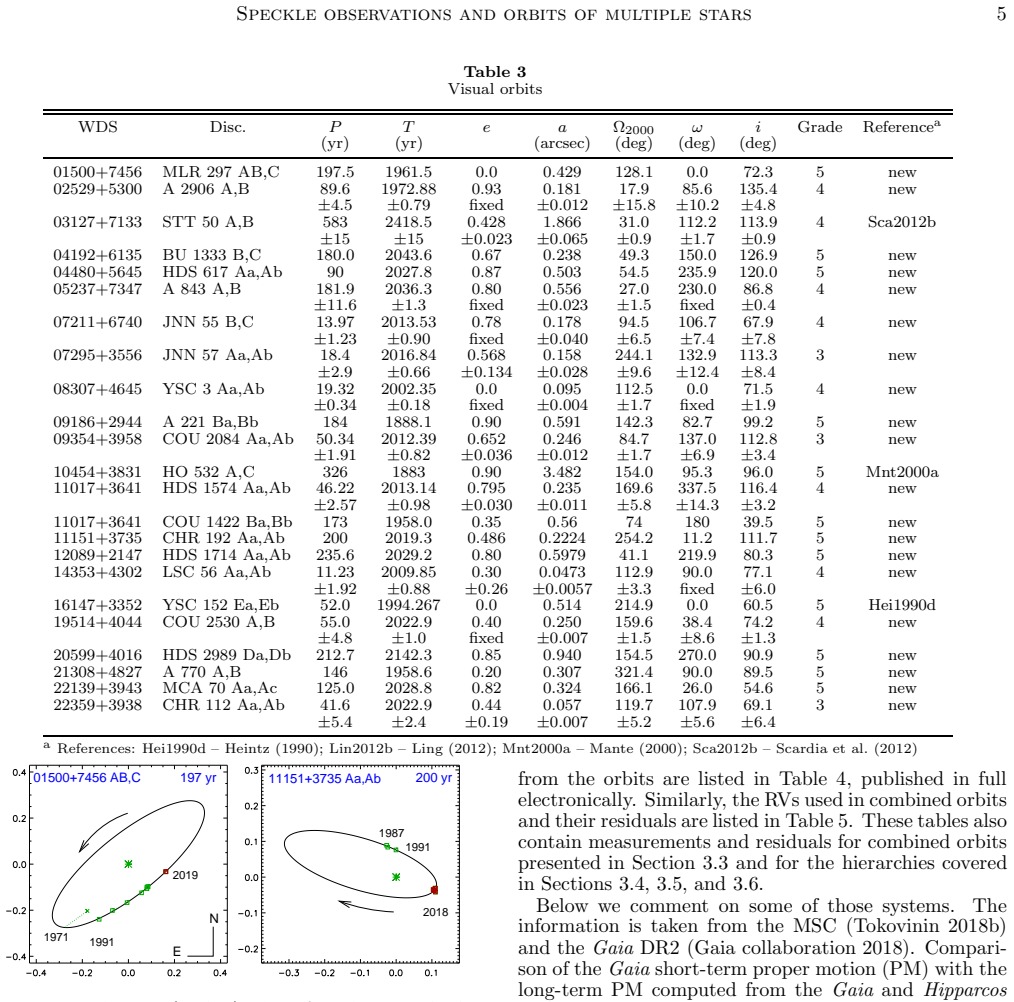
Summary. The paper reports NESSI speckle-interferometric monitoring of 129 resolved subsystems, yielding 390 measurements, and combines these with archival astrometry and radial velocities to compute or revise 36 visual orbits, including seven combined spectro-interferometric orbits. For the compact hierarchical systems HIP 65026 and HIP 85209, it derives mutual orbital inclinations of 11.3±1.0 deg and 12.0±3.0 deg, respectively, and interprets them as evidence for quasi-coplanar, disk-like architectures. The paper also resolves four previously unresolved bright stars, identifies two new triple systems, argues that several cataloged subsystems are spurious, and reports a trend of lower inner eccentricities for outer separations below 100 au.
Significance. If the mutual-inclination measurements are correct, the paper adds two important data points to the small sample of compact stellar hierarchies with measured three-dimensional architectures, directly informing the debate between disk-driven formation and dynamical interactions. It is also a genuine service contribution: the NESSI calibration is carefully validated (mean angular offset -0.15 deg with 0.17 deg rms, scale agreement within 0.3%), the astrometric errors are checked against simultaneous two-channel measurements, and the combined astrometric-RV fits follow standard least-squares practice with publicly referenced codes (ORBIT, orbit3.pro). The wobble-factor checks for HIP 63253 and HIP 65026 provide an independent, mass-based consistency test. However, the headline coplanarity claim for HIP 65026 rests on a nodal angle derived from an outer RV solution whose amplitude is under-fitted by a factor of about 3.4, and the quoted 1 deg uncertainty does not account for the suspected line-blending systematic. The paper itself calls for higher-resolution spectroscopy to obtain unbiased RV amplitudes, which is an internal acknowledgment that the current RV model may be biased.
major comments (3)
- [Section 3.5, Table 6]
- [Section 3.6, Table 6]
- [Section 4, Figure 15]
minor comments (4)
- [Section 2.3] The word 'adaptated' should be 'adapted'.
- [Section 3.3] In the HIP 11253 paragraph, 'approcaches' is a typo for 'approaches'.
- [Section 3.5, Figure 11] The figure caption says the dotted line in the lower panel shows the expected RV curve of component B; the text elsewhere gives the expected B amplitude as 5.1 km/s. Please clarify in the caption what template and assumptions the expected curve uses.
- [Section 3.5] The sentence 'The nodes of both orbits are known from the RVs' is not fully precise: for the inner orbit, astrometry also constrains the orbital plane, and the RV data resolve the ascending/descending node ambiguity. Please state explicitly which data set determines each node.
Circularity Check
No significant circularity: the mutual inclinations are fitted quantities derived from independent astrometry and radial velocities, and the RV-amplitude discrepancy is an externally checked accuracy issue, not a circular input.
full rationale
The central derived claims are the mutual inclinations of HIP 65026 (11.3±1.0 deg) and HIP 85209 (12.0±3.0 deg). These are obtained by least-squares fits of combined astrometric and radial-velocity data using standard orbit-fitting codes (ORBIT, orbit3.pro), not by assuming the answer. The relative inclination is computed from the fitted orbital elements (inclinations and ascending nodes), and the nodes are determined from the data rather than imposed. The under-fitted outer RV amplitude in HIP 65026 (K1=1.07 km/s vs. the mass-based estimate of 3.6 km/s) is explicitly flagged by the authors and treated as an external consistency check; it is not used as an input that would force the mutual inclination. Likewise, the wobble-factor comparison (measured f=0.42 versus the mass/magnitude estimate f=0.44) is an independent cross-check. Self-citations (e.g., orbit3.pro from Tokovinin & Latham 2017, and references to Tokovinin 2017/2018 for contextual statistics) provide software and literature context, but the orbit solutions and mutual-inclination measurements are not justified by those citations. No fitted parameter is renamed as a prediction, and no quoted load-bearing step reduces to its own input by construction. Concerns about blending biasing the RV phases or amplitudes are legitimate accuracy risks, but they are not circularity under the standard definitions used here.
Assumptions & free parameters
free parameters (6)
- Adopted parallax of HIP 65026 =
101 mas
- Fixed inclination of HIP 17126 B,C =
70 deg
- Fixed eccentricity of A 843 A,B =
0.80
- Fixed period and eccentricity of JNN 55 B,C =
P=13.97 yr, e=0.78
- Quadrant flips in YSC 3 Aa,Ab
- Orbital elements of 36 orbits =
various
assumptions (5)
- domain assumption The NESSI pixel scale and angle calibration remained stable over the year, and the corrections derived from 24 binaries apply to all targets.
- standard math The speckle power spectrum model (reference spectrum times binary fringes) with sinc-squared dispersion damping correctly recovers binary parameters.
- domain assumption The RV zero-points of the CfA digital speedometers and TRES are consistent after the +0.14 km/s correction.
- domain assumption The Multiple-Star Catalog visual orbit sample, despite selection effects, is adequate for the eccentricity versus separation trend.
- domain assumption Unresolved reference stars are single, or their binary signature can be removed by the pipeline.
Cite this review
Pith. "Pith review of Speckle observations and orbits of multiple stars." pith.science (2026). https://pith.science/paper/7UDIFHWA
@misc{pith2026190811445,
  author       = {Pith},
  title        = {Pith review of: Speckle observations and orbits of multiple stars},
  year         = {2026},
  howpublished = {\url{https://pith.science/paper/7UDIFHWA}},
  note         = {Machine review of arXiv:1908.11445}
}
read the original abstract
We report results of speckle-interferometric monitoring of visual hierarchical systems using the newly commissioned instrument NESSI at the 3.5-m WIYN telescope. During one year, 390 measurements of 129 resolved subsystems were made, while some targets were unresolved. Using our astrometry and archival data, we computed 36 orbits (27 for the first time). Spectro-interferometric orbits of seven pairs are determined by combining positional measurements with radial velocities measured, mostly, with the Center for Astrophysics digital speedometers. For the hierarchical systems HIP 65026 (periods 49 and 1.23 years) and HIP 85209 (periods 34 and 1.23 years) we determined both the inner and the outer orbits using astrometry and radial velocities and measured the mutual orbit inclinations of 11.3+-1.0 deg and 12.0+-3.0 deg, respectively. Four bright stars are resolved for the first time; two of those are triple systems. Several visual subsystems announced in the literature are shown to be spurious. We note that subsystems in compact hierarchies with outer separations less than 100 au tend to have less eccentric orbits compared to wider hierarchies.
Figures


Figures from the paper (10 more)




Reference graph
Works this paper leans on
-
[1]
Alonso-Floriano, F. J., Caballero, J. A. Cort´ es-Contreras, M et al. 2015, A&A, 583, 85
work page 2015
-
[2]
Beuzit, J.-L., S´ egransan, D., Forveille, T. et al. 2004, A& A, 425, 997
work page 2004
-
[3]
Bowler, B. P., Liu, M. C., Shkolnik, E. L., & Tamura, M. 2015, ApJS, 216, 7
work page 2015
- [4]
- [5]
-
[6]
Delfosse, X., Forveille, T., Beuzit, J.-L. et al. 1999, A&A, 344, 897 Fabrycky D. & Tremaine S., 2007, ApJ, 669, 1298
work page 1999
-
[7]
Fabrycky, D. C., Lissauer, J. J., Ragozzine, D. et al. 2014, A pJ, 790, 146
work page 2014
-
[8]
Fekel, F. C., Willmarth, D. W., Abt, H. A. & Pourbaix, D. 2018, AJ, 156, 117 Gaia Collaboration, Brown, A. G. A., Vallenari, A., Prusti, T. et al. 2018, A&A, in preparation (Vizier Catalog I/345/gaia2)
work page 2018
Show all 43 references
-
[9]
Goldberg, D., Mazeh, T., Latham, D. W. et al. 2002, AJ, 124, 1132 F˝ ur´ esz, G. 2008, PhD thesis, University of Szeged, Hungary
2002
-
[10]
Guillout, P., Klutsch, A., Frasca, A., Freire Ferrero, R. et al. 2009, A&A, 504, 829
2009
-
[11]
Hartkopf, W.I., McAlister,H.A., Mason, B.D. et al. 1994, AJ 108, 2299
1994
-
[12]
I., Mason, B
Hartkopf, W. I., Mason, B. D. & W orley, C. E. 2001, AJ, 122, 3472
2001
-
[13]
N., Franz, O
Heasley, J. N., Franz, O. G., W asserman, L. H., & Horch, E. P. 2002, BAAS, 34, 1095
2002
-
[14]
Heintz, W. D. 1969, AJ, 74, 768
1969
-
[15]
Heintz, W. D. 1990, AJ, 99, 420
1990
-
[16]
Heintz, W. D. 1993, AJ, 105, 1188
1993
-
[17]
P., Franz, O
Horch, E. P., Franz, O. G., W asserman, L. H., & Heasley, J. N. 2006, AJ, 132, 836
2006
-
[18]
P., Bahi, L
Horch, E. P., Bahi, L. A. P., Gaulin, J. R. et al. 2012, AJ, 143, 10
2012
-
[19]
P., van Belle, G
Horch, E. P., van Belle, G. T., Davidson, J. W., Jr. et al. 2015 b, AJ, 150, 151
2015
-
[20]
I., Tokovinin, A., W eiss, S
Horch, E. I., Tokovinin, A., W eiss, S. A. et al. 2019, AJ, 157, 56
2019
-
[21]
2012, ApJ, 754, 44
Janson, M., Hormuth, F., Bergfors, C., et al. 2012, ApJ, 754, 44
2012
-
[22]
B., Orosz, J
Kostov, V. B., Orosz, J. A., W elsh, W. F. et al. 2016, ApJ, 827, 86 2016ApJ...827...86K Kepler-1647 1100 d arounf 11-d SB
2016
-
[23]
Latham, D. W. 1992, in IAU Coll. 135, Complementary Approaches to Double and Multiple Star Research, ASP Conf. Ser. 32, eds. H. A. McAlister & W. I. Hartkopf (San Francisco: ASP), 110
1992
-
[24]
W., Stefanik, R
Latham, D. W., Stefanik, R. P., Torres, G. et al. 2001, AJ, 124 , 1144
2001
-
[25]
2012, IAU Inf
Ling, J. 2012, IAU Inf. Circ. 176, 1
2012
-
[26]
2000, IAU Inf
Mante, R. 2000, IAU Inf. Circ., 140, 1
2000
-
[27]
D., Wycoff, G
Mason, B. D., Wycoff, G. L., Hartkopf, W. I. et al. 2001, AJ, 122 , 3466 (WDS)
2001
-
[28]
& Kratter, K
Moe, M. & Kratter, K. M. 2018, ApJ, 854, 44
2018
-
[29]
Perryman, M. A. C., Lindegren, L., Kovalevsky, J. et al. 1997 , A&A, 323L, 49 (Vizier Catalog I/239/hip main)
1997
-
[30]
C., Jr., Tokovinin, A., Mason, B
Roberts, L. C., Jr., Tokovinin, A., Mason, B. D. et al. 2015, A J, 150, 130
2015
-
[31]
Roberts, L. C., Jr. & Mason, B. D. 2018 MNRAS, 473, 4497
2018
-
[32]
J., Howell, S
Scott, N. J., Howell, S. B., Horch, E. P., & Everett, M. E. PASP , 2018, 130, 054502 Sperauskas et al. 2019, A&A, accepted (preprint arXiv:1904.06544)
2018 arXiv
-
[33]
H., & F˝ ur´ esz, G
Szentgyorgyi, A. H., & F˝ ur´ esz, G. 2007,Precision Radial Velocities for the Kepler Era , in The 3rd Mexico-Korea Conference on Astrophysics: Telescopes of the Future and Sa n Pedro M´ artir, ed. S. Kurtz, RMxAC, 28, 129
2007
-
[34]
2016, ORBIT: IDL software for visual, spectroscopic, and combined orbits
Tokovinin, A. 2016, ORBIT: IDL software for visual, spectroscopic, and combined orbits. Zenodo, doi:10.2581/zenodo.61119
2016 doi
-
[35]
2017, ApJ, 844, 103
Tokovinin, A. 2017, ApJ, 844, 103
2017
-
[36]
2018, AJ, 155, 160
Tokovinin, A. 2018, AJ, 155, 160
2018
-
[37]
Tokovinin, A. A. & Smekhov, M. G. 2002, A&A, 382, 118
2002
-
[38]
D., & Hartkopf, W
Tokovinin, A., Mason, B. D., & Hartkopf, W. I. 2010, AJ, 139, 7 43
2010
-
[39]
W., & Mason, B
Tokovinin, A., Latham, D. W., & Mason, B. D. 2015, AJ, 149, 195
2015
-
[40]
& Latham, D
Tokovinin, A. & Latham, D. W. 2017, ApJ, 838, 54
2017
-
[41]
Horch, E. P. 2018, AJ, 155, 235
2018
-
[42]
1994, ApJ, 420, 806
Zucker, S., & Mazeh, T. 1994, ApJ, 420, 806
1994
-
[43]
1995, ApJ, 452, 863
Zucker, S., Torres, G., & Mazeh, T. 1995, ApJ, 452, 863
1995
Reviewed August 14, 2026 · model on record in the stance chip above.
Discussion (0). Continue with ORCID to comment.