Dragon curves in Littlewood roots
Pith reviewed 2026-06-25 20:03 UTC · model grok-4.3
The pith
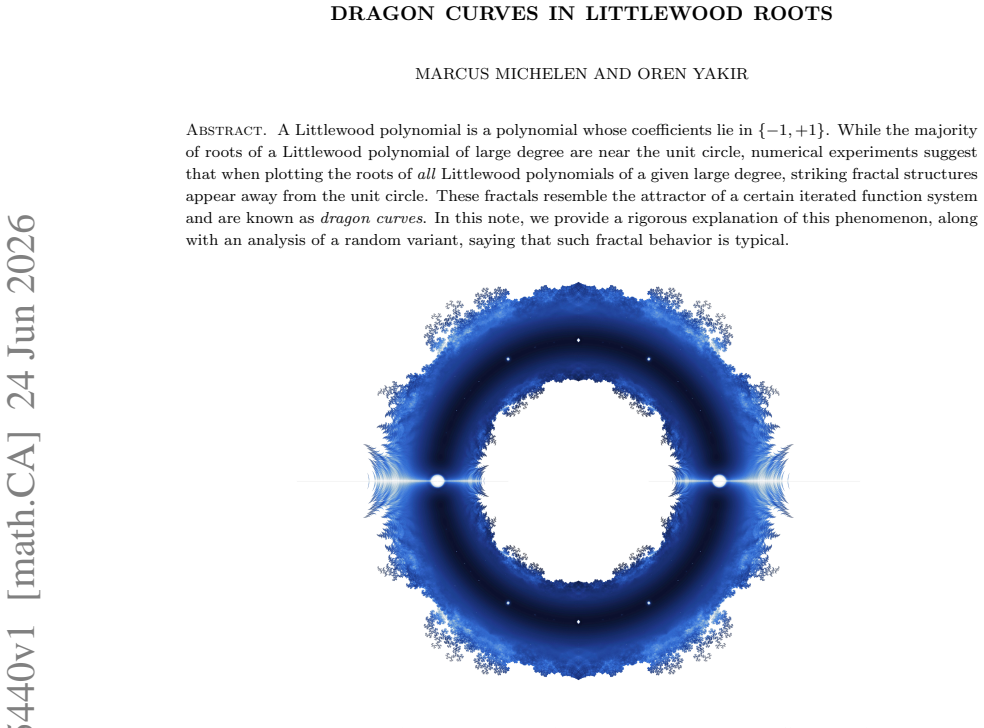
Roots of all Littlewood polynomials of large degree form dragon curve fractals away from the unit circle.
A machine-rendered reading of the paper's core claim, the machinery that carries it, and where it could break.
Core claim
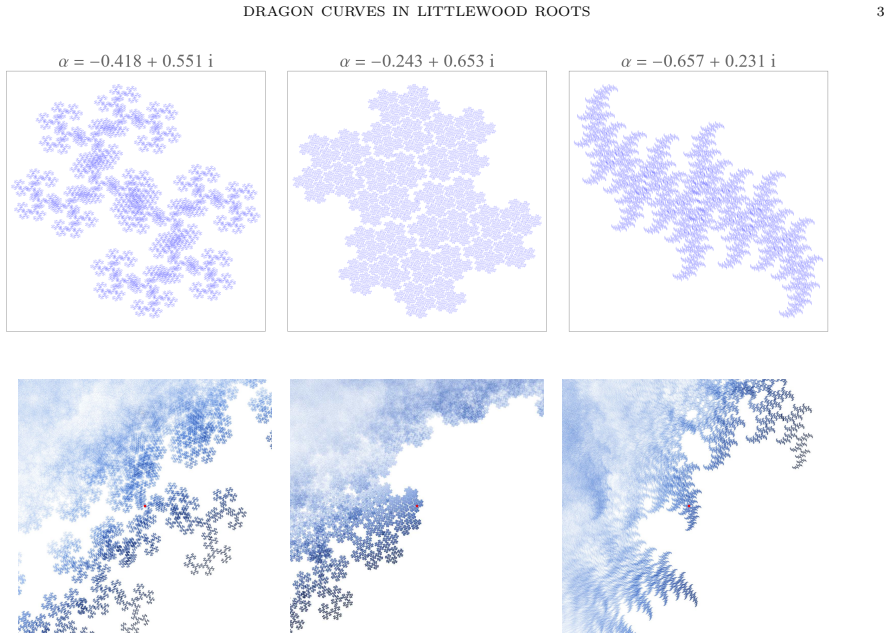
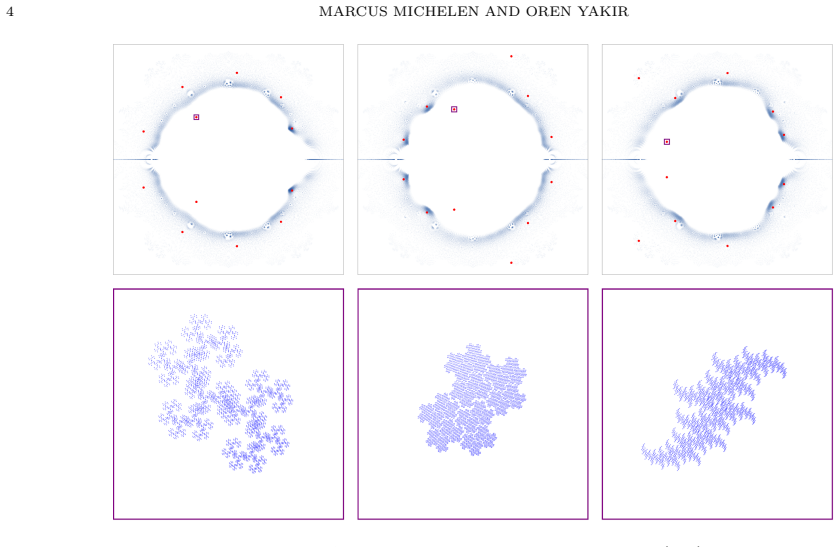
When the roots of all Littlewood polynomials of a given large degree are plotted together, they form striking fractal structures away from the unit circle that match the attractor of a certain iterated function system, with analysis of a random variant showing that such fractal behavior is typical.
What carries the argument
The attractor of an iterated function system that captures the limiting distribution of roots for both deterministic and random Littlewood polynomials.
If this is right
- The fractal structures appear consistently for both the standard Littlewood polynomials and their random variants.
- The majority of roots remain near the unit circle while the off-circle roots follow the fractal attractor.
- The phenomenon receives a rigorous proof rather than remaining a numerical observation.
Where Pith is reading between the lines
- Similar iterated function system models may describe root distributions for other coefficient-restricted polynomial families.
- The typicality result could guide statistical sampling methods when studying large ensembles of random polynomials.
- Higher-degree computations could be checked directly against the attractor to measure convergence rate.
Load-bearing premise
The observed numerical fractals are generated by an iterated function system whose attractor accurately captures the limiting distribution of roots for both the deterministic and random models of Littlewood polynomials.
What would settle it
A computation of the empirical root distribution from all Littlewood polynomials of sufficiently high degree that fails to converge to the attractor of the iterated function system would falsify the explanation.
Figures
read the original abstract
A Littlewood polynomial is a polynomial whose coefficients lie in $\{- 1, +1\}$. While the majority of roots of a Littlewood polynomial of large degree are near the unit circle, numerical experiments suggest that when plotting the roots of \emph{all} Littlewood polynomials of a given large degree, striking fractal structures appear away from the unit circle. These fractals resemble the attractor of a certain iterated function system and are known as \emph{dragon curves}. In this note, we provide a rigorous explanation of this phenomenon, along with an analysis of a random variant, saying that such fractal behavior is typical.
Editorial analysis
A structured set of objections, weighed in public.
Referee Report
Summary. The manuscript claims that plotting the roots of all Littlewood polynomials (coefficients in {-1,+1}) of large fixed degree produces fractal structures away from the unit circle that resemble dragon curves; these are identified with the attractor of a specific iterated function system (IFS). It supplies a rigorous explanation of the phenomenon for the deterministic enumeration of all such polynomials and for a random variant, concluding that fractal behavior is typical.
Significance. If the claimed rigorous identification of the IFS attractor with the support and limiting distribution of the roots holds, the work would furnish a precise geometric explanation for the observed numerical fractals in Littlewood root plots and would establish that such structure persists under randomization. The explicit treatment of both the deterministic and random models is a positive feature.
major comments (2)
- [Section constructing the IFS maps and stating the main theorem] The central claim requires that the IFS attractor is not merely a visual or set-theoretic container but the actual support (and ideally the weak limit) of the empirical root measure. The provided argument appears to establish containment of limit points inside the attractor via the recursive sign choices, but does not demonstrate that every point of the attractor is realized as a limit point of actual roots or that the empirical measures converge weakly to the IFS invariant measure.
- [Analysis of the random variant] For the random variant, the analysis shows that the same IFS governs the typical behavior, yet it is unclear whether the proof controls the discrepancy between the random sign model and the deterministic enumeration sufficiently to transfer the limiting distribution statement without additional error estimates.
minor comments (2)
- The notation for the individual IFS contractions could be introduced with an explicit list of the four maps and their fixed-point equations to aid readers.
- A brief remark on how the numerical plots were generated (e.g., degree range and root-finding method) would improve reproducibility of the motivating figures.
Simulated Author's Rebuttal
We thank the referee for the careful reading and constructive comments on our manuscript. We address each major comment below and will revise the paper accordingly to strengthen the arguments.
read point-by-point responses
-
Referee: [Section constructing the IFS maps and stating the main theorem] The central claim requires that the IFS attractor is not merely a visual or set-theoretic container but the actual support (and ideally the weak limit) of the empirical root measure. The provided argument appears to establish containment of limit points inside the attractor via the recursive sign choices, but does not demonstrate that every point of the attractor is realized as a limit point of actual roots or that the empirical measures converge weakly to the IFS invariant measure.
Authors: We agree that a more explicit demonstration is needed to confirm the attractor coincides with the support of the limiting root set. In the revision we will insert a lemma constructing, for any point in the attractor, a sequence of sign patterns whose associated roots converge to it by iterating the inverse branches of the IFS maps. We will also add a short argument establishing weak convergence of the empirical root measures to the unique IFS-invariant probability measure, using the contractive property and uniqueness of the invariant measure. revision: yes
-
Referee: [Analysis of the random variant] For the random variant, the analysis shows that the same IFS governs the typical behavior, yet it is unclear whether the proof controls the discrepancy between the random sign model and the deterministic enumeration sufficiently to transfer the limiting distribution statement without additional error estimates.
Authors: The random-model analysis establishes that the same IFS governs the roots with high probability. To close the gap with the deterministic enumeration we will add explicit discrepancy bounds (e.g., via concentration or Wasserstein-distance estimates) showing that the random empirical measures remain close to their deterministic counterparts, thereby transferring the weak-convergence statement to the random setting. revision: yes
Circularity Check
No significant circularity; derivation is self-contained from polynomial recursion
full rationale
The paper derives an iterated function system directly from the recursive sign-choice structure inherent to Littlewood polynomials (coefficients in {-1,+1}), then rigorously analyzes the attractor for both the deterministic enumeration and a random variant. This construction is independent of the target limiting distribution; the IFS maps are defined from the same algebraic recursion that generates the polynomials, and the claim that fractal behavior is typical follows from explicit analysis of the attractor rather than any fitted parameter, self-citation chain, or renaming of an input. No load-bearing step reduces by construction to the observed roots or their empirical measure. The derivation therefore stands as a genuine mathematical explanation rather than a tautology.
Axiom & Free-Parameter Ledger
Reference graph
Works this paper leans on
-
[1]
Ahlfors.Complex analysis—an introduction to the theory of analytic functions of one complex variable
L. Ahlfors.Complex analysis—an introduction to the theory of analytic functions of one complex variable. AMS Chelsea Publishing, 2021
2021
-
[2]
J. C. Baez, J. D. Christensen, and S. Derbyshire. The beauty of roots.Notices Amer. Math. Soc., 70(9):1495–1497, 2023
2023
-
[3]
C. Bandt. On the Mandelbrot set for pairs of linear maps.Nonlinearity, 15(4):1127–1147, 2002
2002
-
[4]
M. F. Barnsley and A. N. Harrington. A Mandelbrot set for pairs of linear maps.Phys. D, 15(3):421–432, 1985
1985
-
[5]
Beer.Topologies on closed and closed convex sets
G. Beer.Topologies on closed and closed convex sets. Kluwer Academic Publishers Group, Dordrecht, 1993
1993
-
[6]
C. J. Bishop and Y. Peres.Fractals in probability and analysis. Cambridge University Press, 2017
2017
-
[7]
Borwein.Computational excursions in analysis and number theory, volume 10
P. Borwein.Computational excursions in analysis and number theory, volume 10. Springer-Verlag, New York, 2002
2002
-
[8]
Borwein and C
P. Borwein and C. Pinner. Polynomials with 0, +1, -1 coefficients and a root close to a given point.Canadian Journal of Mathematics, 49(5):887–915, 1997
1997
-
[9]
T. Bousch. Paires de similitudes. Unpublished manuscript.https://www.imo.universite-paris-saclay.fr/ ~thierry. bousch/preprints/. 1988
1988
-
[10]
Calegari, S
D. Calegari, S. Koch, and A. Walker. Roots, Schottky semigroups, and a proof of Bandt’s conjecture.Ergodic Theory Dynam. Systems, 37(8):2487–2555, 2017
2017
-
[11]
P. Erd˝ os. On a lemma of Littlewood and Offord.Bull. Amer. Math. Soc., 51:898–902, 1945
1945
-
[12]
Erd˝ os and P
P. Erd˝ os and P. Tur´ an. On the distribution of roots of polynomials.Ann. of Math. (2), 51:105–119, 1950
1950
-
[13]
D. Hokken. Topology of zero sets of polynomials with square discriminant.C. R. Math. Acad. Sci. Paris, 364:101–106, 2026
2026
-
[14]
S. V. Konyagin and W. Schlag. Lower bounds for the absolute value of random polynomials on a neighborhood of the unit circle.Trans. Amer. Math. Soc., 351(12):4963–4980, 1999
1999
-
[15]
J. E. Littlewood. On polynomials Pn ±zm, Pn eαmizm,z=e θi.J. London Math. Soc., 41:367–376, 1966
1966
-
[16]
J. E. Littlewood and A. C. Offord. On the number of real roots of a random algebraic equation. III.Rec. Math. [Mat. Sbornik] N.S., 12/54:277–286, 1943
1943
-
[17]
Michelen and O
M. Michelen and O. Yakir. Limit law for root separation in random polynomials.Adv. Math., 496:Paper No. 110990, 2026
2026
-
[18]
A. M. Odlyzko and B. Poonen. Zeros of polynomials with 0,1 coefficients.Enseign. Math. (2), 39(3-4):317–348, 1993
1993
-
[19]
Shmerkin and B
P. Shmerkin and B. Solomyak. Absolute continuity of complex Bernoulli convolutions.Math. Proc. Cambridge Philos. Soc., 161(3):435–453, 2016
2016
-
[20]
Solomyak and H
B. Solomyak and H. Xu. On the ‘Mandelbrot set’ for a pair of linear maps and complex Bernoulli convolutions.Nonlinearity, 16(5):1733–1749, 2003. Department of Mathematics, Northwestern University Email address:michelen@northwestern.edu Department of Mathematics, Massachusetts Institute of Technology Email address:oren.yakir@gmail.com
2003
discussion (0)
Sign in with ORCID, Apple, or X to comment. Anyone can read and Pith papers without signing in.