REVIEW 2 major objections 5 minor 39 references
Spectral and Dynamic Consequences of Network Specialization
T0 review · 2 major / 5 minor · reviewed 2026-08-14 · deepseek-v4-flash
Pith's one-line read Network specialization preserves intrinsic stability exactly.
desk verdict Strong spectral results, but the stability preservation theorem has a proof gap that needs a nondegeneracy assumption or a more careful argument. read the letter →
The pith
A machine-rendered reading of the paper's core claim, the machinery that carries it, and where it could break.
The reading
What carries the argument
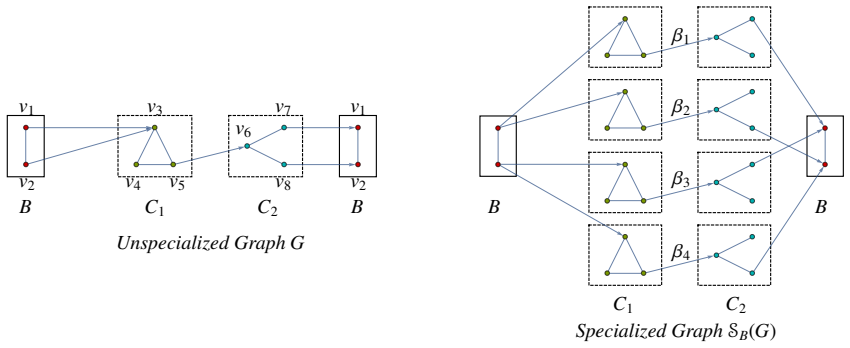
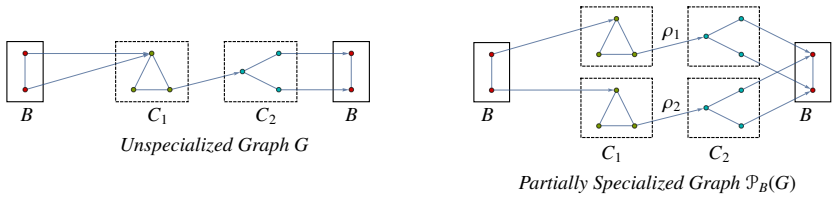
The central object is the specialization of a graph over a base vertex set $B$: decompose the subgraph induced by the complement of $B$ into strongly connected components, collect all paths and cycles that run from one base vertex through these components and back to a base vertex (the component branches), and then merge these branches at the base vertices. This operation is defined so that edge weights are copied verbatim. The analytical workhorse is the stability matrix $\Lambda$ of a dynamical network, with entries $\Lambda_{ij}=\sup_x |\partial F_i/\partial x_j(x)|$, whose spectral radius controls global stability; the key identity $S_B(\Lambda)=\Lambda$, together with the spectral-radius preservation of nonnegative matrices, carries the main dynamic theorem. For eigenvectors, the paper introduces the eigenvector transfer matrix $T(\beta,Z,\lambda)$ of an incoming branch, which expresses the eigenvector entries on any copied component as a deterministic function of the eigenvector on the base vertices.
What would settle it
Compute the spectral radius of a positively weighted graph and of its specialization over a base set—for instance, the graph of Example 2.2 with $B=\{v_1,v_2\}$; Corollary 3.1 predicts exact equality $\rho(S_B(G))=\rho(G)$, so any observed disparity would falsify the spectral-radius-preservation claim on which Theorem 4 rests. Alternatively, define a specialization in which one copied component uses a perturbed interaction function, such as multiplying a $\tanh$ activation by 1.1, and check whether the stability matrix's spectral radius crosses 1.
Extended reading notes
Core claim
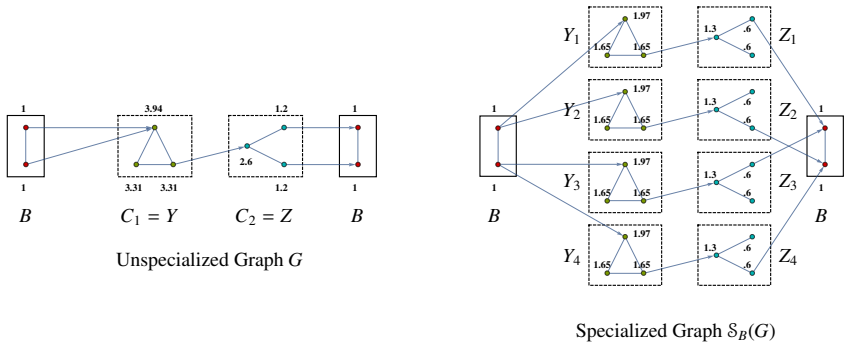
The paper's central claim is that graph specialization acts on spectra exactly: for any graph $G$ and base $B$, the spectrum of the specialized graph $S_B(G)$ is the spectrum of $G$ together with extra copies of the spectra of the strongly connected components of $G$ restricted to the complement of $B$. When all edge weights are positive, the spectral radius is therefore exactly preserved. The authors then lift this to dynamical networks of the form $F_i(x)=\sum_j A_{ij} f_{ij}(x_j)$: specializing the network produces a dynamical network whose stability matrix is the matrix specialization of the original stability matrix, $S_B(\Lambda)=\Lambda$. Since the stability matrix is nonnegative, Corollary 3.1 gives $\rho(S_B(\Lambda))=\rho(\Lambda)$, so intrinsic stability—defined by $\rho(\Lambda)<1$—is inherited by every specialization, and by Corollary 4.3 by every sequence of specializations. According to the authors, this is the first general growth mechanism that provably preserves network stability, and it also gives a complete description of how eigenvector centralities change under specialization.
Load-bearing premise
The entire result rests on the modeling premise that each specialized copy inherits exactly the same interaction functions as the original element, since only then does the stability matrix of the specialized network equal the specialization of the original stability matrix.
Editorial extensions
If this is right
- For any positively weighted graph, specialization over any base preserves the spectral radius exactly, so repeated specialization leaves the dominant eigenvalue unchanged.
- Eigenvector centrality of the base vertices is unchanged by specialization; copies with the same incoming branch have identical centrality, and summing centralities of copies sharing an outgoing branch recovers the original vertex's centrality.
- An intrinsically stable dynamical network of the form (3) remains intrinsically stable under any standard, partial, or thinned specialization over any base.
- Any sequence of such specializations, in any combination, preserves intrinsic stability.
- Thinned specializations can only lower the spectral radius relative to the original network, so they never create instability in an intrinsically stable system.
Reading between the lines
- Because the proof only needs $S_B(\Lambda)=\Lambda$, a natural testable extension is to allow copied interaction functions to be slightly perturbed versions of the originals; if the perturbation is small, continuity of eigenvalues should imply stability is retained up to a computable threshold, but the paper does not prove this.
- The spectral-radius preservation suggests other dynamics driven by spectral quantities—such as synchronization speed, consensus rates, or spectral gaps used in community detection—should also be inherited under specialization, a direction the paper does not pursue.
- For real networks whose function must survive growth, this model supplies a candidate null rule: growth that preserves function should look like specialization of strongly connected components, because that is a structural change that provably keeps the dominant dynamics unchanged.
- Combining intrinsic stability's known resilience to time delays with the present resilience to specialization suggests that these two types of structural perturbation act independently, and one could test whether networks specialized with delays still converge to the same equilibrium.
Signed reviews
Editorial analysis
A structured set of objections, weighed in public.
Referee Report
Summary. The paper studies a graph-growth model called network specialization and analyzes its spectral and dynamical consequences. Theorem 1 states that the spectrum of a specialized graph is the spectrum of the original graph together with the spectra of the newly created copies of strongly connected components; Corollary 3.1 concludes that the spectral radius is preserved for positive edge weights. Theorem 2 describes how eigenvectors, in particular eigenvector centrality, transform under specialization. The main dynamical result, Theorem 4, asserts that intrinsic stability (spectral radius of the stability matrix less than one) is preserved under specialization for dynamical networks of the form (3). The paper also treats partial and thinned specializations and applies the results to discrete-time recurrent neural networks.
Significance. If the results are correct, the paper provides a rigorous link between two types of network dynamics: the evolution of network topology via specialization and the stability of dynamics on the network. The spectral-radius invariance and the eigenvector transfer formulas are explicit, falsifiable predictions, and the applications to recurrent neural networks give the results practical relevance. The paper is also commendable for proving the new spectral statements from block-matrix and Schur-complement arguments rather than treating them as numerical observations. However, the proof of the central stability-preservation theorem has a gap concerning zero entries in the stability matrix, and the proof of Theorem 1 for multiple components relies on an informal stepwise argument; both need attention before the claims are fully established.
major comments (2)
- [Sec. 4, proof of Theorem 4] The equality SB(Λ) = Λ̄ asserted in the proof of Theorem 4 does not follow from Definitions 7 and 8. In Definition 7, SB(Λ) is the specialization of the graph G(Λ), whose edges are the nonzero entries of Λ; in Definition 8, the stability matrix of the specialized network is Λ̄_ij = SB(A)_ij sup_{y_j} |f'_{τ(i)τ(j)}(y_j)|, where SB(A) is the specialization of the 0-1 interaction graph G(A). If A_ij = 1 but sup |f'_ij| = 0, then the edge (j,i) is absent from G(Λ) but present in G(A), so the two graphs can have different strongly connected components in the complement of B and hence different numbers of copies; SB(Λ) and Λ̄ can even have different dimensions. The displayed computation of SB(Λ)_ij therefore presumes that every edge of A has a strictly positive derivative bound. Corollary 3.1 is also stated for positive edge weights and is invoked for the merely nonnegative matrix Λ. The theorem may still be true, because the extra copies created by SB(A) carry zero weights on the missing edges and need not increase the spectral radius, but the proof as written does not establish this. Please either add the positivity assumption on the derivative bounds or prove the spectral-radius statement directly for Λ̄ = SB(A) ⊙ D̄.
- [Sec. 6, proof of Theorem 1] The stepwise specialization argument used to extend Theorem 1 from a single strongly connected component to multiple components is asserted rather than proved. The stepwise process specializes over complements of individual components, not over the original base B, and the claimed one-to-one correspondence between BB(G_k) and BB(G_{k+1}) is the core of the argument; if this correspondence failed, the induction would double-count or miss eigenvalues. The termination claim also depends on this correspondence, and the statement that in the final graph each strongly connected component has exactly one edge into and one edge out of it requires justification. The single-component Schur complement computation is convincing, so this is a rigor gap rather than a detected error; please replace the informal termination paragraph with an explicit induction on the number of components or an equivalent argument.
minor comments (5)
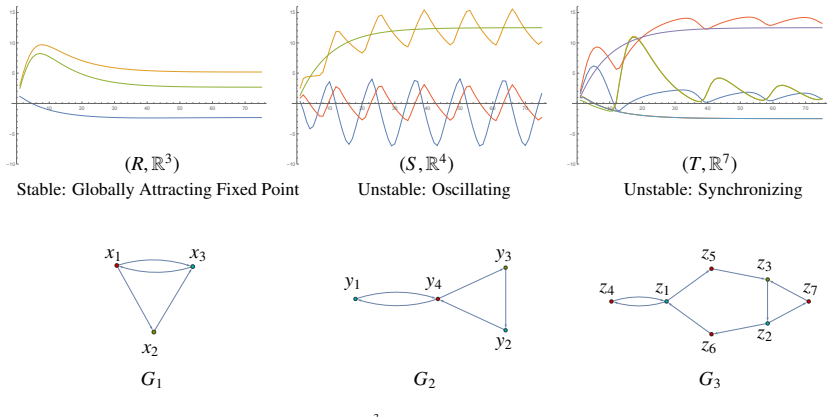
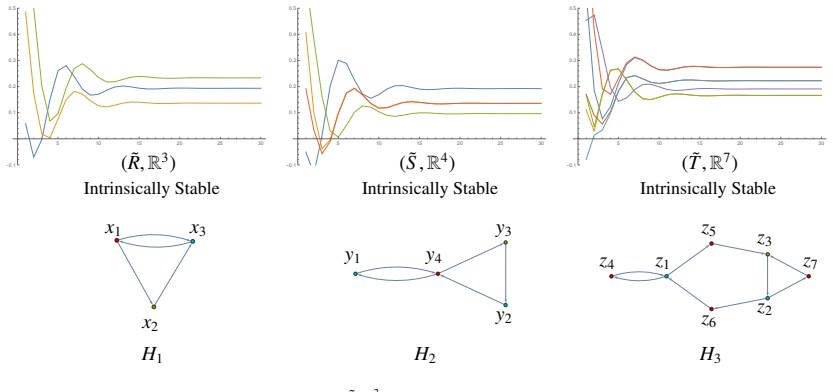
- [Example 4.2] The text in Example 4.2 repeatedly refers to 'Figure 5' when describing the networks (R̃, R³), (S̃, R⁴), and (T̃, R⁷); these are displayed in Figure 6, not Figure 5.
- [Paragraph before Theorem 4] The sentence 'each of the networks in Example 4.2 have the same spectral radius ρ(R)=ρ(S)=ρ(T)=2.669>1' contradicts Example 4.2, where the spectral radius is reported as 0.962 < 1; this likely should refer to Example 4.1. The later reference 'cf. Example 4.2 and 4.2' should also be corrected.
- [Definition 13] The formula for the partial eigenvector transfer matrix appears to contain a typo: it ends with a factor (λI−T)^{-1} and repeats Y_m, whereas the proof and Lemma 1 indicate that the last factor should be (λI−S)^{-1}.
- [Corollary 3.1 and Theorem 4] Corollary 3.1 is stated for positive edge weights, but Theorem 4 invokes it for a nonnegative stability matrix. Since the nonnegative case follows from the same argument using the Perron-Frobenius bound for principal submatrices, please state the nonnegative version explicitly to avoid the appearance of a mismatch.
- [Sec. 6, proof of Theorem 2 part (i)] In the line after Equation (11), 'U− ˆY( ˆZ−λI)−1 ˆW = u− ...' uses a lowercase 'u' where the block matrix 'U' is intended.
Circularity Check
No circularity: spectral-radius preservation is proved from the stated definitions, and the self-citations to prior isospectral-reduction work are not load-bearing for the central claim.
full rationale
The paper's central derivation is self-contained in the relevant sense. Theorem 1 and Theorem 2 are proved in Section 6 using Schur complements and an eigenvector transfer-matrix argument; the self-citations to the authors' isospectral-reduction theory [7,9] and to the specialization model [6] support tools or context, but the specific spectral-radius claim is derived in the paper itself (Corollary 3.1 from Theorem 1). Theorem 4 establishes the equality SB(Λ) = Λ and then applies Corollary 3.1; this is a mathematical equality following from the definitions of graph and dynamical-network specialization, not a fitted parameter renamed as a prediction and not a target claim assumed by construction. There is a genuine non-circular proof gap: if some interaction f_ij has zero derivative bound on an edge of the 0-1 matrix A, then SB(Λ) is computed from the zero pattern of Λ, while the specialized network's stability matrix copies edges from SB(A); the displayed equality SB(Λ)=Λ is then not automatic. This is a correctness concern, not a circularity, and per the rubric it does not raise the circularity score. The paper also openly states limitations, including that the realism of the specialization model and whether any real-world network is intrinsically stable remain unknown, which further supports the non-circular reading. In sum, no load-bearing step reduces by construction to its own input.
Assumptions & free parameters
assumptions (5)
- standard math Perron-Frobenius theorem and spectral radius monotonicity for nonnegative matrices: the spectral radius of a nonnegative matrix is at least that of any principal submatrix.
- domain assumption Theorem 3 (Network Stability) from Bunimovich and Webb [7]: if the spectral radius of the stability matrix Λ is less than 1, then the dynamical network is globally stable.
- domain assumption The state space is a product of closed intervals and each component map Fi is C1 with bounded derivatives, as in equation (3) and Definition 5.
- domain assumption In Definition 8, when a node is specialized, each copy inherits exactly the same interaction functions f_{τ(i)τ(j)} as the original node, so the stability matrix of the specialized network is the specialization of the original stability matrix.
- domain assumption Isospectral reduction theory from Bunimovich and Webb [9], including the fact that the reduction preserves eigenvalues and that equation (11) holds for all relevant λ.
Cite this review
Pith. "Pith review of Spectral and Dynamic Consequences of Network Specialization." pith.science (2026). https://pith.science/paper/7UUAJVPZ
@misc{pith2026190804435,
  author       = {Pith},
  title        = {Pith review of: Spectral and Dynamic Consequences of Network Specialization},
  year         = {2026},
  howpublished = {\url{https://pith.science/paper/7UUAJVPZ}},
  note         = {Machine review of arXiv:1908.04435}
}
read the original abstract
One of the hallmarks of real networks is their ability to perform increasingly complex tasks as their topology evolves. To explain this, it has been observed that as a network grows certain subsets of the network begin to specialize the function(s) they perform. A recent model of network growth based on this notion of specialization has been able to reproduce some of the most well-known topological features found in real-world networks including right-skewed degree distributions, the small world property, modular as well as hierarchical topology, etc. Here we describe how specialization under this model also effects the spectral properties of a network. This allows us to give conditions under which a network is able to maintain its dynamics as its topology evolves. Specifically, we show that if a network is intrinsically stable, which is a stronger version of the standard notion of global stability, then the network maintains this type of dynamics as the network evolves. This is one of the first steps toward unifying the rigorous study of the two types of dynamics exhibited by networks. These are the \emph{dynamics of} a network, which is the study of the topological evolution of the network's structure, modeled here by the process of network specialization, and the \emph{dynamics on} a network, which is the changing state of the network elements, where the type of dynamics we consider is global stability. The main examples we apply our results to are recurrent neural networks, which are the basis of certain types of machine learning algorithms.
Figures
Figures from the paper (5 more)

Reference graph
Works this paper leans on
-
[1]
Topology of evolving networks: Local events and universiality,
Albert, R. & Barabasi, A.-L. [2000] “Topology of evolving networks: Local events and universiality,” Phys. Rev. Lett. 85, 5234–5237
work page 2000
-
[2]
A globally stable adaptive congestion control scheme for internet-style networks with delay,
Alpcan, T. & Basar, T. [2005] “A globally stable adaptive congestion control scheme for internet-style networks with delay,”IEEE/ACM Transactions on Networking 13
work page 2005
-
[3]
Emergence of scaling in random networks,
Barabasi, A.-L. & Albert, R. [1999] “Emergence of scaling in random networks,” Science 286
work page 1999
-
[4]
Network physiology: How organ systems dynamically interact,
Bartsch, L. K. K. L. B. A., R. P. & Ivanov, P. C. [2015] “Network physiology: How organ systems dynamically interact,”PLOS ONE
work page 2015
-
[5]
Complex brain networks: graph theoretical analysis of structural and functional systems,
Bullmore, E. & Sporns, O. [2009] “Complex brain networks: graph theoretical analysis of structural and functional systems,”Nature Reviews Neuroscience 10, 186–198
work page 2009
-
[6]
Specialization models of network growth,
Bunimovich, D., L. A. Smith & Webb, B. Z. [2018] “Specialization models of network growth,” Jour- nal of Complex Networks
work page 2018
-
[7]
Isospectral graph transformations, spectral equivalence, and global stability of dynamical networks,
Bunimovich, L. A. & Webb, B. Z. [2012] “Isospectral graph transformations, spectral equivalence, and global stability of dynamical networks,”Nonlinearity 25, 211–254
work page 2012
-
[8]
Restrictions and stability of time-delayed dynamical net- works,
Bunimovich, L. A. & Webb, B. Z. [2013] “Restrictions and stability of time-delayed dynamical net- works,”Nonlinearity 26, 2131–2156
work page 2013
Show all 39 references
-
[9]
Bunimovich, L. A. & Webb, B. Z. [2014] Isospectral Transformations: A New Approach to Analyzing Multidimensional Systems and Networks Springer Monographs in Mathematics
2014
-
[10]
Global asymptotic stability of delayed bi-directional associative memory neural net- works,
Cao, J. [2003] “Global asymptotic stability of delayed bi-directional associative memory neural net- works,”Applied Mathematics and Computation 142, 333–339
2003
-
[11]
New criteria for globally exponential stability of delayed cohen- grossberg neural network,
Chena, Z. W., S. & Xub, Y . [2009] “New criteria for globally exponential stability of delayed cohen- grossberg neural network,”Mathematics and Computers in Simulation 79, 1527–1543
2009
-
[12]
Multistability in reccurent neural networks,
Cheng, L. K.-H., C.-Y . & Shih, C.-W. [2006] “Multistability in reccurent neural networks,” SIAM J. Appl. Math 66, 1301–1320
2006
-
[13]
Hierarchical structure and the prediction of missing links in networks,
Clauset, C., A. Moore & Newman, M. [2008] “Hierarchical structure and the prediction of missing links in networks,”Nature 453
2008
-
[14]
Absolute stability and global pattern formation and parallel memory stor- age by competitive neural networks,
Cohen, M. & S., G. [1983] “Absolute stability and global pattern formation and parallel memory stor- age by competitive neural networks,” IEEE Transactions on Systems, Man, and Cybernetics 13, 815– 821. 38
1983
-
[15]
Scaling behaviour of developing and decaying net- works,
Dorogovtsev, S. N. & Mendes, J. F. F. [2000] “Scaling behaviour of developing and decaying net- works,”Europhys Lett. 52, 33–39
2000
-
[16]
Specialization can drive the evolution of modularity,
Espinosa-Soto, C. & Wagner, A. [2010] “Specialization can drive the evolution of modularity,” PLoS Comput Biol 6(3)
2010
-
[17]
& Sole, R
Ferrer i Cancho, R. & Sole, R. V . [2003]Optimization in complex networks, 625 (in R. Pastor-Satorras, J. Rubi, and A. Diaz-Guilera, eds. Statistical Mechanics of Complex Networks, Springer, Berlin)
2003
-
[18]
Optimal design of spacial distribution networks,
Gaster, M. T. & Newman, M. [2006] “Optimal design of spacial distribution networks,” Phys. Rev. E 74
2006
-
[19]
& Sayama, H
Gross, T. & Sayama, H. [2009] Adaptive Networks: Theory Models and Applications (Springer)
2009
-
[20]
& Johnson, C
Horn, R. & Johnson, C. [2013] Matrix Analysis, 2nd ed. (Cambridge University Press, Cambridge)
2013
-
[21]
Network small-world-ness: A quantitative method for deter- mining canonical network equivalence,
Humphries, M. D. & Gurney, K. [2008] “Network small-world-ness: A quantitative method for deter- mining canonical network equivalence,”PLOS ONE 3(4)
2008
-
[22]
Statistical properties of community structure in large social and information networks,
J. Leskovec, A. D., K. Lang & Mahoney, M. [2008] “Statistical properties of community structure in large social and information networks,” Proceedings of the 17th International Conference on World Wide Web, New York
2008
-
[23]
The web as a graph: Measurments, models, and methods,
Kleinberg, K. S. R. R. P. R., J. M. & Tomkins, A. [1999] “The web as a graph: Measurments, models, and methods,” in T. Asano, H. Imai, D. T. Lee, S.-I. Nakano, and T. Tokuyama, eds. Proceedings of the 5th Annual International Confernce on Combinatorics and Computing
1999
-
[24]
Degree distributions of growing networks,
Krapivsky, R. G. J., P. L. & Redner, S. [2001] “Degree distributions of growing networks,” Phys. Rev. Lett. 86, 5401–5404
2001
-
[25]
Discrete-time recurrent neural networks with time-varying delays: Exponential stability analysis,
Liu, W. Z. S. A., Y . & Liu, X. [2007] “Discrete-time recurrent neural networks with time-varying delays: Exponential stability analysis,” Physics Letters A 362(5-6)
2007
-
[26]
Network motifs: Simple building blocks of complex networks,
Milo, S.-O. S. I. S. K. N. C. D., R. & Alon, U. [2002] “Network motifs: Simple building blocks of complex networks,”Science 298
2002
-
[27]
Barabasi & Watts, D
Newman, A.-L., M. Barabasi & Watts, D. J. [2006] The Structure and Dynamics of Complex Networks (Princeton University Press, Princeton)
2006
-
[28]
The structure and function of complex networks,
Newman, M. [2003] “The structure and function of complex networks,” SIAM Review 45
2003
-
[29]
Modularity and community structure in networks,
Newman, M. [2006] “Modularity and community structure in networks,” Proc Natl Acad Sci USA 103(23), 8577–8582
2006
-
[30]
[2010] Networks: An Introduction (Oxford University Press, Oxford)
Newman, M. [2010] Networks: An Introduction (Oxford University Press, Oxford)
2010
-
[31]
A general theory of bibliometric and other cumilitive advantage processes,
Price, D. d. S. [1976] “A general theory of bibliometric and other cumilitive advantage processes,” J. Amer. Soc. Inform. Sci. 27, 292–306
1976
-
[32]
Intrinsic stability: Global stability of dynamical networks and switched systems resilient to any type of time-delays,
Reber, D. & Webb, B. Z. [2019] “Intrinsic stability: Global stability of dynamical networks and switched systems resilient to any type of time-delays,”arXiv:1906.04000 . 39
2019 arXiv
-
[33]
Deep learning in neural networks: An overview,
Schmidhuber, J. [2015] “Deep learning in neural networks: An overview,” Neural Networks 61, 85– 117
2015
-
[34]
A model of large scale proteome evolution,
Sole, P.-S. R. S. E., R. V . & Kepler, T. B. [2002] “A model of large scale proteome evolution,” Adv. Complex Syst 5, 43–53
2002
-
[35]
Structure and function of complex brain networks,
Sporns, O. [2013] “Structure and function of complex brain networks,” Dialogues Clin. Neurosci. 15(3), 247–262
2013
-
[36]
Stability analysis on discrete-time cohen-grossberg neural net- works with bounded distributed delay,
Tao, T. W., L. & Shumin, F. [2011] “Stability analysis on discrete-time cohen-grossberg neural net- works with bounded distributed delay,”Proceedings of the 30th Chinese Control Conference
2011
-
[37]
Modeling of protein interaction networks,
Vazquez, F. A.-M. A., A. & Vespignani, A. [2003] “Modeling of protein interaction networks,” Com- plexus 1, 38–44
2003
-
[38]
Global stability of virus spreading in complex heterogeneous networks,
Wang, L. & Dai, G.-Z. [2008] “Global stability of virus spreading in complex heterogeneous networks,” SIAM J. Appl. Math. 68(5), 1495–1502
2008
-
[39]
Enhancing the spectral gap of networks by node removal,
Watanabe, T. & Masuda, N. [2010] “Enhancing the spectral gap of networks by node removal,” Phys. Rev. E 82. 40
2010
Reviewed August 14, 2026 · model on record in the stance chip above.
Discussion (0). Continue with ORCID to comment.