REVIEW 4 major objections 6 minor 68 references
Molecular gas stratification and disturbed kinematics in the Seyfert galaxy MCG-05-23-16 revealed by JWST and ALMA
T0 review · 4 major / 6 minor · reviewed 2026-08-12 · deepseek-v4-flash
Pith's one-line read Combining JWST mid-infrared H$_2$ lines with ALMA CO(2-1), the paper shows that molecular gas in the Seyfert galaxy MCG-05-23-16 is stratified: cold gas rotates in a bar-driven spiral and ring while warmer, turbulent gas fills the…
desk verdict A solid JWST+ALMA single-galaxy study whose stratification result is robust, but the inflow/outflow sub-claims rest on one 3DBAROLO geometry and need a cross-check before being quoted. read the letter →
The pith
A machine-rendered reading of the paper's core claim, the machinery that carries it, and where it could break.
The reading
What carries the argument
The argument is carried by comparing molecular gas tracers at different temperatures: CO(2-1) with the lower H$_2$ pure-rotational lines S(1) and S(2) for cold gas at tens of Kelvin, and S(3), S(4), and S(5) for warmer gas at hundreds of Kelvin. The quantitative tool is 3DBAROLO, a named 3D tilted-ring model that fits a rotating disk to each datacube; subtracting the model residual identifies gas that is not in circular rotation. The 'forbidden velocity' criterion, gas appearing redshifted on the blueshifted side of the rotation pattern, is what converts the R5 residual into an outflow candidate. Supporting measurements are the S(1)/S(3) excitation map, rotational-diagram fits that separate warm and hot components and give their temperatures and masses, and the 11.3 micron PAH feature used as a star-formation tracer.
What would settle it
Observe the R5 region at higher spatial and spectral resolution in H$_2$ S(3) and in a cold-gas tracer such as CO: if the positive-velocity component disappears once a warped or two-component disk model replaces the single tilted ring, or if CO is detected there, the outflow interpretation is refuted; detecting whether the 11.3 micron PAH emission is really co-spatial with the outflowing gas would test the star-formation driver.
Extended reading notes
Core claim
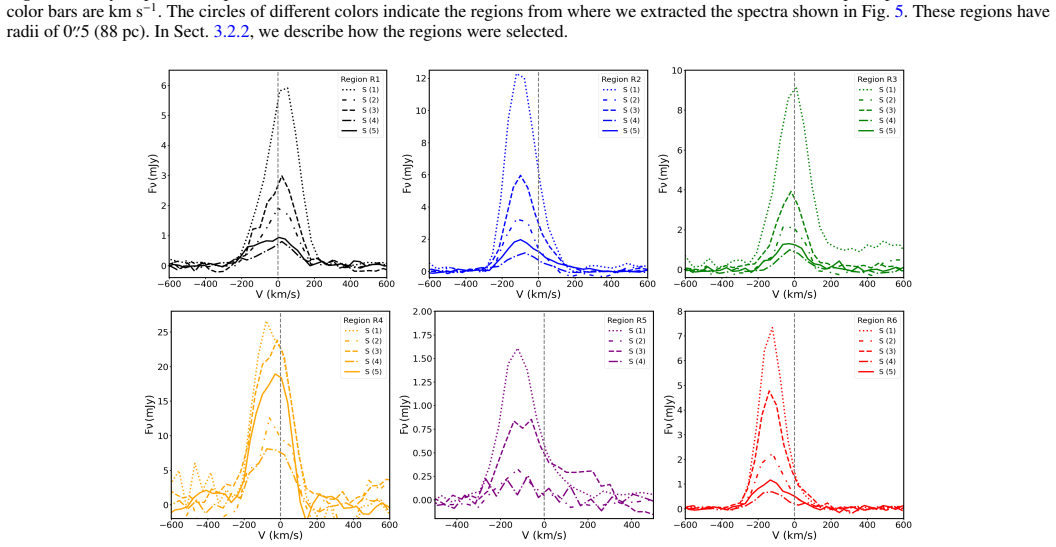
The central claim is a temperature stratification of the molecular interstellar medium in MCG-05-23-16, seen by mapping five H$_2$ pure-rotational lines together with CO(2-1). The cold gas forms a ~350 pc nuclear trailing spiral connected to a ~1.4 kpc ring, with roughly regular rotation reaching $\pm 250$ km s$^{-1}$ and residual velocities along the minor axis that the authors attribute to inflow on elliptical orbits in a barred potential. The warmer H$_2$ transitions show more disturbed kinematics, including clumps with velocity dispersion up to about 160 km s$^{-1}$, located precisely where CO(2-1) is absent. One such clump, R5, about 350 pc west of the nucleus, has redshifted velocities on the blueshifted side of the galaxy, a 'forbidden' position in the rotation model, and the paper interprets it as outflowing warm gas most plausibly driven by localized star formation rather than by the ~200 pc VLA jet, which shows no spatial association with the molecular gas. The paper concludes that cold molecular gas rotates and flows inward while warmer, higher-dispersion molecular gas occupies the inter-arm volume, and that the AGN jet does not significantly affect the molecular gas disk.
Load-bearing premise
All the dynamical interpretations assume that one 3DBAROLO tilted-ring rotating disk is the correct baseline for the CO and H$_2$ kinematics, and that the southeast side of the galaxy is the near side because it is more extincted; if those assumptions fail, the inferred inflows and the R5 outflow weaken, although the observed temperature stratification would survive.
Editorial extensions
If this is right
- Molecular gas is being delivered to the AGN through a bar-driven trailing spiral and ring, so AGN fueling in this S0 galaxy appears to work by secular inflow rather than by a major merger.
- Warm and cold molecular gas are spatially anti-correlated in the central kiloparsec, so studies that trace only CO can miss the turbulent warm phase that fills the inter-arm regions.
- If the R5 knot is an outflow, star formation rather than the AGN jet can drive warm molecular outflows in a Seyfert galaxy, with a mass loading factor below 0.8 relative to the local star formation rate.
- The warm molecular gas mass is less than 5 percent of the cold gas mass in the central 630 pc under the adopted Milky-Way conversion factor, so the warm phase is a small but kinematically distinct reservoir.
- The compact jet's lack of a detectable effect on the molecular gas implies that jet-disk orientation is a decisive factor for whether AGN feedback disturbs the cold ISM.
Reading between the lines
- If this stratification is generic, other barred Seyferts observed with JWST and ALMA should show high-dispersion warm H$_2$ filling the gaps between CO spiral arms and rings; that is a testable prediction for a small survey.
- The R5 outflow may belong to a broader class of star-formation-driven molecular outflows located near the ends of nuclear spirals or bars, well away from the jet axis; similar knots should appear in other galaxies where PAH emission coincides with high-dispersion H$_2$.
- The apparent non-interaction between the jet and the molecular gas could be a resolution or projection effect; deeper ALMA observations at sub-100 pc scales might reveal jet-induced turbulence that the current 70 pc beam washes out.
- Because S(5) was outside the field at R5, the clump's temperature rests on a single-component fit and is uncertain; obtaining S(5) coverage there would test whether the 'outflowing' gas is truly hot and excited or merely blended kinematic components.
Signed reviews
Editorial analysis
A structured set of objections, weighed in public.
Referee Report
Summary. This paper presents JWST/MIRI MRS observations of the pure-rotational H2 lines S(1) through S(5) together with ALMA CO(2-1) observations of the Seyfert galaxy MCG-05-23-16, and combines them with archival HST and VLA images. The authors map fluxes, velocities, and velocity dispersions of the warm molecular gas, compare them with the CO morphology and kinematics, fit a single tilted-ring rotating-disc model with 3DBAROLO to CO(2-1), H2 S(1), and S(3), extract position-velocity diagrams along selected axes, and derive rotational-diagram temperatures, column densities, and masses for six regions. The central claim is a stratification of the molecular gas: the colder gas traced by CO(2-1), S(1), and S(2) lies in the nuclear spiral, ring, and connecting arms, whereas warmer gas traced by S(3) through S(5) fills the inter-arm regions and shows high velocity dispersions, with one knot (R5) at about 350 pc west of the nucleus interpreted as a possible star-formation-driven molecular outflow. The paper also reports non-circular motions along the kinematic minor axis, attributed to bar-driven inflow, and concludes that the compact VLA jet does not significantly affect the molecular gas.
Significance. If the claims hold, the paper provides one of the few spatially resolved comparisons of cold and warm molecular gas kinematics in a Seyfert galaxy, exploiting the complementary resolutions of JWST/MIRI and ALMA. The morphological stratification - cold gas in the nuclear spiral, ring, and connecting arms, and warmer, more turbulent gas in the inter-arm regions - is directly supported by the maps and the S(1)/S(3) excitation map, and it is a testable and potentially important result for barred galaxies and AGN fueling. The paper also demonstrates a useful methodological approach by combining 3DBAROLO residual analysis with PVDs for warm H2 lines, and the authors are appropriately cautious in presenting the outflow mass as an upper limit. However, the dynamical sub-claims (inflow and the R5 outflow) rest on assumptions about the disc model and the near/far-side geometry that are not yet cross-checked; these need to be strengthened before the kinematic interpretation can be considered secure.
major comments (4)
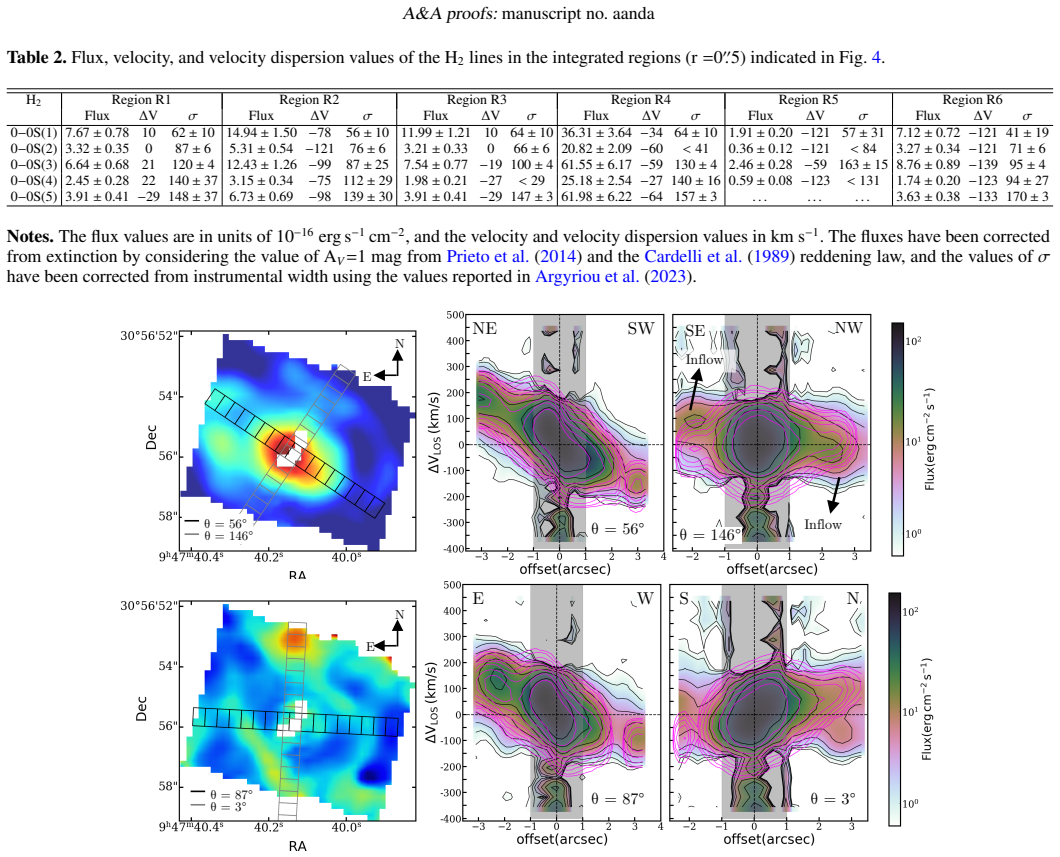
- [Sect. 4, near/far-side geometry] The interpretation of the minor-axis residuals as inflow and of the R5 knot as outflow in Sect. 4 rests on the near/far-side assignment (southeast near, northwest far, based on dust extinction). Since the residual velocities are computed relative to a single 3DBAROLO rotating-disc model, flipping this geometric assignment would reverse the sign of the radial residual pattern and would change the R5 interpretation from outflow to a motion on the blueshifted side of the galaxy. Please test the alternative near/far-side geometry explicitly, for example by re-deriving the residual maps and PVDs under the opposite assignment or by using a kinematic model with the two possible sides, and show how the inflow and outflow claims fare in each case.
- [Sect. 3.2.3] The 3DBAROLO fits return very different inclinations for CO (i=75 degrees) and for H2 S(1) (i=33 degrees) and S(3) (i=37 degrees), which the paper attributes to the smaller MIRI FOV. Because the residuals that define the non-circular motions are computed with respect to these fitted models, the amplitude and sign of the residual velocities are sensitive to the adopted inclination and position angle, which are not given error bars or systematically explored. Please provide a quantitative exploration of the allowed range of (i, PA) for each tracer (for example, fixed versus free fits or a grid of models) and show how the residual maps and the R5 PVD change within that range.
- [Sect. 3.2.3, Fig. 7] The R5 outflow claim is based on a single pseudo-slit PVD along PA=87 degrees and on the residual moment maps of S(3). The paper notes that BAROLO cannot reproduce the high central velocity dispersions but does not propagate this limitation into the outflow interpretation, and no independent check on the full datacube is presented. Please verify the R5 red wing with a two-Gaussian decomposition of the S(3) line in that aperture and/or with channel maps covering the velocities around +350 km/s, so that the non-circular component is confirmed independently of the model subtraction.
- [Sect. 4, paragraph beginning 'The mass of the H2 knot'] In Sect. 4 the mass outflow rate is computed as Mdot_out = M_R5 times v_out divided by r_out, using the total mass of R5 (about 4000 solar masses), a representative velocity of about 200 km/s, and r=88 pc, with the caveat that only part of the gas is actually outflowing. As stated, this makes the upper limit (<0.01 solar masses per year) not directly comparable to the SFR of 0.013 solar masses per year, since the numerator and denominator refer to different gas components. A two-component line fit that isolates the outflowing part of R5 would provide a self-consistent mass-outflow rate and a firmer basis for the mass-loading comparison.
minor comments (6)
- [Throughout] The paper switches between '3DBAROLO' and 'BAROLO' (for example in Sect. 3.2.3 and in Fig. B.3); please use the full name consistently or define the abbreviation once.
- [Fig. 3 caption] In the caption of Fig. 3, the beam sizes are quoted as '0.14 x 0.30 and 0.68 x 0.83' without units; please add arcseconds.
- [Sect. 3.2.1] The statement that 'if we subtract the S(5) from the S(1) velocity map' is not illustrated; consider adding a residual map to make this comparison quantitative.
- [Sect. 3.2.3] The central positions used for the 3DBAROLO fits are given in the text for S(1) and S(3), but the adopted coordinate for the CO fit is only described as the peak of the 200 GHz continuum; please list the actual coordinates for all three tracers for reproducibility.
- [Table 2 caption] In Table 2, several sigma entries are quoted as '< 41', '< 84', '< 29', and '< 131' km/s, but the table caption does not explain whether these are upper limits from non-detections or from the fitting; please clarify the notation.
- [Abstract and Conclusions] The abstract carefully says the R5 kinematics 'are consistent with outflowing gas', while the conclusions repeat the claim without the 'consistent with' caveat; consider harmonizing the strength of the wording.
Circularity Check
No significant circularity: the stratification and R5 outflow claims are independent of the fitted models and self-citations.
full rationale
The paper's central claims are derived from direct imaging, line-profile fitting, moment maps, 3DBAROLO model subtraction, and position-velocity diagrams. None of these steps defines its output in terms of its input: the two-temperature and power-law rotational-diagram fits take measured H2 line fluxes as input and produce temperatures, column densities, and masses as output; the molecular-gas stratification is a spatial anti-correlation between CO(2-1) and the warmer H2 transitions that is directly visible in the moment maps; and the R5 outflow interpretation is a residual from a rotating-disc model fitted to the full datacube, with the excess appearing in a 'forbidden' quadrant of the rotation pattern rather than being enforced by the model. The near/far-side geometry used to interpret minor-axis residuals as inflow comes from an external extinction argument, not from the model output. The paper does cite prior work by overlapping authors for data-reduction methods and for the utility of PAH emission as a star-formation tracer, but these citations are not load-bearing for the kinematic or morphological conclusions, which are tested against the independent ALMA and JWST data presented here. The paper explicitly acknowledges that 3DBAROLO cannot reproduce the high central velocity dispersions, which is a modeling limitation relevant to robustness but not a circular reduction. No equation or fitted parameter is renamed as a prediction, and no uniqueness or ansatz is imported from the authors' prior work. Therefore no significant circularity is present; the residual concerns are correctness risks rather than logical circularity.
Assumptions & free parameters
free parameters (4)
- Extinction correction A_V =
1 mag (from Prieto et al. 2014)
- CO-to-H2 conversion factor alpha_CO =
4.36 (K km/s pc^2)^-1, with alternatives 0.8 and 0.40-0.61 considered
- CO line ratio R21 =
1 (assumed)
- 3DBAROLO disc orientation (i, PA) =
CO: i=75 deg, PA=59 deg; S(1): i=33 deg, PA=56 deg; S(3): i=37 deg, PA=61 deg
assumptions (5)
- domain assumption The H2 rotational lines are emitted under LTE conditions.
- domain assumption MCG-05-23-16 hosts a nuclear bar that drives the spiral and ring structure and non-circular motions.
- domain assumption The southeast side of the galaxy is the near side.
- domain assumption Assumed cosmology and redshift z=0.008486 from Kawamuro et al. 2016.
- domain assumption A single rotating tilted-ring disc is an adequate baseline for the molecular gas kinematics.
Cite this review
Pith. "Pith review of Molecular gas stratification and disturbed kinematics in the Seyfert galaxy MCG-05-23-16 revealed by JWST and ALMA." pith.science (2026). https://pith.science/paper/7VLQBWFW
@misc{pith2026241112398,
  author       = {Pith},
  title        = {Pith review of: Molecular gas stratification and disturbed kinematics in the Seyfert galaxy MCG-05-23-16 revealed by JWST and ALMA},
  year         = {2026},
  howpublished = {\url{https://pith.science/paper/7VLQBWFW}},
  note         = {Machine review of arXiv:2411.12398}
}
abstract
Understanding the processes that drive the morphology and kinematics of molecular gas in galaxies is crucial for comprehending star formation and, ultimately, galaxy evolution. Using data obtained with the James Webb Space Telescope (JWST) and the Atacama Large Millimeter/submillimeter Array (ALMA), we study the behavior of the warm molecular gas at temperatures of hundreds of Kelvin and the cold molecular gas at tens of Kelvin in the galaxy MCG$-$05$-$23$-$16, which hosts an active galactic nucleus (AGN). Hubble Space Telescope (HST) images of this spheroidal galaxy, classified in the optical as S0, show a dust lane resembling a nuclear spiral and a surrounding ring. These features are also detected in CO(2$-$1) and H2, and their morphologies and kinematics are consistent with rotation plus local inward gas motions along the kinematic minor axis in the presence of a nuclear bar. The H2 transitions 0-0 S(3), 0-0 S(4), and 0-0 S(5), which trace warmer and more excited gas, show more disrupted kinematics than 0-0 S(1) and 0-0 S(2), including clumps of high-velocity dispersion (of up to $\sim$ 160 km/s), in regions devoid of CO(2$-$1). The kinematics of one of these clumps, located at $\sim$ 350 pc westward from the nucleus, are consistent with outflowing gas, possibly driven by localized star formation traced by Polycyclic Aromatic Hydrocarbon (PAH) emission at 11.3 ${\mu}$m. Overall, we observe a stratification of the molecular gas, with the colder gas located in the nuclear spiral, ring, and connecting arms, while most warmer gas with higher velocity-dispersion fills the inter-arm space. The compact jet, approximately 200 pc in size, detected with Very Large Array (VLA) observations, does not appear to significantly affect the distribution and kinematics of the molecular gas, possibly due to its limited intersection with the molecular gas disc.
Figures


Figures from the paper (8 more)



Reference graph
Works this paper leans on
-
[1]
Alonso-Herrero, A., García-Burillo, S., Hönig, S. F., et al. 2021, A&A, 652, A99. Álvarez-Márquez, J., Labiano, A., Guillard, P., et al. 2023, A&A, 672, A108. Argyriou, I., Glasse, A., Law, D. R., et al. 2023, A&A, 675, A111. Asmus, D., Gandhi, P., Hönig, S. F., et al. 2015, MNRAS, 454,
work page 2021
-
[8]
1964, Astrophysica Norvegica, 9, 103 Liu, V ., Zoghbi, A., & Miller, J
Lindblad, B. 1964, Astrophysica Norvegica, 9, 103 Liu, V ., Zoghbi, A., & Miller, J. M. 2024, ApJ, 963,
work page 1964
-
[9]
Hicks, E. K. S., Davies, R. I., Malkan, M. A., et al. 2009, ApJ, 696,
work page 2009
-
[14]
Kim, W.-T. & Elmegreen, B. G. 2017, ApJ, 841, L4. Kolcu, T., Maciejewski, W., Gadotti, D. A., et al. 2023, MNRAS, 524,
work page 2017
-
[17]
Hermosa Muñoz, L., Alonso-Herrero, A., Pereira-Santaella, M., et al. 2024, A&A, 690, A350. Herrera-Camus, R., Janssen, A., Sturm, E., et al. 2020, A&A, 635, A47. Hickox, R. C., Mullaney, J. R., Alexander, D. M., et al. 2014, ApJ, 782,
work page 2024
-
[26]
Olivares, V ., Su, Y ., Nulsen, P., et al. 2022, MNRAS, 516, L101. Orienti, M. & Prieto, M. A. 2010, MNRAS, 401,
work page 2022
- [31]
- [38]
Show all 68 references
-
[39]
& Chattopadhyay, T
Mondal, D. & Chattopadhyay, T. 2021, Celestial Mechanics and Dynamical As- tronomy, 133,
2021
-
[41]
R., Ostriker, E
Narayanan, D., Krumholz, M. R., Ostriker, E. C., et al. 2012, MNRAS, 421,
2012
-
[43]
G., Ferruit, P., Nagar, N., et al
Mundell, C. G., Ferruit, P., Nagar, N., et al. 2009, ApJ, 703,
2009
-
[55]
P., et al
Pereira-Santaella, M., Spinoglio, L., van der Werf, P. P., et al. 2014, A&A, 566, A49. Pereira-Santaella, M., Colina, L., García-Burillo, S., et al. 2018, A&A, 616, A171. Pereira-Santaella, M., Álvarez-Márquez, J., García-Bernete, I., et al. 2022, A&A, 665, L11. Prieto, M. A.,...
2014
-
[57]
2021, MN- RAS, 507,
Ruschel-Dutra, D., Storchi-Bergmann, T., Schnorr-Müller, A., et al. 2021, MN- RAS, 507,
2021
-
[60]
T., Davies, R
Shimizu, T. T., Davies, R. I., Lutz, D., et al. 2019, MNRAS, 490,
2019
-
[61]
M., & Vanden Bout, P
Solomon, P. M., & Vanden Bout, P. A. 2005, ARA&A, 43,
2005
-
[71]
Harrison, C. M. & Ramos Almeida, C. 2024, Galaxies, 12,
2024
-
[74]
Sanders, R. H. & Tubbs, A. D. 1980, ApJ, 235,
1980
-
[103]
D., Wolfire, M., & Leroy, A
Bolatto, A. D., Wolfire, M., & Leroy, A. K. 2013, ARA&A, 51,
2013
-
[105]
I., Thomas, J., Genzel, R., et al
Davies, R. I., Thomas, J., Genzel, R., et al. 2006, ApJ, 646,
2006
-
[111]
2011, ApJ, 733, L16
Sturm, E., González-Alfonso, E., Veilleux, S., et al. 2011, ApJ, 733, L16. Tremaine, S., Gebhardt, K., Bender, R., et al. 2002, ApJ, 574,
2011
-
[114]
2020, MNRAS, 498,
Davies, R., Baron, D., Shimizu, T., et al. 2020, MNRAS, 498,
2020
-
[124]
& Merritt, D
Ferrarese, L. & Merritt, D. 2000, ApJ, 539, L9. Ferruit, P., Wilson, A. S., & Mulchaey, J. 2000, ApJS, 128,
2000
-
[139]
2022, A&A, 666, L5
García-Bernete, I., Rigopoulou, D., Alonso-Herrero, A., et al. 2022, A&A, 666, L5. García-Bernete, I., Alonso-Herrero, A., Rigopoulou, D., et al. 2024, A&A, 681, L7. Article number, page 13 of 19 A&A proofs: manuscript no. aanda García-Bernete, I., Rigopoulou, D., Donnan, F. R...
2022
-
[140]
M., Rieke G
Diamond-Stanic A. M., Rieke G. H. 2012, ApJ, 746,
2012
-
[148]
I., Sternberg, A., Lehnert, M
Davies, R. I., Sternberg, A., Lehnert, M. D., et al. 2005, ApJ, 633,
2005
-
[155]
Bushouse, H., Eisenhamer, J., Dencheva, N., et al
Lecture 2: Barred and spiral galaxies. Bushouse, H., Eisenhamer, J., Dencheva, N., et al. 2023, Zenodo. JWST Calibra- tion Pipeline (1.10.2). Zenodo. https://doi.org/10.5281/zenodo.7829329 Cardelli, J. A., Clayton, G. C., & Mathis, J. S. 1989, ApJ, 345,
2023 doi
-
[159]
A., Sheth, K., Helou, G., et al
Dale, D. A., Sheth, K., Helou, G., et al. 2005, AJ, 129,
2005
-
[168]
Di Teodoro, E. M. & Fraternali, F. 2015, MNRAS, 451,
2015
-
[195]
2024, ApJ, 975, L2
Zhang, L., García-Bernete, I., Packham, C., et al. 2024, ApJ, 975, L2. Zoghbi, A., Cackett, E. M., Reynolds, C., et al. 2014, ApJ, 789,
2024
-
[207]
Briggs, D. S. 1995, Ph.D. Thesis, New Mexico Institute of Mining and Technol- ogy Buta, R. & Combes, F. 1996, Fund. Cosmic Phys., 17, 95 Buta, R. J. 2013, Secular Evolution of Galaxies,
1995
-
[235]
2022, MNRAS, 516,
Marinucci, A., Muleri, F., Dovciak, M., et al. 2022, MNRAS, 516,
2022
-
[245]
& Tielens, A
Cazaux, S. & Tielens, A. G. G. M. 2002, ApJ, 575, L29. Cohen, D. P., Turner, J. L., & Consiglio, S. M. 2020, MNRAS, 493,
2002
-
[301]
Regan, M. W. & Teuben, P. 2003, ApJ, 582,
2003
-
[323]
H., Hardcastle, M
Ineson, J., Croston, J. H., Hardcastle, M. J., et al. 2015, MNRAS, 453,
2015
-
[374]
Rodríguez-Ardila, A., Riffel, R., & Pastoriza, M. G. 2005, MNRAS, 364,
2005
-
[411]
2014, A&A, 565, A97
Combes, F., García-Burillo, S., Casasola, V ., et al. 2014, A&A, 565, A97. Dale, D. A. & Helou, G. 2002, ApJ, 576,
2014
-
[448]
Higdon, S. J. U., Armus, L., Higdon, J. L., et al. 2006, ApJ, 648,
2006
-
[521]
2005, Space Sci
Habart, E., Walmsley, M., Verstraete, L., et al. 2005, Space Sci. Rev., 119,
2005
-
[547]
2024, A&A, 681, A117
Pereira-Santaella, M., González-Alfonso, E., García-Bernete, I., et al. 2024, A&A, 681, A117. Peralta de Arriba, L., Alonso-Herrero, A., García-Burillo, S., et al. 2023, A&A, 675, A58. Pereira-Santaella, M., Spinoglio, L., Busquet, G., et al. 2013, ApJ, 768,
2024
-
[581]
2016, Proc
Labiano, A., Azzollini, R., Bailey, J., et al. 2016, Proc. SPIE, 9910, 99102W. doi:10.1117/12.2232554 Labiano, A., Argyriou, I., Álvarez-Márquez, J., et al. 2021, A&A, 656, A57. Le Bourlot, J., Pineau des Forêts, G., & Flower, D. R. 1999, MNRAS, 305,
2016 doi
-
[595]
S., Rieke, G
Wright, G. S., Rieke, G. H., Glasse, A., et al. 2023, PASP, 135, 048003. Zhang, L. & Ho, L. C. 2023, ApJ, 953, L9. Zhang, L., Packham, C., Hicks, E. K. S., et al. 2024, ApJ, 974,
2023
-
[627]
2003, Active Galactic Nuclei: From Central Engine to Host Galaxy, 290,
Combes, F. 2003, Active Galactic Nuclei: From Central Engine to Host Galaxy, 290,
2003
-
[665]
2002, A&A, 389,
Rigopoulou, D., Kunze, D., Lutz, D., et al. 2002, A&A, 389,
2002
-
[677]
C., Sobacchi, E., & Sanders, J
Sormani, M. C., Sobacchi, E., & Sanders, J. L. 2024, MNRAS, 528,
2024
-
[723]
H., Ressler, M
Rieke, G. H., Ressler, M. E., Morrison, J. E., et al. 2015, PASP, 127,
2015
-
[740]
& Véron, P
Véron-Cetty, M.-P. & Véron, P. 2006, A&A, 455,
2006
-
[754]
I., Maciejewski, W., Hicks, E
Davies, R. I., Maciejewski, W., Hicks, E. K. S., et al. 2009, ApJ, 702,
2009
-
[766]
2019, A&A, 632, A33
Audibert, A., Combes, F., García-Burillo, S., et al. 2019, A&A, 632, A33. Audibert, A., Combes, F., García-Burillo, S., et al. 2021, A&A, 656, A60. Audibert, A., Ramos Almeida, C., García-Burillo, S., et al. 2023, A&A, 671, L12. Bianchin, M., U, V ., Song, Y ., et al. 2024, ApJ, 965,
2019
-
[773]
S., Wright, D., Goodson, G
Wright, G. S., Wright, D., Goodson, G. B., et al. 2015, PASP, 127,
2015
-
[802]
J., Spoon, H
Lebouteiller, V ., Barry, D. J., Spoon, H. W. W., et al. 2011, ApJS, 196,
2011
-
[803]
O., Mast, D., Díaz, R
Schmidt, E. O., Mast, D., Díaz, R. J., et al. 2019, AJ, 158,
2019
-
[959]
N., Malkan, M
Runco, J. N., Malkan, M. A., Fernández-Ontiveros, J. A., et al. 2020, ApJ, 905,
2020
-
[1011]
& Combes, F
García-Burillo, S. & Combes, F. 2012, Journal of Physics Conference Series, 372, 012050. García-Burillo, S., Alonso-Herrero, A., Ramos Almeida, C., et al. 2021, A&A, 652, A98. García-Burillo, S., Hicks, E. K. S., Alonso-Herrero, A., et al. 2024, A&A, 689, A347. Gardner, J. P.,...
2012
-
[1041]
J., et al
Roussel, H., Helou, G., Hollenbach, D. J., et al. 2007, ApJ, 669,
2007
-
[1379]
2022, A&A, 658, A155
Ramos Almeida, C., Bischetti, M., García-Burillo, S., et al. 2022, A&A, 658, A155. Ramos Almeida, C., Esparza-Arredondo, D., González-Martín, O., et al. 2023, A&A, 669, L5. Reeves, J. N., Awaki, H., Dewangan, G. C., et al. 2007, PASJ, 59,
2022
-
[2145]
H., Combes, F., Carignan, C., et al
Randriamampandry, T. H., Combes, F., Carignan, C., et al. 2015, MNRAS, 454,
2015
-
[2197]
I., Tacconi, L
Davies, R. I., Tacconi, L. J., & Genzel, R. 2004, ApJ, 602,
2004
-
[2285]
2004, The Interplay Among Black Holes, Stars and ISM in Galactic Nuclei, 222,
Martini, P. 2004, The Interplay Among Black Holes, Stars and ISM in Galactic Nuclei, 222,
2004
-
[2599]
Pence, W. D. & Blackman, C. P. 1984, MNRAS, 210,
1984
-
[2682]
2016, ApJS, 225,
Kawamuro, T., Ueda, Y ., Tazaki, F., et al. 2016, ApJS, 225,
2016
-
[3021]
J., Alonso-Herrero, A., García-Burillo, S., et al
Domínguez-Fernández, A. J., Alonso-Herrero, A., García-Burillo, S., et al. 2020, A&A, 643, A127. Dubois, Y ., Peirani, S., Pichon, C., et al. 2016, MNRAS, 463,
2020
-
[3127]
S., Ostriker, J
Novak, G. S., Ostriker, J. P., & Ciotti, L. 2011, ApJ, 737,
2011
-
[3743]
M., & Acosta-Pulido, J
Ramos Almeida, C., Pérez García, A. M., & Acosta-Pulido, J. A. 2009, ApJ, 694,
2009
-
[3948]
2018, ApJ, 859,
Esparza-Arredondo, D., González-Martín, O., Dultzin, D., et al. 2018, ApJ, 859,
2018
-
[4150]
2024, A&A, 689, A263
Davies, R., Shimizu, T., Pereira-Santaella, M., et al. 2024, A&A, 689, A263. Diamond-Stanic, A. M. & Rieke, G. H. 2010, ApJ, 724,
2024
-
[5742]
A., et al
Speranza, G., Ramos Almeida, C., Acosta-Pulido, J. A., et al. 2024, A&A, 681, A63. Stone, M., Veilleux, S., Meléndez, M., et al. 2016, ApJ, 826,
2024
-
[5860]
V ., Papovich, C., Rieke, G
Shipley, H. V ., Papovich, C., Rieke, G. H., et al. 2016, ApJ, 818,
2016
-
[5907]
P., Waters, B., Schiebel, D., et al
McMullin, J. P., Waters, B., Schiebel, D., et al. 2007, Astronomical Data Analy- sis Software and Systems XVI, 376, 127 Meenakshi, M., Mukherjee, D., Wagner, A. Y ., et al. 2022, MNRAS, 516,
2007
Reviewed August 12, 2026 · model on record in the stance chip above.
Discussion (0). Continue with ORCID to comment.