REVIEW 4 major objections 4 minor 59 references
Heterogeneous User Modeling for LLM-based Recommendation
T0 review · 4 major / 4 minor · reviewed 2026-08-06 · deepseek-v4-flash
Pith's one-line read HUM shows that an LLM recommender improves across six domains when user histories are compressed into a dedicated token and domain losses are reweighted.
desk verdict HUM is a reasonable engineering combination for multi-domain LLM recommendation with clear experiments, but a real internal inconsistency in the domain-importance formula undercuts the paper's robustness claim. read the letter →
The pith
A machine-rendered reading of the paper's core claim, the machinery that carries it, and where it could break.
The reading
What carries the argument
The mechanism is a two-part training recipe on a decoder-only LLM. The compression enhancer uses three elements: the instruction prompt "Compress the following description about the user or item into the last token:"; a trainable special token [USER] whose last-layer hidden vector serves as the user and item representation; and a masking step that randomly removes a fraction $r$ of target-domain items from the user history during training. The robustness enhancer computes a domain importance score $\mathrm{DI}_i = \mathcal{L}(d_i,\theta)/\sum_j \mathcal{L}(d_j,\theta)$ from average per-domain loss, smooths the weights via $w_i^t = w_i^{t-1} \exp(\alpha \mathcal{L}(d_i,\theta))/\sum_j w_j^{t-1} \exp(\alpha \mathcal{L}(d_j,\theta))$, and trains with the weighted sum of domain losses. The pairing is what carries the argument: compression improves the quality of each representation, and domain weighting keeps optimization balanced so that no single domain's improvement costs another domain's performance.
What would settle it
Run HUM on the same six Amazon domains with the mask ratio set to 0% and, separately, to 50% and 60%, keeping all other settings identical; if Recall@10 does not peak inside the tested 10-40% window and 0% masking matches or beats the reported gains, the claimed sweet spot for cross-domain masking is not a stable property of the method.
Extended reading notes
Core claim
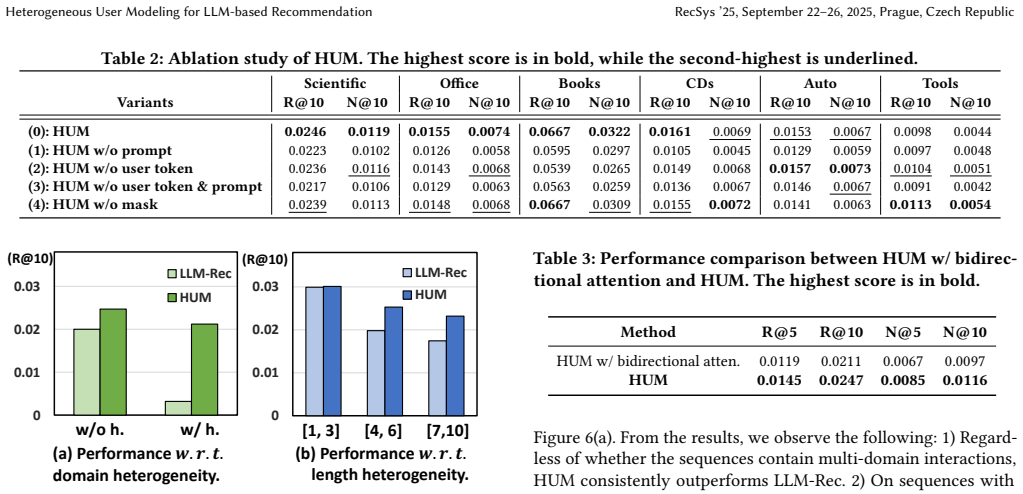
The central claim is that prior semantic- and ID-based heterogeneous user modeling methods fail at two tasks the authors say matter: compressing noisy multi-domain histories into a faithful user representation, and optimizing across domains without the domain seesaw phenomenon, where gains in one domain come at the cost of another. HUM addresses both. It obtains user and item representations as the last-layer hidden vector of a special [USER] token placed after a compression prompt and the item-title sequence, trains with a contrastive loss and negative items from the target domain, and randomly masks a fraction of target-domain items during training. The robustness enhancer defines a domain importance score as the share of total empirical loss contributed by each domain, smooths it with a KL-regularized update, and uses it to weight the domain losses. The paper reports that HUM outperforms all compared baselines on six Amazon domains and also generalizes to four unseen domains.
Load-bearing premise
The masking mechanism assumes that randomly deleting some of the already-purchased items from the target category teaches the model to borrow useful knowledge from other categories, without any extra supervision; if those deleted purchases are the only informative signal, masking can remove exactly what the model needs.
Editorial extensions
If this is right
- If the central claim holds, LLM-based recommenders can gain multi-domain ability through fine-tuning changes alone, without replacing the backbone or adding domain-specific modules.
- The [USER] token as an aggregation anchor transfers to unseen domains, which the paper demonstrates on Instruments, Games, Arts, and Sports.
- The domain importance score offers a general counterweight to the domain seesaw phenomenon and could be applied whenever multi-domain losses are combined.
- The masking mechanism turns target-domain item dropout into a noise-resilience training signal, so recommenders degrade more gracefully as interaction noise grows.
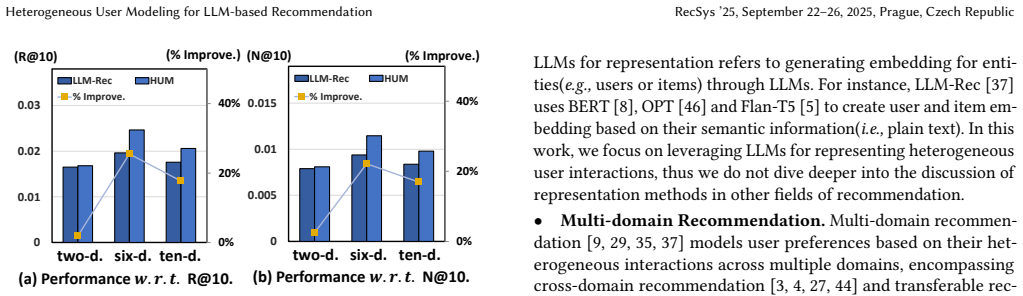
- HUM's performance advantage over the LLM baseline widens as heterogeneity increases from two to six to ten domains, suggesting the method is built for open-domain scale rather than just a narrow multi-domain setting.
Reading between the lines
- If the compression prompt mainly activates the LLM's pretrained summarization skill, equivalent gains should come from other phrasings of the same instruction; this is testable by varying the prompt while holding everything else fixed.
- The masking mechanism is a form of input dropout; it may combine with mask-ratio schedules or curriculum strategies, where early training masks more aggressively and later training masks less, to push the sweet spot beyond the fixed 10-40% range tested.
- The domain importance weighting is essentially empirical-risk reweighting, so the same formula could be applied to any multi-task LLM fine-tuning, not only recommendation; whether it helps depends on whether loss magnitude tracks under-optimization.
- A stronger test of 'transferable knowledge' would be to mask items from non-target domains instead of target-domain items; if that also helps, the mechanism is not specifically about cross-domain transfer.
Editorial analysis
A structured set of objections, weighed in public.
Referee Report
Summary. The paper proposes HUM, a method for heterogeneous user modeling in LLM-based multi-domain and open-domain recommendation. HUM combines a compression enhancer (a compression prompt, a dedicated [USER] aggregation token, and random masking of target-domain items) with a robustness enhancer (domain-importance weighting with KL smoothing) to improve recommendation accuracy and mitigate the domain seesaw phenomenon. The method is evaluated on six Amazon domains against ID-based and semantic-based baselines, with additional experiments on cold-start generalization, noise resistance, scalability, and component ablations. The authors report consistent improvements over baselines and state that code and data are publicly released.
Significance. If the reported results hold, HUM provides a simple, training-only recipe for improving LLM-based recommenders on heterogeneous user histories. The [USER] token and masking mechanism are broadly applicable ideas, and the paper includes extensive comparisons against eight baselines across six domains, ablation studies, cold-start generalization tests, and scalability experiments. The claimed code/data release is a useful strength for reproducibility. However, the central robustness mechanism as written is internally inconsistent, one results table contains impossible metric relationships, and the absence of variance reporting makes some close comparisons difficult to evaluate.
major comments (4)
- [Section 3.2, Eq. (7)] The definition of DI_i as "the average training loss per domain" is inconsistent with the expanded formula, which uses summed losses in both numerator and denominator. For unequal domain sizes this makes DI_i proportional to the number of samples in each domain, so the weights in Eqs. (8)–(10) would upweight the largest domain rather than the under-optimized one. Please state whether L(d_i, θ) denotes a per-sample average or a total, correct Eq. (7) to match that definition, and report which version is actually used in the experiments; the robustness claim from Figure 7 depends on this distinction.
- [Table 4] Within each block of Table 4, the reported R@10 is lower than R@5 and N@10 is lower than N@5 for every method and domain (e.g., Instruments, LLM-Rec: R@5=0.0052 vs R@10=0.0026; Games, HUM: R@5=0.0161 vs R@10=0.0094). Because Recall@K and NDCG@K are non-decreasing in K, these values cannot be correct as labelled. Please verify the column/row mapping and rerun or correct the table; the generalization analysis in Section 4.3.5 currently rests on invalid numbers.
- [Section 4.3.7 and Figure 10] The mask ratio r is selected by sweeping 10%–40%, but the paper does not state which data split is used for this selection. If r is chosen using the test domains, the masking benefit and the final results are inflated by test-set tuning. Please specify the validation procedure used for selecting r, and report the chosen value of r in the final configuration.
- [Tables 1–4 and Figures 6–10] No error bars, number of runs, or significance tests are reported anywhere in the experiments. Several differences are small, and at least one metric goes against the overall trend (e.g., Tools N@5 in Table 1: HUM 0.0029 vs LLM-Rec 0.0031), so the repeated claim that HUM "consistently outperforms" baselines is not statistically supported as presented. Please report variance over multiple seeds or provide significance tests for the main comparisons.
minor comments (4)
- [Section 4.3.1 and Table 2] The text says the masking mechanism "enhances model performance" without qualification, but Table 2 shows that removing the mask improves Tools R@10 and N@10 (0.0113 vs 0.0098 and 0.0054 vs 0.0044, respectively); please add the caveat or explain the discrepancy.
- [Eq. (5)] The contrastive loss in Eq. (5) is written as a sum over the batch without normalization by B; if the implementation averages over the batch, the equation should be updated to match the actual objective.
- [Section 4.1.4] The hyperparameters α in Eq. (9) and the domain-importance update period t are not reported; please include the selected values and the criterion used to select them.
- [Figure 7] The axis labels and legend in Figure 7 are small and hard to read; please enlarge the fonts and clarify that the plotted values are R@10.
Circularity Check
No circularity: HUM's components are training-time heuristics evaluated on held-out Amazon benchmarks; the DI reweighting and citations are not self-referential reductions.
full rationale
The central claim is an empirical performance comparison on held-out Amazon domains, with full-ranking Recall@K and NDCG@K metrics against independent baselines. The compression prompt, [USER] token, masking mechanism, and domain importance score are all training-time components optimized with the contrastive loss in Eq. (5); none of them is defined in terms of the measured recommendation metrics, and the ablations in Table 2 and Figure 7 test each component against otherwise identical variants. The domain importance score in Eq. (7) reweights the training loss using current per-domain losses, which is a feedback heuristic (similar in spirit to reweighting methods), not a prediction derived from the data it is claimed to predict; the reported robustness gains are empirical and could plausibly fail. Self-citations, e.g., [23] for the KKT-based closed-form update in Eq. (9), support a standard optimization device whose formula is stated in the paper and is not the load-bearing justification for the main result. The noted discrepancy between the prose description of DI as an average loss and the total-loss form in Eq. (7) is an internal consistency or correctness concern, not a circularity, since it does not make the evaluation equivalent to the training objective. Overall, the derivation chain is self-contained with respect to external benchmarks, so no circular step is present.
Assumptions & free parameters
free parameters (4)
- mask ratio r =
20% (sweet spot in Figure 10; swept 10-40%)
- smoothing factor alpha =
not reported
- domain importance update period t =
50 steps (six-domain dataset)
- learning rate =
selected from {1e-5, 2e-5, 5e-5}
assumptions (4)
- domain assumption Randomly masking target-domain items forces the model to learn transferable cross-domain knowledge without explicit supervision.
- domain assumption A domain's average training loss is a valid proxy for how under-optimized that domain is.
- domain assumption A decoder-only LLM can compress a heterogeneous item sequence into a single token representation that retains preference information.
- standard math The KKT closed-form solution for the KL-regularized weight update (Eq. 9) is applicable.
invented entities (1)
-
[USER] token
Cite this review
Pith. "Pith review of Heterogeneous User Modeling for LLM-based Recommendation." pith.science (2026). https://pith.science/paper/7W7Y33YR
@misc{pith2026250704626,
  author       = {Pith},
  title        = {Pith review of: Heterogeneous User Modeling for LLM-based Recommendation},
  year         = {2026},
  howpublished = {\url{https://pith.science/paper/7W7Y33YR}},
  note         = {Machine review of arXiv:2507.04626}
}
read the original abstract
Leveraging Large Language Models (LLMs) for recommendation has demonstrated notable success in various domains, showcasing their potential for open-domain recommendation. A key challenge to advancing open-domain recommendation lies in effectively modeling user preferences from users' heterogeneous behaviors across multiple domains. Existing approaches, including ID-based and semantic-based modeling, struggle with poor generalization, an inability to compress noisy interactions effectively, and the domain seesaw phenomenon. To address these challenges, we propose a Heterogeneous User Modeling (HUM) method, which incorporates a compression enhancer and a robustness enhancer for LLM-based recommendation. The compression enhancer uses a customized prompt to compress heterogeneous behaviors into a tailored token, while a masking mechanism enhances cross-domain knowledge extraction and understanding. The robustness enhancer introduces a domain importance score to mitigate the domain seesaw phenomenon by guiding domain optimization. Extensive experiments on heterogeneous datasets validate that HUM effectively models user heterogeneity by achieving both high efficacy and robustness, leading to superior performance in open-domain recommendation.
Figures


Figures from the paper (4 more)


Reference graph
Works this paper leans on
-
[1]
Keqin Bao, Jizhi Zhang, Yang Zhang, Wenjie Wang, Fuli Feng, and Xiangnan He
-
[2]
Tom B. Brown, Benjamin Mann, Nick Ryder, Melanie Subbiah, Jared Kaplan, Prafulla Dhariwal, Arvind Neelakantan, Pranav Shyam, Girish Sastry, Amanda Askell, Sandhini Agarwal, Ariel Herbert-Voss, Gretchen Krueger, Tom Henighan, Rewon Child, Aditya Ramesh, Daniel M. Ziegler, Jeffrey Wu, Clemens Winter, Christopher Hesse, Mark Chen, Eric Sigler, Mateusz Litwin...
work page 2020
-
[3]
Jiangxia Cao, Xin Cong, Jiawei Sheng, Tingwen Liu, and Bin Wang. 2022. Con- trastive Cross-Domain Sequential Recommendation. In CIKM
work page 2022
-
[4]
Jiangxia Cao, Shaoshuai Li, Bowen Yu, Xiaobo Guo, Tingwen Liu, and Bin Wang
-
[5]
Hyung Won Chung, Le Hou, Shayne Longpre, Barret Zoph, Yi Tay, William Fedus, Yunxuan Li, Xuezhi Wang, Mostafa Dehghani, Siddhartha Brahma, et al. 2024. Scaling instruction-finetuned language models. JMLR (2024)
work page 2024
-
[6]
Towards Universal Cross-Domain Recommendation. In WSDM. ACM
-
[7]
Boyi Deng, Wenjie Wang, Fengbin Zhu, Qifan Wang, and Fuli Feng. 2025. Cram: Credibility-aware attention modification in llms for combating misinformation in rag. In AAAI. AAAI
work page 2025
-
[8]
Grégoire Delétang, Anian Ruoss, Paul-Ambroise Duquenne, Elliot Catt, Tim Genewein, Christopher Mattern, Jordi Grau-Moya, Li Kevin Wenliang, Matthew Aitchison, Laurent Orseau, et al. 2024. Language modeling is compression. In ICLR
work page 2024
Show all 59 references
-
[9]
Zichuan Fu, Xiangyang Li, Chuhan Wu, Yichao Wang, Kuicai Dong, Xiangyu Zhao, Mengchen Zhao, Huifeng Guo, and Ruiming Tang. 2024. A unified frame- work for multi-domain ctr prediction via large language models. TOIS (2024)
2024
-
[10]
Jacob Devlin, Ming-Wei Chang, Kenton Lee, and Kristina Toutanova. 2018. BERT: Pre-training of Deep Bidirectional Transformers for Language Understanding. arXiv preprint arXiv:1810.04805 (2018)
2018 arXiv
-
[11]
Yupeng Hou, Shanlei Mu, Wayne Xin Zhao, Yaliang Li, Bolin Ding, and Ji-Rong Wen. 2022. Towards Universal Sequence Representation Learning for Recom- mender Systems. In KDD
2022
-
[12]
Yupeng Hou, Jiacheng Li, Zhankui He, An Yan, Xiusi Chen, and Julian McAuley
-
[13]
Shen, Xinchi Qiu, Dongqi Cai, Yan Gao, and Nicholas D
Alex Iacob, Lorenzo Sani, Meghdad Kurmanji, William F. Shen, Xinchi Qiu, Dongqi Cai, Yan Gao, and Nicholas D. Lane. 2025. DEPT: Decoupled Embeddings for Pre-training Language Models. In ICLR
2025
-
[14]
Wang-Cheng Kang and Julian McAuley. 2018. Self-attentive sequential recom- mendation. In ICDM. IEEE, 197–206
2018
-
[15]
Edward J Hu, Yelong Shen, Phillip Wallis, Zeyuan Allen-Zhu, Yuanzhi Li, Shean Wang, Lu Wang, and Weizhu Chen. 2021. Lora: Low-rank adaptation of large language models. arXiv:2106.09685 (2021)
2021 arXiv
-
[16]
Xinhang Li, Chong Chen, Xiangyu Zhao, Yong Zhang, and Chunxiao Xing. 2024. E4SRec: An elegant effective efficient extensible solution of large language models for sequential recommendation. In WWW. ACM
2024
-
[17]
Yongqi Li, Xinyu Lin, Wenjie Wang, Fuli Feng, Liang Pang, Wenjie Li, Liqiang Nie, Xiangnan He, and Tat-Seng Chua. 2024. A Survey of Generative Search and Recommendation in the Era of Large Language Models. arXiv preprint arXiv:2404.16924 (2024)
2024 arXiv
-
[18]
Jiacheng Li, Ming Wang, Jin Li, Jinmiao Fu, Xin Shen, Jingbo Shang, and Julian McAuley. 2023. Text Is All You Need: Learning Language Representations for Sequential Recommendation. In KDD
2023
-
[19]
Jianghao Lin, Rong Shan, Chenxu Zhu, Kounianhua Du, Bo Chen, Shigang Quan, Ruiming Tang, Yong Yu, and Weinan Zhang. 2024. Rella: Retrieval-enhanced large language models for lifelong sequential behavior comprehension in recom- mendation. In WWW. ACM
2024
-
[20]
Xinyu Lin, Haihan Shi, Wenjie Wang, Fuli Feng, Qifan Wang, See-Kiong Ng, and Tat-Seng Chua. 2025. Order-agnostic Identifier for Large Language Model-based Generative Recommendation. In SIGIR. ACM
2025
-
[21]
Jianghao Lin, Bo Chen, Hangyu Wang, Yunjia Xi, Yanru Qu, Xinyi Dai, Kangning Zhang, Ruiming Tang, Yong Yu, and Weinan Zhang. 2024. ClickPrompt: CTR Models are Strong Prompt Generators for Adapting Language Models to CTR Prediction. In WWW. ACM
2024
-
[22]
Xinyu Lin, Wenjie Wang, Li Yongqi, Shuo Yang, Fuli Feng, Yinwei Wei, and Tat- Seng Chua. 2024. Data-efficient Fine-tuning for LLM-based Recommendation. In SIGIR. ACM
2024
-
[23]
Xinyu Lin, Wenjie Wang, Jujia Zhao, Yongqi Li, Fuli Feng, and Tat-Seng Chua
-
[24]
Xinyu Lin, Wenjie Wang, Yongqi Li, Fuli Feng, See-Kiong Ng, and Tat-Seng Chua
-
[25]
Bridging Items and Language: A Transition Paradigm for Large Language Model-Based Recommendation. In KDD. ACM
-
[26]
Qiyao Ma, Xubin Ren, and Chao Huang. 2025. XRec: Large Language Models for Explainable Recommendation. In EMNLP
2025
-
[27]
Tong Man, Huawei Shen, Xiaolong Jin, and Xueqi Cheng. 2017. Cross-Domain Recommendation: An Embedding and Mapping Approach. In IJCAI
2017
-
[28]
Temporally and distributionally robust optimization for cold-start recom- mendation. In AAAI. AAAI
-
[29]
Qijiong Liu, Nuo Chen, Tetsuya Sakai, and Xiao-Ming Wu. 2024. Once: Boosting content-based recommendation with both open-and closed-source large language models. In WSDM. ACM, 452–461
2024
-
[30]
Ilya Loshchilov and Frank Hutter. 2019. Decoupled weight decay regularization. ICLR
2019
-
[31]
Zhaopeng Qiu, Xian Wu, Jingyue Gao, and Wei Fan. 2021. U-BERT: Pre-training user representations for improved recommendation. In AAAI. AAAI
2021
-
[32]
Xubin Ren, Wei Wei, Lianghao Xia, Lixin Su, Suqi Cheng, Junfeng Wang, Dawei Yin, and Chao Huang. 2024. Representation Learning with Large Language Models for Recommendation. In WWW. ACM
2024
-
[33]
Arvind Neelakantan, Tao Xu, Raul Puri, Alec Radford, Jesse Michael Han, Jerry Tworek, Qiming Yuan, Nikolas Tezak, Jong Wook Kim, Chris Hallacy, et al
-
[34]
Xiang-Rong Sheng, Liqin Zhao, Guorui Zhou, Xinyao Ding, Binding Dai, Qiang Luo, Siran Yang, Jingshan Lv, Chi Zhang, Hongbo Deng, et al. 2021. One model to serve all: Star topology adaptive recommender for multi-domain ctr prediction. In CIKM. ACM
2021
-
[35]
Chung Park, Taesan Kim, Hyungjun Yoon, Junui Hong, Yelim Yu, Mincheol Cho, Minsung Choi, and Jaegul Choo. 2024. Pacer and Runner: Cooperative Learning Framework between Single-and Cross-Domain Sequential Recommendation. In SIGIR. ACM
2024
-
[36]
Tushar Prakash, Raksha Jalan, Brijraj Singh, and Naoyuki Onoe. 2023. Cr-sorec: Bert driven consistency regularization for social recommendation. In RecSys. ACM
2023
-
[37]
Zuoli Tang, Zhaoxin Huan, Zihao Li, Xiaolu Zhang, Jun Hu, Chilin Fu, Jun Zhou, and Chenliang Li. 2023. One model for all: Large language models are domain- agnostic recommendation systems. arXiv preprint arXiv:2310.14304 (2023)
2023 arXiv
-
[38]
Qwen Team. 2024. Qwen2.5: A Party of Foundation Models. https://qwenlm. github.io/blog/qwen2.5/
2024
-
[39]
Victor Sanh, Albert Webson, Colin Raffel, Stephen H Bach, Lintang Sutawika, Zaid Alyafeai, Antoine Chaffin, Arnaud Stiegler, Teven Le Scao, Arun Raja, et al
-
[40]
Multitask prompted training enables zero-shot task generalization. InICLR
-
[41]
Wei Wei, Xubin Ren, Jiabin Tang, Qinyong Wang, Lixin Su, Suqi Cheng, Junfeng Wang, Dawei Yin, and Chao Huang. 2024. Llmrec: Large language models with graph augmentation for recommendation. In WSDM. ACM, 806–815
2024
-
[42]
Xiang-Rong Sheng, Liqin Zhao, Guorui Zhou, Xinyao Ding, Binding Dai, Qiang Luo, Siran Yang, Jingshan Lv, Chi Zhang, Hongbo Deng, and Xiaoqiang Zhu. 2021. One Model to Serve All: Star Topology Adaptive Recommender for Multi-Domain CTR Prediction. In CIKM. ACM
2021
-
[43]
Juntao Tan, Shuyuan Xu, Wenyue Hua, Yingqiang Ge, Zelong Li, and Yongfeng Zhang. 2024. IDGenRec: LLM-RecSys Alignment with Textual ID Learning. In SIGIR
2024
-
[44]
Wujiang Xu, Qitian Wu, Runzhong Wang, Mingming Ha, Qiongxu Ma, Linxun Chen, Bing Han, and Junchi Yan. 2024. Rethinking Cross-Domain Sequential Recommendation under Open-World Assumptions. In WWW. ACM
2024
-
[45]
Yiyan Xu, Jinghao Zhang, Alireza Salemi, Xinting Hu, Wenjie Wang, Fuli Feng, Hamed Zamani, Xiangnan He, and Tat-Seng Chua. 2025. Personalized Generation In Large Model Era: A Survey. In ACL. ACL
2025
-
[46]
Tyler and Yi Zhang
Sarah K. Tyler and Yi Zhang. 2008. Open Domain Recommendation: Social Networks and Collaborative Filtering. In ADMA. Springer
2008
-
[47]
Wenjie Wang, Honghui Bao, Xinyu Lin, Jizhi Zhang, Yongqi Li, Fuli Feng, See- Kiong Ng, and Tat-Seng Chua. 2024. Learnable Item Tokenization for Generative Recommendation. In CIKM. ACM
2024
-
[48]
Jujia Zhao, Wenjie Wang, Xinyu Lin, Leigang Qu, Jizhi Zhang, and Tat-Seng Chua
-
[49]
Hongyi Wen, Xinyang Yi, Tiansheng Yao, Jiaxi Tang, Lichan Hong, and Ed H. Chi. 2022. Distributionally-robust Recommendations for Improving Worst-case User Experience. In WWW. ACM
2022
-
[50]
Yunjia Xi, Weiwen Liu, Jianghao Lin, Jieming Zhu, Bo Chen, Ruiming Tang, Weinan Zhang, Rui Zhang, and Yong Yu. 2023. Towards open-world recommen- dation with knowledge augmentation from large language models.arXiv preprint arXiv:2306.10933 (2023)
2023 arXiv
-
[53]
Susan Zhang, Stephen Roller, Naman Goyal, Mikel Artetxe, Moya Chen, Shuohui Chen, Christopher Dewan, Mona Diab, Xian Li, Xi Victoria Lin, et al. 2022. Opt: Open pre-trained transformer language models. arXiv preprint arXiv:2205.01068 (2022)
2022 arXiv
-
[54]
Yang Zhang, Fuli Feng, Jizhi Zhang, Keqin Bao, Qifan Wang, and Xiangnan He
-
[55]
arXiv preprint arXiv:2310.19488 (2023)
Collm: Integrating collaborative embeddings into large language models for recommendation. arXiv preprint arXiv:2310.19488 (2023)
2023 arXiv
-
[57]
Popularity-aware distributionally robust optimization for recommendation system. In CIKM. ACM
-
[58]
Jujia Zhao, Wenjie Wang, Chen Xu, See Kiong Ng, and Tat-Seng Chua. 2025. A Federated Framework for LLM-based Recommendation. In NAACL. ACL
2025
-
[59]
Bowen Zheng, Yupeng Hou, Hongyu Lu, Yu Chen, Wayne Xin Zhao, and Ji- Rong Wen. 2024. Adapting large language models by integrating collaborative semantics for recommendation. In ICDE. IEEE
2024
-
[2022]
arXiv preprint arXiv:2201.10005 (2022)
Text and code embeddings by contrastive pre-training. arXiv preprint arXiv:2201.10005 (2022)
2022 arXiv
-
[2023]
In RecSys
Tallrec: An effective and efficient tuning framework to align large language model with recommendation. In RecSys. ACM
-
[2024]
arXiv preprint arXiv:2403.03952 (2024)
Bridging Language and Items for Retrieval and Recommendation. arXiv preprint arXiv:2403.03952 (2024)
2024 arXiv
Reviewed August 6, 2026 · model on record in the stance chip above.
Discussion (0). Sign in to comment.