REVIEW 4 major objections 6 minor 141 references
The connection between galaxy mergers, star formation and AGN activity in the HSC-SSP
T0 review · 4 major / 6 minor · reviewed 2026-08-07 · deepseek-v4-flash
Pith's one-line read Merger candidates in the HSC-SSP survey show essentially no enhancement in star formation or AGN activity relative to mass- and redshift-matched controls, with only visually purified postmergers showing a marginal rise in AGN luminosity.
desk verdict A careful null result whose 'secular processes' interpretation is undercut by likely sample contamination and timescale averaging. read the letter →
The pith
A machine-rendered reading of the paper's core claim, the machinery that carries it, and where it could break.
The reading
What carries the argument
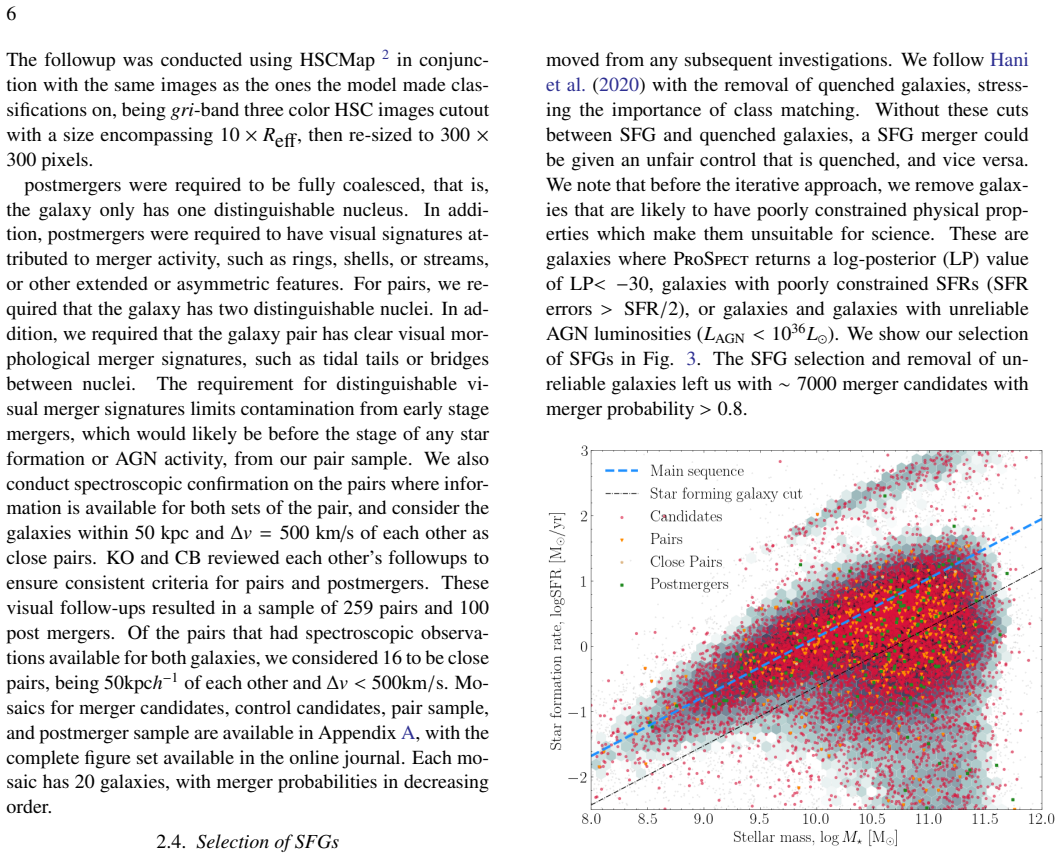
Three components carry the argument. A fine-tuned Zoobot convolutional network, pre-trained on Galaxy Zoo DECaLS and re-trained on roughly 2,400 citizen-science-labeled HSC-SSP images, assigns every galaxy a merger probability, with $P>0.8$ selecting the merger candidates and $P<0.3$ defining the control pool. The SED-fitting code ProSpect simultaneously fits galaxy and AGN components across far-UV to far-infrared photometry, producing the stellar masses, star-formation rates, AGN flux fractions $f_{\mathrm{AGN}}$ (the fraction of 5--20 $\mu$m flux contributed by the AGN), and AGN bolometric luminosities $L_{\mathrm{AGN}}$ that feed both the property comparisons and the sample matching; the simultaneous fit keeps AGN light from being misread as star formation. A 50-control-per-galaxy mass-and-redshift matching scheme with closeness-based statistical weighting isolates the merger effect from stellar mass and redshift, and an iterative main-sequence selection restricts the analysis to star-forming galaxies so that quenched galaxies cannot enter the control pool. A visual-purification stage then splits the candidates into pairs and postmergers, with spectroscopic confirmation isolating a small set of close pairs for a stage-resolved comparison.
What would settle it
Re-run the same 50-control measurement on the same 259 pairs and 100 postmergers using a short-timescale star-formation tracer such as H$\alpha$ emission, which records only the last roughly 10 Myr of star formation: a clearly positive $\Delta \mathrm{SFR}$ would show the ProSpect null is a timescale artifact, while a null would confirm that the absence of enhancement is physical. A companion check would apply the fine-tuned classifier to simulated images of mergers with known stages and known starburst timing, to measure what fraction of $P>0.8$ candidates are already past their peak enhancement.
Extended reading notes
Core claim
The central discovery is that, in the aggregate, merger candidates in HSC-SSP at $z<0.35$ are statistically indistinguishable from mass- and redshift-matched controls in both star formation and AGN activity: $\Delta \mathrm{SFR} = -0.009 \pm 0.003$ dex, $\Delta f_{\mathrm{AGN}} = -0.010 \pm 0.033$ dex, and $\Delta L_{\mathrm{AGN}} = 0.002 \pm 0.025$ dex. Visually purifying 3,000 of the candidates into 259 pairs (two distinguishable nuclei with tidal features) and 100 postmergers (one nucleus with shells, streams, or asymmetry) sharpens the picture only mildly: pairs show no measurable star formation or AGN enhancement, close pairs show a small SFR uptick, and postmergers show the largest elevation in AGN luminosity and AGN flux fraction ($\Delta L_{\mathrm{AGN}} = 0.329 \pm 0.195$ dex), which is not statistically significant. The paper interprets these numbers as showing that secular processes drive much of the star formation and black-hole growth in the local universe, and as a caution that SED-based star-formation rates averaged over roughly 100 Myr, combined with a deliberately diverse CNN merger sample, can hide short-lived merger-triggered starbursts and AGN episodes.
Load-bearing premise
The result holds only if most high-probability merger candidates are genuine mergers observed at stages where triggered star formation or AGN activity would be visible, and if ProSpect's roughly-100-Myr-averaged star-formation rates and AGN indicators are sensitive enough to detect the enhancement if it occurred.
Editorial extensions
If this is right
- Typical merger-like galaxies at $z<0.35$ contribute little net enhancement to the cosmic star formation budget: the broad merger sample sits within 0.01 dex of its controls.
- AGN triggering by mergers is at most a post-coalescence phenomenon in this sample: pairs show no AGN excess, while postmergers carry the only, still marginal, luminosity enhancement.
- Published merger--star formation and merger--AGN boosts measured with long-timescale tracers may be inflated by tracer timing and sample diversity rather than by the merger process itself.
- Secular processes such as disk instabilities and gradual gas accretion must be treated as leading drivers of star formation and black-hole growth at these redshifts.
- Binary CNN merger classification alone yields statistically diluted samples; stage-aware purification into pairs and postmergers is needed to expose stage-dependent signals such as the postmerger AGN excess.
Reading between the lines
- The paper's timescale argument implies a direct test: re-running the same 50-control measurement on the visually purified samples with a short-timescale tracer such as H$\alpha$ ($\sim$10 Myr) should show a clear positive $\Delta\mathrm{SFR}$ if merger-triggered starbursts are real, and a null would make the absence physical.
- In the spectroscopically confirmed pairs, secondary galaxies of minor mergers carry the largest AGN luminosity excess ($\Delta L_{\mathrm{AGN}} = 0.447 \pm 0.138$ dex) while primaries are suppressed, hinting that merger-induced black-hole growth prefers the lower-mass member; a targeted study of pair secondaries with instantaneous tracers could test this asymmetry.
- Applying the same classifier and control-matching to mock observations of mergers with known stages and known starburst timing would bound how much of the null result is dilution from genuine mergers observed after their peak enhancement.
- If the near-unity AGN excess of the broad sample (1.021 $\pm$ 0.061) is upheld, the short AGN duty cycle alone could erase a population-level merger signal, so the null result constrains merger-trigger fractions less stringently than it first appears.
Editorial analysis
A structured set of objections, weighed in public.
Referee Report
Summary. This paper tests the merger-SFR-AGN connection using ~144,000 HSC-SSP galaxies cross-matched with GAMA, identifying mergers with a Zoobot CNN fine-tuned on Galaxy Cruise labels and measuring galaxy and AGN properties with the ProSpect SED-fitting code. The authors compare SFR, f_AGN, and L_AGN between merger candidates (P>0.8) and mass- and redshift-matched controls (P<0.3), and repeat the comparison for visually purified pairs and postmergers. The headline result is a near-null difference for the full merger candidate sample (Delta SFR = -0.009 +/- 0.003 dex, Delta f_AGN = -0.010 +/- 0.033 dex, Delta L_AGN = 0.002 +/- 0.025 dex), with mild SFR suppression and a marginally significant AGN luminosity enhancement for visually confirmed postmergers. The authors argue that secular processes may dominate and caution against longer-timescale tracers.
Significance. If the null result is robust, this would challenge the widespread assumption that mergers produce strong enhancements in star formation and AGN activity at low redshift, and it would strengthen the emerging view that tracer timescale and sample purity are critical in this field. The study has notable strengths: careful control matching with statistical weighting, a pseudo-merger placebo sample, visual purification with cross-review, and the self-consistent ProSpect SED fitting that simultaneously constrains stellar and AGN components. The central claim, however, rests on the purity of the CNN-selected merger sample and the absence of contamination in the control pool; these points are not yet demonstrated. The work is well suited to the journal's scope and would be a valuable contribution after the purity question is resolved.
major comments (4)
- [Section 2.3, Section 3.1] The headline null is computed on the full P>0.8 merger candidate sample, but the purity of this sample is not established. Visual follow-up of 3000 of ~7000 candidates yielded only 259 pairs and 100 postmergers, i.e., about 12% of the inspected candidates meet the paper's own visual merger criteria. The manuscript does not state how the 3000 were selected, nor does it report the CNN probability distribution for visually confirmed versus unconfirmed candidates. If the inspected 3000 are representative, the P>0.8 sample is dominated by objects that are not visually identifiable as mergers, and the measured null would be expected even if every true merger were strongly enhanced. The pseudo-merger placebo in Section 3 is drawn from the P<0.3 control pool, so it validates the matching and weighting machinery, not the purity of the P>0.8 sample. I request that the authors (a) state how the 3000 inspected candidates were chosen and justify their representativeness, (b) report confirmation fraction as a function of CNN probability, and (c) test the sensitivity of the full-sample null to plausible non-merger fractions, for example by restricting the analysis to visually confirmed objects or by reweighting.
- [Section 2.5, Section 3] The control pool (P<0.3) is not visually vetted, and the CNN's false-negative rate on control-like objects is not quantified. If a non-negligible fraction of controls are unrecognized mergers, every Delta SFR, Delta f_AGN, and Delta L_AGN value is biased toward zero, which would produce exactly the same headline null regardless of the true merger enhancement. The pseudo-merger sample does not address this issue because it is drawn from the same control pool and only tests the internal consistency of the weighting scheme. I ask for a visual inspection of a random subset of the control sample (or another quantitative estimate of control contamination, e.g., from Galaxy Cruise labels) and a discussion of how the conclusions would change if those objects were excluded.
- [Section 2.1] The merger classifier's reported accuracy (83%), recall (84%), and precision (84%) are computed on the fine-tuning sample itself, not on a held-out validation set. These numbers therefore do not measure generalization to unseen HSC-SSP galaxies and cannot be used to argue that P>0.8 selects a predominantly true-merger population. Please provide validation performance on a held-out set drawn from the Galaxy Cruise labels, and, if possible, a calibration check showing that the CNN probability is a meaningful predictor of the visual merger fraction.
- [Abstract, Section 5] The abstract and conclusions state that the results 'suggest secular processes being an important driver for SF and AGN activity.' This interpretation goes beyond what the data alone can establish: the near-null differences are equally consistent with sample impurity, with unrecognized mergers in the control pool, and with the ~100 Myr time-averaging of ProSpect SFRs, which the authors themselves discuss in Section 4.1.1. I recommend reframing the conclusion as a null result that is consistent with, but does not uniquely demonstrate, a dominant secular channel, and adding quantitative upper limits on any merger-driven enhancement based on the measured uncertainties.
minor comments (6)
- [Section 2.3] The sentence 'postmergers were required to be fully coalesced...' begins with a lowercase letter; please capitalize the first word.
- [Section 3.2] Equation (5) contains a typo: 'The AGN enhancement enhancement of each galaxy' should be 'The AGN enhancement of each galaxy,' and the parentheses in the numerator are unbalanced.
- [Section 4.3] The sentence 'Figures 8 to shows 10 the results' should read 'Figures 8 to 10 show the results.'
- [Section 2.4] The phrase 'Galaxies with SFRs less than below 0.75 dex the final main sequence' should be reworded, e.g., 'Galaxies more than 0.75 dex below the final main sequence are considered quenched.'
- [Section 2.5] The phrase 'This search was with replacement' is awkward; consider 'Controls were drawn with replacement.'
- [Section 3.1] The word 'meager' is used to describe the SFR suppression; 'modest' would be a more standard scientific descriptor.
Circularity Check
No significant circularity: the merger-SFR/AGN comparison is a direct measurement using an independent SED-fit catalog and label-free controls.
full rationale
The paper's derivation chain is self-contained. Merger candidate status is assigned by a fine-tuned Zoobot CNN from HSC-SSP gri images; the labels used for fine-tuning come from the external Galaxy Cruise citizen-science project, and the output probability P(merger) is a purely morphological quantity that does not use SFR or AGN information. The SFR, f_AGN, and L_AGN values are taken from the externally published ProSpect/GAMA catalog of Thorne et al. (2022), fitted to panchromatic photometry independent of the merger labels. Controls are matched on stellar mass and redshift with weights defined by Equations (1)-(3); matching on mass and redshift does not force the outcome variables SFR/f_AGN/L_AGN to be equal, since the measured Delta quantities in Equations (4)-(6) are residual offsets relative to the control-weighted mean, not fitted parameters. The pseudo-merger placebo (Section 3) is a matching-machinery check rather than a purity calibration, so any sample-purity weakness it fails to address is a validity caveat, not a circular reduction. The paper itself flags the ~100 Myr time-averaging of ProSpect SFRs (Section 4.1.1) and the diversity of CNN-selected samples (Section 4.2) as reasons the null may be insensitive; these are acknowledged limitations and not inputs disguised as predictions. The self-citations to Omori et al. (2023) for fine-tuning sample size and to ProSpect papers for the property catalog are independent, published, externally testable products and are not used as an unverified premise that is equivalent to the conclusion. No equation in the paper reduces the headline Delta values to the merger probability or to the training labels by construction.
Assumptions & free parameters
free parameters (4)
- merger_probability_threshold =
0.8
- control_probability_threshold =
0.3
- L_AGN_minimum =
10^36 L_sun
- SFG_selection_offset =
0.75 dex below main sequence
assumptions (4)
- domain assumption The Fritz et al. (2006) AGN torus model in ProSpect correctly separates AGN and galaxy SED components.
- domain assumption ProSpect SFRs are time-averaged over roughly 100 Myr and are reliable tracers of merger-induced star formation on that timescale.
- domain assumption Visual merger signatures persist for approximately 0.2 to 2 Gyr, so the postmerger sample is representative of late-stage mergers.
- domain assumption The fine-tuned Zoobot generalizes from the Galaxy Cruise fine-tuning sample to the full HSC-GAMA sample.
Cite this review
Pith. "Pith review of The connection between galaxy mergers, star formation and AGN activity in the HSC-SSP." pith.science (2026). https://pith.science/paper/7WVM6DDN
@misc{pith2026250608469,
  author       = {Pith},
  title        = {Pith review of: The connection between galaxy mergers, star formation and AGN activity in the HSC-SSP},
  year         = {2026},
  howpublished = {\url{https://pith.science/paper/7WVM6DDN}},
  note         = {Machine review of arXiv:2506.08469}
}
abstract
Internal gas inflows driven by galaxy mergers are considered to enhance star formation rates (SFR), fuel supermassive black hole growth and stimulate active galactic nuclei (AGN). However, quantifying these phenomena remains a challenge, due to difficulties both in classifying mergers and in quantifying galaxy and AGN properties. We quantitatively examine the merger-SFR-AGN connection using Hyper Suprime-Cam Subaru Strategic Program (HSC-SSP) galaxies using novel methods for both galaxy classification and property measurements.} {Mergers in HSC-SSP observational images are identified through fine-tuning Zoobot, a pretrained deep representation learning model, using images and labels based on the Galaxy Cruise project. We use galaxy and AGN properties that were produced by fitting Galaxy and Mass Assembly (GAMA) spectra using the SED fitting code ProSpect, which fits panchromatically across the far-UV through far-infrared wavelengths and obtains galaxy and AGN properties simultaneously.} \textbf{{Little differences are seen in SFR and AGN activity between mergers and controls, with $\Delta \mathrm{SFR}=-0.009\pm 0.003$ dex, $\Delta f_{\mathrm{AGN}}=-0.010\pm0.033$ dex and $\Delta L_{\mathrm{AGN}}=0.002\pm0.025$ dex. After further visual purification of the merger sample, we find $\Delta \mathrm{SFR}=-0.033\pm0.014$ dex, $\Delta f_{\mathrm{AGN}}=-0.024\pm0.170$ dex, and $\Delta L_{\mathrm{AGN}}=0.019\pm0.129$ dex for pairs, and $\Delta \mathrm{SFR}=-0.057\pm0.024$ dex, $\Delta f_{\mathrm{AGN}}=0.286\pm0.270$ dex, and $\Delta L_{\mathrm{AGN}}=0.329\pm0.195$ dex for postmergers. These numbers suggest secular processes being an important driver for SF and AGN activity, and present a cautionary tale when using longer timescale tracers.
Figures


Figures from the paper (8 more)


Reference graph
Works this paper leans on
-
[1]
2018, PASJ, 70, S8, doi: 10.1093/pasj/psx081
Aihara, H., Armstrong, R., Bickerton, S., et al. 2018, PASJ, 70, S8, doi: 10.1093/pasj/psx081
-
[2]
2022, PASJ, 74, 247, doi: 10.1093/pasj/psab122
Aihara, H., AlSayyad, Y ., Ando, M., et al. 2022, PASJ, 74, 247, doi: 10.1093/pasj/psab122
-
[3]
Alonso, M. S., Lambas, D. G., Tissera, P., & Coldwell, G. 2007, MNRAS, 375, 1017, doi: 10.1111/j.1365-2966.2007.11367.x
arXiv 2007
-
[4]
Baldwin, J. A., Phillips, M. M., & Terlevich, R. 1981, PASP, 93, 5, doi: 10.1086/130766
doi:10.1086/130766 1981
-
[5]
Barton, E. J., Geller, M. J., & Kenyon, S. J. 2000, ApJ, 530, 660, doi: 10.1086/308392
doi:10.1086/308392 2000
-
[6]
2008, Chinese Journal of Astronomy and Astrophysics Supplement, 8, 77
Beckman, J., Carretero, C., & Vazdekis, A. 2008, Chinese Journal of Astronomy and Astrophysics Supplement, 8, 77
2008
-
[7]
Begelman, M. C., Blandford, R. D., & Rees, M. J. 1984, Reviews of Modern Physics, 56, 255, doi: 10.1103/RevModPhys.56.255
-
[8]
Bellstedt, S., Driver, S. P., Robotham, A. S. G., et al. 2020, MNRAS, 496, 3235, doi: 10.1093/mnras/staa1466
Show all 141 references
-
[9]
W., Ellison, S
Bickley, R. W., Ellison, S. L., Patton, D. R., et al. 2022, MNRAS, 514, 3294, doi: 10.1093/mnras/stac1500
2022 doi
-
[10]
W., Ellison, S
Bickley, R. W., Ellison, S. L., Patton, D. R., & Wilkinson, S. 2023, MNRAS, 519, 6149, doi: 10.1093/mnras/stad088
2023 doi
-
[11]
W., Bottrell, C., Hani, M
Bickley, R. W., Bottrell, C., Hani, M. H., et al. 2021, MNRAS, 504, 372, doi: 10.1093/mnras/stab806
2021 doi
-
[12]
W., Ellison, S
Bickley, R. W., Ellison, S. L., Salvato, M., et al. 2024, MNRAS, 533, 3068, doi: 10.1093/mnras/stae1951
2024 doi
-
[13]
2018, PASJ, 70, S5, doi: 10.1093/pasj/psx080
Bosch, J., Armstrong, R., Bickerton, S., et al. 2018, PASJ, 70, S5, doi: 10.1093/pasj/psx080
2018 doi
-
[14]
2022, in SciOps 2022: Artificial Intelligence for Science and Operations in Astronomy (SCIOPS), 2, doi: 10.5281/zenodo.6551859
Bottrell, C. 2022, in SciOps 2022: Artificial Intelligence for Science and Operations in Astronomy (SCIOPS), 2, doi: 10.5281/zenodo.6551859
2022 doi
-
[15]
H., Teimoorinia, H., Patton, D
Bottrell, C., Hani, M. H., Teimoorinia, H., Patton, D. R., & Ellison, S. L. 2022, MNRAS, 511, 100, doi: 10.1093/mnras/stab3717
2022 doi
-
[16]
H., Teimoorinia, H., et al
Bottrell, C., Hani, M. H., Teimoorinia, H., et al. 2019, MNRAS, 490, 5390, doi: 10.1093/mnras/stz2934
2019 doi
-
[17]
M., Popping, G., et al
Bottrell, C., Yesuf, H. M., Popping, G., et al. 2024, MNRAS, 527, 6506, doi: 10.1093/mnras/stad2971
2024 doi
-
[18]
2003, MNRAS, 344, 1000, doi: 10.1046/j.1365-8711.2003.06897.x
Bruzual, G., & Charlot, S. 2003, MNRAS, 344, 1000, doi: 10.1046/j.1365-8711.2003.06897.x
2003
-
[19]
J., Shen, Y ., Blaes, O., et al
Burke, C. J., Shen, Y ., Blaes, O., et al. 2021, Science, 373, 789, doi: 10.1126/science.abg9933
2021 doi
-
[20]
H., Ellison, S
Byrne-Mamahit, S., Hani, M. H., Ellison, S. L., Quai, S., & Patton, D. R. 2023, MNRAS, 519, 4966, doi: 10.1093/mnras/stac3674
2023 doi
-
[21]
R., Ellison, S
Byrne-Mamahit, S., Patton, D. R., Ellison, S. L., et al. 2024, MNRAS, 528, 5864, doi: 10.1093/mnras/stae419
2024 doi
-
[22]
R., V olonteri, M., Dotti, M., et al
Capelo, P. R., V olonteri, M., Dotti, M., et al. 2015, MNRAS, 447, 2123, doi: 10.1093/mnras/stu2500
2015 doi
-
[23]
Cardoso, L. S. M., Gomes, J. M., & Papaderos, P. 2017, A&A, 604, A99, doi: 10.1051/0004-6361/201630378
2017 doi
-
[24]
2003, PASP, 115, 763, doi: 10.1086/376392
Chabrier, G. 2003, PASP, 115, 763, doi: 10.1086/376392
2003 doi
-
[25]
J., et al
Cisternas, M., Jahnke, K., Inskip, K. J., et al. 2011, ApJ, 726, 57, doi: 10.1088/0004-637X/726/2/57
2011 doi
- [26]
-
[27]
Conselice, C. J. 2003, ApJS, 147, 1, doi: 10.1086/375001
2003 doi
-
[28]
M., Rodriguez-Pascual, P
Crenshaw, D. M., Rodriguez-Pascual, P. M., Penton, S. V ., et al. 1996, ApJ, 470, 322, doi: 10.1086/177869
1996 doi
-
[29]
M., & et al
Cutri, R. M., & et al. 2012, VizieR Online Data Catalog: WISE All-Sky Data Release (Cutri+2012), VizieR On-line Data Catalog: II/311. Originally published in: 2012wise.rept....1C
2012
-
[30]
2023, Research in Astronomy and Astrophysics, 23, 095026, doi: 10.1088/1674-4527/aceccb
Das, A., Pandey, B., & Sarkar, S. 2023, Research in Astronomy and Astrophysics, 23, 095026, doi: 10.1088/1674-4527/aceccb
2023 doi
-
[31]
J., Pontzen, A., & Crain, R
Davies, J. J., Pontzen, A., & Crain, R. A. 2022, MNRAS, 515, 1430, doi: 10.1093/mnras/stac1742
2022 doi
-
[32]
Davies, L. J. M., Robotham, A. S. G., Driver, S. P., et al. 2015, MNRAS, 452, 616, doi: 10.1093/mnras/stv1241
2015 doi
-
[33]
Davies, L. J. M., Thorne, J. E., Robotham, A. S. G., et al. 2021, MNRAS, 506, 256, doi: 10.1093/mnras/stab1601
2021 doi
-
[34]
T., Desai, V ., et al
Dey, A., Soifer, B. T., Desai, V ., et al. 2008, ApJ, 677, 943, doi: 10.1086/529516
2008 doi
-
[35]
J., Lang, D., et al
Dey, A., Schlegel, D. J., Lang, D., et al. 2019, AJ, 157, 168, doi: 10.3847/1538-3881/ab089d Di Matteo, P., Combes, F., Melchior, A. L., & Semelin, B. 2007, A&A, 468, 61, doi: 10.1051/0004-6361:20066959 Di Matteo, T., Springel, V ., & Hernquist, L. 2005, Nature, 433, 604, doi:...
2019 doi
-
[36]
S., Ashby, M
Dietrich, J., Weiner, A. S., Ashby, M. L. N., et al. 2018, MNRAS, 480, 3562, doi: 10.1093/mnras/sty2056 Dom´ınguez S´anchez, H., Martin, G., Damjanov, I., et al. 2023, MNRAS, 521, 3861, doi: 10.1093/mnras/stad750
2018 doi
-
[37]
L., Koekemoer, A
Donley, J. L., Koekemoer, A. M., Brusa, M., et al. 2012, ApJ, 748, 142, doi: 10.1088/0004-637X/748/2/142
2012 doi
-
[38]
2021, MNRAS, 506, 4760, doi: 10.1093/mnras/stab1950 —
Donnari, M., Pillepich, A., Nelson, D., et al. 2021, MNRAS, 506, 4760, doi: 10.1093/mnras/stab1950 —. 2019, MNRAS, 485, 4817, doi: 10.1093/mnras/stz712
2021 doi
-
[39]
R., & Ballantyne, D
Draper, A. R., & Ballantyne, D. R. 2012, ApJ, 751, 72, doi: 10.1088/0004-637X/751/1/72
2012 doi
-
[40]
P., Bellstedt, S., Robotham, A
Driver, S. P., Bellstedt, S., Robotham, A. S. G., et al. 2022, MNRAS, 513, 439, doi: 10.1093/mnras/stac472 D’Silva, J. C. J., Driver, S. P., Lagos, C. D. P., et al. 2023, ApJL, 959, L18, doi: 10.3847/2041-8213/ad103e
2022 doi
-
[41]
2024, MNRAS, 528, 7411, doi: 10.1093/mnras/stae481
Eisert, L., Bottrell, C., Pillepich, A., et al. 2024, MNRAS, 528, 7411, doi: 10.1093/mnras/stae481
2024 doi
-
[42]
2024a, The Open Journal of Astrophysics, 7, 121, doi: 10.33232/001c.127779
Ellison, S., Ferreira, L., Wild, V ., et al. 2024a, The Open Journal of Astrophysics, 7, 121, doi: 10.33232/001c.127779
-
[43]
2025, The Open Journal of Astrophysics, 8, 12, doi: 10.33232/001c.129235 14
Ellison, S., Ferreira, L., Bickley, R., et al. 2025, The Open Journal of Astrophysics, 8, 12, doi: 10.33232/001c.129235 14
2025 doi
- [44]
-
[45]
L., Mendel, J
Ellison, S. L., Mendel, J. T., Patton, D. R., & Scudder, J. M. 2013, MNRAS, 435, 3627, doi: 10.1093/mnras/stt1562
2013 doi
-
[46]
L., Patton, D
Ellison, S. L., Patton, D. R., Mendel, J. T., & Scudder, J. M. 2011, MNRAS, 418, 2043, doi: 10.1111/j.1365-2966.2011.19624.x
2011
-
[47]
L., Patton, D
Ellison, S. L., Patton, D. R., Simard, L., & McConnachie, A. W. 2008, AJ, 135, 1877, doi: 10.1088/0004-6256/135/5/1877
2008 doi
-
[48]
L., Viswanathan, A., Patton, D
Ellison, S. L., Viswanathan, A., Patton, D. R., et al. 2019, MNRAS, 487, 2491, doi: 10.1093/mnras/stz1431
2019 doi
-
[49]
2024, ApJ, 965, 60, doi: 10.3847/1538-4357/ad343e
Feng, S., Shen, S.-Y ., Yuan, F.-T., et al. 2024, ApJ, 965, 60, doi: 10.3847/1538-4357/ad343e
2024 doi
- [50]
-
[51]
2006, MNRAS, 366, 767, doi: 10.1111/j.1365-2966.2006.09866.x
Fritz, J., Franceschini, A., & Hatziminaoglou, E. 2006, MNRAS, 366, 767, doi: 10.1111/j.1365-2966.2006.09866.x
2006
-
[52]
2018, PASJ, 70, S3, doi: 10.1093/pasj/psx079
Furusawa, H., Koike, M., Takata, T., et al. 2018, PASJ, 70, S3, doi: 10.1093/pasj/psx079
2018 doi
-
[53]
M., Impey, C
Gabor, J. M., Impey, C. D., Jahnke, K., et al. 2009, ApJ, 691, 705, doi: 10.1088/0004-637X/691/1/705
2009 doi
-
[54]
J., et al
Gao, F., Wang, L., Pearson, W. J., et al. 2020, A&A, 637, A94, doi: 10.1051/0004-6361/201937178
2020 doi
-
[55]
2015, ApJ, 806, 218, doi: 10.1088/0004-637X/806/2/218
Glikman, E., Simmons, B., Mailly, M., et al. 2015, ApJ, 806, 218, doi: 10.1088/0004-637X/806/2/218
2015 doi
-
[56]
2016, Deep learning, MIT press
Goodfellow, I. 2016, Deep learning, MIT press
2016
-
[57]
D., Greene, J
Goulding, A. D., Greene, J. E., Bezanson, R., et al. 2018, PASJ, 70, S37, doi: 10.1093/pasj/psx135
2018 doi
-
[58]
A., Conselice, C
Grogin, N. A., Conselice, C. J., Chatzichristou, E., et al. 2005, ApJL, 627, L97, doi: 10.1086/432256
2005 doi
-
[59]
1991, ApJL, 380, L51, doi: 10.1086/186171
Haardt, F., & Maraschi, L. 1991, ApJL, 380, L51, doi: 10.1086/186171
1991 doi
-
[60]
H., Gosain, H., Ellison, S
Hani, M. H., Gosain, H., Ellison, S. L., Patton, D. R., & Torrey, P. 2020, MNRAS, 493, 3716, doi: 10.1093/mnras/staa459
2020 doi
-
[61]
2017, MNRAS, 470, 755, doi: 10.1093/mnras/stx997
Hewlett, T., Villforth, C., Wild, V ., et al. 2017, MNRAS, 470, 755, doi: 10.1093/mnras/stx997
2017 doi
-
[62]
Hong, J., Im, M., Kim, M., & Ho, L. C. 2015, ApJ, 804, 34, doi: 10.1088/0004-637X/804/1/34
2015 doi
-
[63]
F., Cox, T
Hopkins, P. F., Cox, T. J., Hernquist, L., et al. 2013, MNRAS, 430, 1901, doi: 10.1093/mnras/stt017
2013 doi
-
[64]
F., Hernquist, L., Cox, T
Hopkins, P. F., Hernquist, L., Cox, T. J., & Kereˇs, D. 2008, ApJS, 175, 356, doi: 10.1086/524362
2008 doi
-
[65]
R., Soifer, B
Houck, J. R., Soifer, B. T., Weedman, D., et al. 2005, ApJL, 622, L105, doi: 10.1086/429405
2005 doi
-
[66]
2024, PASJ, 76, 950, doi: 10.1093/pasj/psae061
Inoue, S., Ohta, K., Asada, Y ., et al. 2024, PASJ, 76, 950, doi: 10.1093/pasj/psae061
2024 doi
-
[67]
2021, The Messenger, 183, 25, doi: 10.18727/0722-6691/5232
Iodice, E., Spavone, M., Capaccioli, M., et al. 2021, The Messenger, 183, 25, doi: 10.18727/0722-6691/5232
2021 doi
-
[68]
Ji, I., Peirani, S., & Yi, S. K. 2014, A&A, 566, A97, doi: 10.1051/0004-6361/201423530
2014 doi
-
[69]
2013, ApJ, 764, 176, doi: 10.1088/0004-637X/764/2/176
Juneau, S., Dickinson, M., Bournaud, F., et al. 2013, ApJ, 764, 176, doi: 10.1088/0004-637X/764/2/176
2013 doi
-
[70]
2018, PASJ, 70, 66, doi: 10.1093/pasj/psy056
Kawanomoto, S., Uraguchi, F., Komiyama, Y ., et al. 2018, PASJ, 70, 66, doi: 10.1093/pasj/psy056
2018 doi
-
[71]
H., & Abel, T
Kim, J.-h., Wise, J. H., & Abel, T. 2009, ApJL, 694, L123, doi: 10.1088/0004-637X/694/2/L123
2009 doi
-
[72]
2015, ApJ, 814, 9, doi: 10.1088/0004-637X/814/1/9
Kirkpatrick, A., Pope, A., Sajina, A., et al. 2015, ApJ, 814, 9, doi: 10.1088/0004-637X/814/1/9
2015 doi
-
[73]
D., Faber, S
Kocevski, D. D., Faber, S. M., Mozena, M., et al. 2012, ApJ, 744, 148, doi: 10.1088/0004-637X/744/2/148
2012 doi
-
[74]
D., Brightman, M., Nandra, K., et al
Kocevski, D. D., Brightman, M., Nandra, K., et al. 2015, ApJ, 814, 104, doi: 10.1088/0004-637X/814/2/104
2015 doi
-
[75]
2018, PASJ, 70, S2, doi: 10.1093/pasj/psx069
Komiyama, Y ., Obuchi, Y ., Nakaya, H., et al. 2018, PASJ, 70, S2, doi: 10.1093/pasj/psx069
2018 doi
-
[76]
Kormendy, J., & Ho, L. C. 2013, ARA&A, 51, 511, doi: 10.1146/annurev-astro-082708-101811
2013 doi
-
[77]
1995, ARA&A, 33, 581, doi: 10.1146/annurev.aa.33.090195.003053
Kormendy, J., & Richstone, D. 1995, ARA&A, 33, 581, doi: 10.1146/annurev.aa.33.090195.003053
1995
-
[78]
N., Silverman, J
Lackner, C. N., Silverman, J. D., Salvato, M., et al. 2014, AJ, 148, 137, doi: 10.1088/0004-6256/148/6/137
2014 doi
-
[79]
2023a, ApJ, 944, 168, doi: 10.3847/1538-4357/acb13d
Li, W., Nair, P., Irwin, J., et al. 2023a, ApJ, 944, 168, doi: 10.3847/1538-4357/acb13d
-
[80]
A., Ho, L
Li, Y . A., Ho, L. C., & Shangguan, J. 2023b, ApJ, 953, 91, doi: 10.3847/1538-4357/acdddb
-
[81]
M., Jonsson, P., Cox, T
Lotz, J. M., Jonsson, P., Cox, T. J., & Primack, J. R. 2008, MNRAS, 391, 1137, doi: 10.1111/j.1365-2966.2008.14004.x —. 2010a, MNRAS, 404, 575, doi: 10.1111/j.1365-2966.2010.16268.x —. 2010b, MNRAS, 404, 590, doi: 10.1111/j.1365-2966.2010.16269.x
2008
-
[82]
M., Primack, J., & Madau, P
Lotz, J. M., Primack, J., & Madau, P. 2004, AJ, 128, 163, doi: 10.1086/421849
2004 doi
-
[83]
2011, A&A, 532, A90, doi: 10.1051/0004-6361/201117107
Lutz, D., Poglitsch, A., Altieri, B., et al. 2011, A&A, 532, A90, doi: 10.1051/0004-6361/201117107
2011 doi
-
[84]
2016, ApJ, 817, 34, doi: 10.3847/0004-637X/817/1/34
Marchesi, S., Civano, F., Elvis, M., et al. 2016, ApJ, 817, 34, doi: 10.3847/0004-637X/817/1/34
2016 doi
-
[85]
2004, MNRAS, 351, 169, doi: 10.1111/j.1365-2966.2004.07765.x
Marconi, A., Risaliti, G., Gilli, R., et al. 2004, MNRAS, 351, 169, doi: 10.1111/j.1365-2966.2004.07765.x
2004
-
[86]
2019, ApJ, 882, 141, doi: 10.3847/1538-4357/ab385b
Marian, V ., Jahnke, K., Mechtley, M., et al. 2019, ApJ, 882, 141, doi: 10.3847/1538-4357/ab385b
2019 doi
-
[87]
M., Rosario, D
McAlpine, S., Harrison, C. M., Rosario, D. J., et al. 2020, MNRAS, 494, 5713, doi: 10.1093/mnras/staa1123
2020 doi
-
[88]
J., Milvang-Jensen, B., Dunlop, J., et al
McCracken, H. J., Milvang-Jensen, B., Dunlop, J., et al. 2012, A&A, 544, A156, doi: 10.1051/0004-6361/201219507
2012 doi
-
[89]
A., et al
Mechtley, M., Jahnke, K., Windhorst, R. A., et al. 2016, ApJ, 830, 156, doi: 10.3847/0004-637X/830/2/156
2016 doi
-
[90]
2014, A&A, 569, A37, doi: 10.1051/0004-6361/201424217
Menci, N., Gatti, M., Fiore, F., & Lamastra, A. 2014, A&A, 569, A37, doi: 10.1051/0004-6361/201424217
2014 doi
-
[91]
2018, PASJ, 70, S1, doi: 10.1093/pasj/psx063 15
Miyazaki, S., Komiyama, Y ., Kawanomoto, S., et al. 2018, PASJ, 70, S1, doi: 10.1093/pasj/psx063 15
2018 doi
-
[92]
L., et al
Moreno, J., Torrey, P., Ellison, S. L., et al. 2015, MNRAS, 448, 1107, doi: 10.1093/mnras/stv094
2015 doi
-
[93]
2006, ApJL, 636, L81, doi: 10.1086/500205
Naab, T., Khochfar, S., & Burkert, A. 2006, ApJL, 636, L81, doi: 10.1086/500205
2006 doi
-
[94]
2019, MNRAS, 490, 3234, doi: 10.1093/mnras/stz2306
Nelson, D., Pillepich, A., Springel, V ., et al. 2019, MNRAS, 490, 3234, doi: 10.1093/mnras/stz2306
2019 doi
-
[95]
J., Bock, J., Altieri, B., et al
Oliver, S. J., Bock, J., Altieri, B., et al. 2012, MNRAS, 424, 1614, doi: 10.1111/j.1365-2966.2012.20912.x
2012
-
[96]
C., Bottrell, C., Walmsley, M., et al
Omori, K. C., Bottrell, C., Walmsley, M., et al. 2023, A&A, 679, A142, doi: 10.1051/0004-6361/202346743
2023 doi
-
[97]
Mendel, J. T. 2011, MNRAS, 412, 591, doi: 10.1111/j.1365-2966.2010.17932.x
2011
-
[98]
R., Qamar, F
Patton, D. R., Qamar, F. D., Ellison, S. L., et al. 2016, MNRAS, 461, 2589, doi: 10.1093/mnras/stw1494
2016 doi
-
[99]
R., Torrey, P., Ellison, S
Patton, D. R., Torrey, P., Ellison, S. L., Mendel, J. T., & Scudder, J. M. 2013, MNRAS, 433, L59, doi: 10.1093/mnrasl/slt058
2013 doi
-
[100]
J., Wang, L., Alpaslan, M., et al
Pearson, W. J., Wang, L., Alpaslan, M., et al. 2019, A&A, 631, A51, doi: 10.1051/0004-6361/201936337
2019 doi
-
[101]
2019, MNRAS, 490, 3196, doi: 10.1093/mnras/stz2338
Pillepich, A., Nelson, D., Springel, V ., et al. 2019, MNRAS, 490, 3196, doi: 10.1093/mnras/stz2338
2019 doi
-
[102]
L., Patton, D
Quai, S., Byrne-Mamahit, S., Ellison, S. L., Patton, D. R., & Hani, M. H. 2023, MNRAS, 519, 2119, doi: 10.1093/mnras/stac3713
2023 doi
-
[103]
2015, MNRAS, 446, 2038, doi: 10.1093/mnras/stu2208
Renaud, F., Bournaud, F., & Duc, P.-A. 2015, MNRAS, 446, 2038, doi: 10.1093/mnras/stu2208
2015 doi
-
[104]
Renaud, F., Bournaud, F., Kraljic, K., & Duc, P. A. 2014, MNRAS, 442, L33, doi: 10.1093/mnrasl/slu050
2014 doi
-
[105]
Robotham, A. S. G., Bellstedt, S., & Driver, S. P. 2022, MNRAS, 513, 2985, doi: 10.1093/mnras/stac1032
2022 doi
-
[106]
Robotham, A. S. G., Bellstedt, S., Lagos, C. d. P., et al. 2020, MNRAS, 495, 905, doi: 10.1093/mnras/staa1116
2020 doi
-
[107]
Robotham, A. S. G., Davies, L. J. M., Driver, S. P., et al. 2018, MNRAS, 476, 3137, doi: 10.1093/mnras/sty440
2018 doi
-
[108]
Robotham, A. S. G., Liske, J., Driver, S. P., et al. 2013, MNRAS, 431, 167, doi: 10.1093/mnras/stt156 Rodr´ıguez Montero, F., Dav´e, R., Wild, V ., Angl´es-Alc´azar, D., &
2013 doi
-
[109]
2019, MNRAS, 490, 2139, doi: 10.1093/mnras/stz2580
Narayanan, D. 2019, MNRAS, 490, 2139, doi: 10.1093/mnras/stz2580
2019 doi
-
[110]
R., Daisaka, H., Kokubo, E., et al
Saitoh, T. R., Daisaka, H., Kokubo, E., et al. 2009, PASJ, 61, 481, doi: 10.1093/pasj/61.3.481
2009 doi
-
[111]
B., & Mirabel, I
Sanders, D. B., & Mirabel, I. F. 1996, ARA&A, 34, 749, doi: 10.1146/annurev.astro.34.1.749
1996 doi
-
[112]
B., Soifer, B
Sanders, D. B., Soifer, B. T., Elias, J. H., et al. 1988, ApJ, 325, 74, doi: 10.1086/165983
1988 doi
-
[113]
J., Shao, L., et al
Santini, P., Rosario, D. J., Shao, L., et al. 2012, A&A, 540, A109, doi: 10.1051/0004-6361/201118266
2012 doi
-
[114]
L., McAlpine, W., et al
Satyapal, S., Ellison, S. L., McAlpine, W., et al. 2014, MNRAS, 441, 1297, doi: 10.1093/mnras/stu650
2014 doi
-
[115]
Schawinski, K., Koss, M., Berney, S., & Sartori, L. F. 2015, MNRAS, 451, 2517, doi: 10.1093/mnras/stv1136
2015 doi
-
[116]
2005, in Astrophysics and Space Science Library, V ol
Schweizer, F. 2005, in Astrophysics and Space Science Library, V ol. 329, Starbursts: From 30 Doradus to Lyman Break Galaxies, ed. R. de Grijs & R. M. Gonz´alez Delgado, 143, doi: 10.1007/1-4020-3539-X 25
2005 doi
-
[117]
D., et al
Silva, A., Marchesini, D., Silverman, J. D., et al. 2021, ApJ, 909, 124, doi: 10.3847/1538-4357/abdbb1
2021 doi
-
[118]
D., Kampczyk, P., Jahnke, K., et al
Silverman, J. D., Kampczyk, P., Jahnke, K., et al. 2011, ApJ, 743, 2, doi: 10.1088/0004-637X/743/1/2
2011 doi
-
[119]
J., Simmons, B
Smethurst, R. J., Simmons, B. D., Lintott, C. J., & Shanahan, J. 2019, MNRAS, 489, 4016, doi: 10.1093/mnras/stz2443
2019 doi
-
[120]
Smith, A. G. 1996, in Astronomical Society of the Pacific Conference Series, V ol. 110, Blazar Continuum Variability, ed. H. R. Miller, J. R. Webb, & J. C. Noble, 3
1996
-
[121]
2016, MNRAS, 462, 2418, doi: 10.1093/mnras/stw1793
Sparre, M., & Springel, V . 2016, MNRAS, 462, 2418, doi: 10.1093/mnras/stw1793
2016 doi
-
[122]
2022, MNRAS, 513, 2904, doi: 10.1093/mnras/stac818
Tacchella, S., Smith, A., Kannan, R., et al. 2022, MNRAS, 513, 2904, doi: 10.1093/mnras/stac818
2022 doi
-
[123]
2023, PASJ, 75, 986, doi: 10.1093/pasj/psad055
Tanaka, M., Koike, M., Naito, S., et al. 2023, PASJ, 75, 986, doi: 10.1093/pasj/psad055
2023 doi
-
[124]
D., Yesuf, H
Tang, S., Silverman, J. D., Yesuf, H. M., et al. 2023, MNRAS, 521, 5272, doi: 10.1093/mnras/stad877
2023 doi
-
[125]
E., Robotham, A
Thorne, J. E., Robotham, A. S. G., Davies, L. J. M., et al. 2021, MNRAS, 505, 540, doi: 10.1093/mnras/stab1294 —. 2022, MNRAS, 509, 4940, doi: 10.1093/mnras/stab3208
2021 doi
-
[126]
D., Ellison, S
Thorp, M. D., Ellison, S. L., Simard, L., S´anchez, S. F., & Antonio, B. 2019, MNRAS, 482, L55, doi: 10.1093/mnrasl/sly185
2019 doi
-
[127]
2017, ApJ, 835, 36, doi: 10.3847/1538-4357/835/1/36
Toba, Y ., Nagao, T., Kajisawa, M., et al. 2017, ApJ, 835, 36, doi: 10.3847/1538-4357/835/1/36
2017 doi
-
[128]
M., & Simmons, B
Treister, E., Schawinski, K., Urry, C. M., & Simmons, B. D. 2012, ApJL, 758, L39, doi: 10.1088/2041-8205/758/2/L39
2012 doi
-
[129]
R., Sun, M., Zeimann, G
Trump, J. R., Sun, M., Zeimann, G. R., et al. 2015, ApJ, 811, 26, doi: 10.1088/0004-637X/811/1/26
2015 doi
-
[130]
Urrutia, T., Lacy, M., & Becker, R. H. 2008, ApJ, 674, 80, doi: 10.1086/523959
2008 doi
-
[131]
J., et al
Villforth, C., Hamann, F., Rosario, D. J., et al. 2014, MNRAS, 439, 3342, doi: 10.1093/mnras/stu173
2014 doi
-
[132]
M., et al
Villforth, C., Hamilton, T., Pawlik, M. M., et al. 2017, MNRAS, 466, 812, doi: 10.1093/mnras/stw3037
2017 doi
-
[133]
2022a, MNRAS, 509, 3966, doi: 10.1093/mnras/stab2093
Walmsley, M., Lintott, C., G´eron, T., et al. 2022a, MNRAS, 509, 3966, doi: 10.1093/mnras/stab2093
-
[134]
Walmsley, M., Scaife, A. M. M., Lintott, C., et al. 2022b, MNRAS, 513, 1581, doi: 10.1093/mnras/stac525
-
[135]
2023, Journal of Open Source Software, 8, 5312, doi: 10.21105/joss.05312
Walmsley, M., Allen, C., Aussel, B., et al. 2023, Journal of Open Source Software, 8, 5312, doi: 10.21105/joss.05312
2023 doi
-
[136]
Sanders, D. B. 2018, MNRAS, 476, 2308, doi: 10.1093/mnras/sty383
2018 doi
-
[137]
E., McIntosh, D
Weston, M. E., McIntosh, D. H., Brodwin, M., et al. 2017, MNRAS, 464, 3882, doi: 10.1093/mnras/stw2620 16
2017 doi
-
[138]
L., Bottrell, C., et al
Wilkinson, S., Ellison, S. L., Bottrell, C., et al. 2024, MNRAS, 528, 5558, doi: 10.1093/mnras/stae287 —. 2022, MNRAS, 516, 4354, doi: 10.1093/mnras/stac1962
2024 doi
-
[139]
2005, ApJ, 628, 604, doi: 10.1086/431205
Yan, L., Chary, R., Armus, L., et al. 2005, ApJ, 628, 604, doi: 10.1086/431205
2005 doi
-
[140]
M., Ho, L
Yesuf, H. M., Ho, L. C., & Faber, S. M. 2021, ApJ, 923, 205, doi: 10.3847/1538-4357/ac27a7
2021 doi
-
[141]
A., Schiminovich, D., Rich, R
Zamojski, M. A., Schiminovich, D., Rich, R. M., et al. 2007, ApJS, 172, 468, doi: 10.1086/516593 17 Prediction: 1.00 23 arcsec 228136 Prediction: 1.00 31 arcsec 64269 Prediction: 0.99 22 arcsec 210285 Prediction: 0.98 29 arcsec 261382 Prediction: 0.98 31 arcsec 197672 Predicti...
2007 doi
Reviewed August 7, 2026 · model on record in the stance chip above.
Discussion (0). Sign in to comment.