REVIEW 4 major objections 5 minor 56 references
Momentum Distribution and Contact Parameters of a mass-imbalanced three-body system across the Efimov-Unatomic transition
T0 review · 4 major / 5 minor · reviewed 2026-08-02 · deepseek-v4-flash
Pith's one-line read At the Efimov-unatomic critical dimension, the three-body momentum tail gains a quadratic-logarithmic contact term that changes sign with mass imbalance, making Dc a regime of its own.
desk verdict Plausible new claim that the critical dimension needs its own three-body contact, but the new coefficient comes from undocumented fits — referee it, with demands. read the letter →
The pith
A machine-rendered reading of the paper's core claim, the machinery that carries it, and where it could break.
The reading
What carries the argument
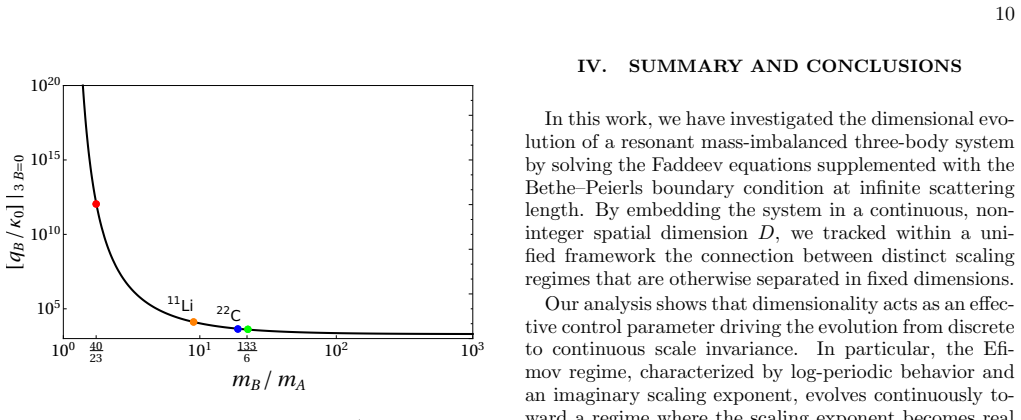
The argument is carried by the asymptotic spectator function of the Faddeev equations in a continuous effective dimension D, with Bethe-Peierls boundary conditions at unitarity. Near Dc the scaling exponent sn tends to zero, and the spectator function acquires a single logarithmic dependence on momentum, Eq. (3.5). Feeding this spectator function into the four Faddeev contributions to the single-particle momentum distribution and expanding at large qB produces Eq. (3.14), whose coefficients define the contact parameters; the quadratic-logarithmic coefficient C3'' is the newly identified three-body contact. The dimension Dc itself is located through the characteristic transcendental equation
What would settle it
Measure the single-particle momentum distribution of a resonantly interacting heavy-light-light mixture tuned to the critical dimension and test whether the subtracted tail qB^{Dc+2}[n(qB) - C2/qB^4] follows a quadratic logarithm with a positive C3'' and a zero crossing; alternatively, solve the three-body problem with a finite-range potential or an explicit harmonic trap and check whether the ln^2 term and its sign change survive beyond the zero-range, continuous-dimension model.
Extended reading notes
Core claim
The central claim is that at the critical dimension Dc the asymptotic single-particle momentum distribution has the form nB(qB) = C2/qB^4 + C3'/qB^{Dc+2} + C3/qB^{Dc+2} ln[qB/(4 muA muB)^{1/4} kappa0] + C3''/qB^{Dc+2} [ln(...)]^2, with the coefficient C3'' of the squared logarithm nonzero only for mass-imbalanced systems, negative for heavy-heavy-light, positive for heavy-light-light, and zero for identical particles. The paper argues that this logarithmic hierarchy is intrinsic to Dc, not a degenerate limit of the log-periodic Efimov oscillations or the pure power law of the unatomic regime. Consequently, a consistent finite description of the momentum tail at the transition requires the ne
Load-bearing premise
The whole prediction depends on treating spatial dimension as a continuous parameter and assuming that this noninteger-dimension problem faithfully represents a real quasi-two-dimensional confined gas; if the confinement-to-dimension mapping fails, the logarithmic-squared contact has no experimental realization.
Editorial extensions
If this is right
- Any universal relation at Dc involving energy, momentum distribution, or response functions must include the new three-body contact C3''; omitting it leaves the leading sub-asymptotic behavior ill-defined.
- In heavy-light-light systems, the three-body contribution vanishes at a finite momentum scale, making the asymptotic tail locally pure 1/q^4 and giving a direct experimental handle on the two-body contact.
- The intermediate scaling regime between Dc and the lower dimension Dbar narrows strongly with mass imbalance, so for heavy-heavy-light systems the transition is sharply localized in effective dimension and requires fine confinement control to resolve.
- The sign of C3'' distinguishes heavy-heavy-light from heavy-light-light configurations and vanishes for identical particles, providing a mass-ratio-dependent diagnostic of the transition.
- The critical dimension should be treated as its own scaling regime in future few-body studies, not as a singular limit obtained by extrapolating Efimov or unatomic formulas.
Reading between the lines
- The sign change of C3'' suggests a practical calibration: a zero crossing in the subtracted momentum tail could serve as an experimental fiducial for tuning a trapped mixture exactly to Dc.
- If the effective-dimension mapping holds for nuclear halo systems, analog logarithmic structure could appear in high-momentum knockout observables from heavy-light-light nuclei, offering a test beyond ultracold atoms.
- The emergence of a marginal quadratic-logarithmic term at Dc resembles the logarithmic corrections familiar at upper critical dimensions in critical phenomena, hinting that the Efimov-unatomic transition may have an effective renormalization-group description with a marginally relevant operator.
- A direct check of the mapping between harmonic confinement and effective dimension could be made by computing the same contacts with an explicit trap potential; the paper does not perform that check.
Signed reviews
Editorial analysis
A structured set of objections, weighed in public.
Referee Report
Summary. The paper studies a resonantly interacting mass-imbalanced three-body system in a continuous effective dimension D, focusing on the critical dimension D_c where the Efimov scaling parameter vanishes. It claims that at D_c the single-particle momentum distribution has a distinct asymptotic structure n_B(q_B) = C_2/q_B^4 + C_3'/q_B^{D_c+2} + C_3 q_B^{-(D_c+2)} ln[...] + C_3'' q_B^{-(D_c+2)} ln^2[...] (Eq. 3.14), requiring a new three-body contact parameter C_3'' associated with a quadratic logarithm. The paper further claims that C_3'' changes sign between heavy-heavy-light and heavy-light-light mass configurations, vanishes for equal masses, and can produce a momentum scale at which the three-body contribution cancels. It also analyzes the narrow intermediate region between D_c and a lower dimension D_*, which it calls the intermediate scaling regime, and relates its width to the mass ratio.
Significance. If the central claims are correct, the paper identifies a genuinely new scaling structure at the Efimov-unatomic transition: a marginal logarithmic regime distinct from both log-periodic Efimov behavior and power-law unatomic behavior. The proposal of an additional three-body contact parameter C_3'' and its mass-ratio dependence would be a valuable extension of contact theory, with experimentally testable consequences for high-momentum tails and possibly for three-body losses in confined ultracold mixtures. The paper also contributes explicit integral representations for the four contributions to the momentum distribution and compares them with full numerical solutions, which is a useful feature. However, the manuscript is not yet self-contained at the point where its central new quantity is defined: the reduction from the integrals (3.10)-(3.13) to the compact expansion (3.14) is not shown, and the coefficients C_3, C_3', C_3'' are extracted from unspecified fits. Because the sign change and equal-mass cancellation of C_3'' are the paper's principal physical message, this derivational gap currently prevents independent verification of the main result.
major comments (4)
- [§III.B, Eqs. (3.10)-(3.14)] The central derivation is missing. The four integrals (3.10)-(3.13) contain logarithmic terms with different momentum arguments (q_B, q_A', p_B', and combinations such as q_B p_B' ±) and different prefactors. The text jumps from these integrals to the compact expansion (3.14) with 'collecting all four terms', without showing the algebra that produces the constant, linear, and quadratic logarithmic terms, and without giving closed-form definitions of C_3, C_3', and C_3''. Since Eq. (3.14) is the basis for the new contact parameter C_3'', the manuscript should either provide the analytic derivation or at minimum state the precise definitions of these coefficients and how they follow from (3.10)-(3.13). The present gap makes the sign change in Fig. 8 and the equal-mass limit unverifiable by the reader.
- [§III.C, Fig. 8] The paper states that C_2, C_3, C_3', and C_3'' are 'obtained from fits to the asymptotic form, Eq. (3.14)', but gives no details: no momentum fitting range, number of fitted parameters, weighting, or statistical uncertainties. Fig. 8 shows smooth curves over a wide range of m_B/m_A, which suggests these are fits to numerical data sets. If C_3'' is determined by fitting the same asymptotic form that it is then used to explain, the risk of a fitting artifact is real; the reader cannot assess whether the claimed sign change and the zero at equal masses are robust. The authors should provide the analytic expressions or, failing that, a complete description of the fitting procedure and the resulting uncertainties.
- [§III.C, equal-mass limit] The text asserts that C_3'' vanishes for three identical particles. This does not follow trivially from the integral representations: in Eqs. (3.11)-(3.13) the pieces n_2, n_3, n_4 have different structures and different coefficients, and the equal-mass limit A=1 does not obviously make the quadratic-logarithmic terms cancel. A direct analytic or numerical demonstration of this cancellation should be given. This point is load-bearing because the paper repeatedly contrasts the C_3'' sign change against the identical-particle case as a limiting check.
- [Eq. (2.1) and Sec. II] The experimental mapping between effective dimension and confinement aspect ratio is used to claim that the intermediate scaling regime is accessible in principle. The footnote reference to Ref. [41] may support the mapping, but the manuscript does not verify that the continuous-D Faddeev solution with Bethe-Peierls boundary conditions describes the actual quasi-two-dimensional trapped system without additional effective-range or confinement-induced corrections. Since the paper's experimental conclusions rely on this mapping, a brief quantitative check or a discussion of its regime of validity should be included. This is not a fatal issue for the central scaling result, but it is necessary to support the experimental framing.
minor comments (5)
- [§II and Fig. 1] The paper alternates between 'Intermediate Scaling Regime (ISR)' and 'Scale Invariant Regime (SIR)' for the same interval D_* < D < D_c. The terminology should be unified to avoid confusion. Also, Fig. 1 uses open circles and green points whose meaning should be made explicit in the caption.
- [§III.B, Eqs. (3.10)-(3.13)] There are notational inconsistencies: some expressions show q'_A with prime and p'_B with prime, while others omit primes in the same formula; the arguments of the logarithms contain factors like '2q' that are not fully defined. Please normalize notation so that the momentum variables and the overall constants are unambiguous.
- [Appendix A, Eq. (A12)] The restriction 2 < D < 4 is stated after Eq. (A12), but the paper also discusses D=3 and the limit D→2^+. The limiting cases should be handled explicitly, including how the formulas behave at D=3 where some gamma functions have special values.
- [Fig. 6] The figure caption and text refer to '6Li–133Cs2' while other parts use '133Cs2–6Li' or '23Na2–40K'. The ordering and naming of the heavy-heavy-light and heavy-light-light configurations should be consistent throughout, because the sign of C_3'' is configuration-dependent.
- [§IV, Summary] The statement that the cancellation of the three-body contribution 'may also indicate reduced loss rates' is speculative. It is correctly labeled as future work, but the sentence should perhaps be more clearly separated from the established results.
Circularity Check
New C3'' contact and its sign change are fitted from the same momentum tail they are claimed to predict; the reduction from the derived integrals to Eq. (3.14) is not shown.
-
fitted input called prediction
[Sec. III.C (Contact Parameters), Eq. (3.14)]
"The quantities C2, C3, C3′, and C3″ are obtained from fits to the asymptotic form of the momentum distribution, Eq. (3.14), and are shown in dimensionless units."
C3″ is advertised in the abstract as a derived property ('requires the introduction of an additional three-body contact parameter ... changing sign across different mass configurations and vanishing for identical particles'). But C3″ is not defined by a closed-form integral or by an independent observable; it is the coefficient of the ln^2 term in the same Eq. (3.14) and is extracted by fitting that same asymptotic tail. The observed sign change and the zero-crossing scale are therefore properties of the fitted function, not independent predictions. Because no explicit formula for C3″ is supplied (unlike C2 in Eq. (B10)), the central claim is a fit result presented as a result.
-
other
[Sec. III.B, between Eqs. (3.13) and (3.14)]
"Collecting all four terms, the leading and sub-leading contributions in the asymptotic region of the momentum distribution is summarized as [Eq. (3.14)]."
The four integrals (3.10)-(3.13) contain logarithms with different momentum arguments and different prefactors (e.g., μA vs μB, q′A integrations); no angular or radial integrations are shown that would produce the compact ln^2 coefficient. The text jumps to Eq. (3.14) and then fits the coefficients. This omitted reduction is what allows C3″ to be treated as a free fit parameter; the derivation of the new contact parameter is therefore incomplete and its sign is not verifiable from the stated equations.
full rationale
The paper is partly self-contained: it solves the Faddeev equations in continuous non-integer dimension, derives the asymptotic spectator function (3.5), and obtains integral representations (3.10)-(3.13). Those pieces do not depend on the present claim in a circular way. The circularity is in the translation of those integrals into the advertised new physics. The paper asserts that the four terms 'collect' into Eq. (3.14), but provides no algebra defining C3, C3′, or C3″; it then states in Sec. III.C that these coefficients come from fits to Eq. (3.14). Thus the central new quantity, C3″, is a fit parameter of the same asymptotic form it is used to explain. The sign change, the vanishing for equal masses, and the cancellation momentum scale in Fig. 9 are all consequences of that fitted form, not independent predictions extracted from the stated derivation. This is partial, bookkeeping-type circularity rather than a definitional identity: the ln^2 structure does appear in the integrals, so the functional form is not entirely invented; however, the paper's signature result reduces to a fit whose reduction is not shown. Self-citations to [29-31,42,53] are frequent, but the key equations are reproduced in Appendices A and B, so the self-citations themselves are not load-bearing in the same way.
Assumptions & free parameters
free parameters (2)
- contact coefficients C3, C3', C3'' =
plotted in Figs. 8 and 10 for several mass ratios; no explicit values
- effective dimension D (via mapping to confinement aspect ratio) =
Dc = 2.296 for 23Na2-40K; Dc values for 6Li-133Cs2, 7Li-23Na2, 7Li-87Rb2
assumptions (4)
- domain assumption The Bethe-Peierls boundary condition (A6) in D dimensions and the restriction 2 < D < 4
- domain assumption The three-body problem in non-integer dimension D is a valid description of a harmonically confined quasi-D-dimensional system, via Eq. (2.1)
- ad hoc to paper The physically acceptable scaling solutions below Dc are those with -1 < s_n < 1 (stated after Fig. 1)
- domain assumption The standard STM/Faddeev equations in non-integer dimension (Eq. A7) from the authors' previous papers
Cite this review
Pith. "Pith review of Momentum Distribution and Contact Parameters of a mass-imbalanced three-body system across the Efimov-Unatomic transition." pith.science (2026). https://pith.science/paper/7WVPYUOO
@misc{pith2026260713769,
  author       = {Pith},
  title        = {Pith review of: Momentum Distribution and Contact Parameters of a mass-imbalanced three-body system across the Efimov-Unatomic transition},
  year         = {2026},
  howpublished = {\url{https://pith.science/paper/7WVPYUOO}},
  note         = {Machine review of arXiv:2607.13769}
}
read the original abstract
We investigate the single-particle momentum distribution and contact parameters of mass-imbalanced three-body systems at the critical dimension Dc, where the transition between discrete and continuous scale invariance takes place as the spatial dimension is tuned between three and two dimensions. We show that the asymptotic momentum distribution at Dc is governed by a distinct logarithmic scaling structure, which differs fundamentally from both the log-periodic behavior of Efimov states and the power-law scaling of the unatomic regime. This structure requires the introduction of an additional three-body contact parameter associated with a quadratic logarithmic contribution, leading to a finite and well-defined description of the momentum tail at the transition. This additional three-body parameter depends sensitively on the mass imbalance, changing sign across different mass configurations and vanishing for identical particles. As a consequence, the three-body contribution to the momentum distribution can be suppressed at a characteristic momentum scale, leaving the asymptotic tail entirely determined by the two-body contact. We further analyze the narrow intermediate region connecting the Efimov and unatomic regimes, here identified as an intermediate scaling regime, whose extent and properties are strongly controlled by the mass ratio. These results establish the critical dimension as a regime with emergent scaling properties and provide experimentally accessible signatures for probing the transition between discrete and continuous scale invariance in few-body quantum systems.
Figures


Figures from the paper (7 more)



Reference graph
Works this paper leans on
-
[41]
K. I. Elghazawy and C. H. Greene, Phys. Rev. A112, 063301 (2025)
2025
-
[1]
One can eliminate the center of mass coordinate and describe the system in terms of two relative Jacobi coordinates
Position space In position space, we consider three different particles with massesm i,m j,m k, and coordinatesx i,x j and xk. One can eliminate the center of mass coordinate and describe the system in terms of two relative Jacobi coordinates. The three sets of such coordinates are given by ri =x j −x k andρ i =x i − mjxj +m kxk mj +m k ,(A1) where (i, j,...
-
[2]
For that, we considerk i,k j andk k as the momenta of each particle in the rest frame
Momentum space We review the derivation of the three-body wave func- tion of a mass-imbalanced system at unitarity in momen- tum space. For that, we considerk i,k j andk k as the momenta of each particle in the rest frame. The Jacobi momenta of the pairs and from one particle to the center of mass of the other two are given, respectively, by pi ηi = kj mj...
-
[3]
Efimov, Phys
V. Efimov, Phys. Lett. B33, 563 (1970)
1970
-
[4]
M. H. Anderson, J. R. Ensher, M. R. Matthews, C. E. Wieman, and E. A. Cornell, Science269, 198 (1995)
1995
-
[5]
Inouye, M
S. Inouye, M. R. Andrews, J. Stenger, H.-J. Miesner, D. M. S.-Kurn and W. Ketterle, Nature392, 151 (1998)
1998
-
[6]
Kraemer, M
T. Kraemer, M. Mark, P. Waldburger, J. G. Danzl, C. Chin, B. Engeser, A. D. Lange, K. Pilch, A. Jaakkola, H.-C. N¨ agerl, and R. Grimm, Nature440, 315 (2006)
2006
-
[7]
Zaccanti, B
M. Zaccanti, B. Deissler, C. D’Errico, M. Fattori, M. Jona-Lasinio, S. M¨ uller, G. Roati, M. Inguscio and G. Modugno, Nature Physics5, pages 586 (2009)
2009
Show all 56 references
-
[8]
Ulmanis, S
J. Ulmanis, S. H¨ afner, R. Pires, E. D. Kuhnle, Y. Wang, C. H. Greene and M. Weidem¨ uller, Phys. Rev. Lett.117, 153201 (2016)
2016
-
[9]
Naidon and S
P. Naidon and S. Endo, Rep. Prog. Phys.80, 056001 (2017)
2017
-
[10]
C. H. Greene, P. Giannakeas, and J. P´ erez-R ´ ıos, Rev. Mod. Phys.89, 035006 (2017)
2017
-
[11]
Hammer, S
H.-W. Hammer, S. K¨ onig, and U. van Kolck, Rev. Mod. Phys.92, 025004 (2020)
2020
-
[12]
Br¨ uhl, A
R. Br¨ uhl, A. Kalinin, O. Kornilov, J. P. Toennies, G. C. Hegerfeldt and M. Stoll, Phys. Rev. Lett.95, 063002 (2005)
2005
-
[13]
Kunitski, S
M. Kunitski, S. Zeller, J. Voigtsberger, A. Kalinin, L. Ph. H. Schmidt, M. Sch¨ offler, A. Czasch, W. Sch¨ ollkopf, R. E. Grisenti, T. Jahnke, D. Blume, and R. D¨ orner, Science 348, 551 (2015)
2015
-
[14]
Nishida, S
Y. Nishida, S. Moroz and D. T. Son, Phys. Rev. Lett. 110, 235301 (2013)
2013
-
[15]
N. Sun, L. Feng, and P. Zhang, Communications Physics 9, 146 (2026)
2026
-
[16]
Bloch, Nature Physics1, 23 (2005)
I. Bloch, Nature Physics1, 23 (2005)
2005
-
[17]
Hadzibabic, P
Z. Hadzibabic, P. Kr¨ uger, M. Cheneau, B. Battelier and J. Dalibard, Nature441, 1118 (2006)
2006
-
[18]
Kinoshita, T
T. Kinoshita, T. Wenger and D. S. Weiss, Nature440, 900 (2006)
2006
-
[19]
Moritz, T
H. Moritz, T. St¨ oferle, K. G¨ unter, M. K¨ ohl, and T. Esslinger, Phys. Rev. Lett.94, 210401 (2005)
2005
-
[20]
Dalibard, F
J. Dalibard, F. Gerbier, G. Juzeli¯ unas and P. ¨Ohberg, Rev. Mod. Phys.83, 1523 (2011)
2011
-
[21]
Nishida and S
Y. Nishida and S. Tan, Phys. Rev. Lett.101, 170401 (2008)
2008
-
[22]
Zhang and Z
P. Zhang and Z. Yu, Phys. Rev. A96, 030702(R) (2017)
2017
-
[23]
Nishida and D
Y. Nishida and D. T. Son, Phys. Rev. Lett.97, 050403 (2006)
2006
-
[24]
Mohapatra and E
A. Mohapatra and E. Braaten, Phys. Rev. A98, 013633 (2018)
2018
-
[25]
Nishida and S
Y. Nishida and S. Tan, Phys. Rev. A79, 060701(R) 15 ● ● ○ ○ □ □ C3 /κ 0 2+2s 1 |C3| /κ 0 2+2s 1 C3 /κ 0 2 |C3'| /κ 0 2 C2 /κ 0 4-D 7Li- 23Na2 2.0 2.1 2.2 2.3 2.4 2.5 2.6 2.7 2.8 2.9 3.0 10-2 10-1 100 101 102 103 D ■ ■ ● ● ○ ○ □ □ |C3| /κ 0 2+2s 1 C3 /κ 0 2 |C3'| /κ 0 2 C2 /κ 0...
2009
-
[26]
J. H. Sandoval, F. F. Bellotti, M. T. Yamashita, T. Fred- erico, D. V. Fedorov, A. S. Jensen and N. T. Zinner, J. Phys. B: At. Mol. Opt. Phys.51, 065004 (2018)
2018
-
[27]
Nielsen, D
E. Nielsen, D. V. Fedorov, A. S. Jensen and E. Garrido, Physics Reports347, 373 (2001)
2001
-
[28]
D. S. Rosa, T. Frederico, G. Krein and M. T. Yamashita, J. Phys. B: At. Mol. Opt. Phys.52, 025101 (2019)
2019
-
[29]
Garrido, E
E. Garrido, E. R. Christensen and A. S. Jensen, Phys. Rev. A106, 013307 (2022)
2022
-
[30]
R. M. Francisco, D. S. Rosa and T. Frederico, Phys. Rev. A106, 063305 (2022)
2022
-
[31]
D. S. Rosa, T. Frederico, G. Krein and M. T. Yamashita, Phys. Rev. A97, 050701(R) (2018). Erratum, Phys. Rev. A104, 029901 (2021)
2018
-
[32]
D. S. Rosa, R. M. Francisco, T. Frederico, G. Krein and M. T. Yamashita, Phys. Rev. A110, 042803 (2024)
2024
-
[33]
R. M. Francisco, D. S. Rosa, T. Frederico, G. Krein and M. T. Yamashita, Phys. Rev. A112, 033315 (2025)
2025
-
[34]
Georgi, Phys
H. Georgi, Phys. Rev. Lett.98, 221601 (2007)
2007
-
[35]
H. -W. Hammer and D. T. Son, Proc. Natl. Acad. Sci. U.S.A.,118, e2108716118 (2021)
2021
-
[36]
Sch¨ afer and G
T. Sch¨ afer and G. Baym, Proc. Natl. Acad. Sci. U.S.A., 118, e2113775118 (2021)
2021
-
[37]
Braaten and H
E. Braaten and H. -W. Hammer, Phys. Rev. D107, 034017 (2023). 16
2023
-
[38]
Braaten and H
E. Braaten and H. -W. Hammer, Phys. Rev. Lett.128, 032002 (2022)
2022
-
[39]
S. D. Chowdhury, R. Mishra and D. T. Son, Phys. Rev. D109, 016001 (2024)
2024
-
[40]
S. R. Beane, D. Orlando and S. Reffert, Phys. Rev. D 112, 014028 (2025)
2025
-
[42]
J.-Garc ´ ıa, J
S.-Kuang Tung, K. J.-Garc ´ ıa, J. Johansen, C. V. Parker and C. Chin, Phys. Rev. Lett.113, 240402 (2014)
2014
-
[43]
Garrido and A
E. Garrido and A. S. Jensen, Phys. Rev. Res.2, 033261 (2020)
2020
-
[44]
D. S. Rosa, T. Frederico, G. Krein and M. T. Yamashita, Phys. Rev. A108, 033307 (2023)
2023
-
[45]
Tan, Ann
S. Tan, Ann. Phys. (N.Y.)323, 2952 (2008)
2008
-
[46]
Tan, Ann
S. Tan, Ann. Phys. (N.Y.)323, 2971 (2008)
2008
-
[47]
Tan, Ann
S. Tan, Ann. Phys. (N.Y.)323, 2987 (2008)
2008
-
[48]
Castin and F
Y. Castin and F. Werner, Phys. Rev. A83, 063614 (2011)
2011
-
[49]
M. T. Yamashita, F. F. Bellotti, T. Frederico,2 D. V. Fedorov, A. S. Jensen and N. T. Zinner, Phys. Rev. A 87, 062702 (2013)
2013
-
[50]
Musolino, H
S. Musolino, H. Kurkjian, M. Van Regemortel, M. Wouters, S. Kokkelmans and V. Colussi, Phys. Rev. Lett. 128, 020401 (2022)
2022
-
[51]
Fletcher, R
R. Fletcher, R. Lopes, N. Navon, R. Smith, M. Zwierlein, Z. Hadzibabic, Science355, 377 (2017)
2017
-
[52]
R. J. Wild, P. Makotyn, J. M. Pino, E. A. Cornell, and D. S. Jin, Phys. Rev. Lett.108, 145305 (2012)
2012
-
[53]
Makotyn, C
P. Makotyn, C. Klauss, D. Goldberger, E. Cornell and D. Jin, Nature Phys10, 116 (2014)
2014
-
[54]
Yudkin, R
Y. Yudkin, R. Elbaz, J. P. D’Incao, P. S. Julienne and L. Khaykovich, Nature Communications15, 2127 (2024)
2024
-
[55]
D. S. Rosa, T. Frederico, G. Krein and M. T. Yamashita, Phys. Rev. A106, 023311 (2022)
2022
-
[56]
Braaten, D
E. Braaten, D. Kang and L. Platter, Phys. Rev. Lett. 106, 153005 (2011)
2011
Reviewed August 2, 2026 · model on record in the stance chip above.
Discussion (0). Continue with ORCID to comment.