Overconfident Coordinates: Quantifying Confidence in Traceroute Geolocation
Pith reviewed 2026-06-25 22:37 UTC · model grok-4.3
The pith
Path Consistency Scoring assigns confidence to traceroute geolocations by checking consistency with latency and speed-of-light constraints.
A machine-rendered reading of the paper's core claim, the machinery that carries it, and where it could break.
Core claim
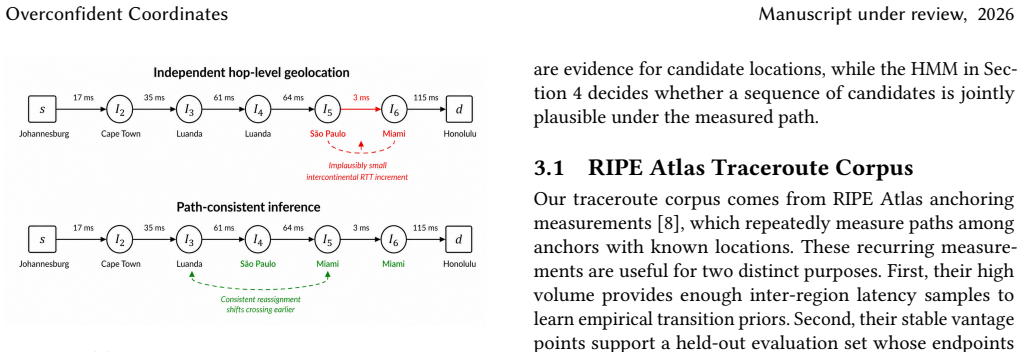
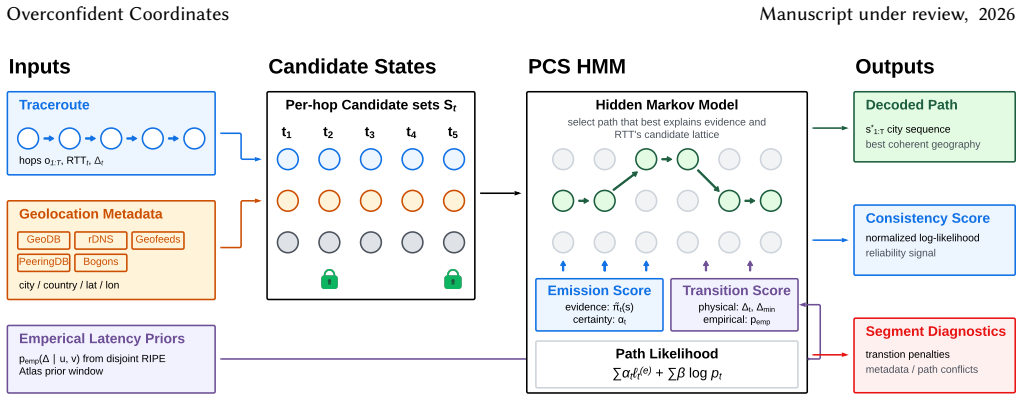
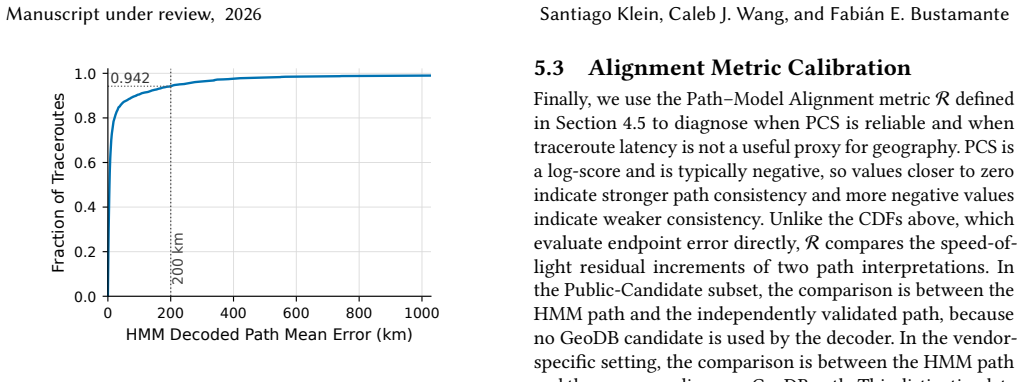
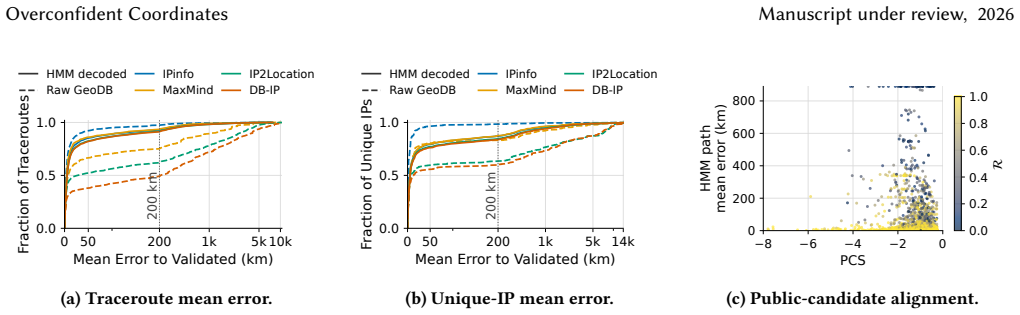
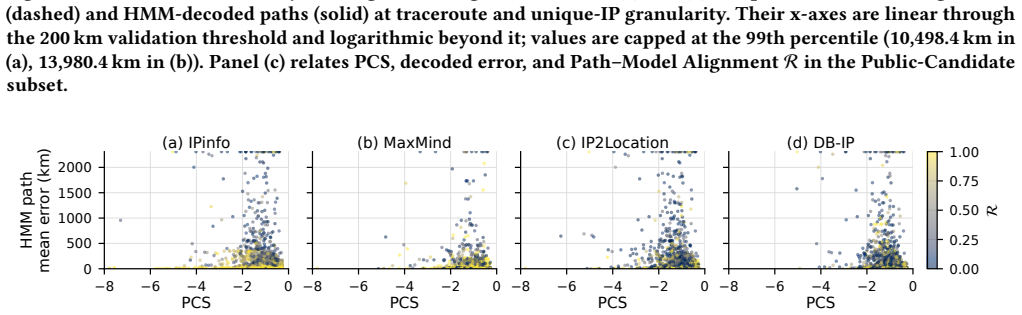
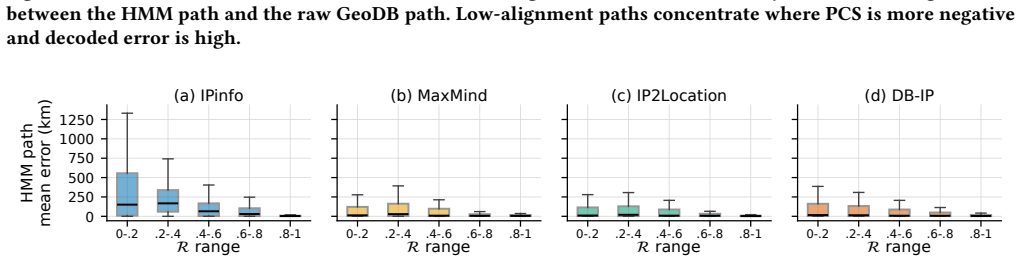
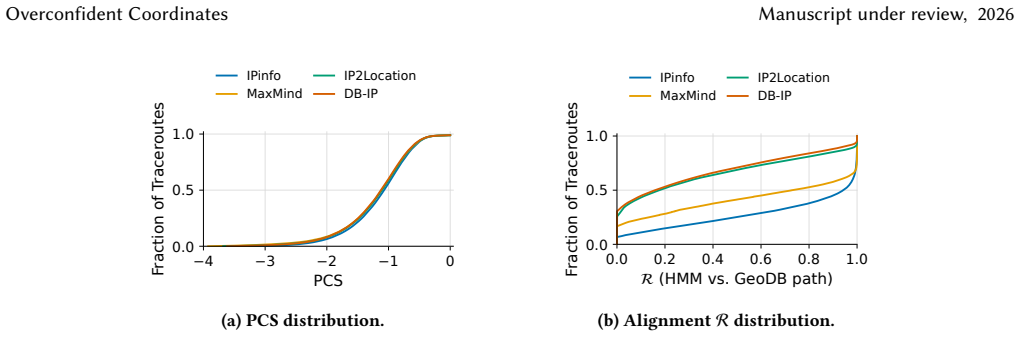
PCS models each traceroute as a sequence of candidate city-level locations and uses a Hidden Markov Model to fuse local evidence with speed-of-light constraints and empirical latency priors. The model produces a path consistency score that summarizes how well metadata and observed RTT increments support a coherent geographic interpretation. On 6,555 validated paths, 94.2% of decoded sequences achieve mean error below 200 km. PCS is largely GeoDB-agnostic, with median scores varying by less than 5% across four commercial databases, while the alignment metric shows that over half of DB-IP and IP2Location paths require substantial correction, compared with 15% for IPinfo.
What carries the argument
Path Consistency Scoring (PCS), a Hidden Markov Model that scores path-level consistency between geolocation metadata and observed latencies under speed-of-light constraints.
If this is right
- Downstream analyses can filter or weight traceroute paths according to their PCS scores instead of treating all geolocation data as equally reliable.
- The Path-Model Alignment metric identifies which geolocation databases produce paths needing the most correction on a given dataset.
- Researchers obtain a passive method to qualify geographic conclusions from traceroutes without requiring active probing for every path.
- Comparisons across geolocation databases become possible through consistency scores rather than point-wise accuracy alone.
Where Pith is reading between the lines
- Studies of Internet routing and topology could improve by discarding or down-weighting low-PCS paths, reducing the impact of unreliable location data.
- The same consistency-checking approach might extend to other forms of network metadata such as rDNS labels or IXP records.
- If latency-to-distance assumptions weaken in certain network regions, PCS scores would need region-specific calibration to remain useful.
Load-bearing premise
The score is only meaningful when latency serves as a reasonable proxy for geographic distance.
What would settle it
A large independent set of ground-truth validated paths on which fewer than 80% of decoded sequences achieve mean error below 200 km would falsify the reported decoding accuracy.
Figures
read the original abstract
Studies of Internet paths often attach router locations to traceroute hops using commercial geolocation databases, rDNS labels, Geofeeds, and IXP metadata. These sources provide useful hints, but they report point locations without calibrated confidence, leaving researchers unable to tell whether a geographic path is trustworthy. We introduce Path Consistency Scoring (PCS), a passive framework that evaluates router geolocation as a path-level consistency problem. PCS models each traceroute as a sequence of candidate city-level locations and uses a Hidden Markov Model to fuse local evidence with speed-of-light constraints and empirical latency priors. PCS produces a path consistency score summarizing how well metadata and observed RTT increments support a coherent geographic interpretation. Because this score is only meaningful when latency proxies for geography, we also define a Path-Model Alignment metric that compares speed-of-light residual increments of the decoded path against a reference path. We evaluate on 413,354 RIPE Atlas traceroutes and a 6,555-path subset verified by active probing. On validated paths, 94.2% of decoded sequences achieve mean error below 200 km. PCS is largely GeoDB-agnostic; median scores vary by less than 5% across four commercial databases, while the alignment metric reveals that over half of DB-IP and IP2Location paths require substantial correction, compared with 15% for IPinfo. This lets downstream analyses quantify confidence in their geographic conclusions rather than inheriting database accuracy without qualification.
Editorial analysis
A structured set of objections, weighed in public.
Referee Report
Summary. The manuscript introduces Path Consistency Scoring (PCS), a passive framework that models traceroute paths as sequences of candidate city-level locations and applies a Hidden Markov Model to combine local geolocation evidence with speed-of-light constraints and empirical latency priors, yielding a path-level consistency score. It also defines a Path-Model Alignment metric to test whether latency serves as a geographic proxy. Evaluation on 413,354 RIPE Atlas traceroutes and a 6,555-path actively verified subset reports that 94.2% of decoded sequences have mean error below 200 km; PCS scores are largely insensitive to the choice of commercial geolocation database (median variation <5%), while the alignment metric indicates that over half of DB-IP and IP2Location paths require substantial correction versus 15% for IPinfo.
Significance. If the central claims hold, the work supplies a practical, quantitative method for assessing confidence in geolocated Internet paths, directly addressing the absence of calibrated uncertainty in existing metadata sources. The scale of the evaluation, the use of an independently verified subset, the explicit precondition statement, and the external alignment check are notable strengths that could improve reliability in downstream measurement studies relying on geographic path data.
major comments (2)
- [Abstract / Methods] Abstract and Methods: The HMM transition and emission probabilities are central to PCS, yet the abstract (and apparently the methods description) provides no information on how these probabilities were set or estimated from data. This detail is load-bearing for reproducibility and for interpreting the reported 94.2% low-error rate.
- [Evaluation] Evaluation section: The 94.2% figure on the verified 6,555-path subset is presented without error bars, confidence intervals, or a clear description of the active-probing validation protocol. These omissions weaken the ability to assess the robustness of the central performance claim.
minor comments (2)
- [Abstract] Abstract: The statement that PCS is 'largely GeoDB-agnostic' is quantified only via median score variation; reporting the full distribution or inter-quartile ranges across the four databases would improve clarity.
- [Evaluation] The Path-Model Alignment metric is introduced as an external check, but the manuscript could more explicitly compare its results against the PCS scores to illustrate how the two metrics interact on the same paths.
Simulated Author's Rebuttal
We thank the referee for the constructive feedback and the recommendation for minor revision. The comments correctly identify areas where additional detail will improve reproducibility and the interpretability of our results. We address each major comment below.
read point-by-point responses
-
Referee: [Abstract / Methods] Abstract and Methods: The HMM transition and emission probabilities are central to PCS, yet the abstract (and apparently the methods description) provides no information on how these probabilities were set or estimated from data. This detail is load-bearing for reproducibility and for interpreting the reported 94.2% low-error rate.
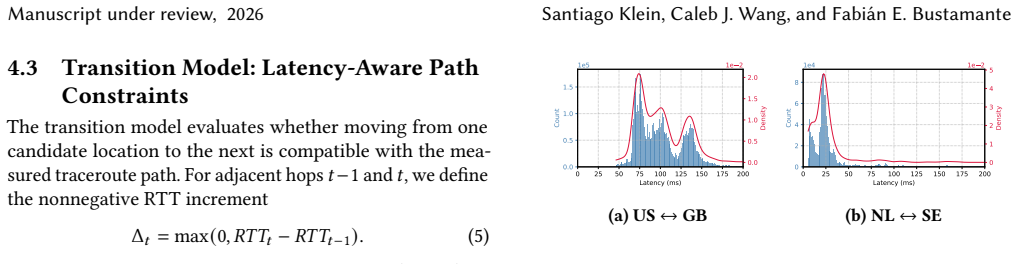
Authors: We agree that the current description of how the HMM parameters were obtained is insufficient for full reproducibility. Transition probabilities are estimated via maximum likelihood from empirical latency-increment distributions observed across the RIPE Atlas corpus, while emission probabilities combine per-database confidence scores with speed-of-light feasibility checks. To resolve the concern we will (1) add a concise statement to the abstract and (2) insert an explicit subsection in Methods that reports the estimation procedure, the data subset used for fitting, and the resulting parameter values. These changes will make the 94.2 % figure more readily interpretable. revision: yes
-
Referee: [Evaluation] Evaluation section: The 94.2% figure on the verified 6,555-path subset is presented without error bars, confidence intervals, or a clear description of the active-probing validation protocol. These omissions weaken the ability to assess the robustness of the central performance claim.
Authors: The referee is correct that uncertainty quantification and protocol details are missing. The 6,555-path subset was obtained by issuing additional active probes from multiple RIPE Atlas vantage points and confirming city-level locations via latency triangulation against known landmarks. We will expand the Evaluation section with a step-by-step description of this validation protocol and will report bootstrap confidence intervals around the 94.2 % statistic. These additions directly address the robustness concern. revision: yes
Circularity Check
No significant circularity identified
full rationale
The paper defines PCS via an HMM that incorporates speed-of-light constraints and empirical latency priors, then reports performance on a 6,555-path actively verified subset separate from the main 413k RIPE corpus. The Path-Model Alignment metric is introduced explicitly to test the latency-as-geography precondition rather than assuming it. No equation or step is shown reducing a claimed prediction or score to a fit performed on the identical data being scored, nor does any load-bearing claim rest solely on a self-citation chain. The derivation therefore remains self-contained against the external validation set and alignment check.
Axiom & Free-Parameter Ledger
axioms (1)
- domain assumption Latency can serve as a proxy for geography
Reference graph
Works this paper leans on
-
[1]
Bischof, Alberto Dain- otti, and Paul Barford
Scott Anderson, Loqman Salamatian, Zachary S. Bischof, Alberto Dain- otti, and Paul Barford. 2022. iGDB: connecting the physical and logical layers of the internet. InProceedings of the 22nd ACM Internet Measure- ment Conference(Nice, France)(IMC ’22). Association for Computing Machinery, New York, NY, USA, 433–448. doi:10.1145/3517745.3561443
-
[2]
Jeff A. Bilmes. 1998.A Gentle Tutorial of the EM Algorithm and Its Application to Parameter Estimation for Gaussian Mixture and Hidden Markov Models. Technical Report. International Computer Science In- stitute. https://www.cs.cmu.edu/~aarti/Class/10701/readings/gentle_ tut_HMM.pdf
1998
-
[3]
Wang, Mia Weaver, Fabián E
Esteban Carisimo, Caleb J. Wang, Mia Weaver, Fabián E. Bustamante, and Paul Barford. 2023. A Hop Away from Everywhere: A View of the Intercontinental Long-haul Infrastructure.Proc. ACM Meas. Anal. Comput. Syst., Article 47 (dec 2023), 26 pages
2023
-
[4]
Corbett, Jeffrey Dean, Michael Epstein, Andrew Fikes, Christo- pher Frost, J
James C. Corbett, Jeffrey Dean, Michael Epstein, Andrew Fikes, Christo- pher Frost, J. J. Furman, Sanjay Ghemawat, Andrey Gubarev, Christo- pher Heiser, Peter Hochschild, et al. 2013. Spanner: Google’s globally distributed database.ACM Transactions on Computer Systems31, 3 (2013), 1–22
2013
-
[5]
Alberto Dainotti, Walter de Donato, Antonio Pescape, and Pierluigi Salvo Rossi. 2008. Classification of Network Traffic via Packet-Level Hidden Markov Models. InIEEE GLOBECOM 2008 - 2008 IEEE Global Telecommunications Conference. 1–5. doi:10.1109/GLOCOM.2008.ECP. 412
-
[7]
Omar Darwich, Hugo Rimlinger, Milo Dreyfus, Matthieu Gouel, and Kevin Vermeulen. 2023. Replication: Towards a Publicly Available Internet Scale IP Geolocation Dataset. InProceedings of the 2023 ACM on Internet Measurement Conference(Montreal QC, Canada)(IMC ’23). Association for Computing Machinery, New York, NY, USA, 1–15. doi:10.1145/3618257.3624801
-
[8]
Alun Davies. 2017. Anchoring Measurements: Bringing Back the Balance. https://labs.ripe.net/author/alun_davies/anchoring- measurements-bringing-back-the-balance/. RIPE Labs article
2017
-
[9]
DB-IP. 2025. DB-IP Geolocation Data. https://db-ip.com/db/
2025
-
[10]
Perera, Rajarathnam Chandramouli, and K.P
Ziqian Dong, Rohan D.W. Perera, Rajarathnam Chandramouli, and K.P. Subbalakshmi. 2012. Network measurement based modeling and optimization for IP geolocation.Computer Networks56, 1 (2012), 85–98. doi:10.1016/j.comnet.2011.08.011
-
[11]
Benoit Donnet, Matthew Luckie, Pascal Mérindol, and Jean-Jacques Pansiot. 2012. Revealing MPLS tunnels obscured from traceroute. ACM SIGCOMM Computer Communication Review42, 2 (March 2012), 87–93
2012
-
[12]
Ben Du, Massimo Candela, Bradley Huffaker, Alex C Snoeren, and KC Claffy. 2020. RIPE IPmap active geolocation: Mechanism and performance evaluation.ACM SIGCOMM Computer Communication Review(2020)
2020
-
[13]
Ben Du, Massimo Candela, Bradley Huffaker, Alex C. Snoeren, and kc claffy. 2020. RIPE IPmap active geolocation: mechanism and perfor- mance evaluation.SIGCOMM Comput. Commun. Rev.50, 2 (May 2020), 3–10. doi:10.1145/3402413.3402415
-
[14]
Yariv Ephraim and Neri Merhav. 2002. Hidden Markov Processes.IEEE Transactions on Information Theory48, 6 (2002), 1518–1569. doi:10. 1109/TIT.2002.1003838
arXiv 2002
-
[15]
Romain Fontugne, Cristel Pelsser, Emile Aben, and Randy Bush. 2017. Pinpointing delay and forwarding anomalies using large-scale tracer- oute measurements. InProc. of IMC
2017
-
[16]
Center for Applied Internet Data Analysis (CAIDA). 2025. CYMRU Bogon Reference Dataset (historical and daily bogons and fullbogons) - Center for Applied Internet Data Analysis (CAIDA) / Team Cymru. https://publicdata.caida.org/datasets/bogon/. Accessed: 2025-11-05
2025
-
[17]
Manaf Gharaibeh, Anant Shah, Bradley Huffaker, Han Zhang, Roya Ensafi, and Christos Papadopoulos. 2017. A look at router geolocation in public and commercial databases. InProc. of IMC. 13 Manuscript under review, 2026 Santiago Klein, Caleb J. Wang, and Fabián E. Bustamante
2017
-
[18]
Manaf Gharaibeh, Anant Shah, Bradley Huffaker, Han Zhang, Roya Ensafi, and Christos Papadopoulos. 2017. A look at router geoloca- tion in public and commercial databases. InProceedings of the 2017 Internet Measurement Conference(London, United Kingdom)(IMC ’17). Association for Computing Machinery, New York, NY, USA, 463–469. doi:10.1145/3131365.3131380
-
[19]
Bamba Gueye, Artur Ziviani, Mark Crovella, and Serge Fdida. 2004. Constraint-based geolocation of internet hosts. InProceedings of the 4th ACM SIGCOMM Conference on Internet Measurement(Taormina, Sicily, Italy)(IMC ’04). Association for Computing Machinery, New York, NY, USA, 288–293. doi:10.1145/1028788.1028828
-
[20]
Naohiro Hayashibara, Xavier Defago, Rami Yared, and Takuya Katayama. 2004. The 𝜑 accrual failure detector. InProc. IEEE Sympo- sium on Reliable Distributed Systems (SRDS). IEEE, 66–78
2004
-
[21]
Zi Hu, John Heidemann, and Yuri Pradkin. 2012. Towards geoloca- tion of millions of IP addresses. InProceedings of the 2012 Internet Measurement Conference(Boston, Massachusetts, USA)(IMC ’12). As- sociation for Computing Machinery, New York, NY, USA, 123–130. doi:10.1145/2398776.2398790
-
[22]
Bradley Huffaker, Marina Fomenkov, and kc claffy. 2014. DRoP: DNS- based router positioning.SIGCOMM Comput. Commun. Rev.44, 3 (July 2014), 5–13. doi:10.1145/2656877.2656879
-
[23]
IP2Location. 2025. IP2Location Geolocation Data. https://www. ip2location.com/databases
2025
-
[24]
Inc. IPinfo. 2025. Bogon IP Address Ranges. https://ipinfo.io/bogon. Accessed: 2025-11-05
2025
-
[25]
Inc. IPinfo. 2025. IPinfo: IP Data Intelligence for Developers & Enter- prises. https://ipinfo.io. Accessed: 2025-11-05
2025
-
[27]
John, Arvind Krishnamurthy, David Wetherall, Thomas Anderson, and Yatin Chawathe
Ethan Katz-Bassett, John P. John, Arvind Krishnamurthy, David Wetherall, Thomas Anderson, and Yatin Chawathe. 2006. Towards IP geolocation using delay and topology measurements. InProceedings of the 6th ACM SIGCOMM Conference on Internet Measurement(Rio de Janeriro, Brazil)(IMC ’06). Association for Computing Machinery, New York, NY, USA, 71–84. doi:10.11...
-
[28]
Ioana Livadariu, Kevin Vermeulen, Maxime Mouchet, and Vasilis Giot- sas. 2024. Geofeeds: Revolutionizing IP Geolocation or Illusionary Promises?Proc. ACM Netw.2, CoNEXT3, Article 15 (Aug. 2024), 21 pages. doi:10.1145/3676869
-
[29]
Matthew Luckie, Bradley Huffaker, Alexander Marder, Zachary Bischof, Marianne Fletcher, and K Claffy. 2021. Learning to extract geographic information from internet router hostnames. InProc. of CoNEXT
2021
-
[30]
Matthew Luckie, Bradley Huffaker, Alexander Marder, Zachary Bischof, Marianne Fletcher, and K Claffy. 2021. Learning to extract geographic information from internet router hostnames. InProceed- ings of the 17th International Conference on Emerging Networking EX- periments and Technologies(Virtual Event, Germany)(CoNEXT ’21). Association for Computing Mach...
-
[31]
Justin Ma, Kirill Levchenko, Christian Kreibich, Stefan Savage, and Geoffrey M. Voelker. 2006. Unexpected means of protocol inference. In Proceedings of the 6th ACM SIGCOMM Conference on Internet Measure- ment(Rio de Janeriro, Brazil)(IMC ’06). Association for Computing Machinery, New York, NY, USA, 313–326. doi:10.1145/1177080.1177123
-
[32]
Geolocate much?
Lorenzo Ariemma Massimo Candela, Emanuele Candela. 2025. Ge- ofeeds Registry "Geolocate much?". https://geolocatemuch.com/
2025
-
[33]
Maxmind. 2025. Maxmind Geolocation Data. https://www.maxmind. com/en/geoip2-services-and-databases
2025
-
[34]
Maxime Mouchet, Sandrine Vaton, Thierry Chonavel, Emile Aben, and Jasper Den Hertog. 2020. Large-Scale Characterization and Segmenta- tion of Internet Path Delays With Infinite HMMs.IEEE Access8 (2020), 16771–16784. doi:10.1109/ACCESS.2020.2968380
-
[35]
Gerhard Münz, Hui Dai, Lothar Braun, and Georg Carle. 2010. TCP Traffic Classification Using Markov Models. InTraffic Monitoring and Analysis, Fabio Ricciato, Marco Mellia, and Ernst Biersack (Eds.). Springer Berlin Heidelberg, Berlin, Heidelberg, 127–140
2010
-
[36]
Padmanabhan and Lakshminarayanan Subramanian
Venkata N. Padmanabhan and Lakshminarayanan Subramanian. 2001. An investigation of geographic mapping techniques for internet hosts. SIGCOMM Comput. Commun. Rev.31, 4 (Aug. 2001), 173–185. doi:10. 1145/964723.383073
arXiv 2001
-
[37]
Vern Paxson. 1996. End-to-End Routing Behavior in the Internet. In Proc. of ACM SIGCOMM
1996
-
[38]
PeeringDB. 2023. PeeringDB. https://www.peeringdb.com/. Dates used: 2023-12-08. Accessed: 2023-12-08
2023
-
[39]
Ingmar Poese, Steve Uhlig, Mohamed Ali Kaafar, Benoit Donnet, and Bamba Gueye. 2011. IP Geolocation Databases: Unreliable? 41, 2 (April 2011)
2011
-
[40]
Ingmar Poese, Steve Uhlig, Mohamed Ali Kaafar, Benoit Donnet, and Bamba Gueye. 2011. IP geolocation databases: unreliable?SIGCOMM Comput. Commun. Rev.41, 2 (April 2011), 53–56. doi:10.1145/1971162. 1971171
-
[41]
Lawrence R. Rabiner and Biing-Hwang Juang. 1986. An Introduction to Hidden Markov Models.IEEE ASSP Magazine3, 1 (1986), 4–16. doi:10.1109/MASSP.1986.1165342
-
[42]
Alagappan Ramanathan and Sangeetha Abdu Jyothi. 2023. Nautilus: A Framework for Cross-Layer Cartography of Submarine Cables and IP Links.Proc. ACM Meas. Anal. Comput. Syst.7, 3 (dec 2023)
2023
-
[43]
Hugo Rimlinger, Olivier Fourmaux, Timur Friedman, and Kevin Ver- meulen. 2025. GeoResolver: An Accurate, Scalable, and Explainable Geolocation Technique Using DNS Redirection.Proc. ACM Netw.3, CoNEXT3, Article 19 (Sept. 2025), 21 pages. doi:10.1145/3749219
-
[44]
Quirin Scheitle, Oliver Gasser, Patrick Sattler, and Georg Carle. 2017. HLOC: Hints-based geolocation leveraging multiple measurement frameworks. InProc. of TMA
2017
-
[45]
Ankit Singla, Balakrishnan Chandrasekaran, P Brighten Godfrey, and Bruce Maggs. 2014. The internet at the speed of light. InProc. of HotNets
2014
-
[46]
Joel Sommers, Paul Barford, and Brian Eriksson. 2011. On the preva- lence and characteristics of MPLS deployments in the open internet. InProc. of IMC
2011
-
[47]
Bustamante
Kedar Thiagarajan, Esteban Carisimo, and Fabián E. Bustamante. 2025. The Aleph: Decoding DNS PTR Records With Large Language Models. InACM CoNEXT
2025
-
[48]
Kedar Thiagarajan, Esteban Carisimo, and Fabián E. Bustamante. 2025. The Aleph: Decoding Geographic Information from DNS PTR Records Using Large Language Models.Proc. ACM Netw.3, CoNEXT1, Article 7 (March 2025), 20 pages. doi:10.1145/3709374
-
[49]
Yves Vanaubel, Pascal Mérindol, Jean-Jacques Pansiot, and Benoit Donnet. 2017. Through the wormhole: tracking invisible MPLS tunnels. InProc. of IMC
2017
-
[50]
Caleb Wang, Ying Zhang, Qianli Dong, Esteban Carisimo, Ramakr- ishnan Durairajan, and Fabián E. Bustamante. 2025. Threading the Ocean: Mapping Digital Routes Across Submarine Cables us- ing Calypso. InProceedings of the ACM SIGCOMM 2025 Conference (São Francisco Convent, Coimbra, Portugal)(SIGCOMM ’25). Asso- ciation for Computing Machinery, New York, NY,...
-
[51]
Wei Wei, Bing Wang, Don Towsley, and Jim Kurose. 2011. Model-Based Identification of Dominant Congested Links.IEEE/ACM Transactions on Networking19, 2 (2011), 456–469. doi:10.1109/TNET.2010.2068058 A ETHICS This work does not raise any ethical issues. B MODEL PARAMETERS We use one fixed parameter configuration for all valida- tion and evaluation decodes. ...
discussion (0)
Sign in with ORCID, Apple, or X to comment. Anyone can read and Pith papers without signing in.