REVIEW 2 major objections 4 minor 134 references
LBT IR observations of candidate super-Eddington quasars
T0 review · 2 major / 4 minor · reviewed 2026-08-16 · deepseek-v4-flash
Pith's one-line read CIV winds from six super-Eddington quasars carry about 4% of the bolometric luminosity.
desk verdict The new LBT spectra and the selection-criteria check are worth having; the headline 0.04 L_bol feedback number does not reproduce from the paper's own Table 8 and equations. read the letter →
The pith
A machine-rendered reading of the paper's core claim, the machinery that carries it, and where it could break.
The reading
What carries the argument
The load-bearing tool is multi-component spectral decomposition: each line is fitted with a Lorentzian broad component kept at the rest frame plus a blueshifted skewed Gaussian component, so the C IV blueshifted component isolates the wind from the virialized gas. Outflow dynamical parameters then come from a published framework for collisionally excited lines in photoionized gas, which expresses the ionized-gas mass, mass outflow rate, thrust, and kinetic power as functions of line luminosity, outflow velocity, and assumed density, radius, metallicity, and terminal-to-observed velocity ratio. The terminal velocity is taken as five times the observed blueshift, following a simple radiation-pressure wind model. For metallicity, the machinery is a grid of photoionization models predicting ten line-intensity ratios such as C IV/He II, Al III/C IV, and Fe II/H$\beta$ as functions of hydrogen density, ionization parameter, and metallicity; the best metallicity is the one minimizing $\chi^2$ over the grid. This decomposition is what connects an observed line profile to a physical feedback power.
What would settle it
Measure the C IV outflow radius and electron density in one of these six quasars directly, for instance by reverberation mapping of the C IV line or by using the C III]/Si III] ratio as a density diagnostic; if the emitting radius is roughly 10 pc rather than 1 pc, or the density is $10^8$ cm$^{-3}$ rather than $10^9$ cm$^{-3}$, the computed kinetic power would drop by roughly an order of magnitude, below the $0.5\%\,L_{\rm bol}$ threshold for circum-nuclear feedback.
Extended reading notes
Core claim
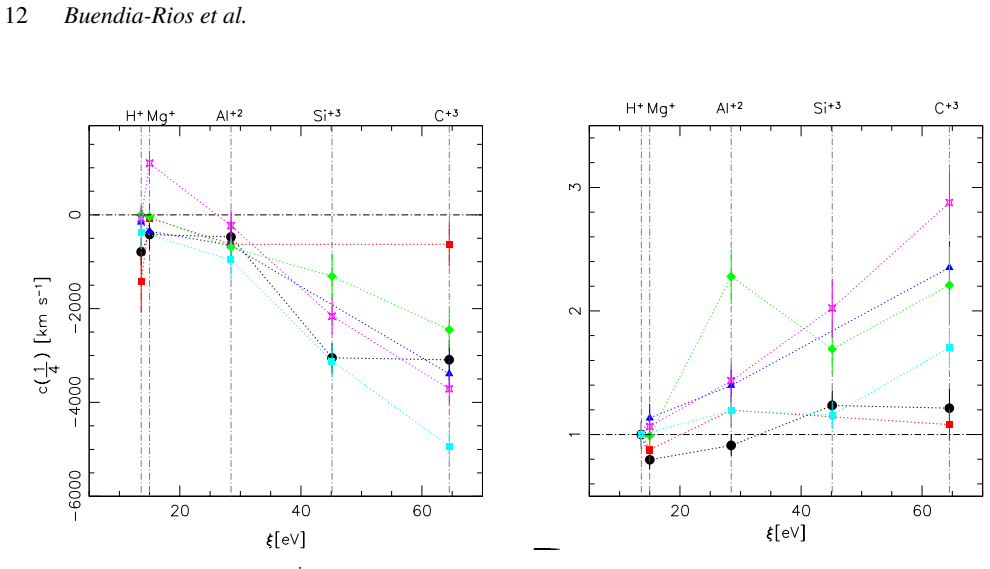
Anchoring the quasar rest frame with H$\beta$ shows that C IV $\lambda$1549 in most of the super-Eddington candidates is dominated by a blueshifted component with velocities of roughly $-2000$ to $-5000$ km/s, while H$\beta$, Mg II, and Al III stay symmetric and near the rest frame. Interpreting this blueshifted C IV component as a radiation-driven wind, the paper derives ionized-gas masses, outflow rates, thrusts, and kinetic powers under explicit assumptions of density, radius, metallicity, and terminal-velocity factor; the resulting kinetic power is, on average, about $0.04\,L_{\rm bol}$, close to the 5% threshold invoked for AGN feedback on the host galaxy. A grid of photoionization models fitted to ten UV and optical diagnostic ratios returns broad-line metallicities of roughly $10$–$20\,Z_\odot$ for the objects with the best data. The paper concludes that super-Eddington quasars at $z\approx2$–$3$ are capable of both mechanical and chemical feedback on their hosts, and that low-ionization lines such as H$\beta$ remain reliable virial tracers even in these extreme accretors.
Load-bearing premise
The outflow dynamical parameters assume the C IV blueshifted component is a wind with fixed electron density $n=10^9$ cm$^{-3}$, radius $r=1$ pc, abundance $Z=5\,Z_\odot$, and terminal velocity $k=5$ times the observed shift; since kinetic power scales as $k^2 v^3$, a different radius, density, or velocity factor would move the derived feedback power below or above the $0.5$–$5\%\,L_{\rm bol}$ band.
Editorial extensions
If this is right
- If the average kinetic power of about $0.04\,L_{\rm bol}$ holds, these super-Eddington quasars sit close to the 5% $L_{\rm bol}$ threshold at which AGN outflows are expected to affect the black-hole–host-galaxy relation.
- Broad-line metallicities of about $10$–$20\,Z_\odot$ imply the same winds carry metal-enriched gas, making chemical enrichment of the host and circumgalactic medium a corollary of mechanical feedback.
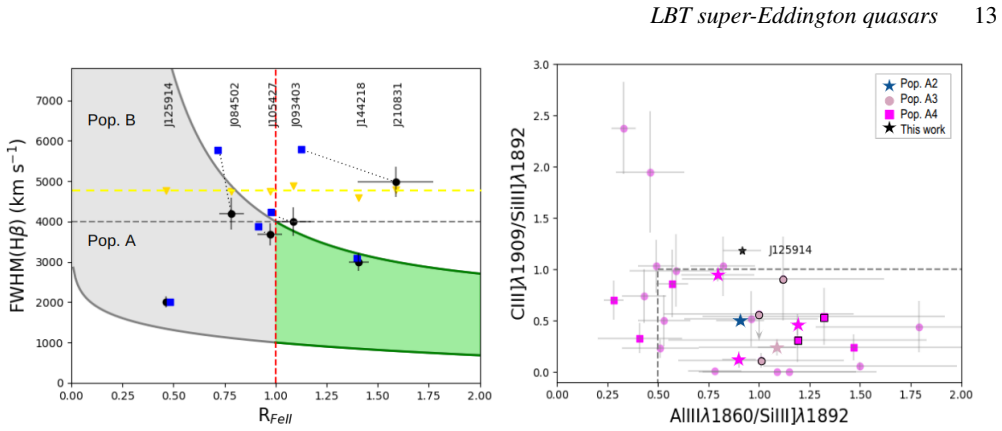
- The UV and optical selection criteria agree in roughly 75%–90% of cases, supporting the use of UV line ratios to find super-Eddington quasars when H$\beta$ is unavailable.
- Because H$\beta$ and Mg II remain symmetric while C IV is strongly blueshifted, H$\beta$-based black hole masses and Eddington ratios stay trustworthy in these extreme accretors.
- The H$\beta$ line-width distance moduli of the extreme quasars follow the standard cosmological curve, strengthening the proposal that low-ionization line widths can serve as distance indicators at $z>1$.
Reading between the lines
- The largest lever on the feedback number is the assumed terminal-velocity factor $k=5$: kinetic power scales as $k^2 v^3$, so a calibration of the true acceleration law (from line-profile shape or multi-epoch monitoring) could move the result across the $0.5$–$5\%\,L_{\rm bol}$ range.
- If the high metallicities are real, super-Eddington quasar winds should leave detectable abundance imprints in circumgalactic gas at $z\approx2$; deep surveys of C II or CO emission around such quasars could test this.
- The paper's single-epoch estimates could be turned into direct measurements by reverberation mapping of C IV in one or two of these objects, replacing the assumed radius of 1 pc and density of $10^9$ cm$^{-3}$ with measured values.
- The H$\beta$ Hubble-diagram agreement hints that a larger near-infrared sample of super-Eddington quasars could become a standalone distance ladder at $z>1$, but the current five-object sample is too small to establish this.
Signed reviews
Editorial analysis
A structured set of objections, weighed in public.
Referee Report
Summary. The manuscript reports new LUCI/LBT near-IR spectroscopy of six SDSS quasars at z ≈ 2.37–2.44 selected as candidate super-Eddington (xA) sources. The Hβ+FeII coverage is combined with SDSS UV spectra to determine systemic redshifts, decompose line profiles, estimate black hole masses and Eddington ratios, derive CIV outflow dynamical parameters (mass rate, thrust, kinetic power), estimate BLR metallicities via photoionization grids, and build a virial-luminosity Hubble diagram. The headline conclusions are that the CIV winds carry kinetic power |epsilon| ≈ 0.04 L_bol, close to the 5% L_bol feedback threshold, and that the broad-line/outflow gas is metal-rich (Z ≳ 10 Zsun), implying both mechanical and chemical feedback to the host galaxies.
Significance. If the quantitative results hold, the paper is a valuable addition to the study of super-Eddington quasars at the epoch of peak galaxy growth: high-z Hβ spectroscopy of xA candidates is rare, and the combination of systemic redshifts, line decompositions, accretion parameters, outflow energetics, and metallicity in one sample is useful. The detailed multi-component fits, residual/noise analysis, quality-parameter uncertainties, and publication of the IR spectra are strengths. The central quantitative claim, however, is not currently reproducible from the printed equations and tabulated values, and the near-threshold feedback conclusion therefore needs revision before the paper can be accepted.
major comments (2)
- [§6.2 and Table 8] Table 8 does not reproduce the equations printed in §6.2 under the stated normalizations. For J084502 (log L_CIV = 44.52, v_o = 11293 km/s), the displayed expressions with n = 10^9 cm^-3, r = 1 pc, Z = 5 Zsun, and k = 5 give Mdot_ion ≈ 8 × 0.331 × 2.26 ≈ 6 Msun/yr and kinetic power ≈ 6.6 × 10^43 × 0.331 × 25 × 2.26^3 ≈ 6.3 × 10^45 erg/s, whereas Table 8 lists 50 Msun/yr and 2.1 × 10^45 erg/s. For J093403 the same equations give kinetic power ≈ 2.6 × 10^44 erg/s, while Table 8 lists 8.6 × 10^44 erg/s. In addition, combining the Table 8 kinetic powers with the L_bol values in Table 7 gives |epsilon|/L_bol ≈ 0.002–0.014 per object, with a sample average near 0.004–0.006, not the ≈ 0.04 quoted in §6.2 and used in §7 to argue proximity to the 5% L_bol feedback threshold. The table must be recomputed consistently with the stated model, the input values and equations for each column must be specified, and the abstract and conclusions must be based on the corrected average ratio.
- [§6.2 and Table 8] The outflow energetics are highly sensitive to assumed parameters that are not measured: n = 10^9 cm^-3, r = 1 pc, Z = 5 Zsun, and the terminal-velocity factor k = 5. Since kinetic power scales as k^2 and r^-1, a factor-of-two change in k or in r moves |epsilon| by factors of several, enough to cross the 0.005 L_bol and 0.05 L_bol thresholds for individual objects. The paper states these assumptions but does not propagate them into uncertainties or present alternative choices. Because the near-threshold feedback conclusion depends directly on these scalings, a sensitivity analysis (or at minimum explicit conservative lower/upper bounds) should be added before the claim can be evaluated.
minor comments (4)
- [Abstract] The abstract contains grammatical slips: 'The aim is obtain' should be 'The aim is to obtain', and 'on second stance' should be 'on second instance' or similar.
- [Table 5 note] The units in the Table 5 note are inconsistent: line fluxes are listed as 10^-17 erg s^-1 cm^-1, which should be 10^-17 erg s^-1 cm^-2.
- [§6.3 and Table 9] The text 'For J2018 the Mgii is not available' should refer to J2108 (J210831). In addition, the abstract's 'Z ≳ 10 Zsun' is based on three objects, one of which (J210831) reaches Z ≈ 500 Zsun and another (J144218) has a wide, poorly constrained 1σ range; the summary should state explicitly that the metallicity result rests on a small subset.
- [Fig. 5 caption] The caption's sentence about blue squares and black circles is garbled ('...are in blue'); please clarify which symbol/color corresponds to the full Hβ profile and which to the BC-only FWHM.
Circularity Check
No significant circularity: the outflow and metallicity derivations are transparent applications of published, externally calibrated methods; self-citations anchor methodology but do not make the central claims equivalent to their inputs.
full rationale
The paper's central measurements—redshifts, FWHMs, line shifts, and fluxes—are independent of the derived physical quantities. The outflow parameters in Section 6.2 are computed with equations reproduced in the text, following Marziani et al. (2017) and Deconto-Machado et al. (2024), with explicitly stated assumptions (k=5, n=10^9 cm^-3, r=1 pc, Z=5 Zsun). These are assumptions, not fitted to the claimed feedback fraction; changing them changes the results, so the derivation is not equivalent to its inputs by construction. The metallicity analysis uses observed diagnostic ratios against a CLOUDY photoionization grid, which is an external forward modeling step, and the quoted super-solar values follow from matching observed and predicted ratios. The Hubble diagram in Section 6.4 is explicitly presented as a restatement of virial and spectral-invariance assumptions, and it is not the basis of the paper's main feedback or metallicity conclusions. Self-citations (MS14, M17, Netzer & Marziani 2010, Floris et al. 2024) anchor the adopted methodology, but the relevant equations are stated in the paper and are externally falsifiable; they are not invoked as uniqueness theorems or as ground truth forbidding alternatives. One internal numerical concern should be flagged separately from circularity: Table 8 does not transparently reproduce the Section 6.2 equations for at least some objects, and the quoted average |epsilon| approximately 0.04 L_bol is not recovered from the tabulated kinetic powers and L_bol values in Tables 7 and 8. That is an arithmetic or reporting inconsistency, not a circular reduction of the derivation chain.
Assumptions & free parameters
free parameters (5)
- electron density n =
10^9 cm^-3 (assumed)
- emitting radius r =
1 pc (assumed)
- terminal velocity factor k =
5 (assumed)
- metallicity Z in outflow normalization =
5 Zsun (assumed)
- ionization parameter density product n_H U =
10^9.6 cm^-3 (assumed)
assumptions (5)
- domain assumption CIV blueshifted component is a wind with uniform density, single ionization stage, and well-defined abundance
- ad hoc to paper Terminal velocity of the wind is k=5 times the observed CIV line shift
- domain assumption Hbeta, MgII, and AlIII FWHM are virial broadening estimators for black hole mass
- domain assumption xA quasars have roughly constant Eddington ratio near 1 and spectral invariance
- domain assumption CLOUDY photoionization models with the adopted SED reproduce the observed line ratios
Cite this review
Pith. "Pith review of LBT IR observations of candidate super-Eddington quasars." pith.science (2026). https://pith.science/paper/7YUII43H
@misc{pith2026250418740,
  author       = {Pith},
  title        = {Pith review of: LBT IR observations of candidate super-Eddington quasars},
  year         = {2026},
  howpublished = {\url{https://pith.science/paper/7YUII43H}},
  note         = {Machine review of arXiv:2504.18740}
}
abstract
Quasars accreting at very high rates are believed to be prime movers of galactic evolution because of their high radiative and mechanical output. The study presented in this paper investigates a sample of six highly accreting quasars at redshifts \( z = 2-3 \) using near-infrared observations from the LUCI spectrograph at the Large Binocular Telescope (LBT). The aim is obtain a precise measure of the quasar systemic redshift and accretion parameters (black hole mass and Eddington ratio) primarily from the \hb\ line, \ and on second stance from other intermediate and low ionization lines. Outflow dynamical parameters (mass rate of outflowing gas, its kinetic power and momentum rate) were estimated from the \civ\ emission line that is perhaps the most easily accessible tracer of high-ionization winds from the accretion disk, obtained from the Sloan Digital Sky Survey. In addition, the joint analysis of the rest-frame optical and UV spectra allowed us to estimate the chemical composition of the broad line emitting gas. The high metal content of the outflowing gas ($Z \gtrsim 10 Z_\odot$) and the high values of thrust and kinetic power may induce a chemical feedback effect in the quasar host, in addition to mechanical feedback.
Figures


Figures from the paper (7 more)


Reference graph
Works this paper leans on
-
[1]
write newline
" write newline "" before.all 'output.state := FUNCTION fin.entry write newline FUNCTION new.block output.state before.all = 'skip after.block 'output.state := if FUNCTION new.sentence output.state after.block = 'skip output.state before.all = 'skip after.sentence 'output.state := if if FUNCTION not #0 #1 if FUNCTION and 'skip pop #0 if FUNCTION or pop #1...
-
[2]
Bischetti M., et al., 2017, @doi [ ] 10.1051/0004-6361/201629301 , https://ui.adsabs.harvard.edu/abs/2017A&A...598A.122B 598, A122
-
[3]
Bisogni S., di Serego Alighieri S., Goldoni P., Ho L. C., Marconi A., Ponti G., Risaliti G., 2017, preprint, http://adsabs.harvard.edu/abs/2017arXiv170208046B ( @eprint arXiv 1702.08046 )
arXiv 2017
-
[4]
A., Dultzin D., del Olmo A., D'Onofrio M., Mart \' nez-Aldama M
Bon N., Marziani P., Bon E., Negrete C. A., Dultzin D., del Olmo A., D'Onofrio M., Mart \' nez-Aldama M. L., 2020, @doi [A&A] 10.1051/0004-6361/201936773 , https://ui.adsabs.harvard.edu/abs/2020A&A...635A.151B 635, A151
-
[5]
Bonzini M., et al., 2015, @doi [ ] 10.1093/mnras/stv1675 , http://adsabs.harvard.edu/abs/2015MNRAS.453.1079B 453, 1079
-
[6]
Boroson T. A., Green R. F., 1992, @doi [ApJS] 10.1086/191661 , https://ui.adsabs.harvard.edu/abs/1992ApJS...80..109B 80, 109
doi:10.1086/191661 1992
-
[7]
Brotherton M. S., Runnoe J. C., Shang Z., DiPompeo M. A., 2015, @doi [ ] 10.1093/mnras/stv767 , http://adsabs.harvard.edu/abs/2015MNRAS.451.1290B 451, 1290
-
[8]
Bruhweiler F., Verner E., 2008, @doi [ ] 10.1086/525557 , https://ui.adsabs.harvard.edu/abs/2008ApJ...675...83B 675, 83
doi:10.1086/525557 2008
Show all 134 references
-
[9]
M., Negrete C
Buendia-Rios T. M., Negrete C. A., Marziani P., Dultzin D., 2023, @doi [ ] 10.1051/0004-6361/202244177 , https://ui.adsabs.harvard.edu/abs/2023A&A...669A.135B 669, A135
2023 doi
-
[10]
Caccianiga A., et al., 2015, @doi [ ] 10.1093/mnras/stv939 , https://ui.adsabs.harvard.edu/abs/2015MNRAS.451.1795C 451, 1795
2015 doi
-
[11]
Cano-D \' az M., Maiolino R., Marconi A., Netzer H., Shemmer O., Cresci G., 2012, @doi [A&A] 10.1051/0004-6361/201118358 , https://ui.adsabs.harvard.edu/abs/2012A&A...537L...8C 537, L8
2012 doi
-
[12]
M., Netzer H., Lira P., Trakhtenbrot B., Mej \' a-Restrepo J., 2016, @doi [ ] 10.1093/mnras/stw937 , https://ui.adsabs.harvard.edu/abs/2016MNRAS.460..212C 460, 212
Capellupo D. M., Netzer H., Lira P., Trakhtenbrot B., Mej \' a-Restrepo J., 2016, @doi [ ] 10.1093/mnras/stw937 , https://ui.adsabs.harvard.edu/abs/2016MNRAS.460..212C 460, 212
2016 doi
-
[13]
Chartas G., et al., 2021, @doi [ ] 10.3847/1538-4357/ac0ef2 , https://ui.adsabs.harvard.edu/abs/2021ApJ...920...24C 920, 24
2021 doi
-
[14]
C., Banerji M., Richards G
Coatman L., Hewett P. C., Banerji M., Richards G. T., 2016, @doi [ ] 10.1093/mnras/stw1360 , https://ui.adsabs.harvard.edu/abs/2016MNRAS.461..647C 461, 647
2016 doi
-
[15]
J., 2014, @doi [ ] 10.1146/annurev-astro-081913-040037 , https://ui.adsabs.harvard.edu/abs/2014ARA&A..52..291C 52, 291
Conselice C. J., 2014, @doi [ ] 10.1146/annurev-astro-081913-040037 , https://ui.adsabs.harvard.edu/abs/2014ARA&A..52..291C 52, 291
2014 doi
-
[16]
A., 2024, @doi [Universe] 10.3390/universe10060254 , https://ui.adsabs.harvard.edu/abs/2024Univ...10..254D 10, 254
D'Onofrio M., Marziani P., Chiosi C., Negrete C. A., 2024, @doi [Universe] 10.3390/universe10060254 , https://ui.adsabs.harvard.edu/abs/2024Univ...10..254D 10, 254
2024 doi
-
[17]
M., 2023, @doi [ ] 10.1051/0004-6361/202243801 , https://ui.adsabs.harvard.edu/abs/2023A&A...669A..83D 669, A83
Deconto-Machado A., del Olmo Orozco A., Marziani P., Perea J., Stirpe G. M., 2023, @doi [ ] 10.1051/0004-6361/202243801 , https://ui.adsabs.harvard.edu/abs/2023A&A...669A..83D 669, A83
2023 doi
- [18]
-
[19]
Di Matteo T., Springel V., Hernquist L., 2005, @doi [ ] 10.1038/nature03335 , https://ui.adsabs.harvard.edu/abs/2005Natur.433..604D 433, 604
2005 doi
-
[20]
C., Constantin A., Heidt J., J \"a ger K., Vestergaard M., Wagner S
Dietrich M., Hamann F., Shields J. C., Constantin A., Heidt J., J \"a ger K., Vestergaard M., Wagner S. J., 2003, @doi [ ] 10.1086/374662 , https://ui.adsabs.harvard.edu/abs/2003ApJ...589..722D 589, 722
2003 doi
-
[21]
S., Popovi \'c L
Dimitrijevi \'c M. S., Popovi \'c L. C ., Kova c evi \'c J., Da c i \'c M., Ili \'c D., 2007, @doi [ ] 10.1111/j.1365-2966.2006.11238.x , https://ui.adsabs.harvard.edu/abs/2007MNRAS.374.1181D 374, 1181
2007
-
[22]
Du P., Wang J.-M., 2019, @doi [ ] 10.3847/1538-4357/ab4908 , https://ui.adsabs.harvard.edu/abs/2019ApJ...886...42D 886, 42
2019 doi
-
[23]
C., Li Y.-R., Bai J.-M., 2016, @doi [ApJL] 10.3847/2041-8205/818/1/L14 , https://ui.adsabs.harvard.edu/abs/2016ApJ...818L..14D 818, L14
Du P., Wang J.-M., Hu C., Ho L. C., Li Y.-R., Bai J.-M., 2016, @doi [ApJL] 10.3847/2041-8205/818/1/L14 , https://ui.adsabs.harvard.edu/abs/2016ApJ...818L..14D 818, L14
2016 doi
-
[24]
Dultzin D., et al., 2020, @doi [Frontiers in Astronomy and Space Sciences] 10.3389/fspas.2019.00080 , https://ui.adsabs.harvard.edu/abs/2020FrASS...6...80M 6, 80
2020
-
[25]
Duras F., et al., 2017, @doi [ ] 10.1051/0004-6361/201731052 , https://ui.adsabs.harvard.edu/abs/2017A&A...604A..67D 604, A67
2017 doi
-
[26]
Duras F., et al., 2020, @doi [ ] 10.1051/0004-6361/201936817 , https://ui.adsabs.harvard.edu/abs/2020A&A...636A..73D 636, A73
2020 doi
-
[27]
C., Trump J
Elitzur M., Ho L. C., Trump J. R., 2014, @doi [ ] 10.1093/mnras/stt2445 , https://ui.adsabs.harvard.edu/abs/2014MNRAS.438.3340E 438, 3340
2014 doi
-
[28]
Elvis M., 2000, @doi [ ] 10.1086/317778 , https://ui.adsabs.harvard.edu/abs/2000ApJ...545...63E 545, 63
2000 doi
-
[29]
T., Blandford R
Emmering R. T., Blandford R. D., Shlosman I., 1992, @doi [ ] 10.1086/170955 , https://ui.adsabs.harvard.edu/abs/1992ApJ...385..460E 385, 460
1992 doi
-
[30]
P., 2004, @doi [ ] 10.1086/379823 , https://ui.adsabs.harvard.edu/abs/2004ApJS..150..181E 150, 181
Eracleous M., Halpern J. P., 2004, @doi [ ] 10.1086/379823 , https://ui.adsabs.harvard.edu/abs/2004ApJS..150..181E 150, 181
2004 doi
-
[31]
C., 2012, @doi [ ] 10.1146/annurev-astro-081811-125521 , https://ui.adsabs.harvard.edu/abs/2012ARA&A..50..455F 50, 455
Fabian A. C., 2012, @doi [ ] 10.1146/annurev-astro-081811-125521 , https://ui.adsabs.harvard.edu/abs/2012ARA&A..50..455F 50, 455
2012 doi
-
[32]
Fiore F., et al., 2017, @doi [ ] 10.1051/0004-6361/201629478 , https://ui.adsabs.harvard.edu/abs/2017A&A...601A.143F 601, A143
2017 doi
- [33]
-
[34]
J., Hewett P
Francis P. J., Hewett P. C., Foltz C. B., Chaffee F. H., Weymann R. J., Morris S. L., 1991, @doi [ ] 10.1086/170066 , https://ui.adsabs.harvard.edu/abs/1991ApJ...373..465F 373, 465
1991 doi
-
[35]
A., 2019, @doi [ ] 10.1051/0004-6361/201936270 , https://ui.adsabs.harvard.edu/abs/2019A&A...630A.110G 630, A110
Ganci V., Marziani P., D'Onofrio M., del Olmo A., Bon E., Bon N., Negrete C. A., 2019, @doi [ ] 10.1051/0004-6361/201936270 , https://ui.adsabs.harvard.edu/abs/2019A&A...630A.110G 630, A110
2019 doi
-
[36]
A., Marziani P., Dultzin D., \'S niegowska M., Panda S., 2022, @doi [ ] 10.1051/0004-6361/202142837 , https://ui.adsabs.harvard.edu/abs/2022A&A...667A.105G 667, A105
Garnica K., Negrete C. A., Marziani P., Dultzin D., \'S niegowska M., Panda S., 2022, @doi [ ] 10.1051/0004-6361/202142837 , https://ui.adsabs.harvard.edu/abs/2022A&A...667A.105G 667, A105
2022 doi
-
[37]
E., et al., 2024, @doi [ ] 10.1051/0004-6361/202348908 , https://ui.adsabs.harvard.edu/abs/2024A&A...687A.235G 687, A235
Gianolli V. E., et al., 2024, @doi [ ] 10.1051/0004-6361/202348908 , https://ui.adsabs.harvard.edu/abs/2024A&A...687A.235G 687, A235
2024 doi
-
[38]
Gillette J., Hamann F., 2024, @doi [ ] 10.1093/mnras/stae429 , https://ui.adsabs.harvard.edu/abs/2024MNRAS.528.6425G 528, 6425
2024 doi
-
[39]
M., van Hoof P
Gunasekera C. M., van Hoof P. A. M., Chatzikos M., Ferland G. J., 2023, @doi [Research Notes of the American Astronomical Society] 10.3847/2515-5172/ad0e75 , https://ui.adsabs.harvard.edu/abs/2023RNAAS...7..246G 7, 246
2023 doi
-
[40]
Hamann F., Ferland G., 1993, @doi [ ] 10.1086/173366 , http://adsabs.harvard.edu/abs/1993ApJ...418...11H 418, 11
1993 doi
-
[41]
Hamann F., Ferland G., 1999, @doi [ARA&A] 10.1146/annurev.astro.37.1.487 , http://adsabs.harvard.edu/abs/1999ARA
1999 doi
-
[42]
F., Baldwin J
Hartig G. F., Baldwin J. A., 1986, @doi [ ] 10.1086/163974 , https://ui.adsabs.harvard.edu/abs/1986ApJ...302...64H 302, 64
1986 doi
-
[43]
C., Wild V., 2010, @doi [ ] 10.1111/j.1365-2966.2010.16648.x , http://adsabs.harvard.edu/abs/2010MNRAS.405.2302H 405, 2302
Hewett P. C., Wild V., 2010, @doi [ ] 10.1111/j.1365-2966.2010.16648.x , http://adsabs.harvard.edu/abs/2010MNRAS.405.2302H 405, 2302
2010
-
[45]
F., Hernquist L., Cox T
Hopkins P. F., Hernquist L., Cox T. J., Di Matteo T., Robertson B., Springel V., 2006, @doi [ ] 10.1086/499298 , http://adsabs.harvard.edu/abs/2006ApJS..163....1H 163, 1
2006 doi
-
[47]
O., Ishibashi K., Davidson K., Gull T., 2000, , https://ui.adsabs.harvard.edu/abs/2000A&A...361..977J 361, 977
Johansson S., Zethson T., Hartman H., Ekberg J. O., Ishibashi K., Davidson K., Gull T., 2000, , https://ui.adsabs.harvard.edu/abs/2000A&A...361..977J 361, 977
2000
-
[48]
Kakkad D., et al., 2020, @doi [ ] 10.1051/0004-6361/202038551 , https://ui.adsabs.harvard.edu/abs/2020A&A...642A.147K 642, A147
2020 doi
-
[49]
I., Sramek R., Schmidt M., Shaffer D
Kellermann K. I., Sramek R., Schmidt M., Shaffer D. B., Green R., 1989, @doi [ ] 10.1086/115207 , https://ui.adsabs.harvard.edu/abs/1989AJ.....98.1195K 98, 1195
1989 doi
-
[50]
Kharb P., Silpa S., 2023, @doi [Galaxies] 10.3390/galaxies11010027 , https://ui.adsabs.harvard.edu/abs/2023Galax..11...27K 11, 27
2023 doi
-
[51]
King A., Pounds K., 2015, @doi [ ] 10.1146/annurev-astro-082214-122316 , http://adsabs.harvard.edu/abs/2015ARA
2015 doi
-
[52]
M., Richards G
Krawczyk C. M., Richards G. T., Mehta S. S., Vogeley M. S., Gallagher S. C., Leighly K. M., Ross N. P., Schneider D. P., 2013, @doi [ ] 10.1088/0067-0049/206/1/4 , https://ui.adsabs.harvard.edu/abs/2013ApJS..206....4K 206, 4
2013 doi
-
[53]
R., Hanisch R
Kriss G., 1994, in Crabtree D. R., Hanisch R. J., Barnes J., eds, Astronomical Society of the Pacific Conference Series Vol. 61, Astronomical Data Analysis Software and Systems III. p. 437
1994
-
[54]
Kwan J., Cheng F.-Z., Fang L.-Z., Zheng W., Ge J., 1995, @doi [ ] 10.1086/175302 , https://ui.adsabs.harvard.edu/abs/1995ApJ...440..628K 440, 628
1995 doi
-
[55]
Laha S., Reynolds C. S., Reeves J., Kriss G., Guainazzi M., Smith R., Veilleux S., Proga D., 2021, @doi [Nature Astronomy] 10.1038/s41550-020-01255-2 , https://ui.adsabs.harvard.edu/abs/2021NatAs...5...13L 5, 13
2021 doi
-
[56]
J., McDowell J
Laor A., Fiore F., Elvis M., Wilkes B. J., McDowell J. C., 1997, @doi [ ] 10.1086/303696 , https://ui.adsabs.harvard.edu/abs/1997ApJ...477...93L 477, 93
1997 doi
-
[57]
M., 2004, @doi [ApJ] 10.1086/42\-20\-89 , http://adsabs.harvard.edu/abs/2004ApJ...611..125L 611, 125
Leighly K. M., 2004, @doi [ApJ] 10.1086/42\-20\-89 , http://adsabs.harvard.edu/abs/2004ApJ...611..125L 611, 125
2004 doi
-
[58]
M., Moore J
Leighly K. M., Moore J. R., 2004, @doi [ ] 10.1086/422088 , http://adsabs.harvard.edu/abs/2004ApJ...611..107L 611, 107
2004 doi
-
[59]
L., Greene J
Liu G., Zakamska N. L., Greene J. E., Nesvadba N. P. H., Liu X., 2013a, @doi [MNRAS] 10.1093/mnras/stt051 , https://ui.adsabs.harvard.edu/abs/2013MNRAS.430.2327L 430, 2327
-
[60]
L., Greene J
Liu G., Zakamska N. L., Greene J. E., Nesvadba N. P. H., Liu X., 2013b, @doi [MNRAS] 10.1093/mnras/stt1755 , https://ui.adsabs.harvard.edu/abs/2013MNRAS.436.2576L 436, 2576
-
[61]
A., Sargent W
Malkan M. A., Sargent W. L. W., 1982, @doi [ ] 10.1086/159701 , https://ui.adsabs.harvard.edu/abs/1982ApJ...254...22M 254, 22
1982 doi
-
[62]
L., Del Olmo A., Marziani P., Sulentic J
Mart \' nez-Aldama M. L., Del Olmo A., Marziani P., Sulentic J. W., Negrete C. A., Dultzin D., Perea J., D'Onofrio M., 2018, @doi [Frontiers in Astronomy and Space Sciences] 10.3389/fspas.2017.00065 , 4, 65
2018
-
[63]
W., 2012, @doi [NewAR] 10.1016/j.newar.2011.09.001 , https://ui.adsabs.harvard.edu/abs/2012NewAR..56...49M 56, 49
Marziani P., Sulentic J. W., 2012, @doi [NewAR] 10.1016/j.newar.2011.09.001 , https://ui.adsabs.harvard.edu/abs/2012NewAR..56...49M 56, 49
2012 doi
-
[64]
W., 2014, @doi [MNRAS] 10.1093/mnras/stu951 , https://ui.adsabs.harvard.edu/abs/2014MNRAS.442.1211M 442, 1211
Marziani P., Sulentic J. W., 2014, @doi [MNRAS] 10.1093/mnras/stu951 , https://ui.adsabs.harvard.edu/abs/2014MNRAS.442.1211M 442, 1211
2014 doi
-
[65]
W., Dultzin-Hacyan D., Calvani M., Moles M., 1996, @doi [ ] 10.1086/192291 , https://ui.adsabs.harvard.edu/abs/1996ApJS..104...37M 104, 37
Marziani P., Sulentic J. W., Dultzin-Hacyan D., Calvani M., Moles M., 1996, @doi [ ] 10.1086/192291 , https://ui.adsabs.harvard.edu/abs/1996ApJS..104...37M 104, 37
1996 doi
-
[66]
W., Stirpe G
Marziani P., Sulentic J. W., Stirpe G. M., Zamfir S., Calvani M., 2009, @doi [ ] 10.1051/0004-6361:200810764 , https://ui.adsabs.harvard.edu/abs/2009A&A...495...83M 495, 83
2009 doi
-
[67]
W., Plauchu-Frayn I., del Olmo A., 2013a, AAp, http://adsabs.harvard.edu/abs/2013arXiv1305.1096M 555, 89, 16pp
Marziani P., Sulentic J. W., Plauchu-Frayn I., del Olmo A., 2013a, AAp, http://adsabs.harvard.edu/abs/2013arXiv1305.1096M 555, 89, 16pp
-
[68]
W., Plauchu-Frayn I., del Olmo A., 2013b, @doi [ApJ] 10.1088/0004-637X/764/2/150 , https://ui.adsabs.harvard.edu/abs/2013ApJ...764..150M 764, 150
Marziani P., Sulentic J. W., Plauchu-Frayn I., del Olmo A., 2013b, @doi [ApJ] 10.1088/0004-637X/764/2/150 , https://ui.adsabs.harvard.edu/abs/2013ApJ...764..150M 764, 150
-
[69]
W., Negrete C
Marziani P., Sulentic J. W., Negrete C. A., Dultzin D., D'Onofrio M., Del Olmo A., Martinez-Aldama M. L., 2014, @doi [The Astronomical Review] 10.1080/21672857.2014.11519739 , https://ui.adsabs.harvard.edu/abs/2014AstRv...9d...6M 9, 6
2014
-
[70]
A., Sulentic J
Marziani P., Mart \' nez Carballo M. A., Sulentic J. W., Del Olmo A., Stirpe G. M., Dultzin D., 2016, @doi [ ] 10.1007/s10509-015-2611-1 , http://adsabs.harvard.edu/abs/2016Ap
2016 doi
-
[71]
A., Dultzin D., Mart \' nez-Aldama M
Marziani P., Negrete C. A., Dultzin D., Mart \' nez-Aldama M. L., Del Olmo A., D'Onofrio M., Stirpe G. M., 2017, @doi [Frontiers in Astronomy and Space Sciences] 10.3389/fspas.2017.00016 , https://ui.adsabs.harvard.edu/abs/2017FrASS...4...16M 4, 16
2017
-
[72]
Marziani P., et al., 2018a, @doi [Frontiers in Astronomy and Space Sciences] 10.3389/fspas.2018.00006 , https://ui.adsabs.harvard.edu/abs/2018FrASS...5....6M 5, 6
2018
-
[73]
9-13 April 2018
Marziani P., et al., 2018b, in Revisiting narrow-line Seyfert 1 galaxies and their place in the Universe. 9-13 April 2018. Padova Botanical Garden, Italy. Online at <A href=``https://pos.sissa.it/cgi-bin/reader/conf.cgi?confid=328''>https://pos.sissa.it/cgi-bin/reader/conf.cgi...
2018 arXiv
-
[74]
Marziani P., et al., 2019, @doi [ ] 10.1051/0004-6361/201935265 , https://ui.adsabs.harvard.edu/abs/2019A&A...627A..88M 627, A88
2019 doi
-
[75]
Marziani P., et al., 2021, @doi [Research Notes of the American Astronomical Society] 10.3847/2515-5172/abe46a , https://ui.adsabs.harvard.edu/abs/2021RNAAS...5...25M 5, 25
2021 doi
-
[76]
Marziani P., et al., 2022, @doi [ApJS] 10.3847/1538-4365/ac6fd6 , https://ui.adsabs.harvard.edu/abs/2022ApJS..261...30M 261, 30
2022 doi
-
[77]
M., et al., 2021, @doi [ ] 10.3847/1538-4365/abc705 , https://ui.adsabs.harvard.edu/abs/2021ApJS..252...15M 252, 15
Matthews B. M., et al., 2021, @doi [ ] 10.3847/1538-4365/abc705 , https://ui.adsabs.harvard.edu/abs/2021ApJS..252...15M 252, 15
2021 doi
-
[78]
A., Falco E., Motta V., Guerras E., 2018, @doi [ ] 10.3847/1538-4357/aacbd3 , https://ui.adsabs.harvard.edu/abs/2018ApJ...862..104M 862, 104
Mediavilla E., Jim \'e nez-Vicente J., Fian C., Mu \ n oz J. A., Falco E., Motta V., Guerras E., 2018, @doi [ ] 10.3847/1538-4357/aacbd3 , https://ui.adsabs.harvard.edu/abs/2018ApJ...862..104M 862, 104
2018 doi
-
[79]
A., Fian C., Guerras E., 2019, @doi [ ] 10.3847/1538-4357/ab2910 , https://ui.adsabs.harvard.edu/abs/2019ApJ...880...96M 880, 96
Mediavilla E., Jim \'e nez-vicente J., Mej \' a-restrepo J., Motta V., Falco E., Mu \ n oz J. A., Fian C., Guerras E., 2019, @doi [ ] 10.3847/1538-4357/ab2910 , https://ui.adsabs.harvard.edu/abs/2019ApJ...880...96M 880, 96
2019 doi
-
[80]
Mejia-Restrepo J., Trakhtenbrot B., Lira P., Netzer H., Capellupo D., 2016, in Active Galactic Nuclei: What's in a Name?. p. 7, @doi 10.5281/zenodo.60354
2016 doi
-
[81]
E., Lira P., Netzer H., Trakhtenbrot B., Capellupo D
Mej \' a-Restrepo J. E., Lira P., Netzer H., Trakhtenbrot B., Capellupo D. M., 2018, @doi [Nature Astronomy] 10.1038/s41550-017-0305-z , https://ui.adsabs.harvard.edu/abs/2018NatAs...2...63M 2, 63
2018 doi
-
[82]
Mineshige S., Kawaguchi T., Takeuchi M., Hayashida K., 2000, , http://adsabs.harvard.edu/abs/2000PASJ...52..499M 52, 499
2000
-
[83]
E., 1945, Contributions from the Princeton University Observatory, https://ui.adsabs.harvard.edu/abs/1945CoPri..20....1M 20, 1
Moore C. E., 1945, Contributions from the Princeton University Observatory, https://ui.adsabs.harvard.edu/abs/1945CoPri..20....1M 20, 1
1945
-
[84]
A., Dultzin D., Marziani P., Sulentic J
Negrete C. A., Dultzin D., Marziani P., Sulentic J. W., 2012, @doi [ ] 10.1088/0004-637X/757/1/62 , https://ui.adsabs.harvard.edu/abs/2012ApJ...757...62N 757, 62
2012 doi
-
[85]
A., Dultzin D., Marziani P., Sulentic J
Negrete C. A., Dultzin D., Marziani P., Sulentic J. W., 2013, @doi [ ] 10.1088/0004-637X/771/1/31 , https://ui.adsabs.harvard.edu/abs/2013ApJ...771...31N 771, 31
2013 doi
-
[86]
A., et al., 2018, @doi [ ] 10.1051/0004-6361/201833285 , https://ui.adsabs.harvard.edu/abs/2018A&A...620A.118N 620, A118
Negrete C. A., et al., 2018, @doi [ ] 10.1051/0004-6361/201833285 , https://ui.adsabs.harvard.edu/abs/2018A&A...620A.118N 620, A118
2018 doi
-
[87]
Netzer H., 2015, @doi [ ] 10.1146/annurev-astro-082214-122302 , https://ui.adsabs.harvard.edu/abs/2015ARA&A..53..365N 53, 365
2015 doi
-
[88]
Netzer H., 2019, @doi [ ] 10.1093/mnras/stz2016 , https://ui.adsabs.harvard.edu/abs/2019MNRAS.488.5185N 488, 5185
2019 doi
-
[89]
Netzer H., Marziani P., 2010, @doi [ ] 10.1088/0004-637X/724/1/318 , https://ui.adsabs.harvard.edu/abs/2010ApJ...724..318N 724, 318
2010 doi
-
[90]
Netzer H., Lira P., Trakhtenbrot B., Shemmer O., Cury I., 2007, @doi [ ] 10.1086/523035 , https://ui.adsabs.harvard.edu/abs/2007ApJ...671.1256N 671, 1256
2007 doi
-
[91]
Netzer H., Lani C., Nordon R., Trakhtenbrot B., Lira P., Shemmer O., 2016, @doi [ ] 10.3847/0004-637X/819/2/123 , https://ui.adsabs.harvard.edu/abs/2016ApJ...819..123N 819, 123
2016 doi
-
[92]
Ohsuga K., Mineshige S., 2007, @doi [ ] 10.1086/522324 , https://ui.adsabs.harvard.edu/abs/2007ApJ...670.1283O 670, 1283
2007 doi
-
[93]
Ohsuga K., Mori M., Nakamoto T., Mineshige S., 2005, @doi [ ] 10.1086/430728 , https://ui.adsabs.harvard.edu/abs/2005ApJ...628..368O 628, 368
2005 doi
-
[94]
E., Pogge R
Osterbrock D. E., Pogge R. W., 1985, @doi [ ] 10.1086/163513 , https://ui.adsabs.harvard.edu/abs/1985ApJ...297..166O 297, 166
1985 doi
-
[95]
J., 1998, @doi [ ] 10.1086/316197 , https://ui.adsabs.harvard.edu/abs/1998PASP..110..863P 110, 863
Pickles A. J., 1998, @doi [ ] 10.1086/316197 , https://ui.adsabs.harvard.edu/abs/1998PASP..110..863P 110, 863
1998 doi
- [96]
-
[97]
P., 2016, @doi [ ] 10.3847/0004-637X/830/2/104 , https://ui.adsabs.harvard.edu/abs/2016ApJ...830..104P 830, 104
Punsly B., Marziani P., Zhang S., Muzahid S., O'Dea C. P., 2016, @doi [ ] 10.3847/0004-637X/830/2/104 , https://ui.adsabs.harvard.edu/abs/2016ApJ...830..104P 830, 104
2016 doi
-
[98]
T., et al., 2006, @doi [ ] 10.1086/503559 , https://ui.adsabs.harvard.edu/abs/2006AJ....131.2766R 131, 2766
Richards G. T., et al., 2006, @doi [ ] 10.1086/503559 , https://ui.adsabs.harvard.edu/abs/2006AJ....131.2766R 131, 2766
2006 doi
-
[99]
T., et al., 2011, @doi [AJ] 10.1088/0004-6256/141/5/167 , https://ui.adsabs.harvard.edu/abs/2011AJ....141..167R 141, 167
Richards G. T., et al., 2011, @doi [AJ] 10.1088/0004-6256/141/5/167 , https://ui.adsabs.harvard.edu/abs/2011AJ....141..167R 141, 167
2011 doi
-
[100]
Risaliti G., Elvis M., 2010, @doi [ ] 10.1051/0004-6361/200912579 , https://ui.adsabs.harvard.edu/abs/2010A&A...516A..89R 516, A89
2010 doi
-
[101]
G., Moreels G., Monnet G., 2000, , https://ui.adsabs.harvard.edu/abs/2000A&A...354.1134R 354, 1134
Rousselot P., Lidman C., Cuby J. G., Moreels G., Monnet G., 2000, , https://ui.adsabs.harvard.edu/abs/2000A&A...354.1134R 354, 1134
2000
-
[102]
arXiv:1108.0396
Sadowski A., 2011, arXiv e-prints, https://ui.adsabs.harvard.edu/abs/2011arXiv1108.0396S p. arXiv:1108.0396
2011 arXiv
-
[103]
C., Trakhtenbrot B., Sturm E., Boller T., 2010, @doi [MNRAS] 10.1111/j.1365-2966.2009.16217.x , http://adsabs.harvard.edu/abs/2010MNRAS.403.1246S 403, 1246
Sani E., Lutz D., Risaliti G., Netzer H., Gallo L. C., Trakhtenbrot B., Sturm E., Boller T., 2010, @doi [MNRAS] 10.1111/j.1365-2966.2009.16217.x , http://adsabs.harvard.edu/abs/2010MNRAS.403.1246S 403, 1246
2010
-
[104]
Seifert W., et al., 2003, in Iye M., Moorwood A. F. M., eds, Society of Photo-Optical Instrumentation Engineers (SPIE) Conference Series Vol. 4841, Instrument Design and Performance for Optical/Infrared Ground-based Telescopes. pp 962--973, @doi 10.1117/12.459494
2003 doi
-
[105]
L., De Zotti G., Danese L., 2004, @doi [ ] 10.1111/j.1365-2966.2004.08261.x , https://ui.adsabs.harvard.edu/abs/2004MNRAS.354.1020S 354, 1020
Shankar F., Salucci P., Granato G. L., De Zotti G., Danese L., 2004, @doi [ ] 10.1111/j.1365-2966.2004.08261.x , https://ui.adsabs.harvard.edu/abs/2004MNRAS.354.1020S 354, 1020
2004
-
[106]
H., Miralda-Escud \'e J., 2009, @doi [ ] 10.1088/0004-637X/690/1/20 , https://ui.adsabs.harvard.edu/abs/2009ApJ...690...20S 690, 20
Shankar F., Weinberg D. H., Miralda-Escud \'e J., 2009, @doi [ ] 10.1088/0004-637X/690/1/20 , https://ui.adsabs.harvard.edu/abs/2009ApJ...690...20S 690, 20
2009 doi
- [107]
-
[108]
Shen Y., 2016, @doi [ ] 10.3847/0004-637X/817/1/55 , https://ui.adsabs.harvard.edu/abs/2016ApJ...817...55S 817, 55
2016 doi
-
[109]
C., 2014, @doi [ ] 10.1038/nature13712 , http://adsabs.harvard.edu/abs/2014Natur.513..210S 513, 210
Shen Y., Ho L. C., 2014, @doi [ ] 10.1038/nature13712 , http://adsabs.harvard.edu/abs/2014Natur.513..210S 513, 210
2014 doi
-
[110]
Shen Y., Liu X., 2012, @doi [ ] 10.1088/0004-637X/753/2/125 , https://ui.adsabs.harvard.edu/abs/2012ApJ...753..125S 753, 125
2012 doi
-
[111]
Sigut T. A. A., Pradhan A. K., 1998, @doi [ ] 10.1086/311369 , https://ui.adsabs.harvard.edu/abs/1998ApJ...499L.139S 499, L139
1998 doi
-
[112]
Sigut T. A. A., Pradhan A. K., Nahar S. N., 2004, @doi [ ] 10.1086/422027 , https://ui.adsabs.harvard.edu/abs/2004ApJ...611...81S 611, 81
2004 doi
-
[113]
F., et al., 2006, @doi [ ] 10.1086/498708 , https://ui.adsabs.harvard.edu/abs/2006AJ....131.1163S 131, 1163
Skrutskie M. F., et al., 2006, @doi [ ] 10.1086/498708 , https://ui.adsabs.harvard.edu/abs/2006AJ....131.1163S 131, 1163
2006 doi
-
[114]
\'S niegowska M., Koz owski S., Czerny B., Panda S., Hryniewicz K., 2020, @doi [ ] 10.3847/1538-4357/aba620 , https://ui.adsabs.harvard.edu/abs/2020ApJ...900...64S 900, 64
2020 doi
-
[115]
L., del Olmo A., D'Onofrio M., 2021, @doi [ ] 10.3847/1538-4357/abe1c8 , https://ui.adsabs.harvard.edu/abs/2021ApJ...910..115S 910, 115
\'S niegowska M., Marziani P., Czerny B., Panda S., Mart \' nez-Aldama M. L., del Olmo A., D'Onofrio M., 2021, @doi [ ] 10.3847/1538-4357/abe1c8 , https://ui.adsabs.harvard.edu/abs/2021ApJ...910..115S 910, 115
2021 doi
-
[116]
W., Marziani P., Dultzin-Hacyan D., 2000, @doi [ ] 10.1146/annurev.astro.38.1.521 , https://ui.adsabs.harvard.edu/abs/2000ARA&A..38..521S 38, 521
Sulentic J. W., Marziani P., Dultzin-Hacyan D., 2000, @doi [ ] 10.1146/annurev.astro.38.1.521 , https://ui.adsabs.harvard.edu/abs/2000ARA&A..38..521S 38, 521
2000 doi
-
[117]
W., Bachev R., Marziani P., Negrete C
Sulentic J. W., Bachev R., Marziani P., Negrete C. A., Dultzin D., 2007, @doi [ ] 10.1086/519916 , https://ui.adsabs.harvard.edu/abs/2007ApJ...666..757S 666, 757
2007 doi
-
[118]
W., et al., 2017, @doi [ ] 10.1051/0004-6361/201630309 , https://ui.adsabs.harvard.edu/abs/2017A&A...608A.122S 608, A122
Sulentic J. W., et al., 2017, @doi [ ] 10.1051/0004-6361/201630309 , https://ui.adsabs.harvard.edu/abs/2017A&A...608A.122S 608, A122
2017 doi
-
[119]
Teerikorpi P., 2005, ArXiv Astrophysics e-prints, http://adsabs.harvard.edu/abs/2005astro.ph.10382T
2005
-
[120]
J., Ferland G
Temple M. J., Ferland G. J., Rankine A. L., Hewett P. C., Badnell N. R., Ballance C. P., Del Zanna G., Dufresne R. P., 2020, @doi [ ] 10.1093/mnras/staa1717 , https://ui.adsabs.harvard.edu/abs/2020MNRAS.496.2565T 496, 2565
2020 doi
-
[121]
J., Ferland G
Temple M. J., Ferland G. J., Rankine A. L., Chatzikos M., Hewett P. C., 2021, @doi [ ] 10.1093/mnras/stab1610 , https://ui.adsabs.harvard.edu/abs/2021MNRAS.505.3247T 505, 3247
2021 doi
-
[122]
J., et al., 2024, @doi [ ] 10.1093/mnras/stae1524 , https://ui.adsabs.harvard.edu/abs/2024MNRAS.532..424T 532, 424
Temple M. J., et al., 2024, @doi [ ] 10.1093/mnras/stae1524 , https://ui.adsabs.harvard.edu/abs/2024MNRAS.532..424T 532, 424
2024 doi
-
[123]
L., ed., Society of Photo-Optical Instrumentation Engineers (SPIE) Conference Series Vol
Tody D., 1986, in Crawford D. L., ed., Society of Photo-Optical Instrumentation Engineers (SPIE) Conference Series Vol. 627, Instrumentation in astronomy VI. p. 733, @doi 10.1117/12.968154
1986 doi
-
[124]
Trakhtenbrot B., Netzer H., 2012, @doi [ ] 10.1111/j.1365-2966.2012.22056.x , https://ui.adsabs.harvard.edu/abs/2012MNRAS.427.3081T 427, 3081
2012
-
[125]
E., et al., 2001, @doi [ ] 10.1086/321167 , https://ui.adsabs.harvard.edu/abs/2001AJ....122..549V 122, 549
Vanden Berk D. E., et al., 2001, @doi [ ] 10.1086/321167 , https://ui.adsabs.harvard.edu/abs/2001AJ....122..549V 122, 549
2001 doi
-
[126]
M., 2006, @doi [ ] 10.1086/500572 , https://ui.adsabs.harvard.edu/abs/2006ApJ...641..689V 641, 689
Vestergaard M., Peterson B. M., 2006, @doi [ ] 10.1086/500572 , https://ui.adsabs.harvard.edu/abs/2006ApJ...641..689V 641, 689
2006 doi
-
[127]
J., 2001, @doi [ ] 10.1086/320357 , https://ui.adsabs.harvard.edu/abs/2001ApJS..134....1V 134, 1
Vestergaard M., Wilkes B. J., 2001, @doi [ ] 10.1086/320357 , https://ui.adsabs.harvard.edu/abs/2001ApJS..134....1V 134, 1
2001 doi
-
[128]
Vietri G., 2017, in American Astronomical Society Meeting Abstracts. p. 302.06
2017
-
[129]
Vietri G., et al., 2018, @doi [ ] 10.1051/0004-6361/201732335 , http://adsabs.harvard.edu/abs/2018A
2018 doi
-
[130]
Vietri G., et al., 2020, @doi [ ] 10.1051/0004-6361/202039136 , https://ui.adsabs.harvard.edu/abs/2020A&A...644A.175V 644, A175
2020 doi
-
[131]
Wandel A., Petrosian V., 1988, @doi [ ] 10.1086/185166 , https://ui.adsabs.harvard.edu/abs/1988ApJ...329L..11W 329, L11
1988 doi
-
[132]
Wang J.-M., et al., 2023, @doi [ ] 10.3847/1538-4357/acdf48 , https://ui.adsabs.harvard.edu/abs/2023ApJ...954...84W 954, 84
2023 doi
-
[133]
Wills D., Netzer H., 1979, @doi [ ] 10.1086/157358 , https://ui.adsabs.harvard.edu/abs/1979ApJ...233....1W 233, 1
1979 doi
-
[134]
Xu F., Bian F., Shen Y., Zuo W., Fan X., Zhu Z., 2018, @doi [ ] 10.1093/mnras/sty1763 , https://ui.adsabs.harvard.edu/abs/2018MNRAS.480..345X 480, 345
2018 doi
-
[135]
W., Calvani M., Dultzin-Hacyan D., Bachev R., 2002, @doi [ApJL] 10.1086/342783 , https://ui.adsabs.harvard.edu/abs/2002ApJ...576L...9Z 576, L9
Zamanov R., Marziani P., Sulentic J. W., Calvani M., Dultzin-Hacyan D., Bachev R., 2002, @doi [ApJL] 10.1086/342783 , https://ui.adsabs.harvard.edu/abs/2002ApJ...576L...9Z 576, L9
2002 doi
-
[136]
W., Marziani P., 2008, @doi [MNRAS] 10.1111/j.1365-2966.2008.13290.x , http://adsabs.harvard.edu/abs/2008MNRAS.387..856Z 387, 856
Zamfir S., Sulentic J. W., Marziani P., 2008, @doi [MNRAS] 10.1111/j.1365-2966.2008.13290.x , http://adsabs.harvard.edu/abs/2008MNRAS.387..856Z 387, 856
2008
Reviewed August 16, 2026 · model on record in the stance chip above.
Discussion (0). Continue with ORCID to comment.