REVIEW 3 major objections 4 minor 1 cited by
The Cosmological analysis of X-ray cluster surveys VII. Bypassing scaling relations with Lagrangian Deep Learning and Simulation-based inference
T0 review · 3 major / 4 minor · reviewed 2026-08-06 · deepseek-v4-flash
Pith's one-line read The paper claims that cluster number count cosmology can be performed without explicit mass-observable scaling relations, by replacing them with a fast simulation-based forward model whose nuisance parameters are astrophysical feedback…
desk verdict Genuine proof-of-concept for scaling-relation-free cluster counts via conditioned LDL and SBI, but the headline 'less degenerate' claim rests on an uncontrolled comparison and needs a same-engine test. read the letter →
The pith
A machine-rendered reading of the paper's core claim, the machinery that carries it, and where it could break.
The reading
What carries the argument
The central object is the extended Lagrangian Deep Learning (LDL) baryonification model: a shallow, physics-inspired network that displaces dark-matter particles along a learned potential and then applies a nonlinear activation to paint baryonic fields. The extension conditions the LDL weights on cosmological and feedback parameters through a meta-learned multilayer perceptron, with redshift dependence handled by interpolation for temperature fields. Its role is to replace the analytic mass-observable relation with a differentiable surrogate of the hydrodynamical simulations, so that cluster observables respond to astrophysical parameters rather than to empirical coefficients. The inference chain then rests on a ResNet compressor that maps X-ray observable diagrams to six summary numbers and a mixture-density-network posterior estimator that directly samples the conditional posterior.
What would settle it
Apply the identical mock-generation and detection pipeline to an observed cluster sample like XXL or eROSITA, including Poisson photon noise, galactic absorption, backgrounds, and AGN contaminants. If the resulting observed (CR, HR, z) distribution cannot be reproduced by any values of the six varied parameters within the allowed ranges, or if the recovered posterior on ($\Omega_m$, $\sigma_8$) excludes the values already constrained by other probes, then the simulation-based model does not in fact bypass scaling relations.
Extended reading notes
Core claim
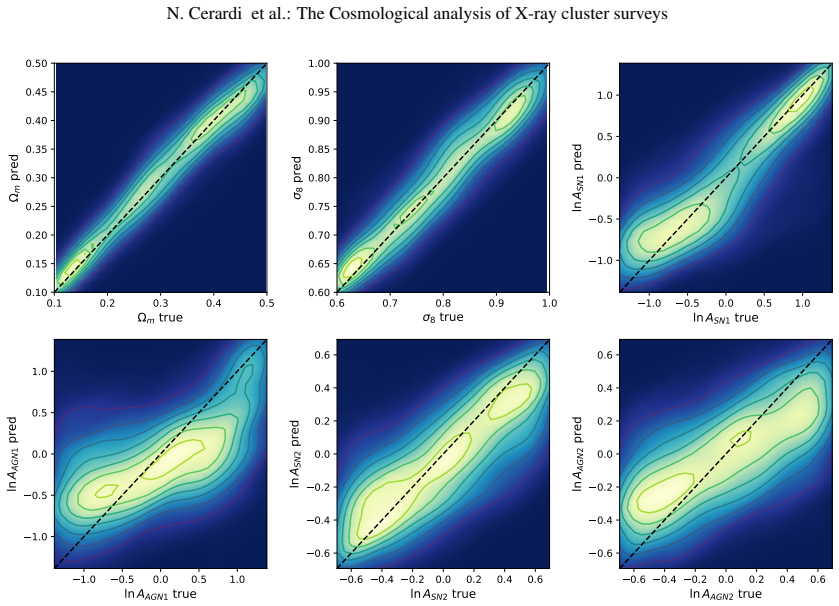
The central claim is that empirical scaling relations linking X-ray luminosity and temperature to mass can be bypassed in cluster number count cosmology, because a sufficiently fast simulation model can carry the same information more faithfully. The authors construct an extended Lagrangian Deep Learning emulator trained on CAMELS/IllustrisTNG that maps a fast particle-mesh dark-matter field to electron density and temperature fields, conditioned on two cosmological parameters and four feedback parameters. This feeds a pipeline that produces X-ray light cones in XMM count-rate and hardness-ratio observables, and a simulation-based inference chain (neural compression plus neural posterior estimation) recovers posteriors on all six parameters. The paper's quantitative findings are that the emulated clusters reproduce the count-rate-mass relation of the hydrodynamical simulations including per-cluster deviations (correlation 0.88), that supernova feedback parameters are recoverable while AGN parameters are barely constrained by the chosen observables, and that the simulation-based model shows a much weaker degeneracy between $\Omega_m$ and $\sigma_8$ than the scaling-relation baseline.
Load-bearing premise
The approach assumes that the IllustrisTNG subgrid feedback model, varied through its four adjustable parameters, describes the real intracluster medium closely enough to replace empirically calibrated scaling relations.
Editorial extensions
If this is right
- Cluster number count analyses can be run with a forward model that carries no explicit scaling relations, shifting the nuisance parameters to physical feedback parameters.
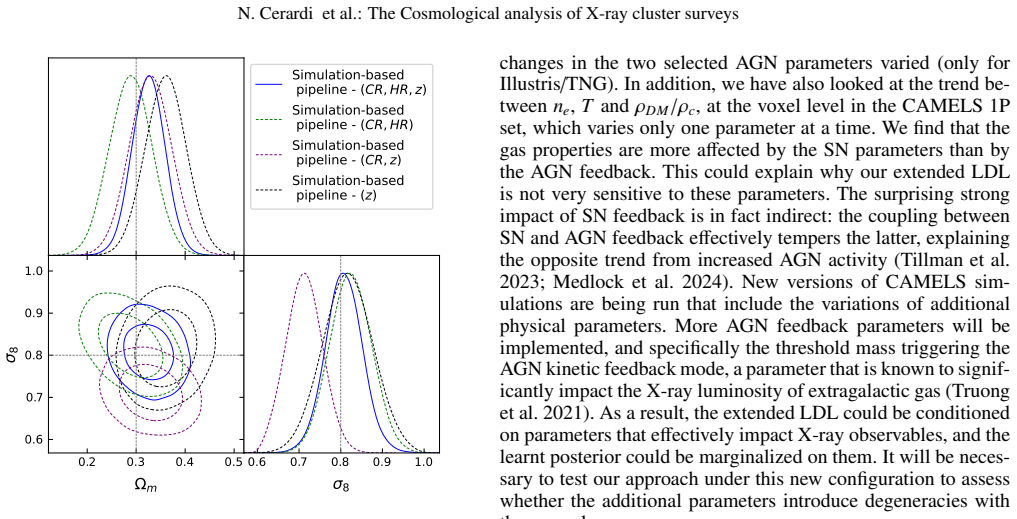
- The $\Omega_m$-$\sigma_8$ degeneracy is substantially weakened when feedback parameters are varied in the simulation-based model; the paper's figure 10 shows broadening only transverse to the degeneracy.
- The same parametrisation works across summary statistics (CR-HR-z, CR-HR, CR-z, z alone) with only mild loss of constraining power, suggesting the model's nuisance parameters are more universal than scaling-relation coefficients.
- The emulator recovers not just the mean count-rate-mass relation but part of the individual cluster scatter (correlation 0.88 with simulation residuals), meaning it can attribute why a cluster is over- or under-luminous at fixed mass.
- With sufficient resolution and volume, the approach could extend from CR-HR-z diagrams to full spatial mapping CR-HR-z-x-y, adding clustering-like information.
Reading between the lines
- A natural next test is to calibrate the feedback parameters on cluster-specific X-ray observables rather than galaxy-scale star formation, since the paper notes the CAMELS tuning is not optimized for cluster X-ray properties.
- If the view that simulations carry implicit scaling relations is right, the same LDL machinery could be inverted to build emulated scaling relations as explicit functions of cosmological and feedback parameters, giving physically motivated priors for classical analyses.
- The reduced degeneracy reported here is measured on simulated data with a known detection model; applying the identical forward model to real surveys with contaminants and noise would test whether the advantage survives real selection effects.
- The weak sensitivity of the emulator to AGN parameters suggests that upcoming CAMELS versions with more AGN parameters may change the posterior landscape, so the current claim of non-degeneracy is tied to the present parameter set.
Editorial analysis
A structured set of objections, weighed in public.
Referee Report
Summary. The paper presents a proof-of-concept simulation-based forward model for galaxy cluster number counts that bypasses explicit empirical scaling relations. The authors extend the Lagrangian Deep Learning (LDL) baryonification framework to emulate ICM electron density and temperature from fast particle-mesh dark-matter-only simulations, conditioned on two cosmological parameters (Omega_m, sigma_8) and four IllustrisTNG feedback parameters (AAGN1, AAGN2, ASN1, ASN2), using the CAMELS/IllustrisTNG simulation suite for training. They build a pipeline that produces mock XMM X-ray lightcones and observable diagrams (CR, HR, z), then perform simulation-based inference via a neural compressor (ResNet) and neural posterior estimation (NPE). The LDL emulator is validated on held-out CAMELS CV simulations at the fiducial parameters, reproducing the cluster CR-M relation and partially capturing individual cluster deviations. The paper then compares the resulting 6-parameter posterior with a Fisher-based analysis of an analytical scaling-relations model with 8 free parameters, claiming the simulation-based model is less degenerate. The authors explicitly frame the work as a proof of concept and discuss several limitations, including the 40% discrepancy in number counts relative to the analytical model and the need for more realistic simulations before applying the method to real data.
Significance. The methodological contribution is substantial: a fast, physics-based emulator that maps dark matter fields to X-ray cluster observables without an explicit scaling-relation likelihood is a promising direction for cluster cosmology. The LDL validation results (Figure 6) are strong: the emulator reproduces the CR-M relation and, importantly, the deviations of individual clusters from the mean relation are highly correlated with the hydrodynamical simulations (rho=0.88), indicating that the surrogate captures information beyond a simple power law. The reported speed (about 100 seconds per 200 deg2 survey) is a practical enabler for simulation-based inference. The paper is transparent about its limitations, including the injected information from the subgrid feedback model (Section 5.1) and the lack of external validation. However, the headline claim that the simulation-based model is 'less degenerate' than the scaling-relations approach is not yet robustly established, as the comparison in Figures 11 and 12 mixes different inference engines, parameter counts, and prior treatments.
major comments (3)
- [Section 5.1, Figures 11 and 12, Table 2] The central claim that the simulation-based model is less degenerate than the scaling-relations approach rests on comparing a 6-parameter NPE posterior (Figure 11) with an 8-parameter Fisher covariance (Figure 12) that uses a different parameterization (2+4 vs 2+6 free parameters) and different inference machinery. NPE contours encode prior volume and possible network bias, while Fisher contours are local Gaussian curvature around a fiducial; their correlation structures are not directly comparable. Part of the apparent reduction in degeneracy is therefore a bookkeeping effect of the lower number of nuisance parameters. I recommend a same-engine, same-dimensionality test, for example an NPE posterior for the analytical scaling-relations model (or a Fisher forecast for the simulation-based model) using the same summary statistic and the same number of free parameters, before the abstract and Section 5.1 claims are made.
- [Appendix B, Figure B.1] The rank distribution for Omega_m shows a clear negative slope, indicating a biased posterior, which the authors attribute to the MSE loss in the neural compressor (Section 3.1). Because the headline comparison concerns the size and orientation of the cosmological contours, a biased posterior is not a reliable basis for quantifying reduced degeneracy. The authors should quantify the impact of this bias on the claimed constraints, or replace the MSE loss with a loss that yields approximately unbiased summaries (e.g., score-based compression), and repeat the comparison.
- [Section 5.1, last paragraph] The paper states that assuming the feedback models are correct 'introduces a lot of information in the inference.' This is a central caveat: the reduced degeneracy between cosmology and feedback is achieved by substituting the physical priors of the IllustrisTNG subgrid model (through the four varied feedback parameters) for the empirical priors of scaling-relation coefficients. The paper also validates the emulator on held-out CAMELS boxes that share the same subgrid physics as the training data. The claim of 'less degenerate' should therefore be explicitly qualified as conditional on the chosen feedback model, and the conclusions should state that external validation against simulations with different feedback prescriptions (or against observed scaling relations) is needed before the claim can be generalized.
minor comments (4)
- [Section 2.2.2] In 'that we coin Θ fid', the relative pronoun should be 'which' rather than 'that'.
- [Section 3.1] The phrase 'a choice that can lead to biased posterior' should be 'a choice that can lead to biased posteriors'.
- [Section 4.3] In 'neither used for the ResNet training nor its testing', the last part should read 'nor for its testing'.
- [Table 2] For the analytical model, the six free nuisance parameters (e.g., M0, L0, alpha_MT, gamma_MT, alpha_LT, gamma_LT) are not explicitly named in the text or table; listing them would make the comparison with Figure 12 easier to follow.
Circularity Check
Central 'less degenerate' claim is partly built from parameter-count asymmetry, injected feedback-model information, and calibration-simulation validation; no self-citation chain is load-bearing.
-
self definitional
[Section 5.1, Figs. 11-12; Table 2]
"We show in figure 11 and 12 the full posteriors for the simulation-based and the analytical model, respectively obtained through the NPE and Fisher analysis methods."
The headline 'less degenerate' conclusion is obtained by directly comparing a 6-parameter NPE posterior (Table 2: 'This work, simulation-based model ... 2+4') with an 8-parameter Fisher covariance (Table 2: 'This work, analytical model ... 2+6'). Adding two extra nuisance dimensions to the analytic model guarantees extra elongated directions in the Fisher matrix, so part of the claimed reduction in degeneracy is a bookkeeping effect of the chosen parameterizations. The comparison is also between different statistical objects: the NPE posterior encodes the prior and is trained on the simulation-based XODs, while the Fisher matrix is a prior-free local curvature estimate. The 'less degenerate' result is thus partly defined by the comparison design rather than measured independently.
-
self definitional
[Section 5.1]
"This is the consequence of our approach being based on feedback prescriptions describing the physical processes within the ICM. Our model carries inherent physical constraints on cluster observable properties. In this proof of concept, we assume that feedback models are correct (within the freedom given to the four feedback parameters), which introduces a lot of information in the inference."
The paper explicitly attributes the reduced degeneracy to the physical constraints inherited from the assumed feedback model. But those constraints are injected as an assumption, not learned from external data: the XODs used for training and testing are generated by the same CAMELS/IllustrisTNG-calibrated LDL pipeline, and the NPE prior is encoded in the final posterior. The claim that the simulation-based model is 'less degenerate' therefore reduces, at least in part, to the information that was put in by assuming the feedback prescription is correct, rather than a gain established against an equally parameterized and equally conditioned reference model.
1 more flagged steps
-
fitted input called prediction
[Abstract; Section 4.2, Fig. 6]
"Our model correctly reproduces the cluster population from the calibration simulations at the fiducial parameter values, and allows us to constrain feedback mechanisms."
The 'calibration simulations' are the same CAMELS CV/LH boxes used to train the LDL emulator and the downstream simulation-based pipeline. Figure 6 validates the LDL cluster population against the CV test split of those calibration simulations, which is an internal consistency check of the surrogate rather than an out-of-sample prediction. Likewise, the feedback constraints come from NPE posteriors trained and tested on XODs generated by the calibrated simulator, so they encode the assumed CAMELS subgrid feedback model rather than independent observational data. The abstract presents this calibration fit as a predictive result, which is circular in wording even if the technical validation is standard.
full rationale
The technical core of the paper is not broadly circular: the LDL baryonification is a physics-inspired surrogate trained on CAMELS with a held-out CV test set; the XOD pipeline is a genuine forward model; and the NPE validation uses XODs unseen by the compressor and density estimator, with rank checks in Appendix B. No self-citation chain is load-bearing: Cerardi et al. (2024) and Kosiba et al. (2024) are cited for standard Fisher and SBI machinery, not to forbid alternatives. The circularity burden falls on the headline comparative claim and on the abstract's validation wording. First, the 'less degenerate' result in Figs. 11-12 compares a 6-parameter NPE posterior with an 8-parameter Fisher covariance, so the extra analytic nuisance parameters guarantee additional degeneracy directions; Fisher and NPE are also different objects, with the NPE explicitly carrying the prior. Second, Section 5.1 openly states that assuming the feedback model is correct 'introduces a lot of information in the inference,' which means the 'inherent physical constraints' removing degeneracies are inputs, not measured outputs. Third, the abstract claims the model 'reproduces the cluster population from the calibration simulations,' which is a fit to the training simulation suite evaluated on its held-out split, not a prediction against external data. Appendix B's negative rank slope for Omega_m further weakens the evidential value of the NPE contour size. The paper is transparent about these limitations, but the central 'less degenerate' claim is partially constructed from the chosen parameterization and injected physical assumptions rather than established by a like-for-like comparison.
Assumptions & free parameters
free parameters (8)
- LDL learnable parameters Theta = (gamma, alpha, Xi, b0, b1, mu) =
not reported
- MLP weight offsets deltaTheta(theta_sim) =
not reported
- ResNet compressor weights =
not reported
- MDN weights phi =
not reported
- Fixed metallicity Z = 0.3 Z_sun =
0.3 Z_sun
- Flux cut CR > 0.02 c/s =
0.02 c/s
- Voxel resolution 0.39 h^-1 Mpc =
0.39 h^-1 Mpc
- Smoothing exponent n in O_s(k) = 1 + k^-n =
not reported (prescription from Dai & Seljak 2021)
assumptions (8)
- domain assumption IllustrisTNG subgrid implementations of AGN and SN feedback are a valid description of ICM physics
- domain assumption Training on CV50 and LH25 boxes at z=0.21 generalizes to the lightcone range 0.1<z<0.5 and to parameter variations
- domain assumption The PM DM approximation from JaxPM is adequate for baryon field emulation
- domain assumption X-ray emissivity can be computed from n_e and T with fixed metallicity and bremsstrahlung via pyatomDB
- domain assumption The simple sep-based detection and characterization (no Poisson noise, no AGN contaminants, no galactic absorption) is sufficient for the proof-of-concept
- standard math The Fisher matrix with independent Poisson bins is a valid approximation for the analytical baseline
- domain assumption The NPE prior is the uniform distribution over the simulated parameter ranges
- domain assumption Tinker et al. (2008) HMF and Pacaud et al. (2018) scaling relations are the correct baseline for the analytical model
Cite this review
Pith. "Pith review of The Cosmological analysis of X-ray cluster surveys VII. Bypassing scaling relations with Lagrangian Deep Learning and Simulation-based inference." pith.science (2026). https://pith.science/paper/7ZCYNDOQ
@misc{pith2026250701820,
  author       = {Pith},
  title        = {Pith review of: The Cosmological analysis of X-ray cluster surveys VII. Bypassing scaling relations with Lagrangian Deep Learning and Simulation-based inference},
  year         = {2026},
  howpublished = {\url{https://pith.science/paper/7ZCYNDOQ}},
  note         = {Machine review of arXiv:2507.01820}
}
read the original abstract
Galaxy clusters, the pinnacle of structure formation in our universe, are a powerful cosmological probe. Several approaches have been proposed to express cluster number counts, but all these methods rely on empirical explicit scaling relations that link observed properties to the total cluster mass. These scaling relations are over-parametrised, inducing some degeneracy with cosmology. Moreover, they do not provide a direct handle on the numerous non-gravitational phenomena that affect the physics of the intra-cluster medium. We present a proof-of-concept to model cluster number counts, that bypasses the explicit use of scaling relations. We rather implement the effect of several astrophysical processes to describe the cluster properties. We then evaluate the performances of this modelling for the cosmological inference. We developed an accelerated machine learning baryonic field-emulator, built upon the Lagrangian Deep Learning method and trained on the CAMELS simulations. We then created a pipeline that simulates cluster counts in terms of XMM observable quantities. We finally compare the performances of our model, with that involving scaling relations, for the purpose of cosmological inference based on simulations. Our model correctly reproduces the cluster population from the calibration simulations at the fiducial parameter values, and allows us to constrain feedback mechanisms. The cosmological-inference analyses indicate that our simulation-based model is less degenerate than the approach using scaling relations. This novel approach to model observed cluster number counts from simulations opens interesting perspectives for cluster cosmology. It has the potential to overcome the limitations of the standard approach, provided that the resolution and the volume of the simulations will allow a most realistic implementation of the complex phenomena driving cluster evolution.
Figures


Figures from the paper (11 more)





Forward citations
Cited by 1 Pith paper
-
Cosmology-dependent covariance in galaxy cluster number counts: consequences for parameter inference
Fixing the covariance at an incorrect cosmology in cluster count analyses leaves Ω_c, σ_8, and w estimates unbiased but distorts their uncertainties, driven by S_8 amplitude effects; a single update at the recovered b...
Reference graph
Works this paper leans on
-
[1]
Abazajian, K., Addison, G., Adshead, P., et al. 2019, CMB-S4 Science Case, Ref- erence Design, and Project Plan, arXiv:1907.04473 [astro-ph, physics:hep- ex]
arXiv 2019
-
[2]
2018, Astronomy & Astrophysics, 620, A5, arXiv:1810.03849 [astro-ph]
Adami, C., Giles, P., Koulouridis, E., et al. 2018, Astronomy & Astrophysics, 620, A5, arXiv:1810.03849 [astro-ph]
arXiv 2018
-
[3]
Arnaud, K. A. 1996, Astronomical Data Analysis Software and Systems V , 101, 17
work page 1996
-
[4]
Arnaud, M., Pratt, G. W., Piffaretti, R., et al. 2010, Astronomy and Astrophysics, 517, A92, aDS Bibcode: 2010A&A...517A..92A
work page 2010
-
[5]
E., Bulbul, E., Clerc, N., et al
Bahar, Y . E., Bulbul, E., Clerc, N., et al. 2022, Astronomy and Astrophysics, 661, A7, aDS Bibcode: 2022A&A...661A...7B
work page 2022
-
[6]
2016, Journal of Open Source Software, 1, 58
Barbary, K. 2016, Journal of Open Source Software, 1, 58
2016
-
[7]
Bertin, E. & Arnouts, S. 1996, Astronomy and Astrophysics Supplement Series, 117, 393, aDS Bibcode: 1996A&AS..117..393B Article number, page 14 of 17 N. Cerardi et al.: The Cosmological analysis of X-ray cluster surveys
work page 1996
-
[8]
Bishop, C. M. 1994, Mixture density networks, place: Birmingham Publisher: Aston University
work page 1994
Show all 64 references
-
[9]
P., Schrabback, T., et al
Bocquet, S., Dietrich, J. P., Schrabback, T., et al. 2019, The Astrophysical Jour- nal, 878, 55, publisher: The American Astronomical Society
2019
-
[10]
2025, Multiprobe Cosmology from the Abundance of SPT Clusters and DES Galaxy Clustering and Weak Lensing, arXiv:2412.07765 [astro-ph]
Bocquet, S., Grandis, S., Krause, E., et al. 2025, Multiprobe Cosmology from the Abundance of SPT Clusters and DES Galaxy Clustering and Weak Lensing, arXiv:2412.07765 [astro-ph]
2025 arXiv
-
[11]
Bocquet, S., Saro, A., Dolag, K., & Mohr, J. J. 2016, Monthly Notices of the Royal Astronomical Society, 456, 2361
2016
-
[12]
N., Mohr, J
Bulbul, E., Chiu, I. N., Mohr, J. J., et al. 2019, The Astrophysical Journal, 871, 50, publisher: IOP ADS Bibcode: 2019ApJ...871...50B
2019
-
[13]
2024, Astronomy and Astrophysics, 682, A138, aDS Bibcode: 2024A&A...682A.138C
Cerardi, N., Pierre, M., Valageas, P., Garrel, C., & Pacaud, F. 2024, Astronomy and Astrophysics, 682, A138, aDS Bibcode: 2024A&A...682A.138C
2024
-
[14]
Clerc, N., Comparat, J., Seppi, R., et al. 2024, The SRG/eROSITA All-Sky Sur- vey: X-ray selection function models for the eRASS1 galaxy cluster cosmol- ogy, publication Title: arXiv e-prints ADS Bibcode: 2024arXiv240208457C
2024
-
[15]
2012a, Monthly Notices of the Royal Astronomical Society, 423, 3545, arXiv:1109.4440 [astro-ph]
Clerc, N., Pierre, M., Pacaud, F., & Sadibekova, T. 2012a, Monthly Notices of the Royal Astronomical Society, 423, 3545, arXiv:1109.4440 [astro-ph]
-
[16]
2012b, Monthly Notices of the Royal Astronomical Society, 423, 3561, arXiv:1109.4441 [astro-ph]
Clerc, N., Sadibekova, T., Pierre, M., et al. 2012b, Monthly Notices of the Royal Astronomical Society, 423, 3561, arXiv:1109.4441 [astro-ph]
-
[17]
2024, Euclid
Collaboration, E., Mellier, Y ., Abdurro’uf, et al. 2024, Euclid. I. Overview of the Euclid mission, arXiv:2405.13491
2024
-
[18]
2018, Journal of Cosmology and Astroparticle Physics, 2018, 009, publisher: IOP ADS Bibcode: 2018JCAP...11..009D
Dai, B., Feng, Y ., & Seljak, U. 2018, Journal of Cosmology and Astroparticle Physics, 2018, 009, publisher: IOP ADS Bibcode: 2018JCAP...11..009D
2018
-
[19]
& Seljak, U
Dai, B. & Seljak, U. 2021, Proceedings of the National Academy of Sciences, 118, e2020324118, arXiv:2010.02926 [astro-ph] DESI Collaboration, Abareshi, B., Aguilar, J., et al. 2022, The Astronomical Journal, 164, 207, publisher: IOP ADS Bibcode: 2022AJ....164..207D
2021 arXiv
-
[20]
R., Ji, L., Smith, R
Foster, A. R., Ji, L., Smith, R. K., & Brickhouse, N. S. 2012, The Astrophysical Journal, 756, 128, publisher: IOP ADS Bibcode: 2012ApJ...756..128F
2012
-
[21]
2022, Astronomy & Astrophysics, 663, A3, arXiv:2109.13171 [astro-ph]
Garrel, C., Pierre, M., Valageas, P., et al. 2022, Astronomy & Astrophysics, 663, A3, arXiv:2109.13171 [astro-ph]
2022 arXiv
-
[22]
2024, The SRG/eROSITA All-Sky Sur- vey: Cosmology Constraints from Cluster Abundances in the Western Galac- tic Hemisphere, arXiv:2402.08458 [astro-ph, physics:gr-qc]
Ghirardini, V ., Bulbul, E., Artis, E., et al. 2024, The SRG/eROSITA All-Sky Sur- vey: Cosmology Constraints from Cluster Abundances in the Western Galac- tic Hemisphere, arXiv:2402.08458 [astro-ph, physics:gr-qc]
2024 arXiv
-
[23]
2022, The Astrophysical Journal, 937, 83, arXiv:2110.02983 [astro-ph]
Hassan, S., Villaescusa-Navarro, F., Wandelt, B., et al. 2022, The Astrophysical Journal, 937, 83, arXiv:2110.02983 [astro-ph]
2022 arXiv
-
[24]
2015, Deep Residual Learning for Image Recognition, arXiv:1512.03385 [cs]
He, K., Zhang, X., Ren, S., & Sun, J. 2015, Deep Residual Learning for Image Recognition, arXiv:1512.03385 [cs]
2015 arXiv
-
[25]
P., Gioia, I
Henry, J. P., Gioia, I. M., Maccacaro, T., et al. 1992, The Astrophysical Journal, 386, 408 Ivezi´c, Z., Kahn, S. M., Tyson, J. A., et al. 2019, The Astrophysical Journal, 873, 111, publisher: The American Astronomical Society
1992
-
[26]
2020, Monthly Notices of the Royal Astro- nomical Society, 501, 954, arXiv:2009.08459 [astro-ph]
Jeffrey, N., Alsing, J., & Lanusse, F. 2020, Monthly Notices of the Royal Astro- nomical Society, 501, 954, arXiv:2009.08459 [astro-ph]
2020 arXiv
-
[27]
1986, Monthly Notices of the Royal Astronomical Society, 222, 323, publisher: OUP ADS Bibcode: 1986MNRAS.222..323K
Kaiser, N. 1986, Monthly Notices of the Royal Astronomical Society, 222, 323, publisher: OUP ADS Bibcode: 1986MNRAS.222..323K
1986
-
[28]
2024, The cosmological analy- sis of X-ray cluster surveys: VI
Kosiba, M., Cerardi, N., Pierre, M., et al. 2024, The cosmological analy- sis of X-ray cluster surveys: VI. Inference based on analytically simu- lated observable diagrams, publication Title: arXiv e-prints ADS Bibcode: 2024arXiv240906001K
2024
-
[29]
Kugel, R., Schaye, J., Schaller, M., Moreno, V . J. F., & McGibbon, R. J. 2024, The FLAMINGO Project: An assessment of the systematic errors in the pre- dictions of models for galaxy cluster counts used to infer cosmological pa- rameters
2024
-
[30]
2022, Hybrid Physical-Neural ODEs for Fast N-body Simulations, arXiv:2207.05509 [astro-ph]
Lanzieri, D., Lanusse, F., & Starck, J.-L. 2022, Hybrid Physical-Neural ODEs for Fast N-body Simulations, arXiv:2207.05509 [astro-ph]
2022 arXiv
-
[31]
L., et al
Lanzieri, D., Zeghal, J., Makinen, T. L., et al. 2024, Optimal Neural Sum- marisation for Full-Field Weak Lensing Cosmological Implicit Inference, arXiv:2407.10877 [astro-ph]
2024 arXiv
-
[32]
E., Genel, S., Wandelt, B
Lee, M. E., Genel, S., Wandelt, B. D., et al. 2024, Zooming by in the CAR- PoolGP lane: new CAMELS-TNG simulations of zoomed-in massive halos, arXiv:2403.10609 [astro-ph]
2024 arXiv
-
[33]
B., Jarvis, M., & Santos, M
Maartens, R., Abdalla, F. B., Jarvis, M., & Santos, M. G. 2015, Cosmology with the SKA – overview, arXiv:1501.04076 [astro-ph, physics:gr-qc]
2015 arXiv
-
[34]
W., Rapetti, D., & Ebeling, H
Mantz, A., Allen, S. W., Rapetti, D., & Ebeling, H. 2010, Monthly Notices of the Royal Astronomical Society, 406, 1759
2010
-
[35]
B., Allen, S
Mantz, A. B., Allen, S. W., Morris, R. G., et al. 2016, Monthly Notices of the Royal Astronomical Society, 463, 3582, publisher: OUP ADS Bibcode: 2016MNRAS.463.3582M
2016
-
[36]
J., Giles, P
Maughan, B. J., Giles, P. A., Randall, S. W., Jones, C., & Forman, W. R. 2012, Monthly Notices of the Royal Astronomical Society, 421, 1583, publisher: OUP ADS Bibcode: 2012MNRAS.421.1583M
2012
-
[37]
2024, Quantifying Baryonic Feed- back on Warm-Hot Circumgalactic Medium in CAMELS Simulations, arXiv:2410.16361
Medlock, I., Neufeld, C., Nagai, D., et al. 2024, Quantifying Baryonic Feed- back on Warm-Hot Circumgalactic Medium in CAMELS Simulations, arXiv:2410.16361
2024 arXiv
-
[38]
2013, The Hot and Energetic Universe: A White Paper presenting the science theme motivating the Athena+ mission, arXiv:1306.2307 [astro-ph]
Nandra, K., Barret, D., Barcons, X., et al. 2013, The Hot and Energetic Universe: A White Paper presenting the science theme motivating the Athena+ mission, arXiv:1306.2307 [astro-ph]
2013 arXiv
-
[39]
2019, Computational Astrophysics and Cosmology, 6, 2
Nelson, D., Springel, V ., Pillepich, A., et al. 2019, Computational Astrophysics and Cosmology, 6, 2
2019
-
[40]
2023, The Astrophysical Journal, 959, 136, publisher: The American Astronomical Society
Ni, Y ., Genel, S., Anglés-Alcázar, D., et al. 2023, The Astrophysical Journal, 959, 136, publisher: The American Astronomical Society
2023
-
[41]
2022, Agora: Multi-Component Simulation for Cross-Survey Science, arXiv:2212.07420 [astro-ph]
Omori, Y . 2022, Agora: Multi-Component Simulation for Cross-Survey Science, arXiv:2212.07420 [astro-ph]
2022 arXiv
-
[42]
2018, Astronomy & Astrophysics, 620, A10, arXiv:1810.01624 [astro-ph]
Pacaud, F., Pierre, M., Melin, J.-B., et al. 2018, Astronomy & Astrophysics, 620, A10, arXiv:1810.01624 [astro-ph]
2018 arXiv
-
[43]
2006, Monthly Notices of the Royal Astronomical Society, 372, 578, arXiv:astro-ph/0607177
Pacaud, F., Pierre, M., Refregier, A., et al. 2006, Monthly Notices of the Royal Astronomical Society, 372, 578, arXiv:astro-ph/0607177
2006 arXiv
-
[44]
& Murray, I
Papamakarios, G. & Murray, I. 2018, Fast $ \epsilon$-free Inference of Simulation Models with Bayesian Conditional Density Estimation, arXiv:1605.06376 [cs, stat]
2018 arXiv
-
[45]
S., & White, M
Perlmutter, S., Turner, M. S., & White, M. 1999, Physical Review Letters, 83, 670, publisher: APS ADS Bibcode: 1999PhRvL..83..670P
1999
-
[46]
2016, Astronomy & Astrophysics, 592, A1, publisher: EDP Sciences
Pierre, M., Pacaud, F., Adami, C., et al. 2016, Astronomy & Astrophysics, 592, A1, publisher: EDP Sciences
2016
-
[47]
2018, Monthly Notices of the Royal Astronomical Society, 473, 4077, arXiv:1703.02970 [astro-ph] {Planck Collaboration}, P., Aghanim, N., Akrami, Y ., et al
Pillepich, A., Springel, V ., Nelson, D., et al. 2018, Monthly Notices of the Royal Astronomical Society, 473, 4077, arXiv:1703.02970 [astro-ph] {Planck Collaboration}, P., Aghanim, N., Akrami, Y ., et al. 2020, Astronomy & Astrophysics, 641, A6, arXiv:1807.06209 [astro-ph]
2018 arXiv
-
[48]
2022, Sunyaev-Zel’dovich effect and X-ray scaling relations of galaxies, groups and clusters in the IllustrisTNG simulations, arXiv:2205.11528 [astro-ph]
Pop, A.-R., Hernquist, L., Nagai, D., et al. 2022, Sunyaev-Zel’dovich effect and X-ray scaling relations of galaxies, groups and clusters in the IllustrisTNG simulations, arXiv:2205.11528 [astro-ph]
2022 arXiv
-
[49]
2021, Astronomy & Astrophysics, 647, A1, publisher: EDP Sciences
Predehl, P., Andritschke, R., Arefiev, V ., et al. 2021, Astronomy & Astrophysics, 647, A1, publisher: EDP Sciences
2021
-
[50]
2025, Galaxy cluster count cosmology with simulation-based inference, arXiv:2506.05457 [astro-ph]
Regamey, M., Eckert, D., Seppi, R., et al. 2025, Galaxy cluster count cosmology with simulation-based inference, arXiv:2506.05457 [astro-ph]
2025 arXiv
-
[51]
Rezende, D. J. & Mohamed, S. 2016, Variational Inference with Normalizing Flows, arXiv:1505.05770 [cs, stat]
2016 arXiv
-
[52]
G., Filippenko, A
Riess, A. G., Filippenko, A. V ., Challis, P., et al. 1998, The Astronomical Journal, 116, 1009, arXiv:astro-ph/9805201
1998 arXiv
-
[53]
A., Anderson, A
Sobrin, J. A., Anderson, A. J., Bender, A. N., et al. 2022, The Astrophysical Journal Supplement Series, 258, 42, arXiv:2106.11202 [astro-ph]
2022 arXiv
-
[54]
2020, Journal of Open Source Software, 5, 2505, publisher: The Open Journal
Tejero-Cantero, A., Boelts, J., Deistler, M., et al. 2020, Journal of Open Source Software, 5, 2505, publisher: The Open Journal
2020
-
[55]
T., Burkhart, B., Tonnesen, S., et al
Tillman, M. T., Burkhart, B., Tonnesen, S., et al. 2023, An Exploration of AGN and Stellar Feedback Effects in the Intergalactic Medium via the Low Redshift Lyman-$\alpha$ Forest, arXiv:2307.06360 [astro-ph]
2023 arXiv
-
[56]
L., Kravtsov, A
Tinker, J. L., Kravtsov, A. V ., Klypin, A., et al. 2008, The Astrophysical Journal, 688, 709, arXiv:0803.2706 [astro-ph]
2008 arXiv
-
[57]
2021, Monthly Notices of the Royal Astronomical Society, 501, 2210, arXiv:2009.06634 [astro-ph]
Truong, N., Pillepich, A., & Werner, N. 2021, Monthly Notices of the Royal Astronomical Society, 501, 2210, arXiv:2009.06634 [astro-ph]
2021 arXiv
-
[58]
V ., Burenin, R
Vikhlinin, A., Kravtsov, A. V ., Burenin, R. A., et al. 2009, The Astrophysical Journal, 692, 1060, arXiv:0812.2720 [astro-ph]
2009 arXiv
-
[59]
2021, The Astro- physical Journal, 915, 71, publisher: The American Astronomical Society
Villaescusa-Navarro, F., Anglés-Alcázar, D., Genel, S., et al. 2021, The Astro- physical Journal, 915, 71, publisher: The American Astronomical Society
2021
-
[60]
2022, The Astro- physical Journal Supplement Series, 259, 61, arXiv:2109.10915 [astro-ph]
Villaescusa-Navarro, F., Genel, S., Angles-Alcazar, D., et al. 2022, The Astro- physical Journal Supplement Series, 259, 61, arXiv:2109.10915 [astro-ph]
2022 arXiv
-
[61]
2023, The Astro- physical Journal Supplement Series, 265, 54, arXiv:2201.01300 [astro-ph]
Villaescusa-Navarro, F., Genel, S., Anglés-Alcázar, D., et al. 2023, The Astro- physical Journal Supplement Series, 265, 54, arXiv:2201.01300 [astro-ph]
2023 arXiv
-
[62]
Wood, S. N. 2010, Nature, 466, 1102, publisher: Nature Publishing Group
2010
-
[63]
2025, Extracting cosmo- logical information from the abundance of galaxy clusters with simulation- based inference, arXiv:2504.10230 [astro-ph]
Zubeldia, I., Bolliet, B., Challinor, A., & Handley, W. 2025, Extracting cosmo- logical information from the abundance of galaxy clusters with simulation- based inference, arXiv:2504.10230 [astro-ph]
2025 arXiv
-
[64]
1933, Helvetica Physica Acta, V ol
Zwicky, F. 1933, Helvetica Physica Acta, V ol. 6, p. 110-127, 6, 110 Article number, page 15 of 17 A&A proofs: manuscript no. aanda Appendix A: Distribution We use the CAMELS simulation suite to train and test our ex- tended LDL method. In figure A.1, we show the parameter dis...
2024
Reviewed August 6, 2026 · model on record in the stance chip above.
Discussion (0). Sign in to comment.