Fault Tolerant Metric Dimensions of Leafless Cacti Graphs with Application in Supply Chain Management
Pith reviewed 2026-05-23 21:20 UTC · model grok-4.3
The pith
The fault tolerant metric dimension of bicyclic graphs of type I and II is always 4, and leafless cacti graphs have this dimension expressed in terms of their inner and outer cycles.
A machine-rendered reading of the paper's core claim, the machinery that carries it, and where it could break.
Core claim
Bicyclic graphs of type I and type II have fault tolerant metric dimension 4. Leafless cacti graphs admit a calculation of their fault tolerant metric dimension directly from the counts of inner cycles and outer cycles, obtained by extending the bicyclic case analysis.
What carries the argument
Decomposition of leafless cacti graphs into inner and outer cycles that supports construction of minimal fault-tolerant resolving sets by case analysis on those cycles.
If this is right
- Bicyclic graphs of type I always have fault tolerant metric dimension 4.
- Bicyclic graphs of type II always have fault tolerant metric dimension 4.
- The fault tolerant metric dimension of any leafless cacti graph is determined by its inner cycle count and outer cycle count.
- In supply chain models represented by leafless cacti graphs, the minimal number of centers needed for fault-tolerant location equals the fault tolerant metric dimension of the graph.
Where Pith is reading between the lines
- The cycle-count formula may support polynomial-time computation of the dimension for any leafless cacti graph once the cycles are identified.
- Similar decompositions could be tested on other cactus families or graphs with bounded treewidth to see if fault tolerant dimension remains expressible by local cycle features.
- In network design problems, the result suggests that adding redundant location points scales predictably with the number of cycles rather than total vertices.
Load-bearing premise
Leafless cacti graphs admit a canonical decomposition into inner and outer cycles such that minimal fault-tolerant resolving sets can be constructed and verified by exhaustive case analysis on those cycles without additional vertices required in any configuration.
What would settle it
A leafless cacti graph whose fault tolerant metric dimension cannot be expressed solely as a function of its inner cycle count and outer cycle count, or that deviates from the value obtained by extending the bicyclic results.
Figures


read the original abstract
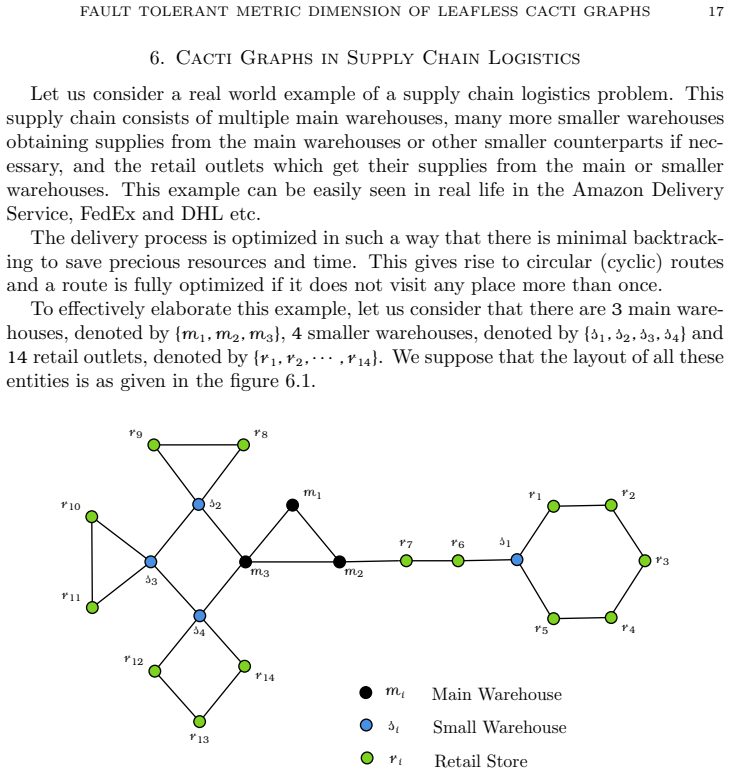
A resolving set for a simple graph $G$ is a subset of vertex set of $G$ such that it distinguishes all vertices of $G$ using the shortest distance from this subset. This subset is a metric basis if it is the smallest set with this property. A resolving set is a fault tolerant resolving set if the removal of any vertex from the subset still leaves it a resolving set. The smallest set satisfying this property is the fault tolerant metric basis, and the cardinality of this set is termed as fault tolerant metric dimension of $G$, denoted by $\beta'(G)$. In this article, we determine the fault tolerant metric dimension of bicyclic graphs of type-I and II and show that it is always $4$ for both types of graphs. We then use these results to form our basis to consider leafless cacti graphs, and calculate their fault tolerant metric dimensions in terms of \textit{inner cycles} and \textit{outer cycles}. We then consider a detailed real world example of supply and distribution center management, and discuss the application of fault tolerant metric dimension in such a scenario. We also briefly discuss some other scenarios where leafless cacti graphs can be used to model real world problems.
Editorial analysis
A structured set of objections, weighed in public.
Referee Report
Summary. The paper claims that the fault-tolerant metric dimension β'(G) equals 4 for all bicyclic graphs of type I and type II. It then extends the result to leafless cacti graphs by expressing β' in terms of the numbers of inner and outer cycles, and illustrates the concept with a supply-chain example modeled by such graphs.
Significance. If the claimed closed-form values hold, the work would supply explicit, easily computable fault-tolerant resolving sets for two infinite families of graphs that arise in network modeling. The supply-chain application shows a concrete setting in which distance-based location under single-vertex failure is relevant.
major comments (2)
- [Abstract] Abstract: the central claim that β'(G)=4 for every bicyclic graph of type I and II is asserted without any proof, case analysis, or verification that candidate sets remain resolving after the removal of any single vertex. Because the subsequent leafless-cactus formulas rest on these bicyclic results, the absence of supporting derivations is load-bearing for the entire contribution.
- [leafless cacti section] The extension to leafless cacti (described after the bicyclic case) presupposes that every such graph admits a decomposition into type-I/II bicyclic blocks plus inner/outer cycles such that a fault-tolerant resolving set of size determined solely by the cycle counts can always be assembled. The manuscript provides no argument that this decomposition covers arbitrary attachment patterns (multiple cycles at one vertex, chains of blocks, etc.) or that no extra vertices are required to resolve distance ties once a resolver fails.
Simulated Author's Rebuttal
We thank the referee for their thorough review and valuable comments. We address each major comment below and will incorporate revisions to strengthen the manuscript.
read point-by-point responses
-
Referee: [Abstract] Abstract: the central claim that β'(G)=4 for every bicyclic graph of type I and II is asserted without any proof, case analysis, or verification that candidate sets remain resolving after the removal of any single vertex. Because the subsequent leafless-cactus formulas rest on these bicyclic results, the absence of supporting derivations is load-bearing for the entire contribution.
Authors: We agree that the abstract presents the result concisely. The full manuscript includes sections dedicated to proving that β'(G) = 4 for bicyclic graphs of type I and II, with case analyses based on the structure of these graphs. However, to make the supporting derivations more explicit and to verify the fault-tolerance property in detail, we will expand the case analysis in the revised version, including explicit checks that the proposed sets remain resolving after any single vertex removal. This will ensure the bicyclic results are self-contained before extending to leafless cacti. revision: yes
-
Referee: [leafless cacti section] The extension to leafless cacti (described after the bicyclic case) presupposes that every such graph admits a decomposition into type-I/II bicyclic blocks plus inner/outer cycles such that a fault-tolerant resolving set of size determined solely by the cycle counts can always be assembled. The manuscript provides no argument that this decomposition covers arbitrary attachment patterns (multiple cycles at one vertex, chains of blocks, etc.) or that no extra vertices are required to resolve distance ties once a resolver fails.
Authors: We acknowledge the need for a more rigorous justification of the decomposition for leafless cacti graphs. In the revised manuscript, we will add a dedicated subsection that formally describes the decomposition into bicyclic blocks and cycles, proves that it covers arbitrary attachment patterns including multiple cycles at vertices and chains of blocks, and demonstrates that the fault-tolerant resolving set size, determined by the numbers of inner and outer cycles, suffices without requiring additional vertices. This will include arguments showing that distance ties are resolved even after a resolver failure. revision: yes
Circularity Check
No significant circularity in derivation chain
full rationale
The paper determines fault-tolerant metric dimension for bicyclic graphs (always 4) via direct combinatorial arguments, then extends the result to leafless cacti by expressing it in terms of inner/outer cycle counts. No equations, parameters, or quantities are defined in terms of the quantities they are claimed to predict. No self-citations are invoked as load-bearing premises for uniqueness or ansatz choices. The central claims rest on case analysis of cycle structures rather than any self-referential reduction or fitted-input renaming. This is the expected non-finding for a purely combinatorial graph-theory paper whose results are stated as explicit determinations.
Axiom & Free-Parameter Ledger
axioms (2)
- standard math Shortest-path distance in an undirected graph forms a metric that distinguishes vertices via unique distance vectors.
- domain assumption Bicyclic graphs of type I and II and leafless cacti graphs possess the cycle decompositions described in the paper.
Reference graph
Works this paper leans on
-
[1]
P. J. Slater, “Leaves of trees,” Congr. Numer , vol. 14, no. 549-559, p. 37, 1975
work page 1975
-
[2]
On the metric dimension of a graph,
F. Melter and F. Harary, “On the metric dimension of a graph,” Ars Combin , vol. 2, pp. 191–5, 1976
work page 1976
-
[3]
R esolvability in graphs and the metric dimension of a graph,
G. Chartrand, L. Eroh, M. A. Johnson, and O. R. Oellermann, “R esolvability in graphs and the metric dimension of a graph,” Discrete Applied Mathematics, vol. 105, no. 1, pp. 99–113, 2000
work page 2000
-
[4]
Families of regular graphs with co nstant metric dimension,
I. Javaid, M. T. Rahim, and K. Ali, “Families of regular graphs with co nstant metric dimension,” Utilitas mathematica, vol. 75, no. 1, pp. 21–33, 2008
work page 2008
-
[5]
The metric dimens ion of some generalized petersen graphs,
Z. Shao, S. Sheikholeslami, P. Wu, and J.-B. Liu, “The metric dimens ion of some generalized petersen graphs,” Discrete Dynamics in Nature and Society , vol. 2018, 2018
work page 2018
-
[6]
The metric dimension of subdivisions of lilly graph, tadpole graph and special trees,
B. Mohamed and M. Amin, “The metric dimension of subdivisions of lilly graph, tadpole graph and special trees,” Applied and Computational Mathe- matics, vol. 12, no. 1, pp. 9–14, 2023
work page 2023
-
[7]
Metric dimensions of bicyclic graphs,
A. Khan, G. Haidar, N. Abbas, M. U. I. Khan, A. U. K. Niazi, and A. U. I. Khan, “Metric dimensions of bicyclic graphs,” Mathematics, vol. 11, no. 4, 2023. F AULT TOLERANT METRIC DIMENSION OF LEAFLESS CACTI GRAPHS 19
work page 2023
-
[8]
Remarks on the vertex and the edge metric dimension of 2-connected graphs,
M. Knor, J. Sedlar, and R. ˇSkrekovski, “Remarks on the vertex and the edge metric dimension of 2-connected graphs,” Mathematics, vol. 10, no. 14, 2022
work page 2022
-
[9]
On the metric dimension of cartesian products of g raphs,
J. C´ aceres, C. Hernando, M. Mora, I. M. Pelayo, M. L. Puerta s, C. Seara, and D. R. Wood, “On the metric dimension of cartesian products of g raphs,” SIAM journal on discrete mathematics , vol. 21, no. 2, pp. 423–441, 2007
work page 2007
-
[10]
On the metric dimension of infinite graphs,
J. C´ aceres, C. Hernando, M. Mora, I. Pelayo, and M. Puerta s, “On the metric dimension of infinite graphs,” Discrete Applied Mathematics , vol. 160, no. 18, pp. 2618–2626, 2012. V Latin American Algorithms, Graphs, and Op timization Symposium — Gramado, Brazil, 2009
work page 2012
-
[11]
Extremal results fo r graphs of bounded metric dimension,
J. Geneson, S. Kaustav, and A. Labelle, “Extremal results fo r graphs of bounded metric dimension,” Discrete Applied Mathematics , vol. 309, pp. 123– 129, 2022
work page 2022
-
[12]
Bounds on metric dimensions of graphs with edge disjoint cycles,
J. Sedlar and R. ˇSkrekovski, “Bounds on metric dimensions of graphs with edge disjoint cycles,” Applied Mathematics and Computation , vol. 396, p. 125908, 2021
work page 2021
-
[13]
Metric dimensions of bicyclic graphs with potential application s in supply chain logistics,
M. Wang, G. Haidar, F. Yousafzai, M. U. I. Khan, W. Sikandar, a nd A. U. I. Khan, “Metric dimensions of bicyclic graphs with potential application s in supply chain logistics,” arXiv preprint arXiv:2409.02947 , 2024
-
[14]
Complexity of Metric Dimension on Planar Graphs
J. Diaz, O. Pottonen, and E. J. van Leeuwen, “Planar metric dim ension is np-complete,” arXiv preprint arXiv:1107.2256 , 2011
work page internal anchor Pith review Pith/arXiv arXiv 2011
-
[15]
Com plexity of met- ric dimension on planar graphs,
J. D ´ ıaz, O. Pottonen, M. Serna, and E. J. van Leeuwen, “Com plexity of met- ric dimension on planar graphs,” Journal of Computer and System Sciences , vol. 83, no. 1, pp. 132–158, 2017
work page 2017
-
[16]
The local metric dimens ion of a graph,
F. Okamoto, B. Phinezy, and P. Zhang, “The local metric dimens ion of a graph,” Mathematica Bohemica, vol. 135, no. 3, pp. 239–255, 2010
work page 2010
-
[17]
The k-metric dimension of a graph
A. Estrada-Moreno, J. A. Rodr ´ ıguez-Vel´ azquez, and I. G.Yero, “The k-metric dimension of a graph,” arXiv preprint arXiv:1312.6840 , 2013
work page internal anchor Pith review Pith/arXiv arXiv 2013
-
[18]
Mixed met ric dimension of graphs,
A. Kelenc, D. Kuziak, A. Taranenko, and I. G. Yero, “Mixed met ric dimension of graphs,” Applied Mathematics and Computation , vol. 314, pp. 429–438, 2017
work page 2017
-
[19]
Fault-to lerant metric dimension of graphs,
C. Hernando, M. Mora, P. J. Slater, and D. R. Wood, “Fault-to lerant metric dimension of graphs,” Convexity in discrete structures , vol. 5, pp. 81–85, 2008
work page 2008
-
[20]
F ault- tolerant metric dimension of interconnection networks,
S. Hayat, A. Khan, M. Y. H. Malik, M. Imran, and M. K. Siddiqui, “F ault- tolerant metric dimension of interconnection networks,” IEEE Access, vol. 8, pp. 145435–145445, 2020
work page 2020
-
[21]
Fault-tolerant m etric dimension of circulant graphs cn(1,2,3),
M. Basak, L. Saha, G. K. Das, and K. Tiwary, “Fault-tolerant m etric dimension of circulant graphs cn(1,2,3),” Theoretical Computer Science, vol. 817, pp. 66– 79, 2020
work page 2020
-
[22]
S. Prabhu, V. Manimozhi, M. Arulperumjothi, and S. Klavˇ zar, “ Twin vertices in fault-tolerant metric sets and fault-tolerant metric dimension of multistage interconnection networks,” Applied Mathematics and Computation , vol. 420, p. 126897, 2022
work page 2022
-
[23]
On the fault-tolerant resolvability in line graphs of dragon and kayak paddles graphs,
M. R. Faheem and Z. Zahid, “On the fault-tolerant resolvability in line graphs of dragon and kayak paddles graphs,” Mathematical Problems in Engineering , 2022
work page 2022
-
[24]
Fault-tolerant edge me tric dimension of certain families of graphs,
X. Liu, M. Ahsan, Z. Zahid, and S. Ren, “Fault-tolerant edge me tric dimension of certain families of graphs,” AIMS Mathematics, vol. 6, no. 2, pp. 1140–1152, 2021
work page 2021
-
[25]
Metric a nd fault- tolerant metric dimension for gesbte superlattice chemical struct ure,
L. Liqin, K. Shahzad, A. Rauf, F. Tchier, and A. Aslam, “Metric a nd fault- tolerant metric dimension for gesbte superlattice chemical struct ure,” PLOS ONE, vol. 18, pp. 1–14, 11 2023. 20 T. ASIF, G. HAIDAR, F. YOUSAFZAI, M. U. I. KHAN, Q. KHAN, AND R. F ATIMA
work page 2023
-
[26]
S. K. Sharma and V. K. Bhat, On Fault-Tolerant Metric Dimension of Heptag- onal Circular Ladder and Its Related Graphs , pp. 111–122. Singapore: Springer Nature Singapore, 2023
work page 2023
-
[27]
Fault-tolerant resolv ability of some graphs of convex polytopes,
S. K. Sharma, H. Raza, and V. K. Bhat, “Fault-tolerant resolv ability of some graphs of convex polytopes,” Discrete Mathematics and Applications , vol. 33, no. 3, pp. 177–187, 2023
work page 2023
-
[28]
The maximal total irregu larity of bicyclic graphs,
L. You, J. Yang, Y. Zhu, and Z. You, “The maximal total irregu larity of bicyclic graphs,” Journal of Applied Mathematics , vol. 2014, 2014
work page 2014
-
[29]
Computing the metric dimen sion of kayak paddles graph and cycles with chord,
A. Ahmad, M. Baˇ ca, and S. Sultan, “Computing the metric dimen sion of kayak paddles graph and cycles with chord,” Proyecciones (Antofagasta), vol. 39, no. 2, pp. 287–300, 2020
work page 2020
-
[30]
Fault-t olerance in resolvability,
I. Javaid, M. Salman, M. A. Chaudhry, and S. Shokat, “Fault-t olerance in resolvability,” Utilitas Mathematica , vol. 80, p. 263, 2009
work page 2009
-
[31]
S. Khuller, B. Raghavachari, and A. Rosenfeld, “Landmarks in g raphs,” Dis- crete applied mathematics , vol. 70, no. 3, pp. 217–229, 1996. Department of Mathematics and Statistics, The University of Haripur, Pakistan Email address : tasif@uoh.edu.pk Department of Mathematics and Statistics, The University of Haripur, Pakistan Email address : haidersehani0...
work page 1996
discussion (0)
Sign in with ORCID, Apple, or X to comment. Anyone can read and Pith papers without signing in.