REVIEW 6 minor 59 references
Challenges and Opportunities for time-delay cosmography with multi-messenger gravitational lensing
T0 review · 0 major / 6 minor · reviewed 2026-08-08 · deepseek-v4-flash
Pith's one-line read Ultra-precise lensed gravitational-wave delays can substitute for astrometry and lens-model knowledge in measuring H0.
desk verdict A well-hedged forecast that 1 ms GW time delays can partially compensate for poor astrometry inside a power-law lens model; the compensation is real but model-dependent, and the authors say so. read the letter →
The pith
A machine-rendered reading of the paper's core claim, the machinery that carries it, and where it could break.
The reading
What carries the argument
The Fermat potential $\phi(\vec\theta,\vec\beta)=(\vec\theta-\vec\beta)^2/2-\psi(\vec\theta)$ maps image positions to arrival times, and the time-delay distance $D_{\Delta t}\propto H_0^{-1}$ is the cosmological ruler the method reads. The forecast's machinery is a joint posterior inference over lens parameters, image positions, and $D_{\Delta t}$ that combines imaging-like priors with astrometric and time-delay measurements. Ultra-precise delays constrain Fermat-potential differences tightly, and through the lens equation $\vec\beta=\vec\theta-\vec\nabla\psi$ those constraints propagate back to image positions and mass-model parameters, which is the compensation effect that lets time delays stand in for missing astrometry and lens-model knowledge.
What would settle it
Run the same mock inference with the same 0.5 arcsecond quad, but inject a small subhalo or a mass-sheet transformation into the true lens; if the recovered $H_0$ shifts by more than the quoted uncertainty when time delays are 1 ms, the claim that delays beat the lens-model noise floor fails for realistic lenses.
Extended reading notes
Core claim
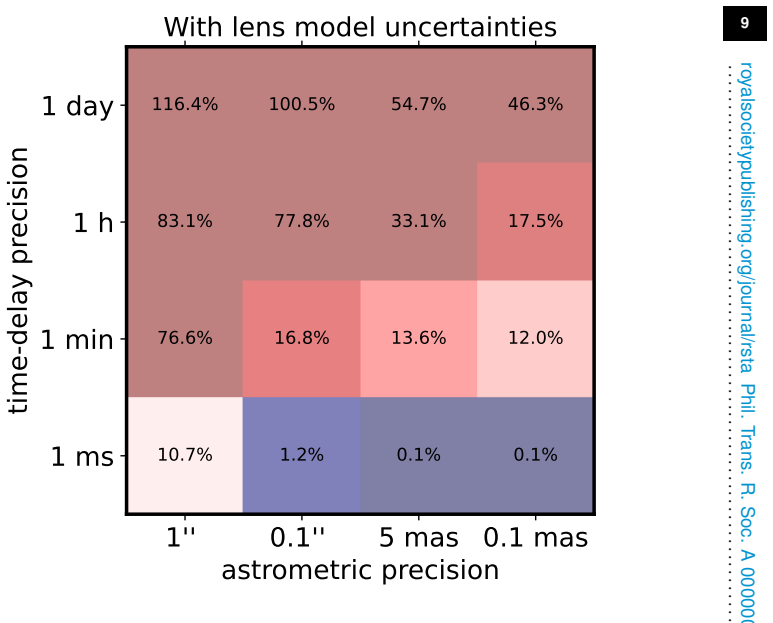
On its own terms, the paper's central claim is that with ultra-precise time-delay measurements, the time delays can provide sufficient information on the astrometry and the lens model, effectively beating the noise floors of the astrometry and the lens model priors simultaneously. In the forecast of Figure 3, a quadruply lensed GW event with 1 ms timing and 0.1 mas astrometry reaches roughly 0.1% precision on $H_0$ under an elliptical power-law mass distribution with external shear, while even 1 arcsec astrometry with 1 ms delays yields about 10% precision. The paper is explicit that this result holds for that model complexity and that the mass-sheet degeneracy is likely to remain the dominant source of uncertainty in time-delay cosmography.
Load-bearing premise
The forecast assumes the deflector is an elliptical power-law mass distribution plus external shear, with priors mimicking HST/JWST imaging constraints; if the true mass distribution has substructure, multipoles, or mass-sheet-like degeneracies, the compensating power of millisecond delays is reduced.
Editorial extensions
If this is right
- Millisecond timing makes the arrival-time error term negligible, setting an $H_0$ measurement floor near 10 km/s/Mpc from timing alone.
- Small-separation lenses with hour-scale delays, normally poor for optical time-delay cosmography, become usable for lensed-GW systems and open access to lower-mass deflectors.
- Astrometric requirements relax: with 1 ms delays, the forecast gives about 10% $H_0$ precision at 1 arcsec astrometry and about 0.1% at 0.1 mas.
- Wave-optics interference in lensed GW events may break the mass-sheet degeneracy with a single waveform, removing the dominant remaining systematic.
- Ratios of time-delay distances between multiple lenses remain invariant under a joint mass-sheet transformation, so ultra-precise delays can measure relative distance ratios even while the degeneracy is unresolved.
Reading between the lines
- If the compensation effect holds, lensed-GW time delays become an astrometric instrument: with the lens model known, a quad's relative image positions could be pinned to roughly $10^{-7}$ mas, a level that would enable transverse cosmological-parallax tests.
- The same millisecond sensitivity that beats noise floors should register delay perturbations from dark-matter subhalos; residuals from the paper's power-law model fit could be recast as a substructure statistic.
- The per-event 0.1% precision suggests the eventual bottleneck is model uniqueness rather than timing or astrometry; injecting a deliberately wrong radial mass slope into the mock analysis would quantify how much the compensation depends on the assumed family of mass models.
Editorial analysis
A structured set of objections, weighed in public.
Referee Report
Summary. This paper reviews the prospects for time-delay cosmography using strongly lensed gravitational-wave events in place of, or in addition to, electromagnetic variable sources. It summarizes the standard time-delay formalism, compares GW and EM measurement characteristics, and identifies relative astrometry of the lensed images as a key challenge. The central quantitative contribution is a numerical forecast in Section 4: a quadruply imaged mock with an elliptical power-law mass distribution plus external shear, imaging-like priors, and a grid of assumed astrometric and time-delay precisions. The forecast indicates that with millisecond time-delay precision, the time delays themselves can constrain the lens model and image astrometry strongly enough to yield about 0.1% H0 precision within that model family, even when the astrometry is poor. The paper is careful to state that this result holds only for the assumed model complexity and that the mass-sheet degeneracy and substructure remain dominant systematics.
Significance. If the central result holds, the paper identifies a qualitatively new feature of lensed-GW time-delay cosmography: ultra-precise arrival times can partially substitute for high-precision astrometry and tight lens-model priors, and they open the small-separation lens regime that is difficult to exploit with EM time-delay surveys. The forecast is a forward simulation with transparent priors and a public code (lenstronomy), and the paper explicitly separates measurement noise from model systematics. The numerical results are conditional on the elliptical power-law plus shear family, and the authors state this limitation in the text; the MSD is correctly identified as a dominant remaining uncertainty. The manuscript is therefore a useful roadmap, although the 0.1% numbers should be read as an information-theoretic limit within a stated model family rather than as an end-to-end realistic precision forecast.
minor comments (6)
- [Section 4(b), Figure 3 caption] The Figure 3 caption states that ultra-precise time delays can 'effectively beat the noise floors of the astrometry and the lens model priors, simultaneously,' without the qualifier that this is demonstrated only for the elliptical power-law plus external shear model family and without including the mass-sheet degeneracy or substructure-induced time-delay fluctuations; the same caveat that appears in the body text should be added to the caption because the caption is the most likely part to be quoted.
- [Section 4(a), Section 4(b)] The forecast uses a single mock lens configuration and a single realization; the quoted percentages should be described explicitly as illustrative of one typical configuration, since the exact numbers may depend on image geometry, source position, and the assumed priors.
- [Section 4(a)] The description of the likelihood used in the lenstronomy posterior inference is sparse; please specify how the astrometric and time-delay measurements enter the likelihood (for example, Gaussian errors with covariances) and, if possible, release the mock and fitting script to make the forecast reproducible.
- [Section 4(a)] The sentence describing the one-hour precision as corresponding to substructure fluctuations conflates detector timing precision with a physical noise floor in the time-delay prediction; consider clarifying that the Figure 3 grid is a measurement-precision grid and that the substructure floor is discussed separately in Section 4(b).
- [Section 3(a)] The sentence 'The detected in gamma rays or radio do not require a further detection in gravitational waves' is missing a subject and should be rephrased.
- [Section 4(a)] The word 'mimique' should be 'mimic'.
Circularity Check
No significant circularity: the forecast is a self-contained forward simulation whose H0 precisions are posterior outputs, not inputs, and the model dependence of the headline claim is explicitly disclosed.
full rationale
The paper's central quantitative claim is a mock forecast. The simulated lens is generated with an elliptical power-law plus external shear model (Section 4(a)), and the posterior inference is run with lenstronomy over the same parametric family. This self-consistency is a limitation in model realism, but it is not circular: the H0 precision values in Figures 2 and 3 are outputs of the posterior, not inputs, and the time-delay and astrometric data are simulated measurements, not fitted parameters renamed as predictions. The claim that 1 ms time delays can simultaneously constrain astrometry and lens model parameters is derived from the Fermat-potential structure of the assumed model, not assumed by construction. The paper explicitly qualifies the result: 'The result presented in Figure 3 holds for the model complexity of an elliptical power-law mass density with external shear,' and it flags the mass-sheet degeneracy as likely remaining dominant. The cited Birrer and Treu (2019) astrometric formula is an analytic propagation relation, and the lenstronomy software is open-source code, so these self-citations are independent support rather than load-bearing circularity. No equation in the paper is defined in terms of the quantity it purports to predict, and no fitted parameter is relabeled as a prediction.
Assumptions & free parameters
free parameters (8)
- power-law slope prior width =
sigma_gamma = 0.1
- Einstein radius prior uncertainty =
0.01 arcsec
- deflector centroid prior uncertainty =
0.01 arcsec per direction
- ellipticity component prior uncertainty =
0.05
- external shear component prior uncertainty =
0.01
- mock Einstein radius =
0.5 arcsec
- astrometric precision grid =
1 arcsec, 0.1 arcsec, 5 mas, 0.1 mas
- time-delay precision grid =
1 day, 1 hour, 1 min, 1 ms
assumptions (5)
- domain assumption The Fermat potential and time-delay distance formalism of strong lensing applies unchanged to gravitational waves when the lens size exceeds the GW wavelength.
- domain assumption The deflector mass distribution is an elliptical power-law with external shear, with priors mimicking HST/JWST imaging constraints.
- domain assumption A lensed GW event is detected with sufficient SNR in all four images to achieve the assumed time-delay precision.
- domain assumption The mass-sheet degeneracy can be ignored for the numerical forecast or handled separately.
- domain assumption The mock forecast uses a typical redshift configuration, though explicit redshifts are not specified.
Cite this review
Pith. "Pith review of Challenges and Opportunities for time-delay cosmography with multi-messenger gravitational lensing." pith.science (2026). https://pith.science/paper/A257LTLK
@misc{pith2026250204472,
  author       = {Pith},
  title        = {Pith review of: Challenges and Opportunities for time-delay cosmography with multi-messenger gravitational lensing},
  year         = {2026},
  howpublished = {\url{https://pith.science/paper/A257LTLK}},
  note         = {Machine review of arXiv:2502.04472}
}
read the original abstract
Strong gravitational lensing of variable sources, such as quasars or supernovae, can be used to constrain cosmological parameters through a technique known as "time-delay cosmography''. Competitive constraints on the Hubble constant have been achieved with electromagnetic observations of lensed quasars and lensed supernovae. Gravitational wave (GW) astronomy may open up a new channel for time-delay cosmography with GW signal replacing the electromagnetic (EM) one. We highlight the similarities of using GW signals to be applied to time-delay cosmography compared to EM signal. We then discuss key differences between GW and EM signals and their resulting advantages and inconveniences from the angle of the current state-of-the-art using quasars and lensed supernovae for time-delay cosmography. We identify the astrometric precision requirement of the images as a key challenge to overcome and highlight the potentially significant impact that near-perfect time-delay measurements of lensed GWs can bring to the table.
Figures


Reference graph
Works this paper leans on
-
[1]
Refsdal S. 1964 On the possibility of determining Hubble’s parameter and the masses of galaxies from the gravitational lens effect. MNRAS 128, 307. (10.1093/mnras/128.4.307)
-
[2]
Riess AG, Yuan W, Macri LM, Scolnic D, Brout D, Casertano S, Jones DO, Murakami Y, Anand GS, Breuval L, Brink TG, Filippenko AV , Hoffmann S, Jha SW, D’arcy Kenworthy W, Mackenty J, Stahl BE, Zheng W. 2022 A Comprehensive Measurement of the Local Value of the Hubble Constant with 1 km s−1 Mpc−1 Uncertainty from the Hubble Space Telescope and the SH0ES Tea...
-
[3]
2020 Planck 2018 results
Planck Collaboration, Aghanim N, Akrami Y, Ashdown M, Aumont J, Baccigalupi C, Ballardini M, Banday AJ, Barreiro RB, Bartolo N, Basak S, Battye R, Benabed K, Bernard JP , Bersanelli M, Bielewicz P , Bock JJ, Bond JR, Borrill J, Bouchet FR, Boulanger F, Bucher M, Burigana C, Butler RC, Calabrese E, Cardoso JF, Carron J, Challinor A, Chiang HC, Chluba J, Co...
2020
-
[4]
2021 Cosmology Intertwined II: The hubble constant tension
Di Valentino E, Anchordoqui LA, Akarsu Ö, Ali-Haimoud Y, Amendola L, Arendse N, Asgari M, Ballardini M, Basilakos S, Battistelli E, Benetti M, Birrer S, Bouchet FR, Bruni M, Calabrese E, Camarena D, Capozziello S, Chen A, Chluba J, Chudaykin A, Colgáin EÓ, Cyr-Racine FY, de Bernardis P , de Cruz Pérez J, Delabrouille J, Dunkley J, Escamilla-Rivera C, Fert...
arXiv 2021
-
[5]
Abdalla E, Abellán GF, Aboubrahim A, Agnello A, Akarsu Ö, Akrami Y, Alestas G, Aloni D, Amendola L, Anchordoqui LA, Anderson RI, Arendse N, Asgari M, Ballardini M, Barger V , Basilakos S, Batista RC, Battistelli ES, Battye R, Benetti M, Benisty D, Berlin A, de Bernardis P , Berti E, Bidenko B, Birrer S, Blakeslee JP , Boddy KK, Bom CR, Bonilla A, Borghi N...
2022
-
[6]
2010 Dissecting the Gravitational lens B1608+656
Suyu SH, Marshall PJ, Auger MW, Hilbert S, Blandford RD, Koopmans LVE, Fassnacht CD, Treu T. 2010 Dissecting the Gravitational lens B1608+656. II. Precision Measurements of the Hubble Constant, Spatial Curvature, and the Dark Energy Equation of State. Astrophysical Journal 711, 201–221. (10.1088/0004-637X/711/1/201)
-
[7]
Wong KC, Suyu SH, Chen GCF, Rusu CE, Millon M, Sluse D, Bonvin V , Fassnacht CD, Taubenberger S, Auger MW, Birrer S, Chan JHH, Courbin F, Hilbert S, Tihhonova O, Treu T, Agnello A, Ding X, Jee I, Komatsu E, Shajib AJ, Sonnenfeld A, Blandford RD, Koopmans LVE, Marshall PJ, Meylan G. 2020 H0LiCOW - XIII. A 2.4 per cent measurement of H 0 from lensed quasars...
-
[8]
Birrer S, Shajib AJ, Galan A, Millon M, Treu T, Agnello A, Auger M, Chen GCF, Christensen L, Collett T, Courbin F, Fassnacht CD, Koopmans LVE, Marshall PJ, Park JW, Rusu CE, Sluse D, Spiniello C, Suyu SH, Wagner-Carena S, Wong KC, Barnabè M, Bolton AS, Czoske O, Ding X, Frieman JA, Van de Vyvere L. 2020 TDCOSMO. IV . Hierarchical time-delay cosmography - ...
Show all 59 references
-
[9]
2023 Constraints on the Hubble constant from supernova Refsdal’s reappearance
Kelly PL, Rodney S, Treu T, Oguri M, Chen W, Zitrin A, Birrer S, Bonvin V , Dessart L, Diego JM, Filippenko AV , Foley RJ, Gilman D, Hjorth J, Jauzac M, Mandel K, Millon M, Pierel J, Sharon K, Thorp S, Williams L, Broadhurst T, Dressler A, Graur O, Jha S, McCully C, Postman M,...
2023 doi
-
[10]
2024 SN H0pe: The First Measurement of H0 from a Multiply-Imaged Type Ia Supernova, Discovered by JWST
Pascale M, Frye BL, Pierel JDR, Chen W, Kelly PL, Cohen SH, Windhorst RA, Riess AG, Kamieneski PS, Diego JM, Meena AK, Cha S, Oguri M, Zitrin A, Jee MJ, Foo N, Leimbach R, Koekemoer AM, Conselice CJ, Dai L, Goobar A, Siebert MR, Strolger L, Willner SP . 2024 SN H0pe: The First...
-
[11]
2021 TDCOSMO
Birrer S, Treu T. 2021 TDCOSMO. V . Strategies for precise and accurate measurements of the Hubble constant with strong lensing. Astronomy & Astrophysics 649, A61. (10.1051/0004- 6361/202039179)
2021 doi
-
[12]
2019 Magnified or multiply imaged? - Search strategies for gravitationally lensed supernovae in wide-field surveys
Wojtak R, Hjorth J, Gall C. 2019 Magnified or multiply imaged? - Search strategies for gravitationally lensed supernovae in wide-field surveys. MNRAS 487, 3342–3355. (10.1093/mnras/stz1516)
2019 doi
- [13]
-
[14]
2021 The Hubble constant from strongly lensed supernovae with standardizable magnifications
Birrer S, Dhawan S, Shajib AJ. 2021 The Hubble constant from strongly lensed supernovae with standardizable magnifications. arXiv e-prints p. arXiv:2107.12385
2021 arXiv
-
[15]
2020 HOLISMOKES
Suyu SH, Huber S, Cañameras R, Kromer M, Schuldt S, Taubenberger S, Yıldırım A, Bonvin V , Chan JHH, Courbin F, Nöbauer U, Sim SA, Sluse D. 2020 HOLISMOKES. I. Highly Optimised Lensing Investigations of Supernovae, Microlensing Objects, and Kinematics of Ellipticals and Spiral...
2020 doi
-
[16]
2024 Strong Gravitational Lensing and Microlensing of Supernovae
Suyu SH, Goobar A, Collett T, More A, Vernardos G. 2024 Strong Gravitational Lensing and Microlensing of Supernovae. Space Science Reviews 220, 13. (10.1007/s11214-024-01044-7)
2024 doi
-
[17]
2017 Precision cosmology from future lensed gravitational wave and electromagnetic signals
Liao K, Fan XL, Ding X, Biesiada M, Zhu ZH. 2017 Precision cosmology from future lensed gravitational wave and electromagnetic signals. Nature Communications 8, 1148. (10.1038/s41467-017-01152-9)
2017 doi
-
[18]
2017 Strongly lensed gravitational waves and electromagnetic signals as powerful cosmic rulers
Wei JJ, Wu XF. 2017 Strongly lensed gravitational waves and electromagnetic signals as powerful cosmic rulers. MNRAS 472, 2906–2912. (10.1093/mnras/stx2210)
2017 doi
-
[19]
2019 Constraining Cosmological Parameters in the FLRW Metric with Lensed GW+EM Signals
Li Y, Fan X, Gou L. 2019 Constraining Cosmological Parameters in the FLRW Metric with Lensed GW+EM Signals. Astrophysical Journal 873, 37. (10.3847/1538-4357/ab037e)
2019 doi
-
[20]
2020 Gravitational wave interference via gravitational lensing: Measurements of luminosity distance, lens mass, and cosmological parameters
Hou S, Fan XL, Liao K, Zhu ZH. 2020 Gravitational wave interference via gravitational lensing: Measurements of luminosity distance, lens mass, and cosmological parameters. Physical Review D 101, 064011. (10.1103/PhysRevD.101.064011)
2020 doi
-
[21]
2023 Cosmography Using Strongly Lensed Gravitational Waves from Binary Black Holes
Jana S, Kapadia SJ, Venumadhav T, Ajith P . 2023 Cosmography Using Strongly Lensed Gravitational Waves from Binary Black Holes. Physical Review Letter 130, 261401. (10.1103/PhysRevLett.130.261401)
2023 doi
-
[22]
2022 Time-Delay Cosmography: Measuring the Hubble Constant and other cosmological parameters with strong gravitational lensing
Birrer S, Millon M, Sluse D, Shajib AJ, Courbin F, Koopmans LVE, Suyu SH, Treu T. 2022 Time-Delay Cosmography: Measuring the Hubble Constant and other cosmological parameters with strong gravitational lensing. arXiv e-prints p. arXiv:2210.10833. (10.48550/arXiv.2210.10833)
-
[23]
2022 Strong lensing time-delay cosmography in the 2020s
Treu T, Suyu SH, Marshall PJ. 2022 Strong lensing time-delay cosmography in the 2020s. The Astronomy and Astrophysics Review 30, 8. (10.1007/s00159-022-00145-y)
2022 doi
-
[24]
2024 Essentials of Strong Gravitational Lensing
Saha P , Sluse D, Wagner J, Williams LLR. 2024 Essentials of Strong Gravitational Lensing. Space Science Reviews 220, 12. (10.1007/s11214-024-01041-w)
2024 doi
-
[25]
1964 Fourth Test of General Relativity
Shapiro II. 1964 Fourth Test of General Relativity. PRL 13, 789–791. (10.1103/PhysRevLett.13.789)
1964 doi
-
[26]
2023 The Magnificent Five Images of Supernova Refsdal: Time Delay and Magnification Measurements.Astrophysical Journal 948,
Kelly PL, Rodney S, Treu T, Birrer S, Bonvin V , Dessart L, Foley RJ, Filippenko AV , Gilman D, Jha S, Hjorth J, Mandel K, Millon M, Pierel J, Thorp S, Zitrin A, Broadhurst T, Chen W, Diego JM, Dressler A, Graur O, Jauzac M, Malkan MA, McCully C, Oguri M, Postman M, Schmidt KB...
2023
-
[27]
2024 JWST Photometric Time-delay and Magnification Measurements for the Triply Imaged Type Ia “SN H0pe” at z = 1.78
Pierel JDR, Frye BL, Pascale M, Caminha GB, Chen W, Dhawan S, Gilman D, Grayling M, Huber S, Kelly P , Thorp S, Arendse N, Birrer S, Bronikowski M, Cañameras R, Coe D, Cohen SH, Conselice CJ, Driver SP , D´Silva JCJ, Engesser M, Foo N, Gall C, Garuda N, Grillo C, Grogin NA, He...
2024
-
[28]
2024 JWST Spectroscopy of SN H0pe: Classification and Time Delays of a Triply-imaged Type Ia Supernova at z = 1.78.arXiv e-prints p
Chen W, Kelly PL, Frye BL, Pierel J, Willner SP , Pascale M, Cohen SH, Conselice CJ, Engesser M, Furtak LJ, Gilman D, Grogin NA, Huber S, Jha SW, Johansson J, Koekemoer AM, Larison C, Meena AK, Siebert MR, Windhorst RA, Yan H, Zitrin A. 2024 JWST Spectroscopy of SN H0pe: Class...
-
[29]
2019 Astrometric requirements for strong lensing time-delay cosmography
Birrer S, Treu T. 2019 Astrometric requirements for strong lensing time-delay cosmography. MNRAS 489, 2097–2103. (10.1093/mnras/stz2254)
2019 doi
-
[30]
2023 Discovering gravitationally lensed gravitational waves: predicted 13royalsocietypublishing.org/journal/rsta Phil
Smith GP , Robertson A, Mahler G, Nicholl M, Ryczanowski D, Bianconi M, Sharon K, Massey R, Richard J, Jauzac M. 2023 Discovering gravitationally lensed gravitational waves: predicted 13royalsocietypublishing.org/journal/rsta Phil. Trans. R. Soc. A 0000000. . . . . . . . . . ....
2023
-
[31]
Abbott BP , Abbott R, Abbott TD, Acernese F, Ackley K, Adams C, Adams T, Addesso P , Adhikari RX, Adya VB, Affeldt C, Afrough M, Agarwal B, Agathos M, Agatsuma K, Aggarwal N, Aguiar OD, Aiello L, Ain A, Ajith P , Allen B, Allen G, Allocca A, Altin PA, Amato A, Ananyeva A, Ande...
2017
-
[32]
Graham MJ, Ford KES, McKernan B, Ross NP , Stern D, Burdge K, Coughlin M, Djorgovski SG, Drake AJ, Duev D, Kasliwal M, Mahabal AA, van Velzen S, Belecki J, Bellm EC, Burruss R, Cenko SB, Cunningham V , Helou G, Kulkarni SR, Masci FJ, Prince T, Reiley D, Rodriguez H, 16royalsoc...
2020
-
[33]
2019 LSST: From Science Drivers to Reference Design and Anticipated Data Products.Astrophysical Journal 873, 111
Ivezi´ c Ž, Kahn SM, Tyson JA, Abel B, Acosta E, Allsman R, Alonso D, AlSayyad Y, Anderson SF, Andrew J, Angel JRP , Angeli GZ, Ansari R, Antilogus P , Araujo C, Armstrong R, Arndt KT, Astier P , Aubourg É, Auza N, Axelrod TS, Bard DJ, Barr JD, Barrau A, Bartlett JG, Bauer AE,...
2019
-
[34]
2018 Target of Opportunity 17royalsocietypublishing.org/journal/rsta Phil
Margutti R, Cowperthwaite P , Doctor Z, Mortensen K, Pankow CP , Salafia O, Villar VA, Alexander K, Annis J, Andreoni I, Baldeschi A, Balmaverde B, Berger E, Bernardini MG, Berry CPL, Bianco F, Blanchard PK, Brocato E, Carnerero MI, Cartier R, Cenko SB, Chornock R, Chomiuk L, ...
-
[35]
2019 Discovery of Strongly-lensed Gravitational Waves - Implications for the LSST Observing Strategy
Smith GP , Robertson A, Bianconi M, Jauzac M. 2019 Discovery of Strongly-lensed Gravitational Waves - Implications for the LSST Observing Strategy. arXiv e-prints p. arXiv:1902.05140. (10.48550/arXiv.1902.05140)
-
[36]
2022 Target-of-opportunity Observations of Gravitational- wave Events with Vera C
Andreoni I, Margutti R, Salafia OS, Parazin B, Villar VA, Coughlin MW, Yoachim P , Mortensen K, Brethauer D, Smartt SJ, Kasliwal MM, Alexander KD, Anand S, Berger E, Bernardini MG, Bianco FB, Blanchard PK, Bloom JS, Brocato E, Bulla M, Cartier R, Cenko SB, Chornock R, Copperwh...
2022
-
[37]
2023 TDCOSMO
Ertl S, Schuldt S, Suyu SH, Schmidt T, Treu T, Birrer S, Shajib AJ, Sluse D. 2023 TDCOSMO. X. Automated modeling of nine strongly lensed quasars and comparison between lens-modeling software. Astronomy & Astrophysics 672, A2. (10.1051/0004-6361/202244909)
2023 doi
-
[38]
2019 Transverse Extragalactic Motions: a New Method for Constraining Cosmological Parameters
Pierce M, Dell’antonio I, Myers A, Birrer S. 2019 Transverse Extragalactic Motions: a New Method for Constraining Cosmological Parameters. Bulletin of the American Astronomical Society 51, 344
2019
-
[39]
2020 What does strong gravitational lensing? The mass and redshift distribution of high-magnification lenses
Robertson A, Smith GP , Massey R, Eke V , Jauzac M, Bianconi M, Ryczanowski D. 2020 What does strong gravitational lensing? The mass and redshift distribution of high-magnification lenses. MNRAS 495, 3727–3739. (10.1093/mnras/staa1429)
2020 doi
-
[40]
2015 The Population of Galaxy-Galaxy Strong Lenses in Forthcoming Optical Imaging Surveys
Collett TE. 2015 The Population of Galaxy-Galaxy Strong Lenses in Forthcoming Optical Imaging Surveys. Astrophysical Journal 811, 20. (10.1088/0004-637X/811/1/20)
2015 doi
-
[41]
2017 iPTF16geu: A multiply imaged, gravitationally lensed type Ia supernova
Goobar A, Amanullah R, Kulkarni SR, Nugent PE, Johansson J, Steidel C, Law D, Mörtsell E, Quimby R, Blagorodnova N, Brandeker A, Cao Y, Cooray A, Ferretti R, Fremling C, Hangard L, Kasliwal M, Kupfer T, Lunnan R, Masci F, Miller AA, Nayyeri H, Neill JD, Ofek EO, Papadogiannaki...
2017 doi
-
[42]
2023 Uncovering a population of gravitational lens galaxies with magnified standard candle SN Zwicky
Goobar A, Johansson J, Schulze S, Arendse N, Carracedo AS, Dhawan S, Mörtsell E, Fremling C, Yan L, Perley D, Sollerman J, Joseph R, Hinds KR, Meynardie W, Andreoni I, Bellm E, Bloom J, Collett TE, Drake A, Graham M, Kasliwal M, Kulkarni SR, Lemon C, Miller AA, Neill JD, Nordi...
2023
-
[43]
1985 On model-dependent bounds on H 0 from gravitational images : application to Q 0957+561 A, B
Falco EE, Gorenstein MV , Shapiro II. 1985 On model-dependent bounds on H 0 from gravitational images : application to Q 0957+561 A, B.. Astrophysical Journal Letter 289, L1–L4. (10.1086/184422)
1985 doi
-
[44]
2018 The impact of microlensing on the standardization of strongly lensed Type Ia supernovae
Foxley-Marrable M, Collett TE, Vernardos G, Goldstein DA, Bacon D. 2018 The impact of microlensing on the standardization of strongly lensed Type Ia supernovae. MNRAS 478, 5081–5090. (10.1093/mnras/sty1346)
2018 doi
-
[45]
2002 The internal structure of the lens PG1115+080: breaking degeneracies in the value of the Hubble constant
Treu T, Koopmans LVE. 2002 The internal structure of the lens PG1115+080: breaking degeneracies in the value of the Hubble constant. MNRAS 337, L6–L10. (10.1046/j.1365- 8711.2002.06107.x)
2002
-
[46]
2003 The Hubble Constant from the Gravitational Lens B1608+656
Koopmans LVE, Treu T, Fassnacht CD, Blandford RD, Surpi G. 2003 The Hubble Constant from the Gravitational Lens B1608+656. Astrophysical Journal 599, 70–85. (10.1086/379226)
2003 doi
-
[47]
2023 TDCOSMO
Shajib AJ, Mozumdar P , Chen GCF, Treu T, Cappellari M, Knabel S, Suyu SH, Bennert VN, Frieman JA, Sluse D, Birrer S, Courbin F, Fassnacht CD, Villafaña L, Williams PR. 2023 TDCOSMO. XII. Improved Hubble constant measurement from lensing time delays using spatially resolved st...
2023 doi
-
[48]
1998 Gravitational lensing of type IA supernovae by galaxy clusters
Kolatt TS, Bartelmann M. 1998 Gravitational lensing of type IA supernovae by galaxy clusters. MNRAS 296, 763–772. (10.1046/j.1365-8711.1998.01466.x)
1998
-
[49]
2003 Gravitational lens time delays for distant supernovae: breaking 18royalsocietypublishing.org/journal/rsta Phil
Oguri M, Kawano Y. 2003 Gravitational lens time delays for distant supernovae: breaking 18royalsocietypublishing.org/journal/rsta Phil. Trans. R. Soc. A 0000000. . . . . . . . . . . . . . . . . . . . . . . . . . . . . . . . . . . . . . . . . . . . . . . . . . . . . . . . . . ....
2003
-
[50]
2024 Breaking the mass-sheet degeneracy in strong lensing mass modeling with weak lensing observations
Khadka N, Birrer S, Leauthaud A, Nix H. 2024 Breaking the mass-sheet degeneracy in strong lensing mass modeling with weak lensing observations. arXiv e-prints p. arXiv:2404.01513. (10.48550/arXiv.2404.01513)
-
[51]
2021 Breaking the mass-sheet degeneracy with gravitational wave interference in lensed events
Cremonese P , Ezquiaga JM, Salzano V . 2021 Breaking the mass-sheet degeneracy with gravitational wave interference in lensed events. Physical Review D 104, 023503. (10.1103/PhysRevD.104.023503)
2021 doi
-
[52]
2020 TDCOSMO
Millon M, Courbin F, Bonvin V , Buckley-Geer E, Fassnacht CD, Frieman J, Marshall PJ, Suyu SH, Treu T, Anguita T, Motta V , Agnello A, Chan JHH, Chao DCY, Chijani M, Gilman D, Gilmore K, Lemon C, Lucey JR, Melo A, Paic E, Rojas K, Sluse D, Williams PR, Hempel A, Kim S, Lachaum...
2020 doi
-
[53]
2009 A New Channel for Detecting Dark Matter Substructure in Galaxies: Gravitational Lens Time Delays
Keeton CR, Moustakas LA. 2009 A New Channel for Detecting Dark Matter Substructure in Galaxies: Gravitational Lens Time Delays. ApJ 699, 1720–1731. (10.1088/0004- 637X/699/2/1720)
2009 doi
-
[54]
2020 TDCOSMO
Gilman D, Birrer S, Treu T. 2020 TDCOSMO. III. Dark matter substructure meets dark energy. The effects of (sub)halos on strong-lensing measurements of H 0. A&A 642, A194. (10.1051/0004-6361/202038829)
2020 doi
-
[55]
2018 lenstronomy: Multi-purpose gravitational lens modelling software package
Birrer S, Amara A. 2018 lenstronomy: Multi-purpose gravitational lens modelling software package. Physics of the Dark Universe 22, 189–201. (10.1016/j.dark.2018.11.002)
2018 doi
-
[56]
2021 lenstronomy II: A gravitational lensing software ecosystem
Birrer S, Shajib A, Gilman D, Galan A, Aalbers J, Millon M, Morgan R, Pagano G, Park J, Teodori L, Tessore N, Ueland M, Van de Vyvere L, Wagner-Carena S, Wempe E, Yang L, Ding X, Schmidt T, Sluse D, Zhang M, Amara A. 2021 lenstronomy II: A gravitational lensing software ecosys...
2021 doi
-
[57]
2024 Lens Modeling of STRIDES Strongly Lensed Quasars using Neural Posterior Estimation.arXiv e-prints p
Erickson S, Wagner-Carena S, Marshall P , Millon M, Birrer S, Roodman A, Schmidt T, Treu T, Schuldt S, Shajib A, Venkatraman P , The LSST Dark Energy Science Collaboration. 2024 Lens Modeling of STRIDES Strongly Lensed Quasars using Neural Posterior Estimation.arXiv e-prints p...
2024 doi
-
[58]
2021 Improved time-delay lens modelling and H0 inference with transient sources
Ding X, Liao K, Birrer S, Shajib AJ, Treu T, Yang L. 2021 Improved time-delay lens modelling and H0 inference with transient sources. MNRAS 504, 5621–5628. (10.1093/mnras/stab1240)
2021 doi
-
[93]
(10.3847/1538-4357/ac4ccb)
Reviewed August 8, 2026 · model on record in the stance chip above.
Discussion (0). Continue with ORCID to comment.