REVIEW 4 major objections 5 minor 62 references
MCTuner: Spatial Decomposition-Enhanced Database Tuning via LLM-Guided Exploration
T0 review · 4 major / 5 minor · reviewed 2026-08-04 · deepseek-v4-flash
Pith's one-line read LLM-picked knobs plus space pruning speed database tuning 1.4x
desk verdict MCTuner's design is plausible and the internal ablations are consistent, but the headline SOTA comparison is undermined by untrained RL baselines, single-run curves, and no artifacts. read the letter →
The pith
A machine-rendered reading of the paper's core claim, the machinery that carries it, and where it could break.
The reading
What carries the argument
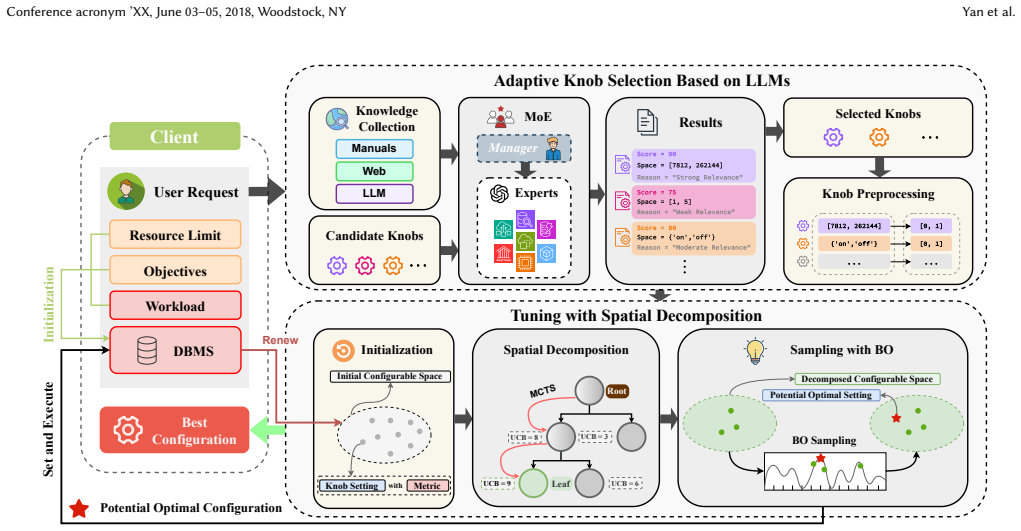
The load-bearing objects are the MoE selector and the recursive spatial decomposition tree. The MoE converts heterogeneous text knowledge about each knob into a single importance score S_final = Σ Wi × Si, where manager-assigned category weights multiply expert scores; this is what shrinks the 60-knob default set to roughly 20 knobs with narrow ranges. The decomposition tree is the paper's main novelty: each node is a subregion; Spatial_Decomposition clusters samples in that region, labels the higher-performing cluster as the promising child, and fits a soft-margin SVM as the boundary; UCB balances visiting high-value versus under-explored leaves; BO then samples only inside the chosen leaf.
What would settle it
Run MCTuner on a synthetic or instrumented PostgreSQL workload where the known optimum sits in a small, isolated high-performance island that is barely represented in the cold-start sample. If the soft-margin SVM boundary learned from the first 50 points places that island on the low-performance side, or if UCB-driven leaf selection never enters it, the decomposition will prune the optimum and MCTuner will converge to a visibly worse configuration; that observation would falsify the spatial-decomposition premise.
Extended reading notes
Core claim
MCTuner's core claim is that a two-stage reduction of the search space turns database tuning into a tractable optimization problem. Stage one uses a Mixture-of-Experts of seven LLM specialists—access control, query optimization, query execution, background processes, CPU, memory, and disk—to score each knob, weight each category by workload relevance, and keep only the top-N knobs with narrowed ranges. Stage two builds a search tree over the remaining space: each leaf is clustered into high- and low-performance groups (spectral clustering on cosine similarity when samples are scarce, Kernel PCA plus K-medoids when they are not), a soft-margin SVM draws the separating boundary, UCB selects a
Load-bearing premise
The decomposition assumes that clusters found on already-evaluated configurations, separated by a soft-margin SVM, correctly delimit high-performance subregions of the still-unexplored space even when only 50 or fewer noisy samples are available.
Editorial extensions
If this is right
- If the roughly 80-iteration convergence holds, an administrator can expect near-optimal PostgreSQL settings after about 80 workload executions instead of hundreds of trials.
- Warm-start results imply configurations transfer across workload scale changes, so the tuner can be reused when data volumes or client loads shift.
- Because the decomposition wraps around any BO surrogate—GP, SMAC, HEBO, and TurBO all improve after the wrapper—the spatial-pruning idea composes with future BO advances.
- MoE knob selection is execution-free and interpretable, meaning it can be run before any database workload executes and can be audited by an administrator.
Reading between the lines
- The SVM and clustering split is only as good as the cold-start sample: the first Latin Hypercube points do the global exploration, so the decomposition likely inherits blind spots of LHS in high dimensions.
- The headline 19.2 percent gain is on one workload (CH-benCHmark latency); on other workloads the gap is smaller, so the practical benefit is workload-dependent and the mechanism, not the single number, is what generalizes.
- A testable extension is to replace the static τ=50 clustering switch with an adaptive criterion tied to estimated sample density, which could make transfer across workloads smoother.
Editorial analysis
A structured set of objections, weighed in public.
Referee Report
Summary. The paper proposes MCTuner, a database knob tuning framework that combines LLM-guided knob selection with recursive spatial decomposition. A Mixture-of-Experts (MoE) mechanism, populated with seven specialized LLM experts, selects and compresses the ranges of performance-critical knobs; a Monte Carlo Tree Search (MCTS) guided spatial decomposition algorithm then partitions the configuration space into high- and low-performance regions, and Bayesian Optimization (BO) is applied within selected leaves. The authors evaluate MCTuner on eight PostgreSQL benchmarks spanning OLAP, OLTP, and HTAP workloads, claiming up to 19.2% performance gains and 1.4x faster configuration discovery per iteration compared to state-of-the-art methods. The paper also reports ablations on the MoE module, the decomposition strategy, the choice of BO surrogate, the clustering method, and warm-start transfer under workload drift.
Significance. The core idea is plausible and potentially useful: using LLM knowledge to compress the knob space before applying partition-based BO is a sensible direction, and the component-level ablations suggest that both the MoE selection and the spatial decomposition contribute to the reported internal improvements. The transfer experiment under workload drift is also a relevant practical question. However, the empirical validation does not substantiate the headline claims. The RL baselines are run without the neural-network training that defines them, all learning curves are single-run with no error bars, and no code or data are released. These issues undermine the comparison against state-of-the-art methods, so the central empirical claim is not established by the current manuscript.
major comments (4)
- [Section 7.1.5] The paper states: 'For RL-based methods, we followed recent work (e.g., DB-BERT, CDBTune) and avoided training neural networks.' DB-BERT and CDBTune are RL-based tuners whose policies are learned through neural-network training; without training, they are essentially untrained/random proposers. Since the headline gains (Abstract; Section 7.2) are computed against these baselines, the comparison is not against the state-of-the-art RL methods and the claimed 'up to 19.2%' advantage is unsupported. The baselines must be run as published, including their training procedures, for a fair comparison.
- [Section 7.2, Fig. 6] All curves in Fig. 6 appear to be single-run trajectories. No error bars, standard deviations, or significance tests are reported. Several reported final gaps are small (e.g., 2.4% on HyAdapt in Section 7.2.1; 4.6% on SmallBank in Section 7.2.2) and could be within run-to-run noise. At a minimum, the main comparison should include multiple seeds and confidence intervals.
- [Eq. (7), Section 6.2-6.3] The UCB formula is dimensionally inconsistent. Section 6.2 defines v_A as the average performance of a node, and Algorithm 1 sets v_A = mean(p(r_i)). However, Eq. (7) writes UCB_B = v_B / n_B + ..., and the accompanying text in Section 6.3 describes v_B as the 'cumulative value.' If v_B is the average, dividing by n_B again makes the exploitation term decay with visit count; if v_B is intended to be cumulative, the notation and Algorithm 1 need to be corrected. This inconsistency directly affects node selection in Algorithm 2.
- [Section 6.2-6.3, Algorithm 1] Spatial decomposition prunes regions using clusters and a soft-margin SVM fit on evaluated samples, then restricts BO to the selected leaf. When n_A <= tau (with tau=50 set 'according to empirical observations' in Section 6.2.1), the boundary is learned from at most 50 noisy samples; an incorrect boundary can exclude the optimal region before BO ever samples it. The paper provides no failure-mode analysis or sensitivity study for tau, gamma, C_p, C, sigma, or the PCA component count, all of which are fixed on the same benchmark workloads. The core speedup claim relies on this pruning being reliable, so this robustness gap is load-bearing.
minor comments (5)
- [Abstract, Section 3] Minor language issues: 'In further' in the abstract should be 'Furthermore'; Section 3 contains 'or or' in the description of categorical domains.
- [Section 7.2.4, Table 1] Table 1 reports per-iteration algorithm time, but the abstract claims '1.4x faster configuration discovery per iteration.' Per-iteration time is not the same as iterations-to-target or total time-to-quality. Clarify which quantity supports the 1.4x claim.
- [Section 7.4.1, Table 3] The warm-start gains are reported without a no-warm-start control in the same drift schedule. Without that control, it is unclear how much of the improvement is due to transfer versus continued online tuning.
- [Section 7.3.2, Table 2] Table 2 is very hard to parse: the multi-column compressed layout and color-based overlap indicators are not legible in monochrome, and the compression ratios are presented without explanation of how they were computed. Please reformat and define all entries.
- [General] No code, data, or reproducibility statement is provided. For an empirical systems paper, this is a significant omission, especially given the number of LLM prompts and hyperparameters involved.
Circularity Check
No significant circularity: the paper's claims are empirical benchmark results, not derivations that reduce to their inputs.
full rationale
MCTuner's central claims are empirical: the headline numbers in the Abstract and Section 7.2 are measured throughput/latency improvements over iterations, not quantities forced by construction. The MoE knob selection (Section 5.2) is an LLM-prompting heuristic with no trainable parameters fitted to the target performance; the downstream BO evaluation (Section 7.3.1) reports actual tuning outcomes, not predictions of the selection mechanism. The spatial decomposition (Section 6.2) partitions observed samples using clustering and SVM, then BO samples within the selected region; the 'space compression' is a descriptive measure of the chosen subregion, and the UCB selection (Eq. 7) is a heuristic that does not define the final performance. There are no self-citations: the reference list contains no works by Yan/Xi/Hou, and LA-MCTS [46] is external prior work cited only as inspiration. The decision to run RL baselines without training neural networks (Section 7.1.5) is a fairness/correctness concern about the comparison, not a circularity, because it does not make MCTuner's advantage equal to its inputs by construction. The inconsistency in Eq. (7) (v_B defined as mean in Algorithm 1 but called cumulative in Section 6.3) is an internal bug, not a circular dependency. Therefore no circularity is present.
Assumptions & free parameters
free parameters (6)
- clustering sample-size threshold tau =
50
- Gaussian similarity matrix gamma =
1.0
- UCB exploration constant C_p =
not reported
- number of selected knobs N =
20
- HTAP metric weights w1, w2 =
latency 0.6, throughput 0.4
- soft-margin SVM C, RBF sigma, PCA component count =
not specified
assumptions (4)
- domain assumption Cluster labels computed from evaluated samples identify true high- and low-performance regions of unobserved configuration space.
- domain assumption LLM-generated and web/manual knob knowledge is accurate enough to restrict ranges and select important knobs without workload-specific feedback.
- domain assumption The performance objective p(r) in Eq. (1) is a valid scalarization, and the default configuration provides a stable reference.
- standard math Standard clustering, SVM, and BO algorithms are correctly applied.
Cite this review
Pith. "Pith review of MCTuner: Spatial Decomposition-Enhanced Database Tuning via LLM-Guided Exploration." pith.science (2026). https://pith.science/paper/A2ZWHM6O
@misc{pith2026250906298,
  author       = {Pith},
  title        = {Pith review of: MCTuner: Spatial Decomposition-Enhanced Database Tuning via LLM-Guided Exploration},
  year         = {2026},
  howpublished = {\url{https://pith.science/paper/A2ZWHM6O}},
  note         = {Machine review of arXiv:2509.06298}
}
read the original abstract
Database knob tuning is essential for optimizing the performance of modern database management systems, which often expose hundreds of knobs with continuous or categorical values. However, the large number of knobs and the vast configuration space make it difficult to identify optimal settings efficiently. Although learning-based tuning has shown promise, existing approaches either ignore domain knowledge by relying solely on benchmark feedback or struggle to explore the high-dimensional knob space, resulting in high tuning costs and suboptimal performance. To address these challenges, we propose MCTuner, an adaptive knob tuning framework that minimizes exploration in ineffective regions of the configuration space. MCTuner employs a Mixture-of-Experts (MoE) mechanism with specialized LLMs to identify performance-critical knobs. In further, MCTuner introduces the first spatial decomposition algorithm that recursively partitions the space into hierarchical subspaces, on which Bayesian Optimization is performed to efficiently search for near-optimal configurations. Evaluated on different benchmarks (OLAP, OLTP, and HTAP), MCTuner achieves up to 19.2% performance gains and 1.4x faster configuration discovery per iteration compared to state-of-the-art methods.
Figures


Figures from the paper (6 more)


Reference graph
Works this paper leans on
-
[1]
Mohiuddin Ahmed, Raihan Seraj, and Syed Mohammed Shamsul Islam. 2020. The k-means algorithm: A comprehensive survey and performance evaluation. Electronics9, 8 (2020), 1295
2020
-
[2]
Peter Akioyamen, Zixuan Yi, and Ryan Marcus. 2024. The Unreasonable Ef- fectiveness of LLMs for Query Optimization.arXiv preprint arXiv:2411.02862 (2024)
arXiv 2024
-
[3]
Jason Ansel, Shoaib Kamil, Kalyan Veeramachaneni, Jonathan Ragan-Kelley, Jeffrey Bosboom, Una-May O’Reilly, and Saman Amarasinghe. 2014. Opentuner: An extensible framework for program autotuning. InProceedings of the 23rd international conference on Parallel architectures and compilation. 303–316
2014
-
[4]
Baoqing Cai, Yu Liu, Ce Zhang, Guangyu Zhang, Ke Zhou, Li Liu, Chunhua Li, Bin Cheng, Jie Yang, and Jiashu Xing. 2022. HUNTER: an online cloud database hybrid tuning system for personalized requirements. InProceedings of the 2022 International Conference on Management of Data. 646–659
2022
-
[5]
Stefano Cereda, Stefano Valladares, Paolo Cremonesi, Stefano Doni, et al. 2021. Cgptuner: a contextual gaussian process bandit approach for the automatic tuning of it configurations under varying workload conditions.Proceedings of the VLDB Endowment14, 8 (2021), 1401–1413
2021
-
[6]
Benoît Dageville and Mohamed Zait. 2002. SQL memory management in Ora- cle9i. InVLDB’02: Proceedings of the 28th International Conference on Very Large Databases. Elsevier, 962–973
work page 2002
-
[7]
Biplob K Debnath, David J Lilja, and Mohamed F Mokbel. 2008. SARD: A statistical approach for ranking database tuning parameters. In2008 IEEE 24th International Conference on Data Engineering Workshop. IEEE, 11–18
work page 2008
-
[8]
Djellel Eddine Difallah, Andrew Pavlo, Carlo Curino, and Philippe Cudré- Mauroux. 2013. OLTP-Bench: An Extensible Testbed for Benchmarking Relational Databases.PVLDB7, 4 (2013), 277–288. http://www.vldb.org/pvldb/vol7/p277- difallah.pdf
work page 2013
Show all 62 references
-
[9]
Songyun Duan, Vamsidhar Thummala, and Shivnath Babu. 2009. Tuning database configuration parameters with ituned.Proceedings of the VLDB Endowment2, 1 (2009), 1246–1257
2009
-
[10]
Jia-Ke Ge, Yan-Feng Chai, and Yun-Peng Chai. 2021. WATuning: a workload- aware tuning system with attention-based deep reinforcement learning.Journal of Computer Science and Technology36, 4 (2021), 741–761
2021
-
[11]
Victor Giannakouris and Immanuel Trummer. 2024. DBG-PT: A Large Language Model Assisted Query Performance Regression Debugger.Proceedings of the VLDB Endowment17, 12 (2024), 4337–4340
2024
-
[12]
2025.𝜆-Tune: Harnessing Large Language Models for Automated Database System Tuning.Proceedings of the ACM on Management of Data3, 1 (2025), 1–26
Victor Giannakouris and Immanuel Trummer. 2025.𝜆-Tune: Harnessing Large Language Models for Automated Database System Tuning.Proceedings of the ACM on Management of Data3, 1 (2025), 1–26
2025
-
[13]
Alex Graves. 2011. Practical variational inference for neural networks.Advances in neural information processing systems24 (2011)
2011
-
[14]
José Miguel Hernández-Lobato and Ryan Adams. 2015. Probabilistic backpropaga- tion for scalable learning of bayesian neural networks. InInternational conference on machine learning. PMLR, 1861–1869
2015
-
[15]
Matthew Hoffman, Eric Brochu, Nando De Freitas, et al. 2011. Portfolio Allocation for Bayesian Optimization.. InUAI, Vol. 11. 327–336
2011
-
[16]
Xinmei Huang, Haoyang Li, Jing Zhang, Xinxin Zhao, Zhiming Yao, Yiyan Li, Tieying Zhang, Jianjun Chen, Hong Chen, and Cuiping Li. 2025. E2ETune: End-to-End Knob Tuning via Fine-tuned Generative Language Model. arXiv:2404.11581 [cs.AI] https://arxiv.org/abs/2404.11581
2025 arXiv
-
[17]
Frank Hutter, Holger H Hoos, and Kevin Leyton-Brown. 2011. Sequential model- based optimization for general algorithm configuration. InLearning and intelligent optimization: 5th international conference, LION 5, rome, Italy, January 17-21, 2011. selected papers 5. Springer, 507–523
2011
-
[18]
Konstantinos Kanellis, Ramnatthan Alagappan, and Shivaram Venkataraman
-
[19]
Konstantinos Kanellis, Cong Ding, Brian Kroth, Andreas Müller, Carlo Curino, and Shivaram Venkataraman. 2022. LlamaTune: sample-efficient DBMS configu- ration tuning.arXiv preprint arXiv:2203.05128(2022)
2022 arXiv
-
[20]
Mayuresh Kunjir and Shivnath Babu. 2020. Black or white? how to develop an autotuner for memory-based analytics. InProceedings of the 2020 ACM SIGMOD International Conference on Management of Data. 1667–1683
2020
-
[21]
Jiale Lao, Yibo Wang, Yufei Li, Jianping Wang, Yunjia Zhang, Zhiyuan Cheng, Wanghu Chen, Mingjie Tang, and Jianguo Wang. 2023. Gptuner: A manual- reading database tuning system via gpt-guided bayesian optimization.arXiv preprint arXiv:2311.03157(2023)
2023 arXiv
-
[22]
Viktor Leis, Andrey Gubichev, Atanas Mirchev, Peter Boncz, Alfons Kemper, and Thomas Neumann. 2015. How good are query optimizers, really?Proceedings of the VLDB Endowment9, 3 (2015), 204–215
2015
-
[23]
Boyan Li, Yuyu Luo, Chengliang Chai, Guoliang Li, and Nan Tang. 2024. The dawn of natural language to SQL: are we fully ready?arXiv preprint arXiv:2406.01265 (2024)
2024 arXiv
-
[24]
Guoliang Li, Xuanhe Zhou, Shifu Li, and Bo Gao. 2019. Qtune: A query-aware database tuning system with deep reinforcement learning.Proceedings of the VLDB Endowment12, 12 (2019), 2118–2130
2019
-
[25]
Haoyang Li, Jing Zhang, Cuiping Li, and Hong Chen. 2023. Resdsql: Decoupling schema linking and skeleton parsing for text-to-sql. InProceedings of the AAAI Conference on Artificial Intelligence, Vol. 37. 13067–13075
2023
-
[26]
Haoyang Li, Jing Zhang, Hanbing Liu, Ju Fan, Xiaokang Zhang, Jun Zhu, Renjie Wei, Hongyan Pan, Cuiping Li, and Hong Chen. 2024. Codes: Towards build- ing open-source language models for text-to-sql.Proceedings of the ACM on Management of Data2, 3 (2024), 1–28
2024
-
[27]
Yiyan Li, Haoyang Li, Zhao Pu, Jing Zhang, Xinyi Zhang, Tao Ji, Luming Sun, Cuiping Li, and Hong Chen. 2024. Is Large Language Model Good at Data- base Knob Tuning? A Comprehensive Experimental Evaluation.arXiv preprint arXiv:2408.02213(2024)
2024 arXiv
-
[28]
Zhaodonghui Li, Haitao Yuan, Huiming Wang, Gao Cong, and Lidong Bing. 2024. LLM-R2: A Large Language Model Enhanced Rule-based Rewrite System for Boosting Query Efficiency.arXiv preprint arXiv:2404.12872(2024)
2024 arXiv
-
[29]
Michael D McKay. 1992. Latin hypercube sampling as a tool in uncertainty analysis of computer models. InProceedings of the 24th conference on Winter simulation. 557–564
1992
-
[30]
Biao Ouyang, Yingying Zhang, Hanyin Cheng, Yang Shu, Chenjuan Guo, Bin Yang, Qingsong Wen, Lunting Fan, and Christian S Jensen. 2025. RCRank: Mul- timodal Ranking of Root Causes of Slow Queries in Cloud Database Systems. arXiv preprint arXiv:2503.04252(2025)
2025 arXiv
-
[31]
Hae-Sang Park and Chi-Hyuck Jun. 2009. A simple and fast algorithm for K- medoids clustering.Expert systems with applications36, 2 (2009), 3336–3341
2009
-
[32]
Mohammadreza Pourreza and Davood Rafiei. 2023. Din-sql: Decomposed in- context learning of text-to-sql with self-correction.Advances in Neural Informa- tion Processing Systems36 (2023), 36339–36348
2023
-
[33]
Tonghui Ren, Yuankai Fan, Zhenying He, Ren Huang, Jiaqi Dai, Can Huang, Yinan Jing, Kai Zhang, Yifan Yang, and X Sean Wang. 2024. Purple: Making a large language model a better sql writer. In2024 IEEE 40th International Conference on Data Engineering (ICDE). IEEE, 15–28
2024
-
[34]
Bernhard Schölkopf, Alexander Smola, and Klaus-Robert Müller. 1997. Kernel principal component analysis. InInternational conference on artificial neural networks. Springer, 583–588
1997
-
[35]
David Silver, Guy Lever, Nicolas Heess, Thomas Degris, Daan Wierstra, and Martin Riedmiller. 2014. Deterministic policy gradient algorithms. InInternational conference on machine learning. Pmlr, 387–395
2014
-
[36]
Vikramank Singh, Kapil Eknath Vaidya, Vinayshekhar Bannihatti Kumar, Sopan Khosla, Murali Narayanaswamy, Rashmi Gangadharaiah, and Tim Kraska. 2024. Panda: Performance debugging for databases using LLM agents. (2024)
2024
-
[37]
Sithursan Sivasubramaniam, Cedric E Osei-Akoto, Yi Zhang, Kurt Stockinger, and Jonathan Fuerst. 2024. SM3-Text-to-Query: Synthetic Multi-Model Medical Text-to-Query Benchmark.Advances in Neural Information Processing Systems37 (2024), 88627–88663
2024
-
[38]
David G Sullivan, Margo I Seltzer, and Avi Pfeffer. 2004. Using probabilistic rea- soning to automate software tuning.ACM SIGMETRICS Performance Evaluation Review32, 1 (2004), 404–405
2004
-
[39]
Zhaoyan Sun, Xuanhe Zhou, and Guoliang Li. 2024. R-Bot: An LLM-based Query Rewrite System.arXiv preprint arXiv:2412.01661(2024)
2024 arXiv
-
[40]
Immanuel Trummer. 2022. CodexDB: Synthesizing code for query processing from natural language instructions using GPT-3 Codex.Proceedings of the VLDB Endowment15, 11 (2022), 2921–2928
2022
-
[41]
Reads the Manual
Immanuel Trummer. 2022. DB-BERT: a Database Tuning Tool that" Reads the Manual". InProceedings of the 2022 international conference on management of data. 190–203
2022
-
[42]
Dana Van Aken, Andrew Pavlo, Geoffrey J Gordon, and Bohan Zhang. 2017. Automatic database management system tuning through large-scale machine learning. InProceedings of the 2017 ACM international conference on management of data. 1009–1024
2017
-
[43]
Dana Van Aken, Dongsheng Yang, Sebastien Brillard, Ari Fiorino, Bohan Zhang, Christian Bilien, and Andrew Pavlo. 2021. An inquiry into machine learning- based automatic configuration tuning services on real-world database manage- ment systems.Proceedings of the VLDB Endowment1...
2021
-
[44]
Ulrike Von Luxburg. 2007. A tutorial on spectral clustering.Statistics and computing17 (2007), 395–416
2007
-
[45]
Junxiong Wang, Immanuel Trummer, and Debabrota Basu. 2021. UDO: uni- versal database optimization using reinforcement learning.arXiv preprint arXiv:2104.01744(2021)
2021 arXiv
-
[46]
Linnan Wang, Rodrigo Fonseca, and Yuandong Tian. 2020. Learning search space partition for black-box optimization using monte carlo tree search.Advances in Neural Information Processing Systems33 (2020), 19511–19522
2020
-
[47]
Haibo Xiu, Li Zhang, Tieying Zhang, Jun Yang, and Jianjun Chen. 2024. Query Performance Explanation through Large Language Model for HTAP Systems. arXiv preprint arXiv:2412.01709(2024)
2024 arXiv
-
[48]
Silei Xu, Wenhao Xie, Lingxiao Zhao, and Pengcheng He. 2025. Chain of draft: Thinking faster by writing less.arXiv preprint arXiv:2502.18600(2025). Conference acronym ’XX, June 03–05, 2018, Woodstock, NY Yan et al
2025 arXiv
-
[49]
Ji Zhang, Yu Liu, Ke Zhou, Guoliang Li, Zhili Xiao, Bin Cheng, Jiashu Xing, Yangtao Wang, Tianheng Cheng, Li Liu, et al. 2019. An end-to-end automatic cloud database tuning system using deep reinforcement learning. InProceedings of the 2019 international conference on manageme...
2019
-
[50]
Limeng Zhang and M Ali Babar. 2024. Automatic configuration tuning on cloud database: A survey.arXiv preprint arXiv:2404.06043(2024)
2024 arXiv
-
[51]
Xinyi Zhang, Zhuo Chang, Yang Li, Hong Wu, Jian Tan, Feifei Li, and Bin Cui. 2021. Facilitating database tuning with hyper-parameter optimization: a comprehensive experimental evaluation.arXiv preprint arXiv:2110.12654(2021)
2021 arXiv
-
[52]
Xinyi Zhang, Hong Wu, Zhuo Chang, Shuowei Jin, Jian Tan, Feifei Li, Tieying Zhang, and Bin Cui. 2021. Restune: Resource oriented tuning boosted by meta- learning for cloud databases. InProceedings of the 2021 international conference on management of data. 2102–2114
2021
-
[53]
Xinyi Zhang, Hong Wu, Yang Li, Jian Tan, Feifei Li, and Bin Cui. 2022. Towards dynamic and safe configuration tuning for cloud databases. InProceedings of the 2022 International Conference on Management of Data. 631–645
2022
-
[54]
Xinyi Zhang, Hong Wu, Yang Li, Zhengju Tang, Jian Tan, Feifei Li, and Bin Cui
-
[55]
Zhuosheng Zhang, Yao Yao, Aston Zhang, Xiangru Tang, Xinbei Ma, Zhiwei He, Yiming Wang, Mark Gerstein, Rui Wang, Gongshen Liu, et al . 2023. Igniting language intelligence: The hitchhiker’s guide from chain-of-thought reasoning to language agents.Comput. Surveys(2023)
2023
-
[56]
Xinxin Zhao, Haoyang Li, Jing Zhang, Xinmei Huang, Tieying Zhang, Jianjun Chen, Rui Shi, Cuiping Li, and Hong Chen. 2025. LLMIdxAdvis: Resource-Efficient Index Advisor Utilizing Large Language Model.arXiv preprint arXiv:2503.07884 (2025)
2025
-
[57]
Xinyang Zhao, Xuanhe Zhou, and Guoliang Li. 2023. Automatic database knob tuning: A survey.IEEE Transactions on Knowledge and Data Engineering35, 12 (2023), 12470–12490
2023
-
[58]
Wei Zhou, Chen Lin, Xuanhe Zhou, and Guoliang Li. 2024. Breaking It Down: An In-Depth Study of Index Advisors.Proceedings of the VLDB Endowment17, 10 (2024), 2405–2418
2024
-
[59]
Xuanhe Zhou, Guoliang Li, Zhaoyan Sun, Zhiyuan Liu, Weize Chen, Jianming Wu, Jiesi Liu, Ruohang Feng, and Guoyang Zeng. 2023. D-bot: Database diagnosis system using large language models.arXiv preprint arXiv:2312.01454(2023)
2023 arXiv
-
[60]
Yuqing Zhu, Jianxun Liu, Mengying Guo, Yungang Bao, Wenlong Ma, Zhuoyue Liu, Kunpeng Song, and Yingchun Yang. 2017. Bestconfig: tapping the perfor- mance potential of systems via automatic configuration tuning. InProceedings of the 2017 symposium on cloud computing. 338–350. R...
2017
-
[2020]
In12th USENIX Workshop on Hot Topics in Storage and File Systems (HotStorage 20)
Too many knobs to tune? towards faster database tuning by pre-selecting important knobs. In12th USENIX Workshop on Hot Topics in Storage and File Systems (HotStorage 20)
-
[2023]
An efficient transfer learning based configuration adviser for database tuning.Proceedings of the VLDB Endowment17, 3 (2023), 539–552
2023
Reviewed August 4, 2026 · model on record in the stance chip above.
Discussion (0). Sign in to comment.