Being a leader or being the leader: The evolution of institutionalised hierarchy
Pith reviewed 2026-05-25 09:37 UTC · model grok-4.3
The pith
Groups evolve a preference for institutional hierarchy because a single appointed leader organizes collective tasks more efficiently than informal hierarchies.
A machine-rendered reading of the paper's core claim, the machinery that carries it, and where it could break.
Core claim
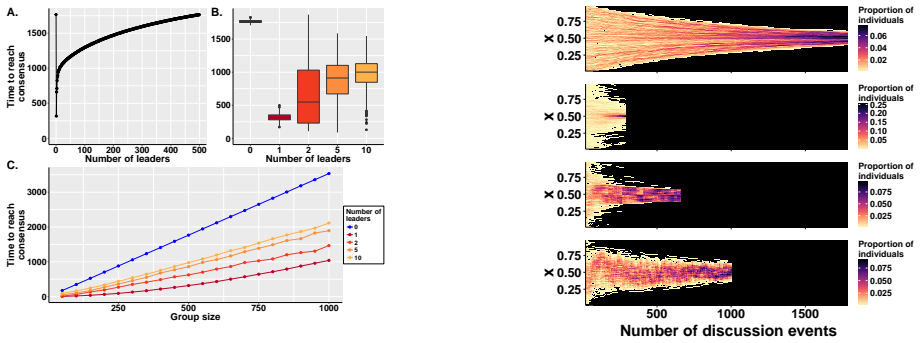
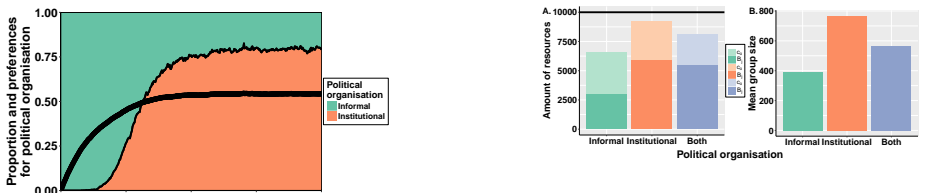
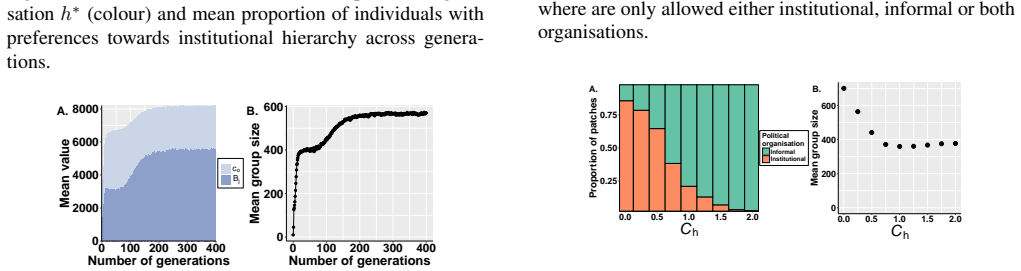
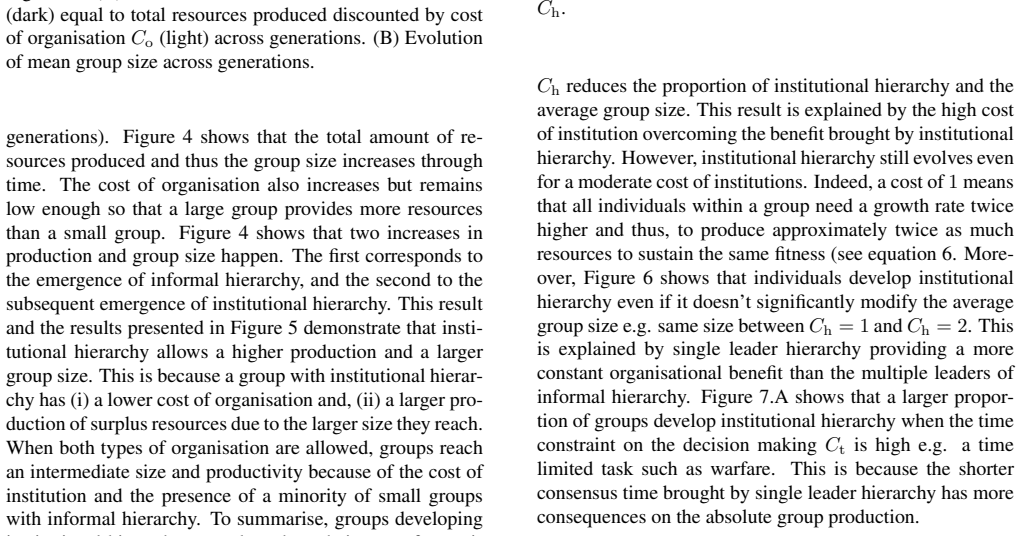
The authors construct an opinion-formation model in which a single-leader hierarchy, unlike informal hierarchy, reduces the time groups need to reach consensus on collective tasks, reduces variation in that time, and reduces how quickly that time grows with group size. When this model is embedded in an evolutionary simulation allowing choice between the two hierarchy types, groups evolve a preference for institutional hierarchy despite its costs because the single-leader form provides a more robust organizational advantage less sensitive to group size and inequality.
What carries the argument
An opinion-formation model that quantifies consensus time under single-leader versus multi-leader hierarchies, used to calculate the cost of collective action and fed into an evolutionary selection process between hierarchy types.
If this is right
- Single-leader hierarchies reach consensus faster than informal ones on collective tasks.
- Consensus time under single leaders increases more slowly with group size.
- Institutional hierarchy is favored by evolution even when creating the institution carries a cost.
- The organizational advantage of institutions holds across different levels of group inequality.
- Groups using institutional hierarchy spend less time organizing and more producing resources.
Where Pith is reading between the lines
- Larger societies may require formal institutions to maintain coordination efficiency as informal structures scale poorly.
- The model predicts that if informal groups are prevented from settling on one leader, evolutionary pressure toward institutions would strengthen.
- The framework could be extended to test whether repeated collective actions amplify the selection for institutions over time.
- If real institutions sometimes fail to enforce single leadership, the evolutionary preference should weaken or reverse.
Load-bearing premise
That institutions reliably produce exactly one leader while informal hierarchies do not, and that this single-leader property is what drives the difference in consensus times.
What would settle it
Run the evolutionary simulation but allow informal hierarchies a chance to produce a single leader with some probability and check whether the preference for institutions then disappears.
Figures

read the original abstract
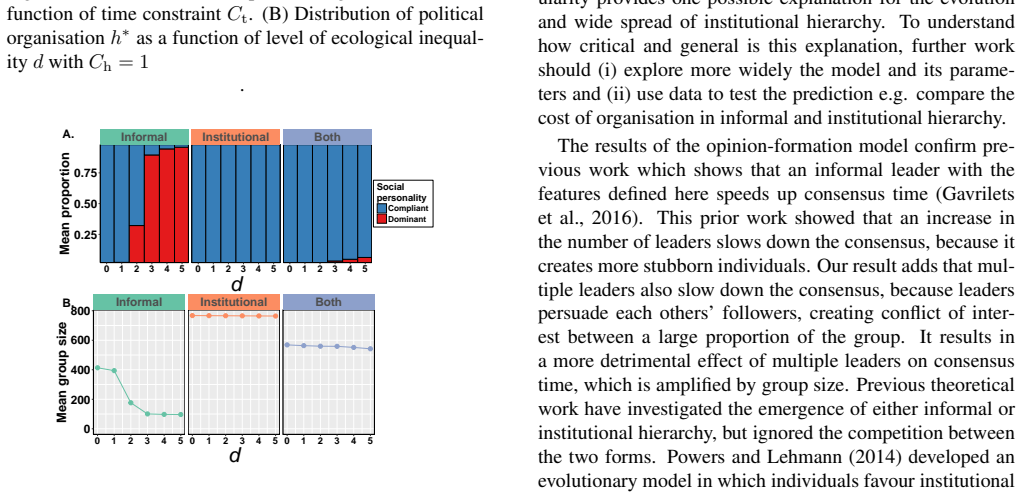
Human social hierarchy has the unique characteristic of existing in two forms. Firstly, as an informal hierarchy where leaders and followers are implicitly defined by their personal characteristics, and secondly, as an institutional hierarchy where leaders and followers are explicitly appointed by group decision. Although both forms can reduce the time spent in organising collective tasks, institutional hierarchy imposes additional costs. It is therefore natural to question why it emerges at all. The key difference lies in the fact that institutions can create hierarchy with only a single leader, which is unlikely to occur in unregulated informal hierarchy. To investigate if this difference can affect group decision-making and explain the evolution of institutional hierarchy, we first build an opinion-formation model that simulates group decision making. We show that in comparison to informal hierarchy, a single-leader hierarchy reduces (i) the time a group spends to reach consensus, (ii) the variation in consensus time, and (iii) the rate of increase in consensus time as group size increases. We then use this model to simulate the cost of organising a collective action which produces resources, and integrate this into an evolutionary model where individuals can choose between informal or institutional hierarchy. Our results demonstrate that groups evolve preferences towards institutional hierarchy, despite the cost of creating an institution, as it provides a greater organisational advantage which is less affected by group size and inequality.
Editorial analysis
A structured set of objections, weighed in public.
Referee Report
Summary. The manuscript develops an opinion-formation model demonstrating that single-leader institutional hierarchies reduce consensus time, its variance, and its scaling with group size relative to informal hierarchies. These derived organizational costs are then embedded in an evolutionary simulation in which agents choose hierarchy type, resulting in the evolution of a preference for institutional hierarchy despite the cost of institution creation.
Significance. If the modeling results are robust, the work supplies a mechanistic evolutionary account of why institutionalised hierarchy can emerge: the single-leader structure yields measurable efficiency gains that are less sensitive to group size and inequality. The explicit construction of the opinion model to quantify those gains (rather than positing them) is a methodological strength that directly addresses potential circularity objections.
minor comments (3)
- [Abstract] Abstract: the headline claim would be easier to evaluate if the abstract briefly indicated the range of group sizes simulated and whether the institution cost is fixed or scales with N.
- [Methods] The integration step between the opinion-formation output and the evolutionary fitness function should state explicitly how consensus-time statistics are converted into resource-acquisition rates (e.g., via a specific functional form).
- [Results] Figure captions or the results section should report sensitivity checks on the key free parameter (institution-creation cost) to confirm that the evolutionary preference is not confined to a narrow interval.
Simulated Author's Rebuttal
We thank the referee for their careful reading and positive assessment of the manuscript. The recommendation for minor revision is noted. However, the report lists no specific major comments under the MAJOR COMMENTS section, so we have no individual points requiring point-by-point rebuttal or revision.
Circularity Check
No significant circularity identified
full rationale
The paper explicitly constructs an opinion-formation model that quantifies consensus-time advantages arising from the single-leader assumption for institutional hierarchy versus informal hierarchy, then embeds the resulting organizational costs as inputs to a separate evolutionary simulation in which agents select hierarchy type. This workflow derives the evolutionary preference as an output consequence of the modeled differences rather than presupposing it; no step reduces by definition or by construction to its own inputs, no parameters are fitted and relabeled as predictions, and no load-bearing self-citations or imported uniqueness theorems appear in the described chain.
Axiom & Free-Parameter Ledger
free parameters (1)
- cost of creating an institution
axioms (2)
- domain assumption Institutions can create hierarchy with only a single leader, which is unlikely to occur in unregulated informal hierarchy
- domain assumption The opinion-formation model captures the relevant features of real group consensus dynamics
Lean theorems connected to this paper
-
IndisputableMonolith/Cost/FunctionalEquation.leanwashburn_uniqueness_aczel unclear?
unclearRelation between the paper passage and the cited Recognition theorem.
We develop an opinion-formation model... x′v = xv + (αu − αv)(xu − xv). ... consensus time t∗ ... evolutionary model where individuals can choose between informal or institutional hierarchy.
-
IndisputableMonolith/Foundation/RealityFromDistinction.leanreality_from_one_distinction unclear?
unclearRelation between the paper passage and the cited Recognition theorem.
The key difference lies in the fact that institutions can create hierarchy with only a single leader, which is unlikely to occur in unregulated informal hierarchy.
What do these tags mean?
- matches
- The paper's claim is directly supported by a theorem in the formal canon.
- supports
- The theorem supports part of the paper's argument, but the paper may add assumptions or extra steps.
- extends
- The paper goes beyond the formal theorem; the theorem is a base layer rather than the whole result.
- uses
- The paper appears to rely on the theorem as machinery.
- contradicts
- The paper's claim conflicts with a theorem or certificate in the canon.
- unclear
- Pith found a possible connection, but the passage is too broad, indirect, or ambiguous to say the theorem truly supports the claim.
Reference graph
Works this paper leans on
-
[1]
Berggren, N., Jordahl, H., and Poutvaara, P. (2010). The looks of a winner: Beauty, gender and electoral success. Journal of public economics, 94(1-2)
work page 2010
-
[2]
Bocquet-Appel, J.-P. (2011). When the world’s population took off: the springboard of the neolithic demographic transition. Science, 333(6042):560–561
work page 2011
-
[3]
Boehm, C. (2001). Hierarchy in the forest: The evolution of egali- tarian behavior. Harvard University Press, Cambridge
work page 2001
-
[4]
Calvert, R. (1992). Leadership and its basis in problems of so- cial coordination. International Political Science Review , 13(1):7–24
work page 1992
-
[5]
Castellano, C., Fortunato, S., and Loreto, V . (2009). Statistical physics of social dynamics. Reviews of Modern Physics , 81(2):591–646
work page 2009
-
[6]
Deffuant, G., Neau, D., Amblard, F., and Weisbuch, G. (2000). Mixing beliefs among interacting agents. Technical report
work page 2000
-
[7]
Dunbar, R. (1992). Neocortex size as a constraint on group size in primates. Journal of Human Evolution, 22(6):469–493
work page 1992
-
[8]
Foster, K. R. (2004). Diminishing returns in social evolution: The not-so-tragic commons. Journal of Evolutionary Biology , 17(5):1058–1072
work page 2004
-
[9]
Gavrilets, S., Auerbach, J., and Van Vugt, M. (2016). Convergence to consensus in heterogeneous groups and the emergence of informal leadership. Scientific Reports, 6(January)
work page 2016
-
[10]
Hewlett, B. S., Fouts, H. N., Boyette, A. H., and Hewlett, B. L. (2011). Social learning among Congo Basin hunter-gatherers. Philosophical Transactions of the Royal Society B: Biological Sciences, 366(1567):1168–1178
work page 2011
-
[11]
Hooper, P. L., Kaplan, H. S., and Boone, J. L. (2010). A theory of leadership in human cooperative groups. Journal of Theoret- ical Biology, 265(4):633–646
work page 2010
-
[12]
Hurwicz, L. (1996). Institutions as families of game forms. The Japanese Economic Review, 47(2):113–132
work page 1996
-
[13]
Johnson, A. W. and Earle, T. (2000). The evolution of human so- cieties: From foraging group to agrarian state . Standford University Press, Stanford
work page 2000
-
[14]
Johnson, G. A. (1982). Organizational structure and scalar stress. In Theory and Explanation in Archaeology , pages 389–421. New York: Academic Press
work page 1982
-
[15]
Johnstone, R. A. and Manica, A. (2011). Evolution of person- ality differences in leadership. Proceedings of the National Academy of Sciences, 108(20):8373–8378
work page 2011
-
[16]
Judge, T. A., Bono, J. E., Ilies, R., and Gerhardt, M. W. (2002). Personality and leadership: A qualitative and quantitative re- view. Journal of Applied Psychology, 87(4):765–780
work page 2002
-
[17]
Mattison, S. M., Smith, E. A., Shenk, M. K., and Cochrane, E. E. (2016). The evolution of inequality. Evolutionary Anthropol- ogy, 25(4):184–199
work page 2016
-
[18]
Ostrom, E. (1990). Governing the commons. Cambridge University Press
work page 1990
-
[19]
Perret, C., Powers, S. T., and Hart, E. (2017). Emergence of hier- archy from the evolution of individual influence in an agent- based model. In Proceedings of the European Conference on Artificial Life 2017, pages 348–355, Cambridge. MIT Press
work page 2017
-
[20]
Pielstick, C. D. (2000). Formal vs. informal leading: A compara- tive analysis. Journal of Leadership Studies, 7(3):99–114
work page 2000
-
[21]
Pindyck, R. S. and Rubinfeld, D. L. (2001).Microeconomics. Pren- tice Hall
work page 2001
-
[22]
Powers, S. T. and Lehmann, L. (2014). An evolutionary model ex- plaining the Neolithic transition from egalitarianism to lead- ership and despotism. Proceedings of the Royal Society B: Biological Sciences, 281(1791):20141349–20141349
work page 2014
-
[23]
Sherif, M., Harvey, O. J., White, B. J., Hood, W. R., Sherif, C. W., and Green, C. D. (1954). Intergroup conflict and cooperation: The Robbers cave experiment. Technical report, Houghton Mifflin Company. Van Vugt, M., Ahuja, A., and Van Vugt, M. (2011). Naturally se- lected : the evolutionary science of leadership . HarperBusi- ness
work page 1954
-
[24]
Wright, S. (1931). Evolution in mendelian populations. Genetics, 16(2):97–159
work page 1931
discussion (0)
Sign in with ORCID, Apple, or X to comment. Anyone can read and Pith papers without signing in.