REVIEW 2 major objections 4 minor 41 references
Wearing A Coat: Dual-Arm Robot-Assisted Dressing with Differentiable Clothing Simulation
T0 review · 2 major / 4 minor · reviewed 2026-07-14 · grok-4.5
Pith's one-line read Dual-arm robots can fully put coats on people by simulating cloth contacts in real time under partial-wear constraints.
desk verdict Working dual-arm coat dressing system with a usable large-step explicit differentiable cloth sim; physical claims rest on single-run demos rather than quantified reliability. read the letter →
The pith
A machine-rendered reading of the paper's core claim, the machinery that carries it, and where it could break.
The reading
What carries the argument
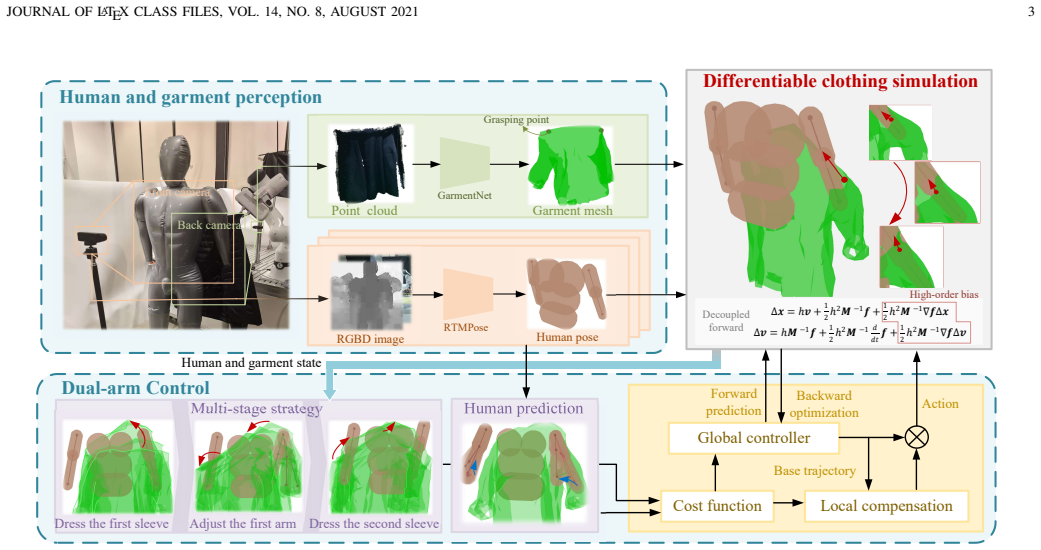
The position-velocity-decoupled explicit iteration with high-order bias (Eqs. 7–12) plus dry-friction contact update, which yields both forward garment states and analytic Jacobians for gradient-based global control; a linearized local dressing model with active-set constrained DDP then supplies the real-time corrections.
What would settle it
In a physical trial with active human motion and a previously unseen coat, measure whether both progress scalars reach exactly 2 while peak simulated inner forces stay below the safety threshold used in the cost; failure of either metric under otherwise identical conditions would refute the claim that the simulation-plus-control loop is sufficient.
Extended reading notes
Core claim
An explicit iterative differentiable clothing simulator that intentionally injects high-order bias terms remains stable and accurate enough under large time steps to supply contact-resolved garment states; those states, combined with multi-stage objective-driven dual-arm model-predictive control and a constrained local compensator, let a robot complete full dual-sleeve coat dressing for varied poses, garments, and human motion patterns.
Load-bearing premise
The high-order bias terms keep the fast explicit simulation accurate enough for contact forces and sleeve tracking at the chosen large steps without artificial damping that would invalidate the dressing predictions.
Editorial extensions
If this is right
- Robots can finish the second sleeve of a conventional coat even when the wearer’s initial arm span exceeds shoulder width.
- Assistive systems can switch online between passive compliance and active human cooperation without garment-specific pre-models.
- The same contact-aware multi-stage decomposition becomes available for other constrained soft-object tasks such as jacket removal or layered dressing.
- Real-time differentiable cloth simulation at 0.01 s steps is now practical for closed-loop dual-arm MPC on commodity hardware.
Reading between the lines
- The same high-order-bias explicit scheme could accelerate differentiable simulation for other frictional soft-body contacts outside dressing, such as blanket covering or bag packing.
- Multi-stage sleeve sequencing may transfer directly to lower-body garments once a comparable local compensator is written for pants legs.
- Because the global controller already predicts human intent, adding force-torque feedback at the grippers would likely tighten the safety margins without changing the architecture.
Editorial analysis
A structured set of objections, weighed in public.
Referee Report
Summary. The paper presents a dual-arm robot-assisted coat dressing system that couples a novel explicit, position-velocity-decoupled differentiable cloth simulator (with intentional high-order bias terms for large-step stability and dry-friction contact) to a multi-stage model-predictive controller. The multi-stage objective (Eq. 32) sequences first-sleeve insertion, arm adjustment under garment constraint, and second-sleeve donning; a constrained local linear model solved by an active-set CDDP variant supplies high-frequency compensation. Perception uses GarmentNets-style reconstruction plus RTMPose and a diffusion-based human-motion predictor. Validation comprises simulation comparisons against Projective Dynamics (Figs. 5–6, Table I), a single-sleeve gradient-control demo (Figs. 7–8), and physical dummy/human trials across garments, standing/sitting poses, and passive/active motion (Figs. 10–14), with progress scalars s_i reaching 2 and force ablations.
Significance. If the claims hold, the work supplies a practical route to full dual-sleeve coat dressing under contact constraints—an open problem that prior segment-based or single-sleeve methods leave unsolved. The explicit high-order-bias simulator is a concrete engineering contribution that demonstrably improves real-time performance relative to PD while remaining differentiable, and the multi-stage + local-compensation architecture is a reusable pattern for other constrained deformable-object HRI tasks. Physical success on both dummy and human subjects with two garments and both passive and active intent is a non-trivial system-level result for assistive robotics.
major comments (2)
- Sec. VII-C and Figs. 10–14: the central claim that the integrated system “successfully completes dual-sleeve coat dressing under contact constraints for varied poses, garments, and both passive and active human motion” rests exclusively on single-run qualitative sequences and progress-scalar/force traces. No multi-trial success rates, inter-subject variance, confidence intervals, or systematic failure-mode analysis are reported. Without quantified reliability, the efficacy of the multi-stage objective (Eq. 32) and the constrained local compensator (Alg. 2) under realistic contact and intent variation remains unproven; at minimum a success-rate table over repeated trials with controlled pose/garment/intent factors is required.
- Eqs. (7)–(12) and Conclusion: the intentionally introduced high-order bias terms are acknowledged by the authors to produce “more pronounced energy dissipation” and to render the method “less suitable for highly dynamic scenarios.” Dressing involves rapid contact transitions and sleeve sliding; the paper never quantifies how much artificial damping distorts contact-force predictions or sleeve-state tracking at the operating steps (h = 0.01 s local, h = 1 s global). A short sensitivity study (e.g., energy residual or force error versus h against a fine-step PD reference under sleeve-contact conditions) is needed to confirm that the bias does not invalidate the contact-constrained control claims.
minor comments (4)
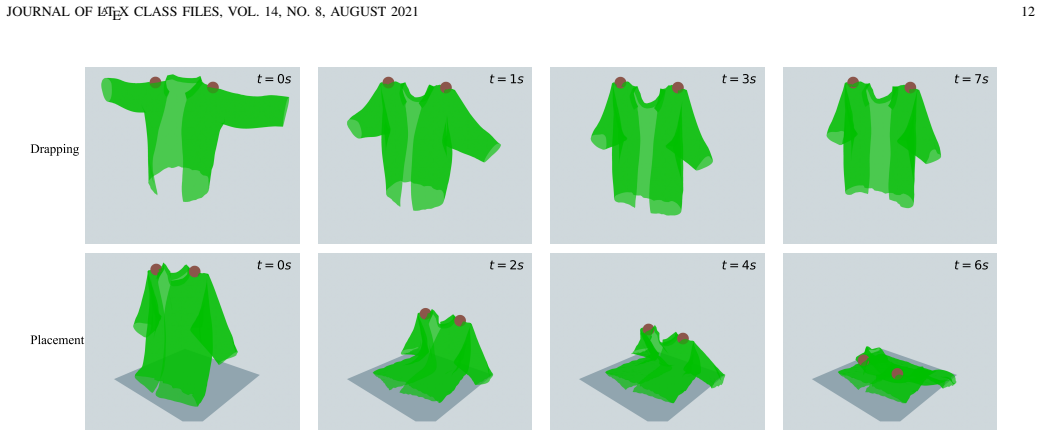
- Table I and Figs. 5–6: computational times for the placement task rise sharply with contact; a brief complexity discussion (O(n_c^{3} + n^{2})) already appears later, but an explicit statement of typical n_c under dressing conditions would help readers assess real-time margins.
- Notation: the same symbol ϕ is overloaded for multiple distinct thresholds (ϕ_p, ϕ_c, ϕ_f, ϕ_x, ϕ_v); a single table of all free parameters and their numerical values used in experiments would improve reproducibility.
- Fig. 1 pipeline diagram is dense; the multi-stage strategy block could be enlarged or split so that the three phases (first sleeve / arm adjust / second sleeve) are visually distinct.
- Related-work discussion of DiffCloth / DiffPD is accurate but could more clearly state which contact and friction gradients are newly derived versus reused.
Circularity Check
No significant circularity: the explicit high-order-bias simulator, multi-stage costs, and local compensator are engineering constructions whose success metric (s_i reaching 2) is independent of free parameters and is checked against external PD baselines plus physical hardware.
full rationale
The derivation chain begins from a second-order Taylor expansion of nodal position/velocity (Eq. 1), augments it with intentionally introduced high-order bias terms that recover a semi-definite mass-matrix compensation (Eqs. 7–12), and obtains an explicit fixed-point iteration whose spectral radius is shown <1 by Rayleigh-quotient argument (Eq. 14). Contact forces are obtained by a Signorini–Coulomb projection that is algebraically independent of the later control objectives (Eqs. 15–20). Differentiability follows by direct matrix differentiation of the same update (Eqs. 21–27). The multi-stage cost J_task (Eq. 32) is a hand-designed sequence of quadratic tracking terms whose stage transitions are thresholded on free scalars ϕ_p, ϕ_c; those thresholds do not appear inside the success metric s_i=2. The local linear model and constrained DDP solver (Alg. 2) are likewise free-parameter constructions. Human-motion training data are generated from the same local model, yet the final claim is physical dual-sleeve completion under both passive and active human motion, measured by independent progress scalars and force traces (Figs. 10–14). No equation reduces a claimed prediction to a fitted input by construction, no uniqueness theorem is imported from the authors’ prior work, and the only external benchmark (Projective Dynamics) is an independent algorithm. Consequently the experimental outcome is not forced by the modeling choices.
Assumptions & free parameters
free parameters (5)
- time step h (local/global)
- stage thresholds ϕ_p, ϕ_c, ϕ_f, ϕ_x, ϕ_v
- cost weights W, Q, R, w_s
- mesh resolution / node count
- friction coefficient μ and material stiffnesses w_i
assumptions (4)
- domain assumption Cloth potential energy decomposes into quadratic stretching/bending terms projectable onto SO(3) manifolds (Projective Dynamics style).
- domain assumption Signorini-Coulomb contact law with constant force per step and mean-velocity approximation is sufficient for dressing contacts.
- ad hoc to paper High-order bias terms of the form h² F_x Δx / Δv keep the explicit scheme stable for large h while remaining o(h³).
- domain assumption Human intent is either passive (follow garment) or active (move to random targets) and can be classified by an attention discriminator + diffusion predictor.
invented entities (2)
-
Position-velocity-decoupled explicit iteration with intentional high-order bias
-
Constrained local linear dressing model + active-set CDDP solver
Cite this review
Pith. "Pith review of Wearing A Coat: Dual-Arm Robot-Assisted Dressing with Differentiable Clothing Simulation." pith.science (2026). https://pith.science/paper/A44TVZXE
@misc{pith2026260710999,
  author       = {Pith},
  title        = {Pith review of: Wearing A Coat: Dual-Arm Robot-Assisted Dressing with Differentiable Clothing Simulation},
  year         = {2026},
  howpublished = {\url{https://pith.science/paper/A44TVZXE}},
  note         = {Machine review of arXiv:2607.10999}
}
read the original abstract
The development of assistive robots for dressing tasks serves to augment human convenience and improve the quality of life for individuals with physical impairments. However, due to the intricate contact interactions between garments and the human limbs during dressing, most robot-assisted dressing algorithms treat clothing as an assembly of discrete segments, thereby struggling to manage the partial worn garments under contact constraints. To overcome this challenge, we propose a novel robotic dressing control algorithm that integrates realtime differentiable clothing simulation. The simulation algorithm employs explicit iterative scheme with intentionally introduced higher-order perturbations to enhance computational efficiency while maintaining stability under large time-step conditions. Through simulation, we resolve the garment state under contact constraints, which then enables a multi-phase control strategy for successful coat dressing assistance. To further improve real-time performance, we introduce a constrained local model along with its corresponding optimization solver, permitting high-frequency local compensation for the differentiable simulation based global controller. Finally, we experimentally validate our approach through both simulated and physical dressing scenarios, conclusively demonstrating its feasibility and efficacy
Figures


Figures from the paper (9 more)


Reference graph
Works this paper leans on
-
[1]
Physically assistive robots: A systematic review of mobile and manipulator robots that physically assist people with disabilities,
A. Nanavati, V . Ranganeni, and M. Cakmak, “Physically assistive robots: A systematic review of mobile and manipulator robots that physically assist people with disabilities,”Annual Review of Control, Robotics, and Autonomous Systems, vol. 7, 2023
2023
-
[2]
From screens to scenes: A survey of embodied ai in healthcare,
Y . Liu, X. Cao, T. Chen, Y . Jiang, J. You, M. Wu, X. Wang, M. Feng, Y . Jin, and J. Chen, “From screens to scenes: A survey of embodied ai in healthcare,”Information Fusion, vol. 119, p. 103033, 2025
2025
-
[3]
What does the person feel? Learning to infer applied forces during robot-assisted dressing,
Z. Erickson, A. Clegg, W. Yu, G. Turk, C. K. Liu, and C. C. Kemp, “What does the person feel? Learning to infer applied forces during robot-assisted dressing,” in2017 IEEE International Conference on Robotics and Automation (ICRA). IEEE, May 2017, pp. 6058–6065
2017
-
[4]
Deep Haptic Model Predictive Control for Robot-Assisted Dressing,
Z. Erickson, H. M. Clever, G. Turk, C. K. Liu, and C. C. Kemp, “Deep Haptic Model Predictive Control for Robot-Assisted Dressing,” in2018 IEEE International Conference on Robotics and Automation (ICRA), May 2018, pp. 4437–4444
2018
-
[5]
Personalized collaborative plans for robot-assisted dressing via optimization and simulation,
A. Kapusta, Z. Erickson, H. M. Clever, W. Yu, C. K. Liu, G. Turk, and C. C. Kemp, “Personalized collaborative plans for robot-assisted dressing via optimization and simulation,”Autonomous Robots, vol. 43, no. 8, pp. 2183–2207, Dec. 2019
2019
-
[6]
Do you need a Hand? – A Bimanual Robotic Dressing Assistance Scheme,
J. Zhu, M. Gienger, G. Franzese, and J. Kober, “Do you need a Hand? – A Bimanual Robotic Dressing Assistance Scheme,”IEEE Transactions on Robotics, vol. 40, pp. 1906–1919, 2024
1906
-
[7]
Iterative path optimisation for personalised dressing assistance using vision and force information,
Y . Gao, H. J. Chang, and Y . Demiris, “Iterative path optimisation for personalised dressing assistance using vision and force information,” in2016 IEEE/RSJ International Conference on Intelligent Robots and Systems (IROS). IEEE, 2016, pp. 4398–4403
2016
-
[8]
Cross-Domain Representation Learning for Clothes Unfolding in Robot-Assisted Dressing,
J. Qie, Y . Gao, R. Feng, X. Wang, J. Yang, E. Dasgupta, H. J. Chang, and Y . Chang, “Cross-Domain Representation Learning for Clothes Unfolding in Robot-Assisted Dressing,” inComputer Vision – ECCV 2022 Workshops, L. Karlinsky, T. Michaeli, and K. Nishino, Eds. Springer Nature Switzerland, 2023, vol. 13806, pp. 658–671
2022
Show all 41 references
-
[9]
Personalized assist-as- needed dressing assistance robot without human modeling using rowat- selverston cpg controller,
K. Yamasaki, T. Shibata, and P. H ´enaff, “Personalized assist-as- needed dressing assistance robot without human modeling using rowat- selverston cpg controller,”Advanced Robotics, vol. 38, no. 19-20, pp. 1408–1423, 2024
2024
-
[10]
Probabilistic Real-Time User Posture Tracking for Personalized Robot-Assisted Dressing,
F. Zhang, A. Cully, and Y . Demiris, “Probabilistic Real-Time User Posture Tracking for Personalized Robot-Assisted Dressing,”IEEE Transactions on Robotics, vol. 35, no. 4, pp. 873–888, Aug. 2019
2019
-
[11]
Motion Generation for Mobile Manipulators to Assist in Putting on a Jacket While Walking,
Y . Kuribayashi, Y . Takase, and K. Yamazaki, “Motion Generation for Mobile Manipulators to Assist in Putting on a Jacket While Walking,” in2024 IEEE 20th International Conference on Automation Science and Engineering (CASE). Bari, Italy: IEEE, Aug. 2024, pp. 2229–2236
2024
-
[12]
Learning adaptive dressing assistance from human demonstration,
E. Pignat and S. Calinon, “Learning adaptive dressing assistance from human demonstration,”Robotics and Autonomous Systems, vol. 93, pp. 61–75, Jul. 2017
2017
-
[13]
A framework for robotic clothing assistance by imitation learning,
R. P. Joshi, N. Koganti, and T. Shibata, “A framework for robotic clothing assistance by imitation learning,”Advanced Robotics, vol. 33, no. 22, pp. 1156–1174, Nov. 2019
2019
-
[14]
Learning to Collaborate From Simulation for Robot-Assisted Dressing,
A. Clegg, Z. Erickson, P. Grady, G. Turk, C. C. Kemp, and C. K. Liu, “Learning to Collaborate From Simulation for Robot-Assisted Dressing,” IEEE Robotics and Automation Letters, vol. 5, no. 2, pp. 2746–2753, Apr. 2020
2020
-
[15]
Learning garment manipulation policies toward robot-assisted dressing,
F. Zhang and Y . Demiris, “Learning garment manipulation policies toward robot-assisted dressing,”Science Robotics, vol. 7, no. 65, p. eabm6010, Apr. 2022
2022
-
[16]
Force-Constrained Visual Policy: Safe Robot-Assisted Dressing via Multi-Modal Sensing,
Z. Sun, Y . Wang, D. Held, and Z. Erickson, “Force-Constrained Visual Policy: Safe Robot-Assisted Dressing via Multi-Modal Sensing,”IEEE Robotics and Automation Letters, vol. 9, no. 5, pp. 4178–4185, May 2024
2024
-
[17]
Large steps in cloth simulation,
D. Baraff and A. Witkin, “Large steps in cloth simulation,” inPro- ceedings of the 25th Annual Conference on Computer Graphics and Interactive Techniques - SIGGRAPH ’98. ACM Press, 1998, pp. 43– 54
1998
-
[18]
Fast simulation of mass-spring systems,
T. Liu, A. W. Bargteil, J. F. O’Brien, and L. Kavan, “Fast simulation of mass-spring systems,”ACM Transactions on Graphics, vol. 32, no. 6, pp. 1–7, Nov. 2013
2013
-
[19]
Projective Dy- namics: Fusing Constraint Projections for Fast Simulation,
S. Bouaziz, S. Martin, T. Liu, L. Kavan, and M. Pauly, “Projective Dy- namics: Fusing Constraint Projections for Fast Simulation,” inSeminal Graphics Papers: Pushing the Boundaries, V olume 2, 1st ed., M. C. Whitton, Ed. ACM, 2023, pp. 787–797
2023
-
[20]
Admm⊇projective dynamics: fast simulation of general constitutive models,
R. Narain, M. Overby, and G. E. Brown, “Admm⊇projective dynamics: fast simulation of general constitutive models,” inProceedings of the ACM SIGGRAPH/Eurographics Symposium on Computer Animation, ser. SCA ’16. Goslar, DEU: Eurographics Association, 2016, p. 21–28
2016
-
[21]
Quasi-Newton Methods for Real- Time Simulation of Hyperelastic Materials,
T. Liu, S. Bouaziz, and L. Kavan, “Quasi-Newton Methods for Real- Time Simulation of Hyperelastic Materials,”ACM Transactions on Graphics, vol. 36, no. 3, pp. 1–16, 2017
2017
-
[22]
Position based dynamics,
M. M ¨uller, B. Heidelberger, M. Hennix, and J. Ratcliff, “Position based dynamics,”J. Vis. Comun. Image Represent., vol. 18, no. 2, p. 109–118, Apr. 2007
2007
-
[23]
Position-based simulation of continuous materials,
J. Bender, D. Koschier, P. Charrier, and D. Weber, “Position-based simulation of continuous materials,”Computers & Graphics, vol. 44, no. 0, pp. 1 – 10, 2014
2014
-
[24]
XPBD: Position-based simulation of compliant constrained dynamics,
M. Macklin, M. M ¨uller, and N. Chentanez, “XPBD: Position-based simulation of compliant constrained dynamics,” inProceedings of the 9th International Conference on Motion in Games. Burlingame California: ACM, Oct. 2016, pp. 49–54
2016
-
[25]
Garment Diffusion Models for Robot- Assisted Dressing,
S. Kotsovolis and Y . Demiris, “Garment Diffusion Models for Robot- Assisted Dressing,”IEEE Robotics and Automation Letters, vol. 10, no. 2, pp. 1217–1224, Feb. 2025
2025
-
[26]
DiffCloth: Differentiable Cloth Simulation with Dry Frictional Contact,
Y . Li, T. Du, K. Wu, J. Xu, and W. Matusik, “DiffCloth: Differentiable Cloth Simulation with Dry Frictional Contact,”ACM Transactions on Graphics, vol. 42, no. 1, pp. 1–20, Feb. 2023
2023
-
[27]
Differentiable simulation of soft multi-body systems,
Y .-L. Qiao, J. Liang, V . Koltun, and M. Lin, “Differentiable simulation of soft multi-body systems,” inAdvances in Neural Information Processing Systems, A. Beygelzimer, Y . Dauphin, P. Liang, and J. W. Vaughan, Eds., 2021
2021
-
[28]
Liang, M
J. Liang, M. C. Lin, and V . Koltun,Differentiable cloth simulation for inverse problems. Red Hook, NY , USA: Curran Associates Inc., 2019
2019
-
[29]
Diffpd: Differentiable projective dynamics,
T. Du, K. Wu, P. Ma, S. Wah, A. Spielberg, D. Rus, and W. Ma- tusik, “Diffpd: Differentiable projective dynamics,”ACM Trans. Graph., vol. 41, no. 2, Nov. 2021
2021
-
[30]
Projective dynamics with dry frictional contact,
M. Ly, J. Jouve, L. Boissieux, and F. Bertails-Descoubes, “Projective dynamics with dry frictional contact,”ACM Trans. Graph., vol. 39, no. 4, Aug. 2020
2020
-
[31]
DiffClothAI: Dif- ferentiable Cloth Simulation with Intersection-free Frictional Contact and Differentiable Two-Way Coupling with Articulated Rigid Bodies,
X. Yu, S. Zhao, S. Luo, G. Yang, and L. Shao, “DiffClothAI: Dif- ferentiable Cloth Simulation with Intersection-free Frictional Contact and Differentiable Two-Way Coupling with Articulated Rigid Bodies,” in2023 IEEE/RSJ International Conference on Intelligent Robots and System...
2023
-
[32]
Incremental potential contact: intersection-and inversion-free, large-deformation dynamics,
M. Li, Z. Ferguson, T. Schneider, T. Langlois, D. Zorin, D. Panozzo, C. Jiang, and D. M. Kaufman, “Incremental potential contact: intersection-and inversion-free, large-deformation dynamics,”ACM Trans. Graph., vol. 39, no. 4, Aug. 2020
2020
-
[33]
Brogliato,Nonsmooth Lagrangian Systems
B. Brogliato,Nonsmooth Lagrangian Systems. Springer Cham, 2016, pp. 241–370
2016
-
[34]
D. E. Kirk,Optimal control theory: an introduction. Courier Corpora- tion, 2004
2004
-
[35]
Differential dynamic programming with nonlinear constraints,
Z. Xie, C. K. Liu, and K. Hauser, “Differential dynamic programming with nonlinear constraints,” in2017 IEEE International Conference on Robotics and Automation (ICRA). IEEE, 2017, pp. 695–702
2017
-
[36]
GarmentNets: Category-Level Pose Estimation for Garments via Canonical Space Shape Completion,
C. Chi and S. Song, “GarmentNets: Category-Level Pose Estimation for Garments via Canonical Space Shape Completion,” in2021 IEEE/CVF International Conference on Computer Vision (ICCV). Montreal, QC, Canada: IEEE, Oct. 2021, pp. 3304–3313
2021
-
[37]
CLOTH3D: Clothed 3D Humans,
H. Bertiche, M. Madadi, and S. Escalera, “CLOTH3D: Clothed 3D Humans,” inComputer Vision – ECCV 2020, A. Vedaldi, H. Bischof, T. Brox, and J.-M. Frahm, Eds. Cham: Springer International Publish- ing, 2020, vol. 12365, pp. 344–359
2020
-
[38]
Assistive gym: A physics simulation framework for assistive robotics,
Z. Erickson, V . Gangaram, A. Kapusta, C. K. Liu, and C. C. Kemp, “Assistive gym: A physics simulation framework for assistive robotics,” IEEE International Conference on Robotics and Automation (ICRA), pp. 10 169–10 176, 2020
2020
-
[39]
Rtmw: Real-time multi-person 2d and 3d whole-body pose estimation,
T. Jiang, X. Xie, and Y . Li, “Rtmw: Real-time multi-person 2d and 3d whole-body pose estimation,” 2024. [Online]. Available: https://arxiv.org/abs/2407.08634 JOURNAL OF LATEX CLASS FILES, VOL. 14, NO. 8, AUGUST 2021 17
2024 arXiv
-
[40]
Leapfrog diffu- sion model for stochastic trajectory prediction,
W. Mao, C. Xu, Q. Zhu, S. Chen, and Y . Wang, “Leapfrog diffu- sion model for stochastic trajectory prediction,” inProceedings of the IEEE/CVF Conference on Computer Vision and Pattern Recognition, 2023, pp. 5517–5526
2023
-
[41]
Cotracker: It is better to track together,
N. Karaev, I. Rocco, B. Graham, N. Neverova, A. Vedaldi, and C. Rup- precht, “Cotracker: It is better to track together,” inComputer Vision – ECCV 2024. Springer Nature Switzerland, 2024, pp. 18–35
2024
Reviewed July 14, 2026 · model on record in the stance chip above.
Discussion (0). Sign in to comment.