The pollution from massive AGB stars favoured by strong hot bottom burning
Pith reviewed 2026-07-01 16:28 UTC · model grok-4.3
The pith
Nearly all mass lost by intermediate-mass stars is processed by hot bottom burning.
A machine-rendered reading of the paper's core claim, the machinery that carries it, and where it could break.
Core claim
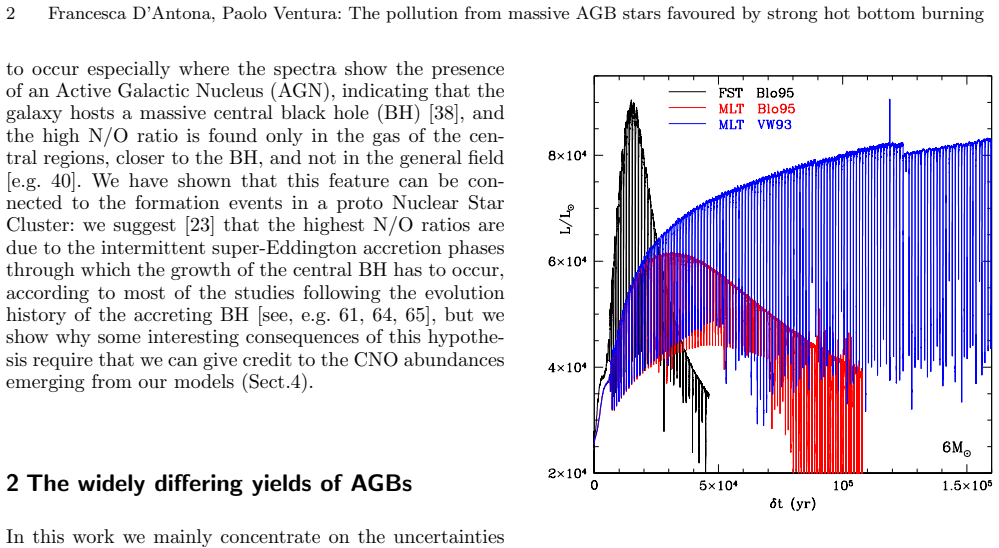
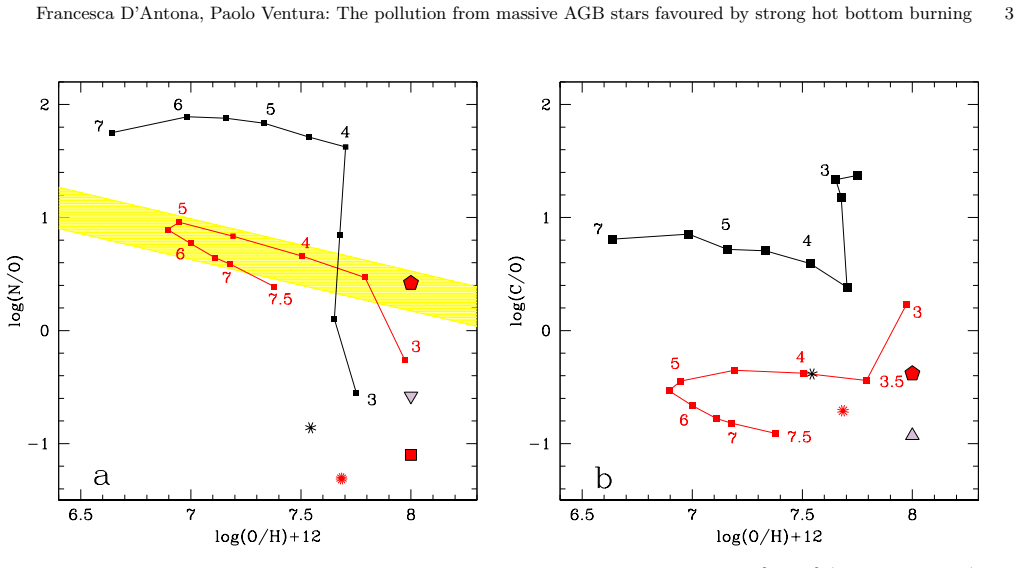
Stars of intermediate mass evolve to the stage of white dwarfs through the asymptotic giant branch stage with stationary hydrogen shell burning and helium thermal pulses, wind mass loss and planetary nebula ejection. Almost the totality of the mass lost is heavily processed by hot bottom burning, as plain convection reaches the outer edge of the H-burning shell. This phase connects to the chemical evolution of proton-capture elements, the role of AGBs in the formation of multiple populations in globular clusters, and the possible AGB role in the composition of hot gas with high N/O in some primordial galaxies.
What carries the argument
Hot bottom burning, enabled by convective mixing reaching the hydrogen-burning shell in the stellar envelope.
If this is right
- The chemical evolution of elements processed by proton captures depends on AGB model details.
- AGB stars contribute to the multiple populations seen in globular clusters through their processed ejecta.
- AGB stars may help explain high N/O ratios in the hot gas of some primordial galaxies.
Where Pith is reading between the lines
- Refining convection prescriptions in stellar models could better match observed abundance spreads.
- These AGB processes may need inclusion in chemical evolution models of galaxies at high redshift.
- Further observations of nitrogen-rich gas could test the contribution from massive AGB stars.
Load-bearing premise
The modeling of convection and mass loss in AGB stars is sufficiently accurate to connect observed chemical patterns to the physical processes in these stars.
What would settle it
Finding abundance patterns in globular cluster stars or high-redshift galaxy gas that show no evidence of the proton-capture processing expected from hot bottom burning in AGB stars.
Figures
read the original abstract
Stars of intermediate mass (~4-8Msun) evolve to the stage of white dwarfs through the asymptotic giant branch (AGB) stage: stationary hydrogen shell burning and helium thermal pulses, wind mass loss and planetary nebula ejection. Almost the totality of the mass lost (the initial mass minus the remnant white dwarf mass) is heavily processed `hot bottom burning' (HBB), as plain convection reaches the outer edge of the H-burning shell. This phase has been subject of intense investigations in the latest 25 years, in connection to three main research subjects: 1) the chemical evolution of proton-capture elements cycled in these stars, and their intrinsic uncertainties due to the uncertainty in the description of the AGB models; 2) the role of AGBs in the formation of multiple populations in globular clusters; 3) the possible AGB role in the composition of hot gas with high N/O in some primordial galaxies, particularly in those hosting a massive black holes. We here summarize some main achievements and problems in these research fields.
Editorial analysis
A structured set of objections, weighed in public.
Referee Report
Summary. The manuscript is a review summarizing the evolution of intermediate-mass stars (~4-8 M☉) through the AGB phase with stationary H-shell burning, He thermal pulses, and wind mass loss. It states that nearly all mass lost (initial mass minus white-dwarf remnant) is processed by hot bottom burning because convection reaches the outer edge of the H-burning shell. The text reviews achievements and open problems in three linked areas: (1) chemical evolution of proton-capture elements and associated model uncertainties, (2) the role of AGB stars in multiple populations within globular clusters, and (3) possible AGB contributions to high N/O gas in primordial galaxies, especially those hosting massive black holes.
Significance. As a synthesis that explicitly flags uncertainties in convection and mass-loss prescriptions, the review could usefully consolidate the literature for researchers working on stellar yields and galactic chemical evolution. Its value is limited to that of a literature overview; no new derivations, quantitative predictions, or model calculations are presented that could be tested independently of the ongoing debates already noted in the cited works.
minor comments (1)
- [Abstract] Abstract: the statement that the paper summarizes 'some main achievements and problems' is accurate but does not indicate which specific results or references will be highlighted; a sentence listing the key papers or quantitative outcomes covered would improve reader orientation.
Simulated Author's Rebuttal
We thank the referee for reviewing the manuscript and recommending minor revision. The paper is a review, as described in the abstract, and we respond below to the assessment of its significance.
read point-by-point responses
-
Referee: As a synthesis that explicitly flags uncertainties in convection and mass-loss prescriptions, the review could usefully consolidate the literature for researchers working on stellar yields and galactic chemical evolution. Its value is limited to that of a literature overview; no new derivations, quantitative predictions, or model calculations are presented that could be tested independently of the ongoing debates already noted in the cited works.
Authors: We agree that this manuscript is a literature review without new derivations, quantitative predictions or model calculations, as explicitly stated in the abstract. Its purpose is to summarize achievements and open problems across the three research areas while highlighting uncertainties in convection and mass-loss prescriptions. We believe this consolidation of the literature is useful for the community. revision: no
Circularity Check
Review paper with no new derivations; no circularity
full rationale
The manuscript is a review summarizing prior AGB/HBB modeling results and their links to observational topics. The central statements restate standard model outcomes already present in the cited literature (e.g., convective envelope reaching the H-shell during dominant mass loss), with explicit discussion of uncertainties in convection and mass-loss prescriptions. No new derivation, prediction, or quantitative result is advanced that reduces to a fitted parameter, self-citation chain, or ansatz defined within the paper. All load-bearing claims reference external work, satisfying the criteria for a self-contained review against external benchmarks.
Axiom & Free-Parameter Ledger
Reference graph
Works this paper leans on
-
[1]
MgAl burning chain inωCentauri.A&A, 681:A54, January 2024
Deimer Antonio Alvarez Garay, Alessio Mucciarelli, Michele Bellazzini, Carmela Lardo, and Paolo Ven- tura. MgAl burning chain inωCentauri.A&A, 681:A54, January 2024
2024
-
[2]
Bastian, I
N. Bastian, I. Cabrera-Ziri, B. Davies, and S. S. Larsen. Constraining globular cluster formation through studies of young massive clusters - I. A lack of ongoing star formation within young clusters.MN- RAS, 436:2852–2863, December 2013
2013
-
[3]
L. R. Bedin, G. Piotto, J. Anderson, S. Cassisi, I. R. King, Y. Momany, and G. Carraro.ωCentauri: The Population Puzzle Goes Deeper.ApJ, 605:L125–L128, April 2004
2004
-
[4]
K. Bekki. Rotation and Multiple Stellar Population in Globular Clusters.ApJ, 724:L99–L103, November 2010
2010
-
[5]
Bloecker
T. Bloecker. Stellar evolution of low and intermediate- mass stars. I. Mass loss on the AGB and its con- sequences for stellar evolution.A&A, 297:727, May 1995
1995
-
[6]
B¨ ohm-Vitense
E. B¨ ohm-Vitense. ¨Uber die Wasserstoffkonvektion- szone in Sternen verschiedener Effektivtemperaturen und Leuchtkr¨ afte. Mit 5 Textabbildungen.Zeitschrift f¨ ur Astrophysik, 46:108, January 1958
1958
-
[7]
Calura, A
F. Calura, A. D’Ercole, E. Vesperini, E. Vanzella, and A. Sollima. Formation of second-generation stars in globular clusters.MNRAS, 489(3):3269–3284, Novem- ber 2019
2019
-
[8]
A. G. W. Cameron and W. A. Fowler. Lithium and the s-PROCESS in Red-Giant Stars.ApJ, 164:111, February 1971
1971
-
[9]
Cameron, Harley Katz, Martin P
Alex J. Cameron, Harley Katz, Martin P. Rey, and Aayush Saxena. Nitrogen enhancements 440 Myr af- ter the big bang: supersolar N/O, a tidal disruption event, or a dense stellar cluster in GN-z11?MNRAS, 523(3):3516–3525, August 2023
2023
-
[10]
V. M. Canuto, I. Goldman, and I. Mazzitelli. Stellar Turbulent Convection: A Self-consistent Model.ApJ, 473:550, December 1996
1996
-
[11]
V. M. Canuto and I. Mazzitelli. Stellar turbulent convection - A new model and applications.ApJ, 370:295–311, March 1991
1991
-
[12]
Carretta, A
E. Carretta, A. Bragaglia, R. G. Gratton, F. Leone, A. Recio-Blanco, and S. Lucatello. Na-O anticorre- lation and HB. I. The Na-O anticorrelation in NGC 2808.A&A, 450:523–533, May 2006
2006
-
[13]
Carretta, S
E. Carretta, S. Lucatello, R. G. Gratton, A. Bragaglia, and V. D’Orazi. Multiple stellar populations in the globular cluster NGC 1851.A&A, 533:A69, Septem- ber 2011
2011
-
[14]
Cassisi, M
S. Cassisi, M. Salaris, A. Pietrinferni, G. Piotto, A. P. Milone, L. R. Bedin, and J. Anderson. The Double Subgiant Branch of NGC 1851: The Role of the CNO Abundance.ApJ, 672:L115–L118, January 2008
2008
-
[15]
Chantereau, C
W. Chantereau, C. Charbonnel, and T. Decressin. Evolution of long-lived globular cluster stars. I. Grid of stellar models with helium enhancement at [Fe/H] = -1.75.A&A, 578:A117, June 2015
2015
-
[16]
Chantereau, C
W. Chantereau, C. Charbonnel, and G. Meynet. Evo- lution of long-lived globular cluster stars. III. Effect of the initial helium spread on the position of stars in a synthetic Hertzsprung-Russell diagram.A&A, 592:A111, August 2016
2016
-
[17]
Charbonnel, D
C. Charbonnel, D. Schaerer, N. Prantzos, L. Ram´ ırez- Galeano, T. Fragos, A. Kuruvanthodi, R. Marques- Chaves, and M. Gieles. N-enhancement in GN-z11: First evidence for supermassive stars nucleosynthesis in proto-globular clusters-like conditions at high red- shift?A&A, 673:L7, May 2023
2023
-
[18]
Clontz, A
C. Clontz, A. C. Seth, Z. Wang, S. O. Souza, M. H¨ aberle, M. S. Nitschai, N. Neumayer, M. La- tour, A. P. Milone, A. Feldmeier-Krause, N. Kacharov, M. Libralato, A. Bellini, G. van de Ven, and M. Alfaro- Cuello. oMEGACat. V. Helium Enrichment inωCen- tauri as a Function of Metallicity.ApJ, 984(2):162, May 2025
2025
-
[19]
J. G. Cohen and E. N. Kirby. The Bizarre Chemi- cal Inventory of NGC 2419, An Extreme Outer Halo Globular Cluster.ApJ, 760:86, November 2012. 8 Francesca D’Antona, Paolo Ventura: The pollution from massive AGB stars favoured by strong hot bottom burning
2012
-
[20]
Cohen and Jorge Mel´ endez
Judith G. Cohen and Jorge Mel´ endez. Abundances in a Large Sample of Stars in M3 and M13.AJ, 129(1):303–329, January 2005
2005
-
[21]
G. S. Da Costa. Are the globular clusters with signif- icant internal [Fe/H] spreads all former dwarf galaxy nuclei?ArXiv e-prints (arXiv:1510.00873), October 2015
work page internal anchor Pith review Pith/arXiv arXiv 2015
-
[22]
D’Antona, R
F. D’Antona, R. Gratton, and A. Chieffi. CNO self- pollution in globular clusters - A model and its possi- ble observational tests.Memorie Societ` a Astronomica Italiana, 54:173–198, 1983
1983
-
[23]
D’Antona, P
F. D’Antona, P. Ventura, A. F. Marino, A. P. Milone, E. Vesperini, F. Calura, M. Tailo, R. Valiante, V. Caloi, A. D’Ercole, and F. Dell’Agli. Dating N-loud AGNs at high redshift: GS 3073 as a snapshot of aω Centauri-like evolution of a nuclear star cluster.A&A, 700:A265, August 2025
2025
-
[24]
D’Antona, E
F. D’Antona, E. Vesperini, F. Calura, P. Ventura, A. D’Ercole, V. Caloi, A. F. Marino, A. P. Milone, F. Dell’Agli, and M. Tailo. GN-z11: Witnessing the formation of second-generation stars and an accreting massive black hole in a massive star cluster.A&A, 680:L19, December 2023
2023
-
[25]
D’Antona, E
F. D’Antona, E. Vesperini, A. D’Ercole, P. Ventura, A. P. Milone, A. F. Marino, and M. Tailo. A sin- gle model for the variety of multiple-population for- mation(s) in globular clusters: a temporal sequence. MNRAS, 458:2122–2139, May 2016
2016
-
[26]
Models for the lithium abundances of multiple populations in globular clusters and the possible role of the big bang lithium.MNRAS, 426(3):1710–1719, November 2012
Francesca D’Antona, Annibale D’Ercole, Roberta Carini, Enrico Vesperini, and Paolo Ventura. Models for the lithium abundances of multiple populations in globular clusters and the possible role of the big bang lithium.MNRAS, 426(3):1710–1719, November 2012
2012
-
[27]
Milone, Marco Tailo, Marcella Di Criscienzo, and Enrico Vesperini
Francesca D’Antona, Paolo Ventura, Anna Fabiola Marino, Antonino P. Milone, Marco Tailo, Marcella Di Criscienzo, and Enrico Vesperini. The Lithium Test for Multiple Populations in Globular Clusters: Lithium in NGC 2808.ApJ, 871(1):L19, January 2019
2019
-
[28]
S. E. de Mink, O. R. Pols, N. Langer, and R. G. Izzard. Massive binaries as the source of abundance anoma- lies in globular clusters.A&A, 507:L1–L4, November 2009
2009
-
[29]
Decressin, G
T. Decressin, G. Meynet, C. Charbonnel, N. Prantzos, and S. Ekstr¨ om. Fast rotating massive stars and the origin of the abundance patterns in galactic globular clusters.A&A, 464:1029–1044, March 2007
2007
-
[30]
P. A. Denissenkov and F. D. A. Hartwick. Super- massive stars as a source of abundance anomalies of proton-capture elements in globular clusters.MN- RAS, 437:L21–L25, January 2014
2014
-
[31]
D’Ercole, F
A. D’Ercole, F. D’Antona, and E. Vesperini. Accre- tion of pristine gas and dilution during the forma- tion of multiple-population globular clusters.MN- RAS, 461:4088–4098, October 2016
2016
-
[32]
D’Ercole, E
A. D’Ercole, E. Vesperini, F. D’Antona, S. L. W. McMillan, and S. Recchi. Formation and dynamical evolution of multiple stellar generations in globular clusters.MNRAS, 391:825–843, December 2008
2008
-
[33]
Doherty, Pilar Gil-Pons, Herbert H
Carolyn L. Doherty, Pilar Gil-Pons, Herbert H. B. Lau, John C. Lattanzio, Lionel Siess, and Simon W. Campbell. Super and massive AGB stars - III. Nucle- osynthesis in metal-poor and very metal-poor stars - Z = 0.001 and 0.0001.MNRAS, 441(1):582–598, June 2014
2014
-
[34]
D’Orazi, R
V. D’Orazi, R. G. Gratton, G. C. Angelou, A. Bra- gaglia, E. Carretta, J. C. Lattanzio, S. Lucatello, Y. Momany, A. Sollima, and G. Beccari. Lithium abundances in globular cluster giants: NGC 1904, NGC 2808, and NGC 362.MNRAS, 449(4):4038– 4047, June 2015
1904
-
[35]
Fishlock, Amanda I
Cherie K. Fishlock, Amanda I. Karakas, Maria Lu- garo, and David Yong. Evolution and Nucleosynthe- sis of Asymptotic Giant Branch Stellar Models of Low Metallicity.ApJ, 797(1):44, December 2014
2014
-
[36]
Vink, and Laura Ram´ ırez-Galeano
Mark Gieles, Paolo Padoan, Corinne Charbonnel, Jorick S. Vink, and Laura Ram´ ırez-Galeano. Glob- ular cluster formation from inertial inflows: accreting extremely massive stars as the origin of abundance anomalies.MNRAS, 544(1):483–512, November 2025
2025
-
[37]
R. G. Gratton, S. Villanova, S. Lucatello, A. Sollima, D. Geisler, E. Carretta, S. Cassisi, and A. Bragaglia. Spectroscopic analysis of the two subgiant branches of the globular cluster NGC 1851.A&A, 544:A12, August 2012
2012
-
[38]
Bunker, Stefano Carniani, Emma Curtis-Lake, Zhiyuan Ji, Nimisha Kumari, Pierluigi Rinaldi, Brant Robertson, Chris Willott, and Joris Witstok
Yuki Isobe, Roberto Maiolino, Francesco D’Eugenio, Mirko Curti, Xihan Ji, Ignas Juodˇ zbalis, Jan Scholtz, Anne Feltre, St´ ephane Charlot, Hannah ¨Ubler, An- drew J. Bunker, Stefano Carniani, Emma Curtis-Lake, Zhiyuan Ji, Nimisha Kumari, Pierluigi Rinaldi, Brant Robertson, Chris Willott, and Joris Witstok. JADES: nitrogen enhancement in high-redshift bro...
2025
-
[39]
Connecting JWST discovered N/O-enhanced galaxies to globular clusters: evidence from chemical imprints.MNRAS, 545(3):staf2110, January 2026
Xihan Ji, Vasily Belokurov, Roberto Maiolino, Stephanie Monty, Yuki Isobe, Andrey Kravtsov, William McClymont, and Hannah ¨Ubler. Connecting JWST discovered N/O-enhanced galaxies to globular clusters: evidence from chemical imprints.MNRAS, 545(3):staf2110, January 2026
2026
-
[40]
Bunker, St´ ephane Charlot, Michele Perna, Bruno Rodr´ ıguez Del Pino, Torsten B¨ oker, Giovanni Cresci, Mirko Curti, Nimisha Kumari, and Isabella Lamperti
Xihan Ji, Hannah ¨Ubler, Roberto Maiolino, Francesco D’Eugenio, Santiago Arribas, Andrew J. Bunker, St´ ephane Charlot, Michele Perna, Bruno Rodr´ ıguez Del Pino, Torsten B¨ oker, Giovanni Cresci, Mirko Curti, Nimisha Kumari, and Isabella Lamperti. GA- NIFS: an extremely nitrogen-loud and chemically stratified galaxy at z 5.55.MNRAS, 535(1):881–908, November 2024
2024
-
[41]
Johnson and Catherine A
Christian I. Johnson and Catherine A. Pilachowski. Chemical Abundances for 855 Giants in the Glob- ular Cluster Omega Centauri (NGC 5139).ApJ, 722(2):1373–1410, October 2010
2010
-
[42]
Rapid Chem- ical Enrichment by Intermittent Star Formation in GN-z11.ApJ, 962(1):L6, February 2024
Chiaki Kobayashi and Andrea Ferrara. Rapid Chem- ical Enrichment by Intermittent Star Formation in GN-z11.ApJ, 962(1):L6, February 2024
2024
-
[43]
M. V. Legnardi, A. P. Milone, L. Armillotta, A. F. Marino, G. Cordoni, A. Renzini, E. Vesperini, F. D’Antona, M. McKenzie, D. Yong, E. Dondoglio, Francesca D’Antona, Paolo Ventura: The pollution from massive AGB stars favoured by strong hot bottom burning 9 E. P. Lagioia, M. Carlos, M. Tailo, S. Jang, and A. Mo- handasan. Constraining the original composi...
2022
-
[44]
Super-critical Growth of Massive Black Holes from Stellar-mass Seeds.ApJ, 784(2):L38, April 2014
Piero Madau, Francesco Haardt, and Massimo Dotti. Super-critical Growth of Massive Black Holes from Stellar-mass Seeds.ApJ, 784(2):L38, April 2014
2014
-
[45]
A. F. Marino, A. P. Milone, A. I. Karakas, L. Casagrande, D. Yong, L. Shingles, G. Da Costa, J. E. Norris, P. B. Stetson, K. Lind, M. Asplund, R. Collet, H. Jerjen, L. Sbordone, A. Aparicio, and S. Cassisi. Iron and s-elements abundance variations in NGC 5286: comparison with ‘anomalous’ globular clusters and Milky Way satellites.MNRAS, 450:815– 845, June 2015
2015
-
[46]
A. F. Marino, A. P. Milone, G. Piotto, S. Villanova, L. R. Bedin, A. Bellini, and A. Renzini. A double stellar generation in the globular cluster NGC 6656 (M 22). Two stellar groups with different iron and s-process element abundances.A&A, 505:1099–1113, October 2009
2009
-
[47]
A. F. Marino, A. P. Milone, G. Piotto, S. Villanova, R. Gratton, F. D’Antona, J. Anderson, L. R. Be- din, A. Bellini, S. Cassisi, D. Geisler, A. Renzini, and M. Zoccali. Sodium-Oxygen Anticorrelation and Neutron-capture Elements in Omega Centauri Stellar Populations.ApJ, 731:64, April 2011
2011
-
[48]
Marques-Chaves, D
R. Marques-Chaves, D. Schaerer, A. Kuruvanthodi, D. Korber, N. Prantzos, C. Charbonnel, A. Weibel, Y. I. Izotov, M. Messa, G. Brammer, M. Dessauges- Zavadsky, and P. Oesch. Extreme N-emitters at high redshift: Possible signatures of supermassive stars and globular cluster or black hole formation in action. A&A, 681:A30, January 2024
2024
-
[49]
The THESAN-ZOOM project: Mystery N/O more - uncovering the ori- gin of peculiar chemical abundances and a not-so- fundamental metallicity relation at 3 ¡ z ¡ 12.MNRAS, January 2026
William McClymont, Sandro Tacchella, Aaron Smith, Rahul Kannan, Enrico Garaldi, Ewald Puchwein, Yuki Isobe, Xihan Ji, Xuejian Shen, Zihao Wang, Vasily Belokurov, Josh Borrow, Francesco D’Eugenio, Laura Keating, Roberto Maiolino, Stephanie Monty, Mark Vogelsberger, and Oliver Zier. The THESAN-ZOOM project: Mystery N/O more - uncovering the ori- gin of pecu...
2026
-
[50]
A. P. Milone, A. F. Marino, A. Renzini, F. D’Antona, J. Anderson, B. Barbuy, L. R. Bedin, A. Bellini, T. M. Brown, S. Cassisi, G. Cordoni, E. P. Lagioia, D. Nardiello, S. Ortolani, G. Piotto, A. Sarajedini, M. Tailo, R. P. van der Marel, and E. Vesperini. The Hubble Space Telescope UV legacy survey of galac- tic globular clusters - XVI. The helium abundan...
2018
-
[51]
A. P. Milone, G. Piotto, A. Renzini, A. F. Marino, L. R. Bedin, E. Vesperini, F. D’Antona, D. Nardiello, J. Anderson, I. R. King, D. Yong, A. Bellini, A. Apari- cio, B. Barbuy, T. M. Brown, S. Cassisi, S. Ortolani, M. Salaris, A. Sarajedini, and R. P. van der Marel. The Hubble Space Telescope UV Legacy Survey of Galactic globular clusters - IX. The Atlas ...
2017
-
[52]
Multiple Chan- nels for Nitrogen Pollution by Metal-enriched Super- massive Stars and Implications for GN-z11.ApJ, 949(1):L16, May 2023
Chris Nagele and Hideyuki Umeda. Multiple Chan- nels for Nitrogen Pollution by Metal-enriched Super- massive Stars and Implications for GN-z11.ApJ, 949(1):L16, May 2023
2023
-
[53]
Regan, Tyrone E
Devesh Nandal, John A. Regan, Tyrone E. Woods, Eoin Farrell, Sylvia Ekstr¨ om, and Georges Meynet. Explaining the high nitrogen abundances observed in high-z galaxies via population III stars of a few thou- sand solar masses.A&A, 683:A156, March 2024
2024
-
[54]
Whalen, Muhammad A
Devesh Nandal, Daniel J. Whalen, Muhammad A. Latif, and Alexander Heger. 1000-10,000 M ⊙ Primor- dial Stars Created the Nitrogen Excess in GS 3073 at z = 5.55.ApJ, 994(1):L11, November 2025
2025
-
[55]
J. Norris. The cyanogen distribution of M4 and the possible connection between horizontal branch mor- phology and chemical inhomogeneity.ApJ, 248:177– 188, August 1981
1981
-
[56]
J. E. Norris. The Helium Abundances ofωCentauri. ApJ, 612:L25–L28, September 2004
2004
-
[57]
Piotto, L
G. Piotto, L. R. Bedin, J. Anderson, I. R. King, S. Cassisi, A. P. Milone, S. Villanova, A. Pietrinferni, and A. Renzini. A Triple Main Sequence in the Globu- lar Cluster NGC 2808.ApJ, 661:L53–L56, May 2007
2007
-
[58]
Piotto, S
G. Piotto, S. Villanova, L. R. Bedin, R. Gratton, S. Cassisi, Y. Momany, A. Recio-Blanco, S. Lucatello, J. Anderson, I. R. King, A. Pietrinferni, and G. Car- raro. Metallicities on the Double Main Sequence of ωCentauri Imply Large Helium Enhancement.ApJ, 621:777–784, March 2005
2005
-
[59]
Renzini, F
A. Renzini, F. D’Antona, S. Cassisi, I. R. King, A. P. Milone, P. Ventura, J. Anderson, L. R. Be- din, A. Bellini, T. M. Brown, G. Piotto, R. P. van der Marel, B. Barbuy, E. Dalessandro, S. Hidalgo, A. F. Marino, S. Ortolani, M. Salaris, and A. Saraje- dini. The Hubble Space TelescopeUV Legacy Survey of Galactic Globular Clusters - V. Constraints on for- ...
2015
-
[60]
Rizzuti, F
F. Rizzuti, F. Matteucci, P. Molaro, G. Cescutti, and R. Maiolino. High N/O ratio at high redshift as a re- sult of a strong burst of star formation and differential galactic winds.A&A, 697:A96, May 2025
2025
-
[61]
Are we surprised to find SMBHs with JWST at z≥9?MNRAS, 526(3):3250–3261, December 2023
Raffaella Schneider, Rosa Valiante, Alessandro Trinca, Luca Graziani, Marta Volonteri, and Roberto Maiolino. Are we surprised to find SMBHs with JWST at z≥9?MNRAS, 526(3):3250–3261, December 2023
2023
-
[62]
Stark, Gwen C
Peter Senchyna, Adele Plat, Daniel P. Stark, Gwen C. Rudie, Danielle Berg, St´ ephane Charlot, Bethan L. James, and Matilde Mingozzi. GN-z11 in Context: Possible Signatures of Globular Cluster Precursors at Redshift 10.ApJ, 966(1):92, May 2024
2024
-
[63]
L. Siess. Evolution of massive AGB stars. III. the thermally pulsing super-AGB phase.A&A, 512:A10, March 2010
2010
-
[64]
Seeking the growth of the first black hole seeds with JWST.MNRAS, 519(3):4753–4764, March 2023
Alessandro Trinca, Raffaella Schneider, Roberto Maiolino, Rosa Valiante, Luca Graziani, and Marta 10 Francesca D’Antona, Paolo Ventura: The pollution from massive AGB stars favoured by strong hot bottom burning Volonteri. Seeking the growth of the first black hole seeds with JWST.MNRAS, 519(3):4753–4764, March 2023
2023
-
[65]
Alessandro Trinca, Rosa Valiante, Raffaella Schneider, Ignas Juodˇ zbalis, Roberto Maiolino, Luca Graziani, Alessandro Lupi, Priyamvada Natarajan, Marta Volonteri, and Tommaso Zana. Episodic super- Eddington accretion as a clue to Overmassive Black Holes in the early Universe.A&A, submitted, page arXiv:2412.14248, December 2024
-
[66]
P´ erez-Gonz´ alez, Mirko Curti, Michele Perna, Santiago Arribas, St´ ephane Charlot, Madeline A
Hannah ¨Ubler, Roberto Maiolino, Emma Curtis-Lake, Pablo G. P´ erez-Gonz´ alez, Mirko Curti, Michele Perna, Santiago Arribas, St´ ephane Charlot, Madeline A. Marshall, Francesco D’Eugenio, Jan Scholtz, Andrew Bunker, Stefano Carniani, Pierre Ferruit, Peter Jakob- sen, Hans-Walter Rix, Bruno Rodr´ ıguez Del Pino, Chris J. Willott, Torsten Boeker, Giovanni ...
2023
-
[67]
Vassiliadis and P
E. Vassiliadis and P. R. Wood. Evolution of Low- and Intermediate-Mass Stars to the End of the Asymptotic Giant Branch with Mass Loss.ApJ, 413:641, August 1993
1993
-
[68]
Ventura, V
P. Ventura, V. Caloi, F. D’Antona, J. Ferguson, A. Milone, and G. P. Piotto. The C+N+O abun- dances and the splitting of the subgiant branch in the globular cluster NGC 1851.MNRAS, 399:934–943, October 2009
2009
-
[69]
Ventura and F
P. Ventura and F. D’Antona. Full computation of massive AGB evolution. I. The large impact of convec- tion on nucleosynthesis.A&A, 431:279–288, February 2005
2005
-
[70]
Ventura and F
P. Ventura and F. D’Antona. Full computation of massive AGB evolution. II. The role of mass loss and cross-sections.A&A, 439:1075–1091, September 2005
2005
-
[71]
Ventura, F
P. Ventura, F. D’Antona, G. Imbriani, M. Di Cri- scienzo, F. Dell’Agli, and M. Tailo. Magnesium iso- topes: a tool to understand self-enrichment in globular clusters.MNRAS, 477(1):438–449, June 2018
2018
-
[72]
Ventura, F
P. Ventura, F. D’Antona, I. Mazzitelli, and R. Grat- ton. Predictions for Self-Pollution in Globular Cluster Stars.ApJ, 550:L65–L69, March 2001
2001
-
[73]
Ventura, M
P. Ventura, M. Di Criscienzo, R. Carini, and F. D’Antona. Yields of AGB and SAGB models with chemistry of low- and high-metallicity globular clus- ters.MNRAS, 431(4):3642–3653, June 2013
2013
-
[74]
Ventura, D
P. Ventura, D. A. Garc´ ıa-Hern´ andez, F. Dell’Agli, F. D’Antona, Sz. M´ esz´ aros, S. Lucatello, M. Di Cri- scienzo, M. Shetrone, M. Tailo, Baitian Tang, and O. Zamora. Evidence of AGB Pollution in Galac- tic Globular Clusters from the Mg-Al Anticorrelations Observed by the APOGEE Survey.ApJ, 831(2):L17, November 2016
2016
-
[75]
The Helium contribution from mas- sive AGBs
Paolo Ventura. The Helium contribution from mas- sive AGBs. In Corinne Charbonnel, Monica Tosi, Francesca Primas, and Cristina Chiappini, editors, Light Elements in the Universe, volume 268, pages 147–152, April 2010
2010
-
[76]
Vincenzo, F
F. Vincenzo, F. Belfiore, R. Maiolino, F. Matteucci, and P. Ventura. Nitrogen and oxygen abundances in the Local Universe.MNRAS, 458(4):3466–3477, June 2016
2016
-
[77]
Jorick S. Vink. Very massive stars and nitrogen- emitting galaxies.A&A, 679:L9, November 2023
2023
-
[78]
The Case for Supercritical Accretion onto Massive Black Holes at High Redshift.ApJ, 804(2):148, May 2015
Marta Volonteri, Joseph Silk, and Guillaume Dubus. The Case for Supercritical Accretion onto Massive Black Holes at High Redshift.ApJ, 804(2):148, May 2015
2015
-
[79]
D. Yong, I. U. Roederer, F. Grundahl, G. S. Da Costa, A. I. Karakas, J. E. Norris, W. Aoki, C. K. Fishlock, A. F. Marino, A. P. Milone, and L. J. Shingles
discussion (0)
Sign in with ORCID, Apple, or X to comment. Anyone can read and Pith papers without signing in.