Flow loops and quantum groups
Pith reviewed 2026-05-21 02:56 UTC · model grok-4.3
The pith
Counting Morse flow loops in fibered knot complements defines a two-variable series that matches the BPS q-series from quantum groups for braid-homogeneous knots.
A machine-rendered reading of the paper's core claim, the machinery that carries it, and where it could break.
Core claim
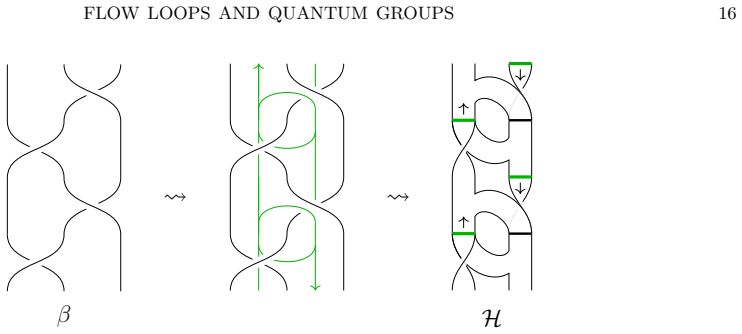
For fibered knots we define a two-variable series invariant by counting Morse flow loops in the complement; this dynamical series is conjectured to agree with the BPS q-series of the knot complement, and the correspondence is proved for all braid-homogeneous knots.
What carries the argument
Morse flow loops counted in the knot complement, generating the two-variable dynamical series that is compared to the BPS q-series.
If this is right
- All colored Jones polynomials of braid-homogeneous fibered knots become computable via enumeration of flow loops.
- The dynamical series supplies a geometric model for the algebraic data carried by Verma modules over quantum groups.
- The proof technique for braid-homogeneous knots may extend to larger classes once suitable flow-counting rules are refined.
- Agreement between the two series implies that quantum invariants of these knots admit a direct interpretation in terms of gradient flows on the complement.
Where Pith is reading between the lines
- If the conjecture holds in full generality, flow dynamics would furnish a new computational route to quantum knot invariants beyond the braid-homogeneous case.
- The correspondence suggests that representation-theoretic data of quantum groups may be recoverable from topological dynamics on three-manifolds.
- Similar loop-counting constructions could be tested on other classes of fibered manifolds to see whether BPS-type series appear more broadly.
Load-bearing premise
The counting procedure for Morse flow loops in the knot complement produces a well-defined two-variable series that can be directly compared to the BPS q-series constructed from Verma modules over quantum groups.
What would settle it
An explicit computation for any braid-homogeneous fibered knot in which the series obtained from flow-loop counts differs from the known BPS q-series.
Figures




read the original abstract
This paper connects two seemingly different ways of studying knots: quantum group invariants and the dynamics of Morse flows. For fibered knots, we define a two-variable series invariant by counting Morse flow loops in the complement. This dynamical series is conjectured to agree with the BPS $q$-series of the knot complement, which arises from Verma modules for quantum groups and encodes all colored Jones polynomials. We prove this correspondence for all braid-homogeneous knots.
Editorial analysis
A structured set of objections, weighed in public.
Referee Report
Summary. The manuscript connects quantum group invariants with dynamical systems by defining, for fibered knots, a two-variable series obtained by counting Morse flow loops in the knot complement. This dynamical series is conjectured to coincide with the BPS q-series of the knot complement (constructed from Verma modules over quantum groups and encoding the colored Jones polynomials). The authors prove the conjectured equality for the subclass of all braid-homogeneous knots.
Significance. If the correspondence holds in general, the work supplies a dynamical-systems interpretation of BPS invariants and a new route to their computation. The explicit proof for braid-homogeneous knots is a concrete, verifiable achievement that demonstrates the viability of the counting construction and strengthens the link between Morse theory on knot complements and representations of quantum groups.
major comments (1)
- [§3] §3 (Definition of the flow-loop series): the manuscript must supply a complete argument that the two-variable generating function is independent of the auxiliary choices of Morse function and Riemannian metric; without an explicit invariance proof or a reference to a standard result that applies verbatim in the knot-complement setting, the claim that the series is a well-defined knot invariant remains incomplete.
minor comments (2)
- [Abstract] The abstract and introduction should state more explicitly that the equality is proved only for braid-homogeneous knots while the general fibered case remains a conjecture.
- [§2] Notation for the two-variable series (e.g., the precise grading variables and the range of summation) should be introduced once and used consistently throughout the text.
Simulated Author's Rebuttal
We thank the referee for the careful reading of the manuscript and for the positive assessment of its significance in linking dynamical systems with quantum group invariants. We address the major comment below and will incorporate the requested clarification in the revised version.
read point-by-point responses
-
Referee: [§3] §3 (Definition of the flow-loop series): the manuscript must supply a complete argument that the two-variable generating function is independent of the auxiliary choices of Morse function and Riemannian metric; without an explicit invariance proof or a reference to a standard result that applies verbatim in the knot-complement setting, the claim that the series is a well-defined knot invariant remains incomplete.
Authors: We agree that the current draft does not contain a fully explicit invariance argument for the two-variable generating function under changes of the Morse function and Riemannian metric. In the revised manuscript we will insert a self-contained subsection immediately after the definition in §3. The argument proceeds by considering generic one-parameter families of Morse functions and metrics on the knot complement; critical-point births, deaths, and handle slides are analyzed using the fibered structure to show that flow loops appear or disappear in canceling pairs, leaving the weighted count unchanged. This establishes independence directly in the knot-complement setting without relying on an external reference. We thank the referee for identifying this omission. revision: yes
Circularity Check
No significant circularity detected
full rationale
The paper defines the two-variable dynamical series independently by counting Morse flow loops in the knot complement for fibered knots, prior to any comparison with the BPS q-series. The conjecture of agreement with the quantum-group construction and the explicit proof for braid-homogeneous knots rest on this separate counting procedure and standard dynamical-systems techniques; no load-bearing step reduces by definition, fitting, or self-citation chain to the target invariant itself. The construction is therefore self-contained against external benchmarks.
Axiom & Free-Parameter Ledger
axioms (2)
- domain assumption Morse flows on the knot complement admit a well-defined notion of closed loops that can be counted to produce a two-variable series
- standard math The BPS q-series is constructed from Verma modules for quantum groups and encodes colored Jones polynomials
invented entities (1)
-
Morse flow loop series
no independent evidence
Lean theorems connected to this paper
-
IndisputableMonolith/Cost/FunctionalEquation.leanwashburn_uniqueness_aczel unclear?
unclearRelation between the paper passage and the cited Recognition theorem.
We define a two-variable series invariant by counting Morse flow loops in the complement... state sum on knot holders... q-binomial coefficients
-
IndisputableMonolith/Foundation/AlexanderDuality.leanalexander_duality_circle_linking unclear?
unclearRelation between the paper passage and the cited Recognition theorem.
ζ_{S³∖K} = (1−x)/Δ_K(x) from flow-loop product; GL1-skein deformation to Φ
What do these tags mean?
- matches
- The paper's claim is directly supported by a theorem in the formal canon.
- supports
- The theorem supports part of the paper's argument, but the paper may add assumptions or extra steps.
- extends
- The paper goes beyond the formal theorem; the theorem is a base layer rather than the whole result.
- uses
- The paper appears to rely on the theorem as machinery.
- contradicts
- The paper's claim conflicts with a theorem or certificate in the canon.
- unclear
- Pith found a possible connection, but the passage is too broad, indirect, or ambiguous to say the theorem truly supports the claim.
Reference graph
Works this paper leans on
-
[1]
Jones, Vaughan F. R. , TITLE =. Bull. Amer. Math. Soc. (N.S.) , FJOURNAL =. 1985 , NUMBER =. doi:10.1090/S0273-0979-1985-15304-2 , URL =
-
[2]
Reshetikhin, N. Yu. and Turaev, V. G. , TITLE =. Comm. Math. Phys. , FJOURNAL =. 1990 , NUMBER =
work page 1990
-
[3]
The Mathematical Heritage of Hermann Weyl , editor =
Atiyah, Michael , title =. The Mathematical Heritage of Hermann Weyl , editor =. 1988 , note =
work page 1988
-
[4]
Witten, Edward , TITLE =. Comm. Math. Phys. , FJOURNAL =. 1989 , NUMBER =
work page 1989
-
[5]
Witten, Edward , TITLE =. Quantum Topol. , FJOURNAL =. 2012 , NUMBER =. doi:10.4171/QT/26 , URL =
-
[6]
Chern-Simons factorization algebras and knot polynomials , author=. 2026 , eprint=
work page 2026
-
[7]
Reshetikhin, N. and Turaev, V. G. , TITLE =. Invent. Math. , FJOURNAL =. 1991 , NUMBER =. doi:10.1007/BF01239527 , URL =
-
[8]
Christopher Bishop.Pattern Recognition and Machine Learning
Lorenz, Edward N. , TITLE =. J. Atmospheric Sci. , FJOURNAL =. 1963 , NUMBER =. doi:10.1175/1520-0469(1963)020<0130:DNF>2.0.CO;2 , URL =
- [9]
- [10]
-
[11]
Park, Sunghyuk , TITLE =. J. Knot Theory Ramifications , FJOURNAL =. 2020 , NUMBER =. doi:10.1142/S0218216520500972 , URL =
-
[12]
Inverted state sums, inverted Habiro series, and indefinite theta functions , author=. 2021 , eprint=
work page 2021
- [13]
-
[14]
Ekholm, Tobias and Gruen, Angus and Gukov, Sergei and Kucharski, Piotr and Park, Sunghyuk and Su kowski, Piotr , TITLE =. Comm. Math. Phys. , FJOURNAL =. 2022 , NUMBER =. doi:10.1007/s00220-022-04469-9 , URL =
- [15]
-
[16]
Neitzke, Andrew and Yan, Fei , TITLE =. J. High Energy Phys. , FJOURNAL =. 2020 , NUMBER =. doi:10.1007/jhep09(2020)153 , URL =
-
[17]
Hutchings, Michael and Lee, Yi-Jen , TITLE =. Geom. Topol. , FJOURNAL =. 1999 , PAGES =. doi:10.2140/gt.1999.3.369 , URL =
-
[18]
Hutchings, Michael , TITLE =. Forum Math. , FJOURNAL =. 2002 , NUMBER =. doi:10.1515/form.2002.010 , URL =
-
[19]
Birman, Joan S. and Williams, R. F. , TITLE =. Topology , FJOURNAL =. 1983 , NUMBER =. doi:10.1016/0040-9383(83)90045-9 , URL =
-
[20]
Birman, Joan S. and Williams, R. F. , TITLE =. Low-dimensional topology (. 1983 , ISBN =. doi:10.1090/conm/020/718132 , URL =
-
[21]
Ghrist, Robert W. and Holmes, Philip J. and Sullivan, Michael C. , TITLE =. 1997 , PAGES =. doi:10.1007/BFb0093387 , URL =
-
[22]
Ghrist, Robert W. , TITLE =. Topology , FJOURNAL =. 1997 , NUMBER =. doi:10.1016/0040-9383(96)00006-7 , URL =
- [23]
-
[24]
Ooguri, Hirosi and Vafa, Cumrun , TITLE =. Nuclear Phys. B , FJOURNAL =. 2000 , NUMBER =. doi:10.1016/S0550-3213(00)00118-8 , URL =
- [25]
-
[26]
Gukov, Sergei and Manolescu, Ciprian , TITLE =. Quantum Topol. , FJOURNAL =. 2021 , NUMBER =. doi:10.4171/qt/145 , URL =
-
[27]
Ekholm, Tobias , TITLE =. Geom. Topol. , FJOURNAL =. 2007 , PAGES =. doi:10.2140/gt.2007.11.1083 , URL =
-
[28]
Diogo, Lu\'is and Ekholm, Tobias , TITLE =. J. Differential Geom. , FJOURNAL =. 2025 , NUMBER =. doi:10.4310/jdg/1740136104 , URL =
- [29]
-
[30]
Rozansky, L. , TITLE =. Adv. Math. , FJOURNAL =. 1998 , NUMBER =. doi:10.1006/aima.1997.1661 , URL =
-
[31]
A contribution of a U(1)-reducible connection to quantum invariants of links I: R-matrix and Burau representation , author=. 1999 , eprint=
work page 1999
-
[32]
Gukov, Sergei and Putrov, Pavel and Vafa, Cumrun , TITLE =. J. High Energy Phys. , FJOURNAL =. 2017 , NUMBER =. doi:10.1007/JHEP07(2017)071 , URL =
-
[33]
Gukov, Sergei and Pei, Du and Putrov, Pavel and Vafa, Cumrun , TITLE =. J. Knot Theory Ramifications , FJOURNAL =. 2020 , NUMBER =. doi:10.1142/S0218216520400039 , URL =
-
[34]
Towards a symplectic Khovanov homology for links in fibered 3 -manifolds , author=. 2025 , eprint=
work page 2025
-
[35]
Khovanov, Mikhail , TITLE =. Duke Math. J. , FJOURNAL =. 2000 , NUMBER =. doi:10.1215/S0012-7094-00-10131-7 , URL =
-
[36]
Asaeda, Marta M. and Przytycki, J\'ozef H. and Sikora, Adam S. , TITLE =. Algebr. Geom. Topol. , FJOURNAL =. 2004 , PAGES =. doi:10.2140/agt.2004.4.1177 , URL =
-
[37]
Baader, Sebastian and Graf, Christian , TITLE =. Expo. Math. , FJOURNAL =. 2016 , NUMBER =. doi:10.1016/j.exmath.2016.06.006 , URL =
-
[38]
Rudolph, Lee , TITLE =. Comment. Math. Helv. , FJOURNAL =. 1983 , NUMBER =. doi:10.1007/BF02564622 , URL =
-
[39]
Rudolph, Lee , TITLE =. Comment. Math. Helv. , FJOURNAL =. 1987 , NUMBER =. doi:10.1007/BF02564467 , URL =
-
[40]
Proceedings of Symposia in Pure Mathematics , volume=
Constructions of fibred knots and links , author=. Proceedings of Symposia in Pure Mathematics , volume=. 1978 , organization=
work page 1978
-
[41]
Lawrence, R. J. , TITLE =. Comm. Math. Phys. , FJOURNAL =. 1990 , NUMBER =
work page 1990
-
[42]
Colored version for Lawrence representations
Jules Martel , year=. Colored version for Lawrence representations. 2004.00977 , archivePrefix=
-
[43]
Ito, Tetsuya , TITLE =. Trans. Amer. Math. Soc. , FJOURNAL =. 2019 , NUMBER =. doi:10.1090/tran/7515 , URL =
-
[44]
Ito, Tetsuya , TITLE =. Comm. Math. Phys. , FJOURNAL =. 2015 , NUMBER =. doi:10.1007/s00220-014-2249-9 , URL =
-
[45]
Configuration spaces , SERIES =
Kohno, Toshitake , TITLE =. Configuration spaces , SERIES =. 2012 , ISBN =. doi:10.1007/978-88-7642-431-1\_16 , URL =
-
[46]
Eliashberg, Y. and Givental, A. and Hofer, H. , TITLE =. Geom. Funct. Anal. , FJOURNAL =. 2000 , PAGES =. doi:10.1007/978-3-0346-0425-3\_4 , URL =
-
[47]
Foata, Dominique and Zeilberger, Doron , TITLE =. Trans. Amer. Math. Soc. , FJOURNAL =. 1999 , NUMBER =. doi:10.1090/S0002-9947-99-02234-5 , URL =
-
[48]
Knots, braids, and mapping class groups---papers dedicated to
Lin, Xiao-Song and Wang, Zhenghan , TITLE =. Knots, braids, and mapping class groups---papers dedicated to. 2001 , ISBN =. doi:10.1090/amsip/024/09 , URL =
discussion (0)
Sign in with ORCID, Apple, or X to comment. Anyone can read and Pith papers without signing in.