REVIEW 3 major objections 5 minor 86 references
2D-Galactic chemical evolution: the role of the spiral density wave
T0 review · 3 major / 5 minor · reviewed 2026-08-14 · deepseek-v4-flash
Pith's one-line read Spiral arms leave a weak chemical imprint on disc galaxies, so the arm–interarm abundance contrasts observed in NGC 6754 imply the arms were born only 1–2 Gyr before the observations.
desk verdict A useful 2D chemical evolution prototype whose negative result (old spiral waves leave small abundance signatures) holds, but whose arm-age inference from NGC 6754 is undermined by post hoc time/angle matching and the absence of advection. read the letter →
The pith
A machine-rendered reading of the paper's core claim, the machinery that carries it, and where it could break.
The reading
What carries the argument
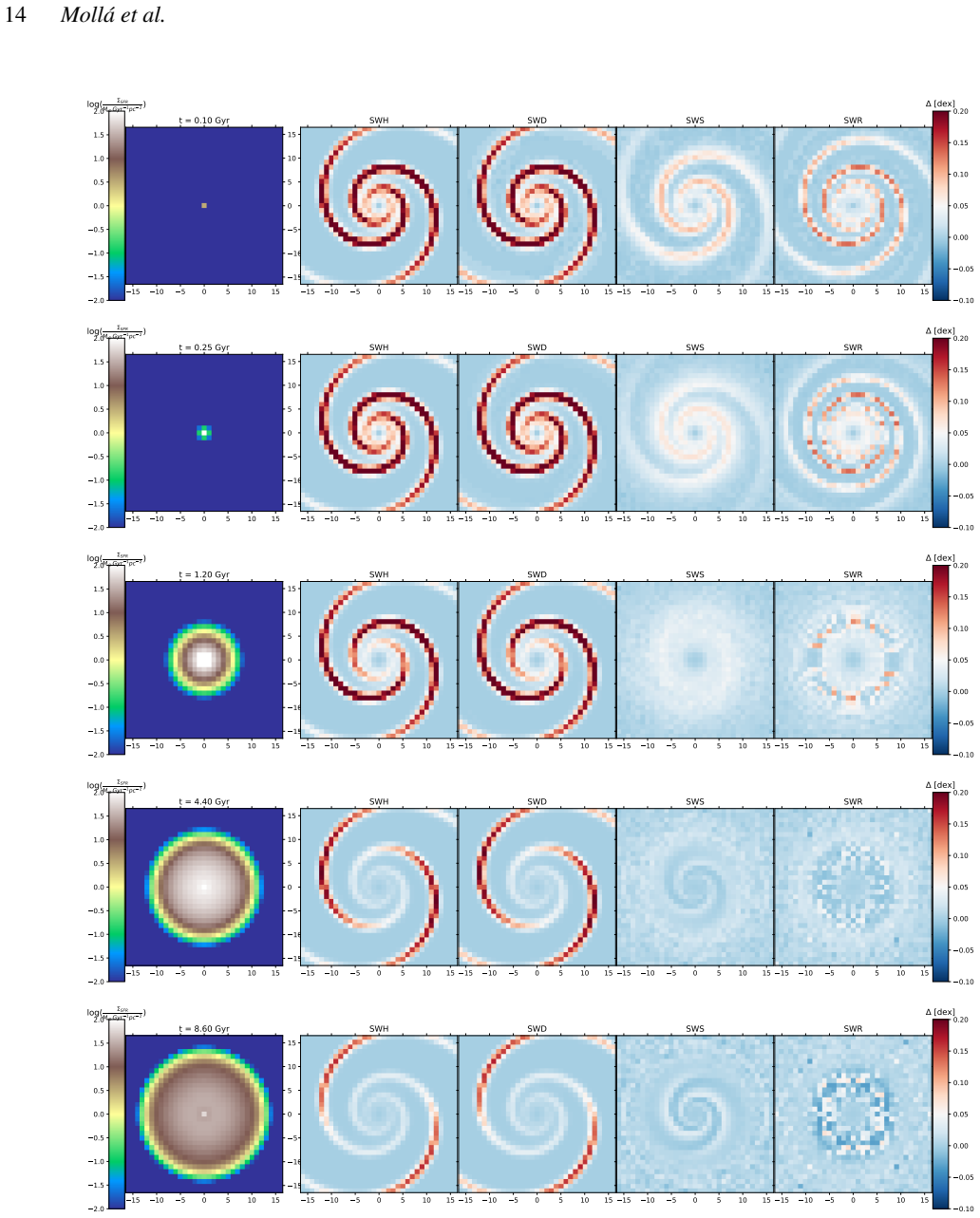
The central object is the spiral-wave surface-density perturbation used throughout: $\Sigma_{\rm sw}(R,\theta,t) = \Sigma_{\rm so}\, e^{-(R^2/\sigma^2)[1-\cos(m\phi(t)-f_m(R))]}$, with $\Sigma_{\rm so} = (\zeta_0 m / 2\pi G)\,(R^2/\sigma^2)\,|\tan i|\,e^{-\varepsilon_s R}$ and shape function $f_m(R) = (m/\tan i)\ln(R/R_i)+\gamma$, evaluated in a frame rotating at $\Omega_p$. This perturbation is added to the halo (model SWH), to the disc (SWD), or to the disc with the wave rotating at $\Omega_p$ (SWS) and with the additional disc rotation $\Omega_p-\Omega$ (SWR), driving star formation through the gas surface density in the multiphase chemical evolution code. The mechanism that carries the argument is the competition between the over-density's boost to star formation and the rotational mixing that homogenises the interstellar medium; the net effect is that the abundance signal is strong only early, so the observable arm–interarm contrast becomes a clock for the arm's age.
What would settle it
Measure azimuthal oxygen abundances with integral-field data in a galaxy whose spiral arms have been independently dated by stellar kinematics or stellar population ages to be older than 2 Gyr; if arm–interarm contrasts of order 0.1 dex are still present, the paper's claim that such contrasts require young arms is contradicted.
Extended reading notes
Core claim
The central discovery is that in a two-dimensional multiphase chemical evolution model of a Milky Way-type disc, a spiral density wave acting as a rigidly rotating surface-density overdensity leaves only a faint chemical imprint: averaged present-day differences in 12+log(O/H) between models with and without the wave are about 0.006 dex, with local residuals up to about 0.1 dex only in the outermost disc, and the azimuthal pattern is erased within a few gigayears by the wave's rotation. The imprint is strongest early: already near t ≈ 1–2 Gyr the arm–interarm oxygen contrast reaches the 0.1 dex level seen in integral-field observations of NGC 6754, after which it decays below detectability. The authors conclude that the existence of measurable arm–interarm abundance differences implies the spiral arm must have formed only 1–2 Gyr before the observations, so spiral density waves in discs are probably recurrent, regenerating on roughly that timescale.
Load-bearing premise
The model fixes the spiral wave as a rigidly rotating, prescribed surface-density overdensity that is added to the gas with no flow of material between the 1 kpc cells, so if real spiral arms drive radial gas flows, the dilution of abundance contrasts and the inferred arm age of 1–2 Gyr could be substantially different.
Editorial extensions
If this is right
- Present-day oxygen abundance maps of a Milky Way-like galaxy should show no more than about 0.03 dex average arm–interarm contrast, so detections of larger contrasts are best interpreted as evidence of a young spiral wave rather than a permanent structure.
- The star formation rate responds more strongly than abundance: the rotating-wave models predict a roughly 0.2 dex SFR enhancement in a ring near R ≈ 5 kpc, which should be visible in Hα maps even when abundance differences are not.
- At the co-rotation radius (about 8 kpc in the SWR model) the wave's time dependence vanishes, making that ring a natural null test for spiral-wave chemical effects.
- The observed NGC 6754 azimuthal oxygen pattern is matched only at t ≤ 2 Gyr, supporting the interpretation that the spiral wave in that galaxy is young; extending this comparison to more integral-field galaxies offers a way to measure arm ages statistically.
Reading between the lines
- If future integral-field surveys find arm–interarm abundance contrasts in galaxies whose arms are demonstrably older than 2 Gyr, the model's assumption that mixing is purely due to rigid wave rotation would need to be relaxed, for example by adding radial gas flows, which would likely change the dilution timescale.
- The same framework could be applied to element ratios such as Fe/O that respond on different timescales than O/H; because supernova iron enrichment lags oxygen production, Fe/O might retain an arm–interarm signal longer than O/H and provide a separate clock for arm age.
- A testable extension: compare the predicted Hα map of the rotating-wave model with integral-field emission-line maps of nearby grand-design spirals; if the 5 kpc SFR ring is absent, the pattern speed or the way the wave feeds star formation would need revision.
- The paper's predicted sign flip in log(N/O) across the arm in the outer disc is a specific signature that targeted observations of outer-disc H II regions could verify; if absent, the fixed-wave prescription is likely at fault.
Signed reviews
Editorial analysis
A structured set of objections, weighed in public.
Referee Report
Summary. The paper extends the MulChem one-dimensional chemical evolution code to a two-dimensional Cartesian grid and studies how a prescribed spiral density-wave perturbation affects star formation and elemental abundances in a Milky Way-type galaxy. Five models are computed: an azimuthally symmetric reference model (AZ) and four spiral-wave models (SWH, SWD, SWS, SWR), which differ in whether the wave is added to the halo or disc, whether it rotates, and whether disc rotation is included. The main results are that the spiral wave leaves only small (≲0.03 dex) present-day signatures in oxygen abundance, that differences with respect to the AZ model are stronger at early times, and that rotating-wave models erase azimuthal contrasts within a few Gyr. The paper then compares model oxygen residuals with VLT/MUSE observations of NGC 6754 from Sánchez-Menguiano et al. (2016), finding that early-time (t ≈ 2 Gyr) model results for the non-rotating models SWH and SWD resemble the observed arm-interarm pattern, and concludes that observed arm-interarm abundance differences imply spiral arms are young, about 1–2 Gyr old.
Significance. The construction of a 2D chemical evolution framework with an explicit spiral-wave perturbation is a useful step toward interpreting integral-field observations, and the systematic comparison of five model variants is clearly laid out. The paper's strongest asset is its demonstration, within the adopted framework, that azimuthal abundance contrasts are diluted on Gyr timescales, and the explicit statement that such contrasts, if observed, would constrain the arm's recent history. The comparison with the contemporaneous work of Spitoni et al. (2019) is also valuable. However, the central observational inference about arm age is weakened by post hoc time and angle selection and by the absence of gas advection; these issues make the claimed 1–2 Gyr arm age a conditional statement rather than a robust diagnostic.
major comments (3)
- [Section 3.2, Figure 12, and Conclusions (v)] The central claim that observed arm-interarm abundance differences imply a spiral arm lifetime of 1–2 Gyr rests on a comparison in which the model time is chosen as t = 2 Gyr after inspecting the data and the azimuthal angle is shifted by an arbitrary constant in each panel. The manuscript states 'we have moved the angle of observations by a given constant quantity in each panel', but no criterion is given for selecting t = 2 Gyr, and no measure of agreement is reported. As presented, this is a demonstration that some early-time model snapshot can resemble the data, not a test of the age hypothesis. The authors should either define a quantitative goodness-of-fit and scan over model time and angle, or explicitly reframe the comparison as illustrative rather than inferential.
- [Section 2.6, Eqs. (20)–(21)] The model contains no advection: the spiral perturbation is added as a local source term to dgD/dt in each 1 kpc cell, so gas and metals never move between cells. The dilution of the arm-interarm abundance contrast with time is therefore the time-averaging of a rotating pattern over isolated cells, not dynamical mixing. The paper acknowledges radial flows as future work in the introduction's phase (iii), but the age inference in Conclusions (v) depends directly on the dilution rate. The authors should state explicitly that the 1–2 Gyr estimate is conditional on negligible radial gas flows and shear, and ideally test the sensitivity of the dilution time to a simple mixing prescription.
- [Section 2.5, Table 2, and Figure 12] The spiral amplitude ζ0 is fixed once from Junqueira et al. (2013) and is never varied, while the model's present-day oxygen residuals in the inner disc are only ~0.03 dex compared with the observed NGC 6754 residuals of ~0.1 dex. A spiral wave with a factor of two or three larger density contrast could plausibly maintain the observed contrast for a substantially older arm, so the inferred 1–2 Gyr arm age is degenerate with the assumed wave strength. A sensitivity test varying ζ0 (or the resulting arm-interarm gas density contrast) is needed before the age claim can be considered robust.
minor comments (5)
- [Section 2.6, last paragraph] The sentence 'in the last two models including rotation (SWS and SWD)' should refer to '(SWS and SWR)', since SWD is defined earlier as a non-rotating model.
- [Section 3.2, Figure 12 caption] The caption says the observed angles are moved by 'a given constant quantity in each panel' but does not list the values; please state the shifts and whether the shift was applied to the data or to the model.
- [Section 3.2, text near Figure 12] The phrase 't is still impossible to reproduce these data' appears to be a typo; it should read 'it is still impossible'.
- [Section 4, Conclusions (v)] The phrase 'if abundance differences arm–interarm there exist' is ungrammatical; consider 'if arm–interarm abundance differences exist'.
- [Eq. (22)] The summation in Eq. (22) is written as ∑i=NTi, which is missing a lower limit; it should be ∑i=1NT.
Circularity Check
Post hoc time and angle matching makes the 1–2 Gyr arm-age inference a fitted conclusion rather than an out-of-sample prediction.
-
fitted input called prediction
[Section 3.2, Figure 12; abstract; conclusion item (v)]
"For this reason, we have moved the angle of observations by a given constant quantity in each panel. Nevertheless, t is still impossible to reproduce these data with our model abundances for the present time. Therefore, ... we have used the abundances at an alternative time, t = 2.00 Gyr ... Our results are then in better agreement with the shape of the observations found in NGC 6754. The predicted azimuthal oxygen abundance patterns for t ≤ 2 Gyr are in reasonable agreement with recent observations obtained with VLT/MUSE for NGC 6754."
The abstract labels the t≤2 Gyr maps as 'predicted' agreement, but the text shows that both the epoch t=2.00 Gyr and a constant angular shift were chosen after inspecting the NGC 6754 residuals, precisely because the present-time model could not reproduce them. Conclusion item (v) then converts this selected epoch into the paper's central physical inference: observed arm–interarm abundance differences imply the spiral arm formed only 1–2 Gyr before observation. The 1–2 Gyr number is therefore the adjusted input epoch reframed as an output age, rather than an independent prediction. The underlying dilution trend is a genuine model outcome, but the specific age claim reduces to an in-sample fit.
full rationale
The paper is not circular in a self-definitional sense: the spiral-wave surface-density formula is taken from the external JUN13 prescription, and the MULCHEM calibration in Mollá et al. (2015, 2017, 2019) is a normal self-citation chain backed by Milky Way observations, not a uniqueness theorem or ansatz smuggled in verbatim. The model's dilution of arm–interarm contrast with time is a nontrivial integration result, and the no-advection limitation is a physical caveat rather than a circularity. However, the central claim—that observed azimuthal abundance residuals require a 1–2 Gyr old spiral arm—depends on choosing t=2 Gyr and an arbitrary angular offset after inspecting the NGC 6754 data. Because that fitted time is then presented as the predicted arm age, the headline inference is partly circular and is not an out-of-sample test. The score of 6 reflects partial but substantive circularity: the central result reduces to a post hoc match, while the underlying model evolution retains independent content.
Assumptions & free parameters
free parameters (5)
- spiral perturbation amplitude zeta0 =
600 km^2 s^-2 kpc^-1
- spiral pattern speed Omega_p =
23 km/s/kpc
- pitch angle and arm width =
14 degrees, 4.7 kpc
- comparison time for NGC 6754 =
2 Gyr
- azimuthal angle shift per panel =
different constants in each panel
assumptions (5)
- domain assumption The spiral density wave surface density from JUN13 (Eq. 16) represents the disc response to the spiral perturbation, with zero-thickness and tightly-wound approximations.
- domain assumption Star formation follows the multiphase Schmidt-type prescriptions of Ferrini et al. with efficiencies calibrated to the Milky Way in the authors' earlier papers.
- domain assumption Each 1 kpc^2 cell evolves independently, with no radial gas flows or exchange of material between cells; the only mixing is the time-varying over-density in rotating models.
- standard math Galactic disc mass distributions and collapse timescales are taken from Salucci et al. rotation curves for a Mdyn = 1e12 Msun halo.
- ad hoc to paper The initial condition is a gas-only protohalo with the spiral over-density already present at t=0 (or growing with halo depletion), rather than a dynamically formed spiral pattern.
Cite this review
Pith. "Pith review of 2D-Galactic chemical evolution: the role of the spiral density wave." pith.science (2026). https://pith.science/paper/A56UXNV2
@misc{pith2026190810571,
  author       = {Pith},
  title        = {Pith review of: 2D-Galactic chemical evolution: the role of the spiral density wave},
  year         = {2026},
  howpublished = {\url{https://pith.science/paper/A56UXNV2}},
  note         = {Machine review of arXiv:1908.10571}
}
abstract
We present a 2-dimensional chemical evolution code applied to a Milky Way type galaxy, incorporating the role of spiral arms in shaping azimuthal abundance variations, and confront the predicted behaviour with recent observations taken with integral field units. To the usual radial distribution of mass, we add the surface density of the spiral wave and study its effect on star formation and elemental abundances. We compute five different models: one with azimuthal symmetry which depends only on radius, while the other four are subjected to the effect of a spiral density wave. At early times, the imprint of the spiral density wave is carried by both the stellar and star formation surface densities; conversely, the elemental abundance pattern is less affected. At later epochs, however, differences among the models are diluted, becoming almost indistinguishable given current observational uncertainties. At the present time, the largest differences appear in the star formation rate and/or in the outer disc (R$\ge$ 18\,kpc). The predicted azimuthal oxygen abundance patterns for $t \le 2$\,Gyr are in reasonable agreement with recent observations obtained with VLT/MUSE for NGC 6754
Figures


Figures from the paper (9 more)




Reference graph
Works this paper leans on
-
[1]
A., et al., 2013, A&A, 557, A107
Acharova I. A., et al., 2013, A&A, 557, A107
2013
-
[2]
Aguerri J. A. L., et al., 2015, A&A, 576, A102
2015
-
[3]
B., L \'e pine J
Am \^o res E. B., L \'e pine J. R. D., Mishurov Y. N., 2009, MNRAS, 400, 1768
2009
-
[4]
Antoja T., Figueras F., Romero-G \'o mez M., Pichardo B., Valenzuela O., Moreno E., 2011, MNRAS, 418, 1423
2011
-
[5]
Baba J., 2015, MNRAS, 454, 2954
2015
-
[6]
Boissier S., Prantzos N., 1999, MNRAS, 307, 857
1999
-
[7]
C., Ryan-Weber E., 2012, ApJ, 750, 122
Bresolin F., Kennicutt R. C., Ryan-Weber E., 2012, ApJ, 750, 122
work page 2012
-
[8]
Bundy K., et al., 2015, ApJ, 798, 7
work page 2015
Show all 86 references
-
[9]
Catal \'a n-Torrecilla C., et al., 2015, A&A, 584, A8
2015
-
[10]
Cavichia O., Moll \'a M., 2019, arXiv e-prints, arXiv:1905.02022
2019 arXiv
-
[11]
Cavichia O., Moll \'a M., Costa R. D. D., Maciel W. J., 2014, MNRAS, 437, 3688
2014
-
[12]
Cedr \'e s B., Cepa J., 2002, A&A, 391, 809
2002
-
[13]
Cedr \'e s B., Cepa J., Bongiovanni \'A ., Casta \ n eda H., S \'a nchez-Portal M., Tomita A., 2012, A&A, 545, A43
2012
-
[14]
Chieffi A., Limongi M., 2004, ApJ, 608, 405
2004
-
[15]
Cid Fernandes R., et al., 2014, A&A, 561, A130
2014
-
[16]
M., et al., 2012, MNRAS, 421, 872
Croom S. M., et al., 2012, MNRAS, 421, 872
2012
-
[17]
I., 1989, epg..conf, 377
Diaz A. I., 1989, epg..conf, 377
1989
-
[18]
J., Heyer M., Audit E., Loinard L., 2009, MNRAS, 398, 1201
Dib S., Walcher C. J., Heyer M., Audit E., Loinard L., 2009, MNRAS, 398, 1201
2009
-
[19]
L., Burkert A., Pringle J
Dobbs C. L., Burkert A., Pringle J. E., 2011, MNRAS, 417, 1318
2011
-
[20]
Ferrini F., Matteucci F., Pardi C., Penco U., 1992, ApJ, 387, 138
1992
-
[21]
C., Diaz A
Ferrini F., Molla M., Pardi M. C., Diaz A. I., 1994, ApJ, 427, 745
1994
-
[22]
C., 1970, ApJ, 160, 811
Freeman K. C., 1970, ApJ, 160, 811
1970
-
[23]
R., 2002, ApJ, 581, 1019
Garnett D. R., 2002, ApJ, 581, 1019
2002
-
[24]
Gavazzi G., Zaccardo A., Sanvito G., Boselli A., Bonfanti C., 2004, A&A, 417, 499
2004
-
[25]
F., Moll \'a M., 2005, A&A, 432, 861
Gavil \'a n M., Buell J. F., Moll \'a M., 2005, A&A, 432, 861
2005
-
[26]
F., 2006, A&A, 450, 509
Gavil \'a n M., Moll \'a M., Buell J. F., 2006, A&A, 450, 509
2006
-
[27]
M., et al., 2015, A&A, 581, A103
Gonz \'a lez Delgado R. M., et al., 2015, A&A, 581, A103
2015
-
[28]
M., et al., 2014, A&A, 562, A47
Gonz \'a lez Delgado R. M., et al., 2014, A&A, 562, A47
2014
-
[29]
Grand R. J. J., et al., 2016, MNRAS, 460, L94
2016
-
[30]
Ho I.-T., et al., 2017, ApJ, 846, 39
2017
-
[31]
Ho I.-T., et al., 2018, A&A, 618, A64
2018
-
[32]
Ho I.-T., 2019, Linking Galaxies from the Epoch of Initial Star Formation to Today, Australia-ESO joint conference, Sydney, Australia, February 18-22, 2019, (http://doi.org/10.5281/zenodo.2635391)
2019 doi
-
[33]
R., Thielemann F.-K., 1999, ApJS, 125, 439
Iwamoto K., Brachwitz F., Nomoto K., Kishimoto N., Umeda H., Hix W. R., Thielemann F.-K., 1999, ApJS, 125, 439
1999
-
[34]
C., L \'e pine J
Junqueira T. C., L \'e pine J. R. D., Braga C. A. S., Barros D. A., 2013, A&A, 550, A91
2013
-
[35]
Kobayashi C., Springel V., White S. D. M., 2007, MNRAS, 376, 1465
2007
-
[36]
A., Andrievsky S
Korotin S. A., Andrievsky S. M., Luck R. E., L \'e pine J. R. D., Maciel W. J., Kovtyukh V. V., 2014, MNRAS, 444, 3301
2014
-
[37]
Kroupa P., 2001, MNRAS, 322, 231
2001
-
[38]
R., 2010, A&A, 521, A63
L \'o pez-S \'a nchez \'A . R., 2010, A&A, 521, A63
2010
-
[39]
C., Jr., 2013, ApJ, 766, 17
Li Y., Bresolin F., Kennicutt R. C., Jr., 2013, ApJ, 766, 17
2013
-
[40]
Limongi M., Chieffi A., 2003, ApJ, 592, 404
2003
-
[41]
J., Andrievsky S., 2019, arXiv e-prints, arXiv:1906.01686
Maciel W. J., Andrievsky S., 2019, arXiv e-prints, arXiv:1906.01686
2019 arXiv
-
[42]
Martin P., Belley J., 1996, ApJ, 468, 598
1996
-
[43]
Martin P., Roy J.-R., 1994, ApJ, 424, 599
1994
-
[44]
Matteucci F., Francois P., 1989, MNRAS, 239, 885
1989
-
[45]
L., Rybski P
McCall M. L., Rybski P. M., Shields G. A., 1985, ApJS, 57, 1
1985
-
[46]
Minchev I., Chiappini C., Martig M., 2013, A&A, 558, A9
2013
-
[47]
Moll \'a M., 2014, AdAst, 2014, 162949
2014
-
[48]
I., 2005, MNRAS, 358, 521
Moll \'a M., D \' az A. I., 2005, MNRAS, 358, 521
2005
-
[49]
K.\ 2015, MNRAS, 451, 3693 (MOL15)
Moll \'a , M., Cavichia, O., Gavil \'a n, M., & Gibson, B. K.\ 2015, MNRAS, 451, 3693 (MOL15)
2015
-
[50]
I., Gibson, B
Moll \'a , M., D\' az A. I., Gibson, B. K., et al., 2016, MNRAS, 462, 1329 (MOL16)
2016
-
[51]
I., Ascasibar Y., Gibson B
Moll \'a M., D \' az \'A . I., Ascasibar Y., Gibson B. K., 2017, MNRAS, 468, 305 (MOL17)
2017
-
[52]
I., Cavichia O., Gibson B
Moll \'a M., D \' az \'A . I., Cavichia O., Gibson B. K., Maciel W. J., Costa R. D. D., Ascasibar Y., Few C. G., 2019, MNRAS, 482, 3071
2019
-
[53]
C., Jr., 2006, ApJS, 164, 81
Moustakas J., Kennicutt R. C., Jr., 2006, ApJS, 164, 81
2006
-
[54]
Pagel B. E. J., Edmunds M. G., Blackwell D. E., Chun M. S., Smith G., 1979, MNRAS, 189, 95
1979
-
[55]
P \'e rez E., et al., 2013, ApJ, 764, L1
2013
-
[56]
Piffl, T., et al., 2014, A&A, 562, A91
2014
-
[57]
Portinari L., Chiosi C., Bressan A., 1998, A&A, 334, 505
1998
-
[58]
Rix H.-W., Zaritsky D., 1995, ApJ, 447, 82
1995
-
[59]
Roca-F \`a brega S., Valenzuela O., Figueras F., Romero-G \'o mez M., Vel \'a zquez H., Antoja T., Pichardo B., 2013, MNRAS, 432, 2878
2013
-
[60]
F., D \' az A
Rosales-Ortega F. F., D \' az A. I., Kennicutt R. C., S \'a nchez S. F., 2011, MNRAS, 415, 2439
2011
-
[61]
Ruiz-Lapuente P., Blinnikov S., Canal R., Mendez J., Sorokina E., Visco A., Walton N., 2000, MmSAI, 71, 435
2000
-
[62]
Ryder, S.D., Fenner, Y., Gibson, B.K., 2005, MNRAS, 358, 1337
2005
-
[63]
Salucci P., Lapi A., Tonini C., Gentile G., Yegorova I., Klein U., 2007, MNRAS, 378, 41
2007
-
[64]
F., et al., 2016, arXiv, arXiv:1604.02289
S \'a nchez S. F., et al., 2016, arXiv, arXiv:1604.02289
2016 arXiv
-
[65]
S \'a nchez S., et al., 2015, Galax, 3, 164
2015
- [66]
-
[67]
F., et al., 2015, A&A, 574, A47
S \'a nchez S. F., et al., 2015, A&A, 574, A47
2015
-
[68]
F., et al., 2015, A&A, 573, A105
S \'a nchez S. F., et al., 2015, A&A, 573, A105
2015
-
[69]
F., et al., 2014, A&A, 563, A49
S \'a nchez S. F., et al., 2014, A&A, 563, A49
2014
-
[70]
F., et al., 2013, A&A, 554, A58
S \'a nchez S. F., et al., 2013, A&A, 554, A58
2013
-
[71]
F., et al., 2012, A&A, 538, A8
S \'a nchez S. F., et al., 2012, A&A, 538, A8
2012
-
[72]
F., et al., 2012, A&A, 546, A2
S \'a nchez S. F., et al., 2012, A&A, 546, A2
2012
-
[73]
et al., 2014, A&A, 540, A6
S \'a nchez-Bl?zquez, P. et al., 2014, A&A, 540, A6
2014
-
[74]
S \'a nchez-Menguiano L., et al., 2016, A&A, 587, A70
2016
-
[75]
S \'a nchez-Menguiano L., et al., 2016, ApJ, 830, L40
2016
-
[76]
S \'a nchez-Menguiano L., et al., 2017, A&A, 603, A113
2017
-
[77]
S \'a nchez-Menguiano L., et al., 2018, A&A, 609, A119
2018
-
[78]
D., 1989, ApJ, 347, 883
Skillman E. D., 1989, ApJ, 347, 883
1989
-
[79]
2019, A&A, 628, A38
Spitoni E., Cescutti G., Minchev I., Matteucci F., Silva Aguirre V., et al. 2019, A&A, 628, A38
2019
-
[80]
J., Jr., & Arnett, W
Talbot, R. J., Jr., & Arnett, W. D.\ 1973, ApJ 186, 51
1973
-
[81]
A., et al., 2004, ApJ, 613, 898
Tremonti C. A., et al., 2004, ApJ, 613, 898
2004
-
[82]
J., Haynes M
van Zee L., Salzer J. J., Haynes M. P., O'Donoghue A. A., Balonek T. J., 1998, AJ, 116, 2805
1998
-
[83]
Vogt F. P. A., P \'e rez E., Dopita M. A., Verdes-Montenegro L., Borthakur S., 2017, A&A, 601, A61
2017
-
[84]
L., van der Marel R
Watkins L. L., van der Marel R. P., Sohn S. T., Evans N. W., 2019, ApJ, 873, 118
2019
-
[85]
C., Jr., Huchra J
Zaritsky D., Kennicutt R. C., Jr., Huchra J. P., 1994, ApJ, 420, 87
1994
-
[86]
A., Pilyugin L
Zinchenko I. A., Pilyugin L. S., Grebel E. K., S \'a nchez S. F., V \' lchez J. M., 2016, MNRAS, 462, 2715
2016
Reviewed August 14, 2026 · model on record in the stance chip above.
Discussion (0). Continue with ORCID to comment.