REVIEW 5 major objections 6 minor 43 references
Over-the-Air Adversarial Attack Detection: from Datasets to Defenses
T0 review · 5 major / 6 minor · reviewed 2026-08-04 · deepseek-v4-flash
Pith's one-line read A detector trained only on genuine speech flags over-the-air voice attacks at an 11.2% equal error rate, and a neural replay simulator doubles the potency of those attacks.
desk verdict A large OTA attack dataset and a plausible attack enhancement, but the CODA-OCC defense results are likely confounded by a missing domain control. read the letter →
The pith
A machine-rendered reading of the paper's core claim, the machinery that carries it, and where it could break.
The reading
What carries the argument
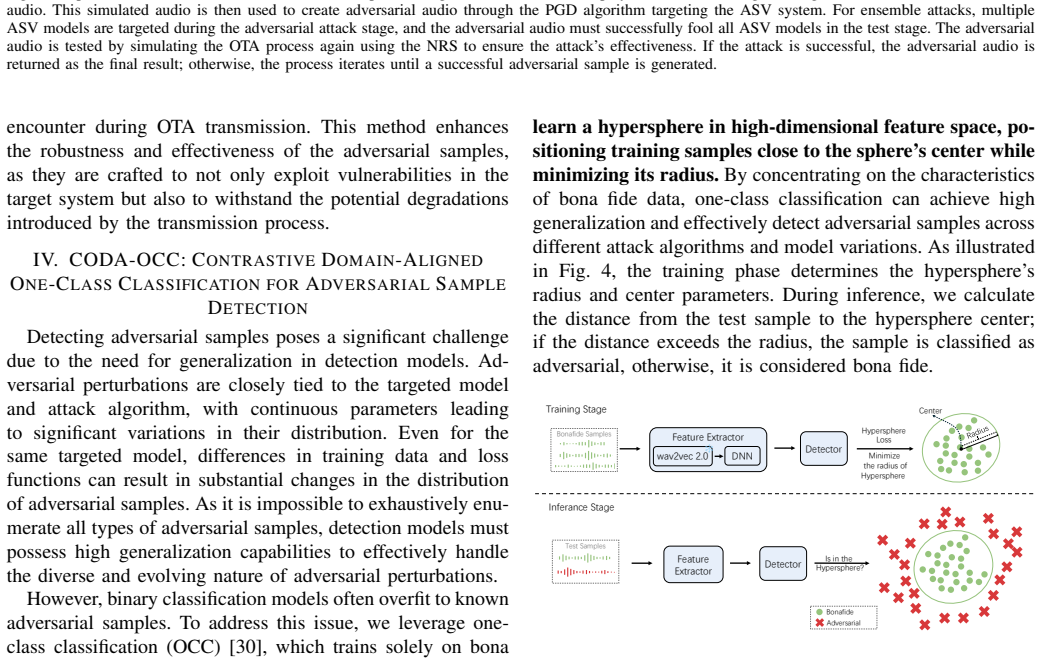
The load-bearing pieces are (1) the Neural Replay Simulator, a Wave-U-Net conditioned on a replay device ID and trained with multi-scale spectral loss on VCTK clean/replay pairs, which is inserted into PGD optimization so perturbations are tested after simulated OTA distortion; and (2) CODA-OCC, which attaches a separate hypersphere to each layer of wav2vec 2.0, applies contrastive loss to keep layer features close to their own centers and distant from other layers' centers, and aligns source and target decision and feature spaces with hypersphere-center-distance and MMD losses. The first carries the attack claim; the second carries the detection claim.
What would settle it
Take NRS-generated adversarial samples from AdvSV 2.0, play them through the same three loudspeakers and record them with the same three mobile devices at 0.3 meters and 90 degrees, and measure ASV attack success; if success stays near the 33.5% no-NRS baseline rather than jumping toward 66.9%, the simulator has not captured the real channel and the attack claim collapses.
Extended reading notes
Core claim
On its own terms, the paper's central discovery is that adversarial audio can be made to survive physical playback if the perturbation is optimized through a learned simulator of that playback, and that a one-class detector can still catch such audio using only bona fide speech for training. The detection model CODA-OCC attaches a hypersphere to every layer of a wav2vec 2.0 encoder, keeps layer-specific centers separated by a contrastive loss, and aligns source- and target-domain hyperspheres and feature distributions. On the new AdvSV 2.0 benchmark it reaches 11.2% EER and 0.95 AUC, against 19.8% EER for the previous purification-based method and 37.4% for plain one-class classification; ab
Load-bearing premise
The neural replay simulator, trained on 12.5 hours of VCTK speech replayed in one room at 0.3 meters and 90 degrees, is assumed to faithfully reproduce how all nine playback and recorder pairs distort Libri-Light audio, so that perturbations optimized through it stay potent after real playback; the paper reports no direct fidelity check.
Editorial extensions
If this is right
- Adversarial samples optimized through the NRS keep 66.9% average success after real playback, versus 33.5% without it, so over-the-air attacks on speaker verification cannot be dismissed as a lab artifact.
- CODA-OCC detects these attacks at 11.2% EER while trained only on bona fide speech, so it does not need to know the attack algorithm or the ASV model used by the attacker.
- The gains of domain alignment and contrastive learning are additive (23.9% plus 2.3% absolute EER reduction), suggesting both are needed for cross-domain generalization.
- The AdvSV 2.0 dataset, with 629,735 samples across four ASV models, three playback devices, and three recorders, provides a common benchmark for future over-the-air attack and defense research.
Reading between the lines
- If the NRS were trained on a broader range of distances, angles, and room acoustics, its simulated channel would likely generalize to more deployment settings; the current single-configuration training is the paper's most exposed point.
- Because CODA-OCC uses only bona fide speech, it may transfer to other audio-safety tasks such as deepfake or replay-spoof detection without retraining on attack data, though the paper does not test this.
- The contrastive one-class structure is not specific to wav2vec 2.0; any layered pre-trained audio encoder could be substituted, and the layer-separation principle might apply to other one-class anomaly detection problems.
- An adaptive attacker aware of the detector could try to craft perturbations that stay inside the bona fide hypersphere while still fooling the ASV; whether CODA-OCC survives such an adversary is an open question the paper leaves unresolved.
Editorial analysis
A structured set of objections, weighed in public.
Referee Report
Summary. The paper proposes three contributions: (i) AdvSV 2.0, a large corpus of over-the-line (OTL) and over-the-air (OTA) adversarial examples against four ASV models using PGD/ensemble-PGD attacks and multiple playback/recording configurations; (ii) an NRS-based OTA attack that optimizes perturbations through a learned replay simulator; and (iii) CODA-OCC, a one-class adversarial-sample detector combining contrastive multi-layer learning with domain alignment. The headline claims are that NRS raises the average OTA attack success rate from 33.5% to 66.9% (Table V) and that CODA-OCC achieves 11.2% EER and 0.95 AUC on AdvSV 2.0 (Table VII), outperforming a purification-based baseline and several ablations.
Significance. If the results hold, AdvSV 2.0 would be a valuable community resource, and the NRS-based attack is a genuine contribution: it is evaluated against real OTA playback rather than only against the simulator, which is a clear strength. The CODA-OCC formulation is also attractive because it avoids the white-box assumption of many prior detectors and requires only bona fide training data. The component-wise ablations (OCC, +CO, +DA, +CODA) support the internal logic of the method. However, the central detection claim is weakened by an evaluation protocol that lacks a clean control for the adversarial test domain, and the central method is not fully specified because the CO-OCC and CODA-OCC objective functions are never written down. These issues are fixable within the manuscript's scope, but they are load-bearing for the reproducibility and validity of the reported numbers.
major comments (5)
- [IV-C and IV-E] The central method is not fully specified. CO-OCC and CODA-OCC are described only verbally and pictorially; no objective function is given for either. Eq. (9) defines OCC and Eq. (11) defines DA-OCC, but the contrastive terms (per-layer hyperspheres, the 'bona fide center,' center-separation penalties) and how they are combined with Eq. (11) — including loss weights and which wav2vec layers are used — are absent. Without these equations the method cannot be implemented or compared.
- [VI-A2, Table VI, Table VII, Fig. 7c] The detection evaluation is confounded by domain shift. Bona fide training uses Libri-Light Medium and VoxCeleb2 (Section VI-A2), while the adversarial test set AdvSV 2.0 is generated from Libri-Light Large (Section V-A2). No clean Libri-Light Large samples appear in the test set (Table VI), so the one-class model may reject Libri-Light Large utterances because of channel/recording mismatch rather than because of adversarial perturbation. The t-SNE in Fig. 7c shows AdvSV 2.0 separated from training clusters, but this cannot distinguish perturbation-induced from domain-induced separation. Please add clean Libri-Light Large bona fide samples to the test set and report per-domain FAR/FRR, or otherwise control for the domain shift.
- [V-B2 and Table V] The NRS is trained on about 12.5 hours of VCTK data in a single acoustic geometry (0.3 m, 90 degrees), yet it is used to craft attacks for Libri-Light utterances replayed through nine device combinations. The paper claims the NRS 'accurately predicts' OTA transmission, but no direct fidelity metric is reported (e.g., spectrogram distance, ASV score agreement, or per-device error on held-out parallel recordings). The attack benefit is only measured end-to-end, so it is possible that the NRS functions as a differentiable augmentation rather than an accurate simulator. Please report a direct fidelity evaluation or an ablation that isolates the NRS's predictive accuracy.
- [VI-A3 and Table VII] All detection results are point estimates from a single training run selected by validation EER. The headline difference between DA-OCC (13.5%) and CODA-OCC (11.2%) is only 2.3% absolute, and the reported 8.6% improvement over the baseline could be within run-to-run variation. Report multiple seeds with standard deviations or a significance test, at least for the main comparison in Table VII.
- [VII and Table VII] The abstract and introduction claim CODA-OCC 'outperforms several state-of-the-art detection methods,' but the only external baseline evaluated is the purification-based method of [11]. Other published detectors (e.g., [12], [13], [25]) are not compared. Please evaluate these competitive detectors on the same protocol, or temper the claim to the methods actually compared.
minor comments (6)
- [III-A1, Eq. (6)] The clipping formula in Eq. (6) is malformed: min(1, max(-1, x+ε, max(x-ε, x'))) does not define a projection to the intersection of the L∞ ball and [-1,1]. Please rewrite as a standard two-stage projection.
- [Abstract and Table II] The abstract says 628k samples and 800 hours, while Table II reports 629,735 samples and 799.5 hours. Reconcile these numbers.
- [Table VII] The column layout is difficult to parse: the relationship between 'EER(%)', 'FAR(%)', 'FRR(%)', 'AUC', and the subcolumns 'ALL', 'Libri-Light', 'VoxCeleb2' should be clarified (e.g., which FAR is global and which are per-domain).
- [V-B2, Algorithm 3] Algorithm 3 initializes the adversarial sample at x_replay_v but takes PGD steps clipped around the original x_v. The first iteration will project x_replay_v into the ε-ball around x_v; please state this explicitly so readers do not interpret the initialization as violating the perturbation bound.
- [III and IV] The paper says AdvSV 2.0 is open-source and that the NRS uses a public MSSL implementation, but no dataset/download or code links are provided in the manuscript. Please add these, as they are essential for the dataset and defense contributions.
- [V-B2] NRS training hyperparameters (number of epochs, optimizer, learning rate, device-embedding dimension) are not specified. Please add them.
Circularity Check
No circularity: NRS attacks are tested over the real air; CODA-OCC is trained on bona fide and tested on held-out samples; remaining domain-shift concern is a validity issue, not a circular reduction.
full rationale
The paper's principal claims are not circular. The NRS-based attack (Algorithm 3) optimizes adversarial perturbations against a learned simulator, but the reported attack success rates (Table V) are measured after actual physical over-the-air playback through the specified loudspeaker/microphone combinations; the simulator is not used as the evaluation oracle. The CODA-OCC detector (Section IV) is trained exclusively on bona fide samples from Libri-Light Medium and VoxCeleb2 and evaluated on held-out adversarial samples from AdvSV 2.0; no adversarial labels or attack configurations are used to fit the detector, so the reported EER/AUC are not forced by construction. The self-citations [5], [6] motivate the OTA threat and the NRS concept, but the current paper provides independent experimental evidence (new real-OTA measurements, new dataset, ablation study) that does not reduce to those citations. The one legitimate concern is a domain-shift confound in the detection evaluation: adversarial test samples come from Libri-Light Large while clean test samples come from Libri-Light Medium and VoxCeleb2, with no clean Libri-Light Large control; this could inflate apparent detection accuracy, but it is a correctness/validity risk rather than a circular derivation. No specific equation or construction makes the claimed predictions equivalent to the inputs.
Assumptions & free parameters
free parameters (4)
- PGD perturbation bound epsilon =
0.01
- PGD step size alpha =
0.0005
- OTA geometry =
0.3 m distance, 90 degree angle
- NRS training data split =
9000/1300 utterances from VCTK, 103 speakers
assumptions (6)
- domain assumption L-infinity-bounded perturbations with epsilon=0.01 are imperceptible and representative of real attacks on ASV
- domain assumption The NRS trained on VCTK accurately simulates the OTA channel for Libri-Light and all nine device combinations
- domain assumption wav2vec 2.0 layer features carry multi-level acoustic/linguistic information useful for one-class attack detection
- domain assumption Deep one-class hypersphere (Deep SVDD) generalizes to unseen attacks when trained only on bona fide samples
- domain assumption MMD and center alignment on bona fide samples from Libri-Light and VoxCeleb2 transfer to the AdvSV 2.0 / OTA domain
- domain assumption The soundproof studio with fixed 0.3 m / 90 degree geometry is representative of over-the-air attacks
Cite this review
Pith. "Pith review of Over-the-Air Adversarial Attack Detection: from Datasets to Defenses." pith.science (2026). https://pith.science/paper/A5Z2TORK
@misc{pith2026250909296,
  author       = {Pith},
  title        = {Pith review of: Over-the-Air Adversarial Attack Detection: from Datasets to Defenses},
  year         = {2026},
  howpublished = {\url{https://pith.science/paper/A5Z2TORK}},
  note         = {Machine review of arXiv:2509.09296}
}
read the original abstract
Automatic Speaker Verification (ASV) systems can be used for voice-enabled applications for identity verification. However, recent studies have exposed these systems' vulnerabilities to both over-the-line (OTL) and over-the-air (OTA) adversarial attacks. Although various detection methods have been proposed to counter these threats, they have not been thoroughly tested due to the lack of a comprehensive data set. To address this gap, we developed the AdvSV 2.0 dataset, which contains 628k samples with a total duration of 800 hours. This dataset incorporates classical adversarial attack algorithms, ASV systems, and encompasses both OTL and OTA scenarios. Furthermore, we introduce a novel adversarial attack method based on a Neural Replay Simulator (NRS), which enhances the potency of adversarial OTA attacks, thereby presenting a greater threat to ASV systems. To defend against these attacks, we propose CODA-OCC, a contrastive learning approach within the one-class classification framework. Experimental results show that CODA-OCC achieves an EER of 11.2% and an AUC of 0.95 on the AdvSV 2.0 dataset, outperforming several state-of-the-art detection methods.
Figures


Figures from the paper (5 more)


Reference graph
Works this paper leans on
-
[11]
Adversarial Sample Detection for Speaker Verification By Neural V ocoders,
H. Wu, P.-C. Hsu, J. Gao, S. Zhang, S. Huang, J. Kang, Z. Wu, H. Meng, and H.-y. Lee, “Adversarial Sample Detection for Speaker Verification By Neural V ocoders,” inICASSP, 2022, pp. 236–240
2022
-
[12]
Improving the Adversarial Robustness for Speaker Verification by Self-supervised Learning,
H. Wu, X. Li, A. T. Liu, Z. Wu, H. Meng, and H.-Y . Lee, “Improving the Adversarial Robustness for Speaker Verification by Self-supervised Learning,”IEEE/ACM Transactions on Audio, Speech, and Language Processing, vol. 30, pp. 202–217, 2021
2021
-
[13]
LMD: A Learnable Mask Network to Detect Adversarial Examples for Speaker Verification,
X. Chen, J. Wang, X.-L. Zhang, W.-Q. Zhang, and K. Yang, “LMD: A Learnable Mask Network to Detect Adversarial Examples for Speaker Verification,”IEEE/ACM Transactions on Audio, Speech, and Language Processing, vol. 31, pp. 2476–2490, 2023
2023
-
[25]
Neural Codec- based Adversarial Sample Detection for Speaker Verification,
X. Chen, J. Du, H. Wu, J.-S. R. Jang, and H.-y. Lee, “Neural Codec- based Adversarial Sample Detection for Speaker Verification,”arXiv preprint arXiv:2406.04582, 2024
arXiv 2024
-
[1]
Speaker Recognition Based on Deep Learning: An Overview,
Z. Bai and X.-L. Zhang, “Speaker Recognition Based on Deep Learning: An Overview,”Neural Networks, vol. 140, pp. 65–99, 2021
2021
-
[2]
Adversarial Attack and Defense Strategies of Speaker Recognition Systems: A Survey,
H. Tan, L. Wang, H. Zhang, J. Zhang, M. Shafiq, and Z. Gu, “Adversarial Attack and Defense Strategies of Speaker Recognition Systems: A Survey,”Electronics, vol. 11, no. 14, p. 2183, 2022
2022
-
[3]
Audio Deepfake Detection: A Survey,
J. Yi, C. Wang, J. Tao, X. Zhang, C. Y . Zhang, and Y . Zhao, “Audio Deepfake Detection: A Survey,”Arxiv Preprint Arxiv:2308.14970, 2023
arXiv 2023
-
[4]
Black-box Attacks on Spoofing Countermeasures Using Transferability of Adversarial Exam- ples
Y . Zhang, Z. Jiang, J. Villalba, and N. Dehak, “Black-box Attacks on Spoofing Countermeasures Using Transferability of Adversarial Exam- ples.” inINTERSPEECH, 2020, pp. 4238–4242
2020
Show all 43 references
-
[5]
AdvSV: An Over-the-air Adversarial Attack Dataset for Speaker Verification,
L. Wang, J. Li, Y . Luo, J. Zheng, L. Wang, H. Li, K. Xu, C. Fang, J. Shi, and Z. Wu, “AdvSV: An Over-the-air Adversarial Attack Dataset for Speaker Verification,” inICASSP, 2024, pp. 4555–4559
2024
-
[6]
An Initial Investigation of Neural Replay Simulator for Over-the-air Adversarial Perturbations to Automatic Speaker Verification,
J. Li, L. Wang, L. Xue, L. Wang, and Z. Wu, “An Initial Investigation of Neural Replay Simulator for Over-the-air Adversarial Perturbations to Automatic Speaker Verification,” inICASSP, 2024, pp. 4635–4639
2024
-
[7]
The Defender’s Perspective on Automatic Speaker Verification: An Overview,
H. Wu, J. Kang, L. Meng, H. Meng, and H. Lee, “The Defender’s Perspective on Automatic Speaker Verification: An Overview,” inDADA Workshop, vol. 3597, 2023, pp. 6–11
2023
-
[8]
Study of Pre-processing Defenses against Adversarial Attacks on State-of-the-art Speaker Recognition Systems,
S. Joshi, J. Villalba, P. ˙Zelasko, L. Moro-Vel ´azquez, and N. Dehak, “Study of Pre-processing Defenses against Adversarial Attacks on State-of-the-art Speaker Recognition Systems,”IEEE Transactions on Information Forensics and Security, vol. 16, pp. 4811–4826, 2021
2021
-
[9]
Representation Learning to Classify and Detect Adversarial Attacks against Speaker and Speech Recognition Systems,
J. Villalba, S. Joshi, P. ˙Zelasko, and N. Dehak, “Representation Learning to Classify and Detect Adversarial Attacks against Speaker and Speech Recognition Systems,” inINTERSPEECH, 2021, pp. 4304–4308
2021
-
[10]
In- vestigating Robustness of Adversarial Samples Detection for Automatic Speaker Verification,
X. Li, N. Li, J. Zhong, X. Wu, X. Liu, D. Su, D. Yu, and H. Meng, “In- vestigating Robustness of Adversarial Samples Detection for Automatic Speaker Verification,” inINTERSPEECH, 2020, pp. 1540–1544
2020
-
[14]
Defending against Adver- sarial Audio via Diffusion Model,
I. J. Goodfellow, J. Shlens, and C. Szegedy, “Defending against Adver- sarial Audio via Diffusion Model,” inICLR, 2015
2015
-
[15]
FoolHD: Fooling Speaker Identification By Highly Imperceptible Adversarial Disturbances,
A. S. Shamsabadi, F. S. Teixeira, A. Abad, B. Raj, A. Cavallaro, and I. Trancoso, “FoolHD: Fooling Speaker Identification By Highly Imperceptible Adversarial Disturbances,” inICASSP, 2021, pp. 6159– 6163
2021
-
[16]
Who is Real Bob? Adversarial Attacks on Speaker Recognition Systems,
G. Chen, S. Chenb, L. Fan, X. Du, Z. Zhao, F. Song, and Y . Liu, “Who is Real Bob? Adversarial Attacks on Speaker Recognition Systems,” in S&P, 2021, pp. 55–72
2021
-
[17]
Speaker-specific Utterance En- semble Based Transfer Attack on Speaker Identification,
C.-X. Zuo, J.-Y . Leng, and W.-J. Li, “Speaker-specific Utterance En- semble Based Transfer Attack on Speaker Identification,” inINTER- SPEECH, 2022, pp. 3203–3207
2022
-
[18]
Interpretable Spectrum Transformation Attacks to Speaker Recognition Systems,
J. Yao, H. Luo, J. Qi, and X.-L. Zhang, “Interpretable Spectrum Transformation Attacks to Speaker Recognition Systems,”IEEE/ACM Transactions on Audio, Speech, and Language Processing, vol. 32, pp. 1531–1545, 2024
2024
-
[19]
Real-time, Universal, and Robust Adversarial Attacks against Speaker Recognition Systems,
Y . Xie, C. Shi, Z. Li, J. Liu, Y . Chen, and B. Yuan, “Real-time, Universal, and Robust Adversarial Attacks against Speaker Recognition Systems,” inICASSP, 2020, pp. 1738–1742
2020
-
[20]
CommanderSong: A Systematic Approach for Practical Adversarial V oice Recognition,
X. Yuan, Y . Chen, Y . Zhao, Y . Long, X. Liu, K. Chen, S. Zhang, H. Huang, X. Wang, and C. A. Gunter, “CommanderSong: A Systematic Approach for Practical Adversarial V oice Recognition,” inUSENIX Security, 2018, pp. 49–64
2018
-
[21]
Black-Box Adversarial Attacks on Commercial Speech Platforms with Minimal Information,
B. Zheng, P. Jiang, Q. Wang, Q. Li, C. Shen, C. Wang, Y . Ge, Q. Teng, and S. Zhang, “Black-Box Adversarial Attacks on Commercial Speech Platforms with Minimal Information,” inCSS, 2021, p. 86–107
2021
-
[22]
QFA2SR: Query-Free Ad- versarial Transfer Attacks to Speaker Recognition Systems,
G. Chen, Y . Zhang, Z. Zhao, and F. Song, “QFA2SR: Query-Free Ad- versarial Transfer Attacks to Speaker Recognition Systems,” inUSENIX Security, 2023, pp. 2437–2454
2023
-
[23]
Effective and Inconspicuous Over-the-air Adversarial Examples with Adaptive Filtering,
P. O’Reilly, P. Awasthi, A. Vijayaraghavan, and B. Pardo, “Effective and Inconspicuous Over-the-air Adversarial Examples with Adaptive Filtering,” inICASSP, 2022, pp. 6607–6611
2022
-
[24]
UTIO: Universal, Targeted, Im- perceptible and Over-the-air Audio Adversarial Example,
C. Zhao, Z. Li, H. Ding, and W. Xi, “UTIO: Universal, Targeted, Im- perceptible and Over-the-air Audio Adversarial Example,” inICPADS, 2023, pp. 346–353
2023
-
[26]
Towards Deep Learning Models Resistant to Adversarial Attacks,
A. Madry, A. Makelov, L. Schmidt, D. Tsipras, and A. Vladu, “Towards Deep Learning Models Resistant to Adversarial Attacks,” inICLR, 2018
2018
-
[27]
Amphion: An Open-Source Audio, Music and Speech Generation Toolkit,
X. Zhang, L. Xue, Y . Gu, Y . Wang, H. He, C. Wang, X. Chen, Z. Fang, H. Chen, J. Zhang, T. Y . Tang, L. Zou, M. Wang, J. Han, K. Chen, H. Li, and Z. Wu, “Amphion: An Open-Source Audio, Music and Speech Generation Toolkit,”arXiv preprint arXiv:2312.09911, 2024
2024 arXiv
-
[28]
Emilia: An Extensive, Multilingual, and Diverse Speech Dataset for Large-Scale Speech Generation,
H. He, Z. Shang, C. Wang, X. Li, Y . Gu, H. Hua, L. Liu, C. Yang, J. Li, P. Shi, Y . Wang, K. Chen, P. Zhang, and Z. Wu, “Emilia: An Extensive, Multilingual, and Diverse Speech Dataset for Large-Scale Speech Generation,”arXiv preprint arXiv:2407.05361, 2024
2024 arXiv
-
[29]
Wave-U-Net: A Multi-scale Neural Network for End-to-end Audio Source Separation,
D. Stoller, S. Ewert, and S. Dixon, “Wave-U-Net: A Multi-scale Neural Network for End-to-end Audio Source Separation,” inISMIR, 2018, pp. 334–340
2018
-
[30]
Deep One-class Classification,
L. Ruff, R. Vandermeulen, N. Goernitz, L. Deecke, S. A. Siddiqui, A. Binder, E. M ¨uller, and M. Kloft, “Deep One-class Classification,” inICML, 2018, pp. 4393–4402
2018
-
[31]
Wav2vec 2.0: A Framework for Self-supervised Learning of Speech Representations,
A. Baevski, Y . Zhou, A. Mohamed, and M. Auli, “Wav2vec 2.0: A Framework for Self-supervised Learning of Speech Representations,” Advances in Neural Information Processing Systems, vol. 33, pp. 12 449–12 460, 2020
2020
-
[32]
Self-supervised Speech Representation Learning: A Review,
A. Mohamed, H.-y. Lee, L. Borgholt, J. D. Havtorn, J. Edin, C. Igel, K. Kirchhoff, S.-W. Li, K. Livescu, L. Maaløeet al., “Self-supervised Speech Representation Learning: A Review,”IEEE Journal of Selected Topics in Signal Processing, vol. 16, no. 6, pp. 1179–1210, 2022
2022
-
[33]
Libri-Light: A Benchmark for Asr with Limited Or No Supervision,
J. Kahn, M. Riviere, W. Zheng, E. Kharitonov, Q. Xu, P. Mazare, J. Karadayi, V . Liptchinsky, R. Collobert, C. Fuegen, T. Likhomanenko, G. Synnaeve, A. Joulin, A. Mohamed, and E. Dupoux, “Libri-Light: A Benchmark for Asr with Limited Or No Supervision,” inICASSP, 2020
2020
-
[34]
V oxCeleb2: Deep Speaker Recognition,
J. S. Chung, A. Nagrani, and A. Zisserman, “V oxCeleb2: Deep Speaker Recognition,” inINTERSPEECH, 2018
2018
-
[35]
A Kernel Method for the Two-sample-problem,
A. Gretton, K. Borgwardt, M. Rasch, B. Sch ¨olkopf, and A. Smola, “A Kernel Method for the Two-sample-problem,”Advances in Neural Information Processing Systems, vol. 19, 2006
2006
-
[36]
ECAPA-TDNN: Emphasized Channel Attention, Propagation and Aggregation in Tdnn Based Speaker Verification,
B. Desplanques, J. Thienpondt, and K. Demuynck, “ECAPA-TDNN: Emphasized Channel Attention, Propagation and Aggregation in Tdnn Based Speaker Verification,” inINTERSPEECH, 2020, pp. 3830–3834
2020
-
[37]
X- Vectors: Robust Dnn Embeddings for Speaker Recognition,
D. Snyder, D. Garcia-Romero, G. Sell, D. Povey, and S. Khudanpur, “X- Vectors: Robust Dnn Embeddings for Speaker Recognition,” inICASSP, 2018, pp. 5329–5333
2018
-
[38]
The Ins and Outs of Speaker Recognition: Lessons From V oxsrc 2020,
Y . Kwon, H.-S. Heo, B.-J. Lee, and J. S. Chung, “The Ins and Outs of Speaker Recognition: Lessons From V oxsrc 2020,” inICASSP, 2021, pp. 5809–5813
2020
-
[39]
Pushing the Limits of Raw Waveform Speaker Recognition,
J. weon Jung, Y . Kim, H.-S. Heo, B.-J. Lee, Y . Kwon, and J. S. Chung, “Pushing the Limits of Raw Waveform Speaker Recognition,” inINTERSPEECH, 2022, pp. 2228–2232
2022
-
[40]
V oxCeleb: A Large-scale Speaker Identification Dataset,
A. Nagrani, J. S. Chung, and A. Zisserman, “V oxCeleb: A Large-scale Speaker Identification Dataset,” inINTERSPEECH, 2017, pp. 2616– 2620
2017
-
[41]
CSTR VCTK Corpus: English Multi-speaker Corpus for CSTR V oice Cloning Toolkit,
C. Veaux, J. Yamagishi, and K. MacDonald, “CSTR VCTK Corpus: English Multi-speaker Corpus for CSTR V oice Cloning Toolkit,” 2016
2016
-
[42]
Parallel Wavegan: A Fast Waveform Generation Model Based on Generative Adversarial Networks with Multi-resolution Spectrogram,
R. Yamamoto, E. Song, and J.-M. Kim, “Parallel Wavegan: A Fast Waveform Generation Model Based on Generative Adversarial Networks with Multi-resolution Spectrogram,” inICASSP, 2020, pp. 6199–6203
2020
-
[43]
Visualizing Data Using T-SNE
L. Van der Maaten and G. Hinton, “Visualizing Data Using T-SNE.” Journal of Machine Learning Research, vol. 9, no. 11, 2008
2008
Reviewed August 4, 2026 · model on record in the stance chip above.
Discussion (0). Sign in to comment.