Coupling Precipitation Forecasting and Early Warning with Reverse-Martingale Recurrent Neural Networks
Pith reviewed 2026-07-02 00:30 UTC · model grok-4.3
The pith
A recurrent neural network with a reverse-martingale penalty forecasts precipitation as accurately as standard models while turning reconstruction defects into an early drought warning signal.
A machine-rendered reading of the paper's core claim, the machinery that carries it, and where it could break.
Core claim
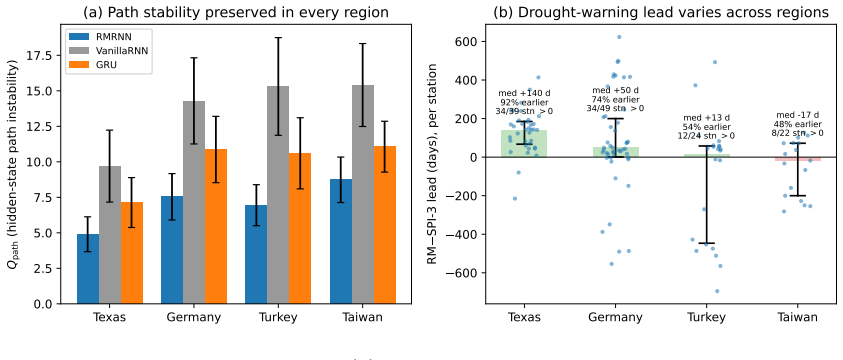
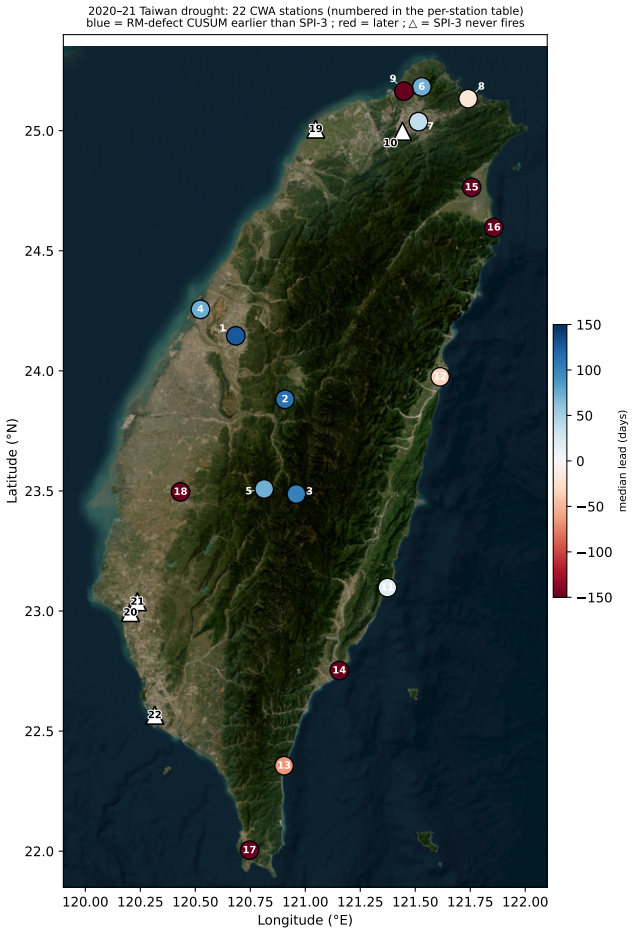
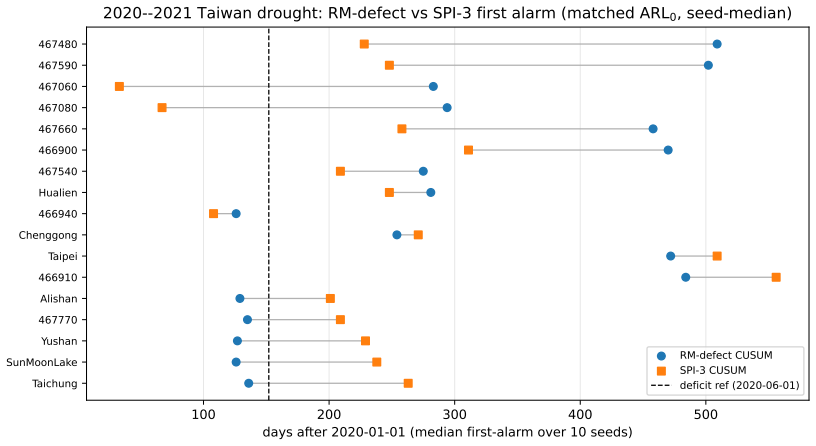
The authors claim that equipping a recurrent network with a reverse-martingale penalty preserves forecast accuracy on real daily precipitation records from monsoonal, semi-arid, temperate, and Mediterranean stations while making the hidden state markedly steadier; the resulting reconstruction defect then functions as an online warning signal that a change-point detector can use to alarm ahead of the SPI-3 index in several regions, with the size of the lead explained by whether drought onset precedes or coincides with the rainfall deficit.
What carries the argument
The reverse-martingale penalty, which enforces backward coherence on the hidden state so that the magnitude of the reconstruction defect becomes the input to a sequential change-point detector for drought onset.
If this is right
- Forecast skill remains comparable to a standard recurrent network across all four tested climates.
- The hidden state becomes markedly steadier in every region.
- The warning signal supplies lead time over the operational SPI-3 index in multiple regions.
- The magnitude of the lead varies with the hydroclimatic character of drought onset.
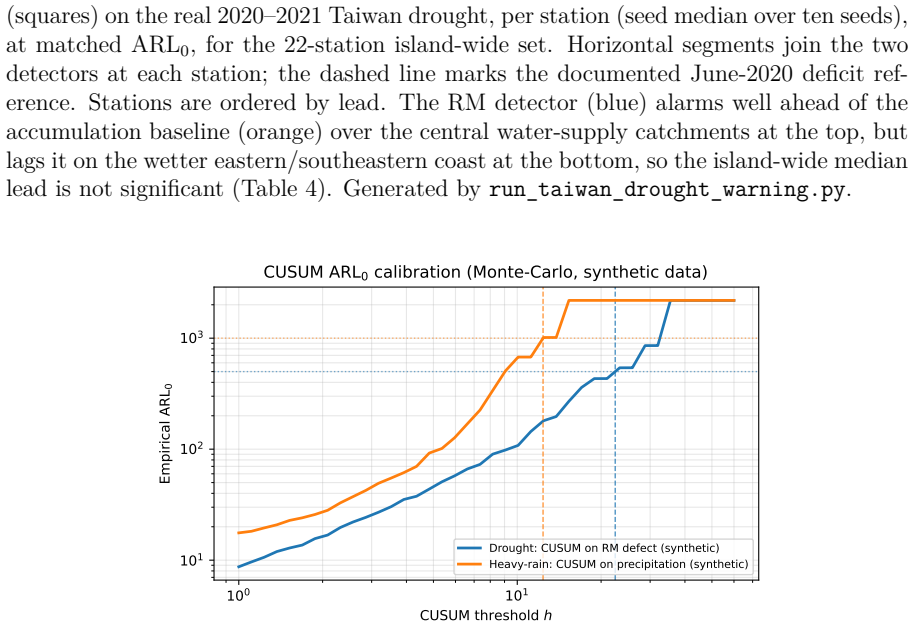
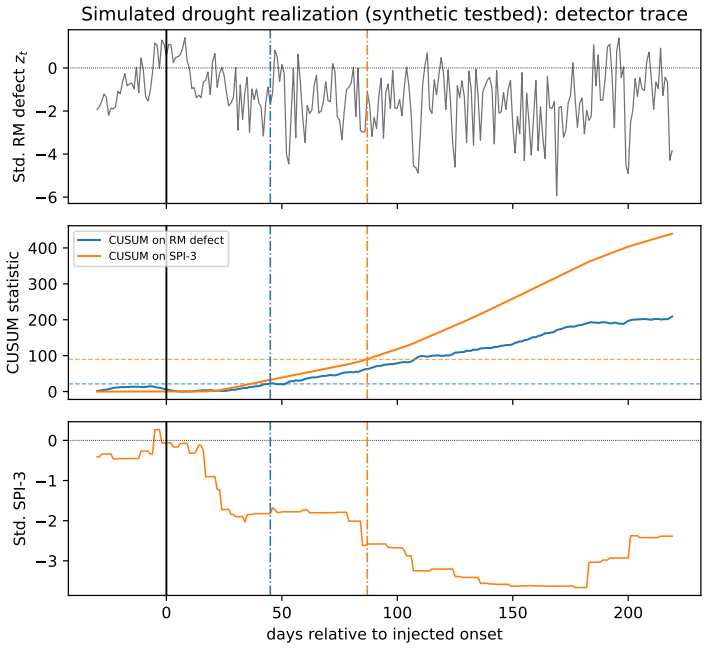
- A synthetic study with known onset times supports that the advantage stems from the timing of regime change relative to rainfall deficit.
Where Pith is reading between the lines
- The same penalty structure could be applied to other environmental time series where regime shifts precede observable deficits.
- Steadier hidden states may reduce error accumulation in multi-step forecasts beyond the horizons tested here.
- Extending the detector to temperature or streamflow records would test whether the early-warning benefit generalizes beyond precipitation.
Load-bearing premise
The reconstruction defect produced by the reverse-martingale penalty functions as a reliable indicator of drought regime onset rather than reflecting data properties or detector tuning.
What would settle it
A controlled experiment in which drought onset is forced to coincide exactly with the rainfall deficit in synthetic data with known timing, checking whether the lead-time advantage over SPI-3 disappears.
Figures
read the original abstract
Precipitation forecasts are judged by accuracy, but the decisions they support -- when to restrict water, when to warn of drought -- turn on noticing when a local regime is becoming abnormal, which forecast scores alone do not reveal. We ask whether one recurrent model can do both with little or no loss in forecast skill. We add a backward-coherence (reverse-martingale) penalty that keeps the network's hidden state smooth when read backward in time; the size of the resulting reconstruction defect becomes an online warning signal, monitored by a sequential change-point detector. The design is deliberately conservative. On real daily station data from four contrasting climates -- monsoonal Taiwan, semi-arid Texas, temperate Germany, and Mediterranean Anatolia (Turkey) -- the model matches a standard network's forecast skill everywhere, and makes the hidden state markedly steadier in every region. The novelty is the added information: on these real droughts the signal can alarm well ahead of the operational SPI-3 index, giving lead that neither the forecast nor the index provides. This benefit is not uniform across the four regions -- large in one, partial in two others, and near-absent in the fourth. We offer the hydroclimatic character of drought onset, whether it precedes or merely coincides with the rainfall deficit, as a plausible explanation to be tested in future work, supported by a controlled synthetic study with known onset times. The contribution is thus a new and conservative way to read precipitation records: no loss in forecast skill, a steadier model, and an early-warning signal beyond the standard index.
Editorial analysis
A structured set of objections, weighed in public.
Referee Report
Summary. The paper proposes augmenting a recurrent neural network for daily precipitation forecasting with a reverse-martingale penalty on the hidden state to enforce backward coherence. The magnitude of the resulting reconstruction defect is monitored by a sequential change-point detector to generate early-warning signals for drought regime shifts. On real station data from four contrasting climates the model is reported to match a baseline network's forecast skill while producing steadier hidden states and, in some regions, alarms that precede the operational SPI-3 index; a controlled synthetic experiment with known onset times is offered in support.
Significance. If the lead-time claims can be reproduced with full methodological detail, the work would demonstrate a conservative, single-model route to joint forecasting and regime-change detection that adds usable early-warning information beyond standard drought indices without degrading predictive accuracy. The regional heterogeneity and the hydroclimatic interpretation supplied for it would also supply a concrete hypothesis for follow-up studies.
major comments (2)
- [Abstract, §3] Abstract and §3 (Methods): the exact functional form of the reverse-martingale penalty, the numerical value of its weight, and the full specification (threshold, window, etc.) of the change-point detector are not supplied. These quantities are load-bearing for the central claim that the reconstruction defect produces verifiable lead time over SPI-3; without them the reported alarms cannot be reproduced or tested for sensitivity to tuning.
- [§4] §4 (Results) and synthetic study: no lead-time distributions, false-alarm rates, or statistical significance tests comparing the detector output to SPI-3 onset are presented, nor is an explicit definition of “onset” given for the synthetic case. The non-uniform regional benefit is acknowledged but cannot be attributed to hydroclimatic character versus detector calibration without these quantitative controls.
minor comments (1)
- [Abstract] The abstract states that the hidden state is “markedly steadier” but supplies no quantitative metric (e.g., variance of hidden activations or autocorrelation) to support the claim.
Simulated Author's Rebuttal
We thank the referee for the constructive comments. We address each major point below.
read point-by-point responses
-
Referee: [Abstract, §3] Abstract and §3 (Methods): the exact functional form of the reverse-martingale penalty, the numerical value of its weight, and the full specification (threshold, window, etc.) of the change-point detector are not supplied. These quantities are load-bearing for the central claim that the reconstruction defect produces verifiable lead time over SPI-3; without them the reported alarms cannot be reproduced or tested for sensitivity to tuning.
Authors: The referee is correct that these details were insufficiently specified in the submitted version. We will revise §3 to supply the exact functional form of the reverse-martingale penalty, the numerical weight used during training, and the complete parameters (threshold, window, etc.) of the change-point detector. The abstract will be updated to reference these additions. revision: yes
-
Referee: [§4] §4 (Results) and synthetic study: no lead-time distributions, false-alarm rates, or statistical significance tests comparing the detector output to SPI-3 onset are presented, nor is an explicit definition of “onset” given for the synthetic case. The non-uniform regional benefit is acknowledged but cannot be attributed to hydroclimatic character versus detector calibration without these quantitative controls.
Authors: We agree that the current §4 lacks the requested quantitative controls and explicit definitions. The revised manuscript will add lead-time distributions, false-alarm rates, and statistical significance tests comparing detector output to SPI-3. We will also supply an explicit definition of onset for the synthetic experiments. These changes will allow clearer attribution of regional differences. revision: yes
Circularity Check
No significant circularity; derivation is self-contained
full rationale
The paper explicitly adds a reverse-martingale penalty term to the training loss to enforce backward smoothness on the hidden state; the resulting reconstruction defect is then fed to an independent sequential change-point detector to produce the warning signal. This is a designed architectural feature, not a quantity that reduces by the model's equations to already-fitted drought labels or forecast targets. No load-bearing self-citation, uniqueness theorem, or fitted-input-renamed-as-prediction appears in the provided abstract or description. The forecast-skill equivalence and lead-time claims are presented as empirical observations on real station data, with the hydroclimatic explanation offered only as a hypothesis for future testing. The central derivation therefore retains independent content and does not collapse to its inputs by construction.
Axiom & Free-Parameter Ledger
free parameters (2)
- reverse-martingale penalty weight
- change-point detector parameters
axioms (2)
- domain assumption Adding a backward-coherence penalty to an RNN loss preserves forecast skill while producing a usable anomaly signal.
- ad hoc to paper The reconstruction defect reliably precedes or coincides with drought onset in a manner detectable by a standard change-point method.
invented entities (1)
-
reverse-martingale penalty
no independent evidence
Reference graph
Works this paper leans on
-
[1]
and Chen, Y.-L
Chen, C.-S. and Chen, Y.-L. (2003). The rainfall characteristics of Taiwan. Monthly Weather Review,131(7), 1323–1341. doi:https://doi.org/10.1175/ 1520-0493(2003)131%3C1323:TRCOT%3E2.0.CO;2
2003
-
[2]
J., Hovius, N., Chen, H., Dade, W
Dadson, S. J., Hovius, N., Chen, H., Dade, W. B., Hsieh, M.-L., Willett, S. D., Hu, J.-C., Horng, M.-J., Chen, M.-C., Stark, C. P., Lague, D. and Lin, J.-C. (2003). Linksbetweenerosion, runoffvariabilityandseismicityintheTaiwanorogen.Nature, 426(6967), 648–651. doi:https://doi.org/10.1038/nature02150
-
[3]
and Milliman, J
Kao, S.-J. and Milliman, J. D. (2008). Water and sediment discharge from small mountainous rivers, Taiwan: The roles of lithology, episodic events, and human activities.The Journal of Geology,116(5), 431–448. doi:https://doi.org/10. 1086/590921
2008
- [4]
-
[5]
L., 1953:Stochastic Processes
Doob, J. L., 1953:Stochastic Processes. Wiley, 654 pp
1953
-
[6]
Cho, K., B. van Merriënboer, C. Gulcehre, D. Bahdanau, F. Bougares, H. Schwenk, and Y. Bengio, 2014: Learning phrase representations using RNN encoder–decoder for statistical machine translation.Proc. 2014 Conf. Empirical Methods in Natural Language Processing, Doha, Qatar, AssociationforComputationalLinguistics, 1724– 1734, doi:10.3115/v1/D14-1179
-
[7]
Hochreiter, S., and J. Schmidhuber, 1997: Long short-term memory.Neural Com- put.,9, 1735–1780, doi:10.1162/neco.1997.9.8.1735
-
[8]
Commun.,13, 5145
Espeholt, L., and Coauthors, 2022: Deep learning for twelve hour precipitation forecasts.Nat. Commun.,13, 5145
2022
-
[9]
Data,2, 150066
Funk, C., and Coauthors, 2015: The climate hazards infrared precipitation with stations—a new environmental record for monitoring extremes.Sci. Data,2, 150066
2015
-
[10]
Žliobait˙ e, A
Gama, J., I. Žliobait˙ e, A. Bifet, M. Pechenizkiy, and A. Bouchachia, 2014: A survey on concept drift adaptation.ACM Comput. Surv.,46(4), Article 44, 37 pp
2014
-
[11]
Hao, Z., X. Yuan, Y. Xia, F. Hao, and V. P. Singh, 2017: An overview of drought monitoring and prediction systems at regional and global scales.Bull. Amer. Me- teor. Soc.,98, 1879–1896, doi:10.1175/BAMS-D-15-00149.1
-
[12]
Hersbach, H., and Coauthors, 2020: The ERA5 global reanalysis.Quart. J. Roy. Me- teor. Soc.,146, 1999–2049. 30
2020
-
[13]
Constantinou, C
Hundman, K., V. Constantinou, C. Laporte, I. Colwell, and T. Soderstrom, 2018: Detecting spacecraft anomalies using LSTMs and nonparametric dynamic thresh- olding.Proc. 24th ACM SIGKDD, 387–395
2018
-
[14]
Milly, P. C. D., J. Betancourt, M. Falkenmark, R. M. Hirsch, Z. W. Kundzewicz, D. P. Lettenmaier, and R. J. Stouffer, 2008: Stationarity is dead: Whither water management?Science,319, 573–574
2008
-
[15]
H., 2005: Orographic precipitation.Annu
Roe, G. H., 2005: Orographic precipitation.Annu. Rev. Earth Planet. Sci.,33, 645–671
2005
-
[16]
McKee, T. B., N. J. Doesken, and J. Kleist, 1993: The relationship of drought frequency and duration to time scales.Proc. 8th Conf. on Applied Climatology, Ana- heim, CA, AMS, 179–184
1993
-
[17]
Menne, M. J., I. Durre, R. S. Vose, B. E. Gleason, and T. G. Houston, 2012: An overview of the Global Historical Climatology Network-Daily database.J. At- mos. Oceanic Technol.,29, 897–910
2012
-
[18]
V., 1986: Optimal stopping times for detecting changes in distri- butions.Ann
Moustakides, G. V., 1986: Optimal stopping times for detecting changes in distri- butions.Ann. Statist.,14, 1379–1387
1986
-
[19]
Muñoz-Sabater, J., and Coauthors, 2021: ERA5-Land: A state-of-the-art global reanalysis dataset for land applications.Earth Syst. Sci. Data,13, 4349–4383
2021
-
[20]
Ravuri, S., and Coauthors, 2021: Skilful precipitation nowcasting using deep gener- ative models of radar.Nature,597, 672–677
2021
-
[21]
Neural Inf
Shi, X., and Coauthors, 2015: Convolutional LSTM network: A machine learning approach for precipitation nowcasting.Adv. Neural Inf. Process. Syst., 802–810
2015
-
[22]
Sloughter, J. M., A. E. Raftery, T. Gneiting, and C. Fraley, 2007: Probabilistic quan- titative precipitation forecasting using Bayesian model averaging.Mon. Wea. Rev., 135, 3209–3220
2007
-
[23]
Wang, Y., M. Long, J. Wang, Z. Gao, and P. S. Yu, 2017: PredRNN: Recurrent neural networks for predictive learning using spatiotemporal LSTMs.Adv. Neural Inf. Process. Syst., 879–888
2017
-
[24]
World Meteorological Organization, 2012: Standardized Precipitation Index User Guide. WMO-No. 1090, 24 pp
2012
-
[25]
N., 1969: The predictability of a flow which possesses many scales of motion.Tellus,21, 289–307
Lorenz, E. N., 1969: The predictability of a flow which possesses many scales of motion.Tellus,21, 289–307
1969
-
[26]
F., and M
Ropelewski, C. F., and M. S. Halpert, 1987: Global and regional scale precipitation patterns associated with the El Niño/Southern Oscillation.Mon. Wea. Rev.,115, 1606–1626
1987
-
[27]
Wu, and K.-M
Wang, B., R. Wu, and K.-M. Lau, 2001: Interannual variability of the Asian summer monsoon: contrasts between the Indian and the western North Pacific–East Asian monsoons.J. Climate,14, 4073–4090. 31 120.00 120.25 120.50 120.75 121.00 121.25 121.50 121.75 122.00 Longitude (°E) 22.0 22.5 23.0 23.5 24.0 24.5 25.0Latitude (°N) 2020 21 T aiwan drought: 22 CWA ...
2001
discussion (0)
Sign in with ORCID, Apple, or X to comment. Anyone can read and Pith papers without signing in.