REVIEW 4 minor 30 references
Bifurcation for Minimal Surface Equation in Hyperbolic $3$-Manifolds
T0 review · 0 major / 4 minor · reviewed 2026-08-14 · deepseek-v4-flash
Pith's one-line read The minimal-surface equation in hyperbolic 3-manifolds has solutions exactly up to a single bending point, with a second unstable branch that blows up as the parameter tends to zero.
desk verdict A thorough, credible completion of Uhlenbeck's bifurcation program for the minimal surface equation in hyperbolic 3-manifolds; the main theorems hold up under scrutiny and the paper deserves serious refereeing. read the letter →
The pith
A machine-rendered reading of the paper's core claim, the machinery that carries it, and where it could break.
The reading
What carries the argument
The load-bearing object is the one-parameter Gauss equation together with its reformulation as a mean-field Liouville-type equation, obtained by setting $v=-2u$, $K=\|\alpha\|_\sigma^2$, and $\rho=t^2\int_S K e^v\,dA$. Four mechanisms carry the argument: the hyperbolic-germ correspondence from the Gauss-Codazzi equations, which turns analytic solutions into geometric minimal immersions; sub- and supersolution methods together with the mountain-pass theorem, which produce the stable and unstable branches and prove there are no others; the concentration-compactness blow-up theory for Liouville equations, which forces any blowing family to have quantized mass $4\pi m$ with explicit point weights; and the Moser-Trudinger functional $J(w)=\frac12\int_S|\nabla w|^2\,dA-8\pi\log\left(\frac{1}{|S|}\int_S K e^w\,dA\right)$, whose attainment decides the genus-2 dichotomy. Leray-Schauder degree computations for the mean-field equation then yield the existence result for prescribed total extrinsic curvature.
What would settle it
For a concrete genus-2 example, determine numerically whether the Moser-Trudinger functional with weight $K=\|\alpha\|_\sigma^2$ attains its infimum on the zero-mean space $E$: a low-energy sequence that neither converges strongly nor concentrates at a maximizer of $4\pi\gamma(p,p)+\log K(p)$ would break Theorem C, and a numerical solution of the Gauss equation at any $t>\tau_0(\sigma,\alpha)$ would break Theorem A.
Extended reading notes
Core claim
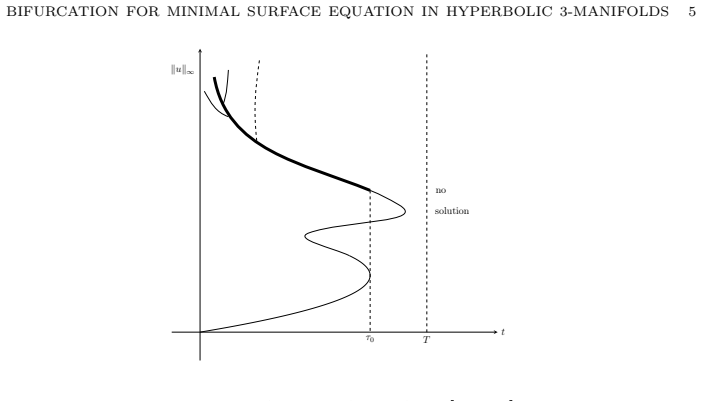
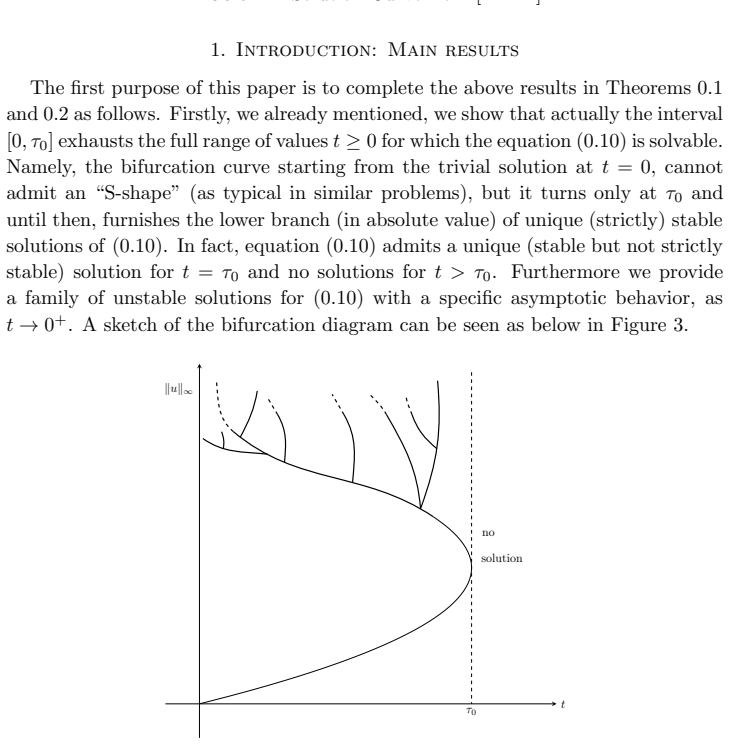
The central claim is that after writing the Gauss equation as $\Delta u+1-e^{2u}-t^2\|\alpha\|_\sigma^2 e^{-2u}=0$, the full solution set is a single curve that starts at the trivial solution $u=0$ at $t=0$, bends at $\tau_0=\tau_0(\sigma,\alpha)$, and then terminates: solutions exist precisely for $0\le t\le\tau_0$, the stable branch is pointwise largest, and for each $t\in(0,\tau_0)$ there is one unstable solution $\tilde u_t$ with $\tilde u_t<u_t<0$ whose $L^\infty$ norm diverges as $t\to0$. At $t=\tau_0$ the two branches meet in the unique degenerate solution, so the previously open possibility of an S-shaped continuation is ruled out. The paper then quantifies the blow-up: in genus $g\ge3$ the measure $t^2\|\alpha\|_\sigma^2 e^{-2\tilde u_t}$ converges to $4\pi\delta_{p_0}$ with $\alpha(p_0)\neq0$, and the limit solves a singular Gauss equation with divisor $2p_0$; in genus 2, either the Moser-Trudinger functional with weight $\|\alpha\|_\sigma^2$ attains its infimum and the blown-up surface converges, or it does not and concentration occurs at a point maximizing $4\pi\gamma(p,p)+\log\|\alpha\|_\sigma^2(p)$. A general theorem classifies every possible blow-up mass as $4\pi m$ with $m\in\{1,\dots,g-1\}$ and assigns explicit weights $1+n(p)$ at zeros of $\alpha$.
Load-bearing premise
The argument assumes that every solution of the Gauss equation can be realized as the conformal factor of a genuine minimal immersion into a hyperbolic 3-manifold through the hyperbolic-germ construction, even though the paper notes that the resulting manifold need not be complete.
Editorial extensions
If this is right
- For fixed $(\sigma,\alpha)$ the bifurcation diagram is complete: exactly two solution branches on $(0,\tau_0)$, one degenerate solution at $\tau_0$, and none beyond, so no S-shape and no hidden branch.
- The stable solution is pointwise the largest, so the area-minimizing minimal immersion with data $(\sigma,t\alpha)$ is the unique one that continues smoothly from the totally geodesic surface at $t=0$.
- As $t\to0$, unstable immersions collapse onto hyperbolic cone-manifolds with explicitly prescribed divisors (a single singularity $2p_0$ for $g\ge3$), giving concrete geometric limits for the disappearance of minimal immersions.
- The blow-up mass quantization $4\pi m$ with weights $1+n(p)$ constrains which divisors can appear in cone-manifold limits: only divisors of the form $2\sum_j(1+n(p_j))p_j$ with $\chi(S)+|D|\le0$.
- Prescribed total extrinsic curvature $\rho\in(0,4\pi(g-1))\setminus\{4\pi m: m=2,\dots,g-2\}$ is achieved by some minimal immersion with data $(\sigma,t_\rho\alpha)$ and $t_\rho\in(0,\tau_0]$.
Reading between the lines
- If Theorem A is correct, numerical continuation codes for this equation should see exactly one fold at $\tau_0$; that is a clean benchmark for bifurcation software on nonlinear elliptic equations over surfaces.
- The genus-2 dichotomy suggests that attainment of the Moser-Trudinger infimum is the effective order parameter for whether the surface persists under blow-up, and small perturbations of $\alpha$ could be used to test whether the compactness-versus-concentration switch is sharp.
- Because the paper notes that hyperbolic germs need not be complete, the analytic theorems stand independently of the geometric cone-manifold interpretation; a separate completeness theorem would be needed before the unstable limits can be called genuine manifolds.
- The excluded values $\rho=4\pi m$ in the prescribed-curvature theorem look removable: the sign analysis in Section 6 shows blow-up for $\rho_n\to4\pi m$ can approach only from one side, so a refined degree argument may close those gaps.
Signed reviews
Editorial analysis
A structured set of objections, weighed in public.
Referee Report
Summary. This paper studies the one-parameter family of Gauss equations (0.10) that govern minimal immersions of a closed surface of genus at least two into hyperbolic 3-manifolds, with prescribed conformal structure and holomorphic quadratic differential. The main analytic result, Theorem A, asserts that solutions exist precisely for t in [0, tau_0], that the unique stable solution is the pointwise largest solution, that for every t in (0, tau_0) there is an additional unstable solution, and that these unstable solutions blow up as t tends to 0. The paper further proves Theorem D, a general blow-up and concentration-compactness analysis for any sequence of solutions as t tends to 0, and derives from it the genus-specific Theorems B and C for genus at least three and genus two, respectively. Finally, Theorem E uses Leray-Schauder degree to construct minimal immersions with prescribed total extrinsic curvature.
Significance. If correct, the paper completes Uhlenbeck's bifurcation picture for equation (0.10) by ruling out S-shaped bifurcation and giving the exact existence interval. The proofs are detailed and combine variational methods, sub/supersolutions, mountain-pass arguments, and standard concentration-compactness for Liouville-type equations; they rely on prior results (Uhlenbeck's tau_0 analysis, Huang-Lucia's existence theorem, Chen-Lin's degree computations) in a transparent way and introduce no fitted parameters. The paper explicitly acknowledges (Section 0) that the hyperbolic-germ construction yields complete 3-manifolds only under additional conditions on the induced metric; this limits the geometric interpretation of Theorems B, C, and E but does not affect the analytic statement of Theorem A. The blow-up analysis is a substantial contribution, and the genus-two alternative is clearly formulated.
minor comments (4)
- [Section 0] The completeness caveat for the hyperbolic-germ construction should be restated in the statements of Theorems B, C, and E, because the abstract describes minimal immersions in hyperbolic 3-manifolds and readers may otherwise take the geometric corollaries as unconditional.
- [Remark 1.3] The phrase 'in its infimum' should read 'its infimum', and the reference contains a doubled closing bracket: 'Theorem 7.2 of [DJLW97]]'.
- [Section 2] The notation for the average integral (used in Lemma 2.2 and elsewhere) is not explicitly defined; please define it at first use, for instance by writing 'we denote the average by f dA = (1/|S|) \int_S f dA'.
- [Section 5.2, Eq. (5.22a)] The display labeled (5.22a) interrupts the derivation in Theorem 5.1 and is not referenced elsewhere; consider renumbering it as part of the main equation sequence.
Circularity Check
No significant circularity: the analytic bifurcation theorem is derived independently of its own conclusions.
full rationale
The paper's central claim, Theorem A, is an analytic statement about the Gauss equation (0.10). Its proof combines Uhlenbeck's stable-branch theorem (cited as external prior work), the sub/super-solution construction in Section 4.2, and a mountain-pass argument with Palais-Smale compactness in Section 4.3. No fitted parameter is renamed as a prediction: the constant τ0 is taken from Theorem 0.1, and the new content is the proof that Λ = Λs = [0, τ0], so the 'only if' direction is not assumed. The cited prior work by the present authors, [HL12], is used only for an elementary bound in Lemma 2.3 and as context, while the unstable solution asserted in Theorem A is constructed by a mountain-pass argument rather than imported from [HL12]. The geometric interpretation via hyperbolic germs is explicitly flagged in Section 0 as requiring completeness assumptions that are not proved, which is a limitation of the geometric corollaries, not a circular step in the analytic theorem. Remark 1.5 openly notes the similarity of Theorem A's structure to Ding-Liu [DL95], and the paper does not present that similarity as a derivation. No equation or parameter in the paper is shown to reduce by definition to its own inputs.
Assumptions & free parameters
assumptions (6)
- standard math Uhlenbeck's Theorem 0.1: existence and uniqueness of the stable solution curve on [0, τ0], strict stability on [0, τ0), and bending behavior at τ0 (including t double-dot < 0).
- standard math Huang-Lucia Theorem 0.2: no solutions for large t and existence of an unstable solution for t in (0, τ0).
- standard math Mean-field concentration-compactness theorem (Brezis-Merle, Li-Shafrir, Bartolucci-Tarantello) as stated in Theorem 3.2: alternatives of compactness vs point concentration with masses 4π(1+n(p_j)).
- standard math Chen-Lin computation of the Leray-Schauder degree of the mean-field operator F^0_ρ: d_{ρ,0} > 0 when the weight has integer-multiplicity zeros.
- domain assumption The hyperbolic-germ construction: solutions of the Codazzi-Gauss equations (0.7),(0.9) give minimal immersions into hyperbolic 3-manifolds (Taubes, Jacobowitz).
- standard math Standard analytic background: Gauss-Bonnet |S|=4π(g-1), the 4(g-1) zeros of a holomorphic quadratic differential, elliptic regularity, and Moser-Trudinger inequalities.
Cite this review
Pith. "Pith review of Bifurcation for Minimal Surface Equation in Hyperbolic $3$-Manifolds." pith.science (2026). https://pith.science/paper/A7ECTSUN
@misc{pith2026190806457,
  author       = {Pith},
  title        = {Pith review of: Bifurcation for Minimal Surface Equation in Hyperbolic $3$-Manifolds},
  year         = {2026},
  howpublished = {\url{https://pith.science/paper/A7ECTSUN}},
  note         = {Machine review of arXiv:1908.06457}
}
read the original abstract
Initiated by the work of Uhlenbeck in late 1970s, we study questions about the existence, multiplicity and asymptotic behavior for minimal immersions of closed surface in some hyperbolic three-manifold, with prescribed conformal structure on the surface and second fundamental form of the immersion. We prove several results in these directions. In particular, we determine when exactly the solution is unique and when multiple solutions appear. Moreover, we analyze in detail the asymptotic behavior of the solutions when (and how) blowing up might occur. Interestingly the blow-up analysis exhibit different behaviors when the surface is of genus two or greater. Furthermore, we extend this program to consider similar problems where the total extrinsic curvature is prescribed and we prove an existence result.
Figures

Reference graph
Works this paper leans on
-
[1]
Rabinowitz, Dual variational methods in critical points theory and applications, J
Antonio Ambrosetti and Paul H. Rabinowitz, Dual variational methods in critical points theory and applications, J. Funct. Anal. 14 (1973), 349--381
work page 1973
-
[2]
Thierry Aubin, Nonlinear analysis on manifolds. M onge- A mp\`ere equations , Grundlehren der Mathematischen Wissenschaften [Fundamental Principles of Mathematical Sciences], vol. 252, Springer-Verlag, New York, 1982
work page 1982
-
[3]
, Some nonlinear problems in R iemannian geometry , Springer Monographs in Mathematics, Springer-Verlag, Berlin, 1998
work page 1998
-
[4]
Franziska Borer, Luca Galimberti, and Michael Struwe, `` L arge'' conformal metrics of prescribed G auss curvature on surfaces of higher genus , Comment. Math. Helv. 90 (2015), no. 2, 407--428
work page 2015
-
[5]
Ha\"im Brezis and Frank Merle, Uniform estimates and blow-up behavior for solutions of - u = V(x)e^u in two dimensions , Comm. Part. Diff. Equ. 16 (1991), 1223--1253
work page 1991
-
[6]
D. Bartolucci and G. Tarantello, Liouville type equations with singular data and their applications to periodic multivortices for the electroweak theory, Comm. Math. Phys. 229 (2002), no. 1, 3--47
work page 2002
-
[7]
Wen Xiong Chen and Congming Li, Prescribing G aussian curvatures on surfaces with conical singularities , J. Geom. Anal. 1 (1991), no. 4, 359--372
work page 1991
- [8]
Show all 30 references
-
[9]
Pure Appl
, Topological degree for a mean field equation on R iemann surfaces , Comm. Pure Appl. Math. 56 (2003), no. 12, 1667--1727
2003
-
[10]
, Mean field equations of L iouville type with singular data: sharper estimates , Discrete Contin. Dyn. Syst. 28 (2010), no. 3, 1237--1272
2010
-
[11]
Pure Appl
, Mean field equation of L iouville type with singular data: topological degree , Comm. Pure Appl. Math. 68 (2015), no. 6, 887--947
2015
-
[12]
Crandall and Paul H
Michael G. Crandall and Paul H. Rabinowitz, Mathematical theory of bifurcation, Bifurcation phenomena in mathematical physics and related topics ( P roc. NATO A dvanced S tudy I nst., C arg\`ese, 1979), NATO Adv. Study Inst. Ser., Ser. C: Math. Phys. Sci., vol. 54, Reidel, Dor...
1979
-
[13]
Weiyue Ding, J\" u rgen Jost, Jiayu Li, and Guofang Wang, The differential equation u=8 -8 he^u on a compact R iemann surface , Asian J. Math. 1 (1997), no. 2, 230--248
1997
-
[14]
Wei Yue Ding and Jia Quan Liu, A note on the problem of prescribing G aussian curvature on surfaces , Trans. Amer. Math. Soc. 347 (1995), no. 3, 1059--1066
1995
-
[15]
Dedicata 158 (2012), 397--411
Zheng Huang and Marcello Lucia, Minimal immersions of closed surfaces in hyperbolic three-manifolds, Geom. Dedicata 158 (2012), 397--411
2012
-
[16]
1000, Springer-Verlag, Berlin, 1989
Heinz Hopf, Differential geometry in the large, Lecture Notes in Mathematics, vol. 1000, Springer-Verlag, Berlin, 1989
1989
-
[17]
Howard Jacobowitz, The G auss- C odazzi equations , Tensor (N.S.) 39 (1982), 15--22
1982
-
[18]
Dedicata 126 (2007), 187--254
Kirill Krasnov and Jean-Marc Schlenker, Minimal surfaces and particles in 3-manifolds, Geom. Dedicata 126 (2007), 187--254
2007
-
[19]
Lawson Jr., Complete s in S^3 , Ann
H.B. Lawson Jr., Complete s in S^3 , Ann. of Math. 92 (1970), 335--374
1970
-
[20]
Yanyan Li and Itai Shafrir, Blow-up analysis for solutions of - u = Ve^u in dimension two , Indiana Univ. Math. J. 43 (1994), 1255--1270
1994
-
[21]
Moser, A sharp form of an inequality by N
J. Moser, A sharp form of an inequality by N . T rudinger , Indiana Univ. Math. J. 20 (1970/71), 1077--1092
1970
-
[22]
Andrea Malchiodi and David Ruiz, New improved M oser- T rudinger inequalities and singular L iouville equations on compact surfaces , Geom. Funct. Anal. 21 (2011), no. 5, 1196--1217
2011
-
[23]
Margherita Nolasco and Gabriella Tarantello, On a sharp S obolev-type inequality on two-dimensional compact manifolds , Arch. Ration. Mech. Anal. 145 (1998), no. 2, 161--195
1998
-
[24]
Hiroshi Ohtsuka and Takashi Suzuki, Blow-up analysis for L iouville type equation in self-dual gauge field theories , Commun. Contemp. Math. 7 (2005), no. 2, 177--205
2005
-
[25]
34, Springer-Verlag, 2000
Michael Struwe, Variational methods, third ed., A Series of Modern Surveys in Mathematics, vol. 34, Springer-Verlag, 2000
2000
-
[26]
, `` B ubbling" of the prescribed curvature flow on the torus , J. Euro. Math. Soc. (2020), to appear
2020
-
[27]
72, Birkh\" a user Boston, Inc., Boston, MA, 2008
Gabriella Tarantello, Self-dual gauge field vortices: an analytical approach, Progress in Nonlinear Differential Equations and their Applications, vol. 72, Birkh\" a user Boston, Inc., Boston, MA, 2008
2008
-
[28]
Clifford Henry Taubes, Minimal surfaces in germs of hyperbolic 3-manifolds, Proceedings of the C asson F est, Geom. Topol. Monogr., vol. 7, Geom. Topol. Publ., Coventry, 2004, pp. 69--100 (electronic)
2004
-
[29]
Trudinger, On imbeddings into O rlicz spaces and some applications , J
Neil S. Trudinger, On imbeddings into O rlicz spaces and some applications , J. Math. Mech. 17 (1967), 473--483
1967
-
[30]
Uhlenbeck, Closed minimal surfaces in hyperbolic 3 -manifolds , Seminar on minimal submanifolds, Ann
Karen K. Uhlenbeck, Closed minimal surfaces in hyperbolic 3 -manifolds , Seminar on minimal submanifolds, Ann. of Math. Stud., vol. 103, Princeton Univ. Press, Princeton, NJ, 1983, pp. 147--168
1983
Reviewed August 14, 2026 · model on record in the stance chip above.
Discussion (0). Continue with ORCID to comment.