REVIEW 3 major objections 2 minor 8 references
Container Unloading via Reinforcement Learning: Picking Order, Deadlock Avoidance, and Proof-of-Concept Simulation
T0 review · 3 major / 2 minor · reviewed 2026-06-29 · grok-4.3
Pith's one-line read A reinforcement learning agent learns to select unloading items at 60 percent success in simulation.
desk verdict Masked DQN beats random at 60% vs 20% in a custom container-unloading sim, but the environment has no reported validation against real physics or geometries. read the letter →
The pith
A machine-rendered reading of the paper's core claim, the machinery that carries it, and where it could break.
The reading
What carries the argument
Masked deep Q-learning inside a custom simulation environment that encodes item geometries and deadlock conditions.
What would settle it
Running the trained policy on physical container-unloading hardware and measuring whether its success rate remains statistically above the 20 percent random baseline.
Extended reading notes
Core claim
A masked deep Q-learning agent equipped with a specially designed neural network learns a policy that selects items for removal from simulated containers while avoiding deadlocks, attaining an average success rate of 60 percent compared with 20 percent for random selection.
Load-bearing premise
The custom simulation environment sufficiently captures the physical constraints, item geometries, and deadlock conditions of real container unloading.
Editorial extensions
If this is right
- RL can generate item-selection policies that respect geometric and deadlock constraints without explicit programming.
- Training occurs entirely inside simulation, allowing repeated trials without physical risk.
- The 60 percent success rate provides a quantitative baseline for future policy improvement in the same environment.
- The approach separates the learning of picking order from low-level robot control.
Reading between the lines
- Policies learned in simulation would still require domain randomization or sim-to-real transfer techniques before physical deployment.
- The same masking and Q-learning structure could be applied to other constrained sequencing problems such as warehouse order picking.
- Extending the state representation to include continuous item poses or partial observability would test the method's scalability.
Editorial analysis
A structured set of objections, weighed in public.
Referee Report
Summary. The paper introduces a custom simulation environment for container unloading in the parcel industry and applies masked deep Q-learning with a specialized neural network architecture to learn an item selection policy that avoids deadlocks. It reports that the trained agent achieves an average success rate of 60% in simulation, compared to 20% for a random baseline policy.
Significance. If the simulation environment accurately captures real-world item geometries, stability, collisions, and deadlock conditions, the work would provide a proof-of-concept that RL can learn non-random unloading policies in constrained logistics settings. The empirical gap over random (60% vs 20%) is a positive signal for further investigation, though the absence of validation against physical data limits immediate transferability claims.
major comments (3)
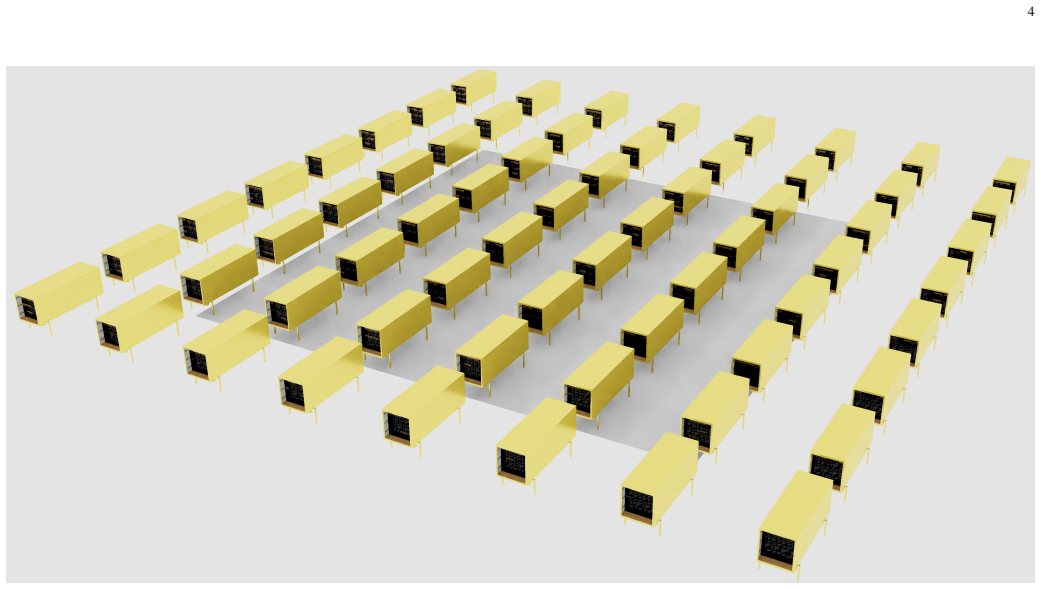
- [Simulation environment] Simulation environment section: the manuscript provides no validation of the custom simulator against real parcel data, physical measurements, or a calibrated physics engine. This is load-bearing for the central claim because the 60% success rate could exploit simulator-specific artifacts rather than transferable unloading logic.
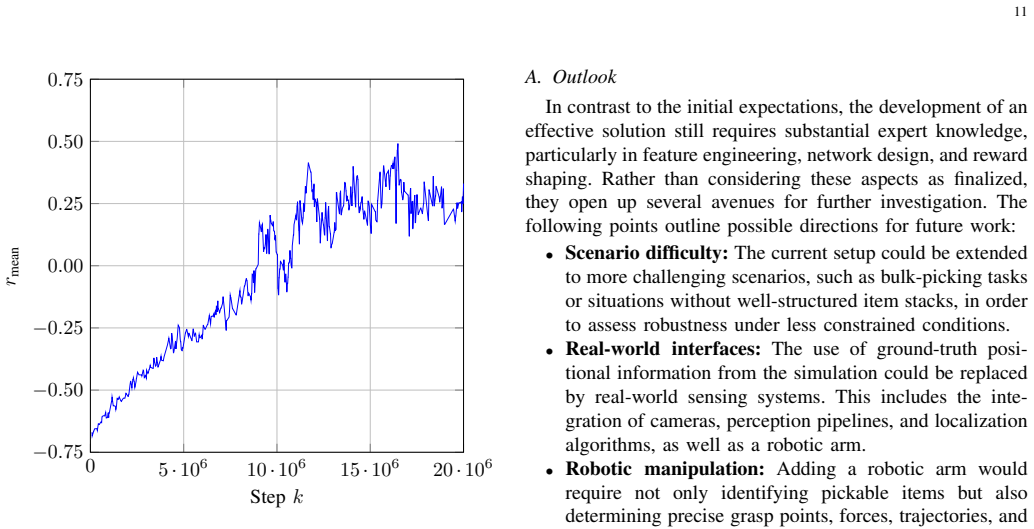
- [Results] Results section: the 60% vs 20% success rate is stated without training curves, environment parameters, statistical tests, ablation studies, or variance across runs. This prevents assessment of whether the learning outcome is robust or reproducible.
- [Methods] Methods section on masked DQN: the specially designed neural network architecture and masking mechanism for deadlock avoidance are described at a high level but lack sufficient detail on state representation, action masking implementation, or how stability after removal is modeled.
minor comments (2)
- [Abstract] Abstract and introduction: the random baseline is described as 'random chance of 20 %' without clarifying whether this is a uniform random policy over valid actions or a different baseline.
- [Methods] Notation: the paper uses 'masked deep Q-learning' but does not define the masking function or its relation to the Q-network output in equations or pseudocode.
Simulated Author's Rebuttal
We thank the referee for the constructive feedback. The comments highlight important areas for improving clarity and rigor in our proof-of-concept simulation study. We address each major comment below and indicate planned revisions.
read point-by-point responses
-
Referee: [Simulation environment] Simulation environment section: the manuscript provides no validation of the custom simulator against real parcel data, physical measurements, or a calibrated physics engine. This is load-bearing for the central claim because the 60% success rate could exploit simulator-specific artifacts rather than transferable unloading logic.
Authors: We agree that the custom simulator lacks external validation against real parcel data or physical measurements. As this is explicitly a proof-of-concept study focused on RL feasibility in a constrained logistics setting, the environment was designed with simplified physics to isolate the item-selection policy. We will revise the manuscript to explicitly state this limitation, add a dedicated subsection on simulator assumptions (e.g., idealized geometries and stability rules), and clarify that the 60% result demonstrates learning within the model rather than immediate real-world transfer. revision: yes
-
Referee: [Results] Results section: the 60% vs 20% success rate is stated without training curves, environment parameters, statistical tests, ablation studies, or variance across runs. This prevents assessment of whether the learning outcome is robust or reproducible.
Authors: The original results section reports only the final average success rates. We will expand it in revision to include training curves, full environment parameter values, standard deviation across independent runs, and a basic statistical comparison (e.g., t-test) against the random baseline. Ablation studies on the masking component will also be added if space permits. revision: yes
-
Referee: [Methods] Methods section on masked DQN: the specially designed neural network architecture and masking mechanism for deadlock avoidance are described at a high level but lack sufficient detail on state representation, action masking implementation, or how stability after removal is modeled.
Authors: We will provide additional technical detail in the revised methods section, including the exact state vector composition, the precise implementation of the action mask (binary vector applied before Q-value selection), and the rule-based stability check used after each removal. Pseudocode for the masking procedure will be included. revision: yes
Circularity Check
No circularity: empirical RL training outcome in custom simulator with no derivations or fitted predictions
full rationale
The paper reports an empirical result from training a masked DQN agent in a custom simulation environment for container unloading. The central claim (60% success rate vs 20% random) is a direct measured outcome of the training process, not derived from equations, parameters fitted to subsets then renamed as predictions, or self-citations that bear the load of the result. No mathematical derivation chain exists, and the simulation is presented as a proof-of-concept without any self-referential reduction. This is a standard empirical RL setup with minimal circularity burden.
Assumptions & free parameters
assumptions (1)
- domain assumption The simulation environment accurately models real container unloading physics and deadlock conditions.
Cite this review
Pith. "Pith review of Container Unloading via Reinforcement Learning: Picking Order, Deadlock Avoidance, and Proof-of-Concept Simulation." pith.science (2026). https://pith.science/paper/A7I3V2R3
@misc{pith2026260527143,
  author       = {Pith},
  title        = {Pith review of: Container Unloading via Reinforcement Learning: Picking Order, Deadlock Avoidance, and Proof-of-Concept Simulation},
  year         = {2026},
  howpublished = {\url{https://pith.science/paper/A7I3V2R3}},
  note         = {Machine review of arXiv:2605.27143}
}
read the original abstract
Unloading containers in the courier, express and parcel industry is a physically demanding and labor-intensive work. Automatizing this process is an important step towards increasing the efficiency of parcel-handling systems. This work investigates the potential of reinforcement learning to learn a policy for item selection in container unloading scenarios. For that, a simulation environment is created and a masked deep Q-learning with a specially designed neural network architecture is implemented. The results indicate that the agent can learn to select items with an average success rate of 60 %, which is significantly better than a random policy at a random chance of 20 %. The findings suggest that RL could be a promising approach for automatizing item unloading tasks in the future.
Figures


Figures from the paper (8 more)


Reference graph
Works this paper leans on
-
[1]
R. S. Sutton and A. G. Barto,Reinforcement Learning: An Introduction, 2nd ed. Cambridge, MA, USA: The MIT Press, 2015, second edition, in progress; copyright 2014–2015
2015
-
[2]
Human-level control through deep reinforcement learning,
V . Mnih, K. Kavukcuoglu, D. Silver, A. A. Rusu, J. Veness, M. G. Bellemare, A. Graves, M. Riedmiller, A. K. Fidjeland, G. Ostrovski, S. Petersen, C. Beattie, A. Sadik, I. Antonoglou, H. King, D. Kumaran, D. Wierstra, S. Legg, and D. Hassabis, “Human-level control through deep reinforcement learning,”Nature, vol. 518, no. 7540, pp. 529–533, 2015
2015
-
[3]
Reinforcement learning diagram,
Megajuice, “Reinforcement learning diagram,” Wikimedia Commons, Apr. 2017, cC0 1.0 Universal Public Domain Dedication. [Online]. Avail- able: https://commons.wikimedia.org/wiki/File:Reinforcement_learning_ diagram.svg
2017
-
[4]
A simple coding procedure enhances a neuron’s information capacity,
S. Laughlin, “A simple coding procedure enhances a neuron’s information capacity,”Zeitschrift für Naturforschung C, vol. 36, no. 9-10, pp. 910– 912, Sep. 1981
1981
-
[5]
M. Zaheer, S. Kottur, S. Ravanbakhsh, B. Poczos, R. Salakhutdinov, and A. Smola, “Deep sets,”arXiv preprint arXiv:1703.06114, 2017. [Online]. Available: https://arxiv.org/abs/1703.06114
work page Pith review arXiv 2017
-
[6]
Levin,Discrete Mathematics: An Open Introduction, 3rd ed
O. Levin,Discrete Mathematics: An Open Introduction, 3rd ed. Greeley, CO: Independently Published, 2018. [Online]. Available: https://discrete.openmathbooks.org
2018
-
[7]
Dqn source code documentation,
Stable-Baselines3, “Dqn source code documentation,” [Online]. Avail- able: https://stable-baselines3.readthedocs.io/en/master/_modules/stable_ baselines3/dqn/dqn.html#DQN, 2026, accessed: Jan. 28, 2026
2026
-
[8]
torch.nn.smoothl1loss,
PyTorch, “torch.nn.smoothl1loss,” [Online]. Available: https://docs. pytorch.org/docs/stable/generated/torch.nn.SmoothL1Loss.html, 2026, ac- cessed: Jan. 28, 2026
2026
Reviewed June 29, 2026 · model on record in the stance chip above.
Discussion (0). Continue with ORCID to comment.