REVIEW 3 major objections 8 minor 123 references
On the black hole content and initial mass function of 47 Tuc
T0 review · 3 major / 8 minor · reviewed 2026-08-14 · deepseek-v4-flash
Pith's one-line read 47 Tuc does not need an intermediate-mass black hole; a self-consistent multimass model with mass-segregated stellar remnants explains the cluster's kinematics, stellar mass functions, and millisecond-pulsar accelerations.
desk verdict A solid, careful refutation of the 47 Tuc IMBH claim using a self-consistent multimass fit, with the no-IMBH conclusion holding up while the bottom-light IMF claim is weaker than the abstract suggests. read the letter →
The pith
A machine-rendered reading of the paper's core claim, the machinery that carries it, and where it could break.
The reading
What carries the argument
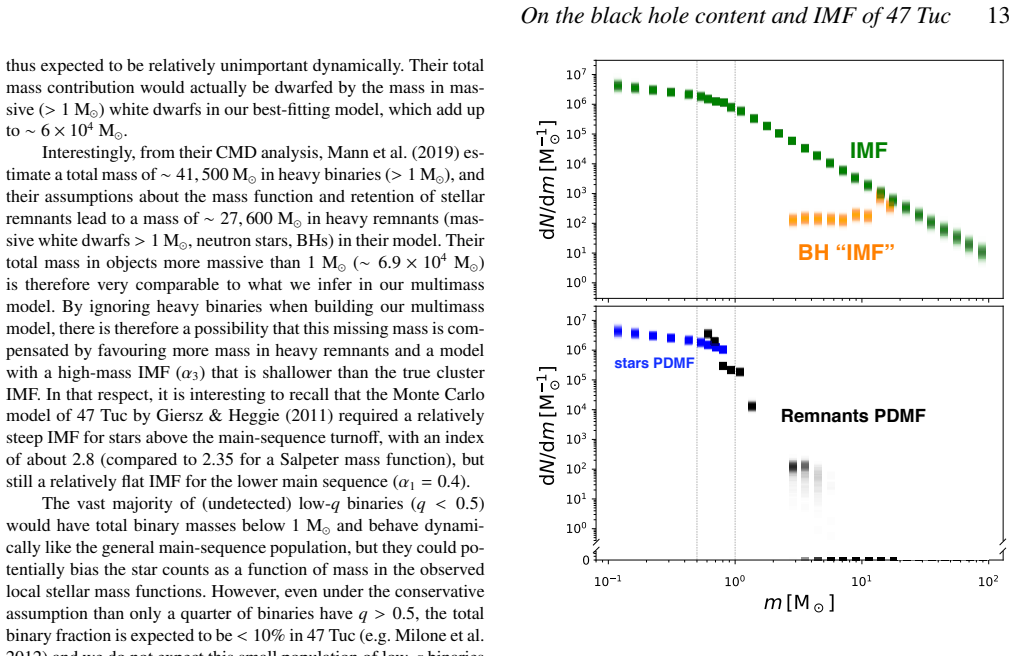
The load-bearing tool is the 'limepy' family of self-consistent, spherically symmetric multimass dynamical models, in which an almost-isothermal distribution function is truncated at an escape energy and each mass component has its own velocity scale set by $s_j \propto m_j^{-\delta}$ (best fit $\delta\simeq0.44$) to mimic partial energy equipartition and mass segregation. A three-part broken power law with slopes $\alpha_1,\alpha_2,\alpha_3$ and breaks at $0.5$ and $1\,M_\odot$ is evolved to the present day through an initial-final mass relation, producing white dwarfs, neutron stars, and black holes, with the black-hole retention fraction and the anisotropy radius as free parameters. The mechanism that carries the argument is that heavy remnants sink to the centre by dynamical friction, inflating the central velocity dispersion and shaping the radial gradient of the visible stellar mass function; the fit therefore lets visible, low-mass stars act as tracers of the otherwise invisible dark content and of the stellar IMF above the present-day turn-off mass.
What would settle it
A long-baseline timing measurement of any 47 Tuc pulsar whose inferred line-of-sight acceleration lies significantly outside the envelope predicted by the best-fit mass-segregated model would reopen the IMBH case; conversely, deep photometry of the cluster's white-dwarf cooling sequence that shows the same low-mass depletion as the main sequence would support the bottom-light IMF, while a white-dwarf population normal at low masses would indicate early dynamical loss instead.
Extended reading notes
Core claim
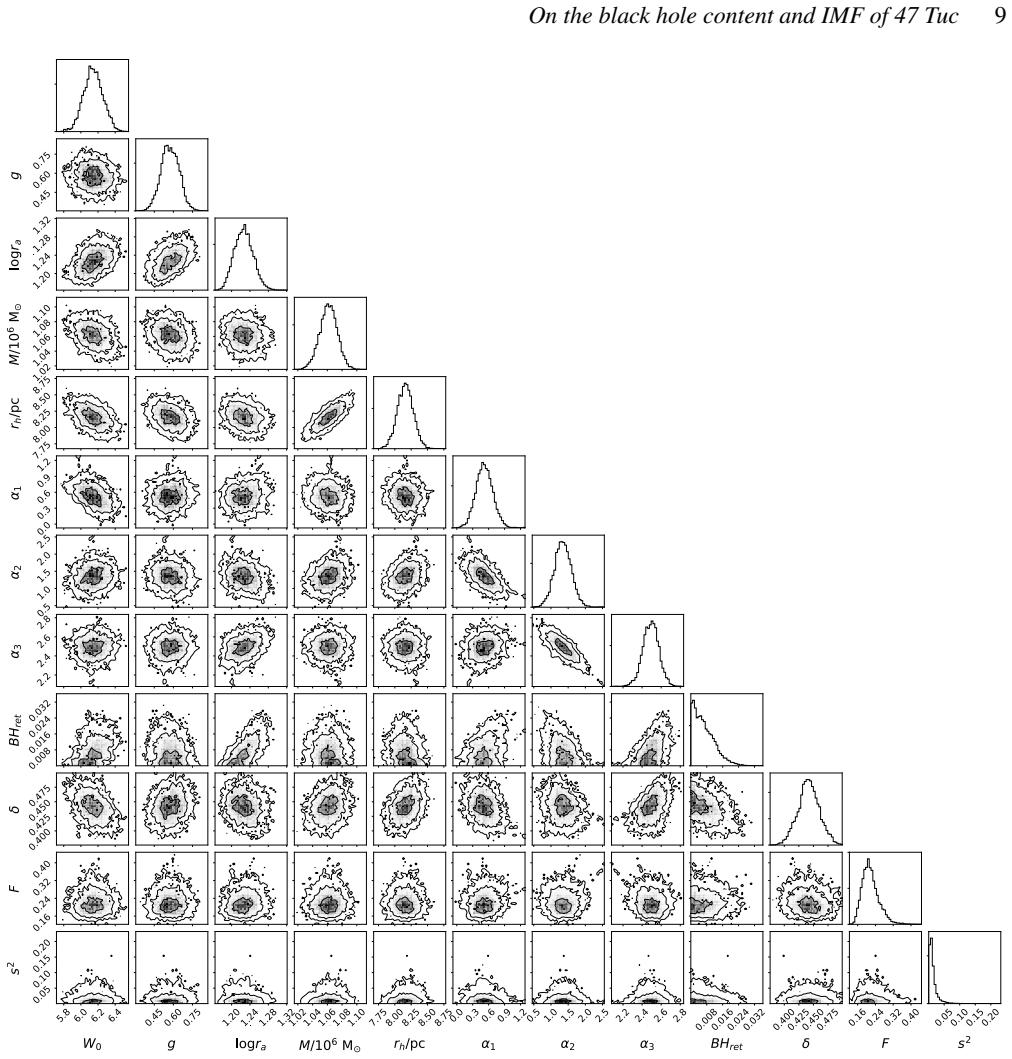
On the paper's own terms, the discovery is that the observable structure of 47 Tuc can be reproduced by a family of equilibrium multimass models that contains no IMBH, once the stellar mass function and the retention fraction of stellar-mass black holes are treated as free parameters. The best-fitting model has a total black-hole mass of $430^{+386}_{-301}\,M_\odot$, corresponding to roughly 141 black holes with a mean mass of $3.1\,M_\odot$, while still being consistent within about $1.5\sigma$ with a cluster that retains almost no black holes. The same model, without any IMBH, predicts the observed radial distribution of millisecond pulsars and accommodates the line-of-sight accelerations inferred from their period derivatives. The inferred global present-day stellar mass function is shallow at low masses ($\alpha_1=0.52^{+0.17}_{-0.16}$ for $m<0.5\,M_\odot$), which the authors interpret, given the cluster's long relaxation time and mild orbit, as evidence that 47 Tuc may have formed with a bottom-light IMF; the slope above $1\,M_\odot$ is $\alpha_3=2.49\pm0.08$, close to Salpeter.
Load-bearing premise
The argument stands on the assumption that 47 Tuc has not lost a significant population of its lowest-mass stars over its lifetime; if early dynamical encounters or tidal stripping removed them, the cluster's flat low-mass stellar census would not prove that it formed with fewer low-mass stars.
Editorial extensions
If this is right
- The pulsar accelerations in 47 Tuc are explained without an IMBH, so future IMBH claims in globular clusters should confront mass-segregated models with a free stellar mass function and remnant content before being accepted.
- The inferred black-hole population is small, $430^{+386}_{-301}\,M_\odot$ in total, which bounds the present-day reservoir available for dynamically formed black-hole binaries and connects to the cluster's initial density and natal-kick physics.
- A bottom-light IMF in a massive, metal-rich cluster would mean the canonical Kroupa and Salpeter IMFs are not universal in globular-cluster formation, affecting mass-to-light ratios and the interpretation of unresolved cluster populations.
- The high-mass slope of $\alpha_3=2.49\pm0.08$ demonstrates a route to measure the IMF above the present turn-off mass via the dynamical signature of dark remnants, not by counting stars.
- The low black-hole retention and flat mass function can be jointly explained if 47 Tuc formed very dense and dynamically ejected its black holes early, linking two otherwise separate conclusions.
Reading between the lines
- If the bottom-light IMF reading is correct, other massive, metal-rich Galactic globular clusters with similarly long relaxation times should show the same flattened low-mass mass function; a systematic survey could test whether the IMF varies with metallicity or birth environment.
- The early-loss alternative could be distinguished observationally: if low-mass stars were stripped by giant-molecular-cloud encounters in a dense birth environment, the white-dwarf cooling sequence should be deficient in the low-mass progenitors, whereas a bottom-light IMF would not imprint that specific remnant signature.
- The same fitting machinery could be applied to other pulsar-rich globular clusters such as NGC 6624 or Terzan 5, where pulsar timing has been used to argue for central black holes; with mass-function freedom, those arguments may dissolve as they did for 47 Tuc.
- Individual black-hole mass measurements in 47 Tuc, from microlensing or detached binaries, would break the degeneracy between many low-mass retained black holes and few high-mass ones, since the paper's dynamical-ejection assumption predicts a population of only a few solar masses.
Signed reviews
Editorial analysis
A structured set of objections, weighed in public.
Referee Report
Summary. The paper presents self-consistent multimass limepy equilibrium models of the globular cluster 47 Tuc in which the three-slope broken power-law stellar mass function, the black-hole retention fraction, and the mass-segregation exponent are fitted by MCMC simultaneously to the projected number density profile, line-of-sight and proper-motion velocity dispersion profiles, and local stellar mass functions in four inner annuli. The best-fitting model without an IMBH matches all fitted datasets and is then compared, out-of-sample, with the cumulative radial distribution of 25 millisecond pulsars and with the line-of-sight accelerations inferred from ten binary orbital-period derivatives and thirteen spin-down upper limits. The authors conclude that no central IMBH is needed, infer a total present-day BH mass of 430+386−301 Msun (while noting that the most likely model has very few BHs and that zero BHs is allowed within ~1.5σ), and infer a flat low-mass slope α1 = 0.52±0.17, which they argue suggests a bottom-light initial mass function, together with a high-mass slope α3 = −2.49±0.08 close to Salpeter. Robustness tests cover distance (4.2–4.7 kpc), neutron-star retention, and the tracer mass of the outer proper-motion sample; binaries and early dynamical mass loss are not modeled.
Significance. The no-IMBH conclusion is significant and well supported: 47 Tuc was a flagship claimed IMBH host, and this analysis, together with Mann et al. (2019), shows that a model with mass-segregated stellar remnants and no IMBH reproduces the central kinematics. The pulsar comparison is a genuine strength: the radial distribution and accelerations were not used in the fit, so the agreement is a non-circular, falsifiable prediction of the mass model. Additional strengths are the availability of the limepy code, the prior validation of these distribution-function models against direct N-body snapshots, and the explicit robustness tests on distance, NS retention, and tracer-mass assumptions. If the IMF inference holds, the method also offers a new route to probing the IMF above the present-day turn-off. The conditional character of the IMF claim, acknowledged partly in Section 5.3, is the main element that separates the robust no-IMBH result from the more speculative bottom-light-IMF conclusion.
major comments (3)
- [§3.2, §4.3, §5.2–5.3] The inference that 47 Tuc 'may have formed with a bottom-light IMF' rests entirely on the assumption in §3.2 that 'modification of the mass function by dynamical evolution and preferential escape of low-mass stars and remnants is negligible for 47 Tuc', which lets the fitted present-day slope α1 = 0.52 be read as an initial slope. This assumption is load-bearing, and the paper's own §5.3 concedes that a dense early phase (initial half-mass relaxation time ~100 Myr) could fully mass-segregate the cluster and lose low-mass stars, and that Δα ≈ 0.8 requires only ~40% evaporative mass loss. The present-day data therefore cannot distinguish a genuinely bottom-light IMF from a standard Kroupa IMF depleted by early dynamical evolution, and the paper acknowledges this ('we cannot exclude'). Because the abstract and title nevertheless foreground the IMF conclusion, I ask that the authors either (i) test the assumption quantitatively, e.g., by fitting with an additional early mass-loss term or by evolving a Kroupa-IMF cluster in an N-body/Monte Carlo calculation with dense initial conditions and comparing the resulting present-day observables to the same likelihood, or (ii) explicitly reframe the bottom-light claim as a present-day mass-function result with an unresolved degeneracy.
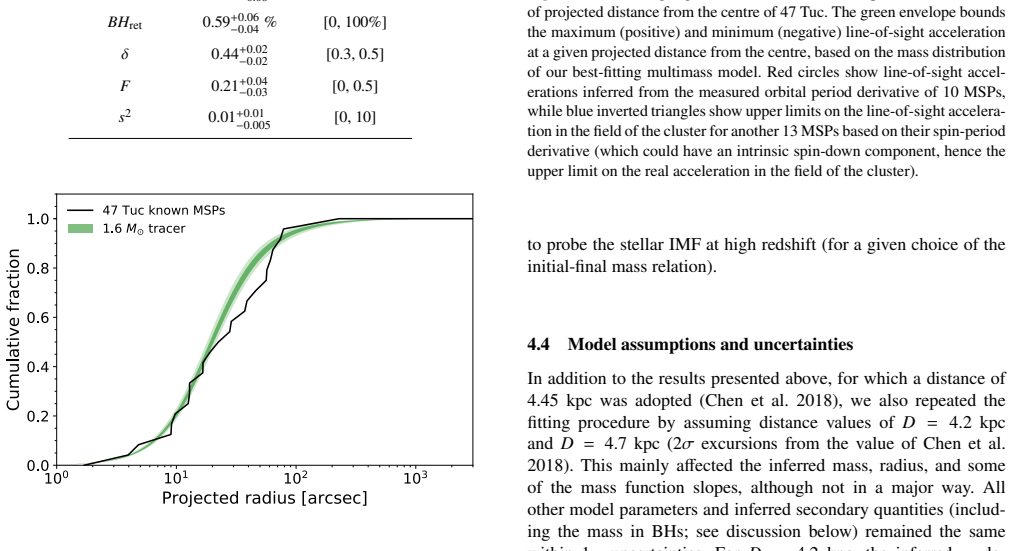
- [§4.2, Fig. 4, Abstract] The abstract states that the model 'correctly predicts the radial distribution of millisecond pulsars and their gravitational accelerations', but the comparison in Fig. 4 is made against the deterministic maximum/minimum line-of-sight acceleration envelope, not against the probability distribution of accelerations predicted by the model at the observed projected radii, and the Fig. 3 radial comparison is visual only; no goodness-of-fit statistic is reported for either test. The reader cannot judge how likely the observed configuration is under the best-fit model, which weakens the advertised out-of-sample validation. I recommend computing the full predicted acceleration distribution (e.g., percentiles) for the pulsar sample, accounting for the selection function of detectable MSPs, and reporting a quantitative test (e.g., a KS or likelihood-ratio statistic) for both the radial and acceleration comparisons, or softening the abstract's wording accordingly.
- [Abstract, §5.1.2, Fig. 6] The headline statement that 'the data favours a population of BHs with a total mass of 430+386−301 Msun' is difficult to reconcile with the same abstract's statement that 'the most likely model has very few BHs' and with §5.1.2's statement that the results are 'consistent with a negligible number of BHs within ~1.5σ'. The posterior for the total BH mass is evidently strongly skewed, with the mode near zero and the median at 430 Msun; reporting the median of such a distribution as a favored value is misleading. I recommend summarizing the constraint as an upper limit (with the median in parentheses if desired), and checking whether the uniform prior on BHret in 0–100% and the degeneracy with α3 contribute undue weight to the high-BH tail of the posterior.
minor comments (8)
- [§3.3] The free-parameter list reads 'α1, α3, α3' and should be 'α1, α2, α3'.
- [Eq. (3)] The tangential proper-motion likelihood uses δσpmR∗,i in the denominator where δσpmT∗,i is intended.
- [Eq. (6) and following text] The mass-function likelihood mixes δN∗,i(R) and δN∗,i(m); the uncertainty should be written consistently as a function of mass.
- [§3.3] There are two typos in this section: 'standard devitiation' and 'nuisance parameters2'.
- [§4.3, §4.4] 'It is worth nothing that...' should read 'worth noting' in §4.3, and 'Al other model parameters' should read 'All other model parameters' in §4.4.
- [§6] The conclusions contain the misspellings 'simultanenous' and 'accomodate'.
- [§3.2] The phrase 'given the estimates the of initial mass and escape velocity at formation' is garbled and should be rewritten.
- [Fig. 4] Showing percentiles of the predicted acceleration distribution in addition to the extrema would aid interpretation, since the paper itself notes that the distribution peaks near the boundaries.
Circularity Check
Independent, out-of-sample checks; no circularity found.
full rationale
The derivation is not circular. The free parameters, including the mass-function slopes and black-hole retention fraction, are fit to the number density profile, proper-motion and line-of-sight velocity dispersions, and the local stellar mass functions (Section 3.3, Eq. 7). The millisecond-pulsar data are explicitly withheld from the fit: Section 2.4 states that pulsar data 'are compared to our best-fitting models to serve as a consistency check', and Section 4.2 compares the cumulative radial distribution and inferred accelerations to the model predictions. These are therefore genuine out-of-sample predictions, not fitted inputs. The bottom-light IMF conclusion is conditional on the Section 3.2 assumption that 'modification of the mass function by dynamical evolution and preferential escape of low-mass stars and remnants is assumed to be negligible for 47 Tuc'; the paper itself flags the early-dense-phase degeneracy in Section 5.3, so the IMF claim is a caveated inference rather than a circular one. The self-citations to the limepy model and its validation (Gieles & Zocchi 2015; Peuten et al. 2017) and to the mock-recovery test (Hénault-Brunet et al. 2019) report comparisons against N-body simulations and mock data, so they constitute independent support rather than a self-citation chain. No fitted quantity is defined in terms of the no-IMBH conclusion, and no prediction reduces to a fit by construction.
Assumptions & free parameters
free parameters (12)
- W0 (dimensionless central potential) =
6.1
- g (truncation sharpness) =
0.57
- log10(ra/pc) (anisotropy radius) =
1.23
- M (total cluster mass) =
1.06e6 Msun
- rh (half-mass radius) =
8.16 pc
- alpha1 (low-mass MF slope, m < 0.5 Msun) =
0.52
- alpha2 (intermediate MF slope, 0.5-1 Msun) =
1.35
- alpha3 (high-mass MF slope, m > 1 Msun) =
2.49
- BHret (black hole retention fraction) =
0.59%
- delta (mass segregation exponent) =
0.44
- F (nuisance fractional uncertainty on MF) =
0.21
- s2 (nuisance variance on density profile) =
0.01
assumptions (10)
- domain assumption The limepy multimass distribution function accurately describes the phase-space structure of evolved multimass star clusters including mass segregation.
- domain assumption A single anisotropy radius ra applies to all mass components.
- domain assumption Velocity scale of each mass component follows s_j proportional to m_j^-delta.
- domain assumption Dynamical evolution and preferential escape of low-mass stars and remnants are negligible for 47 Tuc.
- domain assumption The initial mass function is a three-component broken power law with break masses at 0.5 and 1 solar mass.
- domain assumption The mass function evolution algorithm maps initial masses to white dwarfs, neutron stars, and black holes for [Fe/H]=-0.7 and age 11 Gyr.
- domain assumption Black holes are 100 percent retained after supernovae, then dynamically ejected massive-first according to BHret.
- domain assumption The observed number density profile traces the spatial distribution of upper main-sequence and evolved stars.
- domain assumption The adopted distance to 47 Tuc is 4.45 kpc.
- domain assumption Neutron stars are retained at 10 percent and the result is insensitive to this.
Cite this review
Pith. "Pith review of On the black hole content and initial mass function of 47 Tuc." pith.science (2026). https://pith.science/paper/A7PG44JC
@misc{pith2026190808538,
  author       = {Pith},
  title        = {Pith review of: On the black hole content and initial mass function of 47 Tuc},
  year         = {2026},
  howpublished = {\url{https://pith.science/paper/A7PG44JC}},
  note         = {Machine review of arXiv:1908.08538}
}
abstract
The globular cluster (GC) 47 Tuc has recently been proposed to host an intermediate-mass black hole (IMBH) or a population of stellar-mass black holes (BHs). To shed light on its dark content, we present an application of self-consistent multimass models with a varying mass function and content of stellar remnants, which we fit to various observational constraints. Our best-fitting model successfully matches the observables and correctly predicts the radial distribution of millisecond pulsars and their gravitational accelerations inferred from long-term timing observations. The data favours a population of BHs with a total mass of $430^{+386}_{-301}$ $M_{\odot}$, but the most likely model has very few BHs. Since our models do not include a central IMBH and accurately reproduce the observations, we conclude that there is currently no need to invoke the presence of an IMBH in 47 Tuc. The global present-day mass function inferred is significantly depleted in low-mass stars (power-law slope $\alpha=-0.52^{+0.17}_{-0.16}$). Given the orbit and predicted mass-loss history of this massive GC, the dearth of low-mass stars is difficult to explain with a standard initial mass function (IMF) followed by long-term preferential escape of low-mass stars driven by two-body relaxation, and instead suggests that 47 Tuc may have formed with a bottom-light IMF. We discuss alternative evolutionary origins for the flat mass function and ways to reconcile this with the low BH retention fraction. Finally, by capturing the effect of dark remnants, our method offers a new way to probe the IMF in a GC above the current main-sequence turn-off mass, for which we find a slope of $-2.49\pm0.08$.
Figures


Figures from the paper (4 more)


Reference graph
Works this paper leans on
-
[1]
Abbott B. P., et al., 2016a, @doi [Physical Review Letters] 10.1103/PhysRevLett.116.061102 , http://adsabs.harvard.edu/abs/2016PhRvL.116f1102A 116, 061102
-
[2]
Abbott B. P., et al., 2016b, @doi [ ] 10.3847/2041-8205/818/2/L22 , http://adsabs.harvard.edu/abs/2016ApJ...818L..22A 818, L22
-
[3]
Antonini F., Gieles M., 2019, arXiv:1906.11855, https://ui.adsabs.harvard.edu/abs/2019arXiv190611855A p. arXiv:1906.11855
arXiv 2019
-
[4]
Antonini F., Gieles M., Gualandris A., 2019, @doi [ ] 10.1093/mnras/stz1149 , https://ui.adsabs.harvard.edu/abs/2019MNRAS.486.5008A 486, 5008
-
[5]
Arca Sedda M., Askar A., Giersz M., 2018, @doi [ ] 10.1093/mnras/sty1859 , https://ui.adsabs.harvard.edu/abs/2018MNRAS.479.4652A 479, 4652
-
[6]
Askar A., Arca Sedda M., Giersz M., 2018, @doi [ ] 10.1093/mnras/sty1186 , http://adsabs.harvard.edu/abs/2018MNRAS.478.1844A 478, 1844
-
[7]
Bahcall J. N., Wolf R. A., 1976, @doi [ ] 10.1086/154711 , http://adsabs.harvard.edu/abs/1976ApJ...209..214B 209, 214
doi:10.1086/154711 1976
-
[8]
Bahramian A., et al., 2017, @doi [ ] 10.1093/mnras/stx166 , https://ui.adsabs.harvard.edu/abs/2017MNRAS.467.2199B 467, 2199
Show all 123 references
-
[9]
Balbinot E., Gieles M., 2018, @doi [ ] 10.1093/mnras/stx2708 , https://ui.adsabs.harvard.edu/abs/2018MNRAS.474.2479B 474, 2479
2018 doi
-
[10]
Baumgardt H., 2017, @doi [ ] 10.1093/mnras/stw2488 , http://adsabs.harvard.edu/abs/2017MNRAS.464.2174B 464, 2174
2017 doi
-
[11]
Baumgardt H., Hilker M., 2018, @doi [ ] 10.1093/mnras/sty1057 , http://adsabs.harvard.edu/abs/2018MNRAS.478.1520B 478, 1520
2018 doi
-
[12]
Baumgardt H., Makino J., 2003, @doi [ ] 10.1046/j.1365-8711.2003.06286.x , https://ui.adsabs.harvard.edu/abs/2003MNRAS.340..227B 340, 227
2003
-
[13]
Baumgardt H., et al., 2019, @doi [ ] 10.1093/mnras/stz2060 , https://ui.adsabs.harvard.edu/abs/2019MNRAS.tmp.1999B p. 1999
2019 doi
-
[14]
A., Taam R
Belczynski K., Kalogera V., Rasio F. A., Taam R. E., Zezas A., Bulik T., Maccarone T. J., Ivanova N., 2008, @doi [ ] 10.1086/521026 , https://ui.adsabs.harvard.edu/abs/2008ApJS..174..223B 174, 223
2008 doi
-
[15]
L., Holz D
Belczynski K., Wiktorowicz G., Fryer C. L., Holz D. E., Kalogera V., 2012, @doi [ ] 10.1088/0004-637X/757/1/91 , https://ui.adsabs.harvard.edu/abs/2012ApJ...757...91B 757, 91
2012 doi
-
[16]
Bellini A., et al., 2014, @doi [ ] 10.1088/0004-637X/797/2/115 , http://adsabs.harvard.edu/abs/2014ApJ...797..115B 797, 115
2014 doi
-
[17]
L., Anderson J., Piotto G., van der Marel R
Bellini A., Bianchini P., Varri A. L., Anderson J., Piotto G., van der Marel R. P., Vesperini E., Watkins L. L., 2017, @doi [ ] 10.3847/1538-4357/aa7c5f , http://adsabs.harvard.edu/abs/2017ApJ...844..167B 844, 167
2017 doi
-
[18]
A., van de Ven G., Schinnerer E., 2015, @doi [ ] 10.1093/mnras/stv1651 , http://adsabs.harvard.edu/abs/2015MNRAS.453..365B 453, 365
Bianchini P., Norris M. A., van de Ven G., Schinnerer E., 2015, @doi [ ] 10.1093/mnras/stv1651 , http://adsabs.harvard.edu/abs/2015MNRAS.453..365B 453, 365
2015 doi
-
[19]
A., Schinnerer E., Varri A
Bianchini P., van de Ven G., Norris M. A., Schinnerer E., Varri A. L., 2016, @doi [ ] 10.1093/mnras/stw552 , http://adsabs.harvard.edu/abs/2016MNRAS.458.3644B 458, 3644
2016 doi
-
[20]
G., Heggie D
Breen P. G., Heggie D. C., 2013, @doi [ ] 10.1093/mnras/stt628 , https://ui.adsabs.harvard.edu/abs/2013MNRAS.432.2779B 432, 2779
2013 doi
-
[21]
Cappellari M., et al., 2012, @doi [ ] 10.1038/nature10972 , https://ui.adsabs.harvard.edu/abs/2012Natur.484..485C 484, 485
2012 doi
-
[22]
Carretta E., et al., 2009, @doi [ ] 10.1051/0004-6361/200912096 , http://adsabs.harvard.edu/abs/2009A
2009 doi
-
[23]
Chen S., Richer H., Caiazzo I., Heyl J., 2018, @doi [ ] 10.3847/1538-4357/aae089 , http://adsabs.harvard.edu/abs/2018ApJ...867..132C 867, 132
2018 doi
-
[24]
P., Strader J., Davies M
Church R. P., Strader J., Davies M. B., Bobrick A., 2017, @doi [ ] 10.3847/2041-8213/aa9aeb , https://ui.adsabs.harvard.edu/abs/2017ApJ...851L...4C 851, L4
2017 doi
-
[25]
Claydon I., Gieles M., Zocchi A., 2017, @doi [ ] 10.1093/mnras/stw3309 , http://adsabs.harvard.edu/abs/2017MNRAS.466.3937C 466, 3937
2017 doi
-
[26]
L., Heggie D
Claydon I., Gieles M., Varri A. L., Heggie D. C., Zocchi A., 2019, @doi [ ] 10.1093/mnras/stz1109 , https://ui.adsabs.harvard.edu/abs/2019MNRAS.487..147C 487, 147
2019 doi
-
[27]
G., 2012, @doi [ ] 10.1088/0004-637X/760/1/71 , https://ui.adsabs.harvard.edu/abs/2012ApJ...760...71C 760, 71
Conroy C., van Dokkum P. G., 2012, @doi [ ] 10.1088/0004-637X/760/1/71 , https://ui.adsabs.harvard.edu/abs/2012ApJ...760...71C 760, 71
2012 doi
-
[28]
S., 2016, @doi [ ] 10.1093/mnras/stv2315 , http://adsabs.harvard.edu/abs/2016MNRAS.455..199D 455, 199
Da Costa G. S., 2016, @doi [ ] 10.1093/mnras/stv2315 , http://adsabs.harvard.edu/abs/2016MNRAS.455..199D 455, 199
2016 doi
-
[29]
J., Heggie D
Daniel K. J., Heggie D. C., Varri A. L., 2017, @doi [ ] 10.1093/mnras/stx571 , https://ui.adsabs.harvard.edu/abs/2017MNRAS.468.1453D 468, 1453
2017 doi
-
[30]
Dotter A., 2016, @doi [ ] 10.3847/0067-0049/222/1/8 , https://ui.adsabs.harvard.edu/abs/2016ApJS..222....8D 222, 8
2016 doi
-
[31]
W., Sarajedini A., Anderson J., 2007, @doi [ ] 10.1086/517915 , https://ui.adsabs.harvard.edu/abs/2007AJ....134..376D 134, 376
Dotter A., Chaboyer B., Jevremovi \'c D., Baron E., Ferguson J. W., Sarajedini A., Anderson J., 2007, @doi [ ] 10.1086/517915 , https://ui.adsabs.harvard.edu/abs/2007AJ....134..376D 134, 376
2007 doi
-
[32]
Dotter A., et al., 2010, @doi [ ] 10.1088/0004-637X/708/1/698 , http://adsabs.harvard.edu/abs/2010ApJ...708..698D 708, 698
2010 doi
-
[33]
Ferrarese L., Merritt D., 2000, @doi [ ] 10.1086/312838 , http://adsabs.harvard.edu/abs/2000ApJ...539L...9F 539, L9
2000 doi
-
[34]
W., Lang D., Goodman J., 2013, @doi [ ] 10.1086/670067 , http://adsabs.harvard.edu/abs/2013PASP..125..306F 125, 306
Foreman-Mackey D., Hogg D. W., Lang D., Goodman J., 2013, @doi [ ] 10.1086/670067 , http://adsabs.harvard.edu/abs/2013PASP..125..306F 125, 306
2013 doi
-
[35]
Freire P. C. C., Ridolfi A., 2018, @doi [ ] 10.1093/mnras/sty524 , http://adsabs.harvard.edu/abs/2018MNRAS.476.4794F 476, 4794
2018 doi
-
[36]
Freire P. C. C., et al., 2017, @doi [ ] 10.1093/mnras/stx1533 , http://adsabs.harvard.edu/abs/2017MNRAS.471..857F 471, 857
2017 doi
-
[37]
C., 2000, @doi [ ] 10.1046/j.1365-8711.2000.03811.x , http://adsabs.harvard.edu/abs/2000MNRAS.318..753F 318, 753
Fukushige T., Heggie D. C., 2000, @doi [ ] 10.1046/j.1365-8711.2000.03811.x , http://adsabs.harvard.edu/abs/2000MNRAS.318..753F 318, 753
2000
-
[38]
Gaia Collaboration et al., 2018, @doi [ ] 10.1051/0004-6361/201832698 , https://ui.adsabs.harvard.edu/abs/2018A&A...616A..12G 616, A12
2018 doi
-
[39]
B., Hesser J
Gebhardt K., Pryor C., Williams T. B., Hesser J. E., 1995, @doi [ ] 10.1086/117642 , http://adsabs.harvard.edu/abs/1995AJ....110.1699G 110, 1699
1995 doi
-
[40]
Gebhardt K., et al., 2000, @doi [ ] 10.1086/312840 , http://adsabs.harvard.edu/abs/2000ApJ...539L..13G 539, L13
2000 doi
-
[41]
Gieles M., Zocchi A., 2015, @doi [ ] 10.1093/mnras/stv1848 , http://adsabs.harvard.edu/abs/2015MNRAS.454..576G 454, 576
2015 doi
-
[42]
Gieles M., Balbinot E., Yaaqib R. I. S. M., H \'e nault-Brunet V., Zocchi A., Peuten M., Jonker P. G., 2018a, @doi [ ] 10.1093/mnras/stx2694 , http://adsabs.harvard.edu/abs/2018MNRAS.473.4832G 473, 4832
-
[43]
Gieles M., et al., 2018b, @doi [ ] 10.1093/mnras/sty1059 , https://ui.adsabs.harvard.edu/abs/2018MNRAS.478.2461G 478, 2461
-
[44]
C., 2011, @doi [ ] 10.1111/j.1365-2966.2010.17648.x , http://adsabs.harvard.edu/abs/2011MNRAS.410.2698G 410, 2698
Giersz M., Heggie D. C., 2011, @doi [ ] 10.1111/j.1365-2966.2010.17648.x , http://adsabs.harvard.edu/abs/2011MNRAS.410.2698G 410, 2698
2011
-
[45]
Giersz M., Leigh N., Hypki A., L \"u tzgendorf N., Askar A., 2015, @doi [ ] 10.1093/mnras/stv2162 , http://adsabs.harvard.edu/abs/2015MNRAS.454.3150G 454, 3150
2015 doi
-
[46]
Giesers B., et al., 2018, @doi [ ] 10.1093/mnrasl/slx203 , http://adsabs.harvard.edu/abs/2018MNRAS.475L..15G 475, L15
2018 doi
-
[47]
B., Anderson J., Dotter A., Sarajedini A., Woodley K., 2010, @doi [ ] 10.1088/0004-6256/140/6/1830 , http://adsabs.harvard.edu/abs/2010AJ....140.1830G 140, 1830
Goldsbury R., Richer H. B., Anderson J., Dotter A., Sarajedini A., Woodley K., 2010, @doi [ ] 10.1088/0004-6256/140/6/1830 , http://adsabs.harvard.edu/abs/2010AJ....140.1830G 140, 1830
2010 doi
-
[48]
G., et al., 2013, @doi [ ] 10.1051/0004-6361/201219976 , http://adsabs.harvard.edu/abs/2013A
Gratton R. G., et al., 2013, @doi [ ] 10.1051/0004-6361/201219976 , http://adsabs.harvard.edu/abs/2013A
2013 doi
-
[49]
E., Griffin R
Gunn J. E., Griffin R. F., 1979, @doi [ ] 10.1086/112477 , http://adsabs.harvard.edu/abs/1979AJ.....84..752G 84, 752
1979 doi
-
[50]
Hansen B. M. S., et al., 2013, @doi [ ] 10.1038/nature12334 , http://adsabs.harvard.edu/abs/2013Natur.500...51H 500, 51
2013 doi
-
[51]
L., Zocchi A., Claydon I., Pancino E., Baumgardt H., 2019, @doi [ ] 10.1093/mnras/sty3187 , https://ui.adsabs.harvard.edu/abs/2019MNRAS.483.1400H 483, 1400
H \'e nault-Brunet V., Gieles M., Sollima A., Watkins L. L., Zocchi A., Claydon I., Pancino E., Baumgardt H., 2019, @doi [ ] 10.1093/mnras/sty3187 , https://ui.adsabs.harvard.edu/abs/2019MNRAS.483.1400H 483, 1400
2019 doi
-
[52]
Heyl J., Caiazzo I., Richer H., Anderson J., Kalirai J., Parada J., 2017, @doi [ ] 10.3847/1538-4357/aa974f , http://adsabs.harvard.edu/abs/2017ApJ...850..186H 850, 186
2017 doi
-
[53]
R., 1977, @doi [ ] 10.1086/182586 , http://adsabs.harvard.edu/abs/1977ApJ...218L.109I 218, L109
Illingworth G., King I. R., 1977, @doi [ ] 10.1086/182586 , http://adsabs.harvard.edu/abs/1977ApJ...218L.109I 218, L109
1977 doi
-
[54]
Kamann S., et al., 2018, @doi [ ] 10.1093/mnras/stx2719 , http://adsabs.harvard.edu/abs/2018MNRAS.473.5591K 473, 5591
2018 doi
-
[55]
I., Strader J., Caldwell N., Anderton T., Gregersen D., 2015, @doi [ ] 10.1088/0004-6256/149/2/53 , http://adsabs.harvard.edu/abs/2015AJ....149...53K 149, 53
Kimmig B., Seth A., Ivans I. I., Strader J., Caldwell N., Anderton T., Gregersen D., 2015, @doi [ ] 10.1088/0004-6256/149/2/53 , http://adsabs.harvard.edu/abs/2015AJ....149...53K 149, 53
2015 doi
-
[56]
R., 1966, @doi [ ] 10.1086/109857 , http://adsabs.harvard.edu/abs/1966AJ.....71...64K 71, 64
King I. R., 1966, @doi [ ] 10.1086/109857 , http://adsabs.harvard.edu/abs/1966AJ.....71...64K 71, 64
1966 doi
-
[57]
K z ltan B., Baumgardt H., Loeb A., 2017, @doi [ ] 10.1038/nature21361 , http://adsabs.harvard.edu/abs/2017Natur.542..203K 542, 203
2017 doi
-
[58]
L., Rasio F
Kremer K., Chatterjee S., Rodriguez C. L., Rasio F. A., 2018a, @doi [ ] 10.3847/1538-4357/aa99df , http://adsabs.harvard.edu/abs/2018ApJ...852...29K 852, 29
-
[59]
S., Chatterjee S., Rodriguez C
Kremer K., Ye C. S., Chatterjee S., Rodriguez C. L., Rasio F. A., 2018b, @doi [ ] 10.3847/2041-8213/aab26c , http://adsabs.harvard.edu/abs/2018ApJ...855L..15K 855, L15
-
[60]
S., Rodriguez C
Kremer K., Chatterjee S., Ye C. S., Rodriguez C. L., Rasio F. A., 2019, @doi [ ] 10.3847/1538-4357/aaf646 , http://adsabs.harvard.edu/abs/2019ApJ...871...38K 871, 38
2019 doi
-
[61]
Kroupa P., 2001, @doi [ ] 10.1046/j.1365-8711.2001.04022.x , http://adsabs.harvard.edu/abs/2001MNRAS.322..231K 322, 231
2001
-
[62]
Kunder A., et al., 2017, @doi [ ] 10.3847/1538-3881/153/2/75 , http://adsabs.harvard.edu/abs/2017AJ....153...75K 153, 75
2017 doi
-
[63]
R., Kiss L
Lane R. R., Kiss L. L., Lewis G. F., Ibata R. A., Siebert A., Bedding T. R., Sz \'e kely P., Szab \'o G. M., 2011, @doi [ ] 10.1051/0004-6361/201116660 , http://adsabs.harvard.edu/abs/2011A
2011 doi
-
[64]
Lanzoni B., et al., 2013, @doi [ ] 10.1088/0004-637X/769/2/107 , http://adsabs.harvard.edu/abs/2013ApJ...769..107L 769, 107
2013 doi
-
[65]
A., Mendel J
Leaman R., VandenBerg D. A., Mendel J. T., 2013, @doi [ ] 10.1093/mnras/stt1540 , https://ui.adsabs.harvard.edu/abs/2013MNRAS.436..122L 436, 122
2013 doi
-
[66]
T., Gebhardt K., Baumgardt H., 2011, @doi [ ] 10.1051/0004-6361/201116618 , http://adsabs.harvard.edu/abs/2011A
L \"u tzgendorf N., Kissler-Patig M., Noyola E., Jalali B., de Zeeuw P. T., Gebhardt K., Baumgardt H., 2011, @doi [ ] 10.1051/0004-6361/201116618 , http://adsabs.harvard.edu/abs/2011A
2011 doi
-
[67]
L \"u tzgendorf N., et al., 2012, @doi [ ] 10.1051/0004-6361/201219062 , http://adsabs.harvard.edu/abs/2012A
2012 doi
-
[68]
L \"u tzgendorf N., Baumgardt H., Kruijssen J. M. D., 2013, @doi [ ] 10.1051/0004-6361/201321927 , http://adsabs.harvard.edu/abs/2013A
2013 doi
-
[69]
D., Wilkinson M
Mackey A. D., Wilkinson M. I., Davies M. B., Gilmore G. F., 2008, @doi [ ] 10.1111/j.1365-2966.2008.13052.x , http://adsabs.harvard.edu/abs/2008MNRAS.386...65M 386, 65
2008
-
[70]
R., et al., 2019, @doi [ ] 10.3847/1538-4357/ab0e6d , https://ui.adsabs.harvard.edu/abs/2019ApJ...875....1M 875, 1
Mann C. R., et al., 2019, @doi [ ] 10.3847/1538-4357/ab0e6d , https://ui.adsabs.harvard.edu/abs/2019ApJ...875....1M 875, 1
2019 doi
-
[71]
Mayor M., et al., 1983, , http://adsabs.harvard.edu/abs/1983A
1983
-
[72]
E., van der Marel R
McLaughlin D. E., van der Marel R. P., 2005, @doi [ ] 10.1086/497429 , http://adsabs.harvard.edu/abs/2005ApJS..161..304M 161, 304
2005 doi
-
[73]
E., Anderson J., Meylan G., Gebhardt K., Pryor C., Minniti D., Phinney S., 2006, @doi [ ] 10.1086/505692 , https://ui.adsabs.harvard.edu/abs/2006ApJS..166..249M 166, 249
McLaughlin D. E., Anderson J., Meylan G., Gebhardt K., Pryor C., Minniti D., Phinney S., 2006, @doi [ ] 10.1086/505692 , https://ui.adsabs.harvard.edu/abs/2006ApJS..166..249M 166, 249
2006 doi
-
[74]
Merritt D., Piatek S., Portegies Zwart S., Hemsendorf M., 2004, @doi [ ] 10.1086/422252 , http://adsabs.harvard.edu/abs/2004ApJ...608L..25M 608, L25
2004 doi
-
[75]
Meylan G., Dubath P., Mayor M., 1991, @doi [ ] 10.1086/170816 , http://adsabs.harvard.edu/abs/1991ApJ...383..587M 383, 587
1991 doi
-
[76]
W., 1963, @doi [ ] 10.1093/mnras/125.2.127 , http://adsabs.harvard.edu/abs/1963MNRAS.125..127M 125, 127
Michie R. W., 1963, @doi [ ] 10.1093/mnras/125.2.127 , http://adsabs.harvard.edu/abs/1963MNRAS.125..127M 125, 127
1963 doi
-
[77]
Miller-Jones J. C. A., et al., 2015, @doi [ ] 10.1093/mnras/stv1869 , http://adsabs.harvard.edu/abs/2015MNRAS.453.3918M 453, 3918
2015 doi
-
[78]
P., et al., 2012, @doi [ ] 10.1051/0004-6361/201016384 , https://ui.adsabs.harvard.edu/abs/2012A&A...540A..16M 540, A16
Milone A. P., et al., 2012, @doi [ ] 10.1051/0004-6361/201016384 , https://ui.adsabs.harvard.edu/abs/2012A&A...540A..16M 540, A16
2012 doi
-
[79]
A., Umbreit S., 2015, @doi [ ] 10.1088/0004-637X/800/1/9 , https://ui.adsabs.harvard.edu/abs/2015ApJ...800....9M 800, 9
Morscher M., Pattabiraman B., Rodriguez C., Rasio F. A., Umbreit S., 2015, @doi [ ] 10.1088/0004-637X/800/1/9 , https://ui.adsabs.harvard.edu/abs/2015ApJ...800....9M 800, 9
2015 doi
-
[80]
S., Norris J., 1976, @doi [ ] 10.1086/182232 , http://adsabs.harvard.edu/abs/1976ApJ...208L..55N 208, L55
Newell B., Da Costa G. S., Norris J., 1976, @doi [ ] 10.1086/182232 , http://adsabs.harvard.edu/abs/1976ApJ...208L..55N 208, L55
1976 doi
-
[81]
Noyola E., Gebhardt K., Bergmann M., 2008, @doi [ ] 10.1086/529002 , http://adsabs.harvard.edu/abs/2008ApJ...676.1008N 676, 1008
2008 doi
-
[82]
Parada J., Richer H., Heyl J., Kalirai J., Goldsbury R., 2016, @doi [ ] 10.3847/0004-637X/826/1/88 , https://ui.adsabs.harvard.edu/abs/2016ApJ...826...88P 826, 88
2016 doi
-
[83]
Perera B. B. P., et al., 2017, @doi [ ] 10.1093/mnras/stx501 , http://adsabs.harvard.edu/abs/2017MNRAS.468.2114P 468, 2114
2017 doi
-
[84]
Peuten M., Zocchi A., Gieles M., Gualandris A., H \'e nault-Brunet V., 2016, @doi [ ] 10.1093/mnras/stw1726 , http://adsabs.harvard.edu/abs/2016MNRAS.462.2333P 462, 2333
2016 doi
-
[85]
Peuten M., Zocchi A., Gieles M., H \'e nault-Brunet V., 2017, @doi [ ] 10.1093/mnras/stx1311 , http://adsabs.harvard.edu/abs/2017MNRAS.470.2736P 470, 2736
2017 doi
-
[86]
Pfahl E., Rappaport S., Podsiadlowski P., 2002, @doi [ ] 10.1086/340494 , https://ui.adsabs.harvard.edu/abs/2002ApJ...573..283P 573, 283
2002 doi
-
[87]
S., 1993, in Djorgovski S
Phinney E. S., 1993, in Djorgovski S. G., Meylan G., eds, Astronomical Society of the Pacific Conference Series Vol. 50, Structure and Dynamics of Globular Clusters. p. 141
1993
-
[88]
F., McMillan S
Portegies Zwart S. F., McMillan S. L. W., 2000, @doi [ ] 10.1086/312422 , http://adsabs.harvard.edu/abs/2000ApJ...528L..17P 528, L17
2000 doi
-
[89]
F., Baumgardt H., Hut P., Makino J., McMillan S
Portegies Zwart S. F., Baumgardt H., Hut P., Makino J., McMillan S. L. W., 2004, @doi [ ] 10.1038/nature02448 , http://adsabs.harvard.edu/abs/2004Natur.428..724P 428, 724
2004 doi
-
[90]
J., Ransom S
Prager B. J., Ransom S. M., Freire P. C. C., Hessels J. W. T., Stairs I. H., Arras P., Cadelano M., 2017, @doi [ ] 10.3847/1538-4357/aa7ed7 , http://adsabs.harvard.edu/abs/2017ApJ...845..148P 845, 148
2017 doi
-
[91]
Ridolfi A., et al., 2016, @doi [ ] 10.1093/mnras/stw1850 , http://adsabs.harvard.edu/abs/2016MNRAS.462.2918R 462, 2918
2016 doi
-
[92]
L., Chatterjee S., Rasio F
Rodriguez C. L., Chatterjee S., Rasio F. A., 2016, @doi [ ] 10.1103/PhysRevD.93.084029 , https://ui.adsabs.harvard.edu/\#abs/2016PhRvD..93h4029R 93, 084029
2016 doi
-
[93]
E., 1955, @doi [ ] 10.1086/145971 , https://ui.adsabs.harvard.edu/abs/1955ApJ...121..161S 121, 161
Salpeter E. E., 1955, @doi [ ] 10.1086/145971 , https://ui.adsabs.harvard.edu/abs/1955ApJ...121..161S 121, 161
1955 doi
-
[94]
Sarajedini A., et al., 2007, @doi [ ] 10.1086/511979 , http://adsabs.harvard.edu/abs/2007AJ....133.1658S 133, 1658
2007 doi
-
[95]
L., Gieles M., 2015, @doi [ ] 10.1093/mnrasl/slu205 , http://adsabs.harvard.edu/abs/2015MNRAS.448L..94S 448, L94
Shanahan R. L., Gieles M., 2015, @doi [ ] 10.1093/mnrasl/slu205 , http://adsabs.harvard.edu/abs/2015MNRAS.448L..94S 448, L94
2015 doi
-
[96]
Sigurdsson S., Hernquist L., 1993, @doi [ ] 10.1038/364423a0 , https://ui.adsabs.harvard.edu/abs/1993Natur.364..423S 364, 423
1993 doi
-
[97]
C., Hurley J
Sippel A. C., Hurley J. R., Madrid J. P., Harris W. E., 2012, @doi [ ] 10.1111/j.1365-2966.2012.21969.x , https://ui.adsabs.harvard.edu/abs/2012MNRAS.427..167S 427, 167
2012
-
[98]
Sollima A., Baumgardt H., 2017, @doi [ ] 10.1093/mnras/stx1856 , http://adsabs.harvard.edu/abs/2017MNRAS.471.3668S 471, 3668
2017 doi
-
[99]
L., 2015, @doi [ ] 10.1093/mnras/stv1079 , http://adsabs.harvard.edu/abs/2015MNRAS.451.2185S 451, 2185
Sollima A., Baumgardt H., Zocchi A., Balbinot E., Gieles M., H \'e nault-Brunet V., Varri A. L., 2015, @doi [ ] 10.1093/mnras/stv1079 , http://adsabs.harvard.edu/abs/2015MNRAS.451.2185S 451, 2185
2015 doi
-
[100]
C., 2011, @doi [ ] 10.1088/0004-6256/142/1/8 , http://adsabs.harvard.edu/abs/2011AJ....142....8S 142, 8
Strader J., Caldwell N., Seth A. C., 2011, @doi [ ] 10.1088/0004-6256/142/1/8 , http://adsabs.harvard.edu/abs/2011AJ....142....8S 142, 8
2011 doi
-
[101]
J., Miller-Jones J
Strader J., Chomiuk L., Maccarone T. J., Miller-Jones J. C. A., Seth A. C., 2012a, @doi [ ] 10.1038/nature11490 , http://adsabs.harvard.edu/abs/2012Natur.490...71S 490, 71
-
[102]
J., Miller-Jones J
Strader J., Chomiuk L., Maccarone T. J., Miller-Jones J. C. A., Seth A. C., Heinke C. O., Sivakoff G. R., 2012b, @doi [ ] 10.1088/2041-8205/750/2/L27 , http://adsabs.harvard.edu/abs/2012ApJ...750L..27S 750, L27
-
[103]
A., Vesperini E., Varri A
Tiongco M. A., Vesperini E., Varri A. L., 2016, @doi [ ] 10.1093/mnras/stv2574 , http://adsabs.harvard.edu/abs/2016MNRAS.455.3693T 455, 3693
2016 doi
-
[104]
C., King I
Trager S. C., King I. R., Djorgovski S., 1995, @doi [ ] 10.1086/117268 , http://adsabs.harvard.edu/abs/1995AJ....109..218T 109, 218
1995 doi
-
[105]
Tremou E., et al., 2018, preprint, http://adsabs.harvard.edu/abs/2018arXiv180600259T ( @eprint arXiv 1806.00259 )
2018 arXiv
-
[106]
W., Koopmans L
Treu T., Auger M. W., Koopmans L. V. E., Gavazzi R., Marshall P. J., Bolton A. S., 2010, @doi [ ] 10.1088/0004-637X/709/2/1195 , https://ui.adsabs.harvard.edu/abs/2010ApJ...709.1195T 709, 1195
2010 doi
-
[107]
Tudor V., et al., 2018, @doi [ ] 10.1093/mnras/sty284 , https://ui.adsabs.harvard.edu/abs/2018MNRAS.476.1889T 476, 1889
2018 doi
-
[108]
J., van Dokkum P., 2017, @doi [ ] 10.3847/2041-8213/aa970f , https://ui.adsabs.harvard.edu/abs/2017ApJ...850L..14V 850, L14
Villaume A., Brodie J., Conroy C., Romanowsky A. J., van Dokkum P., 2017, @doi [ ] 10.3847/2041-8213/aa970f , https://ui.adsabs.harvard.edu/abs/2017ApJ...850L..14V 850, L14
2017 doi
-
[109]
Volonteri M., 2010, @doi [ ] 10.1007/s00159-010-0029-x , http://adsabs.harvard.edu/abs/2010A
2010 doi
-
[110]
L., van der Marel R
Watkins L. L., van der Marel R. P., Bellini A., Anderson J., 2015, @doi [ ] 10.1088/0004-637X/812/2/149 , http://adsabs.harvard.edu/abs/2015ApJ...812..149W 812, 149
2015 doi
-
[111]
C., Chatterjee S., Rodriguez C
Weatherford N. C., Chatterjee S., Rodriguez C. L., Rasio F. A., 2018, @doi [ ] 10.3847/1538-4357/aad63d , http://adsabs.harvard.edu/abs/2018ApJ...864...13W 864, 13
2018 doi
-
[112]
P., 1975, @doi [ ] 10.1086/111729 , http://adsabs.harvard.edu/abs/1975AJ.....80..175W 80, 175
Wilson C. P., 1975, @doi [ ] 10.1086/111729 , http://adsabs.harvard.edu/abs/1975AJ.....80..175W 80, 175
1975 doi
-
[113]
Woolley R. V. D. R., 1954, , http://adsabs.harvard.edu/abs/1954MNRAS.114..191W 114, 191
1954
-
[114]
arXiv:1904.07789
Wyrzykowski ., Mandel I., 2019, arXiv:1904.07789, https://ui.adsabs.harvard.edu/abs/2019arXiv190407789W p. arXiv:1904.07789
2019 arXiv
-
[115]
Wyrzykowski ., et al., 2016, @doi [ ] 10.1093/mnras/stw426 , https://ui.adsabs.harvard.edu/abs/2016MNRAS.458.3012W 458, 3012
2016 doi
-
[116]
L., 2016, @doi [ ] 10.1093/mnras/stw1104 , http://adsabs.harvard.edu/abs/2016MNRAS.462..696Z 462, 696
Zocchi A., Gieles M., H \'e nault-Brunet V., Varri A. L., 2016, @doi [ ] 10.1093/mnras/stw1104 , http://adsabs.harvard.edu/abs/2016MNRAS.462..696Z 462, 696
2016 doi
-
[117]
Zocchi A., Gieles M., H \'e nault-Brunet V., 2017, @doi [ ] 10.1093/mnras/stx316 , http://adsabs.harvard.edu/abs/2017MNRAS.468.4429Z 468, 4429
2017 doi
-
[118]
Zocchi A., Gieles M., H \'e nault-Brunet V., 2019, @doi [ ] 10.1093/mnras/sty1508 , http://adsabs.harvard.edu/abs/2019MNRAS.482.4713Z 482, 4713
2019 doi
-
[119]
de Boer T. J. L., Gieles M., Balbinot E., H \'e nault-Brunet V., Sollima A., Watkins L. L., Claydon I., 2019, @doi [ ] 10.1093/mnras/stz651 , http://adsabs.harvard.edu/abs/2019MNRAS.tmp..651D
2019 doi
-
[120]
de Vita R., Trenti M., Bianchini P., Askar A., Giersz M., van de Ven G., 2017, @doi [ ] 10.1093/mnras/stx325 , http://adsabs.harvard.edu/abs/2017MNRAS.467.4057D 467, 4057
2017 doi
-
[121]
den Brok M., van de Ven G., van den Bosch R., Watkins L., 2014, @doi [ ] 10.1093/mnras/stt2221 , http://adsabs.harvard.edu/abs/2014MNRAS.438..487D 438, 487
2014 doi
-
[122]
P., Anderson J., 2010, @doi [ ] 10.1088/0004-637X/710/2/1063 , http://adsabs.harvard.edu/abs/2010ApJ...710.1063V 710, 1063
van der Marel R. P., Anderson J., 2010, @doi [ ] 10.1088/0004-637X/710/2/1063 , http://adsabs.harvard.edu/abs/2010ApJ...710.1063V 710, 1063
2010 doi
-
[123]
write newline
" write newline "" before.all 'output.state := FUNCTION fin.entry write newline FUNCTION new.block output.state before.all = 'skip after.block 'output.state := if FUNCTION new.sentence output.state after.block = 'skip output.state before.all = 'skip after.sentence 'output.stat...
Reviewed August 14, 2026 · model on record in the stance chip above.
Discussion (0). Continue with ORCID to comment.