REVIEW 3 major objections 4 minor 1 cited by
Assessing parameter identifiability of a hemodynamics PDE model using spectral surrogates and dimension reduction
T0 review · 3 major / 4 minor · reviewed 2026-08-07 · deepseek-v4-flash
Pith's one-line read The paper claims that polynomial chaos surrogates can supply both Sobol sensitivity rankings and profile-likelihood identifiability tests for a PDE-based pulmonary hemodynamics model, and that these identifiability conclusions match the…
desk verdict A plausible proof-of-concept for PCE-based profile-likelihood identifiability, but the simulator check never re-optimizes nuisance parameters, so the agreement claim is under-supported. read the letter →
The pith
A machine-rendered reading of the paper's core claim, the machinery that carries it, and where it could break.
The reading
What carries the argument
The load-bearing object is the PCE-PCA spectral surrogate: a polynomial chaos expansion (a spectral polynomial approximation orthogonal with respect to the parameter prior, here Legendre polynomials on uniform priors) fit by regression to the scores of the first five principal components of each output time series. Sobol' indices are read off the PCE coefficients, and the profile-likelihood negative log-likelihood is computed from the inverse-transformed surrogate output, with 95% confidence intervals set by the chi-square threshold on the profile-likelihood difference.
What would settle it
Run the true PDE simulator's profile likelihood for the structured-tree three-parameter set ($k_3$, $\alpha$, $\ell_{rr}$) under design D1, re-optimizing the remaining parameters at every profiled value; if the true simulator's finite confidence bounds appear where the surrogate's are flat, or vice versa, then the surrogate-based identifiability claim is falsified.
Extended reading notes
Core claim
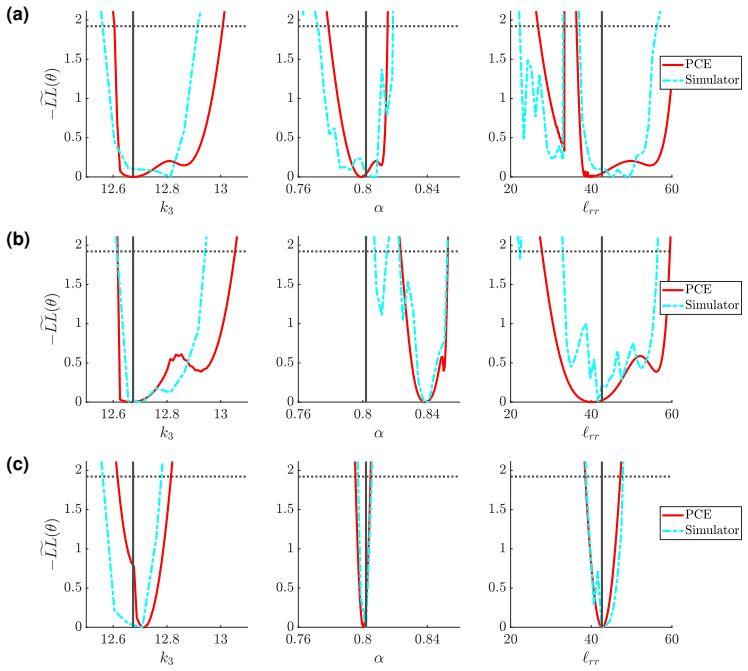
The central claim is that PCE surrogates, after dimension reduction via PCA, enable profile-likelihood confidence intervals for PDE model parameters and that these intervals classify parameters as identifiable or non-identifiable in the same way the full simulator would. For the Windkessel model, the stiffness parameters $k_1$ and $k_2$ are practically non-identifiable in all designs, while the design that adds flow data (D3) makes $k_3$, the proximal and distal resistances, and $C_{T,1}$ identifiable. For the structured tree model, inference requires progressive parameter fixing, with $k_3$, $\alpha$, and $\ell_{rr}$ identifiable under D3 and $\beta$ and $r_{\min}$ harder to identify. The paper supports the surrogate's reliability by evaluating the true simulator at the profile points and reporting similar confidence bounds, despite some differences in likelihood shape.
Load-bearing premise
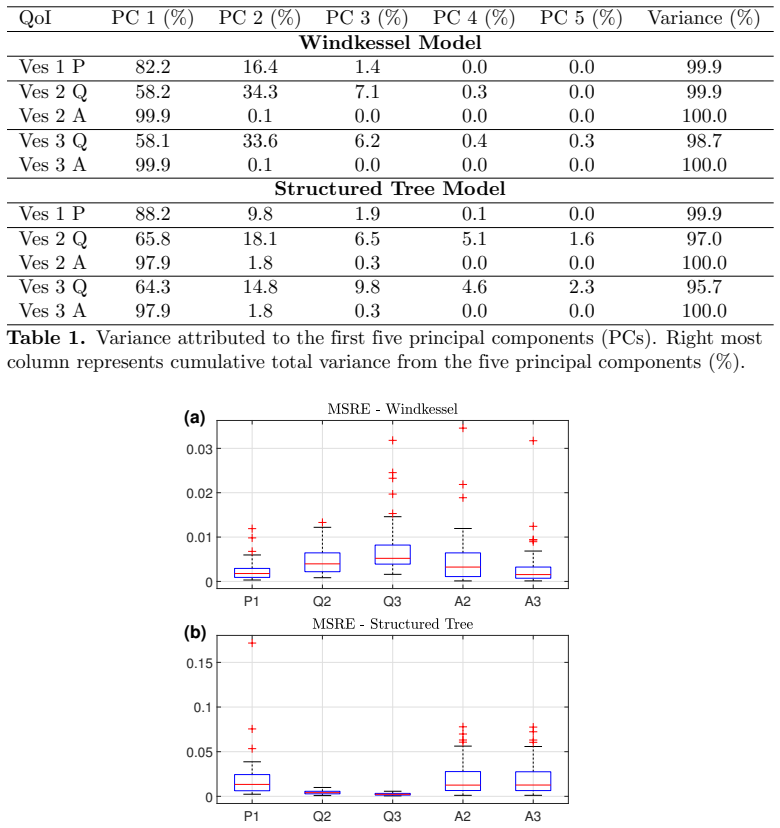
The whole analysis rests on the surrogate reproducing the true simulator's likelihood surface closely enough that identifiability classifications agree; the most exposed point is the structured-tree pressure output, where emulation errors reach outliers of 9-15%.
Editorial extensions
If this is right
- For PDE simulators too expensive for repeated optimization, profile-likelihood identifiability becomes computable from a one-time surrogate training set.
- Measurement design directly controls practical identifiability: pressure data alone leaves most parameters non-identifiable, while adding flow data renders most Windkessel and structured-tree parameters practically identifiable.
- Parameters that are non-influential according to Sobol' indices ($k_1$ and $k_2$) can be fixed first, and the profile-likelihood then shows which remaining parameters are inferable.
- The surrogate-derived confidence bounds agree in shape and classification with simulator evaluations at the profile points, supporting the use of emulator-based identifiability screening before costly inference.
Reading between the lines
- One extension the paper leaves implicit is reusing the same PCE training set under different measurement-noise covariances, which would turn the profile-likelihood test into a fast experimental-design optimization loop.
- Because the simulator check evaluates the emulator's profile points without re-optimizing nuisance parameters on the true simulator, the agreement claim would be strengthened by a full simulator re-optimization at each profiled value; the structured-tree results suggest this could matter in rough landscapes.
- For models with strong correlation across output channels, a multi-output emulator that models cross-output covariance could reduce the emulator error that currently appears as pressure outliers in the structured-tree case.
Editorial analysis
A structured set of objections, weighed in public.
Referee Report
Summary. This paper proposes a PCE-PCA surrogate pipeline for a one-dimensional pulmonary hemodynamics PDE model, using the surrogate both for global sensitivity analysis (Sobol indices) and for profile-likelihood-based practical identifiability assessment across three experimental designs: MPA pressure only (D1), pressure plus daughter-branch area (D2), and pressure plus daughter-branch flow (D3). Windkessel and structured-tree boundary-condition versions are treated separately. The surrogate accuracy is assessed on 50 held-out simulator runs, with median MSRE around 2% and larger structured-tree pressure outliers (9--15%). The identifiability conclusions from the surrogate are then compared with simulator evaluations along the surrogate's profile-likelihood paths in Figures 11 and 12.
Significance. If the proposed equivalence between surrogate and simulator likelihood geometry holds, the paper offers a computationally practical route to formal identifiability analysis for expensive PDE simulators and a useful comparison of experimental designs for pulmonary hemodynamics. The paper's strengths include the public code, the explicit test-set emulator accuracy assessment, the use of both full and reduced parameter sets in the profile-likelihood analysis, and the attempt to check surrogate-based conclusions against the true simulator on selected parameter subsets. However, the validation is weaker than claimed because the simulator check does not recompute the true profile likelihood, and the sensitivity-analysis formulas contain a normalization/index-set error that may affect the pointwise Sobol results.
major comments (3)
- [Profile-likelihood: Simulator, Figures 11-12] The simulator comparison does not test the central claim that identifiability conclusions agree. Each simulator curve is generated by passing the profile-likelihood parameters to the simulator and computing the same weighted likelihood, but this does not re-optimize over nuisance parameters for each fixed profiled parameter. The resulting curve is the joint negative log-likelihood along the surrogate's solution path, not the simulator's profile likelihood. The discrepancies the paper itself notes, such as the biased minimum for R_p,2 in D2 and the rougher landscape for l_rr in D1, are exactly where re-optimization could change whether a confidence bound is finite. To support the statement that 'the conclusions about identifiability agree between the surrogate framework and the true simulator,' the authors should compute true profile likelihoods on the simulator, with re-minimization over nuisance parameters, for at least representative profiled parameters and designs, or alternatively soften the claim to agreement of the joint likelihood along the surrogate path.
- [Global Sensitivity Analysis, Eqs. (26)-(27)] The covariance formulas used for pointwise Sobol indices are incorrect as written. Equation (26) omits the polynomial normalization factor gamma_k that appears in Eq. (19), and Eq. (27) sums over A_{ST_i}, the set of coefficients that include theta_i, whereas the conditional expectation E[c_q | theta_{~i}] involves basis functions independent of theta_i, i.e., the complement of A_{ST_i}. Consequently Eqs. (24)-(25) and the pointwise Sobol indices in Figures 5 and 6 may be wrong. The authors should correct these formulas to include gamma_k and the appropriate index sets, and rerun or justify the pointwise sensitivity results.
- [Profile-likelihood Confidence Intervals and Limitations] The statistical interpretation of the confidence intervals needs clarification. Equation (28) treats Sigma as a measurement noise covariance, but the data are described as noise-free and Sigma is set to a diagonal matrix of mean data values; the Limitations section then says the inherent emulator error is used as the measurement variance. These statements are inconsistent. The chi-square threshold in Eq. (30) is only a valid 95% confidence bound if Sigma is the true covariance of the noise process. As written, the reported intervals are thresholds of a weighted SSE with application-specific scaling. The authors should either specify a coherent noise model with calibrated Sigma, simulate noisy data with known variance, or explicitly qualify the 'formal' identifiability language.
minor comments (4)
- [Methods, Eq. (6)] The Windkessel parameter set lists R_{p,2} twice; the second occurrence should be R_{d,2}.
- [Profile-likelihood: Windkessel Model] The text references 'Figure 3(a)', 'Figure 3(b)', and 'Figure 3(c)' when discussing the profile-likelihood results; these should be 'Figure 7(a)', 'Figure 7(b)', and 'Figure 7(c)'.
- [Typos and notation] There are several typographical errors: 'infleutial' should be 'influential', 'evlauted' should be 'evaluated', 'structed' should be 'structured', 'id enitifiable' should be 'identifiable', and 'Figure 4(b,d,F)' should use a lowercase 'f'.
- [Global Sensitivity Analysis, Figure 5] The text notes that total-order Sobol indices S_{Ti}^Y(t) exceed 1.0 in the MPA and attributes this to numerical approximation error in the PCA decomposition. Since total-order indices should lie in [0,1], this behavior should be explained more precisely, or the affected output should be clearly marked as showing an artifact.
Circularity Check
No significant circularity: the surrogate-based profile-likelihood analysis is self-contained, and the simulator comparison, while not a full re-optimization, is an external check rather than a reduction to the fit.
full rationale
The profile-likelihood intervals are computed from a PCE-PCA emulator fitted to PDE simulator outputs via ordinary least squares (Eq. 11), and the Sobol indices are obtained from the same PCE coefficients by standard spectral formulas (Eqs. 19-25); neither quantity is defined in terms of the other, and the identifiability classification (bounded/unbounded confidence intervals via Eq. 30) is a post-processing rule applied to the emulator likelihood, not a fitted parameter renamed as a prediction. The paper's check against the true simulator (Figs. 11-12) passes the surrogate's profiled parameter values to the simulator and evaluates the same weighted likelihood, which is an external evaluation rather than a circular reduction; the fact that this does not re-minimize over nuisance parameters is a limitation of the validation, but not an instance of the conclusion being equivalent to its inputs by construction. The only noticeable self-citation is the choice of a degree-five PCE and PCA compression, justified by Paun et al. [17], but the paper independently reports test-set MSRE in Figure 3 and variance capture in Table 1, so the self-citation is not load-bearing. No step in the derivation defines a predicted quantity in terms of the target result, fits a parameter and then calls a closely related output a prediction, or imports a uniqueness conclusion from the author's own prior work.
Assumptions & free parameters
free parameters (4)
- PCE polynomial order =
5
- Number of PCA components retained =
5
- Noise covariance scaling =
diagonal of average pressure/flow/area values per design
- Uniform prior parameter ranges =
not specified in manuscript
assumptions (7)
- domain assumption The 1D PDE hemodynamics model assumes laminar, Newtonian, incompressible, axially dominant flow in cylindrical impermeable vessels, with a power-law velocity profile (γ=9).
- domain assumption The pressure-area relation is linear with exponential stiffness Eh/r0 = k1 exp(-k2 r0) + k3.
- domain assumption Boundary conditions are either 3-element Windkessel or structured tree impedance models.
- standard math Polynomial chaos expansion with uniform priors and Legendre polynomials; parameters are assumed independent in their prior space.
- standard math Profile-likelihood confidence intervals use a chi-square threshold with one degree of freedom at 95% significance.
- ad hoc to paper Measurement noise covariance is set to a diagonal matrix of average data values, and data are treated as noise-free.
- domain assumption Structural identifiability of the model itself is assumed, and only practical identifiability is assessed.
Cite this review
Pith. "Pith review of Assessing parameter identifiability of a hemodynamics PDE model using spectral surrogates and dimension reduction." pith.science (2026). https://pith.science/paper/A7W2AEAV
@misc{pith2026250604538,
  author       = {Pith},
  title        = {Pith review of: Assessing parameter identifiability of a hemodynamics PDE model using spectral surrogates and dimension reduction},
  year         = {2026},
  howpublished = {\url{https://pith.science/paper/A7W2AEAV}},
  note         = {Machine review of arXiv:2506.04538}
}
read the original abstract
Computational inverse problems for biomedical simulators suffer from limited data and relatively high parameter dimensionality. This often requires sensitivity analysis, where parameters of the model are ranked based on their influence on the specific quantities of interest. This is especially important for simulators used to build medical digital twins, as the amount of data is typically limited. For expensive models, such as blood flow models, emulation is employed to expedite the simulation time. Parameter ranking and fixing using sensitivity analysis are often heuristic, though, and vary with the specific application or simulator used. The present study provides an innovative solution to this problem by leveraging polynomial chaos expansions (PCEs) for both multioutput global sensitivity analysis and formal parameter identifiability. For the former, we use dimension reduction to efficiently quantify time-series sensitivity of a one-dimensional pulmonary hemodynamics model. We consider both Windkessel and structured tree boundary conditions. We then use PCEs to construct profile-likelihood confidence intervals to formally assess parameter identifiability, and show how changes in experimental design improve identifiability. Our work presents a novel approach to determining parameter identifiability and leverages a common emulation strategy for enabling profile-likelihood analysis in problems governed by partial differential equations.
Figures


Figures from the paper (9 more)


Forward citations
Cited by 1 Pith paper
-
Think before you fit: parameter identifiability, sensitivity and uncertainty in systems biology models
A review arguing that identifiability analysis is a prerequisite for reliable parameter estimation and prediction in systems biology, and summarizing available computational tools.
Reference graph
Works this paper leans on
-
[1]
Challenges and opportunities in uncertainty quantification for healthcare and biological systems
Kimpton LM, Paun LM, Colebank MJ, Volodina V. Challenges and opportunities in uncertainty quantification for healthcare and biological systems. Philosophical Transactions A. 2025;383(2292):20240232
work page 2025
-
[2]
Guidelines for mechanistic modeling and analysis in cardiovascular research
Colebank MJ, Oomen PA, Witzenburg CM, Grosberg A, Beard DA, Husmeier D, et al. Guidelines for mechanistic modeling and analysis in cardiovascular research. American Journal of Physiology-Heart and Circulatory Physiology. 2024;327(2):H473–H503
work page 2024
-
[3]
Foundational Research Gaps and Future Directions for Digital Twins
National Academies for Science, Engineering, and Medicine. Foundational Research Gaps and Future Directions for Digital Twins. National Academies Press; 2024
work page 2024
-
[4]
A guide to uncertainty quantification and sensitivity analysis for cardiovascular applications
Eck VG, Donders WP, Sturdy J, Feinberg J, Delhaas T, Hellevik LR, et al. A guide to uncertainty quantification and sensitivity analysis for cardiovascular applications. International Journal for Numerical Methods in Biomedical Engineering. 2016;32
work page 2016
-
[5]
Uncertainty quantification: theory, implementation, and applications
Smith RC. Uncertainty quantification: theory, implementation, and applications. SIAM; 2024
work page 2024
-
[6]
Sensitivity analysis: A review of recent advances
Borgonovo E, Plischke E. Sensitivity analysis: A review of recent advances. European Journal of Operational Research. 2016;248(3):869–887
work page 2016
-
[7]
Variance-based sensitivity analysis for time-dependent processes
Alexanderian A, Gremaud PA, Smith RC. Variance-based sensitivity analysis for time-dependent processes. Reliability Engineering and System Safety. 2020;196:106722
work page 2020
-
[8]
Nagel JB, Rieckermann J, Sudret B. Principal component analysis and sparse polynomial chaos expansions for global sensitivity analysis and model calibration: Application to urban drainage simulation. Reliability Engineering and System Safety. 2020;195. doi:10.1016/j.ress.2019.106737
arXiv 2020
Show all 38 references
-
[9]
Effects of arterial wall models and measurement uncertainties on cardiovascular model predictions
Eck VG, Sturdy J, Hellevik LR. Effects of arterial wall models and measurement uncertainties on cardiovascular model predictions. Journal of Biomechanics. 2017;50:188–194
2017
-
[10]
Applicability of the polynomial chaos expansion method for personalization of a cardiovascular pulse wave propagation model
Huberts W, Donders WP, Delhaas T, van de Vosse FN. Applicability of the polynomial chaos expansion method for personalization of a cardiovascular pulse wave propagation model. International Journal for Numerical Methods in Biomedical Engineering. 2014;30:1679–1704
2014
-
[11]
Efficient uncertainty quantification in a spatially multiscale model of pulmonary arterial and venous hemodynamics
Colebank MJ, Chesler NC. Efficient uncertainty quantification in a spatially multiscale model of pulmonary arterial and venous hemodynamics. Biomechanics and Modeling in Mechanobiology. 2024;23:1909–1931. doi:10.1007/s10237-024-01875-x
2024 doi
-
[12]
On structural and practical identifiability
Wieland FG, Hauber AL, Rosenblatt M, T¨ onsing C, Timmer J. On structural and practical identifiability. Current Opinion in Systems Biology. 2021;25:60–69. doi:10.1016/j.coisb.2021.03.005
2021 doi
-
[13]
An in-silico analysis of experimental designs to study ventricular function: A focus on the right ventricle
Colebank MJ, Chesler NC. An in-silico analysis of experimental designs to study ventricular function: A focus on the right ventricle. PLOS Computational Biology. 2022;18:e1010017. doi:10.1371/journal.pcbi.1010017. September 23, 2025 28/30
2022 doi
-
[14]
Structural identifiability analysis of age-structured PDE epidemic models
Renardy M, Kirschner D, Eisenberg M. Structural identifiability analysis of age-structured PDE epidemic models. Journal of Mathematical Biology. 2022;84(1):9
2022
-
[15]
Murphy RJ, Maclaren OJ, Simpson MJ. Implementing measurement error models with mechanistic mathematical models in a likelihood-based framework for estimation, identifiability analysis and prediction in the life sciences. Journal of the Royal Society Interface. 2024;21(210):20230402
2024
-
[16]
Parameter identifiability in PDE models of fluorescence recovery after photobleaching
Ciocanel MV, Ding L, Mastromatteo L, Reichheld S, Cabral S, Mowry K, et al. Parameter identifiability in PDE models of fluorescence recovery after photobleaching. Bulletin of Mathematical Biology. 2024;86(4):36
2024
-
[17]
A comparison of Gaussian processes and polynomial chaos emulators in the context of haemodynamic pulse–wave propagation modelling
Paun LM, Colebank MJ, Husmeier D. A comparison of Gaussian processes and polynomial chaos emulators in the context of haemodynamic pulse–wave propagation modelling. Philosophical Transactions of the Royal Society A: Mathematical, Physical and Engineering Sciences. 2025;383:202...
2025
-
[18]
Numerical simulation and experimental validation of blood flow in arteries with structured-tree outflow conditions
Olufsen MS, Peskin CS, Kim WY, Pedersen EM, Nadim A, Larsen J. Numerical simulation and experimental validation of blood flow in arteries with structured-tree outflow conditions. Annals of Biomedical Engineering. 2000;28:1281–1299
2000
-
[19]
Sensitivity analysis and uncertainty quantification of 1-D models of pulmonary hemodynamics in mice under control and hypertensive conditions
Colebank MJ, Qureshi MU, Olufsen MS. Sensitivity analysis and uncertainty quantification of 1-D models of pulmonary hemodynamics in mice under control and hypertensive conditions. International Journal for Numerical Methods in Biomedical Engineering. 2021;37:1–29
2021
-
[20]
Assessing model mismatch and model selection in a Bayesian uncertainty quantification analysis of a fluid-dynamics model of pulmonary blood circulation
Paun LM, Colebank MJ, Olufsen MS, Hill NA, Husmeier D. Assessing model mismatch and model selection in a Bayesian uncertainty quantification analysis of a fluid-dynamics model of pulmonary blood circulation. Journal of The Royal Society Interface. 2020;17:20200886
2020
-
[21]
Pulse Wave Propagation in the Arterial Tree
van de Vosse FN, Stergiopulos N. Pulse Wave Propagation in the Arterial Tree. Annual Review of Fluid Mechanics. 2011;43:467–499
2011
-
[22]
Numerical simulation of blood flow and pressure drop in the pulmonary arterial and venous circulation
Qureshi MU, Vaughan GDA, Sainsbury C, Johnson M, Peskin CS, Olufsen MS, et al. Numerical simulation of blood flow and pressure drop in the pulmonary arterial and venous circulation. Biomechanics and Modeling in Mechanobiology. 2014;13:1137–1154. doi:10.1007/s10237-014-0563-y
2014 doi
-
[23]
Evolution of hemodynamic forces in the pulmonary tree with progressively worsening pulmonary arterial hypertension in pediatric patients
Yang W, Dong M, Rabinovitch M, Chan FP, Marsden AL, Feinstein JA. Evolution of hemodynamic forces in the pulmonary tree with progressively worsening pulmonary arterial hypertension in pediatric patients. Biomechanics and Modeling in Mechanobiology. 2019;18:779–796. doi:10.1007...
2019 doi
-
[24]
The arterial Windkessel
Westerhof N, Lankhaar JW, Westerhof BE. The arterial Windkessel. Medical & Biological Engineering & Computing. 2009;47:131–141
2009
-
[25]
Structural and hemodynamic properties of murine pulmonary arterial networks under hypoxia-induced pulmonary hypertension
Chambers MJ, Colebank MJ, Qureshi MU, Clipp R, Olufsen MS. Structural and hemodynamic properties of murine pulmonary arterial networks under hypoxia-induced pulmonary hypertension. Proceedings of the Institution of Mechanical Engineers, Part H: Journal of Engineering in Medici...
2020
-
[26]
UQLab: A framework for uncertainty quantification in Matlab
Marelli S, Sudret B. UQLab: A framework for uncertainty quantification in Matlab. In: Vulnerability, uncertainty, and risk: quantification, mitigation, and management. ETH Zurich; 2014. p. 2554–2563
2014
-
[27]
Computer model calibration using high-dimensional output
Higdon D, Gattiker J, Williams B, Rightley M. Computer model calibration using high-dimensional output. Journal of the American Statistical Association. 2008;103(482):570–583
2008
-
[28]
Integration based profile likelihood calculation for PDE constrained parameter estimation problems
Boiger R, Hasenauer J, Hroß S, Kaltenbacher B. Integration based profile likelihood calculation for PDE constrained parameter estimation problems. Inverse Problems. 2016;32:125009. doi:10.1088/0266-5611/32/12/125009
2016 doi
-
[29]
Personalization of models with many model parameters: an efficient sensitivity analysis approach
Donders WP, Huberts W, van de Vosse FN, Delhaas T. Personalization of models with many model parameters: an efficient sensitivity analysis approach. International Journal for Numerical Methods in Biomedical Engineering. 2015;31
2015
-
[30]
Bayesian sensitivity analysis of a 1D vascular model with Gaussian process emulators
Melis A, Clayton RH, Marzo A. Bayesian sensitivity analysis of a 1D vascular model with Gaussian process emulators. International Journal for Numerical Methods in Biomedical Engineering. 2017;33:1–11
2017
-
[31]
An Effective Fractal-Tree Closure Model for Simulating Blood Flow in Large Arterial Networks
Perdikaris P, Grinberg L, Karniadakis GE. An Effective Fractal-Tree Closure Model for Simulating Blood Flow in Large Arterial Networks. Annals of Biomedical Engineering. 2015
2015
-
[32]
Rarefaction and blood pressure in systemic and pulmonary arteries
Olufsen MS, Hill NA, Vaughan GDA, Sainsbury C, Johnson M. Rarefaction and blood pressure in systemic and pulmonary arteries. Journal of Fluid Mechanics. 2012;705:280–305. doi:10.1017/jfm.2012.220
2012 doi
-
[33]
Parameter selection and optimization of a computational network model of blood flow in single-ventricle patients
Taylor-LaPole AM, Paun LM, Lior D, Weigand JD, Puelz C, Olufsen MS. Parameter selection and optimization of a computational network model of blood flow in single-ventricle patients. Journal of the Royal Society Interface. 2025;22. doi:10.1098/rsif.2024.0663
2025
-
[34]
To Sobol or not to Sobol? The effects of sampling schemes in systems biology applications
Renardy M, Joslyn LR, Millar JA, Kirschner DE. To Sobol or not to Sobol? The effects of sampling schemes in systems biology applications. Mathematical biosciences. 2021; p. 108593
2021
-
[35]
Hemodynamic assessment of pulmonary hypertension in mice: a model-based analysis of the disease mechanism
Qureshi MU, Colebank MJ, Paun LM, Fix LE, Chesler N, Haider MA, et al. Hemodynamic assessment of pulmonary hypertension in mice: a model-based analysis of the disease mechanism. Biomechanics and Modeling in Mechanobiology. 2019;18:219–243
2019
-
[36]
Emulation-accelerated Hamiltonian Monte Carlo algorithms for parameter estimation and uncertainty quantification in differential equation models
Paun LM, Husmeier D. Emulation-accelerated Hamiltonian Monte Carlo algorithms for parameter estimation and uncertainty quantification in differential equation models. Statistics and Computing. 2022;32:1–25
2022
-
[37]
Bayesian emulation of complex multi-output and dynamic computer models
Conti S, O’Hagan A. Bayesian emulation of complex multi-output and dynamic computer models. Journal of Statistical Planning and Inference. 2010;140(3):640 – 651
2010
-
[38]
Optimal experimental design for infinite-dimensional Bayesian inverse problems governed by PDEs: A review
Alexanderian A. Optimal experimental design for infinite-dimensional Bayesian inverse problems governed by PDEs: A review. Inverse Problems. 2021;37(4):043001. September 23, 2025 30/30
2021
Reviewed August 7, 2026 · model on record in the stance chip above.
Discussion (0). Sign in to comment.