REVIEW 4 major objections 3 minor 25 references
Stable minimality of expanding foliations
T0 review · 4 major / 3 minor · reviewed 2026-08-14 · deepseek-v4-flash
Pith's one-line read A minimal expanding foliation plus one matching hyperbolic periodic point is stably minimal for generic volume-preserving diffeomorphisms.
desk verdict Significant extension of stable minimality beyond partial hyperbolicity, but the proof's main mechanism relies on an unproved geometric assertion that does not follow from minimality. read the letter →
The pith
A machine-rendered reading of the paper's core claim, the machinery that carries it, and where it could break.
The reading
What carries the argument
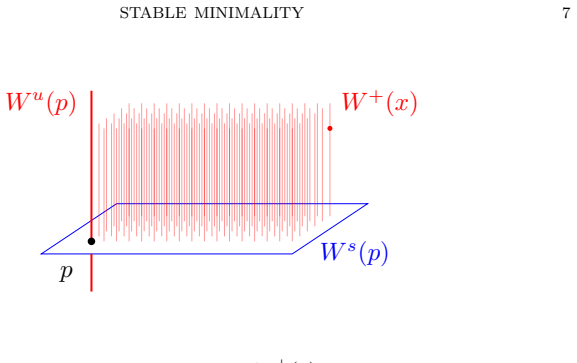
The central mechanism is the s-stable superblender: an open ball around a point of a horseshoe $\Lambda$ such that every well-placed unstable $k$-strip — a $k$-disc of radius much larger than the ball, almost tangent to the expanding subbundle — quasi-transversely intersects the stable manifold of some point of $\Lambda$, with the property holding $C^1$-robustly. Minimality of the expanding foliation is used to ensure every leaf contains such a strip, so every $W_g$-leaf meets $W^s(\Lambda_g)$ quasi-transversely, meaning the tangent spaces share no nonzero vector. Those intersections place every point inside the essential closure of the Pesin homoclinic class $\mathrm{Phc}^g(q_g)$, the set of points whose stable Pesin manifold meets the unstable manifold of $q_g$; the ergodicity criterion of [HHTU11] turns this class into a hyperbolic ergodic component. In the harder case $u(p)<u(q)$, the complementary machinery is a chain of u-blenders — open sets in which every well-placed disc of the appropriate dimension intersects the unstable manifold of a lower-index periodic point — forcing the inclusion $W^u(q_g)\subset\cdots\subset W^u(p_g)$. The Minimality Criterion (Proposition 4.1) is the final switch: dense $W^u(p_g)$ together with $\mathrm{Phc}^{W_g}(p_g)=M$ implies $W_g$ is minimal.
What would settle it
Exhibit a $C^1$-generic volume-preserving diffeomorphism $f$ with a minimal expanding foliation $W$ and a hyperbolic periodic point $p$ with $u(p)=\dim W$, and a $C^2$ map $g$ arbitrarily $C^1$-close to $f$ whose continuation $W_g$ has a non-dense leaf; equivalently, find a $W_f$-leaf that contains no well-placed unstable $k$-strip inside the superblender ball $B^{\mathrm{ls}}_\Lambda(x_0)$ produced by Theorem 3.3, since such a leaf would break the quasi-transverse intersection step and the essential density of the ergodic component.
Extended reading notes
Core claim
The paper's central claim is Theorem A: for a residual subset of $\mathrm{Diff}^1_m(M)$, whenever $W$ is a minimal expanding $f$-invariant foliation and there is a hyperbolic periodic point $p$ with unstable index $u(p)=\dim W$, the foliation is stably minimal — there exists a $C^1$-neighborhood $\mathcal{U}$ of $f$ such that every $g\in\mathcal{U}\cap \mathrm{Diff}^2_m(M)$ has a minimal $g$-invariant continuation $W_g$. In particular every such $g$ is topologically mixing. Theorem B isolates the dynamical content of the mechanism: for each such $g$, the Pesin homoclinic class $\mathrm{Phc}^g(q_g)$ of the periodic point supplied by the generic positive-entropy dichotomy is a hyperbolic ergodic component whose essential closure is $M$, and the component is Bernoulli. The superblender does the work: minimality of $W_f$ guarantees that every leaf contains a well-placed unstable strip inside a superblender ball, so every $W_g$-leaf quasi-transversely meets the stable manifolds of a horseshoe; this places every point of $M$ inside the essential closure of $\mathrm{Phc}^g(q_g)$. When the given periodic point $p$ has smaller unstable index than $q$, a chain of $u$-blenders transfers the density of $W^u(q_g)$ down to $W^u(p_g)$, and a minimality criterion converts dense unstable manifold plus $\mathrm{Phc}^{W_g}(p_g)=M$ into minimality of $W_g$.
Load-bearing premise
The load-bearing premise is the unstated geometric transfer that minimality of $W_f$ forces every $W_f$-leaf to contain a well-placed unstable $k$-strip inside the fixed superblender ball $B^{\mathrm{ls}}_\Lambda(x_0)$, with a $C^1$-robust continuation to $W_g$, together with the unproved assertion 'Since $\mathrm{Phc}^{W}(p)=M$' in Section 4; if either of these gives way, the proof collapses.
Editorial extensions
If this is right
- If Theorem A is correct, then for $C^1$-generic volume-preserving diffeomorphisms a minimal expanding foliation of dimension $u$ is stably minimal as soon as some hyperbolic periodic point of unstable index $u$ exists: the continuation remains minimal for every $C^2$ map in a $C^1$-neighborhood.
- Every $C^2$ map in the $C^1$-neighborhood is topologically mixing, so minimal-foliation-plus-one-periodic-point is a mechanism for robust mixing without partial hyperbolicity.
- Theorem B shows that the same hypotheses give, for all nearby $C^2$ maps, an explicitly defined hyperbolic ergodic component whose essential closure is the whole manifold and whose dynamics is Bernoulli.
- The Section 5 examples show that stably minimal expanding foliations occur among diffeomorphisms that are not partially hyperbolic, so the mechanism is not a corollary of a dominated center splitting.
- Proposition 5.1 supplies a checkable sufficient condition — every leaf intersects an open set that meets the local stable manifold of a periodic point — for residual minimality of the continuation and, by Theorem A, for dense stable minimality in a $C^1$-neighborhood.
Reading between the lines
- A natural sharpness test is to drop the periodic-point hypothesis: if a minimal expanding foliation with no hyperbolic periodic point of matching unstable index can fail to be stably minimal, then the index condition in Theorem A is necessary rather than a technical convenience.
- The proof uses the volume-preserving assumption at superblender creation and at the measure estimate for the Pesin class; transferring the argument to dissipative diffeomorphisms would require new tools at exactly those two steps, so those are the places to look for a counterexample or an extension.
- One quantitative prediction of the mechanism is that the radius of the $C^1$-neighborhood of stable minimality is controlled by the superblender's size and by how uniformly minimal leaves supply well-placed strips; computing these quantities in the Section 5 examples would give concrete lower bounds for the neighborhood.
- The unproved assertion that $\mathrm{Phc}^W(p)=M$ in Section 4 could be verified in the Section 5 examples, where every leaf of the expanding foliation cuts the dense stable manifold of the fixed point; closing that gap would remove the main missing step between Theorem B and Theorem A in the case of equal indices.
Signed reviews
Editorial analysis
A structured set of objections, weighed in public.
Referee Report
Summary. The paper studies C1-generic volume-preserving diffeomorphisms and asks when a minimal expanding invariant foliation is stably minimal. Theorem A claims that, generically, if W is a minimal expanding foliation of dimension u and there is a hyperbolic periodic point p of unstable index u(p)=dim W, then W is stably minimal; in particular all C2 volume-preserving diffeomorphisms in a C1 neighborhood are topologically mixing. Theorem B claims that, under the same hypotheses, every such C2 diffeomorphism has a hyperbolic ergodic component whose essential closure is all of M, and the component is Bernoulli. The proof of Theorem B uses a superblender created from the horseshoe produced by the Avila–Crovisier–Wilkinson theory, together with Pesin homoclinic classes and a criterion for ergodicity. Theorem A is then derived from Theorem B, a minimality criterion, and a chain of blenders when the unstable index of p is strictly lower than that of the generic periodic point q. Section 5 proposes examples, including non-partially-hyperbolic ones, via a criterion for approximating by diffeomorphisms with stably minimal foliations.
Significance. If the main results are correct, they provide a new mechanism for stable minimality, stable topological mixing, and essentially dense hyperbolic ergodic components that does not require partial hyperbolicity. This would substantially extend earlier work by Bonatti–Díaz–Ures, Pujals–Sambarino, and the authors' own dimension-three results, and it would supply new non-partially-hyperbolic examples. The paper draws on deep external results and has no fitted parameters or definitional circularity. However, the proof contains several load-bearing assertions that are not justified in the text, so the significance can only be assessed after those gaps are closed.
major comments (4)
- [§3, paragraph after Theorem 3.4] The assertion that minimality of W_f implies that every leaf contains a well-placed unstable k-strip in the fixed superblender ball B^ls_Λ(x0) is not proved and is not a formal consequence of minimality. Minimality gives that each leaf is dense, but a dense k-dimensional immersed submanifold need not contain a large k-disc centered inside B^ls_Λ(x0) that is C1-close to the specific subbundle E^u_1⊕...⊕E^u_k of the horseshoe Λ. The well-placed strip property is open and W-saturated, but it is not f-invariant, so the standard minimality-open-saturated argument does not force it to hold on every leaf. This step is load-bearing: it is the only mechanism in Theorem B that connects an arbitrary W_g-leaf to the stable manifolds of Λ_g through the superblender property.
- [§3, paragraph after Theorem 3.1] The claim that, generically, the existence of an expanding invariant foliation W_f implies a dominated splitting TM=TW_f⊕F is asserted without proof or reference. Theorem 3.1 provides a dominated splitting of the zipped Oseledets splitting E^+⊕E^-, but if TW_f is a proper subbundle of E^+, it does not automatically follow that TW_f has a dominated complement. This assertion is needed for the very definition of stable minimality, namely for the existence and continuity of the continuation W_g for all g in a C1 neighborhood, and also for quasi-transversality between W_g and stable manifolds. A proof or a precise citation is required.
- [§4, Case 2] In the proof of Theorem A, Case u(p)<u(q), the text states 'Since Phc^W(p)=M' and then applies Lemma 4.2, but this equality is never derived. The hypotheses of Theorem A include only minimality of W and the existence of p with u(p)=dim W; neither minimality alone nor the later argument showing that W^u(q_g) is dense implies that every leaf W(x) quasi-transversely intersects W^s(o(p)). Without Phc^W(p)=M, Proposition 4.1 cannot be applied, and the proof of Theorem A in this case collapses. The authors need either to prove this equality or to modify the argument.
- [Abstract and Lemmas 3.5–3.6] The abstract promises that the hyperbolic ergodic component is Bernoulli and that all C2 diffeomorphisms in the neighborhood are topologically mixing, but the proof does not establish either property. The proof of Theorem B ends with the conclusion that x∈Phc_g(q_g)^ess for every x, and no argument for topological mixing appears in the proof of Theorem A. The Bernoulli assertion is not mentioned in the proof of Theorem B at all. Relatedly, Lemma 3.5 states W^s(q_g)=Phc_g(q_g)^ess and W^u(q_g)=Phc_g(q_g)^ess, but the proof only yields an inclusion after taking essential closures; as sets this equality is impossible when Phc_g(q_g)^ess=M and q_g has nontrivial stable and unstable index. The notation must be clarified and the properties actually needed in Lemmas 3.6 and the final step of Theorem B must be stated and proved.
minor comments (3)
- [§3, Definition 3.2] The notation for the superblender ball is inconsistent (Bls, B^ls, B^ls_Λ), and the definition of 'well-placed unstable k-strip' would benefit from a precise statement about the size of the radius relative to the ball and the allowed C1 distance to the subbundle.
- [§4, Theorem 4.6] The statement of Theorem 4.6 contains a typo: 'indices u and (u+c1)' should presumably be 'u and u+c' or similar, and the following sentence is grammatically incomplete.
- [§5.1.1] The equality W^s_f(p)=W^s_f0(p) is written as a set equality; since these are leaves of a foliation, the notation should specify whether equality means equality as leaves or equality of their closures, and the proof of the internal-radius estimate could be expanded.
Circularity Check
No significant circularity: Theorems A and B are not forced by their inputs; the main weaknesses are an unproved geometric transfer and black-box self-citations, not circular reductions.
full rationale
The derivation chain is largely external. Theorem B is built from Theorem 3.1 (generic dominated splitting), Theorem 3.3 ([ACW17] superblender), Theorem 3.4 ([AC12] homoclinic relatedness), Lemma 3.8 ([AB12] large ergodic component), and Theorem 3.9 ([HHTU11] ergodicity criterion). None of these is the paper's own theorem restated, and none is fitted to the conclusion. The only place where the paper imports a result from the same authors is Lemma 4.2 and Proposition 5.1, attributed to [NH20, Lemma 3.2]; this is a black-box self-citation that is used for persistence of Phc^W, but it is a published companion lemma and not a disguised version of Theorem A or B, so it is at most a minor circularity concern. The asserted sentence in Section 3, 'Since Wf is minimal, all leaves of Wf contain a well-placed unstable k-strip in B^ls_Lambda(x0)' is not proved and is not a formal consequence of minimality as defined in the paper; however, minimality is not defined in terms of strips, so this is a proof gap or correctness risk rather than a definitional circularity. Similarly, the use of PhcW(p)=M in Section 4 is not derived; again this is missing support, not an equation that reduces to the input. No fitted parameters are introduced, no predicted quantity is constructed from the data it claims to predict, and no uniqueness theorem from the authors' prior work is invoked. Theorems A and B therefore have independent mathematical content; the score 2 reflects the black-box self-citation, not a finding that the result is a tautology.
Assumptions & free parameters
assumptions (8)
- domain assumption Generic dichotomy theorem (Theorem 3.1): a C1-generic volume-preserving diffeomorphism either has all Lyapunov exponents zero m-a.e., or else is ergodic, has a dominated Oseledets splitting, and has a hyperbolic periodic point q with Phc(q) essentially equal to M.
- domain assumption Superblender creation (Theorem 3.3): generically with positive metric entropy there is an s-stable superblender associated to a horseshoe Lambda, where s is the stable index of the periodic point q from Theorem 3.1.
- domain assumption Generic homoclinic relations (Theorem 3.4): C1-generically all periodic points of the same index are homoclinically related, and the relation persists on a C1-neighborhood of f.
- domain assumption Measure lemma (Lemma 3.8, from [AB12]): for generic f, for every epsilon > 0 there is a C1-neighborhood U such that for all C2 g in U, m(Phc_g(q_g)) > 1 - epsilon.
- domain assumption Ergodicity criterion (Theorem 3.9, [HHTU11]): for a C2 diffeomorphism with m(Phc+(p)) > 0 and m(Phc-(p)) > 0, the Pesin homoclinic class Phc(p) is, up to measure zero, an ergodic hyperbolic component.
- domain assumption Blender creation (Theorem 4.4): co-index-one pairs of hyperbolic periodic points can be perturbed to create a u-blender, and generically such blenders exist.
- domain assumption Intermediate indices (Theorem 4.6): generically, between hyperbolic periodic points of indices u and u+c1 there is a dense set of hyperbolic periodic points of each intermediate index.
- domain assumption Generic transitivity and homoclinic class theorem from [BC04]: for C1-generic volume-preserving diffeomorphisms the homoclinic class of every hyperbolic periodic point is the whole manifold, so the stable manifold of p is dense and Phc^W(p)=M.
Cite this review
Pith. "Pith review of Stable minimality of expanding foliations." pith.science (2026). https://pith.science/paper/AAI5L2FP
@misc{pith2026190809079,
  author       = {Pith},
  title        = {Pith review of: Stable minimality of expanding foliations},
  year         = {2026},
  howpublished = {\url{https://pith.science/paper/AAI5L2FP}},
  note         = {Machine review of arXiv:1908.09079}
}
abstract
We prove that generically in $\text{Diff}^{1}_{m}(M)$, if an expanding $f$-invariant foliation $W$ of dimension $u$ is minimal and there is a periodic point of unstable index $u$, the foliation is stably minimal. By this we mean there is a $C^{1}$-neighborhood $\mathcal{U}$ of $f$ such that for all $C^{2}$-diffeomorphisms $g\in \mathcal{U}$, the $g$-invariant analytic continuation of $W$ is minimal. In particular, all such $g$ are topologically mixing. Moreover, all such $g$ have a hyperbolic ergodic component of the volume measure $m$ which is essentially dense. This component is, in fact, Bernoulli. We provide new examples of stably minimal diffeomorphisms which are not partially hyperbolic.
Figures


Figures from the paper (1 more)

Reference graph
Works this paper leans on
-
[1]
A. Avila and J. Bochi. Nonuniform hyperbolicity, global dominated splittings and generic properties of volume-preserving diffeomorphisms. Transactions of the American Mathematical Society , 364(6):2883--2907, jun 2012
work page 2012
-
[2]
F. Abdenur, C. Bonatti, and S. Crovisier. Nonuniform hyperbolicity for C ^1 -generic diffeomorphisms. Israel Journal of Mathematics , 183(1):1, Jun 2011
work page 2011
-
[3]
F. Abdenur and S. Crovisier. Transitivity and topological mixing for C^1 diffeomorphisms. In Essays in mathematics and its applications , pages 1--16. Springer, Heidelberg, 2012
work page 2012
- [4]
- [5]
-
[6]
D. V. Anosov and Y. G. Sinai. Some smooth ergodic systems. Russian Mathematical Surveys , 22(5):103--167, oct 1967
work page 1967
-
[7]
C. Bonatti and S. Crovisier. R\'ecurrence et g\'en\'ericit\'e. Inventiones mathematicae , 158(1), apr 2004
work page 2004
-
[8]
C. Bonatti, L.J. Diaz, E.R. Pujals, and J. Rocha. Robustly transitive sets and heterodimensional cycles, 2000
work page 2000
Show all 25 references
-
[9]
Bonatti, L
C. Bonatti, L. D\'iaz, and R. Ures. Minimality of strong stable and unstable foliations for partially hyperbolic diffeomorphisms. Journal de l'Institut de Mathematiques de Jussieu , 1(4):157--193, 2002
2002
-
[10]
Bonatti, L
C. Bonatti, L. J. D\'iaz, and M. Viana. Dynamics Beyond Uniform Hyperbolicity . Springer-Verlag, 2005
2005
-
[11]
J. Bochi. Genericity of zero L yapunov exponents. Ergodic Theory Dynam. Systems , 22(6):1667--1696, 2002
2002
-
[12]
J. Franks. Anosov diffeomorphisms. Global Analysis Proceedings of Symposia in Pure Mathematics , page 6193, 1970
1970
-
[13]
Rodriguez Hertz
M.A. Rodriguez Hertz. Genericity of nonuniform hyperbolicity in dimension 3. Journal of Modern Dynamics , 6(1):121--138, may 2012
2012
-
[14]
Rodriguez Hertz, M.A
F. Rodriguez Hertz, M.A. Rodriguez Hertz, A. Tahzibi, and R. Ures. Creation of blenders in the conservative setting. Nonlinearity , 23(2):211--223, jan 2010
2010
-
[15]
Rodriguez Hertz, M
F. Rodriguez Hertz, M. A. Rodriguez Hertz, A. Tahzibi, and R. Ures. New criteria for ergodicity and nonuniform hyperbolicity. Duke Mathematical Journal , 160(3):599--629, dec 2011
2011
-
[16]
Rodriguez Hertz, M.A
F. Rodriguez Hertz, M.A. Rodriguez Hertz, and R. Ures. Some results on the integrability of the center bundle for partially hyperbolic diffeomorphisms. In Partially hyperbolic dynamics, laminations, and T eichm\" u ller flow , volume 51 of Fields Inst. Commun. , pages 103--109...
2007
-
[17]
Liang, W
C. Liang, W. Sun, and J. Yang. Some results on perturbations of L yapunov exponents. Discrete & Continuous Dynamical Systems - A , 32(12):4287--4305, 2012
2012
-
[18]
Ma \ n \' e
R. Ma \ n \' e . Contributions to the stability conjecture. Topology , 17(4):383--396, 1978
1978
-
[19]
Ma\ n \' e
R. Ma\ n \' e . Oseledec's theorem from the generic viewpoint. In Proceedings of the I nternational C ongress of M athematicians, V ol. 1, 2 ( W arsaw, 1983) , pages 1269--1276. PWN, Warsaw, 1984
1983
-
[20]
Moreira and W
C.G. Moreira and W. Silva. On the geometry of horseshoes in higher dimensions. ArXiv e-prints , 2012. arXiv:1210.2623
2012 arXiv
-
[21]
N \'u \ n ez and J
G. N \'u \ n ez and J. Rodriguez Hertz. Minimality and stable B ernoulliness in dimension 3. Disc. Cont. Dyn. Sys. A , 40(3):1879--1887, 2020
2020
-
[22]
N \'u \ n ez, D
G. N \'u \ n ez, D. Obata, and J. Rodriguez Hertz. New examples of stably ergodic diffeomorphisms in dimension 3. 2020. arXiv:2004.10844v1
2020 arXiv
-
[23]
Characteristic L yapunov exponents and smooth ergodic theory
Ya B Pesin. Characteristic L yapunov exponents and smooth ergodic theory. Russian Mathematical Surveys , 32(4):55--114, aug 1977
1977
-
[24]
E. R. Pujals and M. Sambarino. A sufficient condition for robustly minimal foliations. Ergodic Theory Dynam. Systems , 26(1):281--289, 2006
2006
-
[25]
C. C. Pugh. The C^ 1+ hypothesis in P esin theory. Publications Math\'ematiques de l'IH\'ES , 59:143--161, 1984
1984
Reviewed August 14, 2026 · model on record in the stance chip above.
Discussion (0). Continue with ORCID to comment.